
Archive
Book Review: Buddha Volume 1 Kapilavastu by Osamu Tezuka (Graphic Novel) (series, #1)
 Summary:
The tale of the Buddha’s life is told peripherally to those of fictional, central characters. There is Tatta, an untouchable who can inhabit the bodies of animals. He is joined by Chapra, a slave who wants to become a warrior. Also there is Chapra’s mother and a young monk. Their lives are impacted by the birth of the Buddha.
Review:
I picked this up randomly from the shelf in the library, and I must say I was expecting a bit more focus on the Buddha than is present in the story. Instead this is one of those tales about fictional people living in the shadow of a world-changing person. I honestly was really excited about the idea of the story of the Buddha told in the graphic novel style, so that was a bit of a disappointment to me.
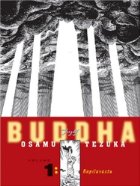
The art style is interesting. Somewhere between manga and more western-style animation. The characters are really easy to tell apart, though, which was a nice change from some manga.
Although the Buddha is mostly gestating and being born during the course of the book, Buddhist ideas are still present periodically in the storyline. One of my favorites is when a saint chastises the monk for how he orders Tatta to use his talents:
To save just one human, you mindlessly harnessed numerous beasts to an impossible task…and killed them one by one! The beasts you bent to your purpose all suffered greatly and died cruelly! You believe that human lives are sacrosanct while animal lives are worthless?!?! You saved [the human], but the beasts that you sacrificed for his sake are now beyond saving. Life is sacred whether or not it is human! (page 350-1)
It was fun to see these sorts of ideals in the context of a story, and I do always enjoy reading a graphic novel. The main story itself fell flat for me though. It mostly focuses in on Chapra attempting to become a great warrior and save his mother from being a slave, which I fail to see how that relates to the Buddha. As I said, though, this book was not what I was expecting, and I don’t tend to really go for warrior/mother tales. Except Oedipus.
Overall, the art is an interesting style and some of the ideas contained within the book are fun to see in fiction, but the main storyline separate from Buddha’s life simply did not resonate with me. Perhaps it will with you.
3 out of 5 stars
Source: Public Library

Book Review: The Mummy by Anne Rice (series #1)
 Summary:
Julie Stratford’s father is a retired shipping mogul who now spends his time as an archaeologist in Egypt. He uncovers a tomb that claims to be that of Ramses the Damned, even though his tomb was already found. Everything in the tomb is written in hieroglyphs, Latin, and Greek, and the mummy is accompanied by scrolls claiming that Ramses is immortal, was a lover of Cleopatra, and can and will rise again.
Review:
I’m a fan of Anne Rice. Her Vampire Chronicles are a lovely mix of social commentary, lyrical writing, and all the best tropes of genre fiction, so I was excited to stumble upon a cheap copy of The Mummy in the second-hand section of the bookstore. I wanted to love it. I really did. But whereas the Vampire Chronicles contain valid social commentary, this is so stereotypical of mainstream romance a la The Titanic that I was sorely disappointed.
Again, the language is lyrical and gorgeous. Rice without a doubt is incredibly talented at putting together sentences that read like a rich tapestry of old. There is no rushing to get the story out as is so often found in more modern writing. It’s fun to indulge the senses and oneself in the scene.
The plot, though, ohhhh the plot. It’s so mainstream romance it hurts. And yes, I know I read and enjoy (and write) paranormal romance, but the difference is that PNR is oftentimes tongue in cheek. It knows it’s ridiculous and over the top and doesn’t take itself too seriously. It’s meant to be fun and ridiculous. Rice is being serious here, however, and that’s why the plot bugs me. Let’s look at it for a second, shall we?
Girl is engaged to the perfect guy but she mysteriously does not think she loves him. Girl meets immortal man who is so hot he would be voted hottest man alive every year forever. Girl immediately “falls in love” with immortal guy. Girl ditches perfect guy for immortal guy. Girl and immortal guy have lots of the hot hot sex. Immortal guy causes a series of unfortunate events in pursuit of his ex-lover. Girl insists she still loves guy but cannot forgive him. Girl decides life is pointless without immortal guy. Girl attempts to kill herself. Immortal guy saves her. Girl forgives immortal guy. Girl agrees to become immortal too. Yay happily ever after.
Like….just……there are SO MANY parts of that that piss me the fuck off. So. Many. The main female character (Julie) is a shallow douchebag in spite of claiming to be a modern, progressive woman. She does not “fall in love” with Ramses. She falls in lust with him. He gives her tinglies in all the right places. He ditches her to pursue his ex-lover (Cleopatra). She, at first, rightfully tells him she can’t forgive him for that. But then she TRIES TO OFF HERSELF. OVER A GUY. And the only reason she doesn’t succeed is douchebag saves her. I just….wow. Not a plot I can respect. Not a plot that gives us anything different from the patriarchal rigamarole so often forced upon us. Anne Rice. I am disappointed.
Then there’s the odd eurocentrism at work in the narration. Even though Julie’s father loves Egypt and Ramses is, um, Egyptian, for some reason everything modern and European is what is impressive to everyone. I suppose I could maybe (maybe) forgive that, but then there’s the fact that the elixir that makes people immortal also for some mysterious reason turns their brown eyes blue. So nobody immortal has brown eyes. I don’t think I need to unpack why that’s offensive for you all. I trust you can figure that out for yourselves. Unlike Rice.
So, essentially, The Mummy is a beautifully written book that is destroyed by a kind of offensive, all-too-common plot and Eurocentrism. Even beautiful writing can’t overcome that.
3 out of 5 stars
Source: Harvard Books

Movie Review: Martha Marcy May Marlene (2011)
 Summary:
Martha calls her sister to come get her from the Catskills. She’s been missing for two years. Over the course of the next two weeks, her behavior becomes increasingly abnormal in ways her sister cannot understand, while the audience sees flashbacks to where Martha was for the previous two years–living in an abusive cult.
Review:
This is the best representation of PTSD I’ve seen on film to date. Martha’s outbursts of violence, sobbing, and even loss of bladder control seem completely out of the blue to her sister and brother-in-law, but she and audience can clearly see what minor things brought them on. Anything from a pine cone falling on the roof to a spoon clanking against a glass to a hand placed in just the wrong place on her body can set her off.
The audience is left with many gaping holes and unanswered questions in the plot line, but this is one of the rare instances where that works. We are seeing things through Martha’s eyes in the bits and pieces typical of someone with PTSD. The film is more about giving us a sense of what it is to be Martha than telling us the story. It is a character study through and through.
The filmography feels documentary style instead of film style. It is gritty and sometimes shaky. This sets the appropriate tone for the film.
The acting is what seals the deal for this film though. Everyone is excellent, but Elizabeth Olson is superb. She *is* Martha Marcy May. She acts from the top of her head to the tips of her toes. I hope she continues to make wise movie role choices, because she could have a major acting career ahead of her.
The one drawback to the film is the ambiguous, sudden ending. I get it that the director was trying to help the audience feel the paranoia Martha feels, but the ending was so jarring that it drew away power from the rest of the film.
Overall, this is a serious, powerful look at PTSD through the eyes of a sufferer. I highly recommend it.
4 out of 5 stars
Source: Movie Theater
Book Review: The Monstrumologist by Rick Yancey (series, #1)
 Summary:
A New England town’s oldest resident dies leaving no known surviving family. His journals end up at the university where a professor loans them to a writer friend. In the first three folios, we learn of young Will Henry whose father and mother died in a terrible house fire leaving him to the care of his father’s employer–Warthrop. Warthrop is a monstrumologist. He studies monsters, and people arrive in the middle of the night for his help. One night a grave robber arrives with the body of a young girl wrapped in the horrifying embrace of an anthropophagus–a creature with no head and a mouth full of shark-like teeth in the middle of his chest. Will Henry, as the assistant apprentice monstrumologist, soon finds himself sucked into the secret horror found in his hometown.
Review:
This book was creating a lot of buzz last year, and I acquired it through the Book Blogger Holiday Swap. Clearly it took me almost a year to read it, and I’m glad I saved it up for Halloween. The chills and thrills were just right for this spooky month. I must admit, I was skeptical at first that it would live up to the hype–particularly the cover blurb praising it as Mary Shelley meets Stephen King. I am pleased to say, however, that it more than lived up to this apt comparison.
This is a combination of classic New England style horror (complete with a small town, small town values, a creepy insane asylum, cemeteries, etc…) with 19th century style lyricism present in the language.
How oft do they rescue or ruin us, through whimsy or design or a combination of both, the adults to whom we entrust our care! (page 251)
Seeing language like this in a new book being marketed as YA (a point I disagree with, but anyway) gave me chills. It was a pleasure to read for the language alone. Yancey, in particular, is quite talented at alliteration. The story itself, though, kept me guessing and was genuinely scary.
The anthropophagi are truly distressing. They are essentially land sharks who live underground and can pop up, like Mushu says in Mulan, LIKE DAISIES. You’re trotting along and all of a sudden, BAM, there’s a monster popping out of the graveyard dirt for you. Only unlike zombies there’s nothing humanoid about them, and they’re fast. The truly perfect monstrosity. It doesn’t hurt that Yancey connects them to myths and legends of the past, even quoting Shakespeare!
The characters are all well-rounded and memorable. From the way everyone calls Will Henry by only his full name to the terrified and perplexed constable to the eccentric Warthrop to the truly delightfully darkly witty Englishman who is brought in to help with the problem (“His teeth were astonishingly bright and straight for an Englishman’s. (page 266)”), everyone is lifelike. In fact I think they will probably live on in my mind forever; that is how clearly and forcefully they are drawn.
More than a delicious fright, beautiful language, and lifelike characters though, the narrator, being an older man looking back on his youth, brings to light several serious real-life questions that there aren’t any easy answers to, but it is lovely to read about within literature. You’ll be reading along, enjoying the terror and horror and wit of the main story, then stumble upon a passage like this:
Perhaps that is our doom, our human curse, to never really know one another. We erect edifices in our minds about the flimsy framework of word and deed, mere totems of the true person, who, like the gods to whom the temples were built, remains hidden. We understand our own construct; we know our own theory; we loved our own fabrication. Still…does the artifice of our affection make our love any less real? (page 362)
And you stop, and you close the book, and you think about it, and maybe you cry a little bit, then you get back into it to see how Will Henry does against the monsters, but that thought, that beauty, that fact that someone else on the planet has wondered the same thing as you (only put it quite a bit better) sticks with you afterward. And that is what takes good writing and characterization into the land of exquisite storytelling.
Frankly, I think everyone should read this book.
5 out of 5 stars
Source: Gift

Counts For:

Book Review: Coming of Age in Mississippi by Anne Moody (The Real Help Reading Project)
 Summary:
Anne Moody in her memoir recounts growing up in the Jim Crow law south, as well as her involvement in the Civil Rights movement as a young adult. She was one of the women at the famous Woolworth’s lunch counter sit-in. Here we get to see her first-hand thoughts and memories of the struggle growing up surrounded by institutionalized racism, as well as the difficulties in fighting it.
Discussion:
This project I am co-hosting with Amy truly seems to be flying by! We are already on our fourth read. I was excited that it was my turn to host the discussion, because memoirs are one of my favorite genres (as my followers know). Plus this is a memoir set just before and during the Civil Rights era, which is a time period I must say I don’t know as much about as I should. History classes in the US have a tendency to run out of time in the semester right around the end of WWII.
Throughout the book there is personal, anecdotal evidence of the statistics we read about in Labor of Love, Labor of Sorrow. The harsh life as sharecroppers produces anxiety and stress in the family structure. Anne is left alone all day with an uncle who is only eight years old to watch her and who treats her badly because he resents being stuck with this responsibility. Similarly, early in her life, Anne’s father and mother divorce. The strain on the family of poverty is abundantly clear.
Similarly what we read about black women taking nowhere near enough time off of work to recover after pregnancy and birth is evident in Anne’s observations of her own mother:
She didn’t stop workin until a week before the baby was born, and she was out of work only three weeks. She went right back to the cafe. (page 26)
Although Anne’s mother tried to stay out of serving in white homes as a maid, before long she ended up taking on that kind of work. She and her children would generally live in a two-room shanty out back. At first Anne didn’t notice the difference in privilege, until her mother brought home food for her children:
Sometimes Mama would bring us the white family’s leftovers. It was the best food I had ever eaten. That was when I discovered that white folks ate different from us. (page 29)
Anne was clearly an intelligent child and picked up on the subtle situations going on around her. Early on she remembers wondering about race and what makes someone white versus black, when there were some “high yellow” black people she knew who could easily pass for white.
Now I was more confused than before. If it wasn’t the straight hair and the white skin that made you white, then what was it? (page 35)
In fact, this issue of levels of color in black communities impacted Anne’s early life a great deal. Her mother’s second significant relationship was with a man from a “high yellow” family who didn’t want him with her because she was “too dark.” Anne’s mother put up with Raymond trying to decide between her and another “high yellow” woman that his family did approve of for years. Later when he does choose her, she must put up with the snobbery of his family who refused to even speak to her. Anne cannot understand how black people can be so cruel to each other when the white people in Mississippi are cruel to them all. It is evident that the racism and oppression of the South caused those oppressed to seek out others to oppress, and the easiest way to do so was to be prejudiced against those with a darker skin tone. Anne is right that it’s sad and confusing, but it also seems to be a natural result of such an oppressive system. It’s like we learned from The Book of Night Women: misery begets misery.
Before she is even in middle school, Anne has her first job working for a white woman. She sweeps her porches in exchange for milk and a quarter. This is when she starts contributing to the family economy. It’s interesting how Anne never expresses any resentment about needing to contribute to keeping the family going at a young age. She does not view it as her parents’ fault. It is just the way it is, and she’ll do what it takes to help her family.
This is the part of the book where we truly see through the eyes of “the help.” There are families that Anne works for her treat her like an equal, have her eat dinner with them, and encourage her to go to college. Then there is the family that is an active member of “the guild” (aka the KKK) where Anne is constantly in terror that they are going to try to frame her for a false wrong-doing. Anne shows many signs of constant stress during this time, both in her body (headaches and losing weight) and in her mind (feeling trapped). Being stuck working for someone who you know is going around organizing the murder of people of your own skin tone purely for their skin tone must have been horribly traumatizing.
It is in high school when the activity of the KKK in her hometown ramps up that Anne starts to develop her fighting spirit that will carry her out of white people’s homes and into the Civil Rights movement. She is angry and fed up with the system, with white people, but with black people too.
But I also hated Negroes. I hated them for not standing up and doing something about the murders. In fact, I think I had a stronger resentment toward Negroes for letting the whites kill them than toward the whites. Anyway, it was at this stage in my life that I began to look upon Negro men as cowards. (page 136)
Anne’s passion for doing what is right in the face of terrible danger and pain is remarkable and admirable. She would rather die fighting the system than live under the system. She does not seem to realize it, but this is an unusual level of strength and courage. It takes people like her to make change happen. People like her become the leaders that get people to act in spite of their fear. I understand her frustration, but her lack of understanding of other black people’s viewpoints can be a bit frustrating at times.
Her passion though does lead her to one of the historic black colleges, eventually, Tougaloo College. Tougaloo was at the center of a lot of the Civil Rights movement in the south, and I found this part of the book totally fascinating. It is here that Anne makes her first white friend, a fellow Civil Rights activist. It is here that her famous sit-in at Woolworth’s is organized.
But something happened to me as I got more and more involved in the Movement. It no longer seemed important to prove anything. I had found something outside myself that gave meaning to my life. (page 288)
Anne used her jobs in white people’s homes to get herself to college where she joined in the Civil Rights movement. It is a truly inspirational tale. One can’t help but wonder if the KKK household she worked in became aware of her significant achievements. The woman who once washed their dishes and ironed their clothes entered into history books. How anyone can find kitschy stories like The Help inspirational when there are real ones like Anne Moody’s is beyond me.
I was a bit surprised at the semi-dark ending, so I did a bit of googling and discovered that this book was first published in 1968, far before the drastic improvement in race relations in the United States. Moody at the time had no idea how things were going to turn out. It’s understandable she was feeling a bit down-trodden and wondering if anything good would ever happen.
I also learned through googling that this memoir ends before her involvement in the Black Power movement. There are rumblings that she will join with them, though, because she starts stating that peaceful protest will get them nowhere when they are constantly met with violence. I wish there was a follow-up memoir, but there is not, and Anne Moody has refused all media interview requests ever since the publication of this one. I suppose I will simply have to read one of the many famous Black Power books to satisfy my curiosity.
Source: Library
Length: 424 pages – average but on the longer side
Buy It (Amazon or Bookshop.org)
Discussion Questions:
- How do you think poverty and racism impacted Anne’s mother’s two significant relationships with men?
- Do you think those working in KKK households were at a greater physical risk than those working in regular white households?
- Anne’s employer has her tutor her son in Algebra, because he is failing. This would suggest that on some level the woman realized that black people are not inferior to white people. Why do you think she was than so insistent on the dominance of white people and a member of the KKK?
- What are your thoughts on the various southern whites in Anne’s life who actively helped her and protested and/or fought racism? What do you think made them act against a system that they were raised in when others like them were defending it?
- Anne ends the book waffling between peaceful protests and violent movement. Which do you think ultimately would lead to a better end result?
If you found this review helpful, please consider tipping me on ko-fi, checking out my digital items available in my ko-fi shop, buying one of my publications, or using one of my referral/coupon codes. Thank you for your support!
Book Review: Horns by Joe Hill
 Summary:
Ig Perrish and Merrin Williams were the perfect couple. Their love was the love that everyone wants but very few people get. But one horrible night Merrin is raped and murdered, and Ig is the prime suspect. They’d just had a lover’s quarrel. Ig was never found guilty, but he was never cleared either. Now a year later Ig wakes up to discover horns coming out of the top of his head. Horns that make everyone who sees them tell him their deepest and darkest desires and secrets.
Review:
For those who don’t know, Joe Hill is Stephen King’s son (writing under a pen name, but everyone knows who he is at this point, so I’m not sure what’s up with the pen name still). It is clear Hill wants his work to be considered on its own merit with no connections to his father, but as a King fan, I couldn’t help but compare a wee bit as I read. I will say this, Hill’s writing is strong. This is not the case of a celebrity’s kid with mediocre talent making it. Hill is definitely talented, and I am interested to see how his writing continues to grow and change. That said; this book didn’t quite work for me.
Hill’s writing on the sentence level is gorgeous. He evokes true New Hampshire small town life in exquisite detail and sensuousness. Every page was a pleasure to read. The story overall, though, started out strong and ended weak. It went from a suspense with delicious twists and turns and a supernatural element to a mushy love story and love lasting and staying together after death yadda yadda. I can take mushiness periodically, but it felt jarring within the context of this book. This was originally a book about revenge and righting a wrong. Then the ending came along and felt like….well, like something Nicholas Sparks would write if he was high on crack.
The characterization of Ig, Terry (his brother), and Lee (his best friend) is strong. These men are three-dimensional and flawed. They are real. Merrin is another story. She seems like an enigma that is impossible to understand. Is she sweet and innocent or a bit cruel? It feels impossible to get a read on her. I’m sure that was part of the point. Every man in the story had their own vision of who Merrin is, but Merrin is never granted her own agency and personality by these same men. Although it seems that this was the point, as a woman, I felt a bit let-down by the lack of insight into Merrin. I kept hoping for something, but nothing came along. Interestingly, I found the minor female character of Glenna to be much more well-rounded and real than Merrin. Again, maybe that was the point, but it didn’t really work for me.
It’s hard to categorize this book. It’s definitely not the horror book I was imagining. I’d call it literary paranormal suspense. It’s a classic tragedy wrapped in mystery and the paranormal. It didn’t work for me, because, well, classic love tragedies tend not to. However, I could see some people loving it. Perhaps people who loved The Notebook and paranormal romance equally well.
3 out of 5 stars
Source: PaperBackSwap

Counts For:

Book Review: Lean, Long & Strong The 6-week Strength-training, Fat-burning Program for Women by Wini Linguvic
 Summary:
In this book Linguvic seeks to lay out multiple strength training routines for women that can be done within your own home with minimal equipment. The routines are divided into core, lower body, and upper body. Each of these have beginner, intermediate, and advanced options. The routines are designed to be combined in various ways to either fat-blast or target core, lower body, or upper body. The book includes a nutrition guide.
Review:
This is one of those times where I really wish I hadn’t trusted the reviews on Amazon and instead borrowed the book from the library. Granted, I got it for only $3 from Better World Books, but it proved to be utterly useless for me.
Linguvic is definitely a strong woman in all of her pictures, but there is NO WAY she got that strong doing these wimpy routines. I’d been strength training for nine months prior to getting this book hoping to expand my routine, and they were all simply way too easy for me. There is nothing intermediate or advanced about this book. It is beginner all the way.
Almost all of the moves include using an exercise ball and a towel and maybe a set of hand-weights. Personally I find exercise balls to be more trouble than they’re worth you can just bench press or use a Roman chair. They’re rolly and annoying. However, I suppose if you’re the timid type wanting to start to work out and not join a gym just yet, it could work for you.
That said, a solid half of the moves are stretches. Stretching is not going to give you muscles, so I have no idea why she dedicates so much space to them.
The nutrition section is disappointing, but that’s not surprising given that I’m veg, and she’s an omnivore. It gives good basic tips, but they’re ones you could get on the internet for free, (such as eat breakfast, don’t eat processed food, etc…)
I think this book suffers a bit from false marketing. It is not a book that will work for any woman at any strength training level. It is clearly a book designed for women who are going from doing nothing physical to attempting to begin building some muscle. It is a beginner’s book. Even as a beginner’s book, though, it is lacking in variety and truly challenging moves.
Overall, there is some value in this book in that it consists of non-threatening, quick routines that women who have never exercised before may find simple enough to stick with. If it will get them off the couch, then it has done something. If you have any experience with strength training at all, though, don’t waste your time with it.
2 out of 5 stars
Source: Better World Books

Book Review: Dark Harvest by Norman Partridge
 Summary:
Every year the people of the town lock their boys aged sixteen to nineteen in their bedrooms for five days without food then let them loose on the night of Halloween for the Run. The October Boy, a living, breathing scarecrow stuffed with candy and topped by a jack-o-lantern head, will try to make it to the church by midnight. Whatever teenage boy stops him is the winner and is allowed past the Line to escape from town. Pete is determined to win this year, but not everything about the Run is as it at first appears.
Review:
This short book reads like a campfire story. I kept finding myself wishing I was huddled up around a campfire reading it out loud to my friends. The narration style is decidedly written that style. The style of a whispered urban legend or a campfire ghost story.
I don’t know what possessed Partridge to name this book Dark Harvest, when while I was reading it I definitely thought of it as The October Boy. Plus, Dark Harvest is a common name whereas The October Boy is not. The title is definitely one of the weakest points of the book.
Basically this story is an allegory for every teenager who ever felt trapped in a small town.
You remember how it feels, don’t you? All that desire scorching you straight through. Feeling like you’re penned up in a small-town cage, jailed by cornstalk bars. Knowing, just knowing, that you’ll be stuck in that quiet little town forever if you don’t take a chance. (page 41)
That desire and drive as a teenager to get the heck out of dodge is palpable in the book. Similarly, the disillusionment as you realize as a teenager that adults are not perfect and do not know it all and maybe even lied to you. It’s a nice allegory for both of those emotions, but it is not a perfect one.
I felt too many questions were left unanswered at the end of the book. Perhaps that wouldn’t bother some readers, but it bothered me. There’s this huge mystery of The October Boy, but while we get some answers, we are left with some questions hanging. I was hoping for more from this book.
Overall, this is a fun, quick horror story told in an intimate, urban legend style. Due to its themes, it will work best for teenagers, but adults who vividly remember those emotions will probably enjoy it as well.
3 out of 5 stars
Source: Better World Books
Buy It

Counts For:

Book Review: The Book of Night Women by Marlon James (The Real Help Reading Project)
 Summary:
This is the story of Lilith. A mulatto with green eyes born on a plantation in Jamaica to a mama who was raped at 14 by the overseer as punishment to her brother. Raised by a whore and a crazy man, all Lilith has ever wanted was to improve her status on the plantation. And maybe to understand why her green eyes seem to freak out slave and master alike. Assigned to be a house slave, Lilith finds herself in direct contact with the most powerful slave on the plantation–Homer, who is in charge of the household. Homer brings her into a secret meeting of the night women in a cave on the grounds and attempts to bring Lilith into a rebellion plot, insisting upon the darkness innate in Lilith’s soul. But Lilith isn’t really sure what exactly will get her what she truly wants–to feel safe and be with the man she cares for.
Discussion:
This is the third book and second fictional work for The Real Help reading project I’m co-hosting with Amy, and it totally blew me away. A reading experience like this is what makes reading projects/challenges such a pleasure to participate in. I never would have picked up this book off the shelf by myself, but having it on the list for the project had me seek it out and determined to read it within a set length of time. Reading the blurb, there’s no way I would imagine identifying with the protagonist so strongly, but I did, and that’s what made for such a powerful experience for me. The more I read literature set in a variety of times and places, the more I see what we as people have in common, instead of our differences.
There is so much subtle commentary within this book to ponder that I’m finding it difficult to unpack and lay out for you all. Part of me wants to just say, “Go read this book. Just trust me on this one,” but then I wouldn’t be doing my job as a book blogger, would I?
Depicted much more clearly here than in any of our reads so far is how detrimental a society based upon racism is for all involved. There is not a single happy story contained here. Everyone’s lives are ruined from the master all the way down to the smallest slave girl. It is a circle of misery begetting misery begetting misery.
Homer was the mistress’ personal slave and many of the evil things that happen to her was because the mistress was so miserable that she make it her mission to make everybody round her miserable as well. (page 415)
Nobody is happy. Everyone lives in misery and fear. The whites are afraid of a black revolt. The blacks are afraid of being whipped or hung. Everyone is afraid of Obeah (an evil witchcraft similar to voodoo). People start to lash out at each other in an attempt to better themselves. For instance, the Johnny-jumpers are male slaves who are pseudo-overseers given power over the other slaves to beat them. It is simply a system exploiting everyone and for what? From the book it appears to be to maintain Britain’s position of power in the world. The system is evil, and it does not simply beget misery, but despair as well. It brings out the worst in everyone.
A strong theme in this book is that of race being a construct rather than an innate true difference in people. Since Lilith is bi-racial, she has trouble simply aligning herself with one side or the other. Although at first she hates white people, she comes to deeply care for a white man. She comes to see people as individuals and not their race, but alas that thought process is far too advanced for the time she is living in, and she senses this.
She not black, she mulatto. Mulatto, mulatto, mulatto. Maybe she be family to both and to hurt white man just as bad as hurting black man…..Maybe if she start to think that she not black or white, then she won’t have to care about neither man’s affairs. Maybe if she don’t care what other people think she be and start think about what she think she be, maybe she can rise over backra and nigger business, since neither ever mean her any good. Since the blood that run through her both black and white, maybe she be her own thing. But what thing she be? (page 277-8)
It’s impossible not to have your heart break for Lilith, a woman whose whole life revolves around race when all she ever wants is to feel happy and safe, an impossible dream represented for her by a picture from a child’s book that her foster slave father let her take from him. The picture is of a sleeping princess with a prince near her, and Lilith’s obsession with this image follows her throughout her life, until she finally tells herself:
She not no fool, Lilith tell herself. She not a sleeping princess and Robert Quinn is not no king or prince. He just a man with broad shoulders and black hair who call her lovey and she like that more than her own name. She don’t want the man to deliver her, she just want to climb in the bed and feel he wrap himself around her. (page 335)
I found myself wishing I could scoop Lilith and Robert up and place them on an island where they could just be together and raise their mixed race babies and just be happy, but that’s not what happened then, and that’s the dream we must keep fighting for, isn’t it? A world where people can just love each other and be happy and not be forced into misery for economic gain of a person or a business or a nation.
I know it sounds like wishful thinking, but that’s really what I got out of this book. If we don’t want to live in a world that dark, we must embrace love in all its forms. Love begets love, but hate begets hate. Don’t like corporate greed or nationalism overtake your capacity to see the humanity in everyone–the capability for powerful good or powerful evil present in us all. Perhaps this is a bit off-topic for The Real Help Reading Project, but that is the old passion from a youthful me in undergraduate classes that this book reignited, and that is what makes me want everyone to read it.
Source: Public Library
Buy It

Please head over to Amy’s post to discuss this book!
Book Review: Symphony of Blood by Adam Pepper
 Summary:
Hank Mondale wanted to be a cop but his gambling, alcohol, and drug addictions ruined his record. Instead, he is now a private detective barely scraping by, so when a wealthy and famous man named Blake hires him to figure out where the monster pursuing his daughter is hiding out, he takes the case in spite of the odd sound of it. Particularly since Blake and his daughter insist that this is a literal, shape-changing, lizard-like monster after her.
Review:
This is a book that suffers from bad structure, a plethora of unlikable characters, and a serious lack of editing.
I don’t need to go into too much detail about the lack of editing. Suffice to say it’s a combination of grammar, spelling, and punctuation errors. For instance, Jaeger is spelled “Yager” at one point (when being spoken about by an alcoholic character, no less). Also, although most of the book is told in past tense, periodically present tense shows up. Similarly, other errors show up that simply jar the reader, such as calling a character “rippled,” when the author meant “ripped.”
These are all editing problems, though, so I always try to look beyond them to see if they were fixed, would the story be a quality one? Alas, the case in this instance is simply no. The first half of the book is told entirely from the detective’s point of view, only to abruptly switch and have the next 25% or so back-track and tell what occurred from the monster’s perspective. Then the last bit of the book reverts back to the detective’s perspective. This gives the book an incredibly odd structure and simultaneously removes most of the mystery and suspense. Where before the creature was an enigma, we now understand it intimately. Similarly, whereas the section told from the creature’s point of view could be an interesting story in its own right, it is instead smushed between two ho-hum detective sections. Either choose to be investigating the monster or be the monster or alternate more quickly between the two to maintain some mystery. This structure simply feels like two different books willy-nilly slammed together.
There’s also the problem of the characters. The only sympathetic one is the monster, which would work if the story was told entirely from the monster’s perspective, yet it is not. Plus the monster itself just doesn’t make much sense. It’s hard to picture or imagine how it operates. It seems the author used the excuse of it being a monster to let it bend all rules whenever it was convenient to the storyline. Beyond the monster, the detective, his friends, Blake, and the daughter are all completely unsympathetic. They are the kind of people you’d move away from on the subway or roll your eyes at behind their backs. Readers, particularly in a mystery, need at least one character they can relate to.
All that said, Pepper does have some writing abilities. He clearly has a creative mind and is capable of telling a story one can follow. This would be a good draft, but not a final published work. He needs to decide if he wants to tell the monster’s story or the detective’s, then rewrite entirely from that point of view and also invest in an editor. If these steps are followed, Pepper could have a solid book here. As it stands now, though, I can’t in good faith recommend it to anyone, even staunch horror fans.
2 out of 5 stars
Source: Copy from the author in exchange for my honest review

Counts For:
 Support my work with a tip or browse my shop for curated book club guides, how to guides, cross-stitch patterns, and more!


This work by Amanda Nevius is licensed under a Creative Commons Attribution-Noncommercial-No Derivative Works 3.0 United States License.
 Opinions of a Wolf