
Archive
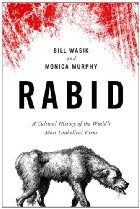
Book Review: Rabid: A Cultural History of the World’s Most Diabolical Virus by Bill Wasik and Monica Murphy
 Summary:
Taking a cultural and public health perspective, husband/wife writing team, Wasik and Murphy, tell the history of the rabies virus through the present.
Review:
My new library (where I work as a librarian) serves a school of public health. Working with these students has opened up a whole new world of science to me. Public health is a fascinating combination of medicine, science, culture, and communication. So when I saw this public health book on Netgalley, I knew I needed to give it a shot.
This is a completely fascinating book. Prior to reading it, my main knowledge of rabies came from that episode of Dr. Quinn Medicine Woman where her adopted son’s dog gets rabies and bites her other adopted son’s fiancee. I didn’t really understand how much of a plague it used to be, but I did know that you’re required to get your pets vaccinated for it.
I learned SO MUCH from this book! And it wasn’t a struggle to read or absorb the information either. Wasik and Murphy strike that hard to find balance in writing science for the layman. They explain complex, scientific things without so much scientific terminology as to be a struggle for the average reader but with enough so that you’ve still learned something. For instance:
With most zoonotic leaps in disease, animal contact is the spark, but urbanization is the bone-dry tinder; a newly evolved pathogen can’t spread from person to person, after all, unless people run across one another in the first place. (location 453)
There are a few passages that use more scientific terminology than that, but they only use them after explaining them. You do not have to be a scientist to be able to read, enjoy, and learn from this book.
The basic structure of the book is typical of a history book. In fact, think of it kind of as a scientific history book. It starts with the earliest accounts of rabies and moves up through time to the present. The strongest passages are: Greco-Roman history of the disease, Dark Ages history of the disease, Pasteur’s creation of a vaccination, and the modern day outbreak in Bali. These strike the perfect balance of discussing the understanding and treatment of the disease and the reflections of rabies and fear of rabies in popular culture of that time period.
For instance, in the Greco-Roman period we learn:
Pliny’s thoughts tend to involve using the animal to treat the man. His best-known cure—to “insert in the wound ashes of hairs from the tail of the dog that inflicted the bite”—lives on today in our expression “hair of the dog,” referring to a not-quite-so-dubious hangover remedy. (location 473)
Or this fascinating bit of public health history in the Pasteur section:
Pasteur’s collaborator Roux believed that Pasteur selected rabies as a subject for research as a calculated bit of stagecraft, so that his ideas about vaccination would attract maximum public interest. (location 1714)
The other sections, particularly the era after the vaccine to about the 1980s, suffer a bit from a lack of focus and direction. There’s a part where the authors try to convince us that zombies are a reflection of a latent fear of rabies. Ok? But that’s rather speculative compared to the rest of the book. There are other elements of pop culture that are nowhere near as loosely connected that they discuss, such as the actual rabies books and movies that came out in the UK when the Chunnel was put in and people were afraid that rabid animals would come over to the island nation from France. That is a tight, interesting connection. The zombie one was a bit of a stretch. I was more interested in more information on things like Old Yeller and why the authors think that even with the vaccine in the US and very little threat at the time the public still was fascinated with the idea of a rabid dog.
The book also explores other zoonotic diseases (diseases that originate in non-human animals). Although this is also technically not rabies, this connection makes a lot more sense, particularly since more started cropping up in the 20th century after rabies was beaten down by vaccination. The knowledge we have from working against rabies and promoting vaccination of it via public health initiatives could really help with things like HIV/AIDS and H1N1. This is using past public health experience to aid in future endeavors, which helps give the book a certain umph and validity for modern readers.
So, although the book struggles a bit during the early 20th century time period, the rest of it is very well put-together. It is written at the appropriate level for a popular science history book. It is easy to learn from and includes lots of fascinating tid-bits in addition to the basic rabies history and information. It also demonstrates as a kind of side-story the history of public health. I recommend it to anyone with an interest in the history of rabies, the history of vaccination, and most especially to those with an interest in public health issues.
4 out of 5 stars
Source: Netgalley

Friday Fun! (Musings On My IBS)
Hello my lovely readers!
This week I haven’t seen much of my library since I’ve been participating in the Science Librarian Boot Camp. I’ll be posting my notes from the Neuroscience section next week, since I think those were the most interesting (at least so far). Perhaps the capstone this morning will be inspiring as well and make the grade too though. :-)
It’s been great to see some of my librarian friends this week, although the Boot Camp was a bit of a struggle. I’ve been experimenting with eating less dairy for multiple reasons (primarily health). I ate quite a bit of dairy on the first day of the conference and subsequently had a flare-up of my IBS. Not pleasant, trust me. :-/ It was frustrating and frankly hard on me emotionally. I’ve struggled with this syndrome for so many years and just when I think it’s mostly under control, something happens again. Although I am passionate about heath, it is frankly sometimes difficult to have to be so incredibly strict on my diet, stress level, sleep amount, etc…. or pay the consequence of being physically ill almost immediately. Trust me, I wish I could indulge in gluttony periodically with the only consequence being a few extra miles on the treadmill! But I know in the grand scheme of things it’s a minor thing to have to deal with, and I am lucky that Boston is such a mecca of vegan food. The key for me, I think, will be figuring out how much indulgence is acceptable to my body. Nobody can be strict all the time! In the meantime, FSM bless Boston for having indulgences like vegan cupcakes.
I also guess this just means I’m going to have to start requesting vegan food at the conferences.
This weekend I’m hoping to see one of my good friends, resume work on my next novel (tentacles, oh my!), and of course gym it. Happy weekends!
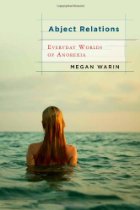
Book Review: Abject Relations: Everyday Worlds of Anorexia by Megan Warin
 Summary:
Warin, an anthropologist, takes an entirely new approach to anorexia, looking it from a purely cultural and anthropological perspective. She spends a couple of years interviewing women with anorexia at various points in the life of the illness from early treatment to recovery to relapse. In this way she analyzes not just the culture of women and men suffering from anorexia but also how anorexia is a response to the culture these people find themselves in.
Review:
This was my first read from the holdings of my new workplace. The instant I saw the title and book cover, I knew I needed to read it. The anthropology of anorexia? How fascinating!
It’s interesting that I feel I actually learned a bit more about anthropology than anorexia from this book, but perhaps that is because I am more familiar with the latter than the former. From my work in psychiatry and as a mental illness advocate, I was already aware that people suffering from anorexia have their own culture. I still highly valued seeing this presented in an academic fashion with a respect for the people involved. I commend Warin for her ability to interact with these women and glean a sense of how they came to be who they are now with a respect for them as people that is all too rare to see in this type of work.
So what of the anthropology then? What are abject relations? Over the course of the book I learned that abject relations are ambiguous relations.
What is abject is in between, ambiguous, and composite. Abjection is thus contrary to dualist concepts because it undermines and threatens that which is separate. As such, abjection is fundamentally concerned with the complexities and contradictions of relatedness. (page 184)
Whereas most books about eating disorders attempt to say THIS definitively caused it, this book’s premise is that the etiology is entirely ambiguous. What caused it, what makes it persist, what it is to suffer from anorexia. Nothing about it is clear-cut. That is the powerful statement of the book. There are no easy answers to anorexia, but we can do much more to understand it both as its own culture and as an aspect of our own.
This focus on anorexia as a response to the mainstream culture and a formation of a new culture leads Warin to question a lot of the inpatient treatment techniques. Warin sees anorexia as frequently about women attempting to assert a right to control over their own bodies that goes horribly awry, ripping the control out of society’s or tormentor’s hands, into their own, into ana’s hands, then into the hands of an authority figure again at treatment. Warin sees value in helping people suffering from anorexia recover in the context of society. Instead of feeding them alone in a single room have them cook and eat together in a group. This reenforces the cultural and connecting aspect of eating that they have been denying for so long.
It is an interesting idea to look at anorexia as an abject cultural response, but I don’t think it’s one that is quite as unique or revolutionary as Warin seems to think. Whereas there have always been those who think anorexia is the ultimate kowtowing to what society deems feminine, there have also been those who view it as women protecting themselves from being perceived as feminine, from having unwanted interactions with those who would objectify them. Perhaps it is really both, which is what makes it so hard to treat. I believe this is what Warin is trying to say, although she is often not as clear as she could be. She gets caught up in academic jargon. She is at her strongest when simply organizing her interactions with the women into themes and presenting them to the reader to do with what they will.
Overall, for an academic look at anorexia this is unique in that it is an anthropological study instead of a psychiatric one. Looking at a group of people who are a group simply because they share the same illness and studying their anthropology is a truly fascinating concept. The book is scientific, but it is social science and is thus easy enough for the mainstream reader to follow. It provides the human aspect of anorexia without sensationalizing. Anyone with an interest in eating disorders or anthropology will enjoy this book.
4 out of 5 stars
Source: Work Library

Counts For:

Friday Fun! (Book Recs From My Job!)
Hello my lovely readers!
I had a wonderful vacation last weekend, thanks for the warm thoughts. It was awesome seeing my dad and visiting the family in general. Plus I got lots of sleep. Also last week I got my stitches out (and by that I mean I took them out myself) and was finally able to resume most of my fitness routines this week! I still can’t do girl pushups because it hurts to put that much pressure directly on my wound. More reasons to work up to guy pushups, yes?
So last week our campus news magazine came out, and they went around asking doctors and professors from different departments for various book recommendations. It was really fun to see from a group of people (scientists) that stereotypes say “don’t read for fun.” So I thought I’d share the recs that made it to my own wishlist with you all today. Descriptions all swiped from the book blurb, because I obviously haven’t read them yet!
- The Social Transformation of American Medicine: The rise of a sovereign profession and the making of a vast industry
by Paul Starr
“Winner of the 1983 Pulitzer Prize and the Bancroft Prize in American History, this is a landmark history of how the entire American health care system of doctors, hospitals, health plans, and government programs has evolved over the last two centuries.”The definitive social history of the medical profession in America….A monumental achievement.”–H. Jack Geiger, M.D.” - Overdiagnosed: Making People Sick in the Pursuit of Health
by H. Gilbert Welch, Lisa Schwartz, and Steve Woloshin
“A complex web of factors has created the phenomenon of overdiagnosis: the popular media promotes fear of disease and perpetuates the myth that early, aggressive treatment is always best; in an attempt to avoid lawsuits, doctors have begun to leave no test undone, no abnormality overlooked; and profits are being made from screenings, medical procedures, and pharmaceuticals. Revealing the social, medical, and economic ramifications of a health-care system that overdiagnoses and overtreats patients, Dr. H. Gilbert Welch makes a reasoned call for change that would save us pain, worry, and money.” - Righteous Dopefiend (California Series in Public Anthropology)
by Phillippe Bourgois and Jeffrey Schonberg
“This powerful study immerses the reader in the world of homelessness and drug addiction in the contemporary United States. For over a decade Philippe Bourgois and Jeff Schonberg followed a social network of two dozen heroin injectors and crack smokers on the streets of San Francisco, accompanying them as they scrambled to generate income through burglary, panhandling, recycling, and day labor. Righteous Dopefiend interweaves stunning black-and-white photographs with vivid dialogue, detailed field notes, and critical theoretical analysis. Its gripping narrative develops a cast of characters around the themes of violence, race relations, sexuality, family trauma, embodied suffering, social inequality, and power relations. The result is a dispassionate chronicle of survival, loss, caring, and hope rooted in the addicts’ determination to hang on for one more day and one more “fix” through a “moral economy of sharing” that precariously balances mutual solidarity and interpersonal betrayal.” - How Doctors Think
by Jerome Groopman
“How Doctors Think is a window into the mind of the physician and an insightful examination of the all-important relationship between doctors and their patients. In this myth-shattering work, Jerome Groopman explores the forces and thought processes behind the decisions doctors make. He pinpints why doctors succeed and why they err. Most important, Groopman shows when and how doctors can — with our help — avoid snap judgments, embrace uncertainty, communicate effectively, and deploy other skills that can profoundly impact our health.” - Your Genes, Your Health: A Critical Family Guide That Could Save Your Life
by Aubrey Milunsky, MD, DSc
“New advances in genetics have dramatically expanded our ability to avoid, prevent, diagnose, and treat a wide range of disorders. Now, more than ever, families need to know about these new discoveries, especially as there are some 7,000 rare genetic diseases that afflict about 1 in 12 of us. In Your Genes, Your Health, Aubrey Milunsky provides an invaluable and authoritative guide to what you should know about your genes. Illustrated with poignant family histories that underscore the lifesaving importance of knowing one’s family medical history and ethnic origin, the book highlights the importance of recognizing seemingly unrelated disorders in a family as due to the same gene mutation and it outlines the key genetic tests needed for diagnosis, detection of carriers, and prenatal diagnosis. Many genetic disorders are discussed including cancer, heart disease, autism, mental illness, birth defects, neurologic disorders, diabetes, obesity and much more. The message of this book is clear–know your family history, be cognizant of your ethnic origins, seek appropriate consultations, and opt for meaningful genetic tests. Recognition of your risk(s) enables prompt preemptive action. By knowing your genes, you may save your life and the lives of those you love.” - Destiny of the Republic: A Tale of Madness, Medicine and the Murder of a President by Candice Millard
“James A. Garfield was one of the most extraordinary men ever elected president. Born into abject poverty, he rose to become a wunderkind scholar, a Civil War hero, and a renowned and admired reformist congressman. Nominated for president against his will, he engaged in a fierce battle with the corrupt political establishment. But four months after his inauguration, a deranged office seeker tracked Garfield down and shot him in the back.
But the shot didn’t kill Garfield. The drama of what happened subsequently is a powerful story of a nation in turmoil. The unhinged assassin’s half-delivered strike shattered the fragile national mood of a country so recently fractured by civil war, and left the wounded president as the object of a bitter behind-the-scenes struggle for power—over his administration, over the nation’s future, and, hauntingly, over his medical care. A team of physicians administered shockingly archaic treatments, to disastrous effect. As his condition worsened, Garfield received help: Alexander Graham Bell, the inventor of the telephone, worked around the clock to invent a new device capable of finding the bullet.
Meticulously researched, epic in scope, and pulsating with an intimate human focus and high-velocity narrative drive, The Destiny of the Republic will stand alongside The Devil in the White City and The Professor and the Madman as a classic of narrative history.”
I hope some of these will make it to your wishlist as well!
Happy weekends!
Book Review: Evolution in a Toxic World: How Life Responds to Chemical Threats by Emily Monosson
 Summary:
Monosson attempts to explain both current and possible future impacts of chemical pollutants on humans by examining how life responded to toxic threats in the past.
Review:
Allow me to preface my review by saying that although I am not a scientist, my profession is that of a medical librarian, so scientific jargon is not new to me. I would therefore say my understanding of science is somewhere above average American but below actual scientist. I had the impression from the description that this book is written by a scientist for public consumption aka the average American. It misses the mark.
The content is great and informative, but it is couched in such an overload of scientific jargon and an assumption of an above average understanding of how the human body works that it was incredibly difficult to get through in order to glean out the interesting information. Thank goodness I had the kindle version and could look up words easily as I went, or I would have given up within the first chapter. Additionally, just when things were starting to get interesting, such as with how DDT impacts development in utero, Monosson would switch topics. Very frustrating!
That said, I did learn quite a bit from this book. It was just difficult to get to these understandable tidbits given the writing style and structure. Here are a few interesting things I learned:
Like some pervasive computer operating systems, p53 is an archetypical example of the unintelligent design and compromise that is inherent in evolution—a multifunctional, multipurpose transcriptional coordinator that has only lately been retasked to the job of tumor suppression in large, long-lived orgasms….At the end of the day p53, together with all our other suppressor mechanisms, fails half of humanity. (location 1314)
Though two species may share a common ancestor and hence a common ancestral receptor or enzyme, once they part ways on the family tree, the branches evolve independently. (location 1670)
For a genetically male mammal to come out looking and functioning male, he requires in utero exposure to hormones like testosterone and its more potent derivative, dihydrotestosterone, along with a functioning AR. An embryo lacking either hormones or a properly functioning AR (or exposed to chemicals that disrupt either receptor or hormone production) will take on a female appearance, despite possessing a Y chromosome….work by Kelce, Gray, and others revealed that a metabolite of the pesticide DDT was an even more potent inhibitor of the AR than was vinclozolin. Given the ubiquity of DDT and its metabolites, this was a potentially explosive finding. (location 1716)
If our CYP enzymes are increasingly metabolizing a variety of pharmaceuticals, what happens when we add one more, or change our diet, or breathe in chemicals like polyaromatics bound to micron-sized air pollution particulates? (location 2509)
Ultimately though, although I learned a lot, the reading experience itself was a bit daunting for the average American. I believe this book would best be enjoyed by a scientist for whom evolution is not their normal research area. They thus would have an easier time with the jargon, but also not already know what Monosson is talking about.
3 out of 5 stars
Source: NetGalley

Book Review: The China Study: The Most Comprehensive Study of Nutrition Ever Conducted And the Startling Implications for Diet, Weight Loss, And Long-term Health by T. Colin Campbell, PhD and Thomas M. Campbell II
 Summary:
Dr. Campbell spent the early part of his scientific career researching diseases of affluence such as cancer, heart disease, and diabetes. When a study in rat livers demonstrated that a greater percentage of protein in the diet led to greater disease, Campbell became intrigued. He designed the China Study to compare Chinese citizens with American citizens, since the Chinese have low rates of these diseases until they immigrate to the United States. Through this and other studies, he believes he has the proof that most diseases of affluence are caused by the Standard American Diet. In his book he presents these findings, as well as an insider’s look at the scientific, health, and government trifecta that vastly affects what Americans learn about health.
Review:
Clearly the most valuable part of this book is the chapter that explains Campbell’s China Study. Since it’s generally not considered ethical to study humans and disease by injecting them with various substances, one of the better methods available is population studies. You compare and contrast over a long period of time the differences between different populations and attempt to determine what aspects may cause bad health. It is undeniable that the traditional Chinese rural population compared to Americans eat less animal products and move more. Additionally they have less disease, particularly cancers, heart disease, and diabetes. Campbell’s study establishes this easily observed fact into something that has been scientifically proven. It is also interesting to note that those who emigrate to the US and adopt the Standard American Diet (SAD) change to the American rate of these diseases. This is ground-breaking information, of course, but it is easy to gather this all from one chapter. Campbell finds it necessary, for some reason, to devote a chapter to each illness, which frankly gets repetitive and tedious to read.
Beyond the study itself, which is interesting and good for people who aren’t already convinced of the health problems caused by animal products, I felt the rest of the presentation of these facts to be dull in comparison to Diet for a New America
He also eloquently shows why we have constantly conflicting news stories on health. Everyone knows the joke about how eggs were bad for you then good for you then bad for you (but only the yolks) all over again. Campbell shows how this is the direct result of the conflict within the science and health industry.
I have come to the conclusion that when it comes to health, government is not for the people; it is for the food industry and the pharmaceutical industry at the expense of the people. It is a systemic problem where industry, academia and government combine to determine the health of this country. (page 318)
I have worked in the health field myself for years now, and I can tell you, the vast majority of the people who do genuinely care about you and your health. But traditions are hard to break and even those within the system don’t know everything that goes on among the lobbyists and the top echelons. I mean, they are still teaching medical students to utilize BMI to determine health in their patients, when multiple studies have shown it is not a reliable tool. Why is this? People want to believe what they’ve first learned, and especially in medicine, if a new idea comes along many many many studies must be done and obstinate people push for it before the method utilized will be changed. This is meant to protect you from quacks, but unfortunately it can lead to the burying of ground-breaking information.
Plus, how would Americans react if tomorrow Mrs. Obama and her obesity prevention program came out and said everyone needs to go vegetarian or vegan? Hell, the woman is taking flak for daring to suggest children play outside. I think you can see my point.
Overall, this book definitely could have been shorter. I believe it would have worked better if Campbell had presented his study and his insider’s knowledge as to why the health care and science industries seem so confused and conflicting half the time. I hope this knowledge will convince more Americans to take direct control of their own health and conduct their own research to come to their own conclusions. It’s worth a read for this knowledge, but if you are not interested in the politics of science and health and simply want the information, then I suggest you go with the more reader-friendly Diet for a New America
4 out of 5 stars
Source: Public Library

Book Review: The Andromeda Strain by Michael Crichton
 Summary:
The US government is searching for new biological weapons by sending satellites into the edges of the atmosphere to collect bacteria strains that may exist there but not on earth. Due to concerns of contamination on reentry, an emergency team called Wildfire is created as a contingency plan. When a satellite crashes in the Arizona desert, grotesquely killing all but two residents of a small town, the team of scientists is put to the test in a race to protect humanity.
Review:
An up-front confession: Michael Crichton is one of my favorite authors. I love how realistic his science is, and he writes suspense quite well. I was therefore excited to read his first book. Unfortunately, Andromeda Strain did not live up to these expectations.
The suspense is killed right off the bat with the narration style. The story is told as if it is a report being written up by someone after the event. This means that we not only know that some of humanity survives this impending doom, but that society is still held together enough to want a report. If I’m sure that everything is going to turn out hunky dory in the end, I’m just not going to be all that concerned throughout the book. Similarly, the characters aren’t fleshed out as well as in later books. They are basically their careers. Here’s the bacteriologist. Here’s the professor. here’s the surgeon. They don’t come across as real, rounded people, so I completely failed to care about them at all. This isn’t good for suspense, because if I don’t care about the characters, I’m not going to worry about them too much.
Crichton’s ability to set a scene shines through well in this book, however. Wildfire’s underground station is vividly imagined, as is the scene at the small town in Arizona. It was simultaneously gruesome and exciting. Similarly, his ability to weave real science into a fake scenario is carried off flawlessly here. The glimmers of the writing that would later appear in Jurassic Park and Prey is clear.
Speaking of the science, Andromeda Strain doesn’t age well. An entire page is devoted to explaining binary like it’s this huge complicated thing, which it isn’t to anyone who grew up with computers. Indeed, a lot of the book is devoted to explaining the huge computer in Wildfire’s base. Unlike biological science, in which the basics stay the same, technology changes rapidly. I don’t think it’s a wise choice to focus on in a scientific thriller, unless you are projecting plausible possibilities in technology in the future. Or super awesome possible technology the government may already have. Crichton does this really well in Prey, which is all about nanotechnology. Science horror needs to take me into a world that is a bit more awesome than my own, not lamer. Thankfully, Crichton figured this out in his later books.
If you’re a Michael Crichton fan, The Andromeda Strain is worth the read to see where he started. If you’re new to him though, I’d recommend starting with some of his later books such as Jurassic Park or Prey.
2.5 out of 5 stars
Source: Bought at Violet’s Book Exchange

Friday Fun! (Grad School Returns)
Grad school is fully back in swing. While I still wish I could miraculously have the copious amount of time I had over winter break when I was just working full-time, instead of working full-time and attending grad school part-time, I don’t totally hate my classes this semester. Yet.
One of my classes is on being an academic librarian in science and technology. The professor is an adjunct, which means he works in the field and knows what he’s talking about. Miraculously, I have yet to loathe any of my fellow students in that class. In fact, I even like some of them. A couple of them were in my medical librarianship class last spring, and I enjoy hanging out with them while they smoke on our break. They don’t have this false sense of being superheroes a lot of students in the program do. They just want a good, stable career, like me.
My other class is an online one on academic libraries. I’ve found I learn more in online classes, not sure why. I pretty much can’t stand any of my fellow students in it, but that’s ok. It’s easy to just roll your eyes at the statements made when you’re not trapped in a classroom with them. I like the professor though, and the assignments seem like I’ll actually learn something from them.
I’ve reached the climax in the novella that I’m writing. I’m excited to get to edit it and send it off to a friend for critique. I seem to actually be following through on my, totally not officially made but thought about a lot, resolution to write my novellas/books more. I really feel like the time I’m spending working on improving my writing is well spent, which is a pretty darn good feel good pill. Maybe someday you guys will get to review my books! Lol.
Happy weekend!
 Support my work with a tip or browse my shop for curated book club guides, how to guides, cross-stitch patterns, and more!


This work by Amanda Nevius is licensed under a Creative Commons Attribution-Noncommercial-No Derivative Works 3.0 United States License.
 Opinions of a Wolf