
Archive
Book Review: The Walking Dead, Book Four by Robert Kirkman (Series, #4) (Graphic Novel)
 Summary:
After escaping the horrors of Woodbury with two new additions to the group in tow, Rick, Michonne, and Glenn high-tail it back to the prison where they warn the other survivors and start prepping to defend their turf. Meanwhile daily life goes on, including a birth, more missing limbs, and a wedding.
Review:
This entry in the series is mind-blowingly awesome. Kirkman demonstrates that he not only is full of surprises, but also pulls no punches. Our group of survivors have their world torn completely apart. And it’s delicious.
First, we have the return of The Governor, and not as a zombie as I’m sure I wasn’t the only one suspecting. He is back missing an arm, an eye, and (I think it’s safe to assume) a dick. This all just makes him even more ferocious and terrifying than before, although that comes as no surprise considering that he is now the man with no penis. But yes, the full-page shot of him arriving at the prison in top of a tank? Fucking. Awesome.
There’s also a lot more zombie action this time around, although I do wonder why it is in pretty much every post-apocalyptic zombie books, no one calls them what they are? The prison folks say roamers, and the Woodbury folks say biters. Um, hello? They are zombies. Be realistic, people. Distancing yourself from your fears won’t help any. In any case, those of us who are huge fans of zombies are pleasantly greeted with many more and varied drawings of them, as well as attacks on people. Zombie gnawing on a dude’s leg? Yes, please.
On a more serious note, the theme of this entry is war. It’s war on a small scale, but it is still war. This is actually quite cool, because it allows Kirkman to show the dangers of war and truthiness on an easier to understand, up-close-and-personal level. The Governor is smart. He manipulates his people (except those closest to him) into believing that those at the prison are the type of evil that he, in fact, is. They thus go in hell-bent on murdering innocent people, who then have to shoot back to defend themselves. The most powerful moment of this, of course, is when a woman from Woodbury realizes she has killed a baby and essentially loses her mind from the instantaneous guilt. It’s a powerful lesson (or reminder) to readers presented in a unique package. The distancing of the situation from reality by the presence of zombies only allows the clarity of the concept of an unjust war to really sink in.
This is absolutely the best entry in the series so far. I cannot wait to find out what happens to the demolished survivors next. Fans of the earlier books should pick this one up asap.
5 out of 5 stars
Source: Public Library

Previous Books in Series:
The Walking Dead, Book One
The Walking Dead, Book Two
The Walking Dead, Book Three
Book Review: The Walking Dead, Book Three by Robert Kirkman (Series, #3) (Graphic Novel)
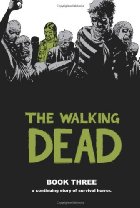 Summary:
The rag-tag band of survivors have adjusted to living in the prison. One day they spot a helicopter go down in flames. Rick, Michonne, and Glenn head out to check on it and end up finding another group of survivors whose leader is known as The Governor. Unfortunately for them, not everyone has maintained their humanity amid the walking dead.
Review:
This entry in the series puts the graphic in graphic novel. We’re talking mutilation, torture, and rape. Also the usual murders and zombies. It is not a book for those disturbed by those things or who find them gratuitous. However, for those of us who love violence all up in our literature, it’s a squee-inducing violence fest. Although you may not want to read it in public just in case someone glances over your shoulder during the rape and/or torture scenes.
The addition of another group of survivors where everything is not hunky dory and evil has arisen was exactly what this series needed. It shows the very dark possibilities that the group we’ve been following have thus far managed to avoid. It puts things like Tyreese and Rick’s fight in the previous book into perspective. Woodbury and The Governor also demonstrate how key Rick has been to the group’s survival and maintenance of a healthy community. All it takes is one bad apple wanting the power for a bad culture to spring up. It’s a good lesson that’s taught here in a subtle way.
I thought long and hard about how I feel about Michonne’s rape. At first I was angry about it with reactions ranging from, “she’s so strong; it doesn’t make sense” to “oh sure, rape the only black woman *eye-roll*.” But the more I thought about it I realized I was being unfair. In a world gone to hell and full of evil rape is going to happen. Rape happens every day now let alone in a post-apocalyptic world, and Kirkman manages to show it in a graphic novel in a way that is respectful to the victim, which I am sure was not easy to do. The concept of what is happening is clear, but at the same time, the drawings focus in on the victim’s emotions and reactions. Similarly, Michonne is the logical choice because she is the most adventurous of the women. She does not stay at home with the kids while the men run out and do things. She’s a strong woman, yes, but being strong doesn’t stop bad things from happening to you. That said, if you are a person who finds rape scene triggering, you should definitely skip this entry in the series and get someone to sum it up for you.
Overall, this is a strong entry that keeps the series fresh and introduces more drama into the post-apocalyptic world. Fans of the first two books will not be disappointed by this one. Highly recommended.
4 out of 5 stars
Source: Public Library
Previous Books in Series:
The Walking Dead, Book One
The Walking Dead, Book Two
Book Review: The Walking Dead, Book 2 by Robert Kirkman (Series, #2) (Graphic Novel)
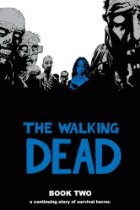 Summary:
The rag-tag group of survivors of the zombie apocalypse stumble upon a prison with two circles of fences just in time. With the warm weather more zombies are active now that they’re no longer frozen. Of course they also discover locked in the cafeteria three surviving inmates. Attempts to make the odd mix of original survivors, inmates, and the farmers into one group might be a task too huge to overcome. Especially when you add in a mysterious woman who arrives with two pet zombies she leads by chains.
Review:
Now that Kirkman has the post-apocalyptic zombie world firmly established, he is more free to move his characters around within it, seeing how different personalities and mores react to an entirely reordered society. This leads to some interesting storylines, such as the May/December romance, suicide pacts, and the idea of a fresh start for the living inmates. It does, however, also lead to some….overly dramatic speeches, let’s say. One in particular reminded me of the infamous “Live together, die alone” speech from Lost, only this one goes, “You kill; you die!” I had to stop reading for a minute to giggle. The close-up of the sheriff’s overly dramatic face had me in stitches, and I”m pretty sure that wasn’t the intended reaction, lol.
That said, though, all of the drama and death and zombies is exactly what one is looking for in a zombie graphic novel. If anything gives a writer an excuse to be overly dramatic, it’s a rag-tag bunch of survivors of the zombie apocalypse. Death and chaos are what we’re looking for here, while also addressing survival issues like farming and people having nervous break-downs. There’s also a creative zombie lore twist that I won’t spoil for you, but that is highly enjoyable.
Overall, Kirkman finds more stable footing in this second entry in the series. It’s chaotic, high-speed disasters, violence, and sex. If that’s what you look for in your graphic novels, I highly recommend this one.
4 out of 5 stars
Source: Public Library
Previous Books in Series:
The Walking Dead, Book 1
Book Review: Buddha Volume Three Devadatta by Osamu Tezuka (Series, #3) (Graphic Novel)
 Summary:
Siddhartha is now a young monk pursuing knowledge and education. He runs into a one-eyed monk who attempts to educate him on the concept of ordeals–essentially punishments for the body designed to help attain enlightenment. The childhood of Devadatta is also depicted. He is bullied and becomes a killer at a young age, thrown out to the wolves who then raise him. Thus his hatred of humanity is explored.
Review:
I am consistently finding this series to be decidedly meh, yet I persist in reading it. I think the art is a large piece of why. It’s almost immediately relaxing to look at, so much so that it doesn’t really matter too much to me what the story is that’s going along with it.
I was intrigued to see a “raised by wolves” myth in another culture. It’s interesting that instead of turning Devadatta into a great warrior, though, it makes him hate humans. A great section is where the wolf mother tells Devadatta that humans are the only animals who kill when they are not hungry. The kindness of and lessons to be learned from the animal world is a persistent theme throughout the series that I enjoy.
Siddhartha’s journey here though does not read at all the way I read it in Siddhartha in college. I appreciate that we’re seeing how no one seems to have answers that ring true for him. For instance, he does not agree with choosing physical punishment purely to suffer an ordeal for no apparent reason. It’s interesting to see his nature depicted as one that just happens to be able to sniff out falseness. It’s a different perspective on the Buddha that I value seeing.
It is odd though for a graphic novel series on an important topic like the Buddha’s life to feel as if it is best read by those already educated on the Buddha. I assumed it would read like an easy introduction, but instead it is so subtle and leaves out so many key details that it is actually best read by those already well educated on Buddhism and the Buddha’s life.
3 out of 5 stars
Source: Public Library

Previous Books in Series:
Buddha, Volume 1: Kapilavastu
Buddha, Volume 2: The Four Encounters
Book Review: Y: The Last Man: Cycles by Brian K. Vaughan (Series, #2) (Graphic Novel)
 Summary:
Yorick and his monkey, Ampersand, (the last males on Earth) continue their reluctant quest to help the government find a way to fix the disease that killed all the other men or at least to clone new men. Their train trip from Boston to California is caught up in Ohio, though, where they stumble upon an oddly utopian town of women. Meanwhile, Yorick’s sister, Hero, and the Amazons continue their quest to rid the Earth of the last man. Plus there’s a mysterious Russian woman who keeps insisting a spaceship with men on it is going to land.
Review:
Now that the premise of the post-apocalyptic world is set up, Vaughan’s story really picks up speed. There is much less explaining and far more action this time around. There are now multiple plot lines and mysteries beyond Yorick’s main one going as well, which helped, because let’s be honest, Yorick isn’t that likeable.
About 1/3 of this entry is set in Boston, primarily around Fenway and the train station. I think having the Amazons duke it out in front of Fenway Park was a pretty nice touch too.
I don’t recall laughing with the first entry, but this one had me laughing out loud on the bus then having to explain to my companions around me what was so funny. The line?
Killing’s easy. Like….like doing laundry!
It is a random, quirky sense of humor that I really enjoy, although I do expect that it might not strike some people as humorous.
The artwork continues to be bright and easy to follow. I really appreciated the preliminary sketches featured in the back of the book. It was most surprising to see that agent 355 originally was white and gradually was changed to black. I’m glad Vaughan made the move, but I do wonder what brought it on!
Overall, if you like a post-apocalyptic graphic world with biting wit and gender commentary, you’re going to enjoy this book.
5 out of 5 stars
Source: Public Library

Previous Books in Series:
Y: The Last Man: Unmanned
Book Review: The Burning Sky by Joseph Robert Lewis (Series, #1)
 Summary:
In an alternate vision of history, the Ice Age has lingered in Europe, slowing down Europeans’ rate of civilization and allowing Ifrica (Africa) to take the lead. Add to this a disease in the New World that strikes down the invaders instead of vice versa, and suddenly global politics are entirely different. In this world, steam power has risen as the power of choice, and women are more likely to be the breadwinners. Taziri is an airship co-pilot whose airfield is attacked in an act of terrorism. She suddenly finds herself flying investigating marshals and a foreign doctor summoned by the queen herself all over the country. Soon the societal unrest allowing for a plot against the queen becomes abundantly clear.
Review:
Can I just say, finally someone wrote a steampunk book I actually like, and it’s a fellow indie kindle author to boot! All of the possibilities innate in steampunk that no other book I’ve read has taken advantage of are used to their fullest possibilities by Lewis.
I love that Lewis used uncontrollable environmental factors to change the political dynamics of the world. Anybody who has studied History for any length of time is aware how much of conquering and advancement is based on dumb luck. (The guns, germs, and steel theory). Lewis eloquently demonstrates how culture is created both by the people and their surroundings and opportunities. For instance, whereas in reality the Native Americans had to rely on dogs for assistance and transportation against invaders on horseback, Lewis has given the Incans giant cats and eagles that they tame to fight invaders. Similarly, in Europe the Europeans are constantly fighting a dangerous, cold environment and have dealt with this harsh landscape by becoming highly superstitious, religious people. This alternate setting allows for Lewis to play with questions of colonization, race, and technology versus tradition in thought-provoking ways.
Women are in positions of power in this world, but instead of making them either perfect or horrible as is often the short-coming of imagined matriarchies, there are good and bad women. Some of the women in power are brilliant and kind, while others are cruel. This is as it should be because women are people just like men. We’re not innately better or worse. Of course, I couldn’t help but enjoy a story where a soldier is mentioned then a character addresses her as ma’am, without anyone feeling the need to point out that this is a woman soldier. Her gender is just assumed. That was fun.
Although Taziri does seem to be the main focus of this book, the story is told by switching around among a few main characters who find themselves swept together in the finale for the ultimate battle to save or assassinate the queen. This strategy reminded me a bit of Michael Crichton’s Next where seemingly unrelated characters suddenly find how their destinies are all connected together. Lewis does a good job with this, although personally I found the beginning a bit slow-moving. It all comes together well in the end, though, with everything resulting in a surprising, yet logical, ending.
What kept me from completely loving the book is that I feel it needs to be slightly more tightly edited and paced. Some sections were longer than they needed to be, which I can certainly understand, because Lewis has made a fun world to play around in, but as a reader reading what amounts to a thriller, I wanted things to move faster.
That said, I thoroughly enjoyed exploring the steampunk world Lewis has created after a couple of years of loving the fashions and possibilities but finding no steampunk books I liked. If someone were to ask me where to start with steampunk, I would point them here since it demonstrates the possibilities for exploring race, colonization, and gender, showing that steampunk is more than just an extended Victorian era.
Overall this is a wonderful book, far better than the traditionally published steampunk I’ve read. I highly recommend it to fans of alternate history, political intrigue, and steampunk alike. Plus it’s only 99 cents on the kindle. You can’t beat prices like that.
4 out of 5 stars
Source: Won on LibraryThing from the author in exchange for my honest review

Book Review: The Walking Dead, Book 1 by Robert Kirkman (Series, #1) (Graphic Novel)
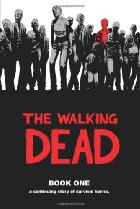 Summary:
When cop Rick wakes up from a coma brought on by a gun shot wound, he discovers a post-apocalyptic mess and zombies everywhere. He sets off for Atlanta in search of his wife, Lori, and son, Carl, and soon teams up with a rag-tag group of survivors camped just outside of Atlanta.
Review:
I just want to point out that this review is purely focused on the graphic novel, not the tv series. I haven’t even seen more than 10 minutes of the tv show, so remember this is about the books not the show. Thanks! Moving along….
I almost gave up on this within the first few pages, because COME ON. Can we PLEASE get over the whole oh I had a coma and then woke up to a zombie apocalypse trope, please? First, it is so highly statistically unlikely that it was laughable the first few times it was used in my beloved dystopian novels, but at this point it just looks lazy. Come up with some other way to start the apocalypse, ok? I don’t care if your main character is out of touch with reality for a few days because he’s on a drug-fueled sex streak. At least it would be different! Also, a cop, really? You want me to root for a cop? And everyone trusts him because he’s a cop? A cop is the last person I would put in charge if I was a member of a rag-tag bunch of survivors; I’m just saying.
Once we move on beyond the initial set-up though to the group of survivors caravaning their way across America, the story vastly improves. The people are real. They’re scared. They’re angry. The snap easily. They hook up with whoever is convenient (and not necessarily young and hot). They teach the kids to use guns. It’s everything we know and love about post-apocalypse stories.
The artwork is good. Scenes are easy to interpret; characters are easy to tell apart. The zombies are deliciously grotesque, although I did find myself giggling at them saying “guk.” Guk? Really? Ok….
The best part, though, is the people that in your everyday life you are just like, come on, god, bolt of lighting, right here? They’re the ones who get eaten by zombies! It is excellent. So that really annoying chick in camp? Totally gets her head bit by a zombie. It’s cathartic and awesome.
The cast is diverse, and no, the black guy is not the first to be eaten (or the red shirt guy for that matter). It wouldn’t kill Kirkman to be a little less heteronormative, but he’s still got time and more survivors to add.
Overall, this is a good first entry in a zombie apocalypse series. Kirkman needs to be more careful to stay away from expected tropes in the genre and bring more of the creativity it is apparent he is capable of. I recommend it to fans of zombies, obviously. ;-)
4 out of 5 stars
Source: Public Library

If you found this review helpful, please consider tipping me on ko-fi, checking out my digital items available in my ko-fi shop, buying one of my publications, or using one of my referral/coupon codes. Thank you for your support!
Book Review: Buddha Volume Two The Four Encounters by Osamu Tezuka (Series, #2) (Graphic Novel)
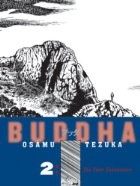 Summary:
The second entry in the novelization of the Buddha’s life takes us through Siddhartha’s youth spent as a prince. He meets a mysterious Brahmin who tells him he is destined to help the whole world, not rule a single kingdom. Siddhartha is weak, frequently sleeps, and has visions. He is discontent as a prince yet reluctant to abandon his people. On an adventure outside the castle walls he meets a grown-up Tatta and falls for a slave woman, Migaila. Conflict between what he believes and his duties as a prince seem central to the plot, yet in fact it is Siddhartha’s reluctance to follow his calling and leave the castle to be a monk that is at the core of the conflict.
Review:
I was pleased to see this entry in the series jump right into Siddhartha’s life instead of those on the periphery, yet Tezuka also brings in the major characters from the first book as minor characters in this one. It works well, definitely better than the first book. However, I am left wondering if the love between Siddhartha and a slave woman was based at all on fact or hearsay or purely came out of Tezuka’s mind. It would definitely give a new perspective on Siddhartha to know he once had an ill-fated love affair.
Although it’s important to know where the Buddha came from, it is difficult and not particularly enjoyable to read about the time in his life when he was a spoiled brat. Siddhartha does not treat his wife or his father well. Although he has natural talents with meditation and visions, he surprisingly lacks compassion for others. One of the things I like, of course, about the Buddha is that he did start out this way. He’s not perfect; he just learned and worked toward Nirvana. So it’s important to see this part of his life, even if it is uncomfortable to read.
I again felt distracted by the characters Tezuka made up though. I wish he had stuck to a straight-forward graphic novelization of Siddhartha or the legends of the Buddha at least. The weakest points of the book are the parts including characters Tezuka made up purely on his own.
The art is again enjoyable but not amazing. The pictures show the story but do not suck you in. They give the feeling of being there to do a job, not necessarily to provide a memorable visual experience to the reader.
Overall, it’s an interesting new way to explore the life of the Buddha, but I would not recommend it to someone completely new to Siddhartha. It is an improvement over the first entry, and hopefully they will continue to improve, but an idea that could have been great is simply average. That’s disappointing.
3.5 out of 5 stars
Source: Public Library

Previous Books in Series:
Buddha, Volume 1: Kapilavastu
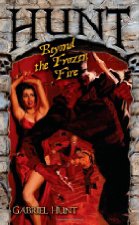
Book Review: Hunt Beyond the Frozen Fire by Gabriel Hunt (series, #4)
 Summary:
Gabriel Hunt is independently wealthy and runs around the world saving artifacts, people, etc… Think Indiana Jones in book form. In this entry, a hot lady named Velda shows up at his office asking him to help look for her father who’s gone missing in Antarctica. His last transmission mentions trees, and his colleagues believe he was hallucinating, but Velda wants to save what could be her father’s greatest discovery. Hunt decides to take the case and assembles a team including his best friend, southern charmer Maximilian, and his ex-girlfriend, a mechanic, which is a bit awkward since he’s now banging Velda. When the team gets out to the portion of ice Velda’s father was lost around, they fall into a fission in the ice and discover red ice and a tunnel that just may prove Velda’s father wasn’t hallucinating after all.
Review:
This is what pulp fiction should be all about. This is the kind of book that I finished and immediately contacted multiple friends to tell them the full plot, and then they all wanted to read it for themselves in spite of knowing how it ends. In fact, knowing the ending made them want to read it more. This is the kind of book where I hit one particular scene, and my jaw dropped open and I started laughing hysterically and everyone in my work cafeteria turned to look at me. Basically: this kind of book is why I love pulp fiction and thumb my nose at literary fiction snobs.
Basically, ridiculous things build up and keep happening until suddenly you’re just accepting something in the plot that is INSANELY out there, but in the world the author has created it works. We go from a murderous knife-throwing gypsy who also sells munitions to a mysterious message from a father who survived the Holocaust to falling into a fission in the ice and not dying to leap-frogging across deadly cold water on ice islands to finding an Amazon style jungle under the ice to being attacked by a giant chicken to being taken hostage by a tribe of Amazon Nazi women.
Yes, you read that right. Amazon Nazi women. Most of whom are naturally late teens to early 20s, blond haired, blue eyed, and completely gorgeous. NATURALLY.
Now, I know what you’re thinking. “What, Amanda? You’re doing The Real Help project. You host the MIA Reading Challenge. What the what?” But the thing is, this sort of fiction is just about FUN, and the plot is so ridiculous it’s not like I’m going to go out there and say obviously there are murderous Amazon Nazis in the ice under Antarctica. Just….no. It’s overly ridiculous on purpose. Kind of like old school MTV shows like Room Raiders and Next. It’s escapist literature. It knows it’s ridiculous, and that’s ok. Most of it is not offensive if you have a modicum of a sense of humor.
Of course, just because it’s hilarious and ridiculous doesn’t mean it’ll be everyone’s cup of tea. It is quite violent. It probably presses the boundaries of what some people would be ok with reading about sex and violence. You guys know me and know I don’t really have boundaries for those things though. To me this would be the perfect read to give a reluctant male reader. It’s action-packed, fast-paced, and basically a male wet dream. Obviously that won’t be everyone’s cup of tea.
Essentially if you think that a book version of 007 complete with a village of Amazon Nazis under the ice sounds like one of the best things ever, you’re going to love this book. If you read that sentence and rolled your eyes or cringed, then yeah, avoid it. It’s not meant for you.
4 out of 5 stars
Source: I think this was Paperbackswap, but I’m not positive.
Buy It

Counts For:

Book Review: Point by Thomas Blackthorne (series, #2)
 Summary:
Mysterious cutter circles are showing up in the Britain of the future. Thirteen teenagers gather in a circle, then slice the wrist of the person next to them all the way around the circle. The MI5 recruits a neuroscientist to help figure out the circles before they reach epidemic proportions. Meanwhile, her boyfriend, Josh Cumberland, finds himself sucked back into his old special forces unit when a civilian job reaches a mysterious end. Are the two events connected?
Review:
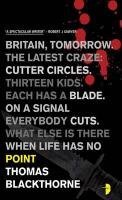
I received an ARC of this book through the Angry Robot Army, and I sort of wish I’d noticed it was the second in a series. I just dislike reading books out of order. Also, I think perhaps if I’d read the first book in the series, I wouldn’t have been so misled by the cover.
In case you can’t see the cover, it says, “Britain, tomorrow. The latest craze: cutter circles. Thirteen kids. Each has a blade. On a signal everybody cuts. What else is there when life has no point.” This makes it seem like this will be a book about depression and suicide in a post-apocalyptic world, right? In fact the people committing suicide have been brainwashed by music in an emotiphone to further a political power move. Which has…..nothing to do with real suicide or depression.
There’s nothing wrong with being a political intrigue book, but I am a bit disturbed at how Blackthorne utilizes psychology, psychiatry, and neuroscience in the book. He makes it look like in the future we’ll be able to just….program people out of it or to do whatever we want them to do. The brain is much more complex than that, and I just don’t like the message that such a plot device sends.
When looking at the book as the political espionage it actually is, as opposed to a book about mental illness in a dystopian world, it’s not a bad book. I have the feeling that those who enjoy political intrigue books will enjoy it. Josh is your typical wounded hero, and I did enjoy the scenes of him training. Blackthorne creatively incorporates reality tv into the plot-line that many readers will enjoy. The characters aren’t flat, but also aren’t particularly well-rounded. That’s ok, though, because the focus of the book is the action and political intrigue.
Overall, the book seems to be an average future political intrigue action flick…in written form. I recommend it to fans of that genre, but others will probably be bored.
3 out of 5 stars
Source: ARC from publisher

 Support my work with a tip or browse my shop for curated book club guides, how to guides, cross-stitch patterns, and more!


This work by Amanda Nevius is licensed under a Creative Commons Attribution-Noncommercial-No Derivative Works 3.0 United States License.
 Opinions of a Wolf