
Archive
Book Review: Nexus by Ramez Naam (Series, #1)
 Summary:
Science is moving forward to and through transhumanism to posthumanism, and no society seems to quite know how to handle it. China is using the tech in their armies, Thailand is interested in its use to enhance meditation and zen, and the US government banned many of the different treatments and drugs after they were used by cults to make cloned children into killing machines. Kaden Lane knows about the potential dangers, but he and his lab partners are still invested in making their brain nanotechnology drug, Nexus, work. It makes minds meld together, able to feel others’ suffering, and they think it will lead to world peace. Samantha Cataranes was a victim of a transhumanist mind control cult as a child, now she fights on the side of the FBI putting a stop to any science deemed too dangerous. When Samantha and Kaden meet, their worlds and worldviews start colliding.
Review:
I had honestly kind of forgotten what this book was about, beyond it being scifi, by the time I picked it up to read it. I thus was able to experience most of it as a surprise. It’s a book that’s a modern twist on cyberpunk with plenty of action to boot.
Jumping far enough ahead that some transhumanist elements already exist is a smart move. It lets the book think forward further than the initial transhumanist elements that it’s generally easy to see the advantages of, like fully functional robotic hands, into the grayer areas with things like cloning and mind control and making soldiers who are super-soldiers. This is a more interesting ethical dilemma, and the book doesn’t take very long to set up the world and get into it.
Nexus itself is a fascinating drug that combines nanotech and drugs. It’s easy to see that the author knows his science and has extrapolated into a possible future with a lot of logic based on current science. That’s part of what makes reading the book so fascinating and slightly frightening. It feels like an actual possibility.
The world building is done smoothly, incorporating both in-plot mentions and newspaper clippings and internal briefings to establish what is going on in the greater world around Kaden and Samantha.
The characterizations are fairly strong. Even if some of the secondary characters can seem two-dimensional, the primary characters definitely are not. Seeing a woman as the world-wise, transhuman strong fighter, and the man as the physically weaker brains was a nice change of pace. Additionally, the book embraces the existence of gray areas. “Bad guy” characters aren’t necessarily bad, and “good guys” aren’t necessarily good. This characterization helps tell the nuanced gray area story of the overarching plot.
The beginning of the book was weaker than the middle and the end. The first chapter that has a character testing out Nexus by using it to land sex with a hot woman almost made me stop reading the book entirely. It felt like some pick-up artist douchebro was imagining a future where tech would make him irresistible to women. Frankly, that whole first chapter still feels extremely out of place to me now. It doesn’t fit into the rest of the presentation of the character throughout the book. It feels like an entirely separate story altogether. I would encourage potential readers to skim it, since it barely belongs, then get to the rest of the book.
After the first chapter, the next few chapters feel a bit overly rose-colored lenses at first. Almost as if the author sees no gray areas and only the potential good in humans. Thankfully, this is mostly the rose-colored lenses of a main character that quickly fall away for the more nuanced storytelling of the rest of the book. But it did induce a few eye-rolls before I got further along.
The middle and end of the book look at human potential for both good and evil within the context of both science and Buddhism. It’s fascinating stuff, and makes a lot of sense since quite a bit of modern psychiatry is working hand-in-hand with ideas from Buddhism, particularly about meditation. This is where the more interesting insights occurred, and also where I felt I could embrace the book a bit more.
Each of us must walk our own ethical path. And together, men and women of ethics can curb the damage of those without. But for you…if you keep vital knowledge from others, then you are robbing them of their freedom, of their potential. If you keep knowledge to yourself, then the fault is not theirs, but yours. (loc 5597)
Overall, this cyberpunk scifi that mixes transhumanism and posthumanism with nanotechnology, fighting big governments, and Buddhism tells a fascinating tale full of gray areas that will appeal to scifi fans. Some may be turned off by the first few chapters that lack the nuance and likeable and strong characterization of the rest of the book, but it’s worth it to skim through the first few chapters to get to the juicier middle and end.
If you found this review helpful, please consider tipping me on ko-fi, checking out my digital items available in my ko-fi shop, buying one of my publications, or using one of my referral/coupon codes. Thank you for your support!
4 out of 5 stars
Length: 460 pages – average but on the longer side
Source: Netgalley

Book Review: The Running Game by L. E. Fitzpatrick (Series, #1)
 Summary:
Rachel is a doctor in the slums outside of London. It’s not a great place to live, but it’s safer than a lot of the other options available. She’s also a Reacher with telepathic powers. Since she was a young girl, she learned to hide her abilities and always know her exits so she could run at any time. But when two brothers show up, one a wounded Reacher, and tell her a mobster sent them looking for her, she has to decide whether to run again or trust the brothers.
Review:
Near-future dystopias will never cease in their appeal to me, and so I was fairly quick to accept this one when I was choosing ARCs to read for 2014. The book offers a grim dystopia but far less running than one would imagine from the title.
The book establishes the overall dreary setting of a dystopia fairly quickly. Rachel’s work at the hospital and commuting home from it is dirty and grimy. Society is clearly barely functioning, a fact that is smoothly and clearly established. It takes a bit more time to learn more about the over-arching world, and the fact that Rachel is a “Reacher,” a person with some form of telepathic powers. For some reason, the government is seeking to eradicate all Reachers, whereas the church, which is illegal, views them as angels sent from above, metaphorically speaking. It’s an interesting world but our view into it is quite narrow, so there’s a lot of questions left unanswered.
Rachel is a good, strong character who is well-rounded in spite of knowing little of her backstory. The brothers, on the other hand, are kind of annoying and two-dimensional. They and the general crime lords/corrupt cops feel much more cookie cutter than Rachel does. In a way, they drag her down. It’s hard to root for her when she chooses to cast in lots with this bunch.
Similarly, the plot focuses in on what feels more like a standard crime thriller plot, rather than a dystopian one. It’s a good crime plot, but it’s not a dystopian one. The title implies a much more dystopian style book, such as Rachel using her powers to outwit the government and start a new colony or something like that. Instead it feels a bit more like an urban fantasy style crime plot that just so happens to be surrounded by society breaking down, somewhere out there. I think marketing it as a running game, rather than as the crime mystery plot it really is hinders the book a bit. Readers who would like an urban fantasy style futuristic crime novel might miss it, because it sounds so dystopian. The title and summary give the vibe of a Logan’s Run or Maze Runner style book, when that’s not what it is. What it is is a perfectly good futuristic crime novel, but that’s not what it sounds like.
Overall, this is a quick-moving tale of futuristic crime with a dash of telepathic powers and an easily imagined setting. Fans of near future, fantasy, and crime will enjoy seeing the three intertwine. Those looking for more of a scifi or dystopian focus should look elsewhere.
If you found this review helpful, please consider tipping me on ko-fi, checking out my digital items available in my ko-fi shop, buying one of my publications, or using one of my referral/coupon codes. Thank you for your support!
3 out of 5 stars
Length: 228 pages – average but on the shorter side
Source: kindle copy from author in exchange for my honest review

Book Review: The Cormorant by Chuck Wendig (Series, #3)
 Summary:
Miriam Black is on her own once again after sending her truck driver boyfriend to the curb. She’s taken to periodically messing with fate by killing the killers she sees in her visions of the deaths of the people she touches. When she gets an offer on Craigslist to read someone’s future death in Florida, it comes at a time when she can’t pass it up, as a recently homeless person. She heads to Florida figuring she might also tackle the demon of her relationship with her mother. Two birds, one stone. But Florida ends up being much more than a quick job and a quick visit.
Review:
I snatch up a new Miriam Black book the first chance I get because I so love the prose style of the books (I’m uncertain if Wendig’s other books read similarly, as I haven’t read any), and I also love Miriam as a character very much (I would definitely run the other way if I spotted her on the street at night). This third entry in the series didn’t disappoint, although I periodically wondered if Miriam’s bad-assness would be sacrificed for character growth.
The urban fantasy world of Miriam Black continues to be slowly fleshed out in this book. We meet a couple more characters with supernatural abilities, not exactly Miriam’s but similar in that they function in the mind. We also start to understand what might cause such a thing to happen. And how Wendig presents this information is beautifully crafted. It is a part of the story, a wonderful example of showing not telling.
Miriam doesn’t just cause chaos and get away with it, and this book fairly clearly exists to show us that Miriam is not invincible, even if she may sometimes seem it in earlier books. She’s a tough broad with a mental gift brutally acquired, and she’s trying to figure out how to function and do the right thing in this incredibly fucked up situation where she is battling unknown forces, particularly fate.
The plot forces Miriam to confront two bad specters from her past: an ex lover and her mother. I was fine with confronting the ex lover, and how it went down made sense. I was incredibly wary of her confrontations with her mother. Her mother was established as a fundamentalist abusive ball of shit in the previous books, and I was deeply concerned that Wendig was going to try to either make it seem like it was all in Miriam’s head or offer redemption for her. And the plot does sometimes dance on the edge of doing one or the other of these. But the way Miriam reacts to her mother in their confrontations help keep it grounded and realistic that not all mothers are great people. In one confrontation she tells her mother,
Don’t act surprised that I have this cyanide cocktail in my heart. Like they say on that old dumb-ass drug commercial: I learned it by watching you. (loc 1824)
On the other hand, an awful lot of the plot revolves around Miriam saving her mother from her untimely death at the hands of a kidnapper. I just have a hard time believing, especially given the vitriol Miriam has felt for her mother this entire time, that she would actually care that much if her mother dies. I get it that Miriam might very much not want the kidnapper to get away with it, because she hates him and he’s fucking with her, but I don’t think Miriam would actually get misty-eyed at the thought of her mother’s untimely demise. It felt forced instead of being Miriam. That said, the plot does manage to stick to its guns enough that Miriam comes out of the situation still seeming like her cyanide-filled self, so I can’t fault it too much for veering that close to the edge.
I would be amiss not to mention the fact that his book establishes the fact that Miriam is bisexual. Of course, she refuses to use the term herself, and I’m fairly certain no one actually ever calls her bi. Normally a bi character refusing to call herself bi would drive me batty, but Miriam refusing labels fits 100% into her character. She doesn’t see the need to label who she fucks and other characters’ attempts to figure her out are met with disgust on her part but that’s how she feels about everything about herself. Yes, I wish more functional non-cyanide cocktail hearted characters were bi, but I also am pretty darn happy that a character I enjoy so much is bi. Plus, scenes of Miriam banging a woman were an unexpected utter delight.
The plot does a great job of being both a single book conflict and something that ultimately propels the overarching plot forward, which is exactly what one hopes for from a series book.
The writing style maintains its gritty sharpness that the series has enjoyed from the beginning. Both the narration and the conversations are a pleasure to read. Passages like those listed below are peppered throughout the book, accosting the reader with the knowledge that we are in Miriam’s world now.
Meetings are like black holes: they eat up the hours, they suck in the light, they gorge on his productivity. (loc 92)
I’m a certified bad-ass indestructible bitch. The sun tries to burn me, I’ll kick him in his fiery balls. I don’t need no stinking suntan lotion. (loc 2787)
Overall, this book brings most things readers have come to expect from a Miriam Black book. A gritty female main character with hard-hitting prose and a plot with a touch of the fantastic and grotesque. Some fans might be a bit disappointed by the direction Miriam’s relationship with her mother goes, but all readers will be pumped by the ending and eagerly anticipating the next entry. Recommended that fans of the first two books pick this one asap.
If you found this review helpful, please consider tipping me on ko-fi, checking out my digital items available in my ko-fi shop, buying one of my publications, or using one of my referral/coupon codes. Thank you for your support!
4 out of 5 stars
Length: 384 pages – average but on the longer side
Source: Gift

Previous Books in Series:
Blackbirds, review
Mockingbird
Book Review: My Big Fat Demon Slayer Wedding by Angie Fox (Series, #5)
 Summary:
Lizzie Brown, once preschool teacher turned demon slayer, is extremely excited to be marrying her true love, Dimitri Kallinikos, who just so happens to also be a magical shape-changing griffin. And she’s also fine with letting her adoptive mother run the whole show, even though her mother wants to make the wedding into a week-long event. She’s not so ok with having to tell her mother about being a demon slayer, though. Or about integrating her mother’s posh southern lady lifestyle with her recently discovered blood-related grandmother’s biker witch gang. She’s pleasantly surprised that her mother found a goth-style mansion to rent for the wedding. Maybe the magical and the non-magical can integrate fairly well, after all. But then it becomes evident that someone in the wedding is trying to kill her. Plus, they find demonic images around the property…..
Review:
This remains one of my most enjoyed urban fantasy series. The world Fox has created is bright, witty, imaginative, and a real pleasure to visit, even though sometimes the main character can rub me the wrong way (she’s a bit too straight-laced for me sometimes). Urban fantasy books can either keep the main character perpetually single or have her get married. If they choose to get married, the wedding book winds up with a lot on its plate. It’s hard to integrate the world of urban fantasy with the wedding scene a lot of readers enjoy reading about. Fox achieves this integration eloquently, presenting an intriguing urban fantasy mystery, the clash of urban fantasy magical folks and real world expectations, and manages to show the wedding is about the marriage, not the party.
My main gripe with the previous book was Dimitri and Lizzie’s relationship. Primarily that they don’t appreciate what they have, and how annoying that is. I think the events of the previous book really snapped them out of it, because here, Lizzie and Dimitri have taken their relationship to another level. They have a trust in and intimacy with one another that manages to withstand some pretty tough tests, and is a pleasure to read about. It’s easy to see that this is a couple that is ready for a marriage. It’s a healthy relationship that’s rare to see in urban fantasy. At this point in the series, I can appreciate that Dimitri and Lizzie aren’t perfect in the earlier books. Relationships change and grow with time, and Fox demonstrates that beautifully. Of course, it’s still more fun to read about a happy couple than one bickering with each other over minor things. But those hiccups in the relationship in earlier books helps make it (and the marriage) seem more real.
Similarly, Lizzie has grown with the series. Where at first she’s annoyingly straight-laced, now she is not just starting to break out of that but is enjoying breaking out of it. Seeing her adoptive mother pushes this issue to the forefront. Lizzie is finally coming into her own, and she, and her loving mother, have to confront that.
[Lizzie’s mother] paused, straightened her already squared shoulders. “Is this type of style…” she waved a hand over me, “appealing to you? You look like a hooligan.” I let out a sigh. “Try biker.” (page 16)
Whereas this confrontation between Lizzie and her mother could have led to the mother looking like a bad guy, Fox leaves room for Lizzie’s mom to be different from her but still a good person and a loving parent. They butt heads over different opinions, just as real-life parents and adult children do, but they both strive to work through them and love each other for who they are. It’s nice to see how eloquently Fox handles that relationship, particularly with so many other plot issues going on at the same time.
The plot is a combination of wedding events and demon problems. Both ultimately intertwine in a scene that I’m sure is part of many bride’s nightmares. Only it really happens because this is urban fantasy. How Fox wrote the plots to get to that point is enjoyable, makes sense, and works splendidly. The climax perfectly demonstrates how to integrate urban fantasy and real life situations. Plus, I did not come even close to guessing the ending, which is a big deal to me as a reader.
The wit and sex scenes both stay at the highly enjoyable level that has been present throughout the series. Dimitri and Lizzie are hot because they are so hot for and comfortable with each other. The humor is a combination of slapstick and tongue-in-cheek dry humor that fits the world perfectly. I actually laughed aloud quite a few times while reading the book.
Overall, this is an excellent entry in this urban fantasy series. It tackles the wedding of the main character with a joyful gusto that leaves the reader full of wedding happiness and perhaps breathing a sigh of relief that no matter what may go wrong at their wedding, it couldn’t possibly be as bad as what can go wrong at an urban fantasy wedding. Highly recommended to fans of the series. You won’t be disappointed in Lizzie’s wedding, and you’ll be left eager to see her marriage.
If you found this review helpful, please consider tipping me on ko-fi, checking out my digital items available in my ko-fi shop, buying one of my publications, or using one of my referral/coupon codes. Thank you for your support!
5 out of 5 stars
Length: 270 pages – average but on the shorter side
Source: Gift

Previous Books in Series:
The Accidental Demon Slayer
The Dangerous Book for Demon Slayers
A Tale of Two Demon Slayers
The Last of the Demon Slayers
Book Review: One Death at a Time by Thomas M. Hewlett (Series, #1)
 Summary:
Jack Strayhorn is a private eye and a member of Alcoholic’s Anonymous. Only, he’s not an alcoholic, he’s one of the vampires who meet in a secret vampire group that exists under the umbrella of AA to learn how to control their urges and feed on humans without killing them. He’s just returned to LA, his death site that he hasn’t been back to since he had to run in 1948 after becoming a vampire. When his current missing person case shows up dead next to a Fae politician, Jack gets dragged into a mixed-up underworld of Faes, werewolves, drugs, and a group of vampires determined to rule the world.
Review:
This is one of the twelve indie books I accepted to be reviewed on my blog in 2014 (complete list). I was immediately intrigued by the summary, due to its delightful urban fantasy/paranormal take on AA. The book delivers exactly what it promises, spiced with a noir writing style.
Jack Strayhorn is the perfect paranormal version of the noir-style hardboiled detective. He’s got a biting, snarky wit, a handsome presence, a sharp mind, and is a bit distant and mysterious. It’s just in this case he’s distant and mysterious because he’s a vampire. Making the private eye a vampire makes his character unique in noir, and, similarly, making the vampire a private eye with his focus primarily on crime solving and not paranormal politics gives the urban fantasy vampire a unique twist. Jack is presented as a complex character, one who we could not possibly get to know fully in just the first entry in the series. It’s easy to see how he will manage to carry the proposed 12 entries in the series.
Supporting Jack is a wide range of characters who accurately portray the diversity in a large town like LA, as well as the diversity one expects in a paranormal world. The characters are multiple races and classes. Whereas some urban fantasy books slowly reveal the presence of more and more paranormal races throughout the series, this book starts out with quite a few, and that is a nice change of pace. Most urban fantasy readers expect there to be more than just vampires, and the book meets the urban fantasy reader where they’re at. Even though the book has a large cast, the secondary characters never blend together. They are easily remembered, and the diversity probably helps with that.
I like the idea of vampires having an AA-like group, but I’m still not sure how I feel about this group existing as some secret under the umbrella of AA itself. The book even goes so far as to say the the founder of AA was a vampire himself, and used the human illness of alcoholism as a cover for the vampire group. I like and appreciate vampirism as a disease that some people just mysteriously have at birth as an analogy for alcoholism, but I feel that having it present in the same group as the real life AA groups dampens the realness of actual AA, weakening the analogy instead of strengthening it. I’ve seen books before have paranormal people get together in AA-style groups (zombies anonymous springs to mind), and in real life AA has spinoffs such as Narcotics Anonymous and Overeaters Anonymous. Prior to reading the book I thought maybe something might be added by having the vampires be a secret organization under AA, but after reading the book, I don’t think it did. I think the analogy would have been stronger if vampires spotted the similarities of their genetic vampirism with alcoholism and formed a “vampires anonymous” group, inspired by AA. Something about vampires creating AA themselves as a cover hits a bit of a sour note and weakens the analogy.
The plot is complex, with just enough twists and surprises. There were parts of the ending that I was unable to predict. The plot contained within the book was wrapped up sufficiently, and the overarching plot intending to cover the whole series was well-established and filled me with the desire to keep reading. Unfortunately, the second book isn’t out yet, so I will just have to wait!
Overall, this is a delightful mix of urban fantasy and noir and is a strong first entry for a new series. Some readers might dislike the paranormal take on Alcoholic’s Anonymous found within the book, but it is secondary to the mystery/noir plot and easy to gloss over if necessary. Recommended to urban fantasy readers looking to venture into noir or vice versa, as well as anyone who enjoys both urban fantasy and noir.
If you found this review helpful, please consider tipping me on ko-fi, checking out my digital items available in my ko-fi shop, buying one of my publications, or using one of my referral/coupon codes. Thank you for your support!
4 out of 5 stars
Length: 216 pages – average but on the shorter side
Source: kindle copy from author in exchange for my honest review

Book Review: The City of Time and Memory Part I by J. A. Childress (Series, #1)
 Summary:
Zak wakes up from a night of drunken revelry to find himself in his apartment but not his apartment building. His apartment is now part of a massive structure of multiple different architectural styles that looks like it goes on forever. Plus his bathroom is missing. Shreya wakes up in her car in a parking garage to Hungry Eyes playing on the radio and an ominous car nearby nicknamed “Die Pflaume.”
Review:
This first entry of a new serial does a quick job establishing a strong setting but just when the action gets going, it leaves the reader hanging.
When I accepted this review copy, I must admit that I didn’t realize it was the first entry in a serial, I thought it was in a series. Serials offer small episodes of an overarching story in bite-size chunks the reader picks up. Think of it as reading an episode of your favorite tv series. I think it would help if this was marketed more clearly as a serial, since certain readers love that reading experience and others aren’t too keen on it. Making it clearer that it’s a serial will help it better reach the right readers.
A good serial entry will read much like an episode in a tv show with a large, overarching plot, but also a smaller plot that can be told in one episode that is, ideally, tied to the overarching plot in some way. This gives the reader the satisfaction of completing a piece of smaller plot but also keeps them engaged in the series as a whole. This serial does a good job setting up the overarching plot. People are waking up in what appears to be an alternate universe that is possibly punishing them for something they did that they can’t remember with sinister beings chasing them or tormenting them from afar. It’s a good mystery, but it is just getting going when the serial entry stops. This would be ok, but the big weakness of the serial entry is that there is no self-contained smaller plot. Thus, instead of feeling any sense of satisfaction of having learned something or completed one mystery, the two main mysteries of the overarching plot are just getting going and then stop abruptly. Without the presence of a second, self-contained, smaller plot for this entry in the serial, this just leaves the reader feeling cheated out of getting the whole story, rather than the dual experience of satisfaction at the wrap-up of the smaller plot and intrigue at the larger plot.
The setting of the alternate universe is well-established and delightfully creepy. Everything being just a little bit off is creatively written without being in the reader’s face. The author also includes a drawing of a mysterious symbol that Zak sees, which helps build the atmosphere.
In contrast, Zak and Shreya feel a bit two-dimensional, but this is possibly because they have such a short time in which to be established. Similarly, the demonic character who chases Zak comes across as corny, straight out of a B movie, not frightening like he is, presumably, supposed to. The world building is so good that the two-dimensional good guys and cheesy bad guys stick out like a sore thumb.
The one flaw in the writing style is there are way too many similes. At times it feels that every other sentence contains one. Any descriptor used too much can go from artful to annoying. A lighter hand on these would be helpful in future entries.
Overall, this first entry in the serial establishes a delightfully creepy alternate universe where everything is just off. The lack of a smaller, self-contained plot in addition to an overarching plot will make this frustrating to read, unless the reader has the next entry at hand to read immediately. Recommended primarily to horror fans who like their horror in small bites and enjoy the concept of a serial who won’t mind waiting a bit for the conclusion to the mystery in future entries.
If you found this review helpful, please consider tipping me on ko-fi, checking out my digital items available in my ko-fi shop, buying one of my publications, or using one of my referral/coupon codes. Thank you for your support!
3 out of 5 stars
Length: 37 pages – novella
Source: Kindle copy provided by author in exchange for my honest review

Book Review: American Science Fiction: Five Classic Novels 1956-58 (Series, #228)
 Summary:
The Library of America collects together great pieces of American literature into themed books. This can be anything from an author, to writing on aviation, to the Harlem Renaissance, to transcendentalism. Clearly this is a collection of classic 1950s scifi, in particular covering the time period from 1956 to 1958. The books included in the collection, in order of publication date, are:
Double Star
The Stars My Destination
A Case of Conscience
Who?
The Big Time
Review:
This is my third Library of America collection and, unfortunately, is the one I’ve liked least so far. Perhaps I have simply discovered that the Red Scare overtakes American scifi of the late 1950s more than I had previously realized, and that is just not to my own personal scifi taste. The collection still does what it purports to, though: it gathers a selection of the best of American scifi in a particular time period, letting the reader immerse herself and truly come to know a particular genre in a particular period.
Since this collection gathers up books written by different authors, I have reviewed the books individually as I read them. Thus, here I will simply summarize my reviews to give you a feeling of the collection as a whole.
Double Star
Similar to The Moon Is a Harsh Mistress, Heinlein presents a delightful mix of wit, Hollywood glamor, and thought-provoking political speeches all in a well-imagined and engaging future society. A fun piece of classic scifi that tosses together acting and politics in outer space with Martians who look like toadstools and a heavy sprinkling of wit. The romance leaves something to be desired, and the tech isn’t particularly predictive or imaginative, but these are minor aspects of the story. Recommended to fans of witty scifi who don’t mind a dash of political intrigue.
4 out of 5 stars
Full Review
The Stars My Destination
The world building is so excellent and gets so much attention from Bester that it overshadows the more average vengeance plot with iffy morals. Readers who enjoy immersing themselves in various possible futures will revel in the uniqueness and richness of the future presented here. Those who believe firmly in punishment for crime as opposed to redemption may not be able to get past the plot to enjoy the setting. Recommended to scifi fans interested in a unique future setting.
4 out of 5 stars
Full Review
A Case of Conscience
Essentially, the book has interesting world-building and what could be a promising plot that get derailed by two-dimensional characters and too many bizarre plot-twists and occurrences. It’s certainly an interesting read, particularly if you are interested in immersing yourself in this odd world Blish has created. However, readers should not expect to connect with the characters on an emotional level and should be prepared for a bizarre plot.
3 out of 5 stars
Full Review
Who?
An interesting concept that wasn’t fully fleshed out nor the possible weaknesses fully addressed. It is definitely a scifi of its time, with its hyper-focus on the Soviets and the Cold War that could almost feel kitschy today. A short read with an interesting premise, albeit a lack of female scientists, soldiers, or government workers. Recommended to scifi fans who enjoy some old-fashioned red scare in their reads and don’t need the science to be perfect.
3 out of 5 stars
Full Review
The Big Time
A thought-provoking whodunit mystery set in an R&R waystation in a time-travel war. Some aspects of the book did not age particularly well, such as the hysterical fear of Communism and the lack of women soldiers, but the heart of the book is timeless. How do you know if those in charge are right or wrong, does love make you see things more or less clearly, and does evolution feel frightening and random when it’s happening. Recommended to scifi fans with an interest in a scifi take on a Clue-like story.
3 out of 5 stars
Full Review
In Conclusion
This is an interesting collection that shows how gradually fear of Communism came to take over American thought by the end of 1958. The two earliest books in the collection are set in a far future with no concerns about the long-reaching impacts of the Cold War. By the last two books, the futures are heavily impacted by the perceived threat of Communism, with one book even having time itself being unraveled and re-written in an attempt to stop the Russians. The most light-hearted, entertaining book in the collection is Double Star
If you found this review helpful, please consider tipping me on ko-fi, checking out my digital items available in my ko-fi shop, buying one of my publications, or using one of my referral/coupon codes. Thank you for your support!
3 out of 5 stars
Length: 835 pages – chunkster
Source: NetGalley

Book Review: The Big Time by Fritz Leiber (Series, #1)
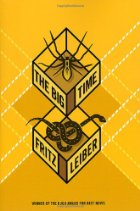 Summary:
It’s the Time War, and the Spiders and Snakes are battling each other up and down the timeline in an attempt to give time the ultimate outcome they each are hoping for. Nobody knows precisely who the spiders and snakes are, but they briefly resurrect humans and ask them if they want to participate in the war. Those who say yes become the soldiers, nurses, and the Entertainers who provide rest and relaxation for the soldiers in the waystation. One waystation is about to hit a ton of trouble when a package shows up and a soldier starts talking mutiny.
Review:
I’m a fan of time-travel as a scifi trope, and I liked the concept of a time war, so when I saw this sitting on my virtual ARC pile, I figured it would be a quick, appealing read. The book is less about time-travel, and more a type of scifi game of Clue, with everyone trapped in a waystation instead of a house trying to figure out who turned off the machine that connects them to the galaxy, rather than solve a murder.
The book takes place entirely within the waystation. The waystation exists outside of time to give the time soldiers a place to recuperate without the pressures of time travel. All but one of the soldiers are men, and most of the Entertainers are women. The one female soldier is from ancient Greece, the clear idea being that her era of women are the only ones tough enough to be soldiers. This definitely dated the book and led to some eye-rolling on my part. On the plus side, the book is narrated by a woman, and she is definitely one of the brains of the bunch. There thus is enough forward-thinking that the sexist distribution of time soldiers doesn’t ruin the book; it’s just irritating.
The crux of the book is the soldiers wondering who, exactly, is telling them what to do up and down the timeline and worrying that they are ruining time, not to mention the planet Earth they once knew. The soldiers are told they’re on the side of the good guys, yet the good guys are insisting that Russia must be stopped at all costs, even if that means the Germans winning WWII. Thus, the soldiers are awkwardly paired up with Nazis in the fight. It’s interesting to force the Allies to attempt to see Germans in a different light. However, the whole idea that Russia (and Communism) will ruin the world is just a bit dated. It’s easy to get past, though, since the dilemma of how to know if who you are following is making the right choices is a timeless one.
The attempted mutineer ends up trying his mutiny because he falls in love with one of the Entertainers.
I decided they were the kind that love makes brave, which it doesn’t do to me. It just gives me two people to worry about. (loc 10353)
The attempted mutiny against the cause is thus kind of simultaneously blamed on love and on the woman behind the man starting the drama. It’s true that love makes people do things they wouldn’t ordinarily do, but I do wish the characters were more even-handed in dealing out the blame for the mutiny to both halves of the couple. On the plus side, it is left unclear if the mutiny is a good or bad idea, so whether the idealistic couple in love are right or not is up to the reader to decide.
The final bit of the book dives into theories about time-travel, time, and evolution. It’s a bit of a heady side-swipe after the romping, Clue-like plot but it also shows how much of an impact the events of the book have on the narrator. At the beginning, the narrator states it was a life-changing sequence of events, and the wrap-up deftly shows how it impacted her.
Overall, this is a thought-provoking whodunit mystery set in an R&R waystation in a time-travel war. Some aspects of the book did not age particularly well, such as the hysterical fear of Communism and the lack of women soldiers, but the heart of the book is timeless. How do you know if those in charge are right or wrong, does love make you see things more or less clearly, and does evolution feel frightening and random when it’s happening. Recommended to scifi fans with an interest in a scifi take on a Clue-like story.
If you found this review helpful, please consider tipping me on ko-fi, checking out my digital items available in my ko-fi shop, buying one of my publications, or using one of my referral/coupon codes. Thank you for your support!
3 out of 5 stars
Length: 128 pages – novella
Source: NetGalley
Book Review: Charlotte Sometimes by Penelope Farmer (Series, #3) (Bottom of TBR Pile Challenge)
 Summary:
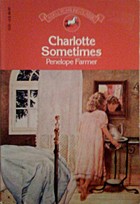
When Charlotte goes away to boarding school for the first time, she’s very excited to get the bed with the particularly pretty wheels right next to the window. When she wakes up, though, the view from the window looks different, and people are calling her Clare! She discovers she’s traveled back in time to the same bed in the same boarding school, but during World War I. The next morning, though, she wakes up in the present again as Charlotte. This pattern continues, meaning both she and Clare are Charlotte….sometimes.
Review:
I picked this book up because I have an affinity for both boarding school books and time-travel books. This looked like the best of both worlds to me. A fun middle grade book that introduces to the reader to two different past time periods–the late 1960s of Charlotte’s present and the nineteen-teens of Clare’s present.
This book is the third in a series, but it is completely possible to read it as a standalone. No mention is made of the events in the first book, and the second book is actually about what Charlotte’s little sister does while she’s away at boarding school.
The concept is intriguing, because instead of time-travel happening once and landing the person stuck in the past (or future), Charlotte keeps switching, spending every other day in the 60s and every other day in the teens. (I get a migraine when the barometric pressure changes….I can only imagine how I’d feel if I time travelled! Do you think I could bring my green lamp therapy with me?)
In addition to the usual issues time-travel books bring up, such as what stays the same and what is actually different throughout time, it also brings up the key question of identity. What makes Charlotte Charlotte? Is she still Charlotte when she’s being called Clare? Why does hardly anyone notice that Clare has changed? Or Charlotte for that matter? The book thus addresses identity issues that middle grade readers might be going through, but in a subtle way through the time-travel trope.
Were you some particular person only because people recognized you as that? (page 66)
The time-travel itself is left as a fantastical mystery, rather than being given a scientific explanation. There’s something magical about the bed that only makes Charlotte and Clare switch places, but no one else. This works without an explanation because the young girls being subjected to the time-travel just accept it without explanation. This is their reality, and it doesn’t matter why it’s happening, they just have to deal with it. Some readers, though, might struggle with the fact that the time-travel itself is never explained.
The one thing that disappointed me about the book, and that I think would have made it a classic and a five star read, is that the book only explores what happens to Charlotte when the girls switch places. Clare, her experiences, and her perspective are only heard about through third parties. The book, while in third person, is entirely Charlotte’s perspective. Clare, a reserved, proper girl from the nineteen-teens must have been shocked by both the technology and the mores of the 1960s she suddenly found herself in. So much more could have been explored by telling both Charlotte’s and Clare’s story. The book misses an opportunity by only focusing on the modern day girl going back in time. The girl being thrust into the future, a future where she finds out Britain wins the war, and there is suddenly no food rationing or flu epidemic, that is such a cool story in and of itself, and Farmer just never ventures out to tell it.
Interestingly, the British band The Cure released a song called “Charlotte Sometimes” that they admitted was pulled directly from this book. Not just the title, but song lyrics are pulled from the first couple of lines of the book. Even the music video features scenes from the book. It seems to be quite a mystery who the actress was who played Charlotte in the video. She wasn’t credited, and there’s a lot of posts on the internet with people speculating about who she might be. In any case, Penelope Farmer was…not amused by the whole thing. But back to the book.
Overall, this is a book that sets up a fantastical world of time-travel within a boarding school. It utilizes the switching of two girls with each other in time to explore questions of identity in a way that surely will appeal to many middle grade readers. The book does not fully explore the story the way it possibly should have, but the young reader will probably enjoy filling in those gaps themselves. Recommended to all fans of boarding school, time-travel, or historic fiction set during World War I’s homefront.
If you found this review helpful, please consider tipping me on ko-fi, checking out my digital items available in my ko-fi shop, buying one of my publications, or using one of my referral/coupon codes. Thank you for your support!
4 out of 5 stars
Length: 174 pages – average but on the shorter side
Source: Better World Books

Previous Books In Series:
The Summer Birds
Emma in Winter


Edit note: Thanks to Vicky for pointing out it was published in 1969.
Book Review: The Golden Torc by Julian May (Series, #2)
 Summary:
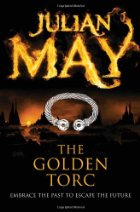
The group of people who traveled from the future to the Pliocene past for a willful exile were split into two by the alien race, the Tanu, who, surprisingly, inhabits Earth. Half were sent to slave labor, while the others were deemed talented at mind powers, given necklace-like torcs to enhance those powers, and sent to the capital city of Muriah. In the first book, we followed the daring escape of the group sent into slavery. They then discovered that the Tanu share the Earth with the Firvulag–an alien race from their home planet that has many similarities to their own. They also organized an attack on the industrial city of Finiah. This book at first follows the adventures of the other group, the one sent to the capital city of Muriah. Through them we discover the inner workings of the Tanu, the intersections of humans and aliens, and the impact of the human/Firvulag attack on Finiah. When the time for the Great Combat between the Tanu/human subjects and the Firvulag arrives, the survivors of the escaped slave group end up coming back into contact with the group of humans in Muriah. With dire consequences.
Review:
I really enjoyed the first book in this series, finding it to be a delightful mash-up of scifi and fantasy. When I discovered my library had the next book in the series, I picked it up as quickly as possible. This entry feels more fantastical than the first, although science definitely still factors in. It is richer in action and intrigue and perhaps a bit less focused on character development.
This is a difficult book to sum up, since so very much happens. It’s an action-packed chunkster, providing the reader with information and new settings without ever feeling like an info-dump. The medieval-like flare of the Tanu and the goblin/fairie/shapeshifter qualities of the Firvulag are stronger in this entry, and it is delightful. Creating a medieval world of aliens on ancient Earth is probably the most brilliant part of the book, followed closely by the idea of torcs enhancing the brain’s abilities. May has created and weaved a complex, fascinating world that manages to also be easy enough to follow and understand. The sense of the medieval-style court is strong from the clothing, buildings, and organization of society. She doesn’t feel the need to willy-nilly invent lots of new words, which I really appreciated.
The intrigue is so complex that it is almost impossible to summarize, and yet it was easy to follow while reading it. Surprises lurk around every corner, and May is definitely not afraid to kill her darlings, following both William Faulkner’s and Stephen King’s writing advice. A lot happens in the book, the characters are tested, and enough change happens that I am excited there are still two more books, as opposed to wondering how the author could possibly tell more story. In spite of the action, sometimes the book did feel overly long, with long descriptions of vegetation and scenery far away from where most of the action was taking place.
The book is full of characters but every single one of them manages to come across as a unique person, even the ones who are not on-screen long enough to be fully three-dimensional. The cast continues to be diverse, similarly to the first book, with a variety of races, ages, and sexual preferences represented. I was surprised by the addition of a transwoman character. She is treated with a mix of acceptance and transphobia. I think, certainly for the 1980s when this was published, it is overall a progressive presentation of her. She is a doctor who is well-respected in Tanu society. However, she also is presented as a bit crazy (not because of being trans but in addition to being trans), and it is stated by one character that she runs the fertility clinic because it is the one part of being a woman that will always be out of her grasp. I am glad at her inclusion in the story but readers should be aware that some aspects of the writing of her and how other characters interact with her could be considered problematic or triggering. I would be interested to hear a transperson’s analysis of her character.
Overall, this entry in the series ramps up the action and more thoroughly investigates the world of the Pliocene Exile. Readers disappointed by the lack of information on the half of the group heading to the capital city in the first book will be pleased that their story is told in this one. Characters are added, including a transwoman doctor, and all continue to feel completely individual and easily decipherable, in spite of the growing cast list. The fast action pace sometimes is interrupted by lengthy descriptions of settings far away from the action, but overall the chunkster of the book moves along at a good pace and remains engaging. Recommended to fans of fantasy who want a touch of science in their stories and who are interested in the idea of medieval aliens.
4 out of 5 stars
Source: Library

Previous Books in Series:
The Many-Colored Land
 Support my work with a tip or browse my shop for curated book club guides, how to guides, cross-stitch patterns, and more!


This work by Amanda Nevius is licensed under a Creative Commons Attribution-Noncommercial-No Derivative Works 3.0 United States License.
 Opinions of a Wolf