
Archive
Book Review: Soul Surfer: A True Story of Faith, Family, and Fighting to Get Back on the Board by Bethany Hamilton
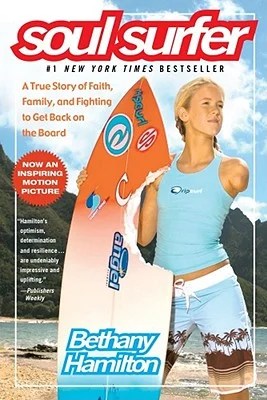
A powerful disability memoir about faith, resilience, and healing after a shark attack.
Summary:
They say Bethany Hamilton has saltwater in her veins. How else could one explain the passion that drives her to surf? How else could one explain that nothing—not even the loss of her arm—could come between her and the waves? That Halloween morning in Kauai, Hawaii, Bethany responded to the shark’s stealth attack with the calm of a girl with God on her side. Pushing pain and panic aside, she began to paddle with one arm, focusing on a single thought: “Get to the beach….” And when the first thing Bethany wanted to know after surgery was “When can I surf again?” it became clear that her spirit and determination were part of a greater story—a tale of courage and faith that this soft-spoken girl would come to share with the world.
Soul Surfer is a moving account of Bethany’s life as a young surfer, her recovery after the attack, the adjustments she’s made to her unique surfing style, her unprecedented bid for a top showing in the World Surfing Championships, and, most fundamentally, her belief in God. It is a story of girl power and spiritual grit that shows the body is no more essential to surfing—perhaps even less so—than the soul.
Review:
In many of the circles I’m in, “recovery” means recovery from addiction. But it can also mean recovery from trauma—and for many of us (studies suggest around 75%), those things are intertwined. That’s part of why memoirs about recovering from trauma resonate so deeply with me. I’m especially drawn to the ones that focus not on the traumatic event itself, but on the response to it—the healing, the resilience, the rebuilding. This is that kind of memoir.
I remember when the news broke in 2003: a teenage surfer in Hawaii had lost her arm to a shark attack. I was in high school myself, and even though I lived in Vermont (far from any waves), I immediately felt heartbroken for her, losing not just a limb, but the ability to pursue something she loved. Years later, when I learned Bethany was not only surfing again but competing professionally, I was stunned—and moved.
Bethany knows that readers will come to her story expecting to read about the shark attack, and she doesn’t shy away from it. But she also doesn’t sensationalize it. It’s described early in the book with striking clarity and calm. There’s no melodrama—just presence, perspective, and truth. It’s a credit to both her and her editorial team that this tone is preserved. Her calm focus in the water (“Get to the beach…”) is echoed in how she writes.
What carries Bethany through, more than anything, is her deep faith. She was a girl of faith before the attack, during recovery, and continues to lean on her faith throughout her life. Her story isn’t preachy, but it is grounded in that spiritual strength. Her family, too—supportive parents and brothers—play a major role, along with a strong friend group that surrounds her in the aftermath.
One of my favorite moments in the book is her description of working with a blind therapist during her recovery. That peer connection—being guided by someone who also lives with a disability—felt powerful and familiar. Coming from the world of recovery, I saw that moment as a type of peer support. Rather than being told how to heal by someone without shared experience, Bethany was supported by someone who understood. It’s a powerful reminder of why peer-based healing matters.
Bethany also takes care to honor Hawaiian culture. As a white surfer growing up in Hawaii, she shares what she’s learned about the Indigenous roots of surfing, respectfully credits Hawaiian words and traditions, and speaks with admiration about her Hawaiian coach. This kind of cultural awareness—especially in faith-based memoirs—is both rare and welcome.
Later in the memoir, she explores what it was like to become famous almost overnight. From media appearances to a Hollywood movie adaptation, Bethany shares the highs and lows with honesty—including awkward encounters with strangers and challenging public questions.
I listened to the audiobook, which includes a charming guitar riff at the end of each chapter—a small touch that added to the overall tone and kept me engaged.
Overall, this is an uplifting, engaging memoir of trauma, recovery, and spiritual grit. It doesn’t just tell the story of a shark attack. It tells how we can recover. If you’re interested in memoirs, faith-based stories of resilience, or narratives about disability and healing, this one’s worth the read.
If you found this review helpful, please consider tipping me on ko-fi, checking out my digital items in my ko-fi shop, buying one of my publications, using one of my referral or coupon codes, signing up for my free microfiction monthly newsletter, or tuning into my podcast. Thank you for your support!
4 out of 5 stars
Length: 222 pages – average but on the shorter side
Source: Library
Buy It (Amazon or Bookshop.org)
Book Review: Jaws by Peter Benchley
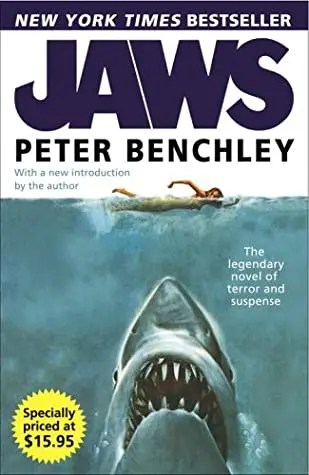
Get ready for shark week with this 1970s classic!
Summary:
A great white shark starts terrorizing a coastal town just as the money-making summer season begins. The classic, blockbuster thriller of man-eating terror that inspired the Steven Spielberg movie and made millions of beachgoers afraid to go into the water. Experience the thrill of helpless horror again—or for the first time!
Review:
As a New England girl born and raised, I can’t tell you how many times I’ve watched Jaws the movie. Everything about it is just so *chef’s kiss* perfectly small New England beach town. (The movie is set on Long Island, New York, but was filmed on Martha’s Vineyard, Massachusetts, and, let me tell you, everything about it reads New England to me.) Plus, my cat absolutely adores watching Jaws. She’s obsessed with that shark. With summer rolling around once again, I decided it was high time I read the book. The book is almost always better than the movie, right? Well, in this case, that almost really comes into play. (Spoilers ahead for both the movie and the book. If you haven’t seen this classic yet, please go watch it then come back to the book review.)
The book starts off strong with a close omniscient perspective of the shark getting ready to eat the drunk lady swimming in the ocean. The book could easily sway into anthropomorphizing territory, imagining the viciousness of the shark. But it consistently describes a creature whose instinct is to feed. What, exactly, made it come in to Amity and stick around is a mystery that is never solved. This first scene is one of the strongest in the book. But I have to admit I was hearing the absolutely classic movie soundtrack in my head while I was reading it, and we all know how essential that is at building suspense. So I’m not sure it’s safe to say I felt engaged purely because of the book.
But it didn’t take too long for the book to showcase itself as…worse than the movie. When we meet Sheriff Brody, he mentions a problem they had the previous summer where a Black gardener sexually assaulted six white women, none of whom would press charges. The only point of this from a narrative perspective is to demonstrate how the police department will keep things under wraps in order to protect the summer season. But it’s a hatefully racist way to establish this, narratively. Even if I charitably imagine that this is supposed to be pointing out the racial divide in Amity that is later even clearer in the book, there are better ways to do that than to play into this horribly racist myth of the serial Black assaulter of white women.
There are two other plot points in the book that weren’t in the movie at all. First, there’s that Brody’s wife cheats on him with Hooper because she feels some weird Feminine Mystique style ennui about her life as a housewife at a lower social class than she was before she got married. (We only see the sex in flashbacks she has about it and how strange and scary Hooper was). There is a large scene where she has lunch with Hooper first and talks about her sexual fantasies. Kind of slows down the pace of the suspense from the shark attacks.
The other additional plot point is that the mayor of the town is mixed up with the mafia because he had to take out a loan from a loan shark (har har) to pay his wife’s cancer treatment medical bills. (What on earth do other countries with nationalized health care do to justify characters taking out unwise loans? This is such a common plot device…but I digress.) The mafia wants the beaches to be kept open. This is a big motivator for why the mayor keeps insisting on it. But I don’t think this motivator is necessary. The economic pressure and need of a tourist town to keep their main tourist attraction open is more than enough motivation. Anyone who has any familiarity with a town that depends on seasonal tourism gets that. Spielberg was right to cut this from the movie. This also brings about a scene I found much more disturbing than any shark attack, which is that the mafia kills Brody’s son’s cat in front of his son, and then Brody takes the dead cat and throws it in the mayor’s face.
The final act where Quint, the old-time fisherman, takes Brody and Hooper out on his boat to hunt the shark is overall pretty good. There’s some nice tension between the three of them, and Quint really has to eat his words about the shark not being intelligent. It does not end with the 70s style bang of the movie. But I kind of liked the simplicity of the ending, leaving Brody to swim to shore and deal with the aftermath on his own without any reader audience.
I’ve seen some lists of the differences between the book and the movie with mistakes and inaccuracies on them, so I do want to clear up a couple of things. Brody is afraid of the water in the book. This is well-established; I’m not sure how people missed that. Mrs. Kintner does slap Brody in the book when she confronts him about the shark killing her son.
The version of the book I read also had an introduction by the author where we find out that he was, basically, a “summer person” himself – from a wealthy family and a legacy graduate of Harvard (his father also went to Harvard). His father was a novelist, and because of that connection, Benchley got an agent before he even had a book written. By Benchley’s own recollection, he sold the idea for Jaws and then they told him he needed to write the book, and the screenplay was sold before the book was even written. He took a first shot at the script, and Spielberg told him to throw out a lot of the stuff that I mentioned in my review as things I didn’t like. Moral of the story being privileged dude sold an admittedly solid idea based on the idea alone to someone else who directed it into it being a classic.
Overall, it was interesting to read the book behind the movie, but I also now have the perfect answer for the next time someone asks me, “When is the movie ever better than the book?”
If you found this review helpful, please consider tipping me on ko-fi, checking out my digital items available in my ko-fi shop, buying one of my publications, or using one of my referral/coupon codes. Thank you for your support!
3 out of 5 stars
Length: 320 pages – average but on the longer side
Source: Library
Buy It (Amazon or Bookshop.org)
Get the Book Club Discussion Guide
A beautifully graphic designed 2 page PDF that contains: 1 icebreaker, 9 discussion questions arranged from least to most challenging, 1 wrap-up question, and 3 read-a-like book suggestions
View a list of all my Book Club Guides.
 Support my work with a tip or browse my shop for curated book club guides, how to guides, cross-stitch patterns, and more!


This work by Amanda Nevius is licensed under a Creative Commons Attribution-Noncommercial-No Derivative Works 3.0 United States License.
 Opinions of a Wolf