
Archive
2011’s 5 Star Reads!
My one regret last year when summing up my year in reading was that the 5 star reads didn’t get enough attention. So! They are getting their own post this time. Please note that if the 5 star went to a book in a graphic novel series, I am just listing the whole series. If it’s a non-graphic series, then the individual book is listed with a note about what series it is in. With no further ado, presenting Opinions of a Wolf’s 5 Star Reads for 2011!
 The Book of Night Women
By: Marlon James
Publication Date: 2009
Publisher: Riverhead
Genre: Historical Fiction
Themes: slavery, Jamaica, resistance, evil of capitalism
Summary:
This is the story of Lilith. A mulatto with green eyes born on a plantation in Jamaica to a mama who was raped at 14 by the overseer as punishment to her brother. Raised by a whore and a crazy man, all Lilith has ever wanted was to improve her status on the plantation. And maybe to understand why her green eyes seem to freak out slave and master alike. Assigned to be a house slave, Lilith finds herself in direct contact with the most powerful slave on the plantation–Homer, who is in charge of the household. Homer brings her into a secret meeting of the night women in a cave on the grounds and attempts to bring Lilith into a rebellion plot, insisting upon the darkness innate in Lilith’s soul. But Lilith isn’t really sure what exactly will get her what she truly wants–to feel safe and be with the man she cares for.
Current Thoughts:
If someone asked me for a book that truly makes the reader feel the desperation of being trapped in an evil system with no escape, this is the book I would hand them.

 The Call of the Wild
By: Jack London
Publication Date: 1903
Publisher: CreateSpace
Genre: Historical Fiction, Animal Perspective
Themes: animal rights, human/animal relationships, the nature of nature, Alaska, Canada, evil of capitalism
Summary:
Buck is a spoiled southern dog enjoying a posh life when one of the family’s servants steals him and sells him away to be a sled dog for the Alaska gold rush. Buck soon goes from an easy life to one of trials and tribulations as the result of humans fawning over a golden metal, but it might not be all bad for him in the wild Alaskan north.
Current Thoughts:
I listened to this on audiobook. I generally do this while cooking or cleaning my apartment. I distinctly remember being in the middle of washing my dishes, stopping, and going to lay down on my bed and cry. No one could read this book and doubt that animals have their own inner lives and emotions. It so powerfully depicts both that and the possible bond between animals and people. Everything I have always felt between myself and the animals I love is so perfectly depicted here.

 The Group
By: Mary McCarthy
Publication Date: 1954
Publisher: Harvest Books
Genre: Historical Fiction
Themes: women’s rights, GLBTQ, women’s colleges, relationships, NYC
Summary:
A collection of women graduate from Vassar in the 1930s. Their friendship is known collectively as “The Group,” and their distinctive Vassar education has given them a distinctly liberal view on the world. How this changes with time as they repeatedly encounter societal expectations and relationship problems are told through a series of vignettes that focus in on moments in their lives over the seven years after graduation.
Current Thoughts:
This book addresses women’s issues in the 1930s and 1940s that are, honestly, too frequently too often issues today as well, through a series of vignettes that pop into the various women’s lives at different points in time. This unique way of telling their stories is what makes this book such a powerful read.

 Hetalia: Axis Powers
By: Hidekaz Himaruya
Publication Date: 2008
Publisher: TokyoPop
Genre: Graphic Novel–Historical Fiction
Themes: international relations, world history
Summary:
The nations involved in WWII and the events leading up to it are personified as over-the-top manga characters and through manga-style scenarios the historic events leading up to WWII are explored. The future of the nations after WWII is also explored. For example: Russia’s dilemmas with his sisters the Ukraine and Belarus, Canada’s persistent ability to somehow be invisible to most of the rest of the G8 nations (and also to be mistaken for America), and Japan-kun and America-kun visiting each other’s homes and attempting to reach a cultural understanding.
Current Thoughts:
I actually squee when I see the manga version of America online. I heart him so much. I heart the whole series so much. This series is the reason I got distraught when TokyoPop went out of business. Read it. Even if you aren’t a history person. It is hilarious!

 Hunger
By: Jackie Morse Kessler
Publication Date: 2010
Publisher: Harcourt Graphia
Genre: YA–Fantasy
Themes: anorexia, bulimia, mental illness, winning inner battles, suicide
Summary:
Lisabeth Lewis thought it was just a nightmare. Death coming to her when she tried to commit suicide with her mom’s antidepressants and offering to make her Famine–one of the four horsemen of the apocalypse–instead of letting her die. It’s just all way too ironic, her as Famine. After all, she’s fat. She has to watch what she eats very carefully. The Thin voice tells her all the time exactly how many calories each bit of food is and how much exercise it’ll take to burn it off. Yes. Lisabeth Lewis is fat. So why would Death assign Famine to her anyway?
Current Thoughts:
I still love how Kessler depicts the inner battles that go on in mental illness via the fantastical appearance of Death and the Riders of the Apocalypse. It makes it more relatable and understandable for teens struggling with those issues.
 I Am Hutterite
By: Mary-Ann Kirkby
Publication Date: 2007
Publisher: Polka Dot Press
Genre: Nonfiction–Memoir
Themes: role of religion in family life, understanding your past, communal living, Canada
Summary:
Mary Ann Kirkby recounts her unique childhood in her memoir. She was born into a Hutterite family. The Hutterites are a religious sect similar to the Amish only they believe that living communally is a mandate for Christians. Mary Ann recounts her childhood both in the religious sect (her particular group was located in western Canada), as well as the journey and culture shock she went through when her parents left the Hutterites when she was nine years old.
Current Thoughts:
This is the most unique memoir I read all year, and I read a lot of them. Not only is the Hutterite lifestyle and community fascinating, but Kirkby also pulled off the rare feat of speaking about her childhood and difficult times in her life without ever once coming across as bitter.

 It
It
By: Stephen King
Publication Date: 1986
Publisher: Signet
Genre: Horror
Themes: growing up, growing old, phases of life, Maine
Summary:
In the late 1950s in the small town of Derry, Maine, children are being mysteriously murdered. Seven misfit and outcast kids band together to face It, and they think they’ve beaten it, but 27 years later, the murders return. Vaguely remembering a promise they all made, the now adults return to their hometown of Derry to face It again.
Current Thoughts:
If someone asked me why I love pulp, what makes a horror writer like King so popular, I’d talk about this book. King eloquently addresses something everyone goes through–being a kid, growing up, growing old–without the reader even really realizing it until the book is done and wraps it up in spine-chilling horror. You relate and learn and your true fears are acquiesced all while being entertained.

 The Jungle
By: Upton Sinclair
Publication Date: 1906
Publisher: Simon & Brown
Genre: American Classic
Themes: socialism, worker’s rights, animal rights, evil of capitalism, Chicago, social justice, vegetarianism, debt slavery
Summary:
In the early 1900s Jurgis and his soon-to-be family by marriage decide to immigrate to the US from Lithuania. Having heard from an old friend that Chicago’s Packingtown is where a working man can easily make his way in the world, this is where they head. Soon the family find themselves deep in the horror that is the regulated in name only meat packing plants. Dominated by a society that circulates entirely around greed and wealth for the few at the expense of the many, the family and individuals within it slowly fall apart. But is there a light at the end of the tunnel?
Current Thoughts:
It still baffles me that when this book came out all anyone could talk about was food safety. I believe Sinclair did a great job demonstrating the plight of the blue collar worker, as well as the horrors of animal slaughter. This is a classic that deserves that label.

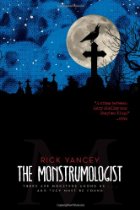 The Monstrumologist
By: Rick Yancey
Publication Date: 2009
Publisher: Simon & Schuster
Genre: Horror
Themes: New England, the nature of evil, relationships
Summary:
A New England town’s oldest resident dies leaving no known surviving family. His journals end up at the university where a professor loans them to a writer friend. In the first three folios, we learn of young Will Henry whose father and mother died in a terrible house fire leaving him to the care of his father’s employer–Warthrop. Warthrop is a monstrumologist. He studies monsters, and people arrive in the middle of the night for his help. One night a grave robber arrives with the body of a young girl wrapped in the horrifying embrace of an anthropophagus–a creature with no head and a mouth full of shark-like teeth in the middle of his chest. Will Henry, as the assistant apprentice monstrumologist, soon finds himself sucked into the secret horror found in his hometown.
Current Thoughts:
I still can’t get the damn image of the anthropophagus out of my head. Also the characters of Will and Warthrop will forever live on in my head. New England horror done exquisitely.
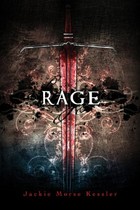 Rage
Rage
By: Jackie Morse Kessler
Publication Date: 2011
Publisher: Harcourt Graphia
Genre: YA–Fantasy
Themes: mental illness, self-injury, bullying
Summary:
Melissa Miller is your typical 16 year old–mom, dad, annoying sister, a jerk of an ex-boyfriend–with one small difference. She deals with her emotions by cutting herself. She keeps a razor in a locked box in her closet and pulls it out when she gets overwhelmed. One night she accidentally cuts too deep, and Death shows up with an option. Either die now or become one of the Horsemen of the Apocalypse–War. Missy chooses the latter option, and as she gets to know the other Horsemen and her job as War, she starts to realize she needs to face the rage inside her.
Current Thoughts:
I periodically find myself thinking back on the climactic scene of this book, which in a fantastical manner depicts a self-injurer facing the anger inside herself. If someone needs to understanding self-injury and doesn’t want to read the academic work on the topic, this is the book I would hand them.
 Touched by an Alien
By: Gini Koch
Publication Date: 2010
Publisher: Daw Books
Genre: Paranormal Romance
Themes: aliens, FBI, intrigue, Arizona, action, sex
Summary:
Katherine “Kitty” Katt manages to get released early from a dull day of jury duty only to find herself confronted with an angry man who sprouts wings and starts flinging knives from their tips toward everyone in the vicinity. Kitty attacks and stops him and quickly finds herself sucked into a world she was unaware existed. A world of alien refugees defending Earth and themselves from a bunch of fugly alien parasites. She soon discovers her ordinary parents are more involved in this secret world than she would ever have dreamed. On top of that, she’s increasingly finding herself falling for one of the alien hunks who announced his intentions to marry her almost immediately upon meeting her.
Current Thoughts:
Aliens in suits? Check. Some lines and scenes pop into my head at odd times and make me laugh? Check. Favorite paranormal romance series to date? Triple-check.
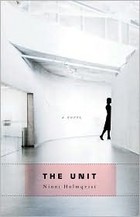 The Unit
By: Ninni Holmqvist
Publication Date: 2006
Publisher: Other Press
Genre: Scifi–Dystopian
Themes: old age, socialism, Sweden, medical research
Summary:
In the Sweden of the near future women who reach the age of 50 and men who reach the age of 60 without having successfully acquired a partner or had children are deemed “dispensable” and sent to live in “a unit.” These units appear at first glance to be like a high-class retirement home, and indeed they have all the amenities. The residents, however, are required both to participate in medical experiments and to donate various organs and body parts up until their “final donation” of their heart anywhere from a year or a few years after their arrival in the unit. Dorrit arrives at the unit depressed, but accepting of her fate as the result of her independent nature, but when she falls in love, she starts to question everything.
Current Thoughts:
This is a book that I literally cannot stop thinking about. It left me with no clear answers, but tons of questions. I also think of Dorrit and her friends every time I have a steam after working out, just like them.

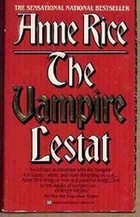 The Vampire Lestat
By: Anne Rice
Publication Date: 1985
Publisher: Ballantine Books
Genre: Fantasy–Vampires
Themes: resiliency, searching for love, European history, Egypt, rock stars, New Orleans
Summary:
Lestat, the maker of Louis and Claudia, takes center stage here to tell his own origin story, as well as explain why he has chosen to come out as a vampire rock star in the 1980s. Starting with his beginnings as a rural member of the ruling class prior to the French Revolution, we discover the origins of the Vampire Theater, as well as the origins of vampires themselves.
Current Thoughts:
I just really love Lestat. You can vamp me and carry me around forever with you, dude.
 The Walking Dead
By: Robert Kirkman
Publication Date: 2010
Publisher: Image Comics
Genre: Graphic Novel–Horror
Themes: creation of a new society, living in fear, unjust wars, truthiness, self-protection, zombies, Georgia, survival
Summary:
When cop Rick wakes up from a coma brought on by a gun shot wound, he discovers a post-apocalyptic mess and zombies everywhere. He sets off for Atlanta in search of his wife, Lori, and son, Carl, and soon teams up with a rag-tag group of survivors camped just outside of Atlanta.
Current Thoughts:
I’m still working my way through this series, but it just progressively gets better and better. Although the beginning is cliche, it does not take Kirkman long to become unique, surprising, and thought-provoking.

 Whitewash: The Disturbing Truth About Cow’s Milk and Your Health
By: Joseph Keon
Publication Date: 2010
Publisher: New Society Publishers
Genre: Nonfiction–Science and Health
Themes: health, Standard American Diet, animal rights, veganism, cancer, heart disease
Summary:
Joseph Keon seeks to combat the cultural myth of dairy being a necessary part of a healthy diet perpetuated by the milk moustache ads with his book citing multiple scientific studies that have been swept under the rug by those being paid by the dairy lobbyists. Although Keon cares about animal welfare as well (and there is a chapter on the suffering of dairy cows), the book predominantly focuses on debunking multiple myths surrounding human consumption of dairy: the overly-hyped “need” for calcium, that dairy is good for children, and the idea that dairy prevents disease. Keon additionally alarmingly shows the various chemical, virus, and bacteria contaminants commonly found in dairy. Citing multiple scientific studies, he unequivocally demonstrates that contrary to what the dairy industry and government want you to think, dairy is actually bad for your health.
Current Thoughts:
Oh god, how am I still eating dairy after reading all of these facts? I am going to get cancer…..gah! Damn you, cheese. Damn you.

 Wild Swans: Three Daughters of China
By: Jung Chang
Publication Date: 1991
Publisher: Touchstone
Genre: Nonfiction–Memoir
Themes: Chinese history, women’s rights, China, communism, revolutions, concubines, foot-binding
Summary:
In this memoir, Jung Chang recounts the lives of herself, her mother, and her grandmother growing up in pre-communist, revolutionary, and communist China. Mixing extensive historical facts with intensely personal remembrances, Jung Chang presents a vivid portrait of real life in China.
Current Thoughts:
This is the book that jump-started my interest in China and learning Chinese history. It is a stunning memoir that covers three generations during the time period that made modern China.

 Y: The Last Man
By: Brian K. Vaughan
Publication Date: 2003
Publisher: Vertigo
Genre: Graphic Novel–Scifi–Post-apocalyptic
Themes: gender, gender norms, organization of society, Boston, United States, Israel, coming of age
Summary:
The world is changed overnight when all the men and boys in the world mysteriously drop dead. Factions quickly develop among the women between those who want the world to remain all female and those who would like to restore the former gender balance. One man is mysteriously left alive though–Yorick. A 20-something, underachieving magician with a girlfriend in Australia. He desperately wants to find her, but the US government and the man-hating Amazons have other ideas.
Current Thoughts:
Another series that I am currently in the middle of. It is also steadily improving from the first volume. It is colorfully illustrated, consistently funny, and thought-provoking.

Book Review: Horns by Joe Hill
 Summary:
Ig Perrish and Merrin Williams were the perfect couple. Their love was the love that everyone wants but very few people get. But one horrible night Merrin is raped and murdered, and Ig is the prime suspect. They’d just had a lover’s quarrel. Ig was never found guilty, but he was never cleared either. Now a year later Ig wakes up to discover horns coming out of the top of his head. Horns that make everyone who sees them tell him their deepest and darkest desires and secrets.
Review:
For those who don’t know, Joe Hill is Stephen King’s son (writing under a pen name, but everyone knows who he is at this point, so I’m not sure what’s up with the pen name still). It is clear Hill wants his work to be considered on its own merit with no connections to his father, but as a King fan, I couldn’t help but compare a wee bit as I read. I will say this, Hill’s writing is strong. This is not the case of a celebrity’s kid with mediocre talent making it. Hill is definitely talented, and I am interested to see how his writing continues to grow and change. That said; this book didn’t quite work for me.
Hill’s writing on the sentence level is gorgeous. He evokes true New Hampshire small town life in exquisite detail and sensuousness. Every page was a pleasure to read. The story overall, though, started out strong and ended weak. It went from a suspense with delicious twists and turns and a supernatural element to a mushy love story and love lasting and staying together after death yadda yadda. I can take mushiness periodically, but it felt jarring within the context of this book. This was originally a book about revenge and righting a wrong. Then the ending came along and felt like….well, like something Nicholas Sparks would write if he was high on crack.
The characterization of Ig, Terry (his brother), and Lee (his best friend) is strong. These men are three-dimensional and flawed. They are real. Merrin is another story. She seems like an enigma that is impossible to understand. Is she sweet and innocent or a bit cruel? It feels impossible to get a read on her. I’m sure that was part of the point. Every man in the story had their own vision of who Merrin is, but Merrin is never granted her own agency and personality by these same men. Although it seems that this was the point, as a woman, I felt a bit let-down by the lack of insight into Merrin. I kept hoping for something, but nothing came along. Interestingly, I found the minor female character of Glenna to be much more well-rounded and real than Merrin. Again, maybe that was the point, but it didn’t really work for me.
It’s hard to categorize this book. It’s definitely not the horror book I was imagining. I’d call it literary paranormal suspense. It’s a classic tragedy wrapped in mystery and the paranormal. It didn’t work for me, because, well, classic love tragedies tend not to. However, I could see some people loving it. Perhaps people who loved The Notebook and paranormal romance equally well.
3 out of 5 stars
Source: PaperBackSwap

Counts For:

Book Review: Thinner by Stephen King
 Summary:
Billy Halleck is an overweight, high-powered lawyer in a wealthy Connecticut town. He’s getting a bit irritated at his wife and a bit frustrated with his weight, but he loves his teenage daughter. One day, a band of gypsies come to town, and Billy accidentally runs one of them down with his car, killing her. His law firm and the cops, naturally, get him out of the manslaughter charge, but nobody can protect him from the lead gypsy’s curse, uttered while stroking one finger down his cheek, “Thinner.” Now he’s dropping weight no matter how much he eats, and he must race against the clock in an attempt to save himself.
Review:
A book about gypsy curses could easily slide into racist territory, but in fact Thinner actually criticizes the treatment the gypsies have received in the United States over the years, in spite of them not always being the most sympathetic characters in the book. They may be a bit non-mainstream and overly quick to exact their own vengeance, but Billy Halleck and his cronies are a much more frightening type of bad. They’re the bad that comes from too much money and power. The bad that comes from being so self-centered and over-indulgent that you’ve stopped noticing the rest of the world exists.
So, the social commentary is good and not offensive, what about the horror and thrills? That is, after all, what one reads a King novel for. The grotesqueness definitely builds gradually over time, making this much more of a thriller than a horror. At first Billy’s weight loss is welcomed. He was, after all, overweight before. Gradually, though he starts to freak out about how much weight he’s consistently losing in spite of eating as much as he possibly can. He starts to investigate and discovers two others with their own unique and, frankly, much more frightening curses. Although the beginning may feel a bit slow, that is exactly as it should be. Billy goes from normal life to life under a curse to racing against the clock to save his own life. The horror builds perfectly.
That said, this still doesn’t quite read as sophisticated as some of King’s later work. It does almost seem like a bit too obvious an allegory. A bit too obvious a statement being made. In spite of the story providing chills, it’s not quite terrifying or mind-blowing. It’s a fun read, but it’s no Dark Tower.
Overall this thriller provides chills, horror, and a good social commentary. I recommend it to fans of horror and thrillers alike, although slightly more to fans of thrillers.
4 out of 5 stars
Source: Harvard Book Store

Book Review: It by Stephen King

Summary:
In the late 1950s in the small town of Derry, Maine, children are being mysteriously murdered. Seven misfit and outcast kids band together to face It, and they think they’ve beaten it, but 27 years later, the murders return. Vaguely remembering a promise they all made, the now adults return to their hometown of Derry to face It again.
Review:
This tale is largely known in the States as “that scary clown story,” so for years I avoided it. I’ve been terrified of clowns for as long as I can remember. My parents tell me that the first time I ever saw one, I screamed uncontrollably. My only encounter with Stephen King’s It (as it’s known in the States) was with a diorama of the clown from the movie in a haunted house I went through in Salem, MA. It scared the crap out of me, so I was a bit nervous to read this book. However, having read the Dark Tower series, I wanted to read all of the other stories that King lists as taking place in the same general universe, and It was one of them. So I manned up and read it, and boy am I ever glad I did.
This is not a cheesy scary clown story. What it is is first a character study and second a commentary on growing up. The dual horror of being a kid and being excited and afraid to grow up and being an adult and being excited and concerned that you are grown up and may have lost a part of yourself in childhood. King very clearly demonstrates that being a kid isn’t all fun and games–most of the kids in the group of 7 have bad home lives–but there is an essential hope that children have that is hard to reclaim as an adult. A child is able to have a horrible experience with a shape-shifting werewolf or a bunch of bullies and then walk a couple of blocks and forget about it and be excited to see American Bandstand that night. Children are incredibly resilient, and King demonstrates that.
What makes the story though is the return to Derry 27 years later. King puts a hope in adults that although they may not remember exactly what it is to be a resilient child, they can still repossess that power in later life. Although the first inclination of kids to survive is to forget the bad, an adult can remember and still survive. For at the beginning, the characters don’t want to remember what happened to them as kids.
Did he remember? Just enough not to want to remember any more. (Location 1416)
Yet the characters are brave and face their childhoods. Yes, King personifies both the childhood evils and the remembering of them as an adult with It, but that’s part of what makes the story powerful. There’s a reason people refer to memories as personal demons. That’s how they feel. In the end, the way the characters grow and change and overcome is to find
A way to be people that had nothing to do with their parents’ fears, hopes, constant demands. (Location5631)
Beyond the excellent symbolism and allegory for the experience of surviving bad things in your childhood and facing them again as an adult, the horror itself is wonderful. It comes at just the right frequency so that the reader settles into a sense of security only to be blind-sided by a terrifically horrifying experience. There were sections that literally had me jumping at the sound of my own phone ringing in the silence. These are some of the better passages of creepy horror that I’ve read written by King.
Of course, the allusions to the universe of the Gunslinger are there. It gave me chills to recognize them as I read. Among just a few were the turtle, spiders, and other worlds than these. One particular line that gave me chills of recognition that other fans of the Dark Tower series will be sure to appreciate is
Eddie had drawn his aspirator. He looked like a crazed malnourished gunslinger with some weird pistol. (Location 20760)
Combining everything from the horror to the allegory of facing childhood demons to the allusions to the Dark Tower series make Stephen King’s It a remarkable read. I recommend it to fans of Stephen King, as well as anyone interested in the idea of childhood demons who feels they can handle passages of horror.
5 out of 5 stars
Source: Amazon
Series Review: The Dark Tower Series by Stephen King (spoiler warning)
Introduction:
I post series reviews after completing reading an entire series of books. It gives me a chance to reflect on and analyze the series as a whole. These series reviews are designed to also be useful for people who: A) have read the series too and would like to read other thoughts on it or discuss it with others OR B) have not read the series yet but would like a full idea of what the series is like, including possible spoilers, prior to reading it themselves or buying it for another. Please be aware that series reviews necessarily contain some spoilers.
 Summary:
“The man in black fled across the desert, and the gunslinger followed.” This famous opening line begins the distinctly American fantasy epic tale of Roland the gunslinger’s quest for the Dark Tower. In this fantasy, there are multiple parallel universes, referred to as whens and wheres. The one Roland inhabits that is home to the Dark Tower and beams that keep all the worlds together and operating functionally just so happens to distinctly resemble the old American wild west. Gunslingers in this world are like the knights of the round table in old England, and Roland is the last of his kind. He’s on a quest both to reach the Dark Tower and save it and the beams, as  they seem to be breaking. Through the course of his quest, Roland draws three new gunslingers and a billy-bumbler to become his ka-tet–his family bound by ka (fate) not blood. These new gunslingers all come from America, but from different whens and versions of America. Eddie is a heroin addict. Susannah is an African-American woman from the 1960s who is missing both of her legs from the knees down and has Dissociative Identity Disorder (more commonly known as multiple personality disorder). Jake is a boy from a wealthy family in NYC that hardly pays attention to him. Oy is a billy-bumbler; a creature from Roland’s world that looks a bit like a dog with a long snout and a curly tail but is able to talk. After training and bonding together, they continue on their quest for the Dark Tower. A quest that leads them through old ruined cities in Roland’s world, gangster territory
  and rural Maine in America, a countryside farming community where almost all births are twins, and much much more. The ultimate questions of ka, how the worlds are bound together, and just what role this gunslinger has to play in all of it loom at the center of this epic tale.
Review:
The interesting thing about the Dark Tower series is that each book has its own unique vibe, feel, and style to it, yet they together work to make up a complete whole that has its own unique feel to it too. Because of this, certain entries  in the series may appeal less to some people than others. For instance, I did not enjoy Wizard and Glass, because it was essentially a slow-paced wild west romance story, yet I know some readers enjoy that entry immensely. Similarly, I love Song of Susannah for both its horror and the way King structured it using song stanzas to correlate with the sections of the book, yet I know some people who found it too dense for one entry in the series. The thing is though, to me, the Dark Tower is more about the experience of reading the series as a whole than the individual books. I’m perfectly willing to work through a book or a few chapters that aren’t quite the genre I prefer, because I know that will change up later on and whatever is being discussed is important to the story as
  a whole. It frankly is interesting to read a series that explores so many different genres within itself. It makes the whole concept of parallel worlds more believable as each area they go through feels different.
The characterization at first seems simplistic. There’s Roland the gunslinger. He’s got a one-track mind in pursuit of the tower. He’ll do anything to reach it, even if it’s questionable. Is he justified in his vehemence? It’s hard to tell at first. Similarly, the man in black who he is originally pursuing is extraordinarily one-dimensional. He is just an evil magician, and that is all. Similarly, when Eddie, Susannah, and Jake are first drawn into Roland’s world, they are also one-dimensional. Eddie is just the junky. Susannah is the crazy woman with multiple  personalities. Jake is a lonely, frightened little boy. Yet as the series progresses, King gradually develops the characters to be rich and multi-dimensional. Their characters are so intensely vivid, including even Oy, that I actually found myself crying as bad things happened to various members of the ka-tet. Eddie overcomes his addiction, as well as the emotional wounds inflicted on him by his older brother to grow up and become a true man. Susannah does not lose her multiple personalities, but she learns to work with them. They are a part of her, and she grows to accept that. She stops being bitter about her accident and her lot in life and comes to be self-sufficient and caring of those around her. Jake quickly grows to become a confident young man who cares for his ka-tet, but especially Oy and Roland. Finally, Roland gradually learns to open himself up to relationships. Although
  the tower still calls to him, he finds himself questioning if maybe the ka-tet is better than the tower.
The horror elements in the series definitely live up to what one would expect from King. There are disgusting moments, such as a man sick from the weed drug in Roland’s world that makes users go insane. There are also truly terrifying moments such as when a baby boy turns into a spider and eats his own mother via her breast. Then there are mentally disturbing themes such as the children who get stolen by the wolves and are returned with their brains completely ruined. It is later discovered that their brain power was fed to telepaths in service of the Crimson King who is seeking to destroy all the worlds. Whatever flavor of horror suits you best, you will find it in the series.
The themes of love and building your own family and being at the hands of fate are what truly carry the series, though. These themes are what make the reader care about the horrors that are happening to Roland and his ka-tet. They’re what makes it possible to suspend disbelief about multiple worlds being held together by a tower, a rose, and beams. The ideas of self-sacrifice, serving your purpose, and caring for others who ka has brought into your life are powerful and subtly expressed. To me the whole concept of making your own family is the most endearing part of the series, and I loved seeing it portrayed in such a subtle, tender manner.
Of course what really brought the series to a whole new level for me is the ending. It blew me away. It was completely unexpected. Roland reaches the tower after having lost his ka-tet. He goes in and climbs with each floor displaying items and smells to represent each year of his life. He reaches the top door and pulls it open only to realize, horrified at the last moment, that he is being pulled through back to the desert where the series began. The voice of the tower speaks to him about his journey. That he’s done it before. That he’s learning a little each time. It points out that Roland realized his mistake in not taking a few moments to pick up the horn of Eld, so this time, it is strapped to Roland’s side, where it wasn’t originally. For a moment Roland remembers what has just occurred, but soon he just feels it was all a mirage. A heat-induced daydream of finally reaching the dark tower. He continues on, ending the series with the same sentence it began with.
Personally, I feel that this puts the series in a whole new light. Who exactly is this Roland that he is so important that he has to redo this quest until, presumably, he gets it right? Why did King choose to tell us about one of the times he didn’t get it right? What did he get wrong? What lessons is Roland supposed to be learning? Will Roland ever escape the cycle or is it some sort of hell punishment he’s doomed to repeat forever? Of course, it all reads a bit like the belief in reincarnation and learning something each life cycle. In any case, it made me personally want to immediately start rereading the series, searching for clues about the repetition of the journey. It brings the series to a whole new philosophical level that truly elevated it in my mind from a fun fantasy to an epic.
Overall, there are parts of the series I didn’t enjoy, and due to the vast variety of genres represented in the series, most people will probably dislike or struggle with at least bits of it. However, when the series is put together and all the pieces click together in your mind, it becomes an unforgettable, completely American epic. A wild west fantasy is unique, and the themes and philosophical questions explored underneath the entertaining prose make for something even deeper than that. I am incredibly glad I took the time to read this series, and I would recommend it to anyone. It is well worth the time invested.
5 out of 5 stars
Source: borrowed, Harvard Book Store
Books in Series:
The Gunslinger, review, buy it
The Drawing of the Three, review, buy it
The Waste Lands, review, buy it
Wizard and Glass, review, buy it
Wolves of the Calla, review, buy it
Song of Susannah, review, buy it
The Dark Tower, review , buy it


Book Review: The Dark Tower by Stephen King, (Series, #7)
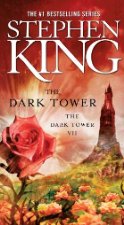 Summary:
Roland and his ka-tet face their greatest challenges yet. First they must successfully save the rose in NYC. Then they must find each other, and Susannah and Jake need to escape the low men who would harm them. Also on their list before continuing to pursue the Dark Tower is to stop the breakers who mean to destroy the beam, thereby leading the worlds to ruin. Can they save the beam? Will Roland reach his beloved Dark Tower with his ka-tet whole or shattered? Will he reach it at all? The Dark Tower looms with a far greater presence than ever before, calling to both Roland and reader commala-come-come.
Review:
Now I understand why people who’ve read the entire Dark Tower series rant with showers of praise about it. This final entry in the series totally blew my mind. The settings were perfectly drawn and easy to visualize. The multiple plot lines were all complex and yet simultaneously easy to follow. I cried multiple times reading this book, including in public, and those who know me know that I generally don’t cry at stories. All of the characters of the ka-tet are treated with full-formed character development. They are richly drawn, but it is also easy to see how they have grown and changed throughout the series. The multiple, inter-locking worlds of Roland and his ka-tet suddenly snap into place in the reader’s mind, and suddenly everything is nearly as clear as it probably is for King.
This book is quite long, but it didn’t feel like it. I wanted to read it nearly constantly, yet I had to put it down periodically due to the emotional wringer King was bringing me through. It’s been so long since I read a series that wasn’t either a trilogy or a serial romance that I’d forgotten how emotional it can get to have a long, fully realized tale told with characters you’ve grown to know and care for. These people read as real people, and the world feels real. It makes me want to go look for my own unfound door to journey to a parallel reality. Even though at first I kind of laughed at the idea of a rose and a tower and beams somehow controlling and seeing over multiple worlds, at some point I bought into it. I suspended my disbelief, and that’s exactly what a spinner of tales is supposed to be able to help his readers do.
What made me truly fall in love with the story and make me want to instantly start re-reading the series over again from the beginning is the ending. I wouldn’t give it away and ruin the experience of discovering it yourself for anybody, so just let me say, it totally blew my mind. I did not see it coming. It made my perspective on the whole tale change, which explains why I want to re-read it so much. (Maybe next year). I can also say that the ending makes reading the rest of the long series entirely worth it. Definitely don’t give up on the series part-way through. Continue all the way to the end.
If you’ve been reading the Dark Tower series and are uncertain about continuing, absolutely do. I don’t hesitate to say that the last entry in the series is tied for the best and will totally blow your mind. I highly recommend the whole series, but I especially encourage anyone who has started it to finish it. It’s well worth your time.
5 out of 5 stars
Source: Harvard Book Store
Previous Books in Series:
The Gunslinger, review
The Drawing of the Three, review
The Waste Lands, review
Wizard and Glass, review
Wolves of the Calla, review
Song of Susannah, review
Reading Challenge: R.eaders I.mbibing P.eril
 I love horror. Love love love it. I know a lot of readers don’t. They say it scares them too much or keeps them awake at night. The thing is, I used to be one of those readers! I used to avoid horror because when I was younger horror would absolutely petrify me for weeks on end. I’d think every squeak my old house would make was the boogey-man coming to get me. But then I decided, “Enough of this shit! I’m letting my fears get in the way of an entire genre.” So I dabbled my toes, then I jumped in, and now it’s one of my favorite genres. Horror lets me get lost in a world where it’s ok to be scared and supernatural things occur and I basically get to watch car crashes repeatedly. It’s awesome. The whole genre. I can’t believe how much I’d be missing if I’d continued to avoid it! For instance: Zombies. Tree porn. Everything Stephen King ever wrote. You get my point.
Anyway, so when I saw via Chris at Book-a-rama that Carl of Stainless Steel Droppings is hosting a mystery/suspense/thriller/dark fantasy/gothic/horror/supernatural reading challenge for the spooky fall months of September and October entitled R.eaders I.mbibing P.eril, I knew I wanted to sign up. Not that I won’t be reading horror for these two months anyway, but I thought if I signed up, it’d alert you guys to the challenge. Maybe one of my lovely readers is tentative about one of those genres? Well this is the perfect opportunity to stretch your boundaries! Plus you’ll be in the company of a lovely bunch of people for a couple months to do it.
Of course, that’s my other reason for participating. I want to virtually meet other book lovers who are reading horror!
Originally, in light of the fact that I try to keep my reading unstructured and fun, I was going to sign up for one of the lower levels of the challenge….then I saw how much of my TBR pile fits! Lol, so I’m signing up for the Peril the First level: read four books that fit into any of the genres I mentioned above.
My potential reads for the challenge (direct from my TBR pile) include:
- An Edgar Allan Poe collection whose name is escaping me at the moment
- The Lady in the Lake
by Raymond Chandler
- Thinner
by Stephen King
- The Dark Tower
by Stephen King
- The Vampire Lestat
- Hunt Beyond the Frozen Fire
by Gabriel Hunt
- His Father’s Son
by Bentley Little
- Fragment: A Novel
by Warren Fahy
- The Day of the Triffids
by John Wyndham
- The Devil You Know
by Mike Carey
I hope you’ll sign up and do the challenge with me! Especially if you’re afraid of horror. You can sign up for one of the lower levels and just dip your toe in. :-)
Any votes for which four out of my list I should read?
Book Review: Song of Susannah by Stephen King (Series, #6)
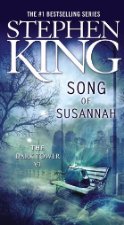 Summary:
The ka-tet faces three challenges: keep the chap from the Crimson King, save Susannah, and get Tower to sell them the rose. With the help of the Manni, they get the door to open two final times, and it sends Eddie and Roland to Maine to see Tower and Jake, Pere, and Oy to NYC in a final desperate attempt to save Susannah and the chap. Meanwhile, Susannah must face not only the foreign woman inside her, Mia, but also the figurative demons of her past and her personality in her mind.
Review:
There are elements of this book that are beautiful and quite literary, primarily everything to do with the title. There are of course two songs about Susannah. One is immediately evident. Each chapter ends with a stanza of a song, remarkably like the commala songs sung in the previous book, but of course the content of the stanza references what happened in that chapter. There’s also a song from Susannah’s past that winds up showing more about who she is and what her life has been than anything else in the books has done. What makes that beautiful is that it’s just a traditional folk song and wasn’t written by King for her at all.
Of course I’d consider this book a failure if all it did was develop Susannah’s character. The Dark Tower is about characters and the quest equally. Thankfully, this entry in the series addresses both. Various mysteries are addressed such as what the Low Men are, who Mia is, how Pere wound up in a book from another one of the worlds, and more. Plus a few new mysteries are added. But in the end the main questions remain: will the ka-tet make it to the Dark Tower and will the Dark Tower fall?
In spite of the well-written action sequences and character development, there is one aspect of this book that rubbed me the wrong way. King writes himself in as a character, but not just any character. He is the Crimson King’s opposite. In other words, he’s the essential good guy. For some reason when he writes his stories they have an impact on the worlds, so he must stay alive and keep writing the Dark Tower series if the ka-tet is to have any hope. The whole thing just reads as egotistical. Plus it forced me out of the story. I can suspend my disbelief for other worlds, but to suspend it enough to believe that the author is not only vaguely aware of these worlds but also his writing impacts them, well, it leaves you going “huh?” and kind of takes the escapism out of it. So I skimmed over the parts featuring King and tried to just focus on the ka-tet. It wasn’t that hard to do, so the King bits definitely didn’t ruin my experience; they just dulled it a bit.
Overall, this is a very good entry into the series. The characters and the plot move forward, and there are some wonderfully memorable scenes that will stick with you for a long time. If you’ve stuck with the series and enjoyed it this far, you’ll definitely enjoy this book.
4 out of 5 stars
Source: Borrowed
Previous Books in Series:
The Gunslinger, review
The Drawing of the Three, review
The Waste Lands, review
Wizard and Glass, review
Wolves of the Calla, review
Book Review: Wolves of the Calla by Stephen King (Series, #5)
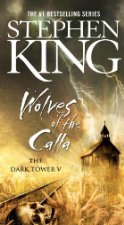 Summary:
The gunslinger’s katet have a lot more on their plate than just continuing along the path of the beam. Susannah is pregnant and has developed another personality, Mia, to deal with the pregnancy as it is most likely demonic. The Rose is in danger in then when of 1977 New York City. The man who owns the empty lot it grows in is under pressure from the mob to sell it to an unseen man. So the last thing the katet needs is to run into a town desperately in need of the help of gunslingers.
The Calla, a town made up of rice growers and ranchers who mostly give birth to twins, has been facing a plague once every generation. Creatures referred to as Wolves come and take one child out of every set of twins between the ages of about 4 and puberty. The child is later returned mentally retarded. Their local robot messenger, Andy, has warned them that the Wolves are coming in about a month, and their holy man believes gunslingers are on their way.
Unable to turn down their duty as gunslingers or give up on their quest for the Dark Tower, can the gunslingers pull it all off or is it just more than any katet, even one as strong as theirs, can handle?
Review:
Toward the beginning of the book, Roland says something like, “Being a gunslinger means weeks of planning, preparation, and hard work for 5 minutes of battle.” That’s really a good description of this book. It’s a lot of exposition, albeit very interesting exposition, followed by a rather anticlimactic battle that is really the exposition for the next leg of the katet’s journey. This could have gone really badly, but thankfully there’s a lot of information King needs to tell us, and most of it is interesting and relevant to the gunslingers’ world, so it works.
King is good at creating a culture. The Calla and its people possess a very distinctive speech pattern and colloquialisms that are simultaneously easy enough for the reader to learn and to follow. He hints that he just took the Maine accent and exaggerated it. Maybe that’s why a New England gal like myself found it so easy to follow. In any case, the town of twins, ranchers, and rice is rich with local legends, folklore, and traditions. It is enjoyable to read about, and the town also manages to provide information about the katet’s greater quest for the Dark Tower.
It is well-known that King’s Dark Tower series brings in elements and characters from his other works, as he sees all of his stories happening in the same world and being connected. To that end, the holy man of the Calla is the priest from Salem’s Lot, and a part of Wolves of the Calla is him relating his backstory to the katet. Something that irritated me about all of the tales told in the “Telling of Tales” section of Wolves of the Calla is that it would switch from the character speaking to an italicized third person narrative. I don’t know if all of the italicized portions were previously written for other books or if King felt that he needed to be an omnipotent narrator in order to properly tell everything that had happened, but I found it disjointing and jarring. It was only my unanswered questions about the Wolves and the Dark Tower that kept me reading through that section.
I enjoyed the growth in the relationship between Roland and Jake. Roland is gradually growing into a father figure/adviser, while Jake is gradually becoming a man and an equal with the other gunslingers. King handles this transition well, and it is believable. Meanwhile, Eddie and Susannah’s relationship doesn’t change per se, but Eddie does realize that he will always love Susannah more than she loves him. It is evident that both of them are uncomfortable with her multiple personalities. This is an issue that clearly has not yet been resolved.
I do have three gripes with King. The first is that he persists in calling Susannah’s multiple personalities schizophrenia, which is just wrong. Schizophrenics hear voices, at worst, they do not have multiple personalities. What Susannah has is Dissociative Identity Disorder, and it is just inexcusable that he would get this wrong.
Second, although previously in the series the reader isn’t allowed to know or see something Roland knows, the reader always gets to know what the other gunslingers know. Here, information is pointedly held back from the reader. I can only assume this was an attempt to maintain suspense about the Wolves, which I found to be a cop-out. Either come up with an idea creative enough that we’ll be surprised anyway or have the characters be surprised as well as us. Also, I already had the wolves figured out long before they are revealed anyway. The suspense came in wondering how the final battle would play out, not in wondering who the Wolves were.
Third, I don’t like the fact that Susannah’s main storyline is a pregnancy. I don’t like that one of her key roles so far as a gunslinger was to fuck the shit out of a demon so that Jake could be pulled through (The Wastelands). I also really don’t like that something as simple as her being pregnant causes her to abandon her husband and her katet in the form of another personality, Mia. It almost seems that King uses the multiple personalities just so that he can have a sweet woman around when he needs one but then can instantaneously turn her back into all of the negative images of women out there. I need to see where Susannah’s storyline winds up before I can offer a final analysis of the character and its implications, but at the moment, it reads as a very negative view of women.
The overarching storyline of the quest for the Dark Tower, however, is still going strong in this book. We learn a bunch of new, important information about the Tower, the beams, and the worlds, and new questions pop up. With each book it becomes more evident that saving the Tower is important to the well-being of all worlds. I am pleased to report that this was a marked improvement over the previous book, although not quite up to the intensity of The Waste Lands or pure readability of The Gunslinger. It still manages to suck you in and gets the story back on the path of the beam.
3 out of 5 stars
Source: Borrowed
Previous Books in Series:
The Gunslinger, review
The Drawing of the Three, review
The Waste Lands, review
Wizard and Glass, review
Book Review: Wizard and Glass By Stephen King (Series, #4)
 Summary:
Roland and his ka-tet escape Blaine the Train, but they accidentally wind up off the path of the beam and in yet another alternate version of Jake, Eddie, and Susannah’s world. They start following an interstate, heading for a palace and hoping therein lies the solution for returning to the path of the beam. One night while traveling, Roland finally tells them what has been haunting him all this time with the story of the summer he was 14 years old and his first love.
Review:
As with The Waste Lands, this book reads like multiple books in one. I was expecting that, since The Waste Lands ended abruptly without solving the problem of Blaine the Train. This book takes care of that storyline, then jumps into a flashback that lasts almost the entire book then jumps back to the present and attempts to solve a big problem. It’s a lot for one book to handle, and it would have worked better if Lud and Blaine the Train were one book taking place after The Waste Lands but before Wizard and Glass. If after doing this, King had shortened the flashback, The Wizard and Glass would be an excellent book. Of course, he didn’t do it that way.
Now that I am this far into the series, I’m seeing that King, whether intentionally or not, is writing different bits of the series as different genres. This could be why it holds wide appeal–if someone doesn’t like the genre the story is currently being told in, it will change soon enough. The first book is mainly a travelogue. The second a horror story. The third is a mix of scifi with the time paradox and horror again with Lud and Blaine the Train. Here, we get partly fantasy with the current issues for Roland’s ka-tet, but mostly a medieval romance–the story of Roland and Susan.
That medieval romance starts out well. King sets up three dialects–High Speech, In-World Speech, and Mejis accent–very well. All three are easy to differentiate, and yet are easy to read. Roland’s world is a wonderful mix of the knights of Arthur and the fabeled American west. It’s fun to read, but only when something’s really happening. That’s the problem with the flashback. It feels too long, because very little happens in large portions of it. Roland, Cuthbert, and Alain must spend most of their summer in Mejis waiting, and instead of telling the reader “wow, they waited a long time,” King makes the reader wait too, and it’s fucking boring and annoying. I seriously wanted to give up, and right when I was about to, the action started again. Finally. The action makes excellent use of this mix of fantastical and wild west, but it really takes too long to come about.
As far as the characters go, I know I’m supposed to feel for Susan, but I honestly found her annoying and dull, which is problematic since she’s Roland’s first love. Also, after all this time of Roland stating how Eddie is almost as funny as Cuthbert, I was expecting Cuthbert to be, y’know, funny. He’s not. He acts like that boy in school who used to pull your braids and think it was funny. He’s just juvenile, not witty. On the other hand, the character of the witch Rhea is excellently done. She’s simultaneously disgusting and intriguing, and she’s one of the few who manages to out-wit Roland, partly because he underestimates her since she is an old, disgusting woman. If only Cuthbert and Alain had been so vividly drawn instead of wandering shells of people for Roland to talk at.
The book is a necessary read if you plan on finishing the series. It gives important insight into why Roland is the man he is today, not to mention explains how the ka-tet escapes Blain the Train and gets back on the path of the beam. I think this is the almost inevitable dull book in an overall good series. Just take my advice and skim over the dull part of Mejis until the action picks up again.
2.5 out of 5 stars
Source: Borrowed
Previous Books in Series:
The Gunslinger, review
The Drawing of the Three, review
The Waste Lands, review
 Support my work with a tip or browse my shop for curated book club guides, how to guides, cross-stitch patterns, and more!


This work by Amanda Nevius is licensed under a Creative Commons Attribution-Noncommercial-No Derivative Works 3.0 United States License.
 Opinions of a Wolf