
Archive
Book Review: A Bánh Mì for Two by Trinity Nguyen
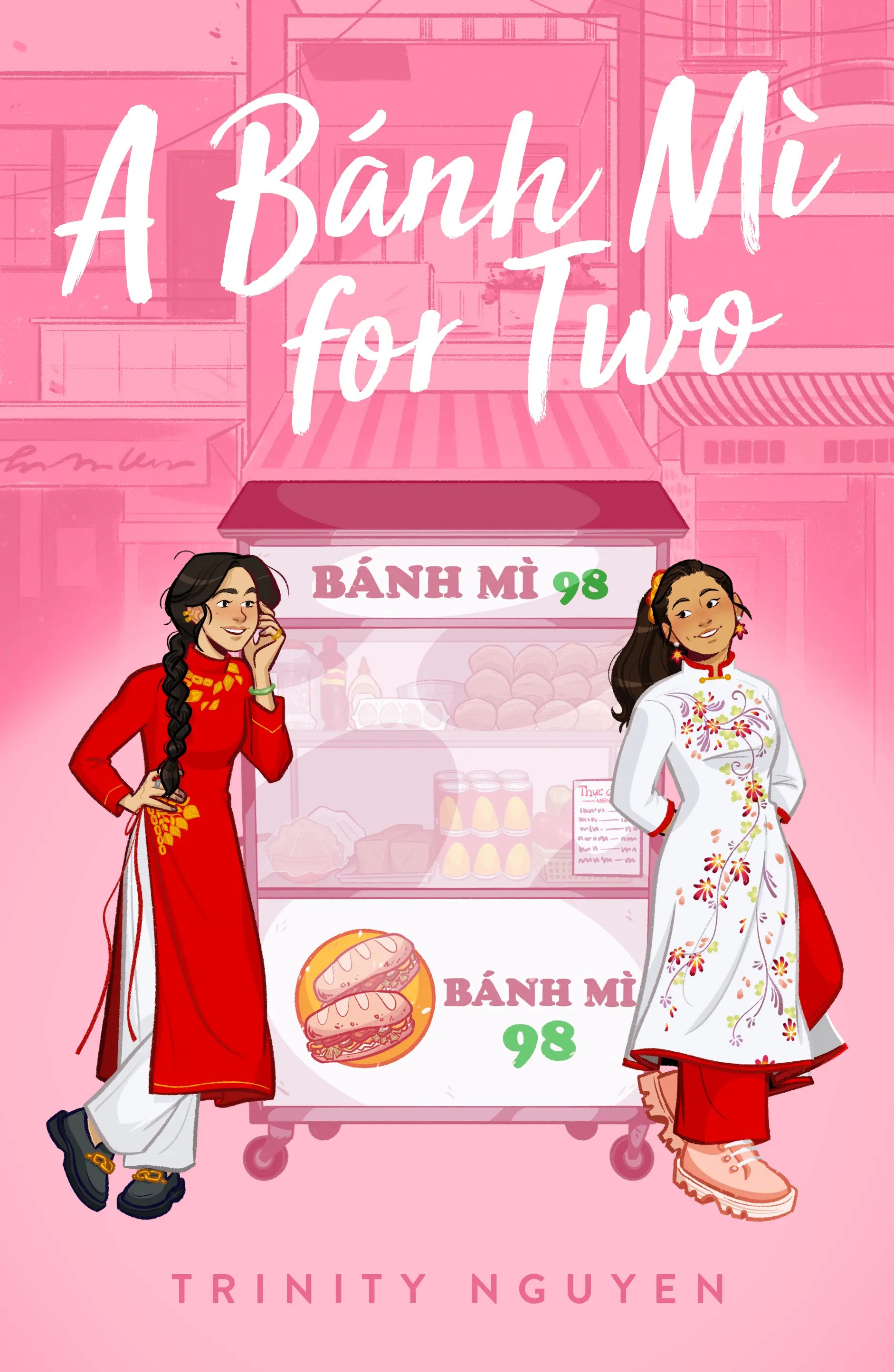
A sweet, closed-door sapphic romance set in Sài Gòn, where two foodie 18-year-olds fall for each other while uncovering family secrets and rekindling a love of food writing.
Summary:
In Sài Gòn, Lan is always trying to be the perfect daughter, dependable and willing to care for her widowed mother and their bánh mì stall. Her secret passion, however, is A Bánh Mì for Two, the food blog she started with her father but has stopped updating since his passing.
Meanwhile, Vietnamese American Vivi Huynh, has never been to Việt Nam. Her parents rarely talk about the homeland that clearly haunts them. So Vivi secretly goes to Vietnam for a study abroad program her freshman year of college. She’s determined to figure out why her parents left, and to try everything she’s seen on her favorite food blog, A Bánh Mì for Two.
When Vivi and Lan meet in Sài Gòn, they strike a deal. Lan will show Vivi around the city, helping her piece together her mother’s story through crumbling photographs and old memories. Vivi will help Lan start writing again so she can enter a food blogging contest. And slowly, as they explore the city and their pasts, Vivi and Lan fall in love.
Review:
I love a sweet, closed-door sapphic romance (see my review of Hani and Ishu’s Guide to Fake Dating), so when I heard about A Bánh Mì for Two, it was an easy add to my wishlist. The focus on food blogging and Vietnamese street food—both eating it and running a street food cart—was just the icing on the cake. This story strikes a delicate yet exquisite balance between lighthearted sweetness and the very real multigenerational trauma caused by the Vietnam War (referred to in Vietnam as The War Against the Americans to Save the Nation).
Told in alternating first-person perspectives between Lan and Vivi, the book avoids the common pitfall of muddled voices. While both characters are kind and thoughtful, they each have distinct ways of seeing the world, which keeps their narration clear and engaging. The romance is a sweet, slow burn, beginning with Vivi’s admiration of Lan’s food blog and blossoming into real-world chemistry after a chance encounter in Sài Gòn.
I especially appreciated the queer representation. There’s no on-page angst about being queer. Vivi does talk briefly with her friend Cindy (a Mexican American character) about how coming out can be complicated with conservative parents, but by the time the story begins, both girls’ families are accepting. It was also refreshing to see Vivi clearly identify as bisexual—representation that could’ve been easily overlooked since her only relationship in the book is with Lan. It’s affirming and intentional, which I loved.
The food descriptions are vivid but never overdone. They strike just the right balance between informing the reader (especially for dishes that might be unfamiliar) and keeping the flow natural. (I’ve eaten many a bánh mì in my life, and still found the food writing delightful!) I also really appreciated that this is a story about two 18-year-olds, and college isn’t presented as the only post–high school option. Lan’s mom encourages her to pursue school if she wants to, but also supports her jumping right into a career—a rare and welcome take in YA-adjacent fiction.
Vivi’s experience as a Vietnamese American studying abroad in Vietnam adds a beautiful emotional layer. She’s not a tourist—she’s searching for a kind of homecoming. She’s exploring why her mother kept so many details about Vietnam and their family a secret. This process is a powerful lens for the reader to learn about the war’s impact on Vietnamese families without the book ever feeling preachy. The historical context emerges naturally—through conversations, shared meals, and street encounters. It’s excellent writing.
The romantic progression between Lan and Vivi is tender and believable. One of my favorite parts was the motorbike rides around Sài Gòn—evocative, cinematic, and intimate. Even the third-act conflict felt justified. It wasn’t a contrived misunderstanding but a believable clash of cultural differences and personal pain. No one is villainized, and the resolution feels earned.
That said, a few elements pulled me out of the story. For example, Vivi’s study abroad program is mentioned as her reason for being in Vietnam, but we never actually see her attend class or study. This absence feels like a missed opportunity—readers might expect the study abroad setting to include some academic context. Similarly, while the book opens with several references to Vivi lying to her mom about her location—including photoshopping photos—the tension fades away later in the book. I found it a bit hard to believe that her mom wouldn’t catch on sooner.
The book is richly diverse, featuring Vietnamese and Vietnamese American characters, a Mexican American side character, and a sapphic romance at the center. Lan’s mother has a chronic illness, and her father passed away young from a stroke. The book also explores difficult family dynamics, grief, and healing across generations.
Overall, this is a fun, sweet sapphic romance featuring the beloved tropes of slow burn and study abroad, while offering thoughtful reflections on Vietnamese culture, family history, and the legacy of war. It’s beautifully steeped in food, healing, and love. Recommended for anyone looking for a sweet, queer romance with emotional depth, cross-cultural exploration, and heartwarming food moments.
If you found this review helpful, please consider tipping me on ko-fi, checking out my digital items in my ko-fi shop, buying one of my publications, using one of my referral or coupon codes, signing up for my free microfiction monthly newsletter, or tuning into my podcast. Thank you for your support!
4 out of 5 stars
Length: 224 pages – average but on the shorter side
Source: Library
Buy It (Amazon or Bookshop.org)
Women and the Vietnam War – 5 Nonfiction Reads
 To celebrate Women’s History Month, I thought it’d be fun to assemble a reading list looking specifically at the women’s history aspect of a particular historical event. When I thought about it, I couldn’t easily think off the top of my head of any books about women and the Vietnam War, so I decided to build my list on that. It taught me something while I was assembling the list for you.
I tried to cover both women part of the War, as well as women protesting the War or part of the counterculture. All book blurbs come from either GoodReads or Amazon.
 Daughters of Aquarius: Women of the Sixties Counterculture
by: Gretchen Lemke-Santangelo
Publication Date: 1997
Blurb:
“Hippie women” have alternately been seen as earth mothers or love goddesses, virgins or vamps-images that have obscured the real complexity of their lives. Gretchen Lemke-Santangelo now takes readers back to Haight Ashbury and country communes to reveal how they experienced and shaped the counterculture. She draws on the personal recollections of women who were there–including such pivotal figures as Lenore Kendall, Diane DiPrima, and Carolyn Adams–to gain insight into what made counterculture women tick, how they lived their days, and how they envisioned their lives.
This is the first book to focus specifically on women of the counterculture. It describes how gender was perceived within the movement, with women taking on much of the responsibility for sustaining communes. It also examines the lives of younger runaways and daughters who shared the lifestyle. And while it explores the search for self enlightenment at the core of the counterculture experience, it also recounts the problems faced by those who resisted the expectations of “free love” and discusses the sexism experienced by women in the arts.
 Hands on the Freedom Plow: Personal Accounts by Women in SNCC
by: Faith S. Holsaert, et al
Publication Date: 2010
Blurb:
Fifty-two women–northern and southern, young and old, urban and rural, black, white, and Latina–share their courageous personal stories of working for the Student Nonviolent Coordinating Committee (SNCC) on the front lines of the Civil Rights Movement.
The testimonies gathered here present a sweeping personal history of SNCC: early sit-ins, voter registration campaigns, and freedom rides; the 1963 March on Washington, the Mississippi Freedom Summer, and the movements in Alabama and Maryland; and Black Power and antiwar activism.
 Home Before Morning: The Story of an Army Nurse in Vietnam
By: Lynda Van Devanter
Publication Date: 1983
Blurb:
On June 8, 1969, a patriotic, happy-go-lucky young nurse fresh out of basic training arrived in Vietnam to serve a year’s tour of duty as a second lieutenant in the Army. It was a year that was to rob Lynda Van Devanter of her youth, her patriotism, her innocence – and her future.
 Unfriendly Fire: A Mother’s Memoir
By: Peg Mullen
Publication Date: 1995
Blurb:
Outspoken, fearless, and wickedly humorous, Peg Mullen tells the story of her transformation from an ordinary farm woman into a nationally recognized peace activist following the death of her oldest son, who was killed by artillery misfire in the Vietnam War.
 The Valiant Women of the Vietnam War
By: Karen Zeinert
Publication Date: 2000
Blurb:
From journalists and nurses to those who mobilized to protest or support the war effort on the home front, women of all ages took advantage of the changing social climate of the 1960s to break free of their traditional roles. A discussion of Vietnamese women’s roles in the conflict is included.
Book Review: The Three Stigmata of Palmer Eldritch by Philip K. Dick
 Summary:
Earth is overcrowded and overheated but people still don’t want to become colonists to other planets. The colonies on the other planets are so boring and depressing that the colonists spend all of their money on Can-D — a drug that lets them imagine themselves living in an idealistic version of Earth. The only trick is they have to set up dioramas of Earth first. The drug is illegal on Earth but the diorama parts are still created by a company there. When the famous Palmer Eldritch returns from the far-flung reaches of space, he brings with him a new drug, Chew-Z, that doesn’t require the dioramas. What the people don’t know, but one of the manager of the Can-D company soon finds out, is that Chew-Z sends those who take it into an alternate illusion controlled by Palmer Eldritch.
Review:
I love Philip K. Dick, and I have since first reading Do Androids Dream of Electric Sheep? So whenever I see his books come up on sale in ebook format, I snatch them up. I picked this up a while ago for this reason, and then randomly selected it as my airplane read on my honeymoon. Like many Dick novels the world of this book is insane, difficult to explain, and yet fun to visit and thought-provoking.
The world Dick has imagined is hilarious, although I’m not sure it was intended to be. Presciently, Dick sets up a future suffering from overpopulation and global warming, given that this was published in 1965, I find it particularly interesting that his mind went to a planet that gets too hot. Even though the planet is unbearably warm (people can only go outside at night and dusk/dawn), they still don’t want to colonize other planets. Colonizing the other planets is just that bad. So there’s a selective service by the UN, only instead of soldiers, those randomly selected are sent to be colonists. The wealthy can generally get out of it by faking mental illness, as the mentally ill can’t be sent away. This particular aspect of the book definitely reflects its era, as the 1960s was when the Vietnam War draft was so controversially going on.
I don’t think it’s going out on much a limb to say that drugs had a heavy influence on this book. Much of the plot centers around two warring drugs, and how altered perceptions of reality impact our real lives. One of the main characters starts out on Earth hearing about how the poor colonists have such a depressing environment that they have to turn to drugs to keep from committing suicide. But when he later is sent to Mars himself as a colonists, his impression is that in fact the colony is this downtrodden because no one tries very hard because they’re so much more focused on getting their next hit of Can-D. The Can-D has caused the lack of success on the planet, not the other way around. Whether or not he is accurate in this impression is left up to the reader.
Then of course there’s the much more major plot revolving around the new drug, Chew-Z. Without giving too much away, people think Chew-Z is a much better alternative to Can-D, but it turns out chewing it puts you under the control of Palmer Eldritch for the duration of your high, and if you overdose, you lose the ability to tell the difference between illusion and reality. The main character (and others who help him) thus must try to convince the humans that Chew-Z is bad for them before they ever even chew it. The main character has another side mission of getting people off of Can-D.
It sounds like a very anti-drugs book when summarized this way, but it felt like much more than that. People chewing Chew-Z can come to have an experience that sounds religious – seeing the three stigmata of Palmer Eldritch (a stigmata in Christian tradition is when God shows his favor on someone by giving them the marks of Jesus’ crucifixion. In this book, the three stigmata are three bodily aspects of Palmer that are unique to him). However, the experience of seeing the stigmata is in fact terrifying, not enlightening. The drugs thus represent more than drugs. They represent the idea that we could possibly know exactly what a higher power is thinking, and perhaps that it might be better to just go along as best we can, guessing, rather than asserting certainty.
All of this said, a few weaknesses of the 1960s are seen. I can’t recall a non-white character off the top of my head. Women characters exist, thank goodness, but they’re all secondary to the male ones, and they are divided pretty clearly into the virgin/whore dichotomy. They are either self-centered, back-stabbing career women, or a demure missionary, or a stay-at-home wife who makes pots and does whatever her husband asks. For the 1960s, this isn’t too bad. Women in the future are at least acknowledged and most of them work, but characterizations like this still do interfere with my ability to be able to 100% enjoy the read. Also, let’s not forget the Nazi-like German scientist conducting experiments he probably shouldn’t. For a book so forward-thinking on things like colonizing Mars and the weather, these remnants of its own time period were a bit disappointing.
Overall, though, this is a complex book that deals with human perception and ability. Are we alone in space? Can we ever really be certain that what we are seeing is in fact reality? How do we live a good life? Is escapism ever justified? Is there a higher power and if there is how can we ever really know what they want from us? A lot of big questions are asked but in the context of a mad-cap, drug-fueled dash around a scifi future full of an overheated planet and downtrodden Mars colonies. It’s fun and thought-provoking in the best way possible.
If you found this review helpful, please consider tipping me on ko-fi, checking out my digital items available in my ko-fi shop, buying one of my publications, or using one of my referral/coupon codes. Thank you for your support!
4 out of 5 stars
Length: 243 pages – average but on the shorter side
Source: Amazon

 Support my work with a tip or browse my shop for curated book club guides, how to guides, cross-stitch patterns, and more!


This work by Amanda Nevius is licensed under a Creative Commons Attribution-Noncommercial-No Derivative Works 3.0 United States License.
 Opinions of a Wolf