
Archive
Book Review: Killing Me by Michelle Gagnon
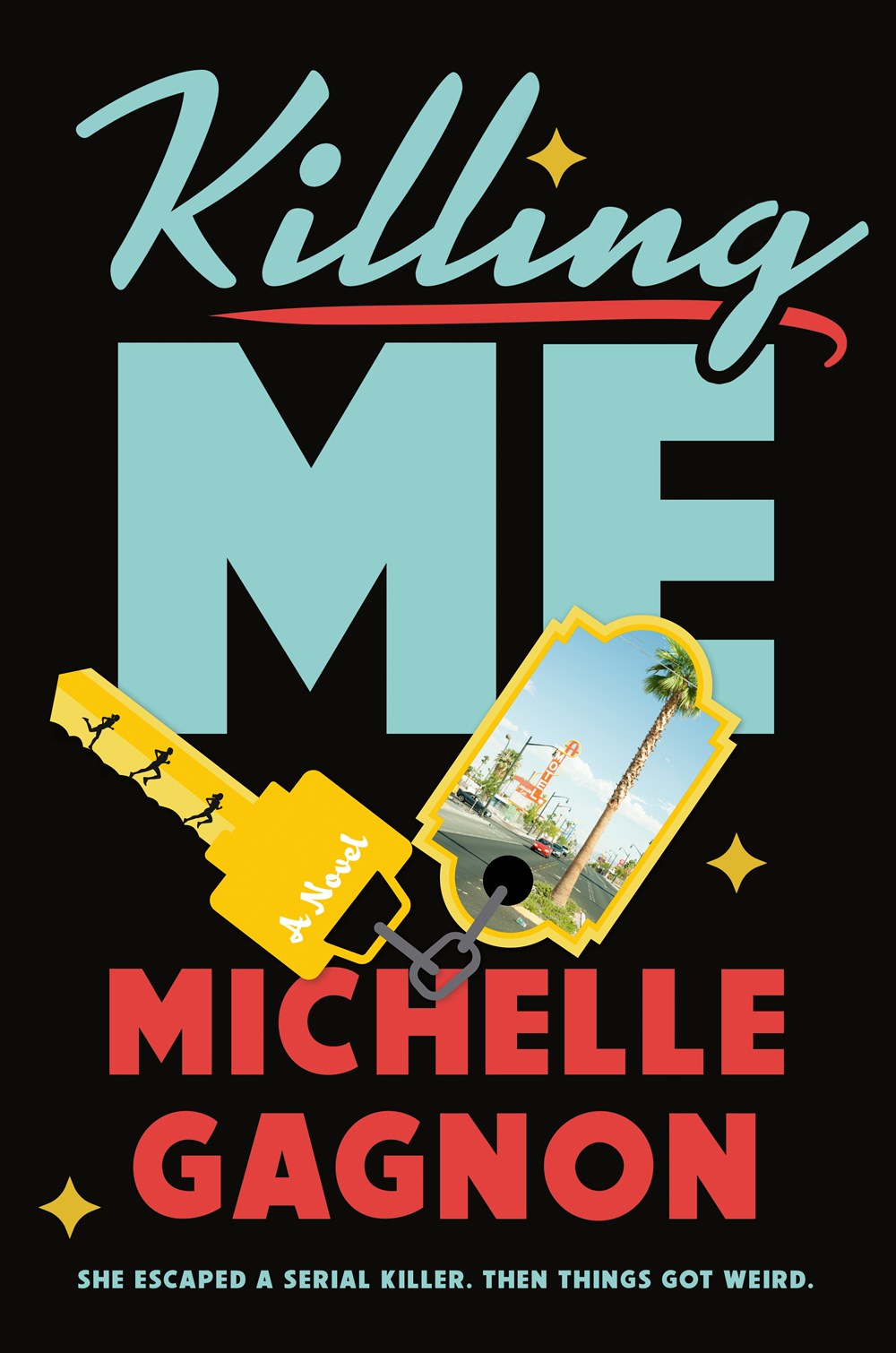
A laugh out loud thriller about women out-smarting a serial killer.
Summary:
Amber Jamison cannot believe she’s about to become the latest victim of a serial killer-she’s savvy and street smart, so when she gets pushed into, of all things, a white windowless van, she’s more angry than afraid. Things get even weirder when she’s miraculously saved by a mysterious woman…who promptly disappears. Who was she? And why is she hunting serial killers?
Review:
When I saw this on NetGalley, I was intrigued by the Final Girls-esque vibe – the women who would be the killer’s victims turning on him. I was skeptical I would find it humorous because, honestly, my funny bone is a little particular. But I actually found myself chortling on page one.
If you’re the type of person with an internal dialogue of self-deprecating humor about bizarre situations you find yourself in, then you’ll probably enjoy the sense of humor in this book. Regardless, you’ll be able to tell quickly if it’s for you or not, because the humor comes so quickly in the book, and that style is what’s present throughout the rest.
This is primarily told in the first person from Amber’s perspective, and she’s dry, acerbic, self-deprecating, but also whip-smart. (There are a few third person chapters that let us see things Amber doesn’t know about.) Amber is simultaneously problematic (she’s a con artist) and easy to root for. She’s richly three-dimensional. The main secondary characters are also rich and well-imagined. It would have been so easy to see a caricature of a sex worker, seedy motel owner, an Evangelical roommate, etc… yet they all are allowed to be more than what they might seem to be at first.
The Las Vegas setting rang very true to me. It depicted both the tourist bits and the seedier local areas quite well. I especially loved the run-down yet beloved film noir stylized motel as compared to the one recently made over to appeal to Gen Z and Millennials. That had me chortling.
I also really appreciated that this is a book whose main character is a lesbian but the plot has absolutely nothing to do with her being a lesbian. You could have almost the exact same book with a heterosexual main character. It’s just Amber so happens to like women. I like having this type of representation. It doesn’t always have to be about the difficulties of coming out or a romance to feature queer people.
The mystery itself was decent. The plot was certainly unique compared to other thrillers I’ve read, and I did not guess the ending. There was one twist that annoyed me only because it was solely a twist because Amber held something back from the reader. But I was willing to forgive it because she sort of breaks the fourth wall and acknowledges that she did it…which was funny.
I hope there’s a sequel, because I think there’s a lot left to explore with Amber, and she has a very interesting set-up at the end of the book.
Overall, I really recommend this to thriller lovers looking for something different. The humor and the plot really deliver.
If you found this review helpful, please consider tipping me on ko-fi, checking out my digital items available in my ko-fi shop, buying one of my publications, or using one of my referral/coupon codes. Thank you for your support!
4 out of 5 stars
Length: 336 pages – average but on the longer side
Source: NetGalley
Buy It (Amazon or Bookshop.org)
Book Review: Hani and Ishu’s Guide to Fake Dating by Adiba Jaigirdar

In this Bangladeshi-Irish YA romance, Hani needs to convince her two best friends that she’s really bisexual. She lies and tells them she’s dating academically focused and acerbic Ishu who agrees to fake date in exchange for help being elected Head Girl.
Summary:
Everyone likes Humaira “Hani” Khan—she’s easy going and one of the most popular girls at school. But when she comes out to her friends as bisexual, they invalidate her identity, saying she can’t be bi if she’s only dated guys. Panicked, Hani blurts out that she’s in a relationship…with a girl her friends absolutely hate—Ishita “Ishu” Dey. Ishu is the complete opposite of Hani. She’s an academic overachiever who hopes that becoming head girl will set her on the right track for college. But Ishita agrees to help Hani, if Hani will help her become more popular so that she stands a chance of being elected head girl.
Despite their mutually beneficial pact, they start developing real feelings for each other. But relationships are complicated, and some people will do anything to stop two Bengali girls from achieving happily ever after.
Review:
I have a soft spot for Irish literature, and when I heard about this book by a Bangladeshi-Irish queer Muslim author with a bisexual main character, it landed on my tbr list very quickly. This was a quick read with an easy to follow story and a sweet, very low spice romance.
I enjoyed Hani and Ishu each separately as character. They take turns narrating in the first person, and I never lost track of who was speaking. This book uses the grumpy/sweet trope quite well. Ishu is only grumpy because she’s focused and willing to speak her mind. Hani quickly sees through that. Hani and Ishu’s cultures are intertwined beautifully in the book. I like it when a book doesn’t feel the need to stop and explain cultural things to the reader. It’s on us to look it up if we want to, and that’s when I really learn things. (Like when Hani makes Ishu porota for breakfast. I looked that up right away. Yum!)
As a bisexual person, I appreciated how the story highlights the specific issues for Hani in coming out as bisexual. It’s clear that her friends would have fairly rapidly accepted her as a lesbian, but they view bisexual as being either confused or attention-seeking. They also don’t believe her because they’ve never seen her date a girl. This is a very realistic depiction of biphobia. Hani is quite confident about who she is and what labels she chooses. In contrast, Ishu is uninterested in labels, although she’s definitely attracted to Hani. It’s not clear if she’s only ever been interested in girls or more or if it’s just that Hani is the first person she’s ever been interested in. But that doesn’t matter to Ishu, and it doesn’t matter to Hani either.
When this book first came out, it was praised for depicting a queer Muslim character. (This article goes into depth about representation for South Asian queer women and interviews the author as well.) There is a perception that you cannot be both queer and Muslim. Both Muslims and non-Muslims hold this viewpoint. Yet people like Jaigirdar are both and depicting this in her books is important to Jaigirdar. Thus, we see Hani engaging with her faith. She goes to the Mosque. She reads the Quran. She eats halal. There is also a perception among many non-Muslims that if someone is serious about Islam and a woman then they will wear the hijab. But it is possible for someone to be devoutly engaging with her faith and also not wearing hijab. The author depicts this in Hani, as well as how she must struggle against the perception that she must not be a “serious” Muslim because she doesn’t wear hijab.
So this book covers a lot of seriously important representation well, and the romance is sweet and believable. What didn’t work for me was the secondary characters. Whereas Hani and Ishu felt well-rounded and interesting, everyone else felt flat and two-dimensional. There also were some kind of big issues that Hani and Ishu seemed to just gloss over. Now, they’re teenagers, so maybe that’s realistic. But Ishu having to hide the relationship from her parents long-term was concerning to me. Also, we never see the characters talk about being in an interfaith relationship. We do hear that Ishu appreciates Hani’s devotion to her faith as part of her. But Ishu is atheist, and we never really hear Hani’s thoughts on that.
Overall, this was a fun read with a lot of important representation. Recommended to readers who enjoy the fake dating and/or grumpy/sweet tropes.
If you found this review helpful, please consider tipping me on ko-fi, checking out my digital items available in my ko-fi shop, buying one of my publications, or using one of my referral/coupon codes. Thank you for your support!
3 out of 5 stars
Length: 352 pages – average but on the longer side
Source: Library
Buy It (Amazon or Bookshop.org)
Get the Reading Group / Book Club Discussion Guide
A beautifully graphic designed 2 page PDF that contains: 1 icebreaker, 9 discussion questions arranged from least to most challenging, 1 wrap-up question, and 3 read-a-like book suggestions
View a list of all my Discussion Guides.
Book Review: In the Lives of Puppets by T.J. Klune
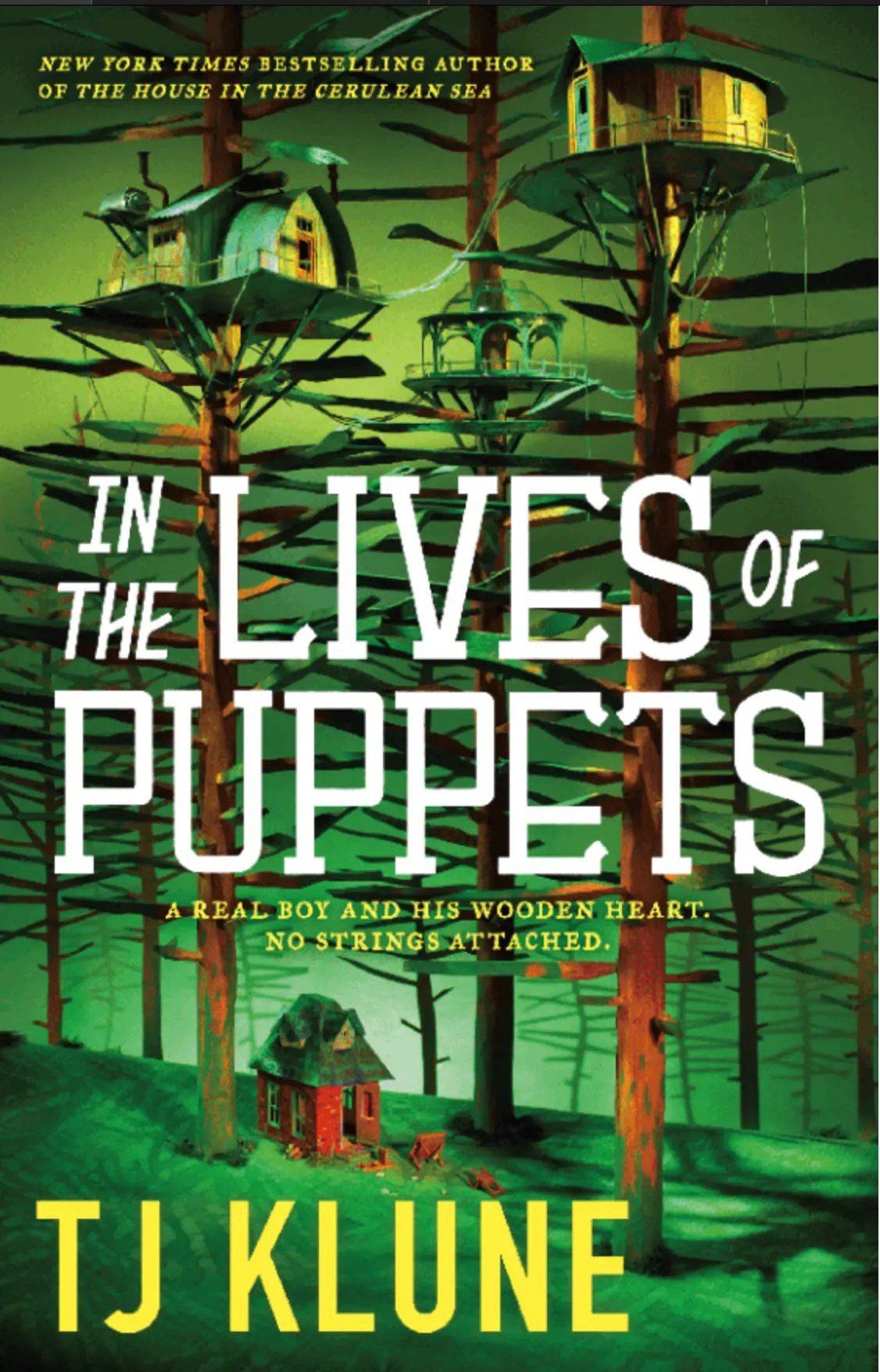
A science fantasy reimagining of Pinocchio where Pinocchio is a “real boy” surrounded by robots (puppets) with a m/m (or, rather, male, male robot) romance added in.
Summary:
In a strange little home built into the branches of a grove of trees, live three robots–fatherly inventor android Giovanni Lawson, a pleasantly sadistic nurse machine, and a small vacuum desperate for love and attention. Victor Lawson, a human, lives there too. They’re a family, hidden and safe.
The day Vic salvages and repairs an unfamiliar android labelled “HAP,” he learns of a shared dark past between Hap and Gio-a past spent hunting humans.
When Hap unwittingly alerts robots from Gio’s former life to their whereabouts, the family is no longer hidden and safe. Gio is captured and taken back to his old laboratory in the City of Electric Dreams. So together, the rest of Vic’s assembled family must journey across an unforgiving and otherworldly country to rescue Gio from decommission, or worse, reprogramming.
Along the way to save Gio, amid conflicted feelings of betrayal and affection for Hap, Vic must decide for himself: Can he accept love with strings attached?
Review:
This is a loving and detailed send-up to Pinocchio. I hadn’t seen the movie in years, and it still stirred up memories for me. When I went to look up the original book version’s plot to compare to this retelling, I found even more details I hadn’t realized or remembered. It’s obvious the author loves Pinocchio, and if you do too, I’m expecting you’ll likely love this retelling. For me, the problem is, I was so excited about a new T.J. Klune book that I sort of…forgot I don’t like Pinocchio. (“Don’t like” is a gentle remembrance. In fact, the movie absolutely terrified me as a child.) Even so, I found myself able to appreciate this loving rendition of the story.
I absolutely adored the character of Rambo – the tiny robot vacuum who’s clearly supposed to be a later generation of roombas. As always, I liked the narrative style the author uses – it reads as sing-songy in my head and feels like someone telling me a fairy tale, which is perfect for this book. I liked the wide variety of robots inhabiting the world, and I really enjoyed the robot substitute for the traveling circus character. I also appreciated that this isn’t an exact retelling of Pinocchio. The story is sometimes restrained, with simple allusions to the original. For example, Victor is never turned into a donkey, but he does stay the night in a hotel like room that is decorated with donkeys at about the right point in the story.
I appreciated the flipping of Pinocchio (Victor in this telling) as being human with his father being a “puppet” (a robot). But I felt like the ending really lets that inversion down, not taking it to its full and complete conclusion. I think there’s supposed to be humor in this book, but it wasn’t funny to me. You will know within the first few chapters if it’s tickling your funny bone or not.
I also found myself unable to root for anyone in this book, save for the small, innocent Rambo. Everyone else has something so wrong with them that it soured me to like them. The one I can talk about without spoilers, as the episode happens in the first chapter, is Nurse Ratched. She is a robot companion of Victor’s who was designed to nurse humans. She’s described as sociopathic, in a way that I think is supposed to read as comedic. As in, she acts like she enjoys inflicting pain but doesn’t really. Yet in the first chapter she chases down a squirrel (off-screen) and kills it by rolling over it again and again. I almost stopped reading the book, I was so horrified. But it was an advanced copy, so I decided to give it another chance. She never does anything like this ever again, but it is actually not uncommon for characters in this book to have something they have done in the past that is truly horrific that is brushed off as their programming. I’m all for plots where characters have to overcome their own tendency toward being bad, and redemption and forgiveness are both very important. But I need for that not to be the plot for almost every single character. It, at the very least, is distressing to read about.
The romance did not move me, which was surprising given what strong feelings I had for the couple in The House in the Cerulean Sea! I also have complicated feelings about how the book depicts what freedom means, how robots pursue freedom, the offerings of the “freedom fighter” character, etc… This, in fact, is a reflection of how I feel the overarching messages tended to get muddled. The only message that I felt was clear and consistent was “be brave!” but no clear reason as to why was ever given. To borrow from an American fairy tale – the overarching story needed a heart. I think, perhaps, the romance was supposed to be the heart, but it didn’t work as one for me.
This is also an incredibly sad book. It’s not uplifting in the slightest. There’s nothing wrong with sad books, but it is a departure from the author’s other books, and so I think the warning is warranted.
Overall, this is an imaginative and loving retelling of Pinocchio that should appeal to fans of that fairy tale. Readers should be aware that the darkness of the original story remains in this retelling.
If you found this review helpful, please consider tipping me on ko-fi, checking out my digital items available in my ko-fi shop, buying one of my publications, or using one of my referral/coupon codes. Thank you for your support!
3 out of 5 stars
Length: 432 pages – average but on the longer side
Source: NetGalley
Buy It (Amazon or Bookshop.org)
5 Short LGBT Book Club Books

So, you want to bring an LGBTQIA+ book to your book club. But Pride month is already upon us, so it needs to be short! Or maybe reading an LGBTQIA+ book will be a bit of a stretch for your group so you want to entice them into it by promising a short read.
Never fear, your friendly queer and bisexual book blogger has your back with 5 books all under 300 pages. Plus, I have discussion guides available for each and every one of them.
Let’s take a look at them from shortest to longest.

On a Grey Thread by Elsa Gidlow
Coming in at just 73 pages, this is also in the public domain – meaning everyone in your book club can read it on Archive.org for free. (They can also get it on Amazon or Bookshop.org if they prefer.)
Published in 1923, this poetry collection was the first in North American history to openly express lesbian desire. Both personal and political, Gidlow’s poems express the poet’s complex feelings as a young woman whose political ideology and sexual identity ran counter to the traditional values of her time. Whether or not this will work for your book club depends on everyone’s feelings about poetry. But it’s a nice, quick read with historical value.
Get the Discussion Guide
A beautifully graphic designed 2 page PDF that contains: 1 icebreaker, 9 discussion questions arranged from least to most challenging, 1 wrap-up question, and 3 read-a-like book suggestions.
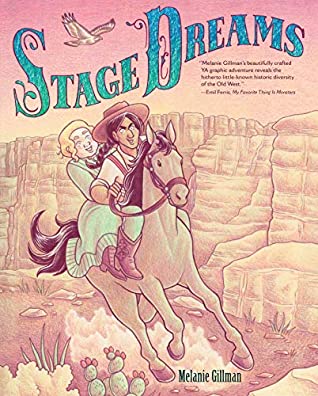
Stage Dreams by Melanie Gillman
While technically more pages than the poetry book with 104, this is a graphic novel, so it’s possible it’s actually an even quicker read. Get it on Amazon or Bookshop.org.
In this rollicking queer western adventure, acclaimed cartoonist Melanie Gillman (Stonewall Award Honor Book As the Crow Flies) puts readers in the saddle alongside Flor and Grace, a Latina outlaw and a trans runaway, as they team up to thwart a Confederate plot in the New Mexico Territory. When Flor—also known as the notorious Ghost Hawk—robs the stagecoach that Grace has used to escape her Georgia home, the first thing on her mind is ransom. But when the two get to talking about Flor’s plan to crash a Confederate gala and steal some crucial documents, Grace convinces Flor to let her join the heist.
Get the Discussion Guide
A beautifully graphic designed 2 page PDF that contains: 1 icebreaker, 9 discussion questions arranged from least to most challenging, 1 wrap-up question, and 3 read-a-like book suggestions.

Solo Dance by Lit Kotomi, translated by Arthur Reiji Morris
This 149 page read is more of a contemporary, literary selection, translated from its original Japanese. Get it on Amazon or Bookshop.org.
Cho Norie, twenty-seven and originally from Taiwan, is working an office job in Tokyo. While her colleagues worry about the economy, life-insurance policies, marriage, and children, she is forced to keep her unconventional life hidden—including her sexuality and the violent attack that prompted her move to Japan. There is also her unusual fascination with death: she knows from personal experience how devastating death can be, but for her it is also creative fuel. Solo Dance depicts the painful coming of age of a queer person in Taiwan and corporate Japan. This striking debut is an intimate and powerful account of a search for hope after trauma.
Get the Discussion Guide
A beautifully graphic designed 2 page PDF that contains: 1 icebreaker, 9 discussion questions arranged from least to most challenging, 1 wrap-up question, and 3 read-a-like book suggestions.

The Gilda Stories by Jewelle Gómez
If your book club likes the paranormal or urban fantasy genres, then this 252 page read should be right up their alley. Get it on Amazon or Bookshop.org.
A young Black girl escapes slavery in the 1850s United States. When she grows up, she is made into a vampire with her consent. We see her immortal life and her perspective of the US through an imagined 2050.
Get the Discussion Guide
A beautifully graphic designed 2 page PDF that contains: 1 icebreaker, 9 discussion questions arranged from least to most challenging, 1 wrap-up question, and 3 read-a-like book suggestions.

Coffee Will Make You Black by April Sinclair
At 256 pages, this will be a great fit for a book club that likes historic fiction set in the mid-20th century. Get it on Amazon or Bookshop.org.
Set on Chicago’s Southside in the mid-to-late 60s, following Jean “Stevie” Stevenson, a young Black woman growing up through the Civil Rights and Black Power movements. Stevie longs to fit in with the cool crowd. Fighting her mother every step of the way, she begins to experiment with talkin’ trash, “kicking butt,” and boys. With the assassination of Dr. King she gains a new political awareness, which makes her decide to wear her hair in a ‘fro instead of straightened, to refuse to use skin bleach, and to confront prejudice. She also finds herself questioning her sexuality. As readers follow Stevie’s at times harrowing, at times hilarious story, they will learn what it was like to be Black before Black was beautiful.
Get the Discussion Guide
A beautifully graphic designed 2 page PDF that contains: 1 icebreaker, 9 discussion questions arranged from least to most challenging, 1 wrap-up question, and 3 read-a-like book suggestions.
Bonus Suggestion:

Bloemetje: a speculative retelling of Hans Christian Andersen’s Thumbelina fairy tale by Amanda McNeil
Of course, I must also mention my own queer-inclusive retelling of Thumbelina, coming in at 121 pages. Available on Amazon.
A Dutch company known as The Bedrijf commences colonizing Venus via the construction of a dome filled with plants that convert its natural air into something breathable by humans. Since all workers are granted permission to bear a child, a woman and her spouse join the crew. But the woman soon discovers she is plagued with infertility. When her spouse illegally brings home a tulip from the garden, they discover a miniature baby inside who they name Bloemetje – little bloom. As the baby grows in mere days into a teenager, pushing her boundaries, she illuminates the true horrors of colonization and leads them all on a journey to decolonize.
If you’re interested in reading this for your book club, drop me a note at mcneil.author@gmail.com. I’d be happy to make a discussion guide and/or talk to your book club via Zoom or similar software.
 Support my work with a tip or browse my shop for curated book club guides, how to guides, cross-stitch patterns, and more!


This work by Amanda Nevius is licensed under a Creative Commons Attribution-Noncommercial-No Derivative Works 3.0 United States License.
 Opinions of a Wolf