
Archive
Book Review: A Sunny Place for Shady People by Mariana Enríquez, translated by Megan McDowell

A chilling yet deeply human collection of short stories where ghosts, goblins, and the macabre collide with everyday life—showcasing a rising star in Argentinian literature.
Summary:
Welcome to Argentina and the fascinating, frightening, fantastical imagination of Mariana Enriquez. In twelve spellbinding new stories, Enriquez writes about ordinary people, especially women, whose lives turn inside out when they encounter terror, the surreal, and the supernatural. A neighborhood nuisanced by ghosts, a family whose faces melt away, a faded hotel haunted by a girl who dissolved in the water tank on the roof, a riverbank populated by birds that used to be women—these and other tales illuminate the shadows of contemporary life, where the line between good and evil no longer exists.
Lyrical and hypnotic, heart-stopping and deeply moving, Enriquez’s stories never fail to enthrall, entertain, and leave us shaken. Translated by the award-winning Megan McDowell, A Sunny Place for Shady People showcases Enriquez’s unique blend of the literary and the horrific, and underscores why Kazuo Ishiguro, winner of the Nobel Prize for Literature, calls her “the most exciting discovery I’ve made in fiction for some time.”
Review:
This diabolical collection of 12 horror stories, each with at least a touch of the supernatural, blends the speculative with the deeply human. While steeped in Argentinian culture, the themes—grief, fear, injustice—resonate universally.
My favorite stories in this collection explore women’s suffering and resilience. “Metamorphosis” follows a woman undergoing a hysterectomy as she confronts medical misogyny, while “Different Colors Made of Tears” examines the far-reaching impact of domestic violence, even on those who haven’t experienced it firsthand. Other stories explore moral dilemmas, like the tension between wanting to help others while maintaining personal safety, or the existential fear of cancer.
The speculative elements vary in intensity—some stories lean fully into the fantastical, while others offer just a whisper of the supernatural. In “Different Colors Made of Tears,” a vintage clothing shop buys dresses from an elderly man—only to later discover that rumor has it he was abusive to his ex-wife. When women try on the dresses, they see horrific injuries appear on their own bodies, disappearing once the garments are removed. In contrast, “Metamorphosis” unfolds primarily as a starkly realistic medical narrative, with the speculative twist emerging only at the end, when a woman considers an unconventional body modification procedure to reclaim part of her lost uterus.
At times, I found the endings too abrupt. While this can work, in this case, I frequently felt like I was just settling in when the narrative was yanked away too soon. One small nitpick: a story features a character’s uncle who emigrated from Argentina to Vermont, where he became wealthy working for Boeing. Having grown up in Vermont and now working in the nonprofit sector here, I found this detail unrealistic. Vermont has exactly four Boeing employees—it’s just not a company with a presence in the state. A medical center, insurance company, or even Ben & Jerry’s would have been a more believable employer.
While most of the horror is not overly explicit, some stories do push boundaries. On-page content includes death, murder, torture, addiction, medical trauma, and the killing of a cat, while mentions of rape and confinement in tight spaces also appear. The collection is largely set in Argentina, with one story taking place in the U.S. To my understanding, all the characters appear to be white Argentines. Some disabilities, such as endometriosis, are explored, and one story features a gay couple. (Information on the current state of LGBTQIA+ rights in Argentina.) Another follows a woman reflecting on her codependent relationship with a partner struggling with Substance Use Disorder and being unhoused.
Overall, this is a dark, thought-provoking collection that blends psychological and supernatural horror with a sharp social lens. It tackles unsettling themes in ways that are both intimate and chilling. Recommended for readers who enjoy horror that lingers long after the final page.
If you found this review helpful, please consider tipping me on ko-fi, checking out my digital items available in my ko-fi shop, buying one of my publications, using one of my referral/coupon codes, or signing up for my free microfiction monthly newsletter. Thank you for your support!
4 out of 5 stars
Length: 257 pages – average but on the shorter side
Source: Library
Buy It (Amazon or Bookshop.org)
Get the Book Club Discussion Guide
A beautifully graphic designed 2 page PDF that contains: 1 icebreaker, 9 discussion questions arranged from least to most challenging, 1 wrap-up question, and 3 read-a-like book suggestions
View a list of all my Book Club Guides.
Book Review: She Who Knows by Nnedi Okorafor
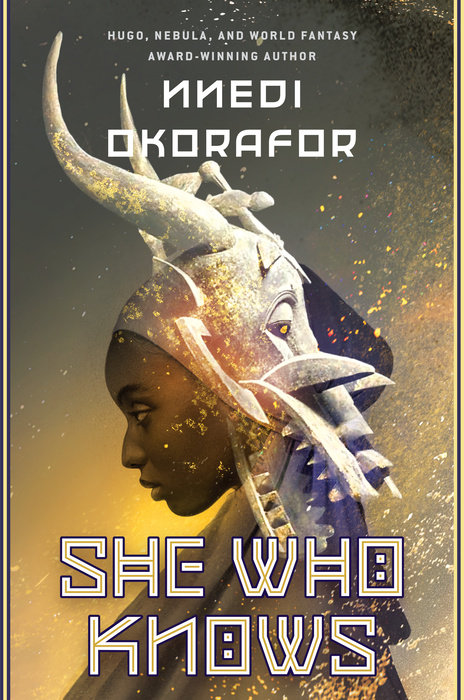
Blending science fiction and fantasy in a near future West African setting, this engaging prequel offers a compelling plot blended with a unique coming-of-age story in a quick read.
Summary:
Najeeba knows.
She has had The Call. But how can a 13-year-old girl have the Call? Only men and boys experience the annual call to the Salt Roads. What’s just happened to Najeeba has never happened in the history of her village. But it’s not a terrible thing, just strange. So when she leaves with her father and brothers to mine salt at the Dead Lake, there’s neither fanfare nor protest. For Najeeba, it’s a dream come true: travel by camel, open skies, and a chance to see a spectacular place she’s only heard about. However, there must have been something to the rule, because Najeeba’s presence on the road changes everything and her family will never be the same.
Review:
This short, powerful book packs quite a punch with its quickly established setting, a main character you can easily root for, and action scenes that will leave you breathless.
This is a perfect example of science fantasy (also called space fantasy), blending elements of both science fiction and fantasy seamlessly. The science fiction aspect is revealed through its post-apocalyptic future—something happened to reset the world. Paper books are rare and kept in a community building, and the salt fields that Najeeba’s people harvest from were created by a drying up of the water. The fantasy elements feel just as integrated, from the “Call” that Najeeba’s people receive when it’s time to go to the salt, to the supernatural powers some individuals can access. (For another science fantasy read, check out my retelling of Thumbelina set on Venus.)
Though part of a prequel series to Nnedi Okorafor’s Who Fears Death, you don’t need to have read that to enjoy this one. I hadn’t read it either, and I never felt lost or like I was missing crucial context. The initial conflict—Najeeba’s desire to do something that’s typically only for boys—is easy to grasp, and the world-building is subtle and effective. By the time the more unique and fantastical elements come into play, I was fully immersed in the world.
Set in a future version of West Africa, this features Black protagonists, with other characters who are Arab. While some of the abilities that develop in the story could be read as an allegory for developing a disability, none are explicitly represented.
The plot kept me hooked, and while I was satisfied with the ending, I found myself eager to explore more of this world. I’m excited to pick up the next book in the series when it’s available.
Overall, this is a quick, engaging read that brings science fantasy to a West African future setting. It’s a refreshing take on the near-future genre, offering a new perspective that I look forward to exploring further.
If you found this review helpful, please consider tipping me on ko-fi, checking out my digital items available in my ko-fi shop, buying one of my publications, using one of my referral/coupon codes, or signing up for my free microfiction monthly newsletter. Thank you for your support!
4 out of 5 stars
Length: 161 pages – average but on the shorter side
Source: Library
Buy It (Amazon or Bookshop.org)
Book Review: The Importance of Being Earnest by Oscar Wilde

This witty farce cleverly comments on romance and class while offering a glimpse into the sharp mind of a writer who was silenced by society for his homosexuality.
Summary:
Cecily Cardew and Gwendolen Fairfax are both in love with the same mythical suitor. Jack Worthing has wooed Gwendolen as Ernest while Algernon has also posed as Ernest to win the heart of Jack’s ward, Cecily. When all four arrive at Jack’s country home on the same weekend the “rivals” to fight for Ernest’s undivided attention and the “Ernests” to claim their beloveds pandemonium breaks loose. Only a senile nursemaid and an old, discarded hand-bag can save the day!
Review:
I wasn’t sure if a play from 1895 could still make me laugh out loud, but this had me literally laughing out loud throughout. Wilde’s sharp wit transcends time, offering humor that still feels fresh and fun.
The bulk of the humor revolves around romance and relationships, themes that are just as relatable today. One of the young women insists she can only marry a man named Ernest because, well, it’s just such a perfect name. Honestly, it feels like something an influencer might say now. Ridiculous? Yes. But her love interest plays along—an endearing and absurd romance that hits just right. The second couple’s drama, involving letters and the oddity of never having met in person, feels like it could be pulled straight from a modern reality TV show like 90 Day Fiancé. It’s both comical and oddly relatable, even today.
Then, there’s Wilde’s satirical take on class—an aspect of the play that’s still tragically relevant. The scene where the two young women exchange polite (but cutting) quips over tea is perhaps my favorite. The tension between societal expectations and personal desires couldn’t be more brilliantly portrayed.
The final twist? Whip-smart and unexpected, it’s a game-changing moment that had me thinking, “This could fit perfectly into a psychological thriller.” It’s brilliant… and hilarious.
I listened to this as an audiobook (with a live reading featuring James Marsters—swoon!), and I highly recommend experiencing plays this way. The clever dialogue really shines in an audio format, bringing Wilde’s wordplay and humor to life in a way you can’t always capture on the page.
As for diversity, it’s worth noting that Wilde’s characters are overwhelmingly upper-crust white English folk. However, it’s important to remember that Wilde wrote this play before being imprisoned for “gross indecency” (a term used at the time to criminalize homosexuality). The Importance of Being Earnest was his last play, and it showcases his sharpest writing before homophobia curtailed his career. Reading it today offers a poignant reminder of his legacy and the oppressive forces that silenced him.
Overall, this remains a clever, sharp, and incredibly funny play—one that continues to satirize the British class system with a witty edge. It’s a must-read for fans of intellectual humor, fans of Wilde, and anyone who appreciates supporting LGBTQIA+ writers who defied the odds in their time.
If you found this review helpful, please consider tipping me on ko-fi, checking out my digital items available in my ko-fi shop, buying one of my publications, using one of my referral/coupon codes, or signing up for my free microfiction monthly newsletter. Thank you for your support!
5 out of 5 stars
Length: 89 pages – novella/short nonfiction
Source: Audible
Buy It (Amazon or Bookshop.org)
 Support my work with a tip or browse my shop for curated book club guides, how to guides, cross-stitch patterns, and more!


This work by Amanda Nevius is licensed under a Creative Commons Attribution-Noncommercial-No Derivative Works 3.0 United States License.
 Opinions of a Wolf