
Book Review: Herculine by Grace Byron
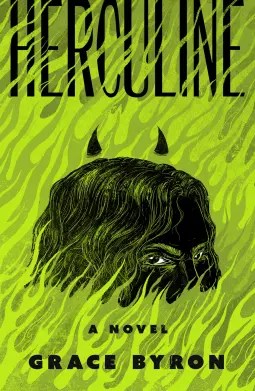
Summary:
Herculine’s narrator has demons. Sure, her life includes several hallmarks of the typical trans girl sob story—conversion therapy, a string of shitty low-paying jobs, and even shittier exes—but she also regularly debates sleep paralysis demons that turn to mist soon after she wakes and carries vials of holy oil in her purse. Nothing, though, prepares her for the new malevolent force stalking her through the streets of New York City, more powerful than any she’s ever encountered. Desperate to escape this ancient evil, she flees to rural Indiana, where her ex-girlfriend started an all-trans girl commune in the middle of the woods.
The secluded camp, named after 19th-century intersex memoirist Herculine Barbin, is a scrappy operation, but the shared sense of community among the girls is a welcome balm to the narrator’s growing isolation and paranoia. Still, something isn’t quite right at Herculine. Girls stop talking as soon as she enters the room, everyone seems to share a common secret, and the books lining the walls of the library harbor strange cryptograms. Soon what once looked like an escape becomes a trap all its own.
While trying to untangle the commune’s many mysteries, the narrator contends with disemboweled pigs, cultlike psychosexual rituals, and the horrors of communal breakfast. And before long, she discovers that her demons have followed her. And this time, they won’t be letting her go.
Review:
Just like any horror reader, I have my favorite settings, and a commune gone wrong is one of them. (Do communes ever go right? Certainly not in horror). But I also like unique takes and twists in my horror, so when I saw this was an own voices trans woman horror (or trans girl, as the characters say), I smashed the request button on NetGalley. I was preemptively thrilled when I received the download, but that just increased as I read the book.
A note on my perspective:
For new blog readers, hi, I’m a queer, progressive Christian who was raised fundamentalist evangelical in the rural US.
Demons in the book:
What immediately struck me about this book is that the narrator literally was put through conversion therapy as a teen and yet still has a functioning relationship with God. Unlike a lot of representation we see in literature, there isn’t this binary thinking that you must either be straight and Christian or a wounded queer kid who grew up to be an atheist scientist. The narrator is wounded (and nameless), yes, but she still finds comfort in her faith. And the demons are not good guys here to help her. Absolutely not! In fact, one aspect that I particularly enjoyed is that the demons latch on to both straight religious folks (her conversion therapist) and other trans folks (people at the commune). The demonic influence has nothing to do with gender identity or sexual orientation. That was absolutely delicious to me.
A wounded yet powerful character:
Our narrator is wounded by life and allowed to be. She struggles with dating and exes and her own history of conversion therapy and yet she is able to articulate just how human her experience really is.
I was not special in my grief. And strangely, I was not alone.
And yet. She makes so many powerful choices. Precisely because she holds onto that humanity. Because she knows she just is who she is. She’s a trans girl, as she would say. She’s from rural middle of the country. She’s having a really hard time making it in NYC.
Own voices trans representation
It’s impossible to read the narrator without seeing her as a full and complete character. Unlike other trans characters I’ve read, her being trans wasn’t something that was the constant center of attention, even with the trauma from conversion therapy. Her being herself was. And yet of course she also reflected on being trans, not just herself but being a part of the trans community.
Loving trans girls is hard, even when you are one. Loving us is like reaching into a waterfall and trying to pull.
My only complaint:
Like a lot of good rock songs that start of strong but don’t know how to end, Herculine doesn’t seem quite sure how to end. The ending fizzled for me compared to the rest of the book. But the progressive Christian in me loved the last word. Selah. It is a word that appears in the Psalms and Habakkuk. We aren’t quite sure what it means. That, in and of itself, is a beautiful way to end a book about the trans experience, I think. But also it’s often interpreted as a liturgical pause or a call to reflect. In the church I grew up in, I was taught to treat it like an exclamation akin to the “So say we all” in Battlestar Galactica. Like a “hear hear.” Any of these meanings make it a cool way to end. I just personally think the rest of the final chapters weren’t quite there compared to that.
Overall:
This is a unique read in both horror and trans main character books. For horror, everything about the characters make the commune gone wrong plot unique. For trans main characters, a main character who went through conversion therapy, remained living her trans identity, and has sorted out faith for herself in her own way is something that isn’t seen so often. This is one worth picking up.
If you found this review helpful, please consider tipping me on ko-fi, checking out my digital items in my ko-fi shop, buying one of my publications, using one of my referral or coupon codes, or tuning into my podcast. Thank you for your support!
4 out of 5 stars
Length: 272 pages – average but on the shorter side
Source: NetGalley
Buy It (Amazon or Bookshop.org)
 Support my work with a tip or browse my shop for curated book club guides, how to guides, cross-stitch patterns, and more!

This work by Amanda Nevius is licensed under a Creative Commons Attribution-Noncommercial-No Derivative Works 3.0 United States License.

