
Archive
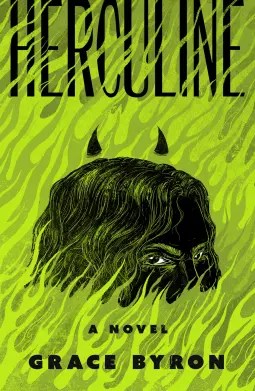
Book Review: Herculine by Grace Byron
Summary:
Herculine’s narrator has demons. Sure, her life includes several hallmarks of the typical trans girl sob story—conversion therapy, a string of shitty low-paying jobs, and even shittier exes—but she also regularly debates sleep paralysis demons that turn to mist soon after she wakes and carries vials of holy oil in her purse. Nothing, though, prepares her for the new malevolent force stalking her through the streets of New York City, more powerful than any she’s ever encountered. Desperate to escape this ancient evil, she flees to rural Indiana, where her ex-girlfriend started an all-trans girl commune in the middle of the woods.
The secluded camp, named after 19th-century intersex memoirist Herculine Barbin, is a scrappy operation, but the shared sense of community among the girls is a welcome balm to the narrator’s growing isolation and paranoia. Still, something isn’t quite right at Herculine. Girls stop talking as soon as she enters the room, everyone seems to share a common secret, and the books lining the walls of the library harbor strange cryptograms. Soon what once looked like an escape becomes a trap all its own.
While trying to untangle the commune’s many mysteries, the narrator contends with disemboweled pigs, cultlike psychosexual rituals, and the horrors of communal breakfast. And before long, she discovers that her demons have followed her. And this time, they won’t be letting her go.
Review:
Just like any horror reader, I have my favorite settings, and a commune gone wrong is one of them. (Do communes ever go right? Certainly not in horror). But I also like unique takes and twists in my horror, so when I saw this was an own voices trans woman horror (or trans girl, as the characters say), I smashed the request button on NetGalley. I was preemptively thrilled when I received the download, but that just increased as I read the book.
A note on my perspective:
For new blog readers, hi, I’m a queer, progressive Christian who was raised fundamentalist evangelical in the rural US.
Demons in the book:
What immediately struck me about this book is that the narrator literally was put through conversion therapy as a teen and yet still has a functioning relationship with God. Unlike a lot of representation we see in literature, there isn’t this binary thinking that you must either be straight and Christian or a wounded queer kid who grew up to be an atheist scientist. The narrator is wounded (and nameless), yes, but she still finds comfort in her faith. And the demons are not good guys here to help her. Absolutely not! In fact, one aspect that I particularly enjoyed is that the demons latch on to both straight religious folks (her conversion therapist) and other trans folks (people at the commune). The demonic influence has nothing to do with gender identity or sexual orientation. That was absolutely delicious to me.
A wounded yet powerful character:
Our narrator is wounded by life and allowed to be. She struggles with dating and exes and her own history of conversion therapy and yet she is able to articulate just how human her experience really is.
I was not special in my grief. And strangely, I was not alone.
And yet. She makes so many powerful choices. Precisely because she holds onto that humanity. Because she knows she just is who she is. She’s a trans girl, as she would say. She’s from rural middle of the country. She’s having a really hard time making it in NYC.
Own voices trans representation
It’s impossible to read the narrator without seeing her as a full and complete character. Unlike other trans characters I’ve read, her being trans wasn’t something that was the constant center of attention, even with the trauma from conversion therapy. Her being herself was. And yet of course she also reflected on being trans, not just herself but being a part of the trans community.
Loving trans girls is hard, even when you are one. Loving us is like reaching into a waterfall and trying to pull.
My only complaint:
Like a lot of good rock songs that start of strong but don’t know how to end, Herculine doesn’t seem quite sure how to end. The ending fizzled for me compared to the rest of the book. But the progressive Christian in me loved the last word. Selah. It is a word that appears in the Psalms and Habakkuk. We aren’t quite sure what it means. That, in and of itself, is a beautiful way to end a book about the trans experience, I think. But also it’s often interpreted as a liturgical pause or a call to reflect. In the church I grew up in, I was taught to treat it like an exclamation akin to the “So say we all” in Battlestar Galactica. Like a “hear hear.” Any of these meanings make it a cool way to end. I just personally think the rest of the final chapters weren’t quite there compared to that.
Overall:
This is a unique read in both horror and trans main character books. For horror, everything about the characters make the commune gone wrong plot unique. For trans main characters, a main character who went through conversion therapy, remained living her trans identity, and has sorted out faith for herself in her own way is something that isn’t seen so often. (See my reviews of other books with trans characters). This book is worth picking up.
If you found this review helpful, please consider tipping me on ko-fi, checking out my digital items in my ko-fi shop, buying one of my publications, using one of my referral or coupon codes, or tuning into my podcast. Thank you for your support!
4 out of 5 stars
Length: 272 pages – average but on the shorter side
Source: NetGalley
Buy It (Amazon or Bookshop.org)
Book Review: Love in the Time of Global Warming by Francesca Lia Block (Series, #1) (Audiobook narrated by Julia Whelan)
 Summary:
Pen’s life was destroyed when an Earthshaker took away her family (even their dog) and destroyed the Los Angeles she once knew. She’s now on a quest to save them from the monstrous giants that rose up after (or with?) the Earthshaker. Along the way she finds other teens who’ve miraculously survived, each with secrets and talents of their own.
Review:
This book left me completely torn. I loved, oh how I loved, the representation of both bisexual (Pen) and trans (Hex, her boyfriend) teens. But the story to go with these teens failed to live up to both these wonderful characters and the beautiful title.
Let’s talk about the good first, because I don’t want it to be overshadowed by what didn’t work. Pen is a bookish teenager who generally prefers to stay in reading the Encyclopedia or The Odyssey to going out to parties. But she still has two close friends. She’s not a loner. She’s brave, open, loving, and sometimes makes rather short-sighted decisions. And it is gradually revealed throughout the book that she is also bisexual. The scenes exploring Pen’s bisexuality, and how it’s hard for her to be out about it, in spite of being completely comfortable with herself, are wonderfully done. Pen acknowledges that even though her parents have always told her that it doesn’t matter a whit if she is straight, lesbian, bisexual, or trans, that the world at large doesn’t always think that, and that’s part of what makes being out hard for her. The world is not always the welcoming place her family is.
The book early on establishes that Pen currently has a crush on a boy, so the reader may perhaps be surprised when she reminisces about an earlier crush on a girl, and how she first realized she liked girls too.
Thinking of how I once kissed Moira on the lips. We were drunk and dancing, and our lips just brushed for that electroshock nanosecond, and then she smiled at some boys who were watching us, laughed, and danced away from me like it was a joke. But I’d had an epiphany, even though I hadn’t fully accepted it at the time. I wanted to kiss girls. And it was no joke. (loc 2:14:53)
Similarly, Pen struggles with self-editing her past when telling Hex about her life before the Earthshaker. She is not sure if he’ll understand or accept the fact that she’s perfectly capable of having crushes on girls as well as boys like himself, so she edits herself when speaking to him. She’s telling him a story about a party she didn’t go to, and the picture that her friends sent her of a boy with her friend, Moira:
I went to sleep staring at the last image wondering not what his mouth tasted like but hers. This part, this last, I don’t tell Hex, although I trust him enough to tell him anything. Don’t I? So I’m not sure why I don’t. Because I don’t want him to know I had a crush on a girl? Or because I have a crush on him. (loc 1:39:44)
It’s rare to see a book explore so eloquently what it is to be bisexual, and these feelings Pen has while not universal still explore the difficulty of coming out and being out as a bisexual person, and they were so wonderful to see in a book that I had to restrain myself from jumping up and shouting “Yes!” when they showed up on my audiobook on the bus.
Similarly, Hex, Pen’s love interest and eventual boyfriend (this is not a spoiler, when Hex shows up he may as well have a giant neon “future boyfriend” sign over his head), is a FTM transman. Hex is just as nervous about being out to Pen and their other travel companions as Pen is about being out to him, probably more. Being cis myself, I can’t say as definitively about the quality of FTM representation as I could about bisexuality, however, the author certainly tries to broach topics that I believe would be of interest to a trans YA reader reading this book: acceptance (or not) by family members and impact on romantic relationships with other teens. Hex comes out to Pen as a transman only because she has fallen for him, and he wants her to know precisely who he is before anything more *ahem* romantic happens. Pen immediately accepts him and tells him he is clearly a boy to her, and this changes nothing about how she feels about him. They then have to navigate their sex life. Hex, like many trans people, is uncomfortable with his body. He would rather touch Pen than allow Pen to touch him. Eventually, they reach an arrangement that both supports and asserts Hex’s maleness and allows Pen to give the pleasure back to him that she wants to. I was glad to see a YA book “go there.” I frankly haven’t seen much of that even in adult literature including a trans person. It both addresses the “how do they….” question some YA readers would certainly have after learning about Hex and also serves a purpose in the story to demonstrate a mature, healthy, loving relationship between the two characters.
In addition to Hex and Pen, they also wind up with two male travel companions who become a couple. The characters themselves point out at one point how odd it is that the minority before the Earthshakers is now the majority (none of them are straight AND cis). I was glad the author acknowledged the quirk and had the characters process why that may be. The answer they decide upon is a positive one, rather than the potentially negative one of punishment.
So now let’s talk about what didn’t work. The plot and the setting. The book is meant to be a magical realism style story told in a non-linear way. This could have worked if in the end the overarching plot, when reassessed by the reader from beginning to end, made sense. But it doesn’t. For most of the book, Pen refers to everything in fantastical ways, such as saying “Earthshaker” for what appears to the reader to be an earthquake. Why is she saying “Earthshaker”? Was there something different about it? Does she just like prettying up her language? What is going on with that? Later it is revealed that an earthquake seems to have happened when some genetically engineered giants escaped (showed up? were released?). The whole world basically goes to shit overnight, though, and it just doesn’t seem logical that that would happen from just a few giants escaping. Similarly, there are other fantastical creatures who are never explained.
Similarly, although it is indicated early on that this is a modern retelling of The Odyssey, it doesn’t line up well with the original. In the original, Odysseus is trying to come home after a war and keeps getting swept into side-quests. In this book, Pen starts out at home and then quests away from home. It would have made more sense for Pen to be somewhere away from home (maybe on a school trip or something), have the disaster occur, and then have her have to find her way home encountering fantastical things along the way. Starting her at home just doesn’t work.
Several elements feel like they are just thrown in because they look pretty or work with the scene even though they don’t work with the book as a whole. For instance, butterflies appearing around people who can be trusted pops up in the middle of the book, but isn’t particularly present at the beginning or the end. Similarly, some characters are revealed to have magical powers toward the end of the book, with no foreshadowing about that, only to have them….not use them much beyond the scene where it’s revealed.
Also, I’m sorry, but the whole some evil scientist genetically engineered giants to be his children and now the giants are out to destroy us but also the whole world inexplicably now resembles a myth just really doesn’t work. First, it makes no sense why a scientist would even want to engineer a giant. To be his children? Really? Why would anyone want giant children? Second, to give the mystical elements that started this whole thing a scientific explanation but then leave the rest fantastical doesn’t work. Either they’re all explained by science or they’re all fantastical. I really felt the book went way downhill for me when there was suddenly a “scientific” explanation for the giants. But just the giants and nothing else.
Finally, we need to talk about the name of the book. It’s a beautiful title but it’s really wasted on this book. First, global warming doesn’t come into play in the book at all, so why is it mentioned in the title? Second, it’s clearly a send-up to Love in the Time of Cholera, but it has nothing in common with that book save both having elements of magical realism in them. It feels as if the author came up with a title that sounded pretty and couldn’t bring herself to let go of it in spite of it not fitting the book she actually wrote.
Overall, this is a short read featuring four well-rounded and written teen characters on the LGBTQ spectrum. YA readers looking for positive representations of bisexual and trans characters, in particular, and who don’t mind some inexplicable fantasy elements will enjoy this quick read. Readers who will easily be bothered by the title not matching the content, a mixture of magical realism and scientific explanations for things, and/or nonlinear plots that when told linearly don’t make sense should probably look elsewhere, in spite of the positive representations of underrepresented letters in the LGBTQ spectrum.
If you found this review helpful, please consider tipping me on ko-fi, checking out my digital items available in my ko-fi shop, buying one of my publications, or using one of my referral/coupon codes. Thank you for your support!
3 out of 5 stars
Length: 240 pages – average but on the shorter side
Source: Audible

 Support my work with a tip or browse my shop for curated book club guides, how to guides, cross-stitch patterns, and more!

This work by Amanda Nevius is licensed under a Creative Commons Attribution-Noncommercial-No Derivative Works 3.0 United States License.

