
Archive
Book Review: Y: The Last Man: Cycles by Brian K. Vaughan (Series, #2) (Graphic Novel)
 Summary:
Yorick and his monkey, Ampersand, (the last males on Earth) continue their reluctant quest to help the government find a way to fix the disease that killed all the other men or at least to clone new men. Their train trip from Boston to California is caught up in Ohio, though, where they stumble upon an oddly utopian town of women. Meanwhile, Yorick’s sister, Hero, and the Amazons continue their quest to rid the Earth of the last man. Plus there’s a mysterious Russian woman who keeps insisting a spaceship with men on it is going to land.
Review:
Now that the premise of the post-apocalyptic world is set up, Vaughan’s story really picks up speed. There is much less explaining and far more action this time around. There are now multiple plot lines and mysteries beyond Yorick’s main one going as well, which helped, because let’s be honest, Yorick isn’t that likeable.
About 1/3 of this entry is set in Boston, primarily around Fenway and the train station. I think having the Amazons duke it out in front of Fenway Park was a pretty nice touch too.
I don’t recall laughing with the first entry, but this one had me laughing out loud on the bus then having to explain to my companions around me what was so funny. The line?
Killing’s easy. Like….like doing laundry!
It is a random, quirky sense of humor that I really enjoy, although I do expect that it might not strike some people as humorous.
The artwork continues to be bright and easy to follow. I really appreciated the preliminary sketches featured in the back of the book. It was most surprising to see that agent 355 originally was white and gradually was changed to black. I’m glad Vaughan made the move, but I do wonder what brought it on!
Overall, if you like a post-apocalyptic graphic world with biting wit and gender commentary, you’re going to enjoy this book.
5 out of 5 stars
Source: Public Library

Previous Books in Series:
Y: The Last Man: Unmanned
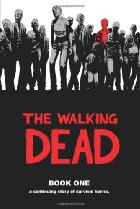
Book Review: The Walking Dead, Book 1 by Robert Kirkman (Series, #1) (Graphic Novel)
 Summary:
When cop Rick wakes up from a coma brought on by a gun shot wound, he discovers a post-apocalyptic mess and zombies everywhere. He sets off for Atlanta in search of his wife, Lori, and son, Carl, and soon teams up with a rag-tag group of survivors camped just outside of Atlanta.
Review:
I just want to point out that this review is purely focused on the graphic novel, not the tv series. I haven’t even seen more than 10 minutes of the tv show, so remember this is about the books not the show. Thanks! Moving along….
I almost gave up on this within the first few pages, because COME ON. Can we PLEASE get over the whole oh I had a coma and then woke up to a zombie apocalypse trope, please? First, it is so highly statistically unlikely that it was laughable the first few times it was used in my beloved dystopian novels, but at this point it just looks lazy. Come up with some other way to start the apocalypse, ok? I don’t care if your main character is out of touch with reality for a few days because he’s on a drug-fueled sex streak. At least it would be different! Also, a cop, really? You want me to root for a cop? And everyone trusts him because he’s a cop? A cop is the last person I would put in charge if I was a member of a rag-tag bunch of survivors; I’m just saying.
Once we move on beyond the initial set-up though to the group of survivors caravaning their way across America, the story vastly improves. The people are real. They’re scared. They’re angry. The snap easily. They hook up with whoever is convenient (and not necessarily young and hot). They teach the kids to use guns. It’s everything we know and love about post-apocalypse stories.
The artwork is good. Scenes are easy to interpret; characters are easy to tell apart. The zombies are deliciously grotesque, although I did find myself giggling at them saying “guk.” Guk? Really? Ok….
The best part, though, is the people that in your everyday life you are just like, come on, god, bolt of lighting, right here? They’re the ones who get eaten by zombies! It is excellent. So that really annoying chick in camp? Totally gets her head bit by a zombie. It’s cathartic and awesome.
The cast is diverse, and no, the black guy is not the first to be eaten (or the red shirt guy for that matter). It wouldn’t kill Kirkman to be a little less heteronormative, but he’s still got time and more survivors to add.
Overall, this is a good first entry in a zombie apocalypse series. Kirkman needs to be more careful to stay away from expected tropes in the genre and bring more of the creativity it is apparent he is capable of. I recommend it to fans of zombies, obviously. ;-)
4 out of 5 stars
Source: Public Library

If you found this review helpful, please consider tipping me on ko-fi, checking out my digital items available in my ko-fi shop, buying one of my publications, or using one of my referral/coupon codes. Thank you for your support!
Book Review: Point by Thomas Blackthorne (series, #2)
 Summary:
Mysterious cutter circles are showing up in the Britain of the future. Thirteen teenagers gather in a circle, then slice the wrist of the person next to them all the way around the circle. The MI5 recruits a neuroscientist to help figure out the circles before they reach epidemic proportions. Meanwhile, her boyfriend, Josh Cumberland, finds himself sucked back into his old special forces unit when a civilian job reaches a mysterious end. Are the two events connected?
Review:
I received an ARC of this book through the Angry Robot Army, and I sort of wish I’d noticed it was the second in a series. I just dislike reading books out of order. Also, I think perhaps if I’d read the first book in the series, I wouldn’t have been so misled by the cover.
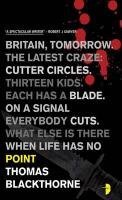
In case you can’t see the cover, it says, “Britain, tomorrow. The latest craze: cutter circles. Thirteen kids. Each has a blade. On a signal everybody cuts. What else is there when life has no point.” This makes it seem like this will be a book about depression and suicide in a post-apocalyptic world, right? In fact the people committing suicide have been brainwashed by music in an emotiphone to further a political power move. Which has…..nothing to do with real suicide or depression.
There’s nothing wrong with being a political intrigue book, but I am a bit disturbed at how Blackthorne utilizes psychology, psychiatry, and neuroscience in the book. He makes it look like in the future we’ll be able to just….program people out of it or to do whatever we want them to do. The brain is much more complex than that, and I just don’t like the message that such a plot device sends.
When looking at the book as the political espionage it actually is, as opposed to a book about mental illness in a dystopian world, it’s not a bad book. I have the feeling that those who enjoy political intrigue books will enjoy it. Josh is your typical wounded hero, and I did enjoy the scenes of him training. Blackthorne creatively incorporates reality tv into the plot-line that many readers will enjoy. The characters aren’t flat, but also aren’t particularly well-rounded. That’s ok, though, because the focus of the book is the action and political intrigue.
Overall, the book seems to be an average future political intrigue action flick…in written form. I recommend it to fans of that genre, but others will probably be bored.
3 out of 5 stars
Source: ARC from publisher

Book Review: Stand on Zanzibar by John Brunner
 Summary:
In the near-future humanity is increasingly facing over-population and all its consequences. In reaction to this, most world governments have established population laws and eugenics boards. In this overly crowded, information overloaded, perpetually on the brink of war society exist Donald and Norman, healthy bachelors who must live as roommates due to the housing crisis. Donald is a dilettante, an information specialist on reserve to be activated as a spy when needed for the US government. Norman is a Muslim African-American working his way up the corporate ladder of the most important technology firm in the world–GT. GT houses the world’s most brilliant computer named Shalmaneser. The intertwining lives of these two oddly well-suited roommates gradually unfold amid digressions into the lives of those they come into contact with and information from the modern-day philosophies and advertizing.
Review:
What is most memorable and striking about this book is not so much the story, although that is fairly unique, but the way in which it is told. Brunner does not simply tell the main storyline, he also immerses the reader into the world the characters live within. To that end, the main storyline (continuity) is interspersed with chapters focusing in on minor characters (tracking with close-ups, essentially short stories), plunging the reader into the middle of the advertizing of the time (the happening world), and works of importance to the world (context). The result is that, although it takes a bit of work to get into the book, in the end the world these characters exist in is much more vivid and clear in the reader’s mind, thus allowing her to more fully understand the characters.
Sometimes this method of writing is a bit difficult to read, of course. For instance, one chapter takes place at a party, and Brunner simply streams all of the conversation together as you would hear it if you were at the party yourself. You catch snippets of bits of different conversations taking place, but never an entire one all at once. It’s the most immersive party scene I’ve ever read, but also took me an inordinate amount of time to get through.
It was also refreshing to have one of the main characters in a futuristic scifi book be a minority. This in and of itself made Stand on Zanzibar a unique, interesting read, and I believe Brunner did a good job portraying both Norman’s struggles with still prevalent racism and presenting him as a well-rounded character.
The major themes of the book, beyond the incredibly meta presentation style, are the very real threat of the loss of privacy and the dehumanization of dependence upon artificial intelligence.
The dehumanizing affect of overpopulation is evident in the language employed by the characters early on in the book.
Not cities in the old sense of grouped buildings occupied by families, but swarming antheaps collapsing into ruin beneath the sledgehammer blows of riot, armed robbery and pure directionless vandalism. (page 52)
These are no longer human cities. They are crawling ant-piles. The vision of piles of swarming ants is simply not a pleasant one. This concept of humanity as a pest is carried even further in a poem from one of the context chapters entitled “Citizen Bacillus,” which begins:
Take stock, citizen bacillus,
Now that there are so many billions of you,
Bleeding through your opened veins,
Into your bathtub, or into the Pacific
Of that by which they may remember you. (page 115)
Not only is this poem taking into account the increasingly suicidal tendencies of the human population in this future society (something that is seen in the animal kingdom when a population becomes overcrowded), but it also is blatantly calling humans a bacteria (bacillus).
The book repeatedly addresses through vignettes, samples of books of the time period, and the lives of the main characters that overpopulation leaves people without enough room to think and figure themselves out in.
True, you’re not a slave. You’re worse off than that by a long, long way. You’re a predatory beast shut up in a cage of which the bars aren’t fixed, solid objects you can gnaw at or in despair batter against with your head until you get punch-drunk and stop worrying. No, those bars are the competing members of your own species, at least as cunning as you on average, forever shifting around so you can’t pin them down, liable to get in your way without the least warning, disorienting your personal environment until you want to grab a gun or an axe and turn mucker. (page 77-8)
In the book “turning mucker” is when a person inexplicably loses their mind and attacks strangers near them. This happens increasingly throughout the book. Thus Brunner’s main point that humans are our own worst enemy is repeated throughout the book.
Added on top of this is the fact that artificial intelligence is outpacing humans. The characters literally cannot keep up with the information overload. They have nightmares about it. They simultaneously depend on the computers and dread them. When one goes awry, they hardly know how to continue on, but simply flounder around. Chad Mulligan (one of my new favorite literary characters) sums it up eloquently:
What in God’s name is it worth to be human, if we have to be saved from ourselves by a machine? (page 645)
Thus, Stand on Zanzibar through postulating an overpopulated future that is overly dependent on technology demonstrates the very real dangers humans pose to ourselves if we outpace either our own minds or our environment’s ability to house us. It is a brilliant read for the meta-literature aspect alone, but the content is also challenging and thought-provoking. I highly recommend it to scifi fans.
4 out of 5 stars
Source: PaperBackSwap

Book Review: How I Live Now by Meg Rosoff
 Summary:
Daisy’s stepmother has convinced her father to send her off to England to live with her aunt and cousins, and Daisy really doesn’t mind. She hates her life in NYC anyway, and life in the countryside seems like a welcome change. Her cousins are quirky and fun, and Aunt Penn is sweet and practices a relaxed parenting style. When Aunt Penn goes away for a work trip, terrorist acts occur in London effectively leaving the kids on their own. On their own to explore feelings and actions they might not otherwise have felt free to.
Review:
The big rumblings about this YA book is that there is incest in it. In the grand scheme of shocking incest though, this incest is just….not that shocking. It’s between two cousins who’ve never met until they’re teenagers. *shrug* Plus, the incestuous relationship is really not the main focus of the story at all. It holds center stage for maybe two chapters. Two very chaste chapters. Oh sure, an astute reader knows what’s going on, but there are no lengthy sexual passages. The most we get to witness is a kiss. So, this book is really just really not about incest, ok? If that was keeping you from reading it, don’t let it. If that’s why you wanted to read it, go read Flowers in the Attic
So what is the story about? Quite simply, it’s about the impact living in an age of world-wide terrorism has on young people. On their perceptions, decisions, morals, and more. As someone who was only a sophomore in highschool when 9/11 happened, I feel safe in saying that Rosoff depicts the experience of a young person growing up in this world very well. The mixture of relaxing and having fun while the adults panic around you with nights of fear are perfectly woven.
Daisy’s voice is wonderful to listen to. She’s an appealing, funny narrator with an acute wit. She is truly someone to like and root for. Similarly, her female cousin, Piper, who she becomes a pseudo-parent to, is extraordinarily interesting and appealing. In fact, I’m hard-pressed to name a character who isn’t well-rounded.
Unfortunately, all of these positives about the book come to a crashing halt at the end. All I can tell you without spoiling the ending is that Rosoff did not take her themes as far as I was hoping she would take them. In my opinion, she copped out, and I was sorely disappointed. The ending reads almost like the beginning of the Beauty and the Beast fairy tale, and I was just left feeling as if Daisy and her cousins had let me down. What could have been an extraordinary book became just average.
Thus, if you are looking for a YA take on the impact life with terrorism has had on the younger generation, but aren’t expecting anything mind-blowing, you’ll enjoy this book. If what you’re after is shocking YA, however, look elsewhere.
3.5 out of 5 stars
Source: PaperBackSwap

Book Review: The Unit by Ninni Holmqvist
 Summary:
In the Sweden of the near future women who reach the age of 50 and men who reach the age of 60 without having successfully acquired a partner or had children are deemed “dispensable” and sent to live in “a unit.” These units appear at first glance to be like a high-class retirement home, and indeed they have all the amenities. The residents, however, are required both to participate in medical experiments and to donate various organs and body parts up until their “final donation” of their heart anywhere from a year or a few years after their arrival in the unit. Dorrit arrives at the unit depressed, but accepting of her fate as the result of her independent nature, but when she falls in love, she starts to question everything.
Review:
The entire concept of this book intrigued me as it is clearly a dystopia whose focus is on the older generations instead of teenagers and young people. The concept itself is of course frightening to any of us who have come to grips with the fact that some day we will be elderly too. This dystopia is also unique though in that it examines the possible future movement of Swedish society, which is vastly different from American society.
The writing is entirely from the perspective of Dorrit. Although it is clear she is writing from some point after the events occurred, Holmqvist eloquently allows her voice to change to reflect her changing ideas on society, her friends, her family, and her own life. When Dorrit first arrives in the unit, she attempts to defend herself saying that women used to be raised to be independent instead of with such a high focus on producing children that will add product to the GNP. It’s not as if she didn’t want a partner, she did, but it didn’t happen. So why is that her fault? Deeper issues are addressed too such as why does only a new family unit count and not siblings? What about pets? Don’t they need us? The vast implications of such a focus on interpersonal relationships found in the traditional family unit are subtly addressed. What type of people tend to be alone family-less by the age of 50 or 60? One resident in the unit’s library, for instance, points out that
“People who read books…tend to be dispensable. Extremely.” (Page 26)
Of course the setting of this dystopia also brings up other interesting issues that Holmqvist handles quite well. The dystopian setting allows the author to address the perpetual loss of friends that the elderly face as well as seeing themselves and their friends sicken mentally and physically. Placing it in a society in which this is exacerbated by science naturally gives it another level as well as a welcome distance for the elderly reader. This of course is a large part of what makes this dystopia different from the typical YA version. Instead of dramatizing the challenges young people typically face such as their world widening and new knowledge being imparted, this one shows how the world becomes smaller and acceptance that it’s too late to change the world becomes the norm.
Perhaps the most universally interesting issue this dystopia addresses is how much the individual should be willing to sacrifice for the greater good. The residents in the unit are constantly being told that their discomfort in an experiment could improve the lives of hundreds of needed people. Or that they should be perfectly fine with “donating” one of their corneas and going half-blind if it means that a nurse with three children can remain a contributing member of society. While some of the residents grow resentful of this concept, referring to the unit as a free-range organ farm, Dorrit finds leaning on this perceived value helps her with her depression in the unit.
“Otherwise I would feel powerless, which I essentially am, but I can cope with that as long as it doesn’t feel that way too.” (Page 71)
Clearly this book makes one think not just about the issues the elderly face but also about how society as a whole treats them and makes them feel. It also firmly addresses just how much individuality and choice it is justifiable to give up for the greater good. The ending completely shocked me and has left me with even more to ponder than the points given above, but I want to leave those for the future reader to discover.
I am incredibly glad this work was translated into English, and I highly recommend it to everyone, but especially to dystopia and scifi lovers, as well as those interested in sociology and psychology.
5 out of 5 stars
Source: Amazon

Book Review: Zoo City by Lauren Beukes
 Summary:
In the near future those who’ve committed a serious wrong for which most would feel guilty are given an animal by the spiritual world. They are known as Zoos, and the animals attempt to guide them back to the straight and narrow as well as keeping the Undertow at bay. Separation is painful and almost impossible. If the animal dies, the Zoo dies. Zinzi December of Johannesburg is one of these Zoos. Her animal is a sloth, and her magical power is finding lost things. Normally she sticks to everyday objects such as keys in the sewer, but when a music producer approaches her via his assistants for help in finding a missing teen Afropop star, she bends the rules. She just may come to regret that decision.
Review:
Beukes excels at world-building, setting a vivid example of how to use showing not telling to its best, fullest extent. I was instantly swept into this fantastical version of a nation I’ve never been to, yet somehow was able to quickly decipher which elements were pure fantasy and which based on the realities of modern South Africa. The reader comes to understand how Zoos first showed up and why they exist without even really realizing she is acquiring this information.
Similarly, the character of Zinzi was a refreshing change from the typical urban fantasy female lead. While she is clever and fairly fit, she is neither abnormally strong not incapable of making bad decisions. She is a three-dimensional character with both positive and negative qualities. She is not simply the put-upon dark heroine. Her struggles are real and current, not simply in the past. At first it appears that Beukes is going to fall into the completely redeemed heroine trope, but instead Zinzi still has demons to face. She must repeatedly fall and get back up, something that rings as far more real than one epic fall followed by heroine perfection.
The one draw-back is that the plot is a bit confusing. I had to re-read the climax to fully understand exactly what had been revealed as the big secret Zinzi was discovering. Part of that was due to a couple of elements of the plot that seemed not to mesh well with the rest of it. Some of the important fantasy parts of the plot should have, perhaps, had a bit more explanation. There is a lot going on in this novel and sometimes it can be a bit overwhelming for the reader who is new not only to the fantastical elements of the tale, but to the South African cultural elements as well. Although the plot is ultimately decipherable, it is not immediately easy to follow.
Overall this is a creative, unique piece of urban fantasy that simultaneously presents a truly flawed heroine and takes the genre into a city many modern readers are not familiar with. I recommend it to fans of urban fantasy as well as fans of African literature.
4 out of 5 stars
Source: Gift

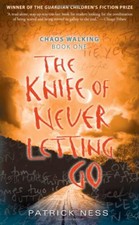
Book Review: The Knife of Never Letting Go by Patrick Ness (Series, #1)
 Summary:
Todd grew up on New World knowing only the constant Noise of other men’s thoughts all around him. He’s never known a world where a boy couldn’t hear his dog talk or where women weren’t all killed off by a horrible plague. Now, mere days before his 13th birthday when he will become a man, his world is turned upside down when his adoptive parents, Ben and Cillian, tell him to run. Run past the swamp. Run and find another settlement. A settlement he never knew existed on New World. He runs with his dog, Manchee, and on the way, they find a creature. A creature whose thoughts they cannot hear.
Review:
This book came recommended to me by three different friends, and I can see based on the summary why they would do so. It’s a dystopia on another planet with talking animals and a narrator who speaks in a mix of rural Americana and British English. The fact is though, I wound up not enjoying this book, and it probably would have been a “did not finish” if I’d had a print copy I could re-sell instead of an ebook I couldn’t. So what’s wrong with it?
Not the world-building. That was truly excellent. The wordle-like clouds of Noise that Todd can hear really bring that aspect of New World to life. Similarly, what the animals say are appropriate to their various evolutionary levels, from Manchee’s partial toddler-like sentences to the herd of elephants who simply say “here” over and over to keep the herd together. Every single scene on New World is easily imaginable in spite of it being quite a foreign location from the buildings to the presence of Noise.
The plot itself isn’t bad but also isn’t amazing. There’s a secret in Todd’s village that we discover at the end of the book that, frankly, did not live up to the build-up. However, that in and of itself doesn’t make me dislike a book. The plot was enough to keep me intrigued, which is the important part, even if in the end it is a bit disappointing.
After much thought I’ve realized that it’s the characters that kept me from enjoying the book, particularly Todd who is also the narrator. I just cannot relate to him at all. I’ve managed to relate to first person narrators ranging from lunatics to serial killers to girly girls to devout Catholics, but Todd is utterly unrelatable to me. He is just so incredibly fucking stupid. Not stupid in the mentally handicapped way. Stupid in the willfully ignorant way that makes me just want to slap him upside the head. For instance, he has this book the whole journey that Ben tells him will explain everything, yet he never sits down to read it. He takes forever to admit he struggles with reading and ask someone else to read it. This is information he needs, and yet he persists in willfully ignoring it. He reminds me of the kids in highschool who wouldn’t do their homework because it wasn’t “cool.” Similarly, I’m sorry, but he’s kind of a pussy, and that irks me. He is fighting not just for himself but for the safety of his dog and another person, but he refuses to man up. I found myself siding with the villains in this regard, and I’m sure that’s not what the author wanted. Similarly, I do not understand why it takes him so long to come around to appreciating Manchee even though he can hear his thoughts from day one and knows that Manchee loves him unconditionally. What the hell, Todd? How are you such an unfeeling idiot, eh? In the end, I simply could not enjoy the book, because although I felt appropriate loathing for the villains, I also loathed the hero and just could not bring myself to care about his plight. The only character I was rooting for at all was Manchee, and that’s not enough to carry a dystopian adventure.
I’m sure there are people out there who can either identify with Todd or empathize with him. For those people who can do so and also enjoy a dystopian adventure, I recommend this book. Anyone who thinks they’ll be even remotely irritated by Todd should stay far away though.
3 out of 5 stars
Source: Amazon

Book Review: The Day of the Triffids by John Wyndham
 Summary:
Bill wakes up in the hospital the day after a worldwide comet show with his eyes still bandaged from a triffid accident. His regular nurse doesn’t show up and all is quieter than it should be except for some distraught murmurings. Shortly he finds out that everyone who saw the comet show has lost their sight, leaving a random bunch of people who just so happened to miss it the only sighted humans left in the world. A hybrid plant created years ago for its highly useful oil, the triffid, is able to walk and eats meat. Swarms of them are now wreaking full havoc on the people struggling to save the human race.
Review:
This book reads like the novelization of a 1950s horror film. Man-eating plants! Dangerous satellite weapons of mass destruction! Humanity being reduced to the countryside! Classic morals versus new morals! This is not a bad thing, and Wyndham seems to be conscious of the innate ridiculousness of his tale, as it possess a certain self-aware wittiness not often present in apocalyptic tales.
Bill is a well-drawn character who is enjoyable as a hero precisely because he is an everyman who is simultaneously not devoid of personality. He is not the strongest or the smartest survivor, but he is just strong and smart enough to survive. Similarly, his love interest, Josella, impressively adapts and changes over time, and their love story is actually quite believable, unlike those in many apocalyptic tales. In fact, all of the characters are swiftly developed in such a way that they are easy to recognize and tell apart. This is important in a tale with so much going on.
On the other hand, the action is stuttering. It never successfully builds to an intense, breaking point. Multiple opportunities present themselves, but Wyndham always pulls the story back just before a true climax. After this has been done a few times, the reader loses the ability to feel excitement or interest in the characters and simply wants the tale to be over. In a way it is almost as if Wyndha couldn’t quite decide which direction to take the action, so took it briefly in all directions instead. This makes for a non-cohesive story that pulls away from the investment in the rich characters.
Additionally, I do not believe the whole concept of the triffids was used to its fullest extent. The name of the book has triffids in it, for goodness sake. I expect them to feature more prominently and fearfully than they do. Perhaps I’ve just read too many zombie books, but the triffids just seem more like a pest than a real threat. The concept of man-eating plants taking over the world is a keen one, and I wish Wyndham had invested more into it.
Overall, the book is a quick, entertaining, one-shot read that could have been much more if Wyndham had made better choices as an author. I recommend it to kitschy scifi and horror fans looking for a quick piece of entertainment.
3.5 out of 5 stars
Source: PaperBackSwap

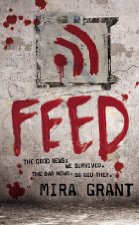
Book Review: Feed by Mira Grant (Series, #1)
 Summary:
Adopted brother and sister Shaun and Georgia Mason are part of the first generation to not remember a world without zombies. The Rising occurred when a cure for the common cold combined with a cure for cancer to create the Kellis-Amberlee virus. Now everyone has dormant KA cells in their body that can be activated anytime they come into contact with the live virus. But that’s not all that’s changed. The Rising led to bloggers becoming the more trusted news source, and Shaun and Georgia are part of the newly important news group of bloggers. Their big break comes when they’re asked to be part of the media team for one of the presidential candidates, and their new job opens a whole world of intrigue.
Review:
I wanted to love this book. I wanted it to be a 5 star read. The world Grant creates is incredibly interesting. Urban and rural structures designed specifically with zombies in mind. Taking blood tests just to enter a town or a hotel as a routine part of your day. The KA virus being in non-zombies as well as zombies. The whole concept of bloggers rocking the media world. (I mean, hello, I’m a blogger. This is a fun idea). Even though I usually find politics dull in books, the politics in this one were actually interesting since so much of the campaigns revolve around the zombie wars.
So why didn’t I love it? The characters. I have serious issues with the two main characters–Shaun and Georgia. There is a creepy, incestuous vibe rampant around the both of them throughout the book that I don’t feel Grant ever sufficiently addresses. They are nearly completely inseparable. Georgia is in her young 20s, Shaun is 19ish, and they still sleep in the same bed together whenever they get the chance to. In their underwear. Neither of them has ever dated anyone, in spite of the fact that the presence of zombies doesn’t keep anyone else their age from dating. The scenes between Shaun and Georgia read like scenese between lovers. He even puts his hand on the small of her back at one point, something that I’ve only ever had men I’m dating seriously do to me. Don’t get me wrong. I can handle incest in a book, but a) Grant skims over it and doesn’t address it and b) it doesn’t seem to serve the storyline here at all. It’s decidedly odd that in a zombie novel, the part that creeped me out had nothing to do with the zombies. See what I’m saying?
Overall, the world-building is excellent, but the characterization takes away from it. If you like reading books purely for the aura of zombie, you’ll enjoy it. Those more interested in the characters should check out The Forest of Hands and Teeth
3.5 out of 5 stars
Source: PaperBackSwap

 Support my work with a tip or browse my shop for curated book club guides, how to guides, cross-stitch patterns, and more!


This work by Amanda Nevius is licensed under a Creative Commons Attribution-Noncommercial-No Derivative Works 3.0 United States License.
 Opinions of a Wolf