
Archive
Book Review: The Keep by F. Paul Wilson (Series, #1) (Bottom of TBR Pile Challenge)
 Summary:
Captain Klaus Woermann isn’t a fan of the Nazis or the SS and doesn’t exactly keep this a secret. But he’s also a hero from the First World War, so the Nazi regime deals with him by sending he and a small troop to Romania to guard a pass the Russians could possibly use. They set up to guard the place in a building known as the keep. It should be a quiet assignment, but when the German soldiers start being killed one a night by having their throats ripped out, the SS is sent to investigate.
SS Major Kaempffer wishes to solve this mystery as soon as possible so he may start his new promotion of running the extermination camp for Romania. He is sure he can solve this mystery quickly.
Professor Cuza and his daughter Magda are Romanian Jews who have already been pushed out of their work in academia. They also just so happen to be the only experts on the keep. When the SS sends for them, they are sure it is the beginning of the end. But what is more evil? The mysterious entity killing the Germans or the Nazis?
Review:
It’s hard not to pick up a book that basically advertises itself as a vampire killing Nazis and the only ones who can stop the vampires are a Jewish professor and his daughter. I mean, really, what an idea! Most of the book executes this idea with intrigue and finesse, although the end leaves a bit to be desired.
The characterization of the Germans is handled well. They are a good mix of morally ethical people who are caught up in a regime following orders and see no way out (the army men) and evil men who enjoy inflicting pain upon others and are taking advantage of the regime to be governmentally sanctioned bullies, rapists, and murderers. Having both present keeps the book from simply demonizing all Germans and yet recognizes the evil of Nazism and those who used it to their advantage.
Similarly, Magda and her father Professor Cuza are well-rounded. Professor Cuza is a man of his time, using his daughter’s help academically but not giving her any credit for it. He also is in chronic pain and acts like it, rather than acting like a saint. Magda is torn between loyalty to her sickly father and desires to live out her own life as she so chooses. They are people with fully developed lives prior to the rise of the Nazis, and they are presented as just people, not saints.
In contrast, the man who arrives to fight the evil entity, Glaeken, is a bit of a two-dimensional deus ex machina, although he is a sexy deus ex machina. Very little is known of him or his motivations. He comes across as doing what is needed for the plot in the moment rather than as a fully developed person. The same could easily be said of the villagers who live near the keep.
The basic conflict of the plot is whether or not to side with the supernatural power that seems to be willing to work against the Nazis. Thus, what is worse? The manmade evil of the Nazis or a supernatural evil? Can you ever use a supernatural evil for good? It’s an interesting conflict right up until the end where a reveal is made that makes everything about the question far too simple. Up until that point it is quite thought-provoking, however.
The plot smoothly places all of these diverse people in the same space. The supernatural entity is frightening, as are the Nazis. These are all well-done.
One thing that was frustrating to me as a modern woman reader was the sheer number of times Magda is almost raped or threatened with rape, and how she only escapes from rape thanks to anything but herself. In one instance, the Nazi simply runs out of time because the train is about to move out. In another, she is saved by a man. In a third, she is saved by supernatural devices. While it is true that rape is a danger in war zones, it would be nice if this was not such a frequently used conflict/plot point for this character. Once would have been sufficient to get the point across. As it is, the situation starts to lose its power as a plot point.
The ending is a combination of a deus ex machina and a plot twist that is a bit unsatisfying. There also isn’t enough resolution, and it appears that the next books in the series do not pick up again with these same characters, so it is doubtful there is more resolution down the road. It is a disappointing ending that takes a turn that is nowhere near as powerful and interesting as the rest of the book.
Overall, this is an interesting fantastical take on a historic time period. The ending could possibly be disappointing and not resolve enough for the reader and some readers will be frustrated with the depiction of the sole female character. However, it is still a unique read that is recommended to historic fiction fans and WWII buffs that don’t mind having some supernatural aspects added to their history.
If you found this review helpful, please consider tipping me on ko-fi, checking out my digital items available in my ko-fi shop, buying one of my publications, or using one of my referral/coupon codes. Thank you for your support!
4 out of 5 stars
Length: 403 pages – average but on the longer side
Source: PaperBackSwap

Book Review: The Underworld King by Ranjit More (Series, #1)
 Summary:
Drumila, four-armed king of the daityas, seeks to take them above ground to escape their enemy the naagas, giant flame-breathing serpents. Meanwhile, Krishna (the highest-ranking god) sends his daughter, Nandini, to Earth in human form to weaken Drumila and keep him from crossing the barrier from Earth into the higher plains. Unfortunately, Nandini ends up liking Drumila a bit more than they bargained for.
Review:
I was excited to have a fantasy based in a non-European mythology submitted to me, and wow is this different from the typical European-based fantasy. In a good way. This is a dense, different fantasy with a strong learning curve unless the reader is already very familiar with Hinduism.
The basic story reads just like mythology. This has pros and cons. On the plus side, it feels quite fantastical. On the minus side, some of the plot points can be cringe-worthy (such as an unwanted kiss that could have turned into a rape if the female character hadn’t suddenly 180ed from zero interest to desire) and the characters can be a bit two-dimensional. This will bother some readers, but those who enjoy mythology, in spite of its shortcomings, will appreciate this read. Personally, I generally prefer if authors update and modernize their mythological rewritings a bit more, but not all readers feel that way.
The author is well-aware that Hindu mythology won’t be familiar to many Western readers, so he offers an extensive footnotes that are well hyperlinked in the ebook that explain both definitions of words and various aspects of Hindu mythology. This means that the reader learns a lot but it does also slow down the reading of the book and breaks up the immersion in the world. The footnotes are a good idea but perhaps if some of the words and concepts were better incorporated and explained within the writing itself then there could be fewer footnotes that offered greater explanations of more value.
The ending is a bit abrupt. It’s clear this is intended to be the first book in a series, but an extremely abrupt ending like this one makes it difficult to feel like the reader got a full book out of the deal. It feels more like the pilot of a tv show than the first book in a series.
I would give this book a more full review, but it has been pulled from publication since the review copy was sent to me. I really wish when authors and/or publishers choose to do this that they would notify those of us with review copies. While I enjoyed the read enough to not regret reading it, it feels rather silly for me to bother reviewing a book no one else can get their hands on anymore.
Overall, this is a fantasy book set firmly in the tradition of Hindu mythology that will best appeal to readers who enjoy the traditional features of mythology and don’t mind an abrupt ending.
If you found this review helpful, please consider tipping me on ko-fi, checking out my digital items available in my ko-fi shop, buying one of my publications, or using one of my referral/coupon codes. Thank you for your support!
3 out of 5 stars
Length: 252 pages – average but on the shorter side
Source: Kindle copy from author in exchange for my honest review
Buy It Currently not available for purchase.
Book Review: Fudoki by Kij Johnson (Bottom of TBR Pile Challenge)
 Summary:
An aging empress decides to fill her empty notebooks before she must get rid of them along with all of her belongings to retire to the convent, as is expected of her. She ends up telling the story of Kagaya-hime, a tortoiseshell cat who loses her cat family in a fire and is turned into a woman by the kami, the god of the road.
Review:
I’m not usually big into fantasy, particularly not ones involving court life, but I am a real sucker for any story involving cats, especially if that cat is a tortoiseshell, since I’m the proud kitty mommy of a talkative tortie. This book didn’t just not disappoint me, it blew me away with two side-by-side, related by different, thoughtful tales.
I had no idea when I picked up the book that the empress would figure into the story quite so much. At first I was a bit irritated that she was a) getting 40% to 50% of the storytime and b) rambling off from one thought to another like elderly people tend to do. But I stayed patient, and I learned that there was more to the empress than met the eye and also that the two stories were actually informing each other. Kagaya-hime’s story shows everything the empress had secretly wished for her whole life, and the empress’s life translated into how Kagaya-hime felt trapped in her human body. It’s artfully done in a subtle way, which is part of what makes it so beautiful.
Kagaya-hime goes from a sad lost kitty with burned paws to a warrior woman, allowed along on a quest for revenge by a moderately elite rural family. She is able to earn respect from the men as a warrior because as a cat she sees no reason not to hunt or defend herself. She is a woman but no one ever took her claws away (though they may be arrows and knives now, instead of claws). Thinking of her is empowering to the empress, who always had an interest in war and politics but was forced to remain literally behind screens in gorgeous gowns that are hard to move in. It’s interesting to note that while the empress may be jealous of Kagaya-hime’s ability to do what she wants and defend herself, Kagaya-hime herself is unhappy because she simply wishes to be a cat again. It is the conclusion to Kagaya-hime’s story that allows the empress to see a conclusion to her own story (her life) that will ultimately make her feel fulfilled.
The details of ancient Japan were clearly meticulously researched. Johnson smoothly writes about the outfits, land, and battles as if she was there for them herself. The information never comes through as an info dump but instead is something that simply is, that the reader learns about naturally just by venturing into Kagaya-hime and the empress’ world. This is what knowing your history inside and out before starting writing does for historic fiction. It makes history come to life.
Overall, this is a stunning piece of historic fiction the reading of which feels like slowly sipping a well-made matcha latte. Fans of historic fiction of all sorts will be engaged, those that love cats will be enthralled, and those with an interest in women’s history will be enamored and touched by how much things change and yet still stay the same for women. Recommended to all who think they might even possibly be interested in a piece of historic fiction set in Japan featuring an aging empress and a shape-changing cat.
If you found this review helpful, please consider tipping me on ko-fi, checking out my digital items available in my ko-fi shop, buying one of my publications, or using one of my referral/coupon codes. Thank you for your support!
5 out of 5 stars
Length: 316 pages – average but on the longer side
Source: Better World Books

Book Review: Charlotte Sometimes by Penelope Farmer (Series, #3) (Bottom of TBR Pile Challenge)
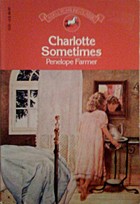 Summary:
When Charlotte goes away to boarding school for the first time, she’s very excited to get the bed with the particularly pretty wheels right next to the window. When she wakes up, though, the view from the window looks different, and people are calling her Clare! She discovers she’s traveled back in time to the same bed in the same boarding school, but during World War I. The next morning, though, she wakes up in the present again as Charlotte. This pattern continues, meaning both she and Clare are Charlotte….sometimes.
Review:
I picked this book up because I have an affinity for both boarding school books and time-travel books. This looked like the best of both worlds to me. A fun middle grade book that introduces to the reader to two different past time periods–the late 1960s of Charlotte’s present and the nineteen-teens of Clare’s present.
This book is the third in a series, but it is completely possible to read it as a standalone. No mention is made of the events in the first book, and the second book is actually about what Charlotte’s little sister does while she’s away at boarding school.
The concept is intriguing, because instead of time-travel happening once and landing the person stuck in the past (or future), Charlotte keeps switching, spending every other day in the 60s and every other day in the teens. (I get a migraine when the barometric pressure changes….I can only imagine how I’d feel if I time travelled! Do you think I could bring my green lamp therapy with me?)
In addition to the usual issues time-travel books bring up, such as what stays the same and what is actually different throughout time, it also brings up the key question of identity. What makes Charlotte Charlotte? Is she still Charlotte when she’s being called Clare? Why does hardly anyone notice that Clare has changed? Or Charlotte for that matter? The book thus addresses identity issues that middle grade readers might be going through, but in a subtle way through the time-travel trope.
Were you some particular person only because people recognized you as that? (page 66)
The time-travel itself is left as a fantastical mystery, rather than being given a scientific explanation. There’s something magical about the bed that only makes Charlotte and Clare switch places, but no one else. This works without an explanation because the young girls being subjected to the time-travel just accept it without explanation. This is their reality, and it doesn’t matter why it’s happening, they just have to deal with it. Some readers, though, might struggle with the fact that the time-travel itself is never explained.
The one thing that disappointed me about the book, and that I think would have made it a classic and a five star read, is that the book only explores what happens to Charlotte when the girls switch places. Clare, her experiences, and her perspective are only heard about through third parties. The book, while in third person, is entirely Charlotte’s perspective. Clare, a reserved, proper girl from the nineteen-teens must have been shocked by both the technology and the mores of the 1960s she suddenly found herself in. So much more could have been explored by telling both Charlotte’s and Clare’s story. The book misses an opportunity by only focusing on the modern day girl going back in time. The girl being thrust into the future, a future where she finds out Britain wins the war, and there is suddenly no food rationing or flu epidemic, that is such a cool story in and of itself, and Farmer just never ventures out to tell it.
Interestingly, the British band The Cure released a song called “Charlotte Sometimes” that they admitted was pulled directly from this book. Not just the title, but song lyrics are pulled from the first couple of lines of the book. Even the music video features scenes from the book. It seems to be quite a mystery who the actress was who played Charlotte in the video. She wasn’t credited, and there’s a lot of posts on the internet with people speculating about who she might be. In any case, Penelope Farmer was…not amused by the whole thing. But back to the book.
Overall, this is a book that sets up a fantastical world of time-travel within a boarding school. It utilizes the switching of two girls with each other in time to explore questions of identity in a way that surely will appeal to many middle grade readers. The book does not fully explore the story the way it possibly should have, but the young reader will probably enjoy filling in those gaps themselves. Recommended to all fans of boarding school, time-travel, or historic fiction set during World War I’s homefront.
If you found this review helpful, please consider tipping me on ko-fi, checking out my digital items available in my ko-fi shop, buying one of my publications, or using one of my referral/coupon codes. Thank you for your support!
4 out of 5 stars
Length: 174 pages – average but on the shorter side
Source: Better World Books

Previous Books In Series:
The Summer Birds
Emma in Winter


Edit note: Thanks to Vicky for pointing out it was published in 1969.
Book Review: The Golden Torc by Julian May (Series, #2)
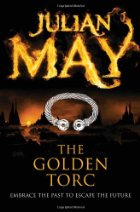 Summary:
The group of people who traveled from the future to the Pliocene past for a willful exile were split into two by the alien race, the Tanu, who, surprisingly, inhabits Earth. Half were sent to slave labor, while the others were deemed talented at mind powers, given necklace-like torcs to enhance those powers, and sent to the capital city of Muriah. In the first book, we followed the daring escape of the group sent into slavery. They then discovered that the Tanu share the Earth with the Firvulag–an alien race from their home planet that has many similarities to their own. They also organized an attack on the industrial city of Finiah. This book at first follows the adventures of the other group, the one sent to the capital city of Muriah. Through them we discover the inner workings of the Tanu, the intersections of humans and aliens, and the impact of the human/Firvulag attack on Finiah. When the time for the Great Combat between the Tanu/human subjects and the Firvulag arrives, the survivors of the escaped slave group end up coming back into contact with the group of humans in Muriah. With dire consequences.
Review:
I really enjoyed the first book in this series, finding it to be a delightful mash-up of scifi and fantasy. When I discovered my library had the next book in the series, I picked it up as quickly as possible. This entry feels more fantastical than the first, although science definitely still factors in. It is richer in action and intrigue and perhaps a bit less focused on character development.
This is a difficult book to sum up, since so very much happens. It’s an action-packed chunkster, providing the reader with information and new settings without ever feeling like an info-dump. The medieval-like flare of the Tanu and the goblin/fairie/shapeshifter qualities of the Firvulag are stronger in this entry, and it is delightful. Creating a medieval world of aliens on ancient Earth is probably the most brilliant part of the book, followed closely by the idea of torcs enhancing the brain’s abilities. May has created and weaved a complex, fascinating world that manages to also be easy enough to follow and understand. The sense of the medieval-style court is strong from the clothing, buildings, and organization of society. She doesn’t feel the need to willy-nilly invent lots of new words, which I really appreciated.
The intrigue is so complex that it is almost impossible to summarize, and yet it was easy to follow while reading it. Surprises lurk around every corner, and May is definitely not afraid to kill her darlings, following both William Faulkner’s and Stephen King’s writing advice. A lot happens in the book, the characters are tested, and enough change happens that I am excited there are still two more books, as opposed to wondering how the author could possibly tell more story. In spite of the action, sometimes the book did feel overly long, with long descriptions of vegetation and scenery far away from where most of the action was taking place.
The book is full of characters but every single one of them manages to come across as a unique person, even the ones who are not on-screen long enough to be fully three-dimensional. The cast continues to be diverse, similarly to the first book, with a variety of races, ages, and sexual preferences represented. I was surprised by the addition of a transwoman character. She is treated with a mix of acceptance and transphobia. I think, certainly for the 1980s when this was published, it is overall a progressive presentation of her. She is a doctor who is well-respected in Tanu society. However, she also is presented as a bit crazy (not because of being trans but in addition to being trans), and it is stated by one character that she runs the fertility clinic because it is the one part of being a woman that will always be out of her grasp. I am glad at her inclusion in the story but readers should be aware that some aspects of the writing of her and how other characters interact with her could be considered problematic or triggering. I would be interested to hear a transperson’s analysis of her character.
Overall, this entry in the series ramps up the action and more thoroughly investigates the world of the Pliocene Exile. Readers disappointed by the lack of information on the half of the group heading to the capital city in the first book will be pleased that their story is told in this one. Characters are added, including a transwoman doctor, and all continue to feel completely individual and easily decipherable, in spite of the growing cast list. The fast action pace sometimes is interrupted by lengthy descriptions of settings far away from the action, but overall the chunkster of the book moves along at a good pace and remains engaging. Recommended to fans of fantasy who want a touch of science in their stories and who are interested in the idea of medieval aliens.
4 out of 5 stars
Source: Library

Previous Books in Series:
The Many-Colored Land
Book Review: Annihilation by Jeff VanderMeer (Series, #1) (Audiobook narrated by Carolyn McCormick)
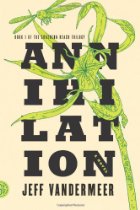 Summary:
Nobody quite knows what is wrong with Area X, but everyone has their speculations. It’s been cut off from the rest of the world for decades, and the government has kept precisely what is going on rather hush-hush. The government periodically sends teams in to investigate it. The narrator, a biologist, is part of Team 12. The team is entirely made up of women, based on a supposition that women are less badly effected in Area X than men. The biologist’s husband was part of Team 11. She is curious to know what happened to him but also entirely intrigued by the tunnel her team finds. She insists on calling it a tower. Through her mandatory journal, we slowly discover what may or may not be in Area X.
Review:
I picked this book up since it sounded like it would be a mix of scifi and Lovecraft style fantasy, plus it features an entirely female investigative group. Although it is an extremely interesting premise, the actual book does drag a bit.
The biologist narrates in a highly analytical way that is true to her character but also doesn’t lend itself to the building of very much tension. Since the biologist calmly narrates everything, the reader stays calm. She also, frankly, isn’t an interesting person due to this same tendency to view everything through an analytical lens. Imagine if Star Trek was 100% written by a Vulcan, and you can begin to imagine the level of ho-hum.
This narration style could have really worked if the language used was stunningly beautiful. While I think that’s probably what the author was going for, it largely missed for me. While the language was good, there was also nothing particularly special about it. I marked three passages that I enjoyed throughout the whole book. Looking back, two were extremely similar. The passage I found to be the most beautiful is:
That’s how the madness of the world tries to colonize you. From the outside in. Forcing you to live in its reality. (time 3:15:47)
While pretty, it’s not pretty enough to make up for the rather dull narrator.
Since the story has four women to work with, it probably would have worked better to bounce around between their four narratives. This also would have given the bonus of seeing the mysteries of Area X through multiple sets of eyes, enhancing the tension the mystery, while also giving the opportunity for a variety of narration styles.
The mystery of Area X is definitely intriguing and different from other Lovecraft style fantasies. In particular, the passage describing the terror of seeing the thing that cannot be described was particularly well-written. However, the passages describing the horror in Area X are mostly toward the end of the book and are not as well spaced-out as they could have been to help build the tension. The end of the book is definitely the most interesting and managed to heighten my interest enough that I was curious about the next book in the series.
Overall, this is a unique take on the idea of a scientific investigation of an area invaded by Lovecraft style, fantastical creatures. It features an entirely female investigative crew but unfortunately limits itself to only the narration of one overly analytical and dull biologist. Recommended to big fans of Lovecraft/fantastical invasion style fantasies. To those newly interested in the genre, I recommend checking out Bad Glass
3 out of 5 stars
Source: Audible

Book Review: The Many-Colored Land by Julian May (Series, #1) (Audiobook narrated by Bernadette Dunne)
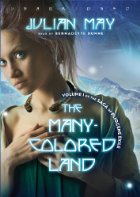 Summary:
In the future, the universe exists in a peace-loving era that allows many alien races and humans to co-exist. People are expected to act within the confines of acceptability and are offered various humane treatment options to help if their nature or nurture sends them the wrong way. But some people don’t want to conform and would rather live in the wild, warrior-like days of old. When a scientist discovers time travel but only to the pliocene era, these people think they have found their solution. There’s only one catch. The time travel only works to the past. For decades the misfits step into the time travel vortex, not knowing what is on the other side. The government approves the solution, since it seems kind and no time paradoxes have occurred. When the newest group steps through, they will discover just what really waits on the other side of exile.
Review:
I became aware of this book thanks to a review by fellow book blogger, Resistance Is Futile. Imagine my surprise when going through my wishlist to check for audiobooks, I discovered a brand-new audiobook production of it featuring the audiobook superstar Bernadette Dunne. This is a creative, action-packed book that truly encompasses both scifi and fantasy in a beautiful way.
Since this is the first book of the series, it takes a bit to set the plot up and get to know the characters. People are sent through the time travel portal in groups, so we get to know everyone in one group prior to going through the time portal so we can follow them all after they go through it. May spends the perfect amount of time familiarizing the reader with the future world, as well as the people who are choosing to leave it. Some readers might be sad to see the imaginative future world left behind for the pliocene era, but it quickly becomes evident that the pliocene is just as richly imagined, albeit different. The pliocene era is not as straight-forward as the exiles believed, and new problems quickly arise for them. It’s not the lawless paradise they were envisioning, and while dealing with the realities of it in an action-packed manner, they also must deal with themselves. Now that they realize there is no true escape to solitude or an imagined perfect past, they must address those aspects of themselves that led them to exile in the first place. These deeper emotional issues are the perfect balance to the other, action-oriented plot. I did feel that the book ends a bit abruptly. However, it is part of a series and clearly the cliff-hanger is intentional. I prefer series entries that tell one complete smaller story within the larger, overarching plot, but this is still a well-done cliff-hanger.
The characters offer up a wide variety of experiences and ethnic and sexual backgrounds, representative of all of humanity fairly well. One of the lead characters is a butch lesbian, another is an elderly Polish-American male expert in the pliocene era, another a nun, another a frat boy style space captain. This high level of diversity doesn’t seem pushed or false due to the nature of the self-selection of exiles. It makes sense a wide variety of humans would choose to go, although the statistics presented in the book establish that more whites and Asians than Africans and more men than women choose to go. Some of the characters get more time to develop and be presented in a three-dimensional nature than others but enough characters are three-dimensional that the reader is able to become emotionally invested in the situation. My one complaint was in prominently featuring a nun in a futuristic scifi, yet again. Statistics show that less and less people are choosing to become nuns or priests. Given that this is set so far in the future with such a different culture, a religious leader of a new or currently rising religion would feel much more thoughtfully predictive of the future.
Most engaging to me is how the book mixes scifi and fantasy. Without giving too much away, the book offers a plausible scientific explanation for human myths of supernatural creatures such as fairies, elves, and shapeshifters. The presence of the inspirations for these myths give a delightful, old world fantastical feel to the story, even while May offers up scientific explanations for all of it. This is not a mix I have seen in much scifi or fantasy, and I was surprised at how much I enjoyed it.
Overall, this is a delightful new take on time-travel that incorporates some fantasy elements into the scifi. Readers looking just for futuristic hard scifi might be disappointed at how much of the book takes place in the ancient past, but those who enjoy scifi and fantasy will delight at the mixing of the two.
4 out of 5 stars
Source: Audible
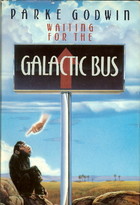
Book Review: Waiting For the Galactic Bus by Parke Godwin (Series, #1) (Bottom of TBR Pile Challenge)
 Summary:
When two brothers from an incorporeal alien species get left behind on a spring break visit to prehistoric Earth, they decide to put their, as yet uncertified, evolutionary development skills to work by prodding along the the evolutionary process on Earth. In doing so, they accidentally create a species with a spirit tied to a body for a certain amount of time that then is tied to the idea of an afterlife. They also manage to turn themselves into Earth’s spiritual mythology.
Review:
An ingenious take on the aliens made humans concept with two overlapping plots, a tongue-in-cheek take on world religions, and a wry wit.
This take on aliens made humans makes humans the result of the bumbling activities of aliens from a species that controls evolution in the universe. However, these aliens are currently uncertified, unsupervised, and basically the frat boys of outerspace. At least at first. Thus, instead of it all being some evil experimental conspiracy, the direction of life on Earth is much more of an accident of floundering fools. Granted, the fools grow and change over the time that they spend on Earth waiting for their ride back from spring break, but the fact remains that evolution on Earth is a result of the experiments of two aliens who are not yet fully trained. This is also used to explain the phenomenon of souls in bodies and then souls that have an afterlife. All other species have souls that can either choose to be in or not in a corporeal body. This is the result of the two aliens, Barion and Coyul, not staying within the rules of evolution.
We thus get to the other really creative part of the book. Since the souls are unfotunately tied to bodies that die, when the bodies die, the souls don’t know what to do or where to go, and so humanity creates the idea of the afterlife, with the two aliens serving as the rulers of the two options (again, created by humans). The aliens thus are kind of forced into the roles of God and Satan. The way afterlives go, though, is generally more the result of what the various humans think it will be or think they deserve. The aliens have mostly tried to stay out of the way, but when they hear rumblings that remind them on the beginning of the nightmare that was Nazi Europe in the American midwest, they decide to dive on in and try to fix it.
Clearly the plot and setting are extremely engaging and thought-provoking. I could truly talk about them for hours. They are creative and a vision of the world I enjoyed visiting. The characterization of the two aliens is a bit weak though. I mixed them up a lot, constantly forgetting who was God and who was Satan. I honestly can’t remember right now if Barion or Coyul plays Satan. I wish they had been characterized more clearly, as this would have strengthened the story.
Overall, this is a unique take on aliens creating humans, featuring a rollicking and thought-provoking plot. The characterization can be a bit weak but the action-packed plot and vibrant setting generally make up for it. Recommended to scifi or fantasy fans looking for an extraterrestrial take on mythology.
4 out of 5 stars
Source: PaperBackSwap

Book Review: Doctor Sleep by Stephen King (Series, #2) (Audiobook narrated by Will Patton)
 Summary:
Danny Torrance didn’t die in the Overlook Hotel but what happened there haunts him to this day. Not as much as the shining does though. His special mental powers that allow him to see the supernatural and read thoughts lead to him seeing some pretty nasty things, even after escaping the Overlook. He soon turns to drinking to escape the terror. But drinking solves nothing and just makes things worse. When he sees his childhood imaginary friend, Tony, in a small New Hampshire town, he turns to AA to try to turn his life around and learn to live with the shining.
Abra is a middle school girl nearby in New Hampshire with a powerful shine. She sees the murder of a little boy by a band of folks calling themselves the True Knot. They travel in campers and mobile homes, seeking out those who have the shine to kill them for it and inhale it. They call it steam. They’re not human. And they’re coming after Abra. Abra calls out to the only person she knows with a shine too, the man she’s talked to before by writing on his blackboard. Dan.
Review:
A sequel that takes the original entry’s theme on overcoming your family origin and ramps it up a notch, Doctor Sleep
The book begins with a brief visit to Danny as a kid who learns that the supernatural creatures exist in places other than the Overlook, and they are attracted to the shine. This lets the reader first get reacquainted with Danny as a child and also establishes that the supernatural are a potential problem everywhere. The book then jumps aggressively forward to Danny as a 20-something with a bad drinking problem. It’s an incredibly gritty series of scenes, and it works perfectly to make Dan a well-rounded character, instead of a perfect hero of the shine. It also reestablishes the theme from The Shining
The way Dan overcomes both his drinking and his temper, as well as how he learns to deal with his shine, is he joins Alcoholics Anonymous (AA). In contrast to his father who tried to quit drinking on his own, Dan attempts it in a group with accountability. This then shows how much easier it is to overcome a mental illness with community support. I appreciated seeing this. I will say, however, that some of the AA talk in the book can get a bit heavy-handed. Some chapter beginnings include quotes from the book of AA, and Dan can sometimes seem a bit obsessed with it when he relates almost everything to something he learned or heard there. AA definitely plays a vital role in many people’s recovery from addiction, and it’s wonderful to see that in a work of fiction. However, it would have been better for the reader to see the role of AA more than to hear quotes from AA so often.
The big bad in this book is a band of supernatural creatures who were once human and still look human. But they change somehow by taking steam and go on to live almost indefinitely. They can die from stupid accidents and sometimes randomly drop dead. The steam is acquired by torturing children who have the shine. The shine comes out of their bodies as steam when they are in pain. They call themselves The True Knot. This troop is a cartoonish group of evil people who try to look like a troop of retirees and some of their family traveling in a camper caravan. The leader of this group is Rose the Hat–a redheaded woman who wears a top hat at an impossibly jaunty angle. I was pleased to see Rose written quite clearly as a bisexual. Her sexuality is just an aspect of who she is, just like her red hair. Seeing a bi person as the big bad was a delight. Her bisexuality isn’t demonized. Her actions as a child killer and eater of steam are. She is a monster because of her choices, not because of who she is. I alternated between finding The True Knot frightening and too ridiculously cartoonish to be scary. I do think that was partially the point, though. You can’t discredit people who seem ridiculous as being harmless.
How Abra is found by The True Knot, and how she in turn finds Dan, makes sense within the world King has created. It doesn’t come until later in the book, though. There is quite a bit of backstory and build-up to get through first. The buildup is honestly so entertaining that it really didn’t hit me until after I finished the book how long it actually took to get to the main conflict. So it definitely works. Abra is a well-written middle school girl. King clearly did his research into what it’s like to be a middle schooler in today’s world. Additionally, the fact that Abra is so much older than Danny was in The Shining
There is one reveal later in the book in relation to Abra that made me cringe a bit, since it felt a bit cliche. It takes a bit of a leap of faith to believe, and I must admit it made me roll my eyes a bit. However, it is minor enough in the context of the overall story that it didn’t ruin my experience with the book. I just wish a less cliche choice had been made.
The audiobook narrator, Will Patton, does a phenomenal job. It was truly the best audiobook narration I’ve heard yet. Every single character in a very large cast has a completely different voice and style. I never once got lost in who was speaking or what was going on. More importantly to me, as a New England girl born and raised, is that he perfectly executes the wide range of New England accents present in the book. Particularly when he narrates the character, Billy, I thought I was hearing one of my older neighbors speak. I could listen to Will Patton read a grocery list and be entertained. Absolutely get the audiobook if you can.
Overall, this sequel to The Shining
4 out of 5 stars
Source: Audible

Previous Books in Series:
The Shining
Counts For:

Book Review: The Reflections of Queen Snow White by David C. Meredith
 Summary:
Snow White lived decades of her happy-ever-after, but when Charming dies she is sent reeling into a depression. Not even their daughter, Raven’s, upcoming marriage can snap Snow White out of it. When wandering the halls of the castle, desperately seeking to be alone, she re-enters her old step-mother’s quarters. Now covered in dust, she discovers her stepmother’s magic mirror, which she never knew about before. The discovery will have far-reaching consequences.
Review:
This is my first read of the 12 indie books I accepted for review here in 2014 (see the whole list). I surprised myself a bit, reaching first for the fantasy, but I was in the perfect mood for a slightly pensive retelling of a fairy tale. The book takes an interesting angle for retelling the story, jumping ahead to Snow White’s elderly years, but it unfortunately doesn’t reimagine Snow White herself quite enough.
The narrative choice of having an elderly Snow White discover her stepmother’s magic mirror that then forces her into introspection on herself and her life is a great idea that works well. We already all know the end of the fairy tale, so flipping it on its head to start at the end addresses that fact head-on. Now the question isn’t, will this fairy tale end the way all the other retellings do. Instead, it looks on a psychological level at the impact of Snow White’s early years on her later ones. It also is an interesting way to address end of life issues. Snow White is elderly and stuck in a bit of a rut. She’s uncertain how to go on without her husband of so many years. These are relevant issues that don’t get addressed often enough in literature, and re-using the Snow White fairy tale to look at them works wonderfully. It thus is a familiar story and setting with a different focus, which is a great tact to take for a fairy tale retelling.
Snow White herself, however, hasn’t been tweaked enough to make for an interesting heroine. I admit, I was hoping for someone who either had found or would find her own strength. The Snow White we see in Disney and other retellings really is a bit of a shrinking violet. This Snow White stays that way. Over and over she is the helpless girl who must be rescued by others. She doesn’t flee the castle, someone else tells her, practically forces her to. She is then saved first by the dwarves and then by Charming. Later in her life, after leaving the official fairy tale, we find that she is a simpering clueless virgin on her wedding night who must be guided by Charming. Then even later she is heinously assaulted by some ladies of her court, and she again must be saved by someone else. Even in the end of her life, she doesn’t pick herself up and continue on. A magic mirror knocks some sense into her. Because fairy tales often remove so much agency from the “good” women in them (only evil women are allowed agency), I prefer to see retellings give the women more agency. Snow White could still have the character flaw of being a bit timid and eventually learn how to save herself. It’s not an all-or-nothing scenario. The way Snow White and her story is presented here reads a bit too traditionally medieval. I want a retelling to take me new places with the character, not extend the same ones.
This issue alone would have led me to give the book 4 stars, but, unfortunately, the book is riddled with spelling and grammar errors. I only marked the most egregious ones, and I still had 12 on my list. Issues such as saying someone laid down in the floor, instead of on the floor (loc 2302), putting the apostrophe in the wrong place (“princes’ tongue” instead of “prince’s tongue” (loc 1315) ), and just flat-out using the wrong word (“followed suite” instead of “followed suit” (loc 1084) ) sorely damaged my enjoyment of the novel. I don’t expect perfection from authors or editors, we are all human, but more than a few errors is something that truly negatively impacts the reading of the novel.
Overall, this retelling of Snow White takes the interesting angle of focusing on the end of her life. This allows the author to explore issues relevant to the elderly, such as losing long-term loved ones and coming to terms with the path your life has taken. Although this plot gives the fairy tale a new focus and extended plot, Snow White herself has not been updated at all. She is still the simpering violet who must be saved by all around her. Some readers may be bothered by the number of errors in the spelling and grammar in the book. Recommended to fans of traditional fairy tales with only a slight twist who won’t be bothered by a lack of editing for spelling and grammar.
3 out of 5 stars
Source: kindle copy from author in exchange for my honest review

 Support my work with a tip or browse my shop for curated book club guides, how to guides, cross-stitch patterns, and more!


This work by Amanda Nevius is licensed under a Creative Commons Attribution-Noncommercial-No Derivative Works 3.0 United States License.
 Opinions of a Wolf