
Archive
Book Review: The Wind Through the Keyhole by Stephen King (Series, #4.5)
 Summary:
There’s a tale we have yet to hear about the ka-tet in the time between facing the man in the green castle and the wolves of the Calla. A time when the ka-tet hunkered down and learned a special billy-bumbler talent, an old tale of Gilead, and the first task Roland faced as a young gunslinger after the events at Mejis.
Review:
When I heard there was going to be a new Dark Tower book, I had basically three reactions. 1) Yay! 2) Shit he better not ruin them. 3) Guess I didn’t actually finish that series after all, did I? May have written the series review a bit too soon…..
But mainly my reaction was a skeptical excitement. I love the world of the Dark Tower and was ecstatic to be able to get more of it (yes, I know there are the young gunslinger comic books, but they feel slightly less the same to me since they are in a different format). However, I was also terrified because well we’ve all been in an instance where we mess with something that was good to the point where it’s not good anymore, right? I was worried King was going to do that to the Dark Tower. I am so so so happy to be able to say that worry was unfounded.
This book goes to show just how clearly the entire world of the Dark Tower series exists in King’s mind. The format is a story within a story within a story. The ka-tet have to hunker down to wait out a storm, so Roland starts to tell them a story from when he was a young gunslinger. Within that story, the young Roland tells someone else an old story of Gilead. The Gilead story wraps up, then the young gunslinger, then the ka-tet. A writer must know his world very well to be able to handle such a structure smoothly without confusing his reader, and King does just that. There was no confusion and each story felt fully told. Or as fully told as anything is in the world of the Dark Tower.
I’ve said before that every book in the series basically is a different genre, which is part of what makes it so fun. So what genre is this one? I’d say it’s fairy tales. Once upon a times. And fairy tales generally have a lesson to be learned within them, so what is it in these three? Well, they vary, but I would say overall it’s about leaving aside childish things and childish ways to become an adult. (And, I might add, that happens much much earlier in the Dark Tower than it does in our particular world).
I will say, although I certainly had the impression that this book was going to be about Jake and Oy, it really isn’t. It isn’t much about the ka-tet at all. It’s about Roland and the role of billy-bumblers in the world. Although, personally I wanted more billy-bumblers, but I *always* want more billy-bumblers, because they are definitely my favorite fantastical creature. I’m still holding out hope that King will write something sometime entirely about Oy or billy-bumblers. But this book is not it.
That said, I was oddly not disappointed to see far less of the ka-tet than I was expecting, because the two stories within the frame of the ka-tet are so strongly told. They are just….wow. Terrifying, horrifying, unpredictable, and hilarious simultaneously.
That’s the thing that makes any Dark Tower book fun. It contains all of those things.
Lines can go from laugh out loud humor (with a touch of truth):
Turn yer ears from their promises and yer eyes from their titties. (page 43)
To the starkly sad truth:
Those were good years, but as we know—from stories and from life—the good years never last long. (page 110)
To the simply universal:
“What if I fail?” Tim cried.
Maerlyn laughed. “Sooner or later, we all do.” (page 255)
*shrugs* I admit I’m a bit of a fan girl of the series, but even a fan girl can be sorely disappointed, and I was really and truly not disappointed at all. I laughed, I nodded, I wondered, I quaked, I wished for an illustration sometime somewhere of billy-bumblers dancing in a clearing in the moonlight. Although, speaking of illustrations, how gorgeous is the US kindle cover?! So fucking gorgeous, that’s how.
Back to the point, I was not disappointed at all. I was ultimately elated and wishing for more. And other fans will be too.
5 out of 5 stars
Source: Amazon
Books in Series:
I’m listing all of the books so you can easily see where The Wind Through the Keyhole
The Gunslinger
The Drawing of the Three
The Waste Lands
Wizard and Glass
The Wind Through the Keyhole
Wolves of the Calla
Song of Susannah
The Dark Tower
Series Review (written before we knew there would be more)
Book Review: Haunted by Glen Cadigan
 Summary:
Mark is an Iraq War vet with PTSD, so he counts himself lucky when a Gulf War vet gives him the chance to be a security guard at an office tower. Unfortunately, he’s the night watchman, and he doesn’t seem to be alone in the tower.
Review:
This is a unique, sympathetic story idea that is not as well-executed as it deserves.
Mark is ultimately a well-rounded character, but it takes too long to get to know him in this novella. Since it is in first-person narrative, he has the option of holding off on telling us about his PTSD symptoms and how they affect him. While a soldier would certainly most likely be more stoic in a traditionally masculine way, it gets in the way of the reader understanding where Mark is coming from and empathizing with him. He *tells* us that his PTSD makes his life difficult, but we don’t really ever see it.
Because this is a first person novella, this problem with the characterization gets in the way of the strengths of the scifi/fantasy plot, which is honestly fairly unique. I was glad I got to the end and saw the surprise reveal, but I certainly wasn’t expecting such a good twist from the rest of the book.
Essentially, the scifi/fantasy element of the book is strong, but the characterization at the center of the first person narrative is weak. Although Mark is a soldier, Cadigan shouldn’t be afraid to let us see the vulnerability of his PTSD. Recommended to fans of a unique ghost story looking for a quick read.
3 out of 5 stars
Source: Kindle copy from author in exchange for my honest review

Counts For:
Book Review: Acacia: The War With the Mein by David Anthony Durham (Series, #1) (Bottom of TBR Pile Challenge)
 Summary:
The Akarans have ruled the Known World for twenty-two generations, but the wrongfully exiled Meins have a bit of a problem with that. They enact a take-over plot whose first action is assassinating the king. Suddenly his four children are flung to different parts of the Known World in exile where they will need to come to terms with who they are, who the Mein are, and the wrongs past generations of Akarans committed in order to help the Known World make a change for the better.
Review:
I have a big announcement to make. Huge even. THIS IS THE FIRST HIGH FANTASY BOOK I HAVE LOVED. There. I said it! And it’s true.
I wish I had some vague idea of how this ended up on my TBR pile. The only clue I have is that I acquired it via PaperBackSwap, so I know I got it very intentionally after reading a review or something somewhere. But where? And why? Who knows! It was entirely out of my comfort zone, took me much longer than my norm to read (over two weeks according to GoodReads), and yet. I loved every moment of it.
A momentous occasion such as this obviously leaves me asking why. Why when I generally am irritated by most high fantasy did this one not just not bug me but worm its way into my heart? This is a key question, because it’s something that helps stories cross genres. I do have an answer, but of course it has many elements.
First, although this primarily depicts a war, no side is depicted as pure evil or good. Both sides have good points and flaws. Good people work for both. Bad people work for both. The Akaran king isn’t a bad guy per se, but he’s allowing things to happen under his rule that are bad. The Meins have a just cause, but they do horrible things in the process of achieving that cause. This realistic complexity is something that I have found to be sorely missing in other fantasy. The Known World is its own fantastical place with its own cultures and history, but it is realistic in the fact that everything is complex and nothing is clear-cut.
Second, the female characters are incredibly well-written. They are well-rounded, strong and yet vulnerable. Beautiful and yet terrifying. They are innately a part of the world depicted, not just princesses in a tall tower or the girl at the side of the field whose beauty inspires the men. Women are historically a part of the Akaran army, and the two Akaran princesses have strengths and flaws of PEOPLE. They are not “female flaws.” They are people who happen to have vaginas. It is some of the best writing of women I’ve seen from a male writer in a while.
Third, the Known World is complex and eloquently imagined, yet clear and easy to understand. It is its own thing, but it is similar enough to our own real world that I wasn’t left grasping for straws trying to understand things. People in cold climates are pale, and people in deserts are dark. The animals range from recognizable horses and monkeys to fantastical creatures that are a mix of rhinoceroses and pigs. It is creative yet fathomable.
Finally, the storyline is complex. I could not predict what was going to happen next at any moment, really. The ending caught me completely by surprise, and I am baffled as to what Durham will be doing with the middle book of the trilogy. Baffled and impatient.
My god. I love a fantasy story.
Overall, this is now the book I will hold up when people ask me what is good fantasy. It is what leaves me with hope for the genre that it can be more than pasty white men wishing for a patriarchal past of quivering ladies in waiting and knights fighting dragons. Fantasy can imagine a world where some things are better than ours, and yet other things are worse. It can be a reflection of our own world through a carnival mirror. Something that makes us think hard while getting lost. I highly recommend it to anyone looking for those things in their reading.
5 out of 5 stars
Source: PaperBackSwap


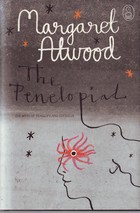
Book Review: The Penelopiad by Margaret Atwood
 Summary:
Hopefully anyone who’s read The Odyssey
Review:
I’ve taken to loading an audiobook on my ipod for those frequent times when I either have to walk from a T stop or am crammed onto a train with literally no elbow-room to hold onto my kindle. I was excited to see this on the shelf at my library, since I had decided rather spur of the moment to pick one up, and I do love Atwood. Plus, this is only three discs long, which is good for my audiobook attention span.
For me the story ultimately fails, although I don’t blame Atwood for that. The thing is, Penelope, to a modern woman, is kind of pathetic. It’s not easy to make her into a heroine we can root for, the way we can root for Odysseus. Ok, so he’s a womanizer and a liar, but he’s also brilliant and hilarious. The kind of guy you want to be friends with, but don’t want to date. Yet Penelope not only is married to him, but has never stood up to him. Even when he’s been gone for years and years fighting in a war. Atwood is a great writer, but that’s just not a situation you can fix. I completely get Atwood’s fascination with Penelope’s story, not to mention the 12 maids. I don’t think any woman can read The Odyssey
Penelope comes across as a woman who lived in tough times to be a woman, yes, but who never does anything really to fight the status quo. She can’t even bring herself to stand up to the elderly maid who takes the run of her household. Plus, she willingly puts her maids into situations where they are likely to get raped (indeed, do get raped) and then doesn’t stand up for them when her wayward husband finally comes home. Is it within character? Sure. Is it something that holds up as the main focus of a story? Nope.
I did enjoy Atwood’s modern take on the Greek chorus using the dead 12 maids. I appreciate her choice to include a chorus in the book, as well as how she played with different ancient and modern music styles. It even left me wishing the maids were the focus of the book instead of Penelope! Of course, interspersing music between chapters is something I’ve seen Atwood do before in The Year of the Flood
So what does this all ultimately mean? Atwood’s writing style is creative and pleasant as always, but the topic of the book just isn’t. I think the constraints of who Penelope is from such an ancient story placed a sour note on Atwood’s work that normally isn’t there. It’s an interesting exercise, but not one I found particularly enjoyable to read. I was more interested in it as an academic exercise. If you’re a fan of retellings of the classics, you’ll be intrigued by it.
3 out of 5 stars
Source: Public Library

Book Review: The Broken Sword by Joseph Robert Lewis (Series, #2)
 Summary:
The international bunch from the first book is back, this time with their lives intersecting in Espani. Taziri is now flying the Halycon 2, which is an airplane instead of an airship. Major Zidane is working as flight security, and Keenan is her copilot. Qhora and Lorenzo are married and living in Madrid running a fencing school. One day, Taziri’s flight drifts a bit off-course, while bringing passengers from Italia to Mazigh, and they happen to spot a brand-new Espani warship that promptly shoots at them. Forced down over Espani, Taziri takes her passengers to Lorenzo’s home, where they stumble into the middle of his personal quest to find the skyfire stone. A stone that fell from heaven in the frigid northern part of Espani, and that is supposed to emit heat that Lorenzo hopes will save the faith of his fellow Espanis.
Review:
In the first book, Lewis surprised me by writing a steampunk that I actually enjoyed. In this one, he managed to do that with a fantasy. Definitely impressive.
Whereas the first book focused on Taziri and the Mazigh steampunk science, this one focuses in on Espani–a culture that shuns science and instead trusts in faith. This is certainly not a set-up that would lead me to be sympathetic toward Lorenzo at all, and yet. It’s hard to blame someone for having faith in a country where people routinely interact with ghosts and water spirits. Eventually it comes to make sense why the Espani are so steeped in their faith and why it’s important to Lorenzo. It is his culture, after all. His culture, his land, his people. He’s afraid that the steampower and innovations from the southern nations are going to overpower and ruin Espani. It’s a culture clash from history only turned a bit on its head with Europe being the one to cling to the old ways. I think addressing the issue this way makes it more understandable and thought-provoking for the reader.
My complaint in the first book was there was too much exposition and it took too long to get the action going. Not a problem here! The plot jumps right in with both feet and sweeps along at a good, steady pace. The method of switching character perspectives in each chapter also works better in this book than in the first one. Perhaps this is because we know and understand them better, but I also think that the overall plot is just better and more tightly structured this time around.
The settings evoked are again stunning, only this time the direct opposite of Mazigh. The frozen north is something I have an affinity for myself, having grown up near the Canadian border in Vermont, and Lewis demonstrates how weather affects culture quite well.
Not to be outdone, Syfax imitated her [taking a shot of vodka] and almost choked on the burning in his throat, but he held it back and managed a grin. “You drink this for fun?”
“No, I drink it to get drunk, major. When you live in a climate like this, some nights are best spent with your brain on fire, burning your blood from the inside out.” (location 1929)
Can I also say, this book has a very hot, sex-positive, sex scene, and I like it, and can we get more of that please? ;-)
Two things I didn’t like quite so much. First, Taziri’s plot again mostly involves her wanting to get back to her family and missing her daughter. This feels a bit too much like a repeat of the first book. Second, where were all the Espani women? I cannot think of a single significant one encountered in a whole book set there. This made me sad after the large presence of females in the first book. Qhora talks about Espani female gentility and such, but we don’t ever really see it.
Overall, this is a fulfilling follow-up to the first book that does not suffer from the middle book in the trilogy plight that so often occurs to book two. The setting is different, and the action is tighter. I’m excited to read the final book in the trilogy and am certain fans of the first book will not be disappointed by this one.
Oh, and Lewis? Can you please write something set in the New World? I need more giant, purring tigers in my life.
4 out of 5 stars
Source: Kindle copy from the author in exchange for my honest review

Previous Books in Series:
The Burning Sky
Book Review: A Crack in the Line by Michael Lawrence (Series, #1) (Bottom of TBR Pile Challenge)
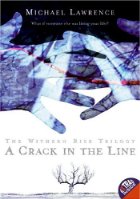 Summary:
Alaric lives in the crumbling Withern Rise house with his widowed father. Nothing has been the same since his mother’s death in a train accident two years ago. Now his dad is off helping his girlfriend get ready to move in with them, and his crazy Aunt Liney is there to keep an eye on him. Miserable, he touches a carving his mother made of the house from wood from the family tree years ago and finds himself transported to a parallel universe where a girl, Naia, is living his life–only with their mother still alive.
Review:
This may be one of those YA books that only someone in the midst of teen angst can truly appreciate, or perhaps an adult with a strong fear of losing their mother.
Alaric is an angsty teen, perhaps with good reason, but he’s annoying nonetheless. Thankfully, his Aunt Liney is present, and she is a breath of fresh air. The long-suffering, quirky aunt who was almost aborted and does not exist in the alternate reality is clearly important, but we never find out why. Probably this is key later in the trilogy, but I doubt I’ll struggle through simply to find out just how she’s a key factor. I also must admit that I find the obvious pro-life slant in Aunt Liney’s storyline annoying.
Although Alaric’s motivation for coming to and continually returning to the Naia’s parallel universe is clear, her motivations are not. Her world seems quite ideal, and Alaric is an unwelcome intrusion into it. She does not seem to possess a naturally curious or quizzical nature. This leaves half of the plot, Naia’s part in it, unclear.
The parallel worlds are interesting, but not nearly as creative as, say, Stephen King’s. The differences are all incredibly minor, based off of decisions and chances playing out in two different scenarios. A baby could be a boy or a girl. A mother could live or die. A sister could be aborted or kept. Yet how Lawrence draws the line on what counts as a chance or a decision is very unclear. Is every single choice and instance a decision? That would make the universes go on forever, which just seems highly illogical and improbable. I simply could not sustain my disbelief quite enough to get into it.
All of that said, I could see a teenager enjoying this story. Particularly one upset with his parents or wishing his life was minutely different in some way. I thus recommend it to a teen into fantasy and the concept of parallel universes.
3 out of 5 stars
Source: PaperBackSwap

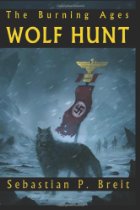
Book Review: Wolf Hunt: The Burning Ages by Sebastian P. Breit (series, #1)
 Summary:
It’s the future, and the world is in another semi-cold war between NATO and BRIC (Brazil, Russia, India, China). A NATO group of British, American, and German naval ships is being sent to Brazil on a mission, but part-way there they are all zapped back in time to 1940. With the chance to change history for the better, what will they decide to do?
Review:
I first want to point out that Breit is German and wrote this in English himself; it is not a translation. I have to say that I wonder why he made that choice as the plot certainly seems to have more of a European than an American appeal, but I am impressed at his effort to write in his second language.
The summary of the book makes the plot sound fast-paced, but in fact it is actually distressingly slow-moving. It takes about 1/3 of the book for the all-important time-traveling event to happen. I spent the whole first part of the book just waiting and wondering when it was going to happen, because once the basic politics of the world and character traits were set up, it’s just a waiting game. The naval mumbo-jumbo filling up the rest of the space just wasn’t necessary. This issue carries on throughout the book with half of the sailors spending a solid amount of their time stranded on an island, for instance. Since this is marketed as a fast-paced historical thriller, perhaps somewhat like the style of The Da Vinci Code it quite simply needs to move along faster. Intense naval specifics and codes are not necessary. Fast-moving plot is.
Breit also needs to invest in a British and American editor each, as the British and American characters say and do things that are just flat-out wrong in British and American English respectively. One that really slapped me across the face is that one of the characters is from Boston, but everyone refers to him as a “Bostoner.” People from Boston are called “Bostonians.” I have never once in my life heard anyone say “Bostoner,” and I live in Boston. Another example is at one point one of the Americans reads another American’s birthdate from off an id and says it the European way “11 September 2001,” instead of the American way “September 11th, 2001.” This is one of those instances where the author needs to have his facts straight in order for the story to be believable. Nothing makes me not believe a character is American quite like having him get a bunch of American English wrong.
Additionally, as a woman and an author, the way the female characters are handled is distressing to me. Just one example is that a bunch of the stranded female sailors are attacked on the island by some of the locals in an attempt at rape. These women who had the exact same training as their male counter-parts are apparently completely incapable of saving themselves, but instead have to be rescued by their male comrades. But it gets worse. Later when the captain of the ship is relating the event to another man, he asks if the women were alright. The captain responds by saying that the doctor said they were fine. The doctor. Apparently nobody bothered to ask these women if they were raped (HINT: I’m pretty sure women can tell if they’ve been raped or not). Plus no one seems to care that these women are clearly not going to be emotionally ok after almost getting raped, and not once do any of the female characters who were attacked say anything about it with their own voices. This is just completely inexcusable. It’s a removal of women’s voices from ourselves, and it’s insulting to a female reader.
There’s the issue of European bias expressed through the American characters. For instance, one American character expresses shame at how Americans only speak one language. First of all, the rate of bilingualism in the US is actually rising, so following the arc of the future, there should be more bilingual Americans, not less. Second, I’ve never once heard an American express woe in an all-encompassing way like that by saying something like “It’s so sad Americans aren’t bilingual.” People say, “I wish I was fluent in another language,” or “I wish I was fluent in Japanese,” but they just don’t put it that way. That whole paragraph sounded like a European using an American character as a puppet to say what Europeans think of Americans. Yeesh.
I also have problems with the German characters though. A bunch of them express the desire to stop the Holocaust not to save lives but to save the German people from harboring the shame and guilt for generations to come. Um, what? That’s your concern oh time-traveling Germans? Having been to Germany myself on a student exchange and visited Dachau, etc… I can say that I have a hard time imagining any of the kids my age at the time (15ish in the early 2000’s) focusing in on that as opposed to stopping a bad thing from happening because it’s evil and wrong. I can only imagine that generations even further along would be even more focused in on stopping a genocide as opposed to saving some broad idea of German honor. It’d be like having a time-traveling modern American decide to stop the Trail of Tears to save us from shame as opposed to doing it to save innocent Cherokees. The whole thought just makes my brain hurt.
To sum up, Breit shows ability as a writer that needs to be worked on and honed. I’d recommend either getting a good editor who can handle both British and American English or switching to writing in German. He also needs to work on tightening up his plot. Normally I’d say, nice first effort keep trying, but due to the opinions and biases and presentation of women present in this first attempt, I’m afraid I can’t say that. It’s readable, but why would you want to read it anyway?
2 out of 5 stars
Source: Ebook from author in exchange for my honest review

Book Review: Daughter of the Blood by Anne Bishop (series, #1)
 Summary:
In this fantasy matriarchal land, people are ranked by their power based on what color jewels they are mystically assigned to wear when they come of age. The darker the jewel, the better. The women all have some sort of witchcraft power, but none have had the power of The Witch in hundreds of years. Corrupt women have messed with the structure of society turning it from harmony to darkly using the men and women to their own advantage. Men in particular are used by controlling them via a ring of obedience (placed around their penis). Into this messed-up society the much waited for Witch is born, but most do not recognize her. Lucky for her, the demon dead Saetan and his two living sons, Daemon and Lucivar, do.
Review:
This is what I would call high fantasy. The only thing missing really is knights in shining armor. A friend gave me this trilogy for my birthday as it is one of her favorite series, and she thought I would like it. I can see why she thought I would like it. It’s dark, graphically violent and sexual, and the choice to depict a messed-up matriarchy instead of patriarchy is unique. Unfortunately I just couldn’t get into it.
First there’s the whole jewels and traveling on webs and wind and speaking on a soundwave that only people with that jewel can hear thing. None of these things are ever particularly explained. They just are. Ok, so that probably works for fantasy fans, but I’m a logical, scifi reading lady. I want explanations for things. Also, how society fell apart is kind of massively unclear to me. I’m not sure how things went from good to bad or what the properly functioning society is supposed to look like. It’s all very confusing, and frankly, I can’t remember the order of the ranks of the jewels. I just remember that gray is second-strongest and black is strongest. But then later in the book some people say they’ve worked their way up to stronger jewels than their birthright. Um, what? When did that happen? How can that happen? If you can do that then why does your birthright jewel matter at all? None of this makes any sense. Agh.
Then there’s the ring of obedience. So they put this on violent males who are now sex slaves, apparently. They serve witches. The ring makes it so they can’t get a hard-on without pain. But they don’t take the ring off for sex, which means these women are using sex slaves but never actually having intercourse. Who would want that?! How does that make sense? Also, Daemon can apparently pleasure women and tie them up just with his mind. He can do this but he can’t get a ring off his dick? This feels like badly-organized erotica. Which would be fine if it was erotica, but it’s fantasy, so wtf Bishop.
So then we have Jaenelle, The Witch. She’s eleven or twelve, I can’t remember exactly which. Her family thinks she’s crazy because she’s super-powerful and travels around meeting mystical creatures and told them about it, which was a bad move. She got sent to an asylum then brought home, and she’s been all Miss Mysterious Dark Eyes That Are Actually Gorgeous and Sapphire ever since. This is the main mystery of the book. That and the manly threesome trying to protect her from the big bad queen witches who want her dead. So Daemon is working in her house and basically falls in love with her. He’s never felt sexual desire for a witch before, but now he does. He feels horrible that he feels it for one so young and vows to wait until she’s grown up enough to be with him, but he still feels it.
Then we *spoiler alert* find out the asylum is just a cover-up for pedophiles, and of course Jaenelle gets raped, and a good witch saves her, and Daemon and Saetan work together to try to save her, and in her mind she tells Daemon that he just wants her body just like everyone else, and he basically makes out with her in her mind to show her he wants to be her lover not hurt her. This makes her come back to her body and heal it. Then she escapes to Saetan and Daemon escapes off to a brothel.
Can we just HOLD THE PHONE for a minute. I am not at all against a pedophilia storyline or plot device. These things happen in real life, so it’s ok for them to be in a story. I do have a problem with the “good guy” having sexual feelings for an eleven or twelve year old when he’s literally centuries old. He himself admits this is bad, but instead of going away from her, he makes out with her in her mind (when she’s in half-horse form no less). I just….what. What the what. What am I supposed to think about this? How am I supposed to feel about a book written by a woman in which the matriarchy basically abuses everyone and yet the men still wind up with most of the power (the manly threesome) over this young girl who is supposed to become the awesome ruler one day, and one of the guys has pedophilic feelings for her. WTF.*end spoilers*
I suppose it’s possible that Daemon is an anti-hero, and we’ll find that out later in the series. That Jaenelle will triumph and prevail over everyone and fix everything. We can only hope. I do suspect that part of my issue with the book is just point-blank never feeling comfortable in the fantasy world Bishop lays out. I just don’t do high fantasy. When will I learn this?
That said, it does seem well-written, and I think if a fantasy fan can handle very dark and graphic violence, sex, and themes, they will probably enjoy this trilogy.
2.5 out of 5 stars
Source: Gift

Book Review: The Flight of the Silver Vixen by Annalinde Matichei (series, #1)
 Summary:
Somewhere in outer space is an alien race consisting entirely of females. It’s not that the men are missing; they never existed. This race is known as intermorph, and those like our own are schizomorph. A teenage hover bike gang steals a space craft and finds themselves on a troubled intermorph planet where they must band together and fight as warriors against demons, internal enemies, and a neighboring aggressive schizomorph race.
Review:
This book reads distinctly like what would happen if you gave a bunch of ten year old girls the ability to record their imaginary playtime into a book and try to sell it. Everything from the dialogue to the plot screams, “A bunch of ten year old girls who like being girls but still think boys have cooties wrote this one day playing in their back yard.”
The writing is really bad. Clear characterization is almost non-existent. I was still uncertain as to who exactly various people were at the end of the book. The dialogue reads as so fake that it makes you cringe. It’s full of made-up words and ways of speaking that aren’t explained at all until a glossary at the end of the book. For example, the intermorphs don’t swear, but they do exclaim “g’doinking” when upset. See what I mean about ten year old girls? If I was, for instance, a middle school English teacher, I could see some merit in the writing and would encourage the young person to continue. This, however, is not a middle school English class. This is supposed to be a well-written, well-realized, novel. It is not.
Then there is the whole entire concept in and of itself. A race of just women absolutely can be a creative way to explore gender and sexuality, and I’ve seen it done well by famous feminist scifi authors. This is not done well, however. The intermorphs are all either brunettes or blondes with the brunettes fulfilling the traditional male role, and the blondes fulfilling the traditional female role. Everything about how they interact is a carbon copy of a traditional patriarchy. Just because both genders have vaginas doesn’t make how the brunettes treat the blondes less offensive. I also was incredibly disturbed at how the female main characters talked about the male schizomorphs. They referred to them as “it” and as animals. Even beards on men were degraded and feared. It’s the first time I’ve seen a book somehow manage to be both misogynistic and misandrist. This in and of itself is enough to warrant one star from me, even if the writing was good. This is not a healthy way to perceive men, women, gender, or sexuality.
I absolutely cannot recommend a piece of bad writing full of unhealthy perceptions of gender and sexuality to anyone. My hope is that the author is still quite young and with time will grow to more mature opinions, as well as more mature writing.
1 out of 5 stars
Source: Kindle copy received from author in exchange for my honest review

 Support my work with a tip or browse my shop for curated book club guides, how to guides, cross-stitch patterns, and more!


This work by Amanda Nevius is licensed under a Creative Commons Attribution-Noncommercial-No Derivative Works 3.0 United States License.
 Opinions of a Wolf