
Archive
Book Review: The Isle of Blood by Rick Yancey (Audiobook narrated by Steven Boyer) (Series, #3)
 Summary:
Will Henry states that this is a story that Dr. Warthrop did not want told…and proceeds to tell it anyway. When a British man shows up with a package being delivered under duress, Dr. Warthrop is ecstatic to realize it is the nest of the Magnificum–the holy grail of monstrumology. Dr. Warthrop decides to leave Will Henry in New York while he pursues this beast. But when his monstrumologist companion returns claiming that Warthrop is dead, Will Henry and two fellow monstrumologists travel to Europe to track him–or his body–down.
Review:
Not as engaging or thought-provoking as the first two books in the series, I can only hope that this third entry is suffering from the common penultimate book malady where the book which must set everything up for the finale of the series can sometimes drag.
There are two problems in this entry that make it fail to be as engaging or thrilling as the first two books. First, Will Henry is left behind in New York for a significant portion of the novel. We are thus left with a whiny teenager bemoaning Warthrop’s choice to be responsible for once and keep him out of danger. We also are left with very little action for far too large a portion of the book. The second issue is perhaps a bit of a spoiler but suffice to say that the monster is disappointing and its disappointment is easily predicted. If we had a lot of action with a disappointing monster, that’s still engaging. If we had less excitement with a surprising, phenomenal monster, that’s still thrilling. The combination of the two, though, prevents this thriller from being as thrilling and engaging as it should be.
Of course there are other elements that still worked, which is why I kept reading it. Yancey’s writing is, as ever, beautiful to read (or listen to) and contains much depth.
“So many times we express our fear as anger…, and now I think I wasn’t angry at all, but afraid. Terribly, terribly afraid.”
The settings are unique, and the characters are strong and leap off of the pages. Will Henry becomes more fully fleshed-out in this entry as we start to see his descent into a love affair with monstrumology. We also get to see Warthrop at what he himself perceives of as his lowest point. It’s a dark bit of characterization but it works very well for the story Yancey is telling.
Overall, I was a bit disappointed, purely because the first two entries in the series were so phenomenal. The third book is still a very good book. Fans might be a bit disappointed, depending on how attached they are to the unique thriller aspect of the series, but the characters and writing still make this well worth the time. Fans will remain in eager anticipation of the final entry in the series.
4 out of 5 stars
Source: Audible

Previous Books in Series
The Monstrumologist
The Curse of the Wendigo
Book Review: Oddkins: A Fable for All Ages by Dean Koontz
 Summary:
Isaac Bodkins is a magical toymaker. He makes toys that actually come alive and seek out children who need them the most, such as children who have lost a parent or who are facing abuse. When he dies before he has a chance to tell his chosen heir about her purpose, evil has a chance to take over again. His toys, the Oddkins, must set out to tell her before evil manages to land its own new evil toymaker that would create living toys to torture children. Evil sends out his evil toys in an attempt to stop the Oddkins on their dangerous cross-town mission.
Review:
The person who loaned me this book told me it was marketed as a fable for all ages but really might be a bit too scary for the youngest among us. Person also knew that I love me some fables, not to mention talking animals or toys, so I was excited to get into this book. Alas, it wasn’t ultimately my style, but it is a well-written book I could see working for a lot of people.
The plot is a quest where each member of the questing group gets at least one chance to shine. Although I was fairly certain that good would ultimately triumph over evil, I still was left worried for the main characters periodically, and I also was unable to predict the details of the triumph. Since the toymaker lived in the countryside outside of the city, the quest consists of time in both the country and the city. This kept situations varied and engaging.
Since this is a fable and most of the characters are in fact magical toys, they are not what one would describe as three-dimensional. However, their two dimensions work for the story. For instance, the teddy bear leader of the good toys is brave and strong and true but he also has to work at being brave. He is not just naturally brave. Similarly, although the two potential inheritors of toymaking are good and evil, they both get background information given to them. The evil one was in prison and only takes pleasure from causing others pain. The good one ran a toy store and was recently widowed and looking for something more in her life.
So why didn’t I love it? Well, some things said were just too clearly religious for me. There’s a lot of talk of afterlife, and the evil toys are driven by who is clearly Satan. There are also times where the good toys stop and make statements to each other that are clearly the author preaching to the reader through them. For instance
God’s world is full of magic, isn’t it? Not just the secret kind of magic of which we’re a part, but the simple magic of everyday life-magic. (location 1358)
Given that this happens rather frequently and given that the evil is clearly represented to be Satan, I just found the whole book to be a bit too heavy-handed in the religion department for me. A reader who does follow Christianity might not be bothered, but even then, the preachiness within a book isn’t for everyone.
Overall this is a well-written fable that is engaging and unique. It is a bit heavy-handed in its presentation of various religious beliefs for this reader, but other readers who enjoy that in their literature will probably enjoy this book.
3 out of 5 stars
Source: Borrowed

Book Review: Where the Blind Horse Sings: Love and Healing at an Animal Sanctuary by Kathy Stevens (Bottom of TBR Pile Challenge)
 Summary:
When Kathy Stevens decided to change careers mid-life, she wanted to do something that would help animals and let her teach. She landed on the idea of founding an animal sanctuary. But this book is very minimally about Kathy. It is mostly about the animals that came to find a safe haven at the sanctuary she founded. Animals like Rambo the sheep who guards other animals. Paulie a former cockfighting rooster who loves car rides. And of course a blind horse once terrified to move who now goes for trail rides.
Review:
This book wasn’t what I was expecting, which was an account of setting up and running an animal sanctuary. Instead it is a collection of short stories about individual animals who live at Catskill Animal Sanctuary, in the vein of James Herriot, although not quite to that classic’s level.
The stories are roughly grouped based on the situations that led the animals to the sanctuary, their personality, and of course some ultimate peaceful deaths at the sanctuary. I was a bit frustrated that instead of telling one animal’s story end to end, they were split up among sections. I can understand not wanting to end every chapter with an animal’s death, but I also think seeing one animal’s life in a complete story would be more touching. On the other hand, I also appreciated how clearly the different animals’ personalities were drawn without ever venturing into the land of hypothesizing. One doesn’t have to impose their own beliefs on an animal to clearly see the difference between a hurt, abused animal and a happy one. Stevens presents the difference quite clearly without venturing into speculation, which I think will give the book the broadest audience.
In spite of the dark past lives of these once abused animals, the book is a light read, both in spirit and in content. You won’t learn the nitty gritty of founding and running an animal sanctuary, which I think is too bad. It’d be nice if there was even an epilogue about more of the day to day realities of rescuing animals. On the other hand, the light, easy read gives the book a broader audience. It also features a suggested further reading list at the end, as well as links to the sanctuary’s website and invitations to visit, so those who want more can seek it out.
Overall, this is a well-written, feel-good collection of stories of the animals of Catskill Animal Sanctuary. It doesn’t provide much insider information on the running of animal rescue charities, but it does provide insight into the personalities of farm animals. Recommended to animal lovers who enjoy short stories.
4 out of 5 stars
Source: Amazon

Book Review: The Curse of the Wendigo by Rick Yancey (Audiobook narrated by Steven Boyer) (Series, #2)
 Summary:
Will Henry, 12 year old orphan and assistant to renowned Monstrumologist, Pellinore Warthrop, is shocked to find a refined woman on Warthrop’s doorstep. She is the wife of Warthrop’s best friend who has now gone missing in rural Canada while looking for the elusive wendigo (aka werewolf). Warthrop insists that there is no such thing as a wendigo, but he agrees to go looking for his missing friend anyway, even if he believes his mission was ridiculous and an affront to monstrumology’s reputation.
Review:
I can’t believe it took me this long to get to the sequel of one of my rare 5 star reads, The Monstrumologist
Yancey does something brave for a second book in the series. Instead of following the formula that worked so well in the first book and basically doing a monster-of-the-week-in-our-town method like Buffy and so many other urban fantasies, he changes things up. There is a monster, yes, but it is entirely different from the first one. This is a monster that might not even exist, unlike the anthropophagi in the first book who are almost immediately clearly real. Additionally, Warthrop and Will must travel away from New England to go looking for the trouble. It does not come to them. Another good plot twist is that the story does not entirely take place in Canada. It moves to New York City. Thus we get both the dangers of the wilderness and the dangers of the city in one book. These plot choices mean that what makes this series a series is the characters, not the fantastical nature of their world. By the end of the book I was thinking of the series in terms of the relationship between Will and Warthrop, not in the context of what nasty beast we might meet next. It thus does what great genre fiction should do. It looks at a real life issue and dresses it up with some genre fun. And the issues addressed here are big ones. What is love and what should we be willing to sacrifice for it? Is it more loving to stay with someone at all costs or to let them go to protect them? At what point do you give up on someone?
The horror certainly felt more grotesque this time around, although it’s possible I just wasn’t remembering the anthropophagi that well. This is a bloody book full of horrible things. Precisely what I expect out of my genre. There’s not much more to say about the horror than keep it up, Yancey. Also that this might not be for you if blood and guts and profanity are not your thing. But they *are* mine and, oh, how well they are done here.
Just as with the first book, the language Yancey uses is beautiful. It’s rich, eloquent, visual, and decadent. It’s a word-lover’s book. An example:
But love has more than one face. And the yellow eye is not the only eye. There can be no desolation without abundance. And the voice of the beast is not the only voice that rides upon the high wind….It is always there. Like the hunger that can’t be satisfied, though the tiniest sip is more satisfying than the most sumptuous of feasts.
Stunning.
The characterization here remains strong for Will and grows much stronger for Warthrop. Will grows and changes as a 12 year old in this time period in his particular situation would be expected to. With Warthrop, though, we get a much clearer backstory and motivations for his actions. In the first book we came to know Will. In this one we come to know Warthrop, although Will is not left without any development. It’s a good balance. I also enjoyed the addition of two female characters, who I thought were well-written, particularly Lily, the budding young feminist determined to be the world’s first female monstrumologist. She is truly three-dimensional in spite of her rather limited screen-time compared to Will.
The pacing doesn’t build steadily from beginning to end. It rather builds to a first climax, comes back down and builds again to a second climax. This makes sense, particularly in a werewolf book, but I must admit it felt a bit odd in the moment. It almost felt like reading two books in one until it all came together in the end. In fact, this is one of those books that gets better the more you look back on the story as a whole. Be prepared to enjoy it more in retrospect that in the first reading.
The audiobook narrator, Boyer, has a tough book to work with. There are a wide range of characters of multiple nationalities to act out (Canadian, German, French, New York, Massachusetts, etc…). Additionally, at least three different languages are spoken (English, French, and German). I’m not fluent in anything but English, but I did take German in university, and I can say that his German accent is at least passable. He also does an excellent job creating a unique voice for each character. I only rarely got lost, and that was generally due to rapid-fire conversation where each character only had a word or two. I must say, though, that he does mispronounce a few words, which detracts from Yancey’s gorgeous writing. I blame the audiobook director for this, though. S/he should have realized and corrected this. Overall, though, the mispronounced words are only in a couple of locations and do not deeply affect the reading of the book.
Overall this is an excellent follow-up to a remarkable first book in the series. It brings to the table that which made the first so powerful: YA horror with rich language set in a historic time period. But it also changes things up enough to avoid falling into the monster-of-the-week trap. The entries in the series are part of a larger story, and that can be seen. Fans of the first book should pick up the second book asap.
5 out of 5 stars
Source: Audible

Previous Books in Series
The Monstrumologist
Book Review: vN by Madeline Ashby (series, #1)
 Summary:
Amy is 5 year old robot. An exact replica–iteration–of her mother, who is in a relationship with a human male. Her parents are restricting her food to raise her slowly at a human child’s pace instead of at a robot’s. But when her grandmother shows up to her kindergarten graduation and threatens her mother, things go haywire. It quickly becomes apparent that the failsafe that makes robots love humans innately and makes them incapable of withstanding seeing violence against humans has failed to activate in Amy. She finds herself full-grown and on the run from humans and her robot aunts alike as she struggles to figure out who she is and what her existence means to humanity.
Review:
Artificial Intelligence/Robot books tend to take a bit more to draw me in than say a zombie book. It’s really hard to do AI in a way that is simultaneously scientifically/culturally believable and unique. Frankly, I need a bit more believability in an AI book than in a zombie one, since AI is real science. Plus, the book should examine their cultural place in the world, and that needs to be believable. I am pleased to say that this book gets it mostly right. It’s enjoyable, scientifically minded, culturally thought-provoking, and examines a real life issue in the context of genre, which long-time readers of this blog know is something I highly enjoy.
The first thing that made me know this is a smart book is the source of the robots (called Von Neumanns after their creator). A fundamentalist group in the American South decided that the humans left behind after Jesus’ Second Coming should have someone to help them through the Tribulation, so they invented humanoid robots to be ready to help. Clearly, the Second Coming didn’t happen, and the fundamentalists ended up selling Von Neumanns, and the Von Neumanns wind up a part of the cultural backdrop, not to mention the porn industry. As a character says to Amy:
There are only two industries in this world that ever make any kind of progress: porn, and the military. And when they hop in bed together with crazy fundamentalists, we get things like you. (location 1944)
This is the most unique and engaging origin story for robots that I’ve seen, plus it makes sense and provides cultural commentary. The Von Neumanns originated as a religious experiment, were swiped by the military and the porn industry, and became a part of everyday life. It’s just an awesome origin story for the world that Amy is in.
The characters, including the robots, are three-dimensional. Everyone has complex motivations and the main characters definitely grow and progress with time. No one is presented as pure evil or good.
The plot is similarly complex. There’s a lot going on in Amy’s world, and none of it is predictable. What is the failsafe precisely and is it a good or a bad thing? Is it a natural progression that it doesn’t work in Amy? What about how Amy’s mother and grandmother reacted to the human world around them? Did they see accurate shortcomings or were they just malfunctioning? And what about how the various humans use the Von Neumann’s? For instance, pedophiles acquire Von Neumanns and keep them young by starving them. Is this a good, harmless thing since it protects human children or have robots evolved to be far more than just a machine? The world is complex and full of tough questions, and thus is challenging and unpredictable, making for an engaging read.
What I most enjoyed though was how the whole book presents the question of nature versus nurture in a genre setting. Are we our parents with no hope of improvement or escape? Or do we have more say in the matter than just our genetics or “programming”? Amy has a psychopathic grandmother and a mother who has made questionable choices. Does this mean that Amy is evil or malfunctioning or even capable of being something different from the rest of her family? All of these questions lead to some interesting stand-offs, one of which includes my favorite quote of the book:
An iteration isn’t a copy, Mother. It’s just the latest version. I’m your upgrade. That’s why I did what I did. Because I’m just better than you. (location 2581)
All that said, there were two things that kept this back from five stars for me. First, some of the writing style choices Ashby uses drew me out of the story a bit. They are periodically highly artistic in a way that didn’t jibe with the story for me. I get why she made those choices, but as a reader they aren’t ones that generally work for me. Second, one thing that really drew me out of the story is the fact that the robot’s boobs don’t move. This is mentioned at one point as being a way to tell if a woman is robot or not. This drew me out of the world very hard while I laughed uproariously. I’m sorry, but machines designed by men would simply not have hard plastic boobs. Their boobs would bounce, dammit. This would at least be in the top 10 list of robot requirements. It simply wasn’t a realistic design choice, and it pulled me out of the story to such an extent that it lost the believability for a bit for me.
Overall, this is a creatively written and complex scifi artificial intelligence story that examines not just what makes us human but also individuality and uniqueness separate from parents and family. Some of the more artistic writing choices and high levels of violence might not appeal to all audiences, but if you’re an AI or scifi lover with an interest in nature versus nurture and stories featuring strong female leads, you should definitely give this a go.
4 out of 5 stars
Source: NetGalley

Book Review: Two To Mango by Jill Marie Landis (Series, #2)
 Summary:
Em Johnson, manager of the Tiki Goddess Bar on Kauai, never intended to get involved in one murder investigation, let alone two. But when the hunky fire dancing detective Roland Sharpe asks for her help looking into some suspicious deaths in a high-profile, competitive halau (hula group), she just can’t say no. Before she knows it, she’s entering the geriatric Hula Maidens halau into the biggest hula competition on the island to help her get in where she can snoop.
Review:
I’ve dipped my toe in a few cozy series, but this is the first one that’s managed to call me back for a second helping. They’re all entertaining in their own way, but this series is also unique and engaging enough to keep me coming back for more, and thankfully those unique elements stayed strong in the second entry.
Em is a good cozy mystery heroine. She’s smart and willing to help but isn’t running amok destroying the police department’s days. She only helps when asked and even then, she’s a bit reluctant to disrupt her life. On the other hand, when she does help, she’s good at it. She lends insight that it makes sense only she would have, such as being able to infiltrate the halau competition. This lets both her and the inevitably hunky police detective she’s helping seem smart and efficient. She also has that every woman quality that lets the reader insert herself into the story.
The setting is perfect escapism. A Hawaiian seaside tiki bar that feels like Hawaii’s answer to Cheers. If Cheers had a set of geriatric hula dancers who started “rehearsing” aka drinking before noon. Not to mention an aging hippie who thinks he’s engaged to a dolphin. The setting represents both the beauty of Hawaii and the diversity of Hawaiians and Hawaiian culture. I certainly learned a few words of Hawaiian along the way in addition to thinking fondly of how nice it would be to live in a place with such tropical beauty.
The plot was multifaceted and engaging. Every character really has their own life and they manage to intertwine just the right amount. The murders (and attempted murders) happened at the right frequency and managed to be a surprise at least part of the time. The murder weapons are creative and well-thought-out. The plot is not predictable but it’s also not entirely off the wall. I felt surprised but also to a certain level knew that I could have figured it out if I’d thought a bit more. That’s the perfect amount of mystery in my book.
This would have been five stars, but there is one part of the book that I thought was in very poor taste at best. This is not a plot spoiler, as it is not necessary to the mystery at all. At one point, Little Estelle (the eldest of the Hula Maidens), climbs into a man’s car and basically throws herself at him. If the genders were reversed, this would definitely be read as a creepy old man assaulting a pleasant young woman. But since it’s an old woman it’s written for laughs. I get it that Little Estelle is presented as a horny, senile old woman, but there’s a way to write that that doesn’t verge into sexual assault territory. I just don’t find that sort of thing funny, and even though I get it that the intention was oh that silly old woman, it didn’t sit well to me. If this was my first Landis book, I probably would have stopped reading. I didn’t, and I’m glad I didn’t, because the rest of the book is 1,000 times more humorous and creative than those few pages. But I am disappointed that Landis chose to write Little Estelle that way. Others might find it more humorous than I did. I just don’t see such things as a laughing matter.
Most cozy books come with an arts and crafts do at home type project. This series includes drink recipes. I’m pleased to say that this book has even more drink recipes at the end than the first one, although I have yet to try mixing any myself. They are creative and fun-looking, though, and let the reader feel a bit like the Tiki Goddess could really exist.
Overall, this is an engaging, humorous cozy mystery. Readers of the first book will enjoy their return to the world of the Tiki Goddess. I am anticipating the next entry in the series, although I do hope that Landis will improve the characterization of Little Estelle.
4 out of 5 stars
Source: Gift

Previous Books in Series:
Mai Tai One On
Book Review: The Wanting Seed by Anthony Burgess (Bottom of TBR Pile Challenge)
 Summary:
In the near future world with no war and totalitarian governments there’s an ever-looming threat of starvation thanks to overpopulation and diseases attacking the crops. The governments have responded with worldwide one child policies and psa campaigns to encourage homosexual relationships. Englishman, Tristram Foxe, lives in a skyscraper with his wife, Beatrice-Joanna and works as a social studies teacher. But his advancement suffers both from his status as a person with siblings and as a married man with a child. When he discovers that his wife is cheating on him with his passing as gay brother who works for the Infertility Bureau, his world falls apart just as the world around him tilts from totalitarian regime to cannibalism and pagan fertility rituals.
Review:
When I picked up this book, the summaries I’d seen were nowhere near as clear or straightforward as the one I just wrote for you. I’m not sure I would have ever picked it up if I’d had an inkling of an idea as to what I was getting myself into. All I saw was a dystopian overpopulated future by the same author as A Clockwork Orange
The first half of the book reads like a treatise by a Quiverfull (Evangelical Christians who believe in having as many children as possible, more info) with some terror of a hyper-liberal future where people are denied their right to choose to have children (funny how they fear that but don’t get that pro-choice is all about protecting a woman’s right to choose what to do with her own reproductive organs but that’s another rant for another day), and people are forced into being gay/lesbian. I know this sounds like it could be an interesting flip-flop of current times, but it didn’t read that way for me. It read as a lot of homophobia and yelling about how population control goes against god’s plan and going against god’s plan sends the plagues. Seriously. That’s how it reads. But, I traveled on because this is Anthony Burgess, and characters don’t have to be likeable. They could be used to show the opposite point. But that’s not really what happens. What happens is that this set-up gets ditched for a mad-cap dash through sociology.
The last half of the book is kind of an interesting sociological exploration of how the world moves through the liberal/conservative/military cycle. It is mad-cap and bizarre, and as a person with a BA in History, I really enjoyed seeing a country move through those cycles at rapid-fire in a slapstick humor style. This part of the book felt like an entirely different book in fact. But I also think only a certain type of person would enjoy it. (Like, oh, Political Science and History majors).
As for character development, there is none. Everyone ends up pretty much where they started after having lived through the cycles of political change. It really reminds me a lot of playing Civ or SimCity where you move artificial people around to illustrate greater points. I enjoyed this alright, but I would have preferred stronger characterizations or at least some growth.
So, is the book a phobic conservative dream of what a liberal society would look like? I don’t think so. I think Burgess actually presented each part of the political cycle as awful, including the fall into tribal-feeling paganism. It sort of felt like the book was saying that someone somewhere will always be unhappy no matter what the political/sociological situation is. Depressing, huh? And yes I know it’s dystopian and lot of people think dystopias are innately depressing, but personally I think they can frequently offer a lot of insight and hope for the future. This just felt a bit defeatist. With some Quiverfull and homophobic characters to boot.
Overall I’m left feeling decidedly no reaction either way to this book, which is not what I was expecting from Burgess. I was neither offended nor enlightened and mildly entertained but I could have had the same entertainment from playing Civ on my computer. I think this book best appeals to readers who also enjoy studying political science or the history of societies, but even they should proceed with the caution that this is decidedly a mad-cap, non character-driven look at those topics.
3 out of 5 stars
Source: PaperBackSwap

Book Review: Dagon by Fred Chappell (Bottom of TBR Pile Challenge)
 Summary:
Peter doesn’t know much about his father’s side of the family as his mother left him when he was little. Now, a married pastor, he returns to his father’s parents’ house, a recent inheritance. Slowly he discovers the cultist history of his family and begins his descent into madness.
Review:
There aren’t that many books in the Lovecraft mythos, so when I spot one, I almost always add it to my wishlist and pick it up if I spot it. (I’m a big fan of the mythos, and my current work in progress is set in it). I spotted this one during one of Better World Books’ periodic sales and got it for just a couple of dollars. The problem with the world of Lovecraftian horror is this. The mythos is great, but a lot of the books/movies set in it are a swing and a miss. Which is sad for me as a reader, because I know that this is an author with the same funky interest as me, so I want it to work. I want it to work very much. It just doesn’t always. This, unfortunately, falls solidly in the swing and a miss category for me.
The germ of the story is a great idea. An ostensibly mainstream “good” man following his roots and falling into a dark god worshiping cult. Brilliant. The execution is weak, however. The cover of my copy of the book claims that it is a “novel of blinding terror.” This is just not the case. In some ways I feel that Chappell just tried too hard. The entire first chapter is meant to set the scene with extremely heavy-handed gothic language, but it is just painful to read. The first chapter describes one room of the house. Excessive energy is spent trying to make even the throw pillows seem malicious. It is too over-the-top and becomes laughable. Thankfully, the next chapter abandons the excessive language, but it is still never scary. It is titillating at a couple of points. Engaging as well. But never terrifying.
Part of the problem is that the book fails to build suspense from beginning to end. It builds up in part one to a singular event, but then immediately crashes back down to a period in part two in which Peter lies around in a depressed funk. While this might be realistic, it does nothing to build the suspense. The suspense thus must start all over again. This may be acceptable in a long work (and even then I’m dubious), but in such a short book it’s just jarring and ruins the suspense.
I also found the ultimate payoff to be a bit disappointing. While we find out one or two things about Peter’s family, we don’t get enough details to truly experience shock or horror. Similarly, the ultimate final descent of Peter was a bit disappointing. He doesn’t engage in any agency or become a committed cultist. A lot of cult things are done to him, but he doesn’t really have the descent into madness promised. He is tortured and made into a slave and has the mental and emotional breakdown such experiences could make someone experience, but he himself doesn’t turn into a raving Dagonite, for instance.
That said, there are some things that worked in the book. As stated previously, the germ of the idea is great. Peter’s nemesis/mentor, the tenant farmer family’s daughter, is delightfully powerful and sinister. A couple of scenes were a great mix of titillation and horror, and the final climax was definitely a surprise.
Overall, then, it’s a book that tries to be a terrifying, gothic horror, but instead is a titillating grotesque bit of southern literature. Fans of the Lovecraftian mythos will appreciate it for this, although the Lovecraftian elements themselves are sparse and a bit disappointing. Recommended for big fans of grotesque, fantastical horror who don’t mind it leaning a bit more toward the grotesque than the scary side of horror.
3 out of 5 stars
Source: Better World Books

Series Review: The John Cleaver Series by Dan Wells
Introduction:
I post series reviews after completing reading an entire series of books. It gives me a chance to reflect on and analyze the series as a whole. These series reviews are designed to also be useful for people who: A) have read the series too and would like to read other thoughts on it or discuss it with others OR B) have not read the series yet but would like a full idea of what the series is like, including possible spoilers, prior to reading it themselves or buying it for another. Please be aware that series reviews necessarily contain some spoilers.
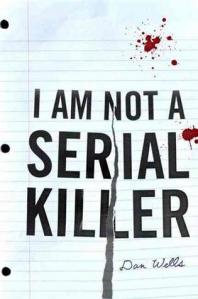 Summary:
Fifteen-year-old John Wayne Cleaver is not a serial killer. At least not yet. John’s therapist believes he has Antisocial Personality Disorder, commonly known as sociopathy, although he can’t legally deliver the official diagnosis until he’s 18 years old. But both his therapist and himself hope John can learn to control his illness in the meantime. An illness John refers to as Mr. Monster. This becomes more difficult as a serial killer shows up in his town. John starts to wonder if he can harness Mr. Monster to find and kill the killer. A killer he soon learns is supernatural and ultimately faces. The demons continue coming to his town, and John feels his grasp on control and an ability to function in average society slipping. Are there really more and more demons coming to his town? Or is it just his sociopathy getting the better of him?
Review:
This trilogy starts with an incredible bang, but makes a slow trajectory downward to end on a whimper.
The first book is incredible. It bashes ableism on its head by featuring a main character who is a teenager struggling with a mental illness, and not an easy one to identify with either. People with APD lack empathy, which can make it difficult to empathize with them in return. Wells carefully crafts a realistic yet sympathetic teenager with APD. His struggles to defeat his mental illness and be a functioning member of society are great to see in a novel period, let alone in a YA one. On top of this, we have a single mother running a business with the help of her just graduated high school daughter and part-time help of her teenage son. It’s the perfect mix of non-traditional and yet not off the wall family to have as a backdrop for John. We have all this, then, with a thriller plot that starts with the hint of a serial killer then deliciously builds to the revelation that the killer is a demon. This fantasy element fits perfectly in with what is hot in YA right now, giving an interesting, unique main character an appealing wrapping.
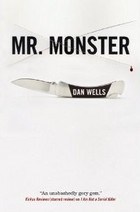 I was stoked after reading this and had high hopes for the trilogy. The middle book maintains some of the elements that made the first book amazing but missed on others. On the plus side, John is still who he was in the first book, although with more confidence. He tries to date, and his family has their own struggles. Although the thriller pacing is less deftly done, it still works in the context of this book, particularly since the middle book of a trilogy is traditionally setting things up for the last hurrah of the final book. Plus this book manages to accomplish two things. It has John learning more about himself and his mental illness and it shows him learning more about demons. It ends on a powerful note with him inviting one of the demon’s friends to Clayton County to face off with him. He’s tired of waiting for things to come to him and is ready to go on the offensive. Thus, although this book wasn’t as strong as the first, I had high hopes that it was setting us up for a powerful final book in the trilogy.
Things really fall apart in the final book, which is what makes the trilogy taken as a whole disappointing. Everything is building toward the final book. Toward what John ultimately learns and what he ultimately becomes. Unfortunately the answers to both of those questions are a major let-down after the unique and albeism-smashing features of the first two books. In the climactic scene, John’s mother sacrifices herself to save her son. When he loses her, he realizes that he is feeling feelings. He’s feeling the pain of losing her. When he realizes this, the lightbulb goes off in his head that he stopped feeling feelings when his father abandoned them. It was just him trying to deal with his broken family. I shit you not. And then he decides he has been healed by his mother’s death. His mother’s sacrifice opens him up to letting himself feel things again. What. The Fuck.
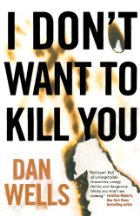 First of all, going numb after being badly emotionally hurt is a real thing. But it’s not a real thing that would be mistaken by a therapist as Antisocial Personality Disorder. And being numb doesn’t mean a person starts daydreaming about killing everyone around him and the girls he has crushes on in particular. Numb is not the same as lacking empathy, and it honestly doesn’t even take a therapist to see that. Numb looks and feels different from sociopathy. They are not the same thing and simply could not be mistaken for each other. If we decide that perhaps Wells didn’t mean to imply that John was simply numb and didn’t have sociopathy, then we can only read this as saying that John’s father abandoning the family *caused* his son’s sociopathy and that his mother’s sacrifice cured it. I’m sorry, but your dad running off does not give people Antisocial Personality Disorder, and it certainly isn’t cured in the span of 10 minutes by someone sacrificing their life for yours. (By the way, does anyone see the heavy-handed religious symbolism in that? Because it is definitely there). The cause, as with many mental illnesses, is officially unknown but is believed to be a combination of genetics and severe environmental factors such as child abuse (source). Since John is not abused, then we can only assume that in his case his APD is genetic. It is utterly ridiculous to present the matter as his APD being caused by something as simple as a parent leaving. Similarly, there is no cure for APD. People do not get magically better overnight. It can be managed so a person may have a healthy, normal life, but it does not just disappear. The symptoms do sometimes become less severe on their own in a person’s 40s (according to the DSM-IV-TR), but John is not 40, and he doesn’t suddenly get better thanks to aging. The whole climax of the series turns the series from being about a person with a mental illness learning to function and do positive things into a story about how a father abandoning his family destroyed them and almost ruined his son for life. The former is unique and powerful. The latter is heavy-handed and preachy. Plus that whole dynamic belittles mental illness and makes it out to be just overcoming a bad part of your life, rather than the very real illness that people deal with every day.
So what we have here is a trilogy that starts as one thing and ends as another. It starts as a thriller with a unique main character demonstrating dealing with mental illness in an engaging, realistic manner. It ends with a thriller that quickly goes from spine-tingling to heavy-handed and preachy. It is unfortunate that this preachiness also gets the facts about a mental illness wrong and presents these false ideas to a YA audience in such an attractive, fantastical thriller wrapping. Ultimately the writing is good but the last book in the trilogy takes a nose-dive when it comes to facts and the realities of having and living with a mental illness. Thankfully, one can read the first or first two books in the trilogy without reading it all. There are not major cliffhangers that compel the reader to continue on, and the first two books stand on their own well enough. I’m disappointed that the series as a whole is not something I can recommend whole-heartedly. I’m disappointed that after starting out so strong, Wells went so far astray. That doesn’t change the quality of the first two books, though, so I still recommend them. But only if you’re capable of leaving a series partly unread.
3 out of 5 stars
Source: PaperBackSwap, Audible
Books in Series:
I Am Not A Serial Killer
Mr. Monster 
I Don’t Want to Kill You
Book Review: I Don’t Want to Kill You by Dan Wells (Audiobook narrated by Kirby Heyborne) (Series, #3)
Summary:
Teenaged John Cleaver had his sociopathy under control but when his town was plagued with two different demons, he had to let it loose a bit to fight them. He invited the demon Nobody to come face off with him, but he and those around him are left wondering if Nobody is real or if John’s sociopathy has just gone out of control. Meanwhile the teenage girls of the town are committing suicide left and right, and John can’t help but wonder why he’s ever tried to save anybody.
Review:
This is one of only a few YA series that I’ve enjoyed reading. The paranormal/youth aspect are almost like a Dexter lite, which is enjoyable. I must say, though, that I was disappointed by the ultimate ending to the series. However, since I write up series review posts every time I finish a series, I’ll leave my analysis of the series as a whole to that post, which will be coming up next. For right now, let’s look at the final book on its own merit.
The plot this time around was disappointingly full of obvious red herrings. I knew within the first chapter where Nobody was hiding, and it was kind of ridiculous that talented, intelligent John was missing it. Similarly, I found the serial killer who John identified as who he could end up being if he made the wrong choices to be a bit heavy-handed. John was already well aware of the risks of his sociopathy from the very first book. It felt a bit unnecessary to make this such a strong plot point. It came across as preachy, which is something that this series had avoided so far. Similarly, John goes to see a priest at one point in his investigations, and his conversations with him felt a bit too heavy-handed, almost like the (known religious) Wells was preaching at the readers through the priest. Authors are allowed their opinions and perspectives, but preachiness is never good writing. Perspective and opinion should be shown eloquently through the plot and characters.
Speaking of characterization, John was still strongly written, but his mother and sister were another story. They felt less like they were doing what was logical and more like they were doing what needed to be done to move the plot forward. On the other hand, I really enjoyed John’s new girlfriend. She was well-rounded and realistic. Plus she was fit while being curvy, which I think is a great thing to see in a book.
In spite of the slightly obvious plot, I still was engaged to get to the end. Even though I knew whether or not there was a demon and who the killer was, I still deeply wanted to see how John would handle it. The audiobook narrator, Kirby Heyborne, helped with this momentum. His narration was just the right amount of tension while still remaining in a teenager’s voice. Be warned, though, that there is some yelling in the book, so the volume does spike considerably at a few points in the narration. You may want to keep the volume a bit lower than usual to accommodate this.
Unfortunately, where the plot ultimately ended up was deeply disappointing to me. It was not at all a satisfying ending, and from a mental illness advocacy perspective, I actually found it distressing. Whereas John’s sociopathy previously was handled with a lot of scientific understanding, I found the ending of this book to be completely out of touch with real sociopathy. While it wasn’t offensive per se, it drastically oversimplifies sociopathy, both its treatment and its causes, which is just as bad as demonizing it. I will address this issue more fully in the series review, but suffice to say that I found the ending to this book’s individual mystery and the series as a whole to be disappointing, particularly given the potential of the book.
Overall, then, this is an average book that wraps up an above average series. If you are someone who is fine with stopping things partway through, I’d recommend just stopping with the previous book in the series, Mr. Monster. But if you are interested in the overall perspective, this book is still an engaging read that doesn’t drag. It just might disappoint you.
3.5 out of 5 stars
Source: Audible
Previous Books in Series
I Am Not A Serial Killer
Mr. Monster
Counts For:

 Support my work with a tip or browse my shop for curated book club guides, how to guides, cross-stitch patterns, and more!


This work by Amanda Nevius is licensed under a Creative Commons Attribution-Noncommercial-No Derivative Works 3.0 United States License.
 Opinions of a Wolf