
Archive
Book Review: Thinner by Stephen King
 Summary:
Billy Halleck is an overweight, high-powered lawyer in a wealthy Connecticut town. He’s getting a bit irritated at his wife and a bit frustrated with his weight, but he loves his teenage daughter. One day, a band of gypsies come to town, and Billy accidentally runs one of them down with his car, killing her. His law firm and the cops, naturally, get him out of the manslaughter charge, but nobody can protect him from the lead gypsy’s curse, uttered while stroking one finger down his cheek, “Thinner.” Now he’s dropping weight no matter how much he eats, and he must race against the clock in an attempt to save himself.
Review:
A book about gypsy curses could easily slide into racist territory, but in fact Thinner actually criticizes the treatment the gypsies have received in the United States over the years, in spite of them not always being the most sympathetic characters in the book. They may be a bit non-mainstream and overly quick to exact their own vengeance, but Billy Halleck and his cronies are a much more frightening type of bad. They’re the bad that comes from too much money and power. The bad that comes from being so self-centered and over-indulgent that you’ve stopped noticing the rest of the world exists.
So, the social commentary is good and not offensive, what about the horror and thrills? That is, after all, what one reads a King novel for. The grotesqueness definitely builds gradually over time, making this much more of a thriller than a horror. At first Billy’s weight loss is welcomed. He was, after all, overweight before. Gradually, though he starts to freak out about how much weight he’s consistently losing in spite of eating as much as he possibly can. He starts to investigate and discovers two others with their own unique and, frankly, much more frightening curses. Although the beginning may feel a bit slow, that is exactly as it should be. Billy goes from normal life to life under a curse to racing against the clock to save his own life. The horror builds perfectly.
That said, this still doesn’t quite read as sophisticated as some of King’s later work. It does almost seem like a bit too obvious an allegory. A bit too obvious a statement being made. In spite of the story providing chills, it’s not quite terrifying or mind-blowing. It’s a fun read, but it’s no Dark Tower.
Overall this thriller provides chills, horror, and a good social commentary. I recommend it to fans of horror and thrillers alike, although slightly more to fans of thrillers.
4 out of 5 stars
Source: Harvard Book Store

Book Review: Mr. Monster by Dan Wells (Series, #2)
 Summary:
John Wayne Cleaver, diagnosed sociopath and assistant in his family’s morgue, is trying to recover from the aftermath of the demonic serial killer that was haunting Clayton County until a few months ago. A few months ago when he let loose his own inner sociopath, otherwise known as Mr. Monster, and killed the demon. For the sake of the town. Now he is struggling to get Mr. Monster back under control as well as deal with new feelings for his neighbor, Brooke, both of which would be easier if the demon hadn’t killed his therapist. In spite of all this, things seem to be slowly calming down–until new dead bodies start showing up.
Review:
In a series such as this, the second book is rather crucial. In the first book, we see John trying to deal with his mental illness in the normal ways, only to be confronted with an abnormal solution. He takes it. The next book must then show not only if John continues down this path, but also why, not to mention set up the structure so that he may continue down this path indefinitely for most of the rest of the series. Wells definitely accomplishes this tough task, although not quite as smoothly or uniquely as he set up the initial plot and character of John in the first book.
One thing that this book suffers from is uneven pacing. Whereas the first book used the classic thriller scenario of gradually amping up the tension, here the tension rises and falls so frequently and to such different levels that it’s a bit off-putting. It provides too many moments where it’s not too distressing to put the book down and go do something else. It is only the last few chapters of the book that hold the same tension as in the first entry in the series. This is problematic when this is supposed to be a thriller, but understandable given all of the set-up and developments that Wells must pull off.
The new demon is definitely well-done and scary in his own way, although I must say I guessed who he was pretty much the instant he showed up in the book. Thus, what was shocking was not who the demon is, but what he does to his victims, why, and how he pulls it off. This part is creative and thankfully it is evident that the demons in the series will be variable and non-formulaic. This is essential if the elements of surprise, disgust, horror, and delight are to remain.
Yet the focus is not just on the demons, thankfully. Wells skillfully still includes the issues John faces as someone struggling with a rather non-sympathetic mental illness, making him alternately relatable and grotesque. John struggles. He is sometimes unlikable, but he tries so damn hard. Similarly, Wells continues to develop the messed-up family structure John has to deal with, an issue that is absolutely relatable to most readers of YA lit. There is much more going on here than demon fighting. Indeed, even John’s first romantic interest is addressed.
I feel the need to say to animal lovers, particularly ones who love the wonderful kitties among us, that there is a very distressing scene in this book involving a cat that almost made me stop reading it. I do think Wells handles it well, including the aftermath, but if you find animal cruelty incredibly upsetting, um, either skip this book or skim that section. You’ll know when it’s coming.
Overall, this entry in the series does well for all the tasks it had to do to smoothly connect the set-up in the first book to the running themes of the rest of the series. Although the pacing struggles a bit, characterization is still strong, as are surprising plot points. I’m interested to see what Wells does with the next book in the series, and I recommend this one to fans of psychological and paranormal thrillers alike.
4 out of 5 stars
Source: PaperBackSwap

Previous Books in Series:
I Am Not a Serial Killer, review
Counts For:
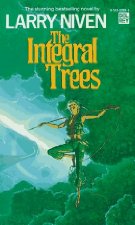
Book Review: The Integral Trees by Larry Niven (Series, #1)
 Summary:
Humans settled on a planet far from Earth after mutinying from their spaceship. Generations later, their descendants have formed various tribes and cities ranging in civilization from tribal to bronze age level of technology. What makes the planet unique is its lack of gravity. Most people live in “integral trees” or in “jungle clouds” with varying amounts of pull (gravity) due to the presence of the tree. In this peek at their existence, we follow a bunch of intrepid people who survive when their tree dies only to find themselves marooned in the sky, along with the flying animals, pools of water, flying fish, and more.
Review:
This book is the definition of classic hard scifi. The world is complex, alien, and unique. It manages to simultaneously be barbaric and technologically advanced in some ways. Everything is as alien from our own lives as we could possibly imagine, from what the people eat to how their cultures are to how people interact.
It takes a bit to get into the book. At first the concept of the planet and how people live on it is overwhelming. But Niven introduces things slowly, so by the time you’re reading about a jungle cloud with people with prehensile toes, it’s easy to imagine and doesn’t slow you down at all in the story. Yet simultaneously it is obvious from looking back to the beginning of the book that Niven always has a clear understanding of how his world works, even if it’s not entirely clear to the reader yet. This is the definition of good writing, and especially good scifi.
The characters have a tendency to be a bit one-dimensional and flat. This is possibly due to all of the attention being paid to the world the story is set in. However, the story still would be improved with more three-dimensional characters. One character in particular goes from a female warrior to a married woman to a concubine and seems to take it all a bit too much in stride for someone who started out as a woman warrior. It felt a bit as if Niven was changing the characters to fit the situation rather than seeing how the characters he had already developed actually would react.
There is definitely a bit of a tinge of male fantasy to the whole story. Even the jungle cloud women who participate equally in their society end up being sister wives to one guy. Personally, I thought given the way women were treated in the story that it must have come out in the 1950s or 1960s, but a quick check shows it came out in 1984. That’s a bit….disturbing. While it’s certainly logical that some cultural things will not be ideal on a foreign planet such as this, the status of women in the novel reads less as a commentary and more as something the author would very much like the world to look like.
Overall, this is an enjoyable hard scifi novel with a rich setting, weak characters, and questionable mores. I recommend it to lovers of hard scifi, but most others probably would not enjoy it.
3 out of 5 stars
Source: PaperBackSwap

Book Review: The Summoner by Layton Green (Series, #1)
 Summary:
Dominic Grey is a rogue US government agent currently assigned to Zimbabwe when a friend of the US Ambassador disappears in the middle of a tribal religious ceremony. Grey finds himself investigating the disappearance under the watchful eye of the beautiful Zimbabwean government official, Nya and with the aid of a religious studies professor aka cult-buster, Viktor. The investigation soon leads them deep into the dark world of Juju–the religion from which Voodoo originates–not to mention the seedy underbelly of Harare.
Review:
Take Raymond Chandler, transplant him to Africa, update mores to modern liberal ones, toss in some African Juju, and you have Green’s first entry in the Dominic Grey series. If that combination doesn’t make detective mystery fans sit up and say “yes please,” then I don’t know what will.
Dominic is the classic wounded and dark but ultimately has a heart of gold detective hero. He broods. He has far more energy than is logical. He is missing the classic addiction to alcohol of yore, but the side-kick Viktor has that (to absinthe no less), so that is easily forgiven. His backstory is unique, yet relatable, plus there’s Japan and jiujitsu tossed in, which is never a minus.
The love interest is, refreshingly, a bi-racial, self-reliant woman with her own issues and priorities. She is smart, yet not lacking in vulnerabilities. Nya was a refreshing depiction of a female character in a detective mystery, and seeing an inter-racial relationship develop in a book that is not a romance novel was fresh and exciting.
The plot is complex and actually fairly terrifying, even for this hardened horror fan. I did figure it out before it was revealed, but only just barely. I did not, however, predict the ending, which is a definite plus. Those who like some horror and torture in their mysteries will certainly enjoy the plot.
The one draw-back is that Green’s writing struggles a bit on the sentence level. Sometimes the sentences are too simplistic, or he tells the reader a bit too much instead of showing. There are also times when his descriptors are a bit off. For instance, at one point the reader is told that the room smells of vivisection. Most readers do not know what vivisection smells like (thank goodness), so that kind of leaves a blank for the scent in the room. Instead, Green could have said something like, “The room smelled of vivisection–a dark musk mixed with the unmistakable scent of blood.” These issues are less of a flaw than weak characterization or bad plot, though, and I have no doubt that Green’s writing on the sentence level will improve with time and exposure.
Overall, this is an excellent first foray into the world of modern detective mysteries. Grey is an intriguing main character, the plots are unique and modern, and I’m already anticipating the next entrance in the series. I highly recommend it to fans of Raymond Chandler and detective mysteries in general.
4 out of 5 stars
Source: Free kindle copy from the author in exchange for review

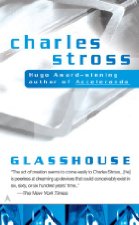
Book Review: Glasshouse by Charles Stross
 Summary:
Robin lives in the 27th century where your consciousness can be switched from body to body (and not just ortho-human ones) indefinitely. Frequent back-ups in an A-gate protect you from ever really dying. Of course, sometimes people go in to get some memories wiped. This is the closest thing to a chance at a new life. Robin wakes up in one of these facilities with a far more extensive memory wipe than usual. People are trying to kill him, and he finds himself signing up for a social experiment where the experimenters are attempting to recreate the second dark ages–the end of the 20th and beginning of the 21st century. He thinks he’ll be safe here, but he might not be. Is he really at risk though or is he just messed up in the head?
Review:
This future where Earth no longer exists and a person is a person because of their consciousness and not their bodies is incredibly richly imagined. It is abundantly clear that Stross has a clearly laid out society in mind when writing. This is all taking place within a world within a certain timeline within a certain culture. That is what makes for the best scifi reading experience, and Stross pulls it off quite well.
The plot is endlessly surprising and nearly impossible to predict until the last few chapters. Of course any plot involving people who can change bodies with a complex civil war previously fought involving a computer virus that enters people’s consciousness via the A-gates would be complex. But don’t be deterred! It is really not difficult to follow, although you may have to stop to think about it a few times.
I also want to say kudos to Stross for writing such an incredibly GLBTQ friendly piece of scifi that isn’t necessarily about gender or sexuality. It’s the first time I’ve ever seen the terms “cis-gendered and trans-gendered” used in a scifi book. In this future where people can pick whatever body they want, it’s natural for everyone to spend at least a few lifetimes as both a male and a female, although they all ultimately tend to choose one over the other. In fact, a plot-point for the book involves the researchers randomly placing someone who identifies predominantly as female in a male body and the resulting depression from that. Similarly, characters identify as mono or poly, meaning both monogamous and polyamorous sexualities are recognized as equally valid. It is an incredibly welcoming environment where people are encouraged to be themselves that only makes the experiment set during our own time period all the more jolting. I could see any queer person finding this story very relatable.
Unfortunately, the strong set-up kind of lost me toward the end. I’m still not quite sure exactly what I should have taken from the ending, but I felt that it didn’t live up to the incredibly high bar Stross set for himself early on. I’m still glad I read it as it was a very different, unique experience, but I do wish he’d spent a bit more time figuring out an ending worthy of the meat of the book.
Overall, I recommend this to scifi fans, and highly recommend it to GLBTQ readers and advocates.
4 out of 5 stars
Source: PaperBackSwap

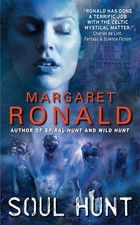
Book Review: Soul Hunt by Margaret Ronald (Series, #3)
 Summary:
Native Bostonian Evie Scolan is an adept bicycle courier and has her first real relationship in a while. Of course, her life isn’t quite that simple. First, she’s The Hound with an uncannily adept sense of smell that helps her find things. Plus her boyfriend is a werewolf. Then there’s the whole try to keep the magical Undercurrent in Boston under control so her beloved city doesn’t fall apart thing. Not to mention the death sentence given to her by yet another sector of the Undercurrent giving her only until Midwinter to pull everything together. Plus the Sox are sucking this season.
Review:
Yet again, I accidentally picked up a book that is partway through a series. I’ve noticed this is a lot easier to do when it’s an ebook than a print book, because the print book tends to have a giant “3” or something on the binding, whereas the ebook gives you zero clue that this is part of a series. Work on that, publishers. Due to this fact, I spent the solid first half of the book trying to figure out what the heck was going on in Evie’s world. Unlike paranormal romance that tends to offer up a quick recap of the important details, it would appear that urban fantasy isn’t so keen on that. Well, that and Ronald’s world she has created is incredibly complex and hard to understand fully part-way into a series.
That aside, however, how is it for an urban fantasy novel? Well, the fantasy element is strong and intensely connected to elements of urban living from good and bad neighborhoods to trolley tracks to old, abandoned buildings, to secret tunnels and ghosts. This has it all if you’re after some seriously steeped fantasy.
Further, as a Bostonian myself, I can tell you that Ronald gets the local slang and layout of the neighborhoods right. Personally, I think she’s a bit heavy-handed with the Red Sox love demonstrated by Evie. I don’t really think Evie would be thinking about the Sox season sucking when she’s currently facing death, but maybe I’m just not enough of a fanatic myself. Hah.
I think, perhaps, that why I couldn’t get into this partway through the way I could other series I started in the middle is that I don’t like Evie, and the mythos of the Undercurrent is way more confusing than it should be. I can’t think of very much that’s appealing or redeeming about Evie as a character, which is problematic when she’s the heroine. Similarly, she’s not beautifully broken or anything. She reads as just…..average. The fact that this is the case when she also has this weird supernatural nose is saying something. Make Evie evil! Make Evie kick-ass! Just don’t make her so dull that I have zero doubt that I wouldn’t give her a second glance if I happened to see her on the streets of Boston.
Similarly, the mythos of the Undercurrent seems to change to suit the author’s needs. Maybe I was missing plot twists from missing the earlier books, but it all just seems so much more complex than it needs to be. Plus, what exactly makes Evie repeatedly go up against demigods when her only supernatural talent is the nose thing? It just doesn’t make sense to me. That and the whole part dog thing is just….ew.
I came into this wanting to love it, as I do with any book set in my home of Boston. The fact is though, too much turned me off from it. It is a fairly well-written urban fantasy, though, and a nice change from the typical southern setting we see. I’d recommend it to urban fantasy fans looking for a change of scenery who don’t mind a rather ordinary heroine who’s basically part dog.
3 out of 5 stars
Source: Amazon

Previous Books in Series:
Spiral Hunt
Wild Hunt


Book Review: The Group by Mary McCarthy
 Summary:
A collection of women graduate from Vassar in the 1930s. Their friendship is known collectively as “The Group,” and their distinctive Vassar education has given them a distinctly liberal view on the world. How this changes with time as they repeatedly encounter societal expectations and relationship problems are told through a series of vignettes that focus in on moments in their lives over the seven years after graduation.
Review:
I am so glad that Nymeth’s review made me add this to my wishlist. This piece of historical fiction told entirely through women’s lives looks at women’s issues in an oft-ignored time period–1930s America. Particular issues that impact these women’s lives and dreams include birth control, gender norms, violence against women, and social justice.
Moving smoothly through the seven years but changing perspectives by spending a chapter or two on each woman in turn, we get a glimpse of their lives. For instance, early in the book we see Kay’s life in detail, but later we only catch glimpses of it through her friends’ eyes. This lends a greater sense of depth and mystery to these women’s lives. What happened to change them? How drastic of an impact did certain events have on their lives? Are they truly happy now? Much like real life, the reader can only speculate based on the limited information she has.
The style of looking at women’s issues in history through the lives of multiple women lends a depth to the story that would not be there if it was told in the traditional manner of focusing in on one single woman. The, essentially, cluster-fuck of circumstances, expectations, and personality that come together to create the different lives they end up leading is endlessly fascinating to study and ponder.
This book humanizes women’s issues in the 1930s and brings them to light in an engrossing manner. I highly recommend this book to anyone with a love of historic fiction or an interest in women’s issues.
5 out of 5 stars
Source: PaperBackSwap

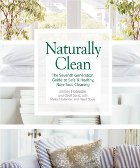
Book Review: Naturally Clean: The Seventh Generation Guide to Safe and Healthy, Non-Toxic Cleaning by Jeffrey Hollender
 Summary:
An introduction to the green concept of natural cleaning, this book gives an overview of why chemical cleaners are bad for people and the environment. Summaries of the scientific evidence are followed by introductory advice on all-natural cleaning and keeping your home as unpolluted as possible.
Review:
Although the concept of cleaners polluting the home seems at first glance like a non-issue, the scientific evidence presented in this book clearly demonstrates that it is an issue. For example:
“Ordinary household products such as cleansers, cosmetics, and paints are now the Los Angeles region’s second-leading source of air pollution, after auto tailpipe emissions, air quality officials say.” Location 182
Ok, but we don’t want to live in dirty squalor, right? The book goes on to clearly point out various natural, safe cleaners that work just as well as regular cleaners, although perhaps requiring a bit more elbow grease.
Although at first I was concerned that the fact that the book was written by the founder of the Seventh Generation cleaning company would lead it to bias or to essentially be an ad for their products, neither was the case. Where products are listed, natural cleaning competitors are included. Further, instructions are given on cleaning your house with products as cheap as vinegar and hydrogen peroxide.
Be cautioned, though, that this is definitely an introductory book. It reads more as a pamphlet to get you headed in the right direction than as a change your entire life guide. As such, I recommend it to those who’ve never considered the benefits of cleaning with natural products before.
3.5 out of 5 stars
Source: Amazon

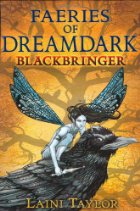
Book Review: Faeries of Dreamdark: Blackbringer by Laini Taylor (Series, #1)
 Summary:
Magpie Windwitch has spent most of her life traveling the world with her parents fighting to save the faerie magic and rid the world of demons and devils mannies accidentally loose from their bottle prisons. Now chasing after a surprisingly powerful demon has brought her and her crew of crow guardians back to her birthplace of Dreamdark, a faerie land no mannie can enter. Here she encounters more members of her generation of faeries, including Poppy who can speak to plants and Talon who possesses an extraordinary knitting talent. Soon Magpie will discover not only secrets about the world, but about herself as well.
Review:
I’ve been working at reading from the bottom of my print TBR pile, and I really do wish I could remember what led me to pick up this book. Faeries and fantasy are generally not my thing, but clearly something caught my eye about this story, and rightly so, for I found myself swept into the tale and really quite enjoying it.
Taylor has created a fun heroine with all the usual traits of a chosen one in fantasy. Blessed by those more powerful, something special about her, has a few flaws such as a strong will, yadda yadda. One thing that really sticks out though is that she’s a girl. The chosen champion is a girl, and so was the most famous prior champion. Nice to see that difference! Plus, seeing a guy fall for a girl because she’s exciting, adventurous, and strong-willed is always fun to see depicted for a change. I truly enjoyed Magpie and Talon, and to me they are the ones who held the story together.
The faerie world is richly imagined without crossing over into being overly romanticized or sexualized like so many faerie stories are wont to do currently. The entire setting reminds me of the books about the adventures of animals in the woods that we humans just can’t see that I used to so enjoy reading as a child. It’s just that in this case in addition to the animals, there are faeries.
The author was inspired by her own drawings, and they pepper throughout the book. They are truly beautiful drawings, and I found myself stopping reading entirely just to get lost in them. Don’t read this one on the tiny screen of an iPod.
The mystery itself is logical within the setting, although it honestly seemed a bit trite and commonplace among fantasy. I was hoping for something a bit more unique. Must every fantasy story be about saving the whole world? Additionally, there were a few side-plots that seemed totally unnecessary, particularly once all was revealed at the end of the book.
On the other hand, the more progressive aspects of the story-telling excuse these short-comings in my mind. Taylor gently expresses a necessary respect for all living creatures, as well as non-gendered expectations and inter-racial relationships. I confidently recommend this to those seeking a fantasy story for middle-grade or YA readers with these positive elements.
4 out of 5 stars
Source: PaperBackSwap

Book Review: Whitewash: The Disturbing Truth About Cow’s Milk and Your Health by Joseph Keon
 Summary:
Joseph Keon seeks to combat the cultural myth of dairy being a necessary part of a healthy diet perpetuated by the milk moustache ads with his book citing multiple scientific studies that have been swept under the rug by those being paid by the dairy lobbyists. Although Keon cares about animal welfare as well (and there is a chapter on the suffering of dairy cows), the book predominantly focuses on debunking multiple myths surrounding human consumption of dairy: the overly-hyped “need” for calcium, that dairy is good for children, and the idea that dairy prevents disease. Keon additionally alarmingly shows the various chemical, virus, and bacteria contaminants commonly found in dairy. Citing multiple scientific studies, he unequivocally demonstrates that contrary to what the dairy industry and government want you to think, dairy is actually bad for your health.
Review:
I’ve been a vegetarian for five years as of January 2011 (working on my sixth year). I’ve honestly stayed away from books on veganism, because I had a feeling vegans were right, and I could not see myself ever giving up cheese. How odd that I could give up so many other things I was raised on like bacon, chicken nuggets, etc… but not cheese. With my recent increased interest in my health, though, I had already decided to cut back on my cheese consumption, so I figured why not give a book on dairy a go. The first few chapters were definitely pushing the buttons I already subconsciously knew–we don’t need dairy, it’s unnatural to consume the milk of another creature intended for their young, etc…. Where I suddenly found myself nodding along and saying yes, though, was when Keon got into the similarities between how adults and children act about cheese and addicts. Keon starts the section by clearly defining addiction:
“Addictions are considered diseases because they are out of our control, often so much so that they lead us to behave in ways that are dangerous to our health. In its most basic definition, an addiction occurs when we are physiologically or psychologically dependent upon a habit-forming substance or behavior, to the point where its elimination from our life may result in trauma or suffering.” Location 721
Keon then goes on to explain exactly what about cheese makes it so addicting when we know it’s bad for us.
“Research has shown detectable amounts of compounds identical to the narcotic opiate morphine in cow’s milk. Study of the morphine found in milk has confirmed it has identical chemical and biological properties to the morphine used as an analgesic. A plausible assumption is that all mammals produce this opiate compound to make sure their offspring return to the breast to acquire essential nutrients and to bond with the mother.” Location 722
Whoa. So cheese, basically, is morphine. The chemical that is healthy for a calf to ingest as it causes her to return to the mother for food, comfort, and safety, when consumed by people causes us to return repeatedly in an addictive manner to a substance that is really, almost pure fat. WOW. You know those life-changing moments? I had one right there.
There are two other sections that are mind-blowing in Keon’s book. The first deals with multiple first world “diseases” that are often actually allergic reactions caused by prolonged exposure to the allergen–cow’s milk. When we take all races into consideration, most people are allergic to cow’s milk: 90% of Asian-Americans, 75% of African-Americans, 50% of Latino-Americans, and 25% of Caucasian-Americans (Location 900). Yet despite these known statistics, the federal government continues to push dairy onto schools at the dairy lobbyists’ urgings.
“The policy of pushing milk upon children in inner-city schools is particularly problematic when we take race into account. African-American children have a lactose intolerance rate of about 75 percent…..Worse, children who have made the healthful transition to beverages made from rice, soy, or almonds are out of luck when they get to school. That’s because any public school in America that attempts to serve these beverages in place of cow’s milk will lose its federal support.” (Location 2163)
Being constantly exposed to an allergen in childhood can cause or exacerbate multiple issues such as colic, irritable bowel syndrome, eczema, acne, asthma, headaches, Crohn’s Disease, chronic nasal congestion, fatigue, depression, joint pain, and even autism.
Keon also addresses the issue of osteoporosis and breast cancer, two issues of utmost concern for women in particular. Whereas women are told that drinking milk will help prevent the former and will not be a contributing factor in the latter, the science actually demonstrates both statements to be false. If a woman follows a typical Western diet, the consumption of that much protein causes her body to become acidic and leech calcium. Studies have shown that no amount of extra calcium consumed can keep up with the leeching. This means that consuming three glasses of milk a day will do nothing for a woman following an omnivorous diet. Add to this the fact that
“Milk has been associated with increased risk for breast cancer, and the combination of pesticides and radiation have been proposed as one possible explanation.” (Location 1816)
When the fact that dairy consumption does not prevent osteoporosis is combined with the association with breast cancer, one is left wondering why there aren’t government campaigns warning women to stay away from dairy to save their lives! (Oh yeah. The dairy lobbies. Money. It always comes down to money). Further, studies have shown that
By age sixty-five, women who have followed a meat-centered diet have lost, on average, 35 percent of their bone mass, while women who have followed a plant-centered diet have lost only about half that amount: 18 percent.” (Location 3195)
I’ve only touched on the surface of the shocking facts backed up by science contained in this book, focusing in on the ones that stuck out the most strongly to me. If you have any interest at all in your health and/or the health of your children, I urge you to read this book. Educate yourself on the facts instead of listening to government programs and advertising caused by dairy lobbyists who are only after your money. Dig for the truth. Read this book.
5 out of 5 stars
Source: Amazon

 Support my work with a tip or browse my shop for curated book club guides, how to guides, cross-stitch patterns, and more!


This work by Amanda Nevius is licensed under a Creative Commons Attribution-Noncommercial-No Derivative Works 3.0 United States License.
 Opinions of a Wolf