
Archive
Book Review: Botanicaust by Tam Linsey (Series, #1)
 Summary:
When the world is devastated by GMO plants over-running the land and destroying cropland, humanity splits into multiple factions. There’s the people who firmly believe in transforming people so that they can photosynthesize food from the sun–and have green skin. There’s the cannibals, who have returned to a hunter/gatherer way and eat humans when necessary. Unbeknownst to the green folk, there’s a holdout of Old Order Amish. They’ve changed from how they were in the past but still hold onto many of their ways. In particular, they have decided that taking green skin is the Mark of the Beast, and will not go for it.
Tula is a scientist among the green folk who is tasked with assisting cannibal children who are kidnapped and converted. Levi is an Amish who leaves the compound against orders, seeking yet another group of scientists who are supposed to live in a mountain and may have the cure to his dying son’s Cystic Fibrosis. When Levi is swept up in a green raid of cannibal land, his and Tula’s worlds collide with unimaginable consequences.
Review:
I picked this up because the cover of a green-skinned woman in a desert appealed to me, and then the description seemed like an interesting post-apocalyptic future. This is certainly and interesting and unique read for any fans of post-apocalyptic or dystopian literature.
The future is imaginative with many different groups and reactions to the botanicaust (the destruction of plant matter that is considered this world’s apocalypse). As someone who has studied the Amish, I appreciated how the author imagined how the Old Order would handle such a crisis and address it for the future. Allowing people into the compound if they are willing to convert seems logical, and showing that the Old Order did accept some technological innovation also makes sense. Similarly, the green scientists who seek to photosynthesize everyone and don’t seem to care too much if the cannibals want to be photosynthesized or not make logical sense. The scientists believe this is the solution in a world without enough food, and hey haven’t bothered to do any cross-cultural studying to see if there is any rhyme or reason or value to the cannibal lifestyle. This again is a logical position for a group of scientists to hold. The other group of scientists who live in the mountain and have managed to find the solution to not aging are a great contrast to the groups of greens. Whereas the greens do sometimes do evil but don’t intend to, they only intend to be helping (with the exception of one bad guy character), the mountain dwellers have been turned inhumane by their abnormally long lives. These three groups set up a nice contrast of pros and cons of scientific solutions and advancement. At what point do we stop being human and at what point are we being too stubborn in resisting scientific advancement? How do we maintain ethics among all of this? The exploration of these groups and these questions was my favorite part of the book.
The plot is complex and fast-paced, visiting many areas of the land and groups of people. I wasn’t particularly a fan of the romance, but I can see where others would find that it adds to the book. I just wasn’t particularly a fan of the pairing that was established, but for no reason other than it seemed a bit illogical to me. Then again, romance is not always logical.
The one thing that really bothered me in the book was the representation of Down Syndrome and the language used to refer to it and those who have it. The mountain scientists have children, but as a result of tampering with their own genetics, all of their children have Down Syndrome. First, I don’t like that this makes it appear as if Down Syndrome is a punishment to the evil scientists who went too far with science. Down Syndrome is a condition some people are born with. It is not a condition as the result of anything a parent did, such as fetal alcohol syndrome. Second, all of the characters with Down Syndrome are presented as large, bumbling oafs with hearts of gold. There is just as much variety to the personalities and abilities of those with Down Syndrome as there are in those of us without Down Syndrome. Finally, the author persists in referring to these characters as:
a Down’s Syndrome woman (loc 2794)
or of course, “a Down’s Syndrome man.” First, the preferred term for Down Syndrome is Down Syndrome, not Down’s Syndrome. This is a mistake that is easy to make, though (I have made it myself), and I am willing to give the author a pass for that. The more upsetting element in the way she refers to these characters though is that she always lists the condition first and then the person, not the other way around. It is always preferred, in any illness or condition, to list the person first and the illness or condition second. For instance, a woman with cancer, not a cancerous woman. A man with PTSD, not a PTSD man. A child with Down Syndrome, not a Down Syndrome child. I cringed every single time this happened, and it happens a lot in the section of the book that takes place in the mountain. Given that this is an indie book, and it is thus quite easy to make editing changes and fixes, I would hope that the author would go through and fix this simple aspect of language. It would be a show of good faith to the entire community of people who have Down Syndrome, as well as their families. For more on the preferred language when referring to Down Syndrome and people who have Down Syndrome, please check out this excellent guide, written by the National Down Syndrome Society.
It’s a real bummer to me that the language about Down Syndrome and presentation of these characters isn’t better, because if it was, this would have been a five star read for me.
Overall, this is an interesting and unique post-apocalyptic future with an action-packed plot. Those who are sensitive to the language used to refer to Down Syndrome and representation of people with Down Syndrome may wish to avoid it, due to an unfortunate section where characters with Down Syndrome are referred to improperly and written a bit two-dimensionally.
If you found this review helpful, please consider tipping me on ko-fi, checking out my digital items available in my ko-fi shop, buying one of my publications, or using one of my referral/coupon codes. Thank you for your support!
4 out of 5 stars
Length: 348 pages – average but on the longer side
Source: Amazon

ETA:
The author has written a thoughtful and kind comment on this post. You may view it by going below. To sum up, she cannot make edits to those book, due to it also having an audiobook version. However, she has promised to edit for these issues in future books containing characters with Down Syndrome. This genuine and thoughtful response is much more than the community of those with Down Syndrome and their families and loved ones often get, and it is very much appreciated.
Book Review: Preserver by William Shatner, Judith Reeves-Stevens, and Garfield Reeves-Stevens (Series, #3) (Audiobook narrated by William Shatner)
 Summary:
Captain Kirk and his nemesis from the mirror universe, Tiberius Kirk, pair up to hunt down the preservers, orbs left by some more intelligent race. Kirk is teaming up with Tiberius because Tiberius holds the key to saving his wife’s and unborn son’s lives. Their quest will reveal hidden secrets about the universe.
Review:
This is the second audiobook my fiancé and I listened to on our road trip to and from Michigan. We listened to the previous book in the series, Dark Victory (review), on the drive out. We listened to this one on the drive back. (Each direction is a 13 hour drive). Whereas the previous book kept us entertained and awake for our road trip, this one left us confused and concerned we might actually be drifting off into sleep periodically, because it made so little sense. (For the record, we were not drifting off into sleep. This book just makes very little sense).
All of the audiobook qualities that were great about the previous book stay great here. Shatner’s narration alternates between hilariously good and hilariously bad but mostly is just hilariously Shatner. The sound effects continue to be stellar and one of my favorite parts of the book. It continues to feel like listening to a Star Trek movie as a radio show, and that it was kept me going through it.
The plot, however, just makes very little sense and seems to fall apart. Whereas in the previous book a continuing plot point is Shatner’s ruined hands, in this one it’s Shatner’s unborn (and then born) son who is all kinds of genetically messed up thanks to the poison in his mother’s system from the cloned children of Tiberius. (Are you confused yet?) This could possibly make for an interesting plot, but it’s dropped frequently to pursue the other plot about the preserver orb things. We read this book and both fiancé and I are still unclear as to precisely what the orbs mean. We’re not even sure if they’re good or bad. This is how confusing the plot is, I can’t even properly sum it up for you folks. In spite of the plot being really confusing, there are still some fun scenes, such as when Kirk meets his son for the first time. It’s a short audiobook, so I’m not unhappy I listened to it, even if I mostly only understood the Kirk’s son plot.
Overall, while this provides very little clear closure to the plot point set up earlier in the trilogy, it does feature the birth of Kirk’s son and all the fun of listening to a radio show version of a Star Trek movie. If you liked the previous books in the trilogy and don’t mind a confusing plot, you’ll enjoy finishing up the trilogy.
If you found this review helpful, please consider tipping me on ko-fi, checking out my digital items available in my ko-fi shop, buying one of my publications, or using one of my referral/coupon codes. Thank you for your support!
3 out of 5 stars
Length: 420 pages – average but on the longer side
Source: Audible

Previous Books in Series:
Spectre
Dark Victory

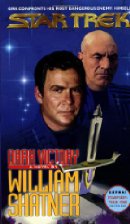
Book Review: Dark Victory by William Shatner, Judith Reeves-Stevens, and Garfield Reeves-Stevens (Series, #2) (Audiobook narrated by William Shatner)
 Summary:
Our universe has been invaded by the inhabitants of the Mirror Universe–a parallel universe that is a dark, twisted version of our own. Now, Captain Kirk, with the captains and crews of The Next Generation and Voyager must battle evil versions of themselves, led by the evil version of Kirk — Tiberius Kirk. What nightmares does Tiberius have planned for the Federation?
Review:
Back in December, my fiancé and I road-tripped to Michigan to visit his family. It’s about a 13 hour drive, and I had Audible credits, so I suggested we pick out a book. We both love Star Trek so we investigated what Star Trek options are available. This one jumped out at us for the obvious reason that it’s narrated by William Shatner himself! Other reviewers complained about sound effects, but that just made us more excited, so we downloaded it, oblivious to the fact that it’s the second book in a series. This book reads like a radio program version of a Star Trek movie featuring a crazy mash-up of the Original Series, Next Generation, and Voyager.
The action starts right away, which was admittedly a bit confusing, since we hadn’t read the first book. It starts with Tiberius and his crew escaping into our own universe, and Kirk and his trying to battle them. Also, Kirk’s hands are mysteriously mangled from something that happened in the first book. Ultimately, we were able to catch up with the plot and follow it somewhat. Kirk is in love with a woman who is pregnant with his baby. Tiberius seems intent on getting to some orbs that the Federation wants to protect. Kirk wants to stop him, but the Federation and some spy branch of theirs are trying to keep him from engaging in the fight anymore. They even go so far as to lie to him and tell him that Tiberius is dead. It’s a complex, twisting plot that makes some sense when listening to it, although summarizing it is nigh on impossible. Suffice to say, that if you enjoy the concept of the mirror universe and the characters from three series all interacting together, you’ll probably enjoy this plot. Plus, there’s also Kirk’s wedding in this book, and that is just not to be missed. (There are horses! And red leather outfits!)
What really made the book for me was the audiobook presentation of it. It is presented like a radio program, complete with amazing sound effects. The communicator actually beeps! There are impact noises from shots at the Enterprise! There are even whinnies from the horses. If you’re a more serious Star Trek fan, you might be irritated by the relative kitsch of this book and its reading, but if you enjoy Star Trek for its periodic utter ridiculous, then you’ll enjoy the way this audiobook is presented.
Shatner’s narration is sometimes good but often hilariously bad. His voice for women is unnaturally high and soft, making me giggle each time, and mysteriously, he uses the same voice for Captain Picard as for women. Listening to him narrate anyone who is not Captain Kirk is a bit like watching Captain Kirk “fight” in the Original Series. I enjoyed it for its ridiculousness, not for its quality.
Overall, if you’re a Star Trek fan who doesn’t take the show too seriously, you’ll enjoy this radio program like audiobook with a plot mashing up everything from a mirror universe to somehow placing Captains Kirk, Picard, and Janeway on the same ship.
If you found this review helpful, please consider tipping me on ko-fi, checking out my digital items available in my ko-fi shop, buying one of my publications, or using one of my referral/coupon codes. Thank you for your support!
4 out of 5 stars
Length: 303 pages – average but on the longer side
Source: Audible
Previous Books in Series:
Spectre

Book Review: The Keep by F. Paul Wilson (Series, #1) (Bottom of TBR Pile Challenge)
 Summary:
Captain Klaus Woermann isn’t a fan of the Nazis or the SS and doesn’t exactly keep this a secret. But he’s also a hero from the First World War, so the Nazi regime deals with him by sending he and a small troop to Romania to guard a pass the Russians could possibly use. They set up to guard the place in a building known as the keep. It should be a quiet assignment, but when the German soldiers start being killed one a night by having their throats ripped out, the SS is sent to investigate.
SS Major Kaempffer wishes to solve this mystery as soon as possible so he may start his new promotion of running the extermination camp for Romania. He is sure he can solve this mystery quickly.
Professor Cuza and his daughter Magda are Romanian Jews who have already been pushed out of their work in academia. They also just so happen to be the only experts on the keep. When the SS sends for them, they are sure it is the beginning of the end. But what is more evil? The mysterious entity killing the Germans or the Nazis?
Review:
It’s hard not to pick up a book that basically advertises itself as a vampire killing Nazis and the only ones who can stop the vampires are a Jewish professor and his daughter. I mean, really, what an idea! Most of the book executes this idea with intrigue and finesse, although the end leaves a bit to be desired.
The characterization of the Germans is handled well. They are a good mix of morally ethical people who are caught up in a regime following orders and see no way out (the army men) and evil men who enjoy inflicting pain upon others and are taking advantage of the regime to be governmentally sanctioned bullies, rapists, and murderers. Having both present keeps the book from simply demonizing all Germans and yet recognizes the evil of Nazism and those who used it to their advantage.
Similarly, Magda and her father Professor Cuza are well-rounded. Professor Cuza is a man of his time, using his daughter’s help academically but not giving her any credit for it. He also is in chronic pain and acts like it, rather than acting like a saint. Magda is torn between loyalty to her sickly father and desires to live out her own life as she so chooses. They are people with fully developed lives prior to the rise of the Nazis, and they are presented as just people, not saints.
In contrast, the man who arrives to fight the evil entity, Glaeken, is a bit of a two-dimensional deus ex machina, although he is a sexy deus ex machina. Very little is known of him or his motivations. He comes across as doing what is needed for the plot in the moment rather than as a fully developed person. The same could easily be said of the villagers who live near the keep.
The basic conflict of the plot is whether or not to side with the supernatural power that seems to be willing to work against the Nazis. Thus, what is worse? The manmade evil of the Nazis or a supernatural evil? Can you ever use a supernatural evil for good? It’s an interesting conflict right up until the end where a reveal is made that makes everything about the question far too simple. Up until that point it is quite thought-provoking, however.
The plot smoothly places all of these diverse people in the same space. The supernatural entity is frightening, as are the Nazis. These are all well-done.
One thing that was frustrating to me as a modern woman reader was the sheer number of times Magda is almost raped or threatened with rape, and how she only escapes from rape thanks to anything but herself. In one instance, the Nazi simply runs out of time because the train is about to move out. In another, she is saved by a man. In a third, she is saved by supernatural devices. While it is true that rape is a danger in war zones, it would be nice if this was not such a frequently used conflict/plot point for this character. Once would have been sufficient to get the point across. As it is, the situation starts to lose its power as a plot point.
The ending is a combination of a deus ex machina and a plot twist that is a bit unsatisfying. There also isn’t enough resolution, and it appears that the next books in the series do not pick up again with these same characters, so it is doubtful there is more resolution down the road. It is a disappointing ending that takes a turn that is nowhere near as powerful and interesting as the rest of the book.
Overall, this is an interesting fantastical take on a historic time period. The ending could possibly be disappointing and not resolve enough for the reader and some readers will be frustrated with the depiction of the sole female character. However, it is still a unique read that is recommended to historic fiction fans and WWII buffs that don’t mind having some supernatural aspects added to their history.
If you found this review helpful, please consider tipping me on ko-fi, checking out my digital items available in my ko-fi shop, buying one of my publications, or using one of my referral/coupon codes. Thank you for your support!
4 out of 5 stars
Length: 403 pages – average but on the longer side
Source: PaperBackSwap

Book Review: The Shade of the Moon by Susan Beth Pfeffer (Series, #4)
 Summary:
Jon Evans has spent the last two years living in an enclave as a slip — someone who received a VIP pass to get into an enclave that was originally intended for someone else. His stepmother and half brother live there as well, while his mother and older sister, Miranda, and her husband, Alex, live just outside of the enclave, working and serving it while living in filth. Jon isn’t like the rest of them. He can barely remember a time before the apocalypse of the moon being hit out of orbit. The enclave and its ways seem increasingly normal, even if he is haunted by the memories of what happened in the years between the apocalypse and the arrival at the enclave.
Review:
I was a bit startled to see that this book featured yet another new perspective, particularly after the return to Miranda’s diary in the third book. I was expecting a turn back to Alex, but instead we get Miranda’s little brother Jon’s perspective. I can understand the reasoning for this shift. Jon is the only young person from the original group living in the enclave. He is a bit of an antihero throughout most of the book, providing a unique look at the privileged elite in this post-apocalyptic society but one that could be alienating to some readers.
Whereas the first two books focused on the actual apocalypse and the third on the immediate aftermath, this book looks at the new society emerging from that wasteland, and it’s not good. It’s quite dystopian. Not everyone who enjoys apocalyptic and post-apocalyptic worlds also enjoy dystopian ones, so this is a bit of a risky move for a series, although it makes logical sense for the plot to progress this way. The dystopia that Pfeffer imagines is interesting. The elite have built up enclaves and use those who are not elite to work supporting them, basically killing themselves slowly mining coal and growing food while the elite stay safe and educated in the enclaves. It allows for a look at social class taken to the extreme while still seeming realistic within the world Pfeffer has created.
Jon also is a realistic character. He’s a bit spoiled rotten, after all, his brother, sister, and mother all routinely gave him extra food while they starved when the apocalypse first occurred. He’s the result of all the coddling they gave the youngest in an effort to keep him alive and healthiest. That said, some readers will be turned off by Jon. He’s unequivocally a jerk throughout at least half of the book before he eventually snaps out of it. While I personally enjoy a good antihero every now and then, not all readers will like visiting one, particularly after the more heroic presence of Miranda and Alex in the first two books.
There is one aspect of Jon’s character that really bothers me, and it has nothing to do with his snobbishness and antihero nature early on in the book.
*spoilers*
He lets on early on in the book that something bad happened to Alex’s sister Julie. He at one point misleads a female character to believe that he raped Julie to drive her away from him. This is done to protect her, and the reader is led to believe through this scene that Jon obviously didn’t rape Julie. Yet when we find out what actually happened, it’s not quite so crystal clear. Jon basically was making out with Julie and not stopping when she asked him to the first time. She then runs out into the storm and is killed in the tornado. Jon states that of course he would have stopped, he was just slow about it and reluctant because he didn’t think Julie’s protests were real. He thought she wanted him but wasn’t letting herself want him because of her religion. This is clearly many levels of fucked up. The reader is supposed to just believe Jon that he would have stopped because he says so? The reader is supposed to believe that Julie 100% over-reacted because Jon claims she did? It’s a squicky scene to read about, partially because it comes across as that the reader is supposed to absolve Jon from any guilt since he clearly didn’t rape Julie. He’s also upsetting because no one in the book treats this like the serious issue it is. Everyone just kind of shrugs and goes oh Julie over-reacted and goes on their merry way. Even if Jon really was about to stop when Julie ran out, he clearly needs to be spoken to about listening to your partner immediately, about seeking out enthusiastic consent, and about not victim blaming. Particularly given that this is a YA book and what an important issue this is, the way it’s glossed over left a really sour taste in my mouth.
*end spoilers*
I’m not against the presence of an antihero, including in a YA book, but I do think that Jon’s worse qualities could have been handled with a bit more deftness. His presence instead dances around the edges of certain issues, rather than drawing them out for examination within the context of a fun dystopia.
The plot gets a bit nuts, and one character in particularly has an ending that is rather anticlimactic. However, the plot does eventually move everyone into a new area of the dystopia that is quite fascinating and sets the series up well for another book that will hopefully be free of Jon’s perspective, if Pfeffer does decide to write one.
Overall, readers of the beginning of the series will enjoy seeing what ultimately happens to Miranda and Alex, although they may be frustrated to have to do it through Jon’s eyes. Jon is an antihero who may irritate some readers, and his presence brings up some issues that are then glossed over, rather than dealt with. Recommended to readers who really want to see more of Miranda and Alex who don’t mind spending some time with an antihero.
If you found this review helpful, please consider tipping me on ko-fi, checking out my digital items available in my ko-fi shop, buying one of my publications, or using one of my referral/coupon codes. Thank you for your support!
2 out of 5 stars
Length: 304 pages – average but on the longer side
Source: Library
Buy It (Amazon or Bookshop.org)
Previous Books in Series:
Life As We Knew It
The Dead and The Gone
This World We Live In
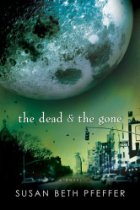
Book Review: The Dead and the Gone by Susan Beth Pfeffer (Series, #2)
 Summary:
Seventeen-year-old Alex Morales works hard with his eyes on a good college. He even works in a local pizza joint to pay for his own private Catholic school uniforms to help his Mami and Papi. Papi is in Puerto Rico for his mother’s funeral and Mami is working late when an asteroid strikes the moon and everything changes. New York City is struck by flooding and loss of infrastructure. Alex is left alone to care for his two younger sisters, Julie and Briana, and slowly he begins to think that maybe things will always be this bad. Maybe Mami and Papi will never come back, the moon will never look right again, and there will never be a world where he can go to college and not be left caring for his little sisters.
Review:
I inhaled the first book in this series, in spite of the scientific flaws (which I addressed in my review of the first book). Miranda’s journal ends so abruptly that I was eager to get to the next book right away. I was surprised, then, when the second book starts back before the moon is struck with an entirely different family in a different area of the country. This book shows Pfeffer’s abilities as a writer by showing the same apocalyptic event seen in the first book from the perspective of an entirely different family.
Miranda’s family is suburban-rural, agnostic/atheist humanist, blended (divorced parents with one remarried), and white. Alex’s family is urban (NYC), Latino, and devotedly Catholic. Both families are given room to have strengths and flaws, most of which have nothing to do with where they live, their ethnicities, or their religions (or lack of one). I honestly was startled to see Alex and his and his sisters’ strong faith treated with such respect in this book after Miranda’s lack of faith was treated with equal respect in the first. It’s easy, particularly in a book written as a journal, to mistake a character’s beliefs for an author’s, and Miranda, a teenage girl, has very strong beliefs. This book reminded me that those beliefs were just Miranda’s, just as Alex’s beliefs are just his, and it shows how well Pfeffer is able to write characters.
Some readers may find it odd and frustrating to go back in time to relive the apocalypse over again with different characters. I personally enjoyed it, because the world falling apart is one of the best parts of post-apocalyptic fiction for me. I also liked having the opportunity to see differences in how the apocalypse plays out based both on the location (suburban/rural versus urban) and the characters’ personalities and reactions. However, that said, I can see how this set-up of two vastly different sets of characters in books one and two could be off-putting to certain readers. Some religious readers may be turned off by the first book and Miranda’s staunch atheism. Those who read the first book and enjoy it for precisely that reason may similarly be turned off by the second book’s heavy Catholicism and faith. The diversity is a good thing but it also makes it hard to pinpoint an audience for the series. Those who are open to and accepting of other belief systems would ultimately be the best match but that’s a demographic that can sometimes be difficult to find or market to. However, if a reader is particularly looking for a diverse set of viewpoints of the apocalypse that is more than just characters’ appearances, this series will be a great match for them.
It should also be mentioned that this book is not a journal. It is told in third person, from Alex’s viewpoint, although the dates are still mentioned. It makes sense to do it this way, since Alex definitely does not come across as a character with the time or the inclination to keep a journal. It would have been interesting to view the apocalypse from the viewpoint of a boy who did keep a journal, however.
The plot makes sense and brings in enough danger without being overly ridiculous. It would have been nice to have maybe started the book just a bit earlier in the week to see more of Alex’s day-to-day life before the disaster. Instead, we learn about it through flashbacks, which makes it a bit harder to get to know him than it was to get to know Miranda.
Overall, this is a surprising and enjoyable second book in this post-apocalyptic series that lets readers relive the apocalypse from the first book over again with a different set of characters. This approach lends diversity to the series, as well as bringing in a greater variety of scenarios for those who enjoy the apocalypse process. Recommended to those looking for a diverse presentation of beliefs and how those impact how characters deal with an apocalypse.
If you found this review helpful, please consider tipping me on ko-fi, checking out my digital items available in my ko-fi shop, buying one of my publications, or using one of my referral/coupon codes. Thank you for your support!
4 out of 5 stars
Length: 341 pages – average but on the longer side
Source: Library
Previous Books in Series:
Life As We Knew It
Book Review: Life As We Knew It by Susan Beth Pfeffer (Series, #1) (Bottom of TBR Pile Challenge)
 Summary:
Miranda’s journal starts out like any other teenage girl’s diary. Worries about school, her after-curricular activities, and wondering how her family will work out with her dad having a brand-new baby with his new wife. But when a meteor strikes the moon things start to change. Slowly at first but with ever-increasing speed. Tsunamis wipe out the coasts. Volcanoes erupt. And soon Miranda finds herself, her mother, and her two brothers struggling to survive in a world that increasingly bares no resemblance to the one she once knew.
Review:
I’m a sucker for journal entry books, even though I know rationally that no diary ever has as much content and exposition as is contained in these fictional works. In addition to the journal format, I liked the premise for the dystopian world Miranda finds herself in. It’s very different from a lot of the other ones out there, since it’s 100% gradual natural disaster. This book lives up to the expectations set by its summary, offering a fun journal entry take on a natural disaster that turns into a dystopia.
Miranda, who lives in semi-suburban Pennsylvania, starts out the journal as a very average teenage girl, adapting to her parents’ divorce and father’s subsequent re-marriage, her older brother being away for his first year of college, and hoping to convince her mother to let her take up ice skating again. The book clearly yet subtly shows her development from this young, carefree teenager through angst and denial and selfishness in the face of the disaster to finally being a young woman willing to make sacrifices for her family. Miranda is written quite three-dimensionally. She neither handles the disaster perfectly nor acts too young for her age. While she sometimes is mature and sees the bigger picture at other times she simply wants her own room and doesn’t understand why she can’t have that. Pfeffer eloquently shows how the changes force Miranda to grow up quickly, and this is neither demonized nor elevated on a pedestal. Miranda’s character development is the best part of the book, whether the reader likes her the best at the beginning, middle or end, it’s still fascinating to read and watch.
Miranda also doesn’t have the perfect family or the perfect parents, which is nice to see a piece of young adult literature. Her parents try, but they make a lot of mistakes. Miranda’s mother becomes so pessimistic about everything that she starts to hone in on the idea of only one of them surviving, being therefore tougher on Miranda and her older brother than on the youngest one. Miranda’s father chooses to leave with his new wife to go find her parents, a decision that is perhaps understandable but still feels like total abandonment to Miranda. Since Miranda is the middle child, she also has a lot of conflict between being not the youngest and so sheltered from as much as possible and also not the oldest so not treated as a semi-equal by her mother like her oldest brother is. This imperfect family will be relatable to many readers.
Miranda’s mother is staunchly atheist/agnostic/humanist and liberal, and this seeps into Miranda’s journal. For those looking for a non-religious take on disaster to give to a non-religious reader or a religious reader looking for another perspective on how to handle disasters, this is a wonderful addition to the YA dystopian set. However, if a reader has the potential to be offended by a disaster without any reliance on god or liberal leanings spelled out in the text, they may want to look elsewhere.
I know much more about medical science than Earth science or astronomy, but I will say that when I was reading this book, the science of it seemed a bit ridiculous. An asteroid knocks the moon out of orbit (maybe) so the tides rise (that makes sense) and magma gets pulled out of the Earth causing volcanoes and volcanic ash leading to temperature drops Earth-wide (whaaaat). So I looked it up, and according to astronomers, an asteroid is too small to hit the moon out of orbit. If it was large enough to, it would destroy the moon in the process. Even if for some reason scientists were wrong and the moon could be knocked out of orbit, even in that scenario, the only thing that would happen would be the tides would be higher. (source 1, source 2) I know dystopian lit is entirely what if scenarios, but I do generally prefer them to be based a bit more strongly in science. I would recommend that reading this book thus be accompanied by some non-fiction reading on astronomy and volcanology. At the very least, it’s good to know that you can safely tell young readers that this most likely would not happen precisely this way, and this book is a great opening dialogue on disasters and disaster preparedness.
Overall, this is a fun take on the dystopian YA genre, featuring the journal of the protagonist and dystopia caused primarily by nature rather than humans. Potential readers should be aware that the science of this disaster is a bit shaky. The story featuring an agnostic humanist post-divorce family makes it a welcome diversifying addition to this area of YA lit.
If you found this review helpful, please consider tipping me on ko-fi, checking out my digital items available in my ko-fi shop, buying one of my publications, or using one of my referral/coupon codes. Thank you for your support!
4 out of 5 stars
Length: 337 pages – average but on the longer side
Source: PaperBackSwap
Book Review: The Alkaline Cure: Lose Weight, Gain Energy, Feel Young and Stay Healthy for the Rest of Your Life by Stephan Domenig
 Summary:
This book offers an introduction to the Alkaline Diet, as well as a 14 day meal plan and lifestyle guide to jump-start the reader into the Alkaline way.
Review:
The introduction to the Alkaline Diet in the first half of the book is wonderfully written and easy to understand. The 14 day meal plan and lifestyle guide falters, however, with dull, complex to make meals and a shortage of exercise tips.
For those who don’t know, the Alkaline Diet basically is the idea that our bodies function best with a pH balance between 7.3 and 7.5, but modern lifestyles wreak havoc with this balance, making us too acidic. What impacts our pH balance is our food and lifestyle. Each food can be either acidic or alkaline. Stress is acidic. Meditation is alkaline. Etc… Whether or not this idea that the body should be at a certain pH balance is valid is rather irrelevant, honestly. The tips offered for creating this balance are all good, healthy ones. The book never veers into extremism, indeed cautioning that acidic foods, such as meat and processed items, do not need to be cut out of the diet entirely in order for the reader to be healthy. It encourages a 2:1 ratio. Two parts alkaline food and activities for every one part acidic food and activities. Essentially, the idea that health is not all or nothing. It is a balancing act. Indeed, balance is a theme of the book.
Your body doesn’t want extremes–it wants balance. (loc 480)
The two parts alkaline it encourages are basically fresh produce, time for self-care, and low-stress exercise. So basically, eat whole foods, stress less, and move more. Fairly common fitness and health advice. The acidic parts include processed food, meat, dairy, stress, and high-stress exercise. Again, the reader is not told to stop enjoying any of these things, but simply to find a balance. The only thing I really disagree with is I think the book underemphasizes the importance of exercise for health. In fact, the book seems a bit concerned with not doing too much “high-stress” cardio or weight lifting. It seems to be more inclined toward the lower-impact, more moderate exercises. I don’t think this is an idea that could claim to have much science behind it. Indeed, high-intensity interval training (HIIT) is written about in over 200 articles on PubMed (a free biomedical database), and most of these articles are talking about the positive effects of HIIT on abilities and cardiovascular health. (List of articles) So essentially the food and lifestyle advice is mostly good but take the exercise advice with a grain of salt. Advising moderate walking and stretching every other day or so is really only appropriate for the most beginner levels of fitness.
After introducing these ideas, the book next offers a 14 day meal plan and lifestyle plan for the person new to Alkaline. The first week is basically a cleanse, and the second week is supposed to be a model of what the non-cleanse Alkaline lifestyle is like. This is the part where I became disappointed. The recipes, including the ones for the non-cleanse week, come across as bland, dull, and labor-intensive, and this is coming from a person who does an awful lot of cooking to minimize the amount of processed foods in her diet. I usually spend at least two hours prepping food for the workweek and cook a minimum of 4 meals at home a week. This plan seemed like an overwhelming amount of work to me. I can only imagine how it might seem to a reader who normally cooks processed meals or picks up fast food most days of the week. Many of the recipes were also not particularly simple. For both of these reasons, I feel the meal plan isn’t particularly appropriate for a beginner, which is odd given that the rest of the book is toned as for a beginner. I would expect an easier, more approachable meal plan from this book.
Each day also has beauty, exercise, and lifestyle suggestions. I particularly enjoyed the beauty suggestions, as they were mostly things that are easy to do at home and seemed enjoyable, such as an alkalizing foot bath or a hair mask. The lifestyle suggestions were good for beginners who maybe are new to the ideas of meditation and stress relief. The exercise sections suffered from the same issue I went into in-depth earlier.
What the book lacks is a clear idea of who its audience is. Is it a person completely new to fitness and healthy eating who is currently a beginner in every way? Is it meant for every person wherever they are on their journey to health? Is it meant for intermediates, looking to amp up their fitness and health regime? Because it lacks a focus, the content veers around between these three options, suggesting extremely beginner level exercises but rather advanced cooking and preparation ideas. For this reason, it would probably frustrate a beginner who finds the first half of the book do-able and understandable but then finds an overwhelming amount to do for an introductory 14 day plan. It would also frustrate someone who is not new to fitness and health who wants more details on how to amp up their regime and who may be a bit insulted at the idea that they will be fine if they just go for walks every few days. Recommended to those interested in a quick introduction to the ideas behind the Alkaline Diet to tweak their diet on their own but who is not so invested in using a 14 day introductory plan.
If you found this review helpful, please consider tipping me on ko-fi, checking out my digital items available in my ko-fi shop, buying one of my publications, or using one of my referral/coupon codes. Thank you for your support!
3 out of 5 stars
Length: 304 pages – average but on the longer side
Source: Netgalley

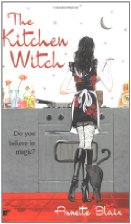
Book Review: The Kitchen Witch by Annette Blair (Series, #1)
 Summary:
Logan finds himself a single dad after his young son’s mother abandons him on his doorstep, so he moves back to his hometown of Salem, Massachusetts, looking to provide his young son with some stability. He has a bad rep from his teen years in Salem to get over, though, and he hopes his new job as a television producer at the local tv station will help. He wasn’t expecting his downstairs neighbor Melody Seabright, however.
Melody, who seems incapable of holding onto a job for any length of time, gets him to get her a meeting with the owner of the tv station and somehow convinces him to give her her own tv show, The Kitchen Witch. The only problem is she can’t cook, and whether or not she’s really a witch is up for debate.
Can Melody learn how to cook and hold onto the job? Or are both of their jobs now in jeopardy? And why does Logan keep thinking about such an unpredictable woman when he knows he needs to provide stability for his son?
Review:
I picked this up on a free book cart at a local library because the cover and title were cute, and I definitely am periodically in the mood for some lighthearted paranormal romance. I was a bit disappointed to find this isn’t really a paranormal romance, but I still enjoyed the contemporary tale it told, primarily due to its featuring a good-hearted single dad.
Logan is a contemporary romance character who will make many readers’ hearts beat a bit faster. He’s cute, young, has a high-powered job, lives in the quirky town of Salem and enjoys it, and is an awesome single dad to his young son. Having him be a bad boy who overcame it for his son is the perfect last touch for a contemporary romance. I can see many readers enjoying fantasizing about him.
Melody may be a bit more hit and miss with readers. The delightfully clumsy bit has been used a lot in romance recently and may feel a bit been there done that. Her apartment is divinely adorable, though, and she has some curves that are always looked upon as a good thing. Her difficult relationship with her own father adds some depth to the character, but some readers might have trouble sympathizing with a poor little rich girl, although I do think that Blair handled this particular aspect well.
Blair also writes children characters beautifully. The son sounds like a child, and yet still has the proper astuteness and vocabulary for his age. The only negative I can say about him is that I honestly already forgot his name. However, I enjoyed his presence every time he popped up into the story.
The plot is where things get a bit shaky. The book is definitely marketed as a paranormal romance, and there are hints at the beginning of the book that Melody might be a witch, but that never comes to fruition. The best I can tell is that she’s learned how to act and sound like a witch by virtue of living and working in Salem. There’s nothing wrong with this, but it was disappointing given that I thought I was getting a paranormal story. I also thought that if the book is going to have Logan suspicious Melody is a witch, at some point he should definitely find out once and for all whether she is one. I think perhaps the book was trying to say she’s just a regular girl with some knowledge of Wicca (which isn’t the same thing as being a paranormal romance witch, since Wicca is a religion and doesn’t actually involve paranormal romance style magic but it’s still a reveal I would have been happier with). However, that also is never firmly revealed. Just what type of witch, if any, Melody is is just a plot idea that is dropped and never fully dealt with, which is a bit frustrating.
A bigger plot issue to me though is that this book falls into the romance trope of everyone can see the couple should be together but the couple makes up fake obstacles to stand in their way and they just have to come to their senses and deal with their own stupidity to get over it. (I really wish there was a shorter way to describe that particular trope…..) It is just a trope that really bugs me. I don’t mind real obstacles in the way of a couple, but the couple just being idiotic and making up their own obstacles feels to me like the author stirring up fake drama to make the book longer. Also, I am 100% a-ok with a couple meeting, working out some realistic difficulties, and then being together. Things that are overly dramatic for the sake of drama just rub me the wrong way. Some readers may be ok with this trope, but for those who aren’t, be aware that this is where the plot eventually goes.
Having been to Salem multiple times, I can say that the author clearly did her research, as she depicts the culture and feel of Salem quite well. She also understands the layout of the town and even gives a realistic vague-ish location for Logan and Melody’s house. (In the few blocks nearish the House of the Seven Gables, in case you’re wondering).
The sex scenes were good, not ridiculous. They weren’t mind-blowingly hot, but they were fun to read and well-written.
Overall, this is a good contemporary romance featuring a lovable single dad love interest that is mismarketed as a paranormal romance. Those looking for paranormal romance should be aware that this fits in much better with the contemporary romance crowd. Additionally, those who are frustrated by couples keeping themselves apart for no reason should be aware that this is the romance trope found in this particular book. Recommended to those looking for a steamy contemporary read featuring a heartthrob single dad and a realistically quirky New England town.
If you found this review helpful, please consider tipping me on ko-fi, checking out my digital items available in my ko-fi shop, buying one of my publications, or using one of my referral/coupon codes. Thank you for your support!
3 out of 5 stars
Length: 320 pages – average but on the longer side
Source: Library free book cart

Book Review: Barely Breathing by Michael J. Kolinski
 Summary:
Jake Wood plans to visit his cousin, Jana, in Los Angeles. He hasn’t seen her in over 10 years, and he’s hoping the visit will help snap him out of the guilt he’s feeling after being the sole survivor of a workplace shooting. But when he arrives in LA, Jana fails to meet him or return his phone calls. He’s not worried at first, since he knows that she just got an exciting job working for the renowned scientific researcher Dr. Gregory Mirek. When he drops by Jana’s house and finds her best friend, Laurie, who hasn’t heard from her in days either, he starts suspecting she’s missing, and it might have something to do with Dr. Mirek.
Review:
I like a good mystery, and the description and cover of this book gave it a bit of a noir feel, so I was excited to see what twists on the noir mystery genre the book could bring. Unfortunately, a potentially interesting plot was held back by both some awkward writing and portions of the book that just left a bad taste in my mouth.
The plot is interesting and different enough from other mysteries to keep the reader engaged and intrigued. I personally have not seen a modern mystery revolving around a missing cousin, and I liked how different this felt. The inclusion of a mystery about Dr. Mirek and just what he’s researching into what happened to Jana, who is working for him, gave it another level of interesting information and twists that keeps the reader reading. On the other hand, the inclusion of Jake’s past trauma being the sole survivor of a work-place shooting felt tacked on and did not add much to the plot. If anything, at the beginning of the book, I was wondering if this book was the second in the series, since it felt like I was supposed to already know what had happened to Jake.
The writing really doesn’t support the plot very well, however. There is quite a bit of showing instead of telling as well as passages that just read awkwardly, instead of building the suspense they were supposed to. The quote below is an example of this.
After a long pause she said, “Yes, sacrifices,” in a faraway voice. At the time, I didn’t realize that she was referring to issues much more meaningful than gridlock. (loc 673)
There were also passages that just felt out of touch with modern life, particularly for the age of Jake, the main character, who sometimes reads like an old man. For instance, when Jana first doesn’t show up he googles her for the first time ever and looks at her Facebook page for the first time ever. There is no way cousins that got back in touch after a decade of low contact would wait that long to google each other or look at each other’s Facebook pages. Even people in this age-range who don’t use Facebook themselves will still google a new contact. Jake’s lack of technological and social media savvy just felt really wrong for his demographic.
As far as the characterizations of the main characters goes, Jake is moderately well-rounded but he also isn’t much of a noir hero. He’s clumsy, bad at appearing bad-ass, and hesitant, and yet simultaneously he’s good at fist-fighting (thanks to wrestling moves from high school), and he keeps being asked to be in porn by random people on the street (or if he is in porn). When his character isn’t thrust into noir-style encounters, it is well-rounded and interesting. When his character is, however, it feels awkward and unnatural. Laurie is relatively well-rounded and interesting, as is her boyfriend. We don’t see anybody else enough for them to be more than a passing two-dimensional character, and these are handled well.
The book does, however, put a bad taste into my mouth both in how it deals with fatness and how it deals with bisexuality. The book comes across as fatphobic. Any overweight character is also bad, and Jake judges them for being fat. I’m not saying an overweight person can’t be bad, but when every single overweight character is bad and the “good guy” main character judges them for it, it comes across as fatphobic.
Dr. Mirek is revealed to be bisexual, and the reveal is in the most insensitive way possible. Jake is pretending to be a journalist who had a tough interview with Dr. Mirek. He’s talking to an undergrad journalist student who previously interviewed Dr. Mirekto under the guise of getting more information on him from her than he could himself. She states that he was really creepy toward her in her interview and then reveals that she thinks he might be bisexual in a tone that implies that this is just as bad as creeping on her during her interview. To this Jake responds,
I don’t think my editor wants me writing that Dr. Mirek is a bi-sexual creep with a gambling problem. (loc 1594)
First, bisexual is spelled wrong, and it is never spelled correctly in the book. Second, this entire conversation implies that bisexuality is just as bad as being addicted to gambling or engaging in inappropriate come-ons. Just as with the fatphobia, there is nothing wrong with a bad guy character being bisexual, but equating his bisexuality with his badness, implying that it is part of what makes him bad, is a problem, and it is biphobic.
At the end of the book, it is revealed that Dr. Mirek had a relationship with Laurie’s boyfriend (implying the boyfriend is also bisexual, I might add), and that the boyfriend only participated in kidnapping Laurie and covering up the illegal animal experiments because of this relationship. The implication from the tone of the book is that getting into a same-sex relationship with Dr. Mirek is what brought the boyfriend down into crime. Even in the trial, the defense lawyer
conceded that Dr. Mirek and Danny Clarke had a consensual homosexual relationship. (loc 3694)
*end spoilers*
I would like to note that since this was a review copy submitted to me last November/December for review this year, I was extra offended at the biphobic content, as my review policies explicitly state that I do not wish to review anything with biphobic content. I am offended that an author who read my review policies well enough to submit properly and get accepted, who also knew one of his characters was bisexual, did not take a moment to check and see if this representation could possibly be biphobic. It is offensive to me as a person, and I feel that the author owes me an apology for putting me through reading something I very clearly stated I did not want to read. It is often impossible to know from a blurb if a book will be biphobic/homophobic/transphobic, and it is really up to the author to self-censor and not submit for review something like that to a reviewer who explicitly stated they do not wish to read that content. In all honesty, though, rather than an apology from the author, I would prefer he take some time to read up on bisexuality and biphobia to correct this biphobia in future writing.
Overall, the plot is interesting but the writing at the sentence level struggles. Additionally, the tone of the book is fatphobic and biphobic, which will both offend some readers and shows a lack of writing three-dimensional characters, since people are bad based on their bodies and sexualities and not their character. I recommend readers looking for a modern LA noir look elsewhere.
If you found this review helpful, please consider tipping me on ko-fi, checking out my digital items available in my ko-fi shop, buying one of my publications, or using one of my referral/coupon codes. Thank you for your support!
2 out of 5 stars
Length: 328 pages – average but on the longer side
Source: Kindle copy from author in exchange for my honest review

Counts For:

 Support my work with a tip or browse my shop for curated book club guides, how to guides, cross-stitch patterns, and more!


This work by Amanda Nevius is licensed under a Creative Commons Attribution-Noncommercial-No Derivative Works 3.0 United States License.
 Opinions of a Wolf