
Archive
Book Review: Unreal City by A.R. Meyering
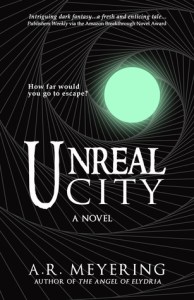 Summary:
Sarah Wilkes can hardly believe she’s going away to freshman year of college without her twin sister Lea–who was discovered dead from drowning far away from any water. She moves through life in a haze until a cat-like creature shows up on one of her walks through campus. He claims to be a familiar spirit who can bring her to Unreal City, a place where she can make her dreams come true. There’s only one catch. The price of permanent admission is drinking her blood. Unable to resist, Sarah journeys to Unreal City but the dream world soon takes on a sinister tone.
Review:
This book piqued my curiosity when it was submitted to me as a possibility for review last year. I knew when I read the summary that a plot such as this could only go either well-rendered and touching or flat and ridiculous. I took a chance, and I’m glad I did. The book offers a look at grief in the young, but wrapped in a fantastical setting that makes encountering such a big topic more palatable.
The fantastical plot at first seems simple. A familiar spirit who reads as sinister comes to Sarah and offers her a bargain. Feed him (preferably with her blood, but her hair will do in the meantime), and he will bring her to a world where she can escape her grief. It seems that he is targeting her for sinister reasons, but slowly over the course of the plot the reader realizes there is more to it than this. This is one of my favorite types of fantasy. One that reads initially as simple but becomes increasingly complex over the course of the book. The fantastical plot slowly takes the reader first deep into Sarah’s grief then into her trying to solve her sister’s death and finally into forgiveness and healing. It perhaps sounds heavy-handed when I put it that way, but the book makes it so it is not at all. The reader realizes initially they are encountering a young person’s grief, but then gets pulled into the fantastical world of Unreal City. Sarah’s grief process then becomes part of that fantasy, so it is more subtle.
The fantasy world is interesting. It takes the basic concept of a familiar spirit (traditionally, a spirit that a witch would allow to suckle from her in exchange for its magical service) and expands upon it. There are a set number of familiars in Unreal city, each of whom is correlated with a certain sector of the city. They each must find a person from our world to feed them and even give them an identity and appearance. That person can control their own sector, and I do mean control. They dictate its appearance and are able to defy all scientific laws. But they can’t control what happens in other people’s sectors, and that’s where Unreal City becomes more complex. It’s a mix of parallel universes and familiar spirits.
The mystery of Lea’s death kept me guessing, and its resolution is eloquent. The only thing holding me back from five stars is that for me, personally, at the time I read this, I did not have the level of experience with the book that is necessary for me to consider a book a five star read. It needs to be something life-changing or that I know I will think of over and over again. I am sure I would have felt differently though if I was either younger when I read it or had recently experienced a close loss. (Interestingly, I read this only a couple of weeks before my father passed. I am certain I would have had a more powerful experience with it if the order had been reversed).
Overall, this is a relatable rendering of grief and loss in the young, particularly in the late teen years, wrapped in a fantastical world that is engaging and keeps the plot from becoming too heavy-handed. Recommended to readers suffering from recent loss or looking for a unique fantastical world. Especially those who are interested in a new adult setting.
If you found this review helpful, please consider tipping me on ko-fi, checking out my digital items available in my ko-fi shop, buying one of my publications, or using one of my referral/coupon codes. Thank you for your support!
4 out of 5 stars
Length: 218 pages – average but on the shorter side
Source: Kindle copy from author in exchange for my honest review

Book Review: The Three Stigmata of Palmer Eldritch by Philip K. Dick
 Summary:
Earth is overcrowded and overheated but people still don’t want to become colonists to other planets. The colonies on the other planets are so boring and depressing that the colonists spend all of their money on Can-D — a drug that lets them imagine themselves living in an idealistic version of Earth. The only trick is they have to set up dioramas of Earth first. The drug is illegal on Earth but the diorama parts are still created by a company there. When the famous Palmer Eldritch returns from the far-flung reaches of space, he brings with him a new drug, Chew-Z, that doesn’t require the dioramas. What the people don’t know, but one of the manager of the Can-D company soon finds out, is that Chew-Z sends those who take it into an alternate illusion controlled by Palmer Eldritch.
Review:
I love Philip K. Dick, and I have since first reading Do Androids Dream of Electric Sheep? So whenever I see his books come up on sale in ebook format, I snatch them up. I picked this up a while ago for this reason, and then randomly selected it as my airplane read on my honeymoon. Like many Dick novels the world of this book is insane, difficult to explain, and yet fun to visit and thought-provoking.
The world Dick has imagined is hilarious, although I’m not sure it was intended to be. Presciently, Dick sets up a future suffering from overpopulation and global warming, given that this was published in 1965, I find it particularly interesting that his mind went to a planet that gets too hot. Even though the planet is unbearably warm (people can only go outside at night and dusk/dawn), they still don’t want to colonize other planets. Colonizing the other planets is just that bad. So there’s a selective service by the UN, only instead of soldiers, those randomly selected are sent to be colonists. The wealthy can generally get out of it by faking mental illness, as the mentally ill can’t be sent away. This particular aspect of the book definitely reflects its era, as the 1960s was when the Vietnam War draft was so controversially going on.
I don’t think it’s going out on much a limb to say that drugs had a heavy influence on this book. Much of the plot centers around two warring drugs, and how altered perceptions of reality impact our real lives. One of the main characters starts out on Earth hearing about how the poor colonists have such a depressing environment that they have to turn to drugs to keep from committing suicide. But when he later is sent to Mars himself as a colonists, his impression is that in fact the colony is this downtrodden because no one tries very hard because they’re so much more focused on getting their next hit of Can-D. The Can-D has caused the lack of success on the planet, not the other way around. Whether or not he is accurate in this impression is left up to the reader.
Then of course there’s the much more major plot revolving around the new drug, Chew-Z. Without giving too much away, people think Chew-Z is a much better alternative to Can-D, but it turns out chewing it puts you under the control of Palmer Eldritch for the duration of your high, and if you overdose, you lose the ability to tell the difference between illusion and reality. The main character (and others who help him) thus must try to convince the humans that Chew-Z is bad for them before they ever even chew it. The main character has another side mission of getting people off of Can-D.
It sounds like a very anti-drugs book when summarized this way, but it felt like much more than that. People chewing Chew-Z can come to have an experience that sounds religious – seeing the three stigmata of Palmer Eldritch (a stigmata in Christian tradition is when God shows his favor on someone by giving them the marks of Jesus’ crucifixion. In this book, the three stigmata are three bodily aspects of Palmer that are unique to him). However, the experience of seeing the stigmata is in fact terrifying, not enlightening. The drugs thus represent more than drugs. They represent the idea that we could possibly know exactly what a higher power is thinking, and perhaps that it might be better to just go along as best we can, guessing, rather than asserting certainty.
All of this said, a few weaknesses of the 1960s are seen. I can’t recall a non-white character off the top of my head. Women characters exist, thank goodness, but they’re all secondary to the male ones, and they are divided pretty clearly into the virgin/whore dichotomy. They are either self-centered, back-stabbing career women, or a demure missionary, or a stay-at-home wife who makes pots and does whatever her husband asks. For the 1960s, this isn’t too bad. Women in the future are at least acknowledged and most of them work, but characterizations like this still do interfere with my ability to be able to 100% enjoy the read. Also, let’s not forget the Nazi-like German scientist conducting experiments he probably shouldn’t. For a book so forward-thinking on things like colonizing Mars and the weather, these remnants of its own time period were a bit disappointing.
Overall, though, this is a complex book that deals with human perception and ability. Are we alone in space? Can we ever really be certain that what we are seeing is in fact reality? How do we live a good life? Is escapism ever justified? Is there a higher power and if there is how can we ever really know what they want from us? A lot of big questions are asked but in the context of a mad-cap, drug-fueled dash around a scifi future full of an overheated planet and downtrodden Mars colonies. It’s fun and thought-provoking in the best way possible.
If you found this review helpful, please consider tipping me on ko-fi, checking out my digital items available in my ko-fi shop, buying one of my publications, or using one of my referral/coupon codes. Thank you for your support!
4 out of 5 stars
Length: 243 pages – average but on the shorter side
Source: Amazon

Book Review: The Kin of Ata Are Waiting for You by Dorothy Bryant
 Summary:
Running from his demons, a man crashes his car and wakes up being assisted by a deceptively primitive people–the kin of Ata. He discovers that he’s been mysteriously brought to an island inhabited only by these people. As time passes, he comes to learn there is much more to them than first appears.
Review:
I can’t recall exactly how this ended up in my tbr but I am certain it had something to do with it being older feminist scifi/fantasy, which I collect and read as much as possible. What I was expecting, particularly from a book from the 1970s, was a wishful book about an impossible utopia. What I got instead was a spiritual parable that left me breathless, surprised, and craving more–not out of the book but out of life.
The book starts slowly. The entire first chapter has the main character driving angrily down a road just after committing a murder during a fit of rage. He is not a character with which you can particularly empathize at this point, and it is confusing as to just when the titular Kin of Ata will show up. I admit that the first chapter moved so slowly and was so difficult to relate to that I was expecting the book to be a slog, but I persevered on, and in retrospect I appreciate the first chapter quite a bit. I’ll discuss why at the end of my review.
The man wakes up to people getting him out of the car and bringing him to a cave. They then bring him out of the cave to their hut-like homes. He perceives of them as primitive and judges them harshly. Gradually over time he comes to better understand them and their ways and to understand that he is not with primitive people hidden in the woods near his home. He is on an island, and he somehow was spirited there. I won’t discuss much more of the plot, because it could ruin it, but essentially the man is a stand-in for the reader. The Kin of Ata have spiritual lessons and teach them to the man, and in turn to the reader. It comes across much like a parable.
The Kin believe that humans need to remember and respect their dreams (actual dreams we have at night). They view our sleeping lives as just as important, if not more so, than our waking ones. They thus design their waking lives to be lived in the right manner so as to elicit the most powerful dreams. This means things like working but not too hard. Thus making yourself tired enough to sleep but not so tired that you sleep the sleep of the dead. It also means discussing your dreams every morning upon awaking. It means listening to your dreams and choosing daytime activities that suit what they are telling you. Put another way, the Kin choose daytime activities that fit the callings of their deepest souls. They essentially live a very mindful life that helps them achieve happiness and a peaceful community.
The main character starts out as a deep blight on the community. He keeps trying to force his ways upon them. He comes across as an angry cloud. In addition to being a murderer he also rapes one of the female Kin early on in the book. I found the depiction of this rape fascinating. The man sees people having sex with each other in what appears to him to be whenever one person demands it. In actuality, the people are choosing each other and subtlely letting each other know whether they want to have sex or not. The man decides he wants to participate and goes after one of the women. She indicates to him through cultural body language (these people do not speak much) that it is the wrong time. He does it anyway and she does not resist but she also does not participate. The whole community judges him as it being a wrong and a rape in spite of the fact that the woman never said no. The whole community views sex as only consensual if joyous consent is given, not just if the word “no” is not said. The man is startled and yet also immediately understands their point. He felt dirty and wrong after the sex and wasn’t sure why but now he understands and doesn’t know why he never thought of it this way before. He is utterly ashamed of himself.
Longtime readers of this blog know that I struggle with plots that ask us to empathize with a rapist. It honestly surprised me that this scene didn’t turn me off the book entirely. Yet this is also a huge turning point for the main character. He realizes that his way of doing things leads to him feeling bad and wrong and negatively impacts others. The woman spends several days in a cavelike place, which is basically where the Kin go to meditate. When she comes out, she forgives the man, because harboring a grudge against him would hurt her own ability to live the right path. I found the whole event of how the community confronts the man about his wrongdoing, how he responds to this confrontation, and how the woman handles it to be incredibly thought-provoking. It made me think about how much culture impacts people’s ability to even recognize when they’ve done something wrong. Also, much as I had heard many times growing up how harboring hate in your own heart poisons yourself and not the one who harmed you, seeing a character fully embrace this after a traumatic experience made it sink in much more for me than just hearing the saying ever did.
This scene also served another purpose. It reminded me that we’ve all done things we’re ashamed of and showed a path of redemption. The man starts to pursue living the right way. He has set-backs and stumbles. It sometimes takes years for him to see the results of certain actions that he starts doing the right way. It takes perseverance, unlike living the easy way, like he used to. It’s a powerful parable for practices such as meditation, for which you often don’t see results right away.
Similarly, again, I don’t want to spoil it, but the book demonstrates how it takes a community living right for a truly peaceful and happy community to exist. It also demonstrates, though, how one person who is very strong in their commitment to this right path can impact a whole community that is lost.
I promised to touch back on why I came to appreciate the first chapter. I appreciate it because it shows us the main character living his life following the wrong path within his own original community. It shows us where he came from before showing us how he develops into a life so much better through his work with the Kin. It also makes for a powerful bookend with the final chapter, whose surprise I will not reveal.
This is a powerful parable that demonstrates how much impact living mindfully can have, and also how important developing healthy communities is for the happiness and peace of all. It shows how wrong cultural ideals can lead people astray and hurt even the perpetrators of violence. Some may struggle with parts of the book, but that is part of the process of learning the lessons in the parable. I highly recommend this short book to all seeking a thought-provoking read.
If you found this review helpful, please consider tipping me on ko-fi, checking out my digital items available in my ko-fi shop, buying one of my publications, or using one of my referral/coupon codes. Thank you for your support!
5 out of 5 stars
Length: 228 pages – average but on the shorter side
Source: PaperBackSwap
Buy It (Amazon or Bookshop.org)
Book Review: Smokin’ Six Shooter by B.J. Daniels (Series, #4)
 Summary:
Dulcie Hughes comes to Montana from the big city of Chicago when she mysteriously inherits property. She immediately runs into Russell Corbett, a local rancher who isn’t too keen on some city woman sniffing around the old Beaumont property. Dulcie doesn’t want to be distracted from uncovering the years’ old mystery at the Beaumont property, but Russell just can’t let himself let her investigate on her own.
Review:
A friend gave this book to me as an extra she had from the publisher. I kept it around because who isn’t in the mood for some light romance sometimes? Plus, there are definitely Harlequins that strike my fancy. This….wasn’t really one of them.
Here’s the main problem with the book. The title and the cover are incredibly misleading for what you’re actually going to get, and that’s a pet peeve of mine. As a friend of mine (who also read it) said to me, “There’s no six shooter in the book.” It sure sounds like it’s a big plot point doesn’t it? But….there’s no six shooter. There are guns, yes. But not six shooters. The cover and title make it sound like the hearthrob is some sort of sharpshooting cowboy, but he’s…neither. He’s a modern day rancher. Who drives a combine. Oh and he and his father hire a rainmaker to try to make it rain because the ranchers need rain. Sorry but none of that strikes my sexy bone the way that a sharpshooter would. WHICH IS WHAT I THOUGHT I WAS GETTING.
Let’s ignore for a moment that I would have self-selected out of this book if the title, cover, and the actual blurb (not the one I wrote above) had been accurate. What about the actual book? Well, the mystery is good…ish. It had lots of twists and turns, and the final chapter just had one too many. I read the last chapter out loud to my husband, and he said it felt like an episode of “All My Circuits” (the over-the-top robot soap opera on Futurama). Which is true. That said, I certainly didn’t figure out the mystery. Because it was so ridiculous. But there’s an entertainment factor in that that I appreciate. However, if over-the-top twists and turns are not your style, you’ll be disappointed by the last chapter of the book.
The romance and sex was sorely missing. Our heroine gets one incredibly quick (and I don’t just mean quick to read, I mean a quickie) sex scene, and that’s it. I don’t know about you, but I don’t pick up Harlequins for the story. I do expect a lot out of the sex scenes though, and this one felt like a throwaway. A “oh do I really have to write one? Fine, but it will be ludicrous and quick.” I kept reading thinking that surely this was just a teaser and there’d be a nice long steamy scene in here somewhere. But no.
So, Harlequin readers who don’t mind the love interest being a combine-driving modern day rancher who does not have a six shooter with most of the focus of the book being on its over-the-top mystery with just a touch of a romance scene will enjoy this book. The quality of the writing is fine, so long as this is the type of story the reader is after, they won’t be disappointed. Just don’t be misled by the title….or the cover….or the blurb. And maybe grab some popcorn for the last chapter.
If you found this review helpful, please consider tipping me on ko-fi, checking out my digital items available in my ko-fi shop, buying one of my publications, or using one of my referral/coupon codes. Thank you for your support!
3 out of 5 stars
Length: 224 pages – average but on the shorter side
Source: Gift

Counts For:
Bottom of TBR Pile Challenge
Previous Books in Series:
Shotgun Bride
Hunting Down The Horseman
Big Sky Dynasty


Book Review: The Veiled Mirror: The Story of Prince Vlad Dracula’s Lost Love by Christine Frost
 Summary:
Vlad the Impaler, a Wallachian prince, inspired the story of Dracula with his bloodthirsty, iron-handed ruling. This, though, is the story of his long-time consort, Ecaterina Floari, mother one of his sons and a daughter. She loves him deeply but is haunted by his ruling style, as well as spirits in a helmet he brings into their home from one of his battles.
Review:
I picked this up during the Smashwords Summer/Winter sale years ago but it took a while for my mood to be just right to read it. It is a historic piece set in 1400s with splashes of the fantastic, and I tended to be in the mood for one or the other but not both. Finally in the heat of the summer, I was ready for a dark historic fantasy that would take me away to heavy gowns and ancient rulers. I was surprised by the level of historic research and detail in the book, as well as the tie-in to the Dracula story, making it a marriage of two genres.
This is a long book with a lot of rich setting detail. That doesn’t tend to be my style but it works with the feel the book is going for, and many readers will enjoy the pace at which the book moves. The dark fantasy elements take time to set up, but when they get into motion they really add to the story. The story strikes a nice balance of Ecaterina working with the culture of her time-period and being bothered by certain things Vlad does. For instance, it bothers her that he has mistresses, but she comes to accept it as is expected of her in the time-period. This trajectory acknowledges the feelings the modern reader may have about the situation but also lets the character be true to her time-period.
The author toes a finely-held line of showing Vlad’s cruelty but also keeping him human and not demonizing him. He was a cruel ruler but he wasn’t a monster. Similarly, although Ecaterina loves him she is still disturbed by his actions when ruling. This lends both characters depth they would not have if Ecaterina’s love was blind or Vlad was monstrous.
In spite of appreciating the historic fiction plot covering many decades, I did sometimes feel that the plot meandered a bit too much. I also felt that sometimes the book told too much instead of showing. Similarly, there were a few too many typos and grammatical errors for a book that is in its final version. It was not enough to make me stop reading but it was enough to detract from my overall enjoyment of the story.
I appreciated how much of the book is from women’s perspectives. Not just Ecaterina’s but her mother’s, servants, and other consorts and even a spy are featured. The female cast is strong, and that would be easy for a less thoughtful writer to pass over in favor of showcasing the men history chose to record more thoroughly.
Overall, readers seeking to learn something about the 1400s in Romania will be pleased by how much they will learn reading this book. Those who come to it due to the Dracula connection will enjoy the fantastical elements toward the end in particular. Recommended to readers of historic fiction and fantasy who do not mind a long book with a slow burn.
If you found this review helpful, please consider tipping me on ko-fi, checking out my digital items available in my ko-fi shop, buying one of my publications, or using one of my referral/coupon codes. Thank you for your support!
4 out of 5 stars
Length: 284 pages – average but on the shorter side
Source: Smashwords

Book Review: Garlic, an Edible Biography: The History, Politics, and Mythology Behind the World’s Most Pungent Food — With Over 100 Recipes by Robin Cherry
 Summary:
A history of the world and medicine as seen through the eyes of garlic, plus a lesson on the many varieties of garlic, how to grow it, and where to find other garlic lovers. Topped off with a collection of over 100 recipes from all over the world featuring garlic, both historic and new.
Review:
When I saw this book on NetGalley, I knew I needed a review copy. I’m a passionate home chef with a love of garlic and a never-ending interest on the history of food. This book’s title indicated it would hit all three of those interests, and its content did not let me down.
The book is divided into two parts. Part One focuses on everything but the recipes. Part Two is the recipes. Part One’s chapters cover the history of using garlic for health and for food, garlic in legends and lore, and how to grow your own. This is the section that most entertained my friends and fiancé, as they found themselves the recipients of random facts about garlic. One friend received an email of all of the types of garlic that originated in the country of Georgia; another a tip that growing some near her fruit tree might be beneficial for the tree. Here are a few of my favorite facts that I learned in Part One:
- The world’s first-known medical text also mentions medical uses of garlic (loc 129)
- Garlic is designated as a drug in Japan (loc 222)
- Spanish immigrants were the most likely to survive during the colonization of the Western hemisphere, thanks to their consumption of garlic. Carrying the cloves protected them from disease-carrying mosquitoes. (loc 309-313)
- Garlic vodka is used as an antiflu remedy in Russia (Bonus: the book has the recipe for making this for yourself). (loc 392)
- “In addition to preventing colds, garlic is effective in killing viral meningitis, viral pneumonia, influenza, and herpes.” (loc 423)
- “Garlic also kills bacteria directly, by invading its cells and causing them to explode, thus bacteria has not opportunity to develop a resistance to it.” (loc 427)
- “Green-colored garlic is stronger than white garlic because it contains more of the aromatic sulfuric compounds.” (loc 922)
- The earliest bridal bouquets incorporated garlic to ward off the evil spirits. (loc 1067)
- There are over 200 varieties of garlic. (loc 1203)
Part One ends with tips on how to cultivate garlic and a selection of the various types of garlic, including notes on where they grow best, how they look, and how they taste. Garlic may be broadly divided into hardnecks and softnecks, but there are subvarieties within these two main ones. (Softnecks are the ones that you can braid). My one criticism of Part One is that I wish it had gone more in-depth into the history of garlic all over the world. It left me wanting more. Perhaps there isn’t more, but I certainly wish there was. I would additionally note that, although I personally enjoyed reading about the many varieties of garlic and took copious notes, some readers might find the listing of the types a bit tedious to read and may not be expecting it in a book of this nature.
Part Two is the recipes. It starts with notes on how to handle and prepare garlic. The recipes are then divided into: dips, sauces, and condiments; bread, pizza, and pasta; soups; salads and salad dressings; appetizers; poultry; lamb; beef; seafood; vegetarian; side dishes; dessert; and historical recipes. I marked off a total of 19 recipes that I definitely want to try, which is quite a lot for me. Often I’ll read a cookbook and only be interested in one or two of the recipes. The recipes cover a nice variety of cuisines, and the historic recipes are fascinating, although most readers will probably not try them as they require things such as fresh blood. Besides the historic recipes, the dessert ones are probably the most surprising. I actually did mark one off as one I’d like to try–Roasted Garlic Creme Brulee.
I have managed to make one of the recipes so far: Garlic Scape Pesto (loc 1649). For those who don’t know, garlic scapes are the green stalks that grow out of the bulbs. They must be trimmed (on most varieties). They taste a bit like a cross between garlic and leeks. Our local produce box happened to give us a bunch of them right around when I read the book, and I’m a big pesto fan, so I decided to try the recipe.
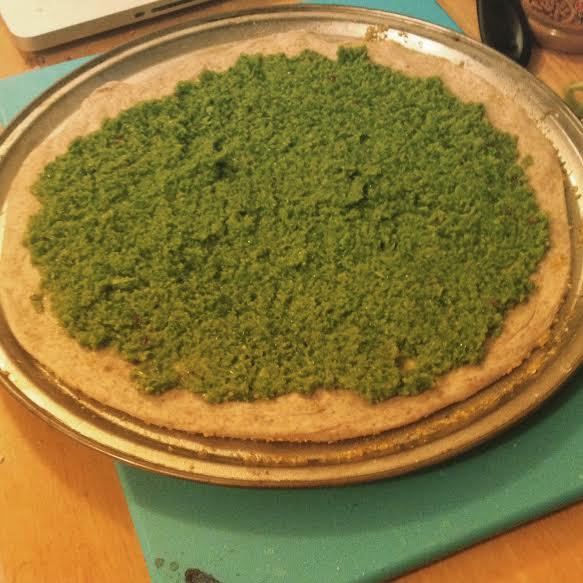
Garlic Scape Pesto on top of my pizza crust, before the rest of the toppings were added.
The recipe is supposed to make 2 cups. I halved it, and somehow still wound up with 2 cups of pesto. The recipe suggests storing the leftovers under a layer of olive oil. I found that unnecessary. My extra kept in the fridge in a tupperware container for a week without adding a layer of protective oil. The pesto was truly delicious though. I partially chose it since I have made garlic scape pesto before, and I must say I found this one much more delicious than the other recipe that I tried. I am looking forward to trying the others I am interested in, although I will probably continue to halve the recipes, as I am only cooking for two.
Overall, foodies with a love of garlic will find this book both fascinating and a source of new recipes to try. Some readers may wish for more information, while others may find themselves a bit more informed on the varieties of garlic than they were really looking for. All will find themselves chock full of new information and eager to try new ways to use garlic…and perhaps even to start growing some heirloom varieties for themselves.
If you found this review helpful, please consider tipping me on ko-fi, checking out my digital items available in my ko-fi shop, buying one of my publications, or using one of my referral/coupon codes. Thank you for your support!
4 out of 5 stars
Length: 240 pages – average but on the shorter side
Source: NetGalley

Book Review: Anarchism and Other Essays by Emma Goldman
 Summary:
Emma Goldman was a Russian immigrant to the United States who embraced Anarchism and became an impassioned orator and pioneer in the movement for birth control. She was deported in 1919 for her antiwar activities and spent the remainder of her life moving among multiple countries. This book is a collection of a variety of her essays and includes a contemporaneous biographical sketch and preface. You may read more about Emma Goldman and her life here.
Review:
I picked up this essay collection due to my interest in both US and women’s history. It then languished on my TBR pile for years until I heard about how the Emma Goldman Archive at UC Berkeley was going to lose its funding (source). The archive is currently still running thanks to charitable donations, (source) but I still wanted to invest some time in learning more about this important female historical figure, and what better way than by reading her own papers.
The essays in this collection are: Anarchism: What It Really Stands For, Minorities Versus Majorities, The Psychology of Political Violence, Prisons: A Social Crime and Failure, Patriotism: A Menace to Liberty, Francisco Ferrer and the Modern School, The Hypocrisy of Puritanism, The Traffic in Women, Woman Suffrage, The Tragedy of Woman’s Emancipation, Marriage and Love, and The Modern Drama: A Powerful Dissenter of Radical Thought.
The thing to understand about Anarchism (the historic early 20th century kind anyway, I won’t venture to talk about modern Anarchism as I have not studied it at all) is that the basis of Anarchist belief is that there should be no government and no religion.
Anarchism is the only philosophy which brings to man the consciousness of himself; which maintains that God, the State, and society are non-existent, that their promises are null and void, since they can be fulfilled only through man’s subordination. (page 38)
Emma took this to the conclusion that fighting for rights within the governmental power structure was pointless since the government shouldn’t be involved anyway. Modern readers may thus be surprised at how against women getting the right to vote she was. The reasoning behind it, though was that she thought it was a pointless fight. Like putting frosting on a shit cake. It won’t make the cake any less shitty. It’s interesting reading these papers how much faith Emma had in human nature to do good. It’s the power structures she considered evil.
My lack of faith in the majority is dictated by my faith in the potentialities of the individual. (page 34)
What I found most interesting in reading these essays, beyond getting a firmer understanding of Anarchism, is how most of them are still highly relatable today. They have not been particularly dated. Only “Francisco Ferrer and the Modern School” and “The Modern Drama: A Powerful Dissenter of Radical Thought” came across as dated and a bit difficult to read to me. The rest could have been pulled straight from a social justice Tumblr account, with just a few names and places changed. The three essays on women were the most interesting to me, particularly for the rather prophetic predictions that Emma made about the direction women’s rights were heading. In particular, one section discusses that women winning the right to work will just make everything more difficult because women are still seen as the primary caregivers and homemakers. They will just end up working just as much at home and out and about. Emma also pointed out that society would come to expect two incomes, making it impossible for women to not work even if they want to. This has certainly come to pass. Emma’s solution to this is more individual freedom, and her passage of advice to women still rings true today:
Her development, her freedom, her independence, must come from and through herself. First, by asserting herself as a personality, and not as a sex commodity. Second, by refusing the right to anyone over her body; by refusing to bear children, unless she wants them; by refusing to be a servant to God, the State, society, the husband, the family, etc.; by making her life simpler, but deeper and richer. That is, by trying to learn the meaning and substance of life in all its complexities, by freeing herself from the fear of public opinion and public condemnation. (page 132)
Sections that would probably stir up the strongest feelings among modern readers include frequent rants against the Catholic church, hatred of all patriotism or nationalism, very strong anti-military positions, and a strong negative view of marriage. However, if the modern reader keeps in mind that Emma was for 100% individual freedom and individuality, it’s easier to see that it’s not an individual institution she had something against, but rather institutions in general. Think of her as an extreme libertarian, and it’s easier to understand. In the case of marriage, for instance, it’s not that Emma was against love or being part of a couple, but rather against the state being involved in that love.
One aspect I think was missing from these essays was more from Emma on what she thought the ideal world would really look like. How would things work once total individual freedom was won? This is not touched upon very much, beyond Emma’s belief that crime would disappear without crooked institutions and there would be no more war. I found her belief in innate human goodness to be overly optimistic, verging on naive. But I also found it to be endearing that she had so much faith in humanity.
Overall, the modern reader will still find most of these essays highly readable and may be surprised by how modern many of them feel. Readers will realize how little some things change through time and also will come away with a better understanding of the stance of the often feared and misunderstood Anarchists.
If you found this review helpful, please consider tipping me on ko-fi, checking out my digital items available in my ko-fi shop, buying one of my publications, or using one of my referral/coupon codes. Thank you for your support!
4 out of 5 stars
Length: 291 pages – average but on the shorter side
Source: Purchased
Buy It (Amazon or Bookshop.org)
Book Review: Mark of the Harbinger: Fall of Eden by Chris R. McCarthy
 Summary:
Humanity, desperate to save themselves from oncoming meteors that will destroy Earth, builds two spaceships and binds them together into one unit. They fill it with the best and brightest of humanity then send it off into space, with nanobots working to keep them all perpetually the same age they were when entering the ship, hoping that they will find another habitable planet. But over the thousands of years of searching, the two ships have slowly evolved into one of beauty, order, and plenty of food. The other has become a prison ship, full of starvation and degradation. Both ruled by an artificial intelligence known as Ark. When a man awakes on the prison ship, he must discover who he is and why he has been awakened.
Review:
The basic idea of a ship full of thousands of people wandering outer space for thousands of years and how that impacts their culture is a good one. But it is unfortunately supported by weak characterization, quite a bit of telling instead of showing (often in the form a conversational infodump), questionable science, and aggravating plot twists.
I am not a scifi reader who expects everything to be Asimov or heavy on the science. I enjoy the broad range that scifi has to offer. But I do expect a scifi that takes itself seriously, as this one does, to have: a plot that makes sense, at least two characters who are well-rounded and richly presented, and any science within it to be accurate or at least plausible. This scifi definitely takes itself seriously, but it fails on these marks.
The book opens with a first person narration of the nameless hero (later named Harbinger) believing he is being dissected by an alien race. It takes quite a bit of time to find out that he was cryogenically frozen on this ship, and the rebels of the prison ship have woken him up. If this wasn’t a review copy, I probably would have given up before Harbinger figures this out, because the reader has zero reason to care about this character who is being dissected, apparently. It’s quite jarring to open up the book that way, and it’s hard to read with no investment in any of the characters at all. It’s a rough beginning.
Harbinger has amnesia, so he can’t help the rebels figure out why exactly he was on the ship. But they do discover that he has superhuman powers, just as the rebels were hoping, so they want him to help them fight for access back to Echelon–the ship that is not a prison (There are names for both ships, but I honestly can’t remember what the name of the prison ship was.) The rebel character who works closest with Harbinger is a woman named Leema. Harbinger gets slightly more characterization than Leema, because we are inside his head. But both come across as flat. Their actions appear to exist entirely as plot devices and not out of real, rich motivation. For instance, Leema seems mostly to exist to give Harbinger information, to have sex with, then to spur him to make certain decision. She doesn’t come across as a person so much as a plot device. The same can be said for the leader of the rebels, Argus, an older man who calls people “son.” He simply does not feel real. He feels like a plot device who pops in whenever it’s necessary to make something happen to Harbinger.
The writing often relies on conversational infodump, which is a shame, because when there are action sequences, they are interesting and exciting. The periodic action sequences are what kept me reading. They are well-written, particularly the fight scenes. But when the characters talk, the conversation doesn’t feel real. It feels like the author is speaking directly to the reader through the characters, often to provide background information. This is known as an infodump, and it’s frustrating to read. It would be better to work this information into the plot, rather than have characters sit in a room and say it at each other for chapters at a time.
The science is a bit shaky. For instance, the spaceship is decorated with marble. Real marble. Real marble is incredibly heavy, and there’s a weight limit that spaceships can handle. It’s hard to imagine a people desperate to save humanity from meteors wasting precious weight space on marble decorations. Similarly, Harbinger is never fully explained. He appears to be human and bleeds but can’t feel pain, has superhuman strength, can only be killed by cutting off his head. Is he a robot? Or a genetically modified humanoid? Maybe a clone? Leema explains “his kind” being created but she seems to know very little about it, which makes it odd that she and the rebels knew enough to know how to break him free from Ark by cutting into him and adjusting things inside his body. The core of the idea is good but it’s just not explained enough. That is really what makes some of the science in the book weak. It’s not gone into in enough depth to make enough sense.
Finally, the plot makes quite a few quick zany twists, most of which I was willing to give a pass. The final twist, however, made me want to throw my kindle against the wall. (I didn’t, because I like my kindle). I’m sure the final plot twist was intended to make the reader want to continue on to the next book in the series, but it actually just left me feeling deeply unsatisfied and frustrated. If I had to put my finger on what made it so frustrating, I’d say that it felt forced, not organic.
Overall, this book consists of a good basic idea that suffers from infodumping, weak characters, and being forced to stick to a plot that doesn’t feel organic. Rich characters who drove an organic plot free of infodumps could have made this into an interesting world and cultural exploration. Instead, it’s a frustrating read.
If you found this review helpful, please consider tipping me on ko-fi, checking out my digital items available in my ko-fi shop, buying one of my publications, or using one of my referral/coupon codes. Thank you for your support!
2 out of 5 stars
Length: 274 pages – average but on the shorter side
Source: kindle copy from author in exchange for my honest review

Book Review: Love in the Time of Global Warming by Francesca Lia Block (Series, #1) (Audiobook narrated by Julia Whelan)
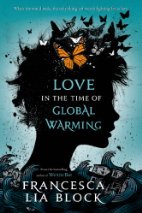 Summary:
Pen’s life was destroyed when an Earthshaker took away her family (even their dog) and destroyed the Los Angeles she once knew. She’s now on a quest to save them from the monstrous giants that rose up after (or with?) the Earthshaker. Along the way she finds other teens who’ve miraculously survived, each with secrets and talents of their own.
Review:
This book left me completely torn. I loved, oh how I loved, the representation of both bisexual (Pen) and trans (Hex, her boyfriend) teens. But the story to go with these teens failed to live up to both these wonderful characters and the beautiful title.
Let’s talk about the good first, because I don’t want it to be overshadowed by what didn’t work. Pen is a bookish teenager who generally prefers to stay in reading the Encyclopedia or The Odyssey to going out to parties. But she still has two close friends. She’s not a loner. She’s brave, open, loving, and sometimes makes rather short-sighted decisions. And it is gradually revealed throughout the book that she is also bisexual. The scenes exploring Pen’s bisexuality, and how it’s hard for her to be out about it, in spite of being completely comfortable with herself, are wonderfully done. Pen acknowledges that even though her parents have always told her that it doesn’t matter a whit if she is straight, lesbian, bisexual, or trans, that the world at large doesn’t always think that, and that’s part of what makes being out hard for her. The world is not always the welcoming place her family is.
The book early on establishes that Pen currently has a crush on a boy, so the reader may perhaps be surprised when she reminisces about an earlier crush on a girl, and how she first realized she liked girls too.
Thinking of how I once kissed Moira on the lips. We were drunk and dancing, and our lips just brushed for that electroshock nanosecond, and then she smiled at some boys who were watching us, laughed, and danced away from me like it was a joke. But I’d had an epiphany, even though I hadn’t fully accepted it at the time. I wanted to kiss girls. And it was no joke. (loc 2:14:53)
Similarly, Pen struggles with self-editing her past when telling Hex about her life before the Earthshaker. She is not sure if he’ll understand or accept the fact that she’s perfectly capable of having crushes on girls as well as boys like himself, so she edits herself when speaking to him. She’s telling him a story about a party she didn’t go to, and the picture that her friends sent her of a boy with her friend, Moira:
I went to sleep staring at the last image wondering not what his mouth tasted like but hers. This part, this last, I don’t tell Hex, although I trust him enough to tell him anything. Don’t I? So I’m not sure why I don’t. Because I don’t want him to know I had a crush on a girl? Or because I have a crush on him. (loc 1:39:44)
It’s rare to see a book explore so eloquently what it is to be bisexual, and these feelings Pen has while not universal still explore the difficulty of coming out and being out as a bisexual person, and they were so wonderful to see in a book that I had to restrain myself from jumping up and shouting “Yes!” when they showed up on my audiobook on the bus.
Similarly, Hex, Pen’s love interest and eventual boyfriend (this is not a spoiler, when Hex shows up he may as well have a giant neon “future boyfriend” sign over his head), is a FTM transman. Hex is just as nervous about being out to Pen and their other travel companions as Pen is about being out to him, probably more. Being cis myself, I can’t say as definitively about the quality of FTM representation as I could about bisexuality, however, the author certainly tries to broach topics that I believe would be of interest to a trans YA reader reading this book: acceptance (or not) by family members and impact on romantic relationships with other teens. Hex comes out to Pen as a transman only because she has fallen for him, and he wants her to know precisely who he is before anything more *ahem* romantic happens. Pen immediately accepts him and tells him he is clearly a boy to her, and this changes nothing about how she feels about him. They then have to navigate their sex life. Hex, like many trans people, is uncomfortable with his body. He would rather touch Pen than allow Pen to touch him. Eventually, they reach an arrangement that both supports and asserts Hex’s maleness and allows Pen to give the pleasure back to him that she wants to. I was glad to see a YA book “go there.” I frankly haven’t seen much of that even in adult literature including a trans person. It both addresses the “how do they….” question some YA readers would certainly have after learning about Hex and also serves a purpose in the story to demonstrate a mature, healthy, loving relationship between the two characters.
In addition to Hex and Pen, they also wind up with two male travel companions who become a couple. The characters themselves point out at one point how odd it is that the minority before the Earthshakers is now the majority (none of them are straight AND cis). I was glad the author acknowledged the quirk and had the characters process why that may be. The answer they decide upon is a positive one, rather than the potentially negative one of punishment.
So now let’s talk about what didn’t work. The plot and the setting. The book is meant to be a magical realism style story told in a non-linear way. This could have worked if in the end the overarching plot, when reassessed by the reader from beginning to end, made sense. But it doesn’t. For most of the book, Pen refers to everything in fantastical ways, such as saying “Earthshaker” for what appears to the reader to be an earthquake. Why is she saying “Earthshaker”? Was there something different about it? Does she just like prettying up her language? What is going on with that? Later it is revealed that an earthquake seems to have happened when some genetically engineered giants escaped (showed up? were released?). The whole world basically goes to shit overnight, though, and it just doesn’t seem logical that that would happen from just a few giants escaping. Similarly, there are other fantastical creatures who are never explained.
Similarly, although it is indicated early on that this is a modern retelling of The Odyssey, it doesn’t line up well with the original. In the original, Odysseus is trying to come home after a war and keeps getting swept into side-quests. In this book, Pen starts out at home and then quests away from home. It would have made more sense for Pen to be somewhere away from home (maybe on a school trip or something), have the disaster occur, and then have her have to find her way home encountering fantastical things along the way. Starting her at home just doesn’t work.
Several elements feel like they are just thrown in because they look pretty or work with the scene even though they don’t work with the book as a whole. For instance, butterflies appearing around people who can be trusted pops up in the middle of the book, but isn’t particularly present at the beginning or the end. Similarly, some characters are revealed to have magical powers toward the end of the book, with no foreshadowing about that, only to have them….not use them much beyond the scene where it’s revealed.
Also, I’m sorry, but the whole some evil scientist genetically engineered giants to be his children and now the giants are out to destroy us but also the whole world inexplicably now resembles a myth just really doesn’t work. First, it makes no sense why a scientist would even want to engineer a giant. To be his children? Really? Why would anyone want giant children? Second, to give the mystical elements that started this whole thing a scientific explanation but then leave the rest fantastical doesn’t work. Either they’re all explained by science or they’re all fantastical. I really felt the book went way downhill for me when there was suddenly a “scientific” explanation for the giants. But just the giants and nothing else.
Finally, we need to talk about the name of the book. It’s a beautiful title but it’s really wasted on this book. First, global warming doesn’t come into play in the book at all, so why is it mentioned in the title? Second, it’s clearly a send-up to Love in the Time of Cholera, but it has nothing in common with that book save both having elements of magical realism in them. It feels as if the author came up with a title that sounded pretty and couldn’t bring herself to let go of it in spite of it not fitting the book she actually wrote.
Overall, this is a short read featuring four well-rounded and written teen characters on the LGBTQ spectrum. YA readers looking for positive representations of bisexual and trans characters, in particular, and who don’t mind some inexplicable fantasy elements will enjoy this quick read. Readers who will easily be bothered by the title not matching the content, a mixture of magical realism and scientific explanations for things, and/or nonlinear plots that when told linearly don’t make sense should probably look elsewhere, in spite of the positive representations of underrepresented letters in the LGBTQ spectrum.
If you found this review helpful, please consider tipping me on ko-fi, checking out my digital items available in my ko-fi shop, buying one of my publications, or using one of my referral/coupon codes. Thank you for your support!
3 out of 5 stars
Length: 240 pages – average but on the shorter side
Source: Audible

Book Review: Everlasting: Da Eb’Bulastin by Rasheedah Prioleau
 Summary:
Aiyana Gamelle has been sleepwalking, waking up on the beach of the half Gullah, half Native American Sa’Fyre Island off the coast of South Carolina. But she knows she’ll soon be transitioning to being Queen of the Gullah half of the island, due to being directly descended from both the founders and a mysterious African goddess, so she brushes it off and focuses on the festival she’s organized on the island to bring in more revenue. But when an important island guest is murdered and her grandmother passes away before the official crowning ceremony, an unwanted family curse is slowly revealed.
Review:
This is one of the six indie books I accepted for review on this blog in 2015. Everything about it from the title to the description stuck out to me both as something that I hadn’t seen a mainstream publisher get around to trying in many years and also as something that piqued my interest. An island that’s half Gullah and half Native American? (Never heard of the Gullah? Check out this informative article about them). A woman inheriting a position of power from another woman? A family curse? Yes please! I am happy to say that the book more than lived up to my expectations, it also had some unexpected elements that I was delightfully surprised by.
The known history of the island and the Gamelle family is well told early in the book. It comes through in bits and pieces at just the right times. There is never an info dump. Similarly, Aiyana and her siblings are slowly revealed, going from how you may first perceive them to more well-rounded characters throughout the book. The island and the people on it are incredibly well described. I had no trouble imagining what this island may be like, despite having never been to the Carolinas myself.
One thing that caught me by surprise in the book and that I think should be promoted more in its promotional materials, as it’s something that is often sought after, is the romance between Aiyana (who is half-Native American and half-Gullah, since her mother dated her Native American father against the wishes of both sides) and one of the Native American men on the island. It’s an inter-racial relationship….with no white people. I can’t remember the last time I saw that in a book, frankly, and I was happy to see it.
This is primarily a mystery/horror book though, so let’s talk about the mystery plot. It takes many twists and turns, none of which I expected but all of which ultimately made sense. I found it at times grotesque and at other times it kept me on the edge of my seat. All the time I was always rooting for Aiyana, which is exactly what I generally want out of a mystery.
One negative I would say is that it’s a bit unclear if the book is the first in a series or a standalone. Amazon mentions it being the first in a series, but neither the GoodReads record nor the page about it on the author’s website mention it being the start of a series. If it is the start of a series, the book’s slightly abrupt ending works. If it’s a standalone, then I would want a bit more closure at the end. If it is the start of a series, then I’d say perhaps a quick “Look for more Sa’Fyre Island adventures coming soon!” at the end would be an excellent addition to help the reader know to expect more and to keep them coming back.
Overall, this is both a fun and a quite different entry into the mystery genre. A Gullah woman takes the center stage of the mystery, rather than being a prop. The mystery is well crafted and told, and there’s even the bonus of a bit of romance in the book. Recommended for readers looking for a completely different mystery from what they may be used to reading and who don’t mind a bit of the fantastical showing up in the plot.
If you found this review helpful, please consider tipping me on ko-fi, checking out my digital items available in my ko-fi shop, buying one of my publications, or using one of my referral/coupon codes. Thank you for your support!
4 out of 5 stars
Length: 206 pages – average but on the shorter side
Source: Kindle copy from author in exchange for my honest review

 Support my work with a tip or browse my shop for curated book club guides, how to guides, cross-stitch patterns, and more!


This work by Amanda Nevius is licensed under a Creative Commons Attribution-Noncommercial-No Derivative Works 3.0 United States License.
 Opinions of a Wolf