
Archive
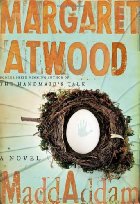
Book Review: MaddAddam by Margaret Atwood (Series, #3) (Audiobook narrated by Bernadette Dunne, Bob Walter, and Robbie Daymond)
 Summary:
The world has been mostly wiped out by a virus released by Crake, who thinks he’s helping save the earth with a cleansing flood. The survivors who are left are some of the scientists who worked with him, some people who were following a crunchy granola earth-centric cult known as God’s Gardeners, and Painballers–dangerous drug addicts who survived a gladiator-style fighting ring. There’s also the Crakers. Genetically engineered by Crake and the scientists, they’re a new version of humans who are herbivorous and naturally poly. They also are only attracted to sex when the women are in heat and visibly blue, thus preventing sexual violence amongst themselves. The God’s Gardeners, scientists, and Crakers comes together to try to survive in this world and defend themselves from the painballers. Toby, a God’s Gardener, ends up leading and educating the Crakers. She also rediscovers Zeb, the God’s Gardener leader’s brother who she previously had a crush on. Zeb tells her the story of how his brother, Adam, came to be mad.
Review:
I was under the impression that this was supposed to be a set of two companion novels, not a trilogy. So when this book was released, I was surprised and excited. The prior two books left the reader hanging, not knowing what really happened after the flood, and I was eager to find out what did happen. I wish this book had lived up to the creativity and excitement of the second one, The Year of the Flood
At first it appears the sole narrator of the book will be Toby, the woman from The Year of the Flood
Toby’s character progression from a strong, creative, firecracker of a woman to someone who second-guesses herself, bemoans her inability to properly defend people, and moons after a man obsessively was rather jarring and disappointing. I’m all for Toby having a love life, and I think her having one as an older woman is something we don’t see enough in literature. But I don’t feel like her excessive pining and worrying over it was totally within character. Similarly, she seems to lose all ability to trust in herself and her capability in defending herself and others in bizarre situations. The one thing that did feel within her character was her taking the Crakers under her wing. These flaws in the characterization of Toby are kind of a big deal since she’s the only female narrator out of three narrators, and since she was such an amazing main character in The Year of the Flood. She deserves to have more of the story and more presence of personality than she gets.
That said, Zeb’s backstory is interesting and lends a lot of light to some of the mysteries from the previous two books. In some ways they were the best parts of the book, since we get to revisit the incredible pre-flood world Atwood created.
In comparison, the post-flood world is dull and lacks creativity. It’s essentially a bunch of survivors living in a jungle with some genetically engineered humans. The only extra or special thing added into this basic formula is the Crakers, and they are not that engaging or interesting. They’re mostly just a little creepy and off-putting.
The main conflict of the plot is rather predictable, although the ending is a bit of a surprise. The end of Toby’s story moved me the most, and that’s not a surprise since she is by far my favorite character in the series. The end of the book makes it clear that this is really more about the Crakers and the basis of their society, which I think explains my lukewarm feelings about the book.
The audiobook narrators all did a lovely job emoting the various characters they played. The choice of having a male narrator speak for Zeb’s story even though Zeb isn’t actually speaking was a bit odd, though.
Overall, those who enjoyed The Year of the Flood
3 out of 5 stars
Source: Audible

Previous Books in Series:
Oryx and Crake
The Year of the Flood
Book Review: The Shining by Stephen King (Series, #1) (Audiobook narrated by Campbell Scott)
 Summary:
Jack Torrance, a writer and schoolteacher, almost let his temper and alcoholism destroy himself and his family. But he’s joined AA and is determined to get his life, family, and career back on track. When he hears through a friend about a hotel in rural Colorado need of a winter caretaker, it seems like the perfect solution. Spend time in seclusion working on his new play and provide for his family simultaneously. But what Jack doesn’t know is that The Overlook Hotel has a sinister past, and his son, Danny, has a shine. Psychic abilities that make him very attractive to the sinister forces of the hotel.
Review:
The new release of Doctor Sleep

The characterization is the strongest here that I’ve seen in the King books I’ve read so far. All the characters are three-dimensional, but the Torrance family in particular are well-explored. Jack and Wendy (his wife) read so much like real people, because while both make some horrible mistakes, neither are truly bad. Neither had a good childhood or much help to overcome it, and both want so badly to have a good family and a good life but no clear idea on how to do so. Danny, a five-year-old, is handled well as well. He speaks appropriately for his age, not too advanced or childish. The use of a third person narrator helps the reader get to know Danny and his psychic abilities at a deeper level than his five-year-old vocabulary would otherwise allow for. This level of character development is true to a certain extent for the rest of the characters as well and is handled with true finesse.
The plot starts out strong and frightening on a true-to-life visceral level. The Torrance home life is not good, and that’s putting it lightly. Wendy feels she has nowhere to be but with her husband, due to her only relative being her abusive mother. Jack is terrified of turning into his father, who abused his wife and children, and yet he has broken Danny’s arm while drunk. And in the midst of this is Danny, a child with special needs. This was where I was the most engrossed in the story. Before the hotel is even a real factor.
The Overlook is the supernatural element of the story that is supposed to kick it up a notch into horror territory. It is never made entirely clear exactly what is up with the hotel but we do know: 1) there is a sinister force at work here 2) that sinister force is out to have people kill others or commit suicide and join their haunting party 3) for some reason, people with a shine are more attractive to this sinister force as someone to have on board 4) the sinister force extorts whatever weaknesses are present in the people in the hotel to get what it wants. So the sinister force very much wants Danny to be dead, as well as his father and mother, although they are sort of more like side dishes to the whole thing. The sinister force figures out the family dynamics and extorts them by kicking Jack’s anger and Wendy’s mistrust up a notch. It also gets Danny to wander off where he’s not supposed to go. But things don’t really get going until the sinister force possesses Jack. I get why this might freak some people out. The sinister force gets the people to do something they normally would never do. However, personally I found the parts where Jack’s own real shortcomings cause him to do something sinister, like breaking Danny’s arm, to be so much more frightening. Jack’s regret over his actions and fear of himself are much more frightening because what if you did something like that? Whereas a sinister force is easier to distance oneself from mentally. It’s gory and thrilling but it’s not terror-inducing evil. Perhaps if the things Jack does at the hotel were just things inside himself that the hotel allows to come out, it would still be truly terrorizing. But it is clearly established in the book that the sinister things Jack does in the hotel are due to his being possessed by the hotel. They are not him. This removes a certain amount of the terror from the book.
The audiobook narrator, Campbell Scott, did a good job bringing a unique voice to each character. His pacing and reading of the book was spot-on. However, the production quality of the reading didn’t match his acting. The entire recording was too quiet. I had to crank my headphones up all the way, and I still had trouble hearing the book when walking around the city, which is not normally a problem for me. In contrast, whenever Jack yells, it blew out my eardrums. Some better sound balance was definitely needed.
Overall, this is a thrilling read that begins with a terrifying focus on overcoming flaws and bad dynamics from the family you were raised in then switches to a less frightening focus on a sinister force within a hotel. It thus ends up being a thrilling read but not a terror-inducing one. Those seeking a thrilling tale with well-rounded main characters being threatened by the supernatural in the form of ghosts and/or possession will certainly enjoy it. Those who are less frightened by the supernatural might enjoy it less. I recommend picking up the print or ebook over the audiobook, due to sound quality.
4 out of 5 stars
Source: Audible
Book Review: Tracking the Tempest by Nicole Peeler (Series, #2) (Audiobook narrated by Kate Reinders)
 Summary:
Things have gotten interesting since Mainiac Jane True found out she’s half selkie. She discovered the whole world of supernatural beings, started training and honing her own powers with the help of a local goblin, and of course met and started dating the sexy vampire Ryu. After being caught up in the mystery that was a supernatural person killing halflings, Jane really just wants to focus in on power honing and Ryu. Particularly with Valentine’s Day approaching. But when she goes down to Boston for her first visit to his home, she ends up getting caught up in his current investigation. Going after a dangerous halfling who just escaped from an illegal lab.
Review:
I enjoyed the first entry in this series as a surprisingly humorous paranormal romance set in the unusual (for pnr) setting of Maine. So when I needed a new audiobook for a roadtrip and saw this lounging on audible, I snatched it up. I kind of regret that choice because not only did I enjoy this entry in the series less but I also apparently misremembered how well I liked the first book in the series. I only rated it as 3.5 stars but remembered enjoying it at at least 4. Hindsight is not always 20/20. Essentially, everything that kinda sorta rubbed me the wrong way in the first book got worse instead of better, and the things I liked became worse as well.
The humor takes a nosedive. Whereas the first book deftly handled a dry New England sense of humor, here things turn mean and inappropriate. Jane laughs at things she shouldn’t laugh at and invites the reader to as well, and it becomes deeply awkward. Like hanging out with a friend who thinks they’re funny but is in fact offensive.
I was excited to see what Peeler did with Boston, and I admit some things she handled well. She nailed the neighborhood of Allston, for instance, but she also put Ryu’s home in Bay Village. Ryu is supposed to be a wealthy vampire, but instead of putting him in Beacon Hill or a wealthy suburb like Cambridge or Newton, she puts him in a neighborhood that is actually a lower to middle class neighborhood that is slowly being gentrified. That’s not where a home like Ryu’s supposedly is would be located. This is a neighborhood that border the Massachusetts Turnpike (noisy big road, for non-Americans). It’s not the mecca of wealth that Peeler seems to think it is. A big mistake like that is rather jarring when she got details like how the exit of the T in Harvard Square is called the Pit, a bit of knowledge even some locals don’t have. On the other hand, she seems to think that the Boston Public Garden closes at night and has a big scene where Ryu takes Jane there on a romantic late-night date. Um. No. The Garden doesn’t close at night. It is, however, full of people trying to sell you drugs. Yes, yes, ideal for a romantic date. This unevenness in knowledge of Boston and its surrounding areas made reading the setting uncomfortable and awkward.
The issue of Ryu being an obvious jerk continues. It’s clear from the beginning of the book that a break-up is coming and Jane is being set up with another character. It’s kind of annoying for the book to be this predictable, but it is paranormal romance, and Jane does ultimately stand up for herself, so I was ultimately ok with this. In fact, the way Jane stands up for herself is handled so well that it saved the book from getting 2 stars instead of 3.
The last, and most important, thing that made the book deeply upsetting for me was the fact that Jane is not once but twice put into a situation where she is about to be raped. Rape comes up a lot in paranormal romance and frankly it bothers me. These are worlds in which women are powerful, talented, and often gifted with great gifts. So why must their confrontations so frequently devolve into threatened or real rape? I get it that rape is a very real thing in the real world, and I am completely fine with it existing as a plot point in horror, dystopian or post-apocalyptic scifi, and mysteries. Horror is supposed to push the boundaries of comfort. Dystopian and postapocalyptic scifi is frequently presenting humanity at its worst, and rape is one of the worst. Mystery needs a victim, and frequently murder victims are also raped. But in a battle between supernatural creatures in a book that is supposed to be a romance suddenly tossing in rape as a weapon doesn’t read right. It removes so much agency from the main female characters. Like, what, she’s always easily defeated because you can just threaten to shove your dick into her against her will and suddenly she will acquiesce to your viewpoint? It’s paranormal romance. Why can’t the paranormal world have fights where rape threats and attempted rapes aren’t a thing?
What really bothered me about the second scene this happened in with Jane is the level of victim blaming that happens as well. Jane has just successfully escaped from the first rape attempt. She saves herself. This is great, and she does it with a mixture of trickery and violence that is commendable. But then a man shows up and immediately takes over. He says he needs to protect her; he’s going to walk her out of this situation. Jane insists she needs to pee. She goes to pee, against his protests, and when she comes back out, he’s gone because another group of villains have him, and Jane starts to be attacked by a known violent rapist. She later blames herself for having to go pee, and no one argues with her that she has every right to pee when she needs to. So we have a powerful halfling who can’t go pee by herself because she might get attacked and raped? That is so incredibly victim blaming and putting all the responsibility for safety on the woman that I can’t even properly articulate how angry it makes me.
Kate Reinders, the narrator, mostly does a good job. She lands the complex voice of Jane quite well. The only negative I can say is that she mispronounces some New England words and city names. But her narration did make the book more enjoyable for me.
Combine these issues (aside from the audiobook narration which was fine) together with the fact that the plot is basically the previous book’s plot flipped in reverse (violent halfling killing supernatural people instead of supernatural person killing halfling), and I can safely say I won’t be continuing on in the series. The only thing that saves the book from a lower rating is the fact that Jane ultimately does stand up for herself. But for me it was too little too late. Not recommended. Unless you enjoy bad humor, awkward settings, and rape threats and victim blaming of the heroine.
3 out of 5 stars
Source: Audible

Previous Books in Series:
Tempest Rising
Friday Fun! (July: Omg I Brought My Bf Home to Meet My Family and We Moved In Together and Oh and Also I Am Now Officially in My Late 20s)

How we decided to mark his/hers on our walk-in closet. Yes, that is Iron Man and Iron Patriot masks. They glow in the dark! Can you guess who is who?
Hello my lovely readers!
Someday, some archivist will look back at this blog and go “Why is it called Friday Fun when it’s never on a Friday?!” I will leave that mystery up to you, future archivist, to discover on your own.
So! On July 2nd I turned 27 and suddenly I had to start ticking off late 20s on everything. I joke about being upset about it, but I’m really not. My late 20s are turning out much much better than the rest of them *knock on wood*, so I really can’t complain. Also I honestly like myself a lot better at 27 than I did at any age prior, and who can complain about that? It is fun to joke around with bf about me being old since he’s still in his mid-20s though.
Speaking of, I brought him home to meet my family, and it’s the first time that’s ever happened, so you should kind of be able to imply what a big deal that is. My family was awesome and very welcoming, and everyone got along just fine, and it was lovely! My dad even taught us how to make doughnuts from scratch while we were home. It was just that awesome. Also, also we celebrated the 4th with them, and my uncle got fireworks to set off in the backyard. I’ve been in the city for so long, I hadn’t had a chance to do that in forever, and I really enjoyed it.
So as soon as we got back from that adventure, we had to start working on moving. With the way the rental market is in Boston right now, we decided to have him move into what was my place (what is now our place) with me and rent a garage nearby for his motorcycles (there are 5). He gave notice and had to be out by July 31st, but really we had to do it quicker than that since he was going away on a mini-vacation with his dad at the end of the month, so we wound up doing it all in 2 weeks, and honestly it was incredibly stressful, mostly because we had to spend so much time apart sorting shit in our own apartments. I had to morph everything I own down into half the apartment, and he had to do the usual sorting that happens when you move. Honestly, most of the choices we had to make were surprisingly easy. We have a lot in common, and we stressed out far more over worrying about making the other person comfortable than over the actual choices when it came down to it. As of today, we’re officially living together, and honestly it’s the best feeling ever. I get to come home to my person and my kitty every day, and it’s just wow. That’s what home is supposed to feel like, y’know?
I’m pretty proud of myself, given all of these goings-on, that I managed to finish 4 books this month. Two of them were audiobooks, and that makes total sense. I could listen while I sorted and packed. Three of them have yet to be reviewed here, so hopefully I’ll get those reviews up soon.
I’m incredibly happy it’s finally August!! Although it will still be a bit eventful. I’m meeting my bf’s mother and one of his sisters, it’s the busiest month in the calendar at my job, and I’m getting my wisdom teeth out. Phew!
How was everyone else’s July? Did you have more time for the beach than me?
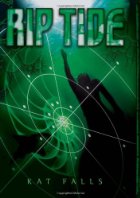
Book Review: Rip Tide by Kat Falls (Series, #2) (Audiobook narrated by Keith Nobbs)
 Summary:
Ty lives with his pioneer family subsea but he can’t convince his crush Gemma to leave Topside. Why is she so afraid of subsea? This was his biggest problem until his parents get kidnapped by surfs when they attempt to do a trade. Plus, Gemma wants to convince her fugitive brother to let her tag along with him. And townships keep disappearing, only to turn up later, chained up and anchored subsea with everyone dead inside. It’s a giant web of mysteries but do they intertwine at all?
Review:
I absolutely loved the first entry in this scifi series, which is unusual for me, since it’s YA. Not generally my genre. So I was excited to see the sequel available on Audible. It’s still an exciting adventure and interesting world but not quite as tightly and expertly constructed as last time.
Whereas Ty’s voice worked perfectly in the first book, in this one he reads a bit young. He went through a lot in the first entry, he should have presumably matured a bit more than he has. Similarly, Gemma hasn’t developed much since the first book either. I think these characters should have been given more space to grow more. Particularly in a YA series, it’s important to let the characters develop and mature at a more rapid rate. That’s the reality for teenagers after all.
Plot-wise, I honestly felt that there was a bit of a deus ex machina at work that also didn’t fully play into the rules of the world as originally set up. Still, though, the mystery is well-plotted and difficult to predict. It includes real danger without being too violent. It’s the perfect level of thriller for a YA reader who’s not so into the gore. On the other hand, I also found it frustrating that Ty’s parents aren’t around for most of the book. One of the things refreshing about the first one was that his parents were actually present and helpful without being too pushy or overshadowing. This time around, Falls went the more popular YA adventure route and just flat-out got rid of them for most of the book.
But the world Falls has built is still rich and unique, and she expanded upon it. We now get to see more of what the surf life is like, in addition to more of the shady side of things, such as the boxing/fighting rings. We also see some more of the government and law enforcement and have a better understanding of the world as a whole. It’s all richly imagined and drawn, right down to what styles of clothes different groups wear to what they eat. One detail I particularly enjoyed was that the surfs, a poor outcast lot, eat a lot of fish and blubber because it’s easy to catch, whereas Ty’s family eats a lot of vegetables because they grow them. Details like that really make a world.
The audiobook narrator, Keith Nobbs, read the whole thing a bit flat for my taste. He didn’t have as much enthusiasm and inflection as I thought was appropriate for a book about a subsea adventure starring two young teenagers! The production quality was high, he was easy to understand, but he didn’t really bring Ty to life. I’d recommend reading the print book over the audio, honestly.
Overall, then, the characters are a bit slow in their development and the plot feels a bit lazier than last time, but the characters are still well-rounded and the plot maintains an appropriate level of mystery. Toss in the richly imagined and describe post-apocalyptic and very wet world, and it’s well worth the read.
4 out of 5 stars
Source: Audible

 ,
, Book Review: A Queer and Pleasant Danger: The True Story of a Nice Jewish Boy Who Joins the Church of Scientology and Leaves Twelve Years Later to Become the Lovely Lady She is Today by Kate Bornstein (Audiobook narrated by Alice Rosengard)
 Summary:
Kate Bornstein is a playwright, gender theorist, and queer activist. She chose to write a memoir as a way to reach out to her daughter, Jessica, who is still in the Church of Scientology, and thus, must not speak to her. Her memoir talks about growing up Jewish in the 1950s, feeling like a girl inside a boy’s body. It then talks about why and how she joined Scientology (still identifying as a man, Al), climbing Scientology’s ladder, marrying, fathering Jessica, and finally getting kicked out of Scientology and becoming disillusioned. From there the memoir explains to Jessica how and why Al decided to become Kate and talks about the person behind the queer theory, trying to explain who the incredibly unique parent she has truly is.
Review:
I was feeling bad about how far behind I’ve fallen in writing up reviews for the books I’ve finished reading, but with the historic DOMA ruling in the US yesterday (giving official federal support to marriage equality), I’m really glad I had a LGBTQIA+ book in the queue ready to be reviewed. And not just any LGBTQIA+ book. An amazing one! You can’t read that title and not be intrigued. It’s impossible. I spotted it on tumblr and instantly knew I had to read it. A memoir about a transwoman who was a member of Scientology?! It’s the intersection of three topics I find fascinating.
Kate is unabashedly honest about the fact that this book exists as a letter to her daughter, Jessica. The prologue explains that this memoir came about as a way for Kate to reach out to Jessica and her children, even after Kate has passed away. This lends a tone to the book of an elderly neighbor sitting down to tell you their life story, and you finding out gradually that your elderly neighbor is, in fact, a bad ass, and age has nothing to do with how cool a person still is to this day. And Kate doesn’t hold back because of this perspective. If anything, she is more brutally honest than she might otherwise be. She wants Jessica to have a whole, clear picture of who she is. Flaws and all. One technique that I thought was brilliant for a memoir and helped establish trust in truth between the reader and the author was the fact that Kate would tell a family story she heard growing up and then say, well, that was a lie. I thought it was true, but it turns out what people told me was a lie. Given that, how can we ever know what really is true? Just because we think something is true doesn’t mean it is. It’s an excellent grain of salt to be given in a memoir.
After the prologue, Kate tells her story chronologically. Her story can be roughly summarized as the following sections: growing up a gender queer person, joining Scientology, break-down after getting kicked out of Scientology and coming to terms with her queerness, transitioning, life as a lesbian trans activist, finding BDSM, and overcoming depression and suicidal thoughts. It’s an emotional rollercoaster ride, and one cannot help but feel empathy for this person just struggling to find a place in the world. Personally, I think Kate’s life story is an excellent argument for breaking down the binary gender divide. A lot of Kate’s struggles come from the rigid gender norms and expectations placed upon her by others. It would have been much simpler for people to have let her be gender fluid, and indeed, Kate in more recent years has come to be an activist for gender fluidity and queerness (as is evidenced by her book Gender Outlaw: On Men, Women and the Rest of Us
The Scientology section was surprisingly mundane compared to what I thought actually happens in Scientology. Yes, there was abuse and lies and many other things going on that demonstrate the fallacies of L. Ron Hubbard, but honestly none of it was that much worse than religious extremists of any religion. Scientology expects its followers to cut themselves off from people deemed poisonous and to proselytize non-stop. It takes over the lives of the people in the upper-echelons, controlling every aspect of their lives. We can see all of this in Kate’s years in Scientology, and while it was interesting, none of it is shocking to anyone moderately informed on Scientology. I actually was more interested in how Kate wound up joining Scientology. Scientology teaches the the soul is genderless, and you also reincarnate. Everyone has been in both male and female bodies. Kate (then Al) found this incredibly comforting. It’s possible that his soul was just more frequently in female bodies, and so that’s why he felt like a girl inside. What an appealing concept to a confused, unsupported trans or gender queer young adult. I think this part of the book demonstrates clearly why it’s important for families and loved ones to be supportive of their LGBTQIA+ teens and young people. You don’t want a harmful group of people snapping them up with promises of understanding and caring and information that sounds more supportive than the people they live with.
Interestingly, the much more shocking section was the one in which Kate discusses discovering BDSM and getting pleasure from pain. Kate was part of a BDSM triad for quite some time, and this is addressed. It does, however, come with a warning for Jessica and readers who might not want to hear the details so they can easily skip over it and still get the most important information without getting all the details. I thought that was a nice touch from Kate, showing her maturity and openness. Of course, I read that section, and I will say that Kate had a more intense BDSM relationship than you tend to see in literature, and it was interesting to read about.
It’s also interesting to note that from the prologue Kate is honest with the reader about being diagnosed with Borderline Personality Disorder years ago. This is not something I knew coming into the book, and I don’t think Kate’s mental illness played very much into the book. I certainly think she would have had a better time coping with her mental health issues if she had had a supportive environment for her queerness. Even within the LGBTQIA+ community, she was ostracized for some of her less mainstream beliefs within that community. It’s sad that even a community of people ostracized by the larger society, people can still be unaccepting and unloving. In spite of the fact that the book talks a lot about depression, self-injury, and other mental health issues, I am hesitant to label it as counting for my Mental Illness Advocacy Reading Challenge. I don’t want the casual reader to think that I’m equating being queer with having a mental illness. However, the fact remains that Kate herself states she was diagnosed with BPD, and trans and queer people certainly can have mental illnesses. One does not cause the other, although certainly I think lack of acceptance and loving increases symptoms of mental illnesses. In any case, for this reason, I am counting this read for the challenge, but I want to be crystal clear that this is due to Kate’s BPD and NOT her queer/trans orientation.
The narration of the audiobook was perfect. Thankfully, they chose to use a female narrator throughout, which fits perfectly with the image of an older Kate Bornstein telling her life story to her daughter. Alice Rosengard was a perfect narrator. She became Kate in my mind, and there’s not a better complement you can pay a narrator than that.
I feel like I’ve rambled a lot about this book. It’s hard to succinctly discuss a memoir as unique as this one, let alone a book you love as much as I loved this one. It’s amazing. It’s unique. It does exactly what a memoir should do. It tells a unique life story in an engaging way that forces the reader to put herself into someone else’s shoes and feel empathy and maybe even come out of it with a changed worldview, however slightly. I strongly recommend this book to everyone, really, but especially anyone with an interest in LGBTQIA+ history/theory/studies or an interest in the first few decades of Scientology. I will definitely be reading more of Kate’s works, myself, and want to thank her for being a pioneer, in spite of everything.
5 out of 5 stars
Source: Audible

Counts For:

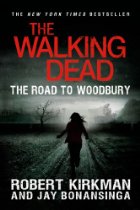
Book Review: The Walking Dead: The Road To Woodbury by Robert Kirkman and Jay Bonansinga (Series, #2) (Audiobook narrated by Fred Berman)
 Summary:
Lilly Caul’s father shoved her into a bus escaping town just as the doors were closing. They closed on him and zombies ate him while she watched. Haunted by the feeling that everyone caring for her puts their own lives in danger, she’s struggling to survive among a rag-tag group of survivors, including her high school friend, Megan. Slowly her small group of friendly survivors, headed by a big strong black man, Josh Lee, who has feelings for her, breaks off from the main group and find their way to Woodbury. There, the sinister side of the town gradually reveals itself.
Review:
My understanding of this print companion series to the graphic novel one was that it was going to follow the life of the villain The Governor. The first book told the backstory of The Governor and brought him to Woodbury, so I was expecting a book showing how he came to rule the town with an iron fist. Instead this entry covers the backstory of Lilly Caul, and how she comes to Woodbury. Although it’s always fun to visit this post-apocalyptic land that Kirman and Bonansinga have created, this entry just didn’t have the energy and appeal of the first book in the series.
I have to admit, although I recognized the name Lilly Caul, I couldn’t for the life of me remember who she was at first, so I spent quite a bit of time scratching my brain trying to figure out why we were following her around. I finally remembered that she’s one of the gang of Woodbury folks who go head-to-head with Rick Grimes’s gang in the graphic novels. A check of the wiki reminded me that she’s the one who shoots and kills Lori and Judith. Eh, this explains why I have no strong feelings about her. I hated Lori and felt nothing about Judith, so I certainly didn’t view her as a memorable villain. I now get it that the series is trying to show how all of Woodbury happened, not just the tale of The Governor. But the thing is that if you could tell the story of a compelling figure like The Governor why talk about the girl next door? It made for a boring book. There is nothing extraordinary about Lilly. She’s just a cowardly girl trying to survive an apocalypse, and she does it by leeching on to people who care for her but she seems to be lacking the ability to truly care about anyone besides herself. She also spends a lot of time slut shaming her “best friend” Megan, which pissed me off to no end. So we have a woman playing with people’s hearts for protection but simultaneously judging Megan for sleeping with people for protection. Yuck. Given all of these aspects of her character, I also found it really unbelievable that she would *spoiler warning* lead a rebellion against The Governor. *end spoilers*
When we finally do get to Woodbury, The Governor is already in charge, although he has yet to call himself The Governor. We do get to see what led to the establishment of the gladiator-style arena with the zombies, and we also see more reasons as to why the town folk trust and respect him. But we see all of this through Lilly, Megan, and Bob’s eyes. I honestly wanted to know more of the inner workings of The Governor, so I found this third person perspective disappointing.
There’s nothing new or ground-breaking in the horror. There is one massive swarm of zombies that is clearly supposed to be terrifying, but it did nothing for me. Maybe I’m just getting acclimated to this world, but neither the characters nor the level of horror increased the intensity enough for me.
That said, even though I didn’t enjoy which characters were focused on or how the plot was constructed, we do learn more about the world of Woodbury, and the post-apocalyptic world in general. We learn how and why the gladiator ring started, how The Governor won people over, and more about how the weather impacted the survivors on that particular winter. Long-time fans will find value in reading this book, even though it is by no means a thrilling or thought-provoking entry in the series. Skim it quickly to get the important bits and move on. For that reason, I would recommend the print over the audio, in spite of Berman’s talent as a narrator. He was better than the book he was given.
3 out of 5 stars
Source: Audible

Previous Books in Series
The Walking Dead: Rise of the Governor
Book Review: The Isle of Blood by Rick Yancey (Audiobook narrated by Steven Boyer) (Series, #3)
 Summary:
Will Henry states that this is a story that Dr. Warthrop did not want told…and proceeds to tell it anyway. When a British man shows up with a package being delivered under duress, Dr. Warthrop is ecstatic to realize it is the nest of the Magnificum–the holy grail of monstrumology. Dr. Warthrop decides to leave Will Henry in New York while he pursues this beast. But when his monstrumologist companion returns claiming that Warthrop is dead, Will Henry and two fellow monstrumologists travel to Europe to track him–or his body–down.
Review:
Not as engaging or thought-provoking as the first two books in the series, I can only hope that this third entry is suffering from the common penultimate book malady where the book which must set everything up for the finale of the series can sometimes drag.
There are two problems in this entry that make it fail to be as engaging or thrilling as the first two books. First, Will Henry is left behind in New York for a significant portion of the novel. We are thus left with a whiny teenager bemoaning Warthrop’s choice to be responsible for once and keep him out of danger. We also are left with very little action for far too large a portion of the book. The second issue is perhaps a bit of a spoiler but suffice to say that the monster is disappointing and its disappointment is easily predicted. If we had a lot of action with a disappointing monster, that’s still engaging. If we had less excitement with a surprising, phenomenal monster, that’s still thrilling. The combination of the two, though, prevents this thriller from being as thrilling and engaging as it should be.
Of course there are other elements that still worked, which is why I kept reading it. Yancey’s writing is, as ever, beautiful to read (or listen to) and contains much depth.
“So many times we express our fear as anger…, and now I think I wasn’t angry at all, but afraid. Terribly, terribly afraid.”
The settings are unique, and the characters are strong and leap off of the pages. Will Henry becomes more fully fleshed-out in this entry as we start to see his descent into a love affair with monstrumology. We also get to see Warthrop at what he himself perceives of as his lowest point. It’s a dark bit of characterization but it works very well for the story Yancey is telling.
Overall, I was a bit disappointed, purely because the first two entries in the series were so phenomenal. The third book is still a very good book. Fans might be a bit disappointed, depending on how attached they are to the unique thriller aspect of the series, but the characters and writing still make this well worth the time. Fans will remain in eager anticipation of the final entry in the series.
4 out of 5 stars
Source: Audible

Previous Books in Series
The Monstrumologist
The Curse of the Wendigo
Book Review: The Curse of the Wendigo by Rick Yancey (Audiobook narrated by Steven Boyer) (Series, #2)
 Summary:
Will Henry, 12 year old orphan and assistant to renowned Monstrumologist, Pellinore Warthrop, is shocked to find a refined woman on Warthrop’s doorstep. She is the wife of Warthrop’s best friend who has now gone missing in rural Canada while looking for the elusive wendigo (aka werewolf). Warthrop insists that there is no such thing as a wendigo, but he agrees to go looking for his missing friend anyway, even if he believes his mission was ridiculous and an affront to monstrumology’s reputation.
Review:
I can’t believe it took me this long to get to the sequel of one of my rare 5 star reads, The Monstrumologist
Yancey does something brave for a second book in the series. Instead of following the formula that worked so well in the first book and basically doing a monster-of-the-week-in-our-town method like Buffy and so many other urban fantasies, he changes things up. There is a monster, yes, but it is entirely different from the first one. This is a monster that might not even exist, unlike the anthropophagi in the first book who are almost immediately clearly real. Additionally, Warthrop and Will must travel away from New England to go looking for the trouble. It does not come to them. Another good plot twist is that the story does not entirely take place in Canada. It moves to New York City. Thus we get both the dangers of the wilderness and the dangers of the city in one book. These plot choices mean that what makes this series a series is the characters, not the fantastical nature of their world. By the end of the book I was thinking of the series in terms of the relationship between Will and Warthrop, not in the context of what nasty beast we might meet next. It thus does what great genre fiction should do. It looks at a real life issue and dresses it up with some genre fun. And the issues addressed here are big ones. What is love and what should we be willing to sacrifice for it? Is it more loving to stay with someone at all costs or to let them go to protect them? At what point do you give up on someone?
The horror certainly felt more grotesque this time around, although it’s possible I just wasn’t remembering the anthropophagi that well. This is a bloody book full of horrible things. Precisely what I expect out of my genre. There’s not much more to say about the horror than keep it up, Yancey. Also that this might not be for you if blood and guts and profanity are not your thing. But they *are* mine and, oh, how well they are done here.
Just as with the first book, the language Yancey uses is beautiful. It’s rich, eloquent, visual, and decadent. It’s a word-lover’s book. An example:
But love has more than one face. And the yellow eye is not the only eye. There can be no desolation without abundance. And the voice of the beast is not the only voice that rides upon the high wind….It is always there. Like the hunger that can’t be satisfied, though the tiniest sip is more satisfying than the most sumptuous of feasts.
Stunning.
The characterization here remains strong for Will and grows much stronger for Warthrop. Will grows and changes as a 12 year old in this time period in his particular situation would be expected to. With Warthrop, though, we get a much clearer backstory and motivations for his actions. In the first book we came to know Will. In this one we come to know Warthrop, although Will is not left without any development. It’s a good balance. I also enjoyed the addition of two female characters, who I thought were well-written, particularly Lily, the budding young feminist determined to be the world’s first female monstrumologist. She is truly three-dimensional in spite of her rather limited screen-time compared to Will.
The pacing doesn’t build steadily from beginning to end. It rather builds to a first climax, comes back down and builds again to a second climax. This makes sense, particularly in a werewolf book, but I must admit it felt a bit odd in the moment. It almost felt like reading two books in one until it all came together in the end. In fact, this is one of those books that gets better the more you look back on the story as a whole. Be prepared to enjoy it more in retrospect that in the first reading.
The audiobook narrator, Boyer, has a tough book to work with. There are a wide range of characters of multiple nationalities to act out (Canadian, German, French, New York, Massachusetts, etc…). Additionally, at least three different languages are spoken (English, French, and German). I’m not fluent in anything but English, but I did take German in university, and I can say that his German accent is at least passable. He also does an excellent job creating a unique voice for each character. I only rarely got lost, and that was generally due to rapid-fire conversation where each character only had a word or two. I must say, though, that he does mispronounce a few words, which detracts from Yancey’s gorgeous writing. I blame the audiobook director for this, though. S/he should have realized and corrected this. Overall, though, the mispronounced words are only in a couple of locations and do not deeply affect the reading of the book.
Overall this is an excellent follow-up to a remarkable first book in the series. It brings to the table that which made the first so powerful: YA horror with rich language set in a historic time period. But it also changes things up enough to avoid falling into the monster-of-the-week trap. The entries in the series are part of a larger story, and that can be seen. Fans of the first book should pick up the second book asap.
5 out of 5 stars
Source: Audible

Previous Books in Series
The Monstrumologist
Book Review: Half of a Yellow Sun by Chimamanda Ngozi Adichie (Audiobook narrated by Robin Miles)
 Summary:
The Nigerian-Biafran War (or the Nigerian Civil War, as it is also known) is seen through the intertwining lives of four different people. The daughter of a wealthy Igbo couple, Kainene, with a fierce business sense. Her fraternal twin sister, who is also the beautiful one, Olanna, an academic in love with a revolutionary-minded man named Odenigbo. Kainene’s boyfriend then fiancee, the white English writer Richard. And Ugwu. Olanna’s houseboy who came to them from a rural village. Their lives are irreparably impacted, and in some cases destroyed, by the war for a cause they all believe in, but that the world largely ignores.
Review:
I originally intended this Nigerian book to be my final read for the Africa Reading Challenge 2012, but even though I started it in November, the audiobook took over three months to get through, so it ultimately missed counting for the challenge. I thought it was much longer than my usual audiobook fare, but a quick check of the listen length shows that it is 18 hours and 56 minutes long, which is only about 7 hours longer than my norm. So why did it take me so long to finish? Well, I just didn’t enjoy it that much.
I believe I was expecting something else from Adichie, since I had previously read her book Purple Hibiscus
As far as the plot goes, it was interesting but it was a bit confusing. Part of my confusion could have been because I listened to it, but from my understanding when I was listening, first there was an affair, then we jumped back to before the affair, then we jumped forward, then we jumped back to a different affair that came before the first affair. It was profoundly confusing. Particularly with a child referred to only as Baby (with no explanation about this for quite some time) who also randomly shows up and disappears. There was already so much going on with four different main characters and the war that this non-linear plot felt unnecessarily extraneous and confusing. However, it is possible that this plot is more clear when reading the print version, as opposed to the audio version.
The language of the writing itself is pretty, and I found periodic astute insights that I’ve come to expect and enjoy from Adichie. For instance,
Why do I love him? I don’t think love has a reason. I think love comes first, and the reasons come later.
Passages like these are what helped me enjoy the book to the extent that I did.
There is one plot point in the book that truly distressed me, so I feel I must discuss it. It is a spoiler though, so consider yourself spoiler warned for this paragraph. Throughout the book, the narration style is third person limited, which means that it is told in third person, but the reader knows what is going on in the main character’s head and is generally limited to that character’s perspective. The point of view is switched around among the four main characters, one of whom is Ugwu, the houseboy. We thus get to know him as the houseboy, he gradually grows up, and then later he is conscripted into the Biafran army. At this point, he participates in a gang rape on a waitress in a bar. I read a lot of gritty things. I routinely read books offering up the point of view of sociopaths or serial killers. I’m not averse to seeing the world through a bad person’s eyes, or through the eyes of a person who does bad things. But it has to be handled in the appropriate manner. I felt that there was entirely too much empathy toward Ugwu in the case of the gang rape. Adichie sets it up so that he walks in on his fellow soldiers gang raping this woman, and he says he doesn’t want to participate, they question his manhood, he admits in his head that he is turned on by the view of her pinned to the ground crying with her legs held apart having just been raped by a different soldier, and he participates. I think what disturbed me the most about this passage was how the narration makes it seem so ordinary. Like it’s something any man would do in that situation. Like it’s only natural he’d be turned on and get a hard-on from seeing a woman forcibly pinned to the ground so she can be gang raped by a bunch of men including himself. I think it’s awful to treat men like that. To act like they clearly are incapable of standing up for what’s right or that they’ll get a hard-on any time they see an orifice they can physically bang. Men are human beings and are entirely capable of thinking with more than their penis. Now, obviously there are men who rape, but there has got to be more going on there then I have a hard on and there’s a woman who I can stick it into. To treat rape that simply is a disservice to men and women’s humanity alike. Part of the reason why this reads this way is that we don’t know Ugwu well but we know him well enough to think that he’s an at least moderately decent young man. We don’t see a gradual downfall. No one holds a gun to his head or even implicitly threatens him with death if he doesn’t participate. It makes it seem like war makes men, even moderately good men, rape, as opposed to war simply providing more opportunities for rapists to rape. That is a perspective that I do not endorse, that I do not enjoy having sprung upon me in my literature, and that I found triggering as well. I was shocked to see it in a book by Adichie. Shocked and disappointed. It left me wishing I could scrub my brain of the book. Wishing for those hours of my life that I spent listening to it back.
Now, let me take a moment to speak about the narrator, Robin Miles. Miles is an astounding narrator. Her audiobook narration is truly voice acting. She is capable of a broad spectrum of accents, including Nigerian, British, and American, and slips in and out of them seamlessly. She easily creates a different voice for many different characters. I absolutely adored listening to her, in spite of not enjoying the book itself. Her performance of this book is easily a 5 star one.
Overall, though, the high quality narration simply could not make up for a story that failed to hit the mark with me on so many levels. It covers an important time period in Nigeria, and the highly important human rights issue of the genocide of the Igbo, but the style in which it does simply misses the mark for me. If this was all, I would still recommend the book to others who are more fond of a more impersonal, sweeping narration style. However, I also found the treatment of rape in the book to be simultaneously offensive and triggering. For this reason, I cannot recommend this book, although I do recommend the audiobook narrator, Robin Miles.
2 out of 5 stars
Source: Audible

 Support my work with a tip or browse my shop for curated book club guides, how to guides, cross-stitch patterns, and more!


This work by Amanda Nevius is licensed under a Creative Commons Attribution-Noncommercial-No Derivative Works 3.0 United States License.
 Opinions of a Wolf