
Archive
Book Review: The Chicken Thief by Fiona Leonard
 Summary:
Alois used to work for the Ministry, but he felt stifled and quit. Now he steals chickens. One night the white owner of one of the large, walled-in houses he steals from stops him. He wants him to get a letter for him. A letter from Gabriel, a revolutionary leader who has been long-thought to be dead. Alois accepts for the money, but soon finds his whole world changing around him.
Review:
This book was a gift from a one-time friend who also enjoys African lit. She enjoyed it and thought I would, but remember that problem I mentioned in my last review where I don’t seem to like books other people recommend to me? Yeah. Still a problem. I do enjoy African lit, and I thought when I saw the cover and heard the title that this book would be more of a social justicey kind of plot. But it’s actually quite a bit of a political thriller, and I personally don’t like those. Putting that element aside, though, I am still able to review the quality of the book.
The plot takes the less common method of looking at political upheavals and developments through the eyes of an average person dragged into the situation. There are a few chapters that show us the president’s perspective, but primarily things are seen through Alois’s eyes. I think this is what made it readable to me, because honestly who cares about politicians? It’s the everyman that is interesting. The plot is also interesting in that it looks at both a past revolution and a present-day coup. That makes it more unique in the world of political thrillers.
The writing can only be described as flowery. For example:
In truth he saw her everywhere, but you couldn’t say to a woman, not one who was meant to be just your friend, “Here, I have brought you this tree because its branches moved as you do” or “see here this bucket, when the water falls from it I hear your voice. (page 104)
Pretty much the entire book has that kind of meandering, highly descriptive cadence. I know that works for lots of readers. It’s just not personally something I enjoy, and I did find it odd in a political thriller.
One thing that bothered me is that it’s never entirely clear what country in Africa this is. I think it might be a fictional country in the southern region of Africa. The author herself lived in Ghana for a time so perhaps the idea was inspired by Ghanaian culture, but not based on anything factual in Ghana. In a book like this, a political thriller, I prefer real countries. Or at least a clearly defined country. That might bother other readers less though.
Overall then, there are some aspects of this political thriller that make it unique in the genre. It examines both a past revolution and a current coup through the eyes of a non-political youth who was not alive for the previous revolution. The writing is surprisingly flowery for the genre, so fans should be aware of that difference going in. Recommended to fans of political thrillers looking for something different.
3 out of 5 stars
Source: Gift

Counts For:
Specific country? Uncertain. Southern region of Africa. Australian author who has lived in Ghana.

Book Review: Poison Study by Maria V. Snyder (Series, #1) (Bottom of TBR Pile Challenge)
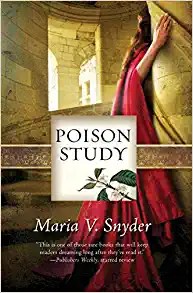
Summary:
Yelena is on death row for killing a man in the military state of Ixia but on the day of her execution she faces a choice. Become the Commander’s food taster and face possible death by poison every day or be hanged as planned. Being a smart person, Yelena chooses the former. Now that she has admittance to the inner circle of the military state, she quickly comes to see that not everything is quite as it seems….not even her own personal history or her heart.
Review:
*sighs* You guys. I have got to stop letting people convince me to pick up books using the phrase, “I know you don’t like [blank] but!” That is how this book wound up on my tbr pile. “I know you don’t like fantasy, but!” and also “I know you don’t like YA, but!” oh and “I know you don’t like romance in YA, but!” A reader knows her own taste. And I don’t like any of those. I still came at it with hope, though, since I did like one fantasy book I read this year (Acacia). There’s a big difference in how they wound up on my pile though. I chose Acacia myself because its reviews intrigued me. Poison Study was foisted upon me by well-meaning friends. So, don’t get my review wrong. This book isn’t bad. It’s just what I would call average YA fantasy. Nothing made it stand-out to me, and it felt very predictable.
The world of Ixia felt similar to basically every other fantasy world I’ve seen drawn out, including ones friends and I wrote up in highschool. Everyone has to wear a color-coded uniform that makes them easily identifiable. There are vague similarities to the middle ages (like Rennaisance-style fairs). There are people in absolute control. There is magic and magicians who are either revered or loathed. There are all the things that are moderately similar to our world but are called something slightly different like how fall is “the cooling season.” Some readers really like this stuff. I just never have. I need something really unique in the fantasy world to grab me, like how in the Fairies of Dreamdark series the characters are tinkerbell-sized sprites in the woods who ride crows. That is fun and unique. This is just….average.
Yelena’s history, I’m sorry, is totally predictable. I knew why she had killed Reyad long before we ever find out. I suspected early on how she truly came to be at General Brazell’s castle. I didn’t know the exact reason he had for collecting these people, but I got the gist.
And now I’m going to say something that I think might piss some readers off, but it’s just true. What the hell is it with YA romance and exploitative, abusive douchebags? This may be a bit of a spoiler, but I think any astute reader can predict it from the first chapter who the love interest is, but consider yourself warned that it’s about to be discussed. Yelena’s love interest is Valek, the dude who is the Commander’s right-hand man and also who offers her the poison taster position and trains her for it. He manipulates her throughout the book, something that Yelena herself is completely aware of. There are three things that he does that are just flat-out abusive. First, he tricks her into thinking that she must come to see him every two days for an antidote or die a horrible death of poisoning. (Controlling much?) Second, he sets her up in a false situation that she thinks is entirely real to test her loyalty to him. (Manipulative and obsessive much?) Finally, and this is a bit of a spoiler, even after professing his love for her, he asserts that he would kill her if the Commander verbally ordered it because his first loyalty is to him. What the WHAT?! Even the scene wherein he professes his love for Yelena he does it in such a way that even she states that he makes her sound like a poison. There’s a healthy start to a relationship. *eye-roll* All of this would be ok if Yelena ultimately rejects him, asserting she deserves better. But she doesn’t. No. She instead has happy fun sex times with him in the woods when she’s in the midst of having to run away because Valek’s Commander has an order out to kill her. This is not the right message to be sending YA readers, and yet it’s the message YA authors persist in writing. I could go into a whole diatribe on the ethics of positively depicting abusive relationships in literature, especially in YA literature, but that should be its own post. Suffice to say, whereas the rest of the book just felt average to me, the romance soured the whole book. It is disappointing.
Ultimately then, the book is an average piece of YA fantasy that I am sure will appeal to fantasy fans. I would recommend it to them, but I feel that I cannot given the positively depicted unhealthy romantic relationship the main character engages in.
2 out of 5 stars
Source: PaperBackSwap

Book Review: The Diviners by Quinn Robles
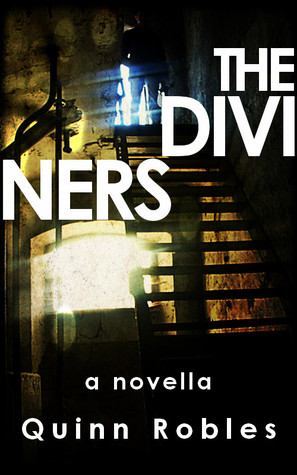 Summary:
In a world where the 1% has taken over the government and resources and the rest are left to fend for themselves, the Symmonds siblings seek to keep starvation at bay with their divining abilities. Everyone knows diviners can find a water source with two rods, but the Symmonds siblings can find much more, including lost people. When they are asked to find girls most likely stolen by the government for sex slavery, they must face a choice. Should they risk it all to save them?
Review:
I actually hesitated over whether or not to review this book because it does not appear to be available for sale anymore in spite of coming out just this February. This shows me that perhaps the author is already aware that it wasn’t quite ready for publication, so why pile it on? But I did promise a review in exchange for a copy, and I also review everything I read, so I ultimately decided to review. But I will keep it short and try to offer simply constructive criticism.
There are two issues with the book. One is some awkward sentence structures and flat-out wrong grammar. This is something that could be quickly fixed in another editing pass, which I recommend. The other is larger, though. The world building is confusing and weak. It took me until around 75% through the kindle book to finally figure out what was going on in this world, and some of it was still unclear. For instance, what I think is a branch of the government (still not sure) is called the “Jacobs,” but they are just called the Jacobs for so long with no other information that at first it seems that they are a rival family or something. The little information the reader does get about the dystopian world is delivered via information dump. It’s not smoothly written into the story. It is told to the reader like a confusing history book. If this wasn’t a review copy, I would have quit in the first chapter, because it’s simply not pleasant to receive information via info dump. The dystopian world itself, though, is interesting and timely. It’s based around the Occupy movement’s rhetoric about the 1% with the wealthy ultimately blatantly taking over. I could see a lot of people really enjoying the mix of that with the more fantastical element of divining. The characters are also fairly well-rounded and easy to tell apart.
Overall I would say it’s a good idea and a good first draft, but it needs some reworking and editing. I hope that’s what this author is doing and that she keeps at it, because her ideas are definitely unique.
2 out of 5 stars
Source: Kindle copy from author in exchange for my honest review
Currently unavailable to buy, but check out the author’s website
Book Review: Germline by T. C. McCarthy (Series, #1) (Audiobook narrated by Donald Corren)
 Summary:
Oscar is a reporter and lands an assignment with Stars and Stripes to go over to Kazakhstan and report on the new war between the US and Russia over resources needed for technology. This is a new kind of warfare. One fought mostly underground, and with the soldiers permanently wearing suits. Plus they’re fighting side-by-side with Genetics–human-looking robots who are all female and all look alike. Oscar started out just wanting a Pulitzer in between his drug addiction, which is easily fueled in Kaz. But Kaz changes people.
Review:
It’s been a while since I ventured in military scifi. I usually stick with the more sociological/psych experiment or cyberpunk areas of the genre, but this one just stuck out to me. I think its combination of aspects is just intriguing–a drug addicted journalist, a future war on earth, underground warfare, and robots. It certainly held my attention and flamed my interest in military scifi, plus it wound up counting for the MIA Reading Challenge, which was an added bonus.
Oscar is a well-rounded character. At first he seems flat and frankly like a total douchebag, but that’s because he’s a depressed drug addict. We learn gradually what landed him there and how he grows out of it with time. It’s an interesting character development arc because although many arcs show how war leads to alcoholism or drug addiction, in Oscar’s case although it at first makes his addiction worse, it ultimately helps him beat it. Because he ultimately snaps and realizes that the drugs are not helping the problems. They’re just making them worse. This is so key for anyone struggling with an addiction to realize. Pain in the present to feel better in the future. And McCarthy does an excellent job showing this progression without getting preachy. Sometimes you want to throttle Oscar, but you ultimately come to at least respect him if not like him. I wasn’t expecting such strong characterization in a military scifi, and I really enjoyed it.
The world McCarthy has built is interesting. The war itself is fairly typical–first world countries butting heads over resources in third world countries. But the content of the battles and the fighting methods are futuristic enough to maintain the scifi feel. There are the Genetics of course, and they are used by both sides. It’s interesting that the Americans use only female Genetics, and that is explained later on. There are also different vehicles and weapons that are scary but still seem plausible. Of course there’s also the suits the soldiers permanently wear, the front-line tunnels (the “subterrene”). It all adds up to a plausible future war.
Now, I will say, some of the battle scenes and near misses that Oscar has seem a bit of a stretch. I know odd things happen in war, and anyone can get lucky, but. Everyone’s luck runs out eventually. It seemed sometimes as if McCarthy wrote himself into a corner then had to figure out a way to make his main character survive. Escaping danger is fine, and necessary for the book to continue. But it should seem like a plausible escape. And if you have one that seems miraculous, it seems a bit excessive to me to have more than one.
The audiobook narrator did a fine job, in my opinion. He didn’t add anything to the story but he also didn’t detract from my enjoyment. I will note, however, that he pronounced “corpsman” wrong, saying the “s,” which is supposed to be silent. This only came up a few times and didn’t really bother me, but some readers, particularly ones who have been in the military themselves, might be bothered. Nothing else was mispronounced, and the voices used fit the characters nicely.
Overall, this piece of futuristic military scifi showcases both war and addiction in an engaging manner. Some readers may be off-put by Oscar at first, but stick it out. It takes many interesting turns. Recommended to scifi fans, whether they generally like military scifi or not.
4 out of 5 stars
Source: Audible

Counts For:
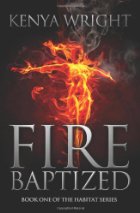
Book Review: Fire Baptized by Kenya Wright (Series, #1)
 Summary:
The humans won the supe-human war, and now all supernaturals are confined to caged cities whose bars are made up of every metal that is harmful to supes. They also all have a brand on their forehead letting everyone now immediately what type of supernatural they are–crescent moon for shifter, full moon for vampire, wings for fairy, X for mixbreed, which is what Lanore just happens to be. Lanore is hoping to be the first mixie to graduate from the caged city’s university, and she also works on the side with another mixie, Zulu, to run a mixie civil rights group. The purebloods by and large hate mixies. As if her life wasn’t already complicated enough, one night Lanore witnesses a murder, and the murderer turns out to be a serial killer. Now Lanore is on his list.
Review:
I am so glad I accepted this review copy. The branding of supes and caged cities was enough to show me that this is a unique urban fantasy series, but I wasn’t aware that it’s also a heavily African-American culture influenced series, and that just makes it even more unique and fun.
It’s not new to parallel supe civil rights issues with those of minorities, but they often flounder. Wright’s book depicts the complexities eloquently. Making a group within the supes that the supes hate makes it more closely parallel the real world. The addition of the brands on the foreheads also makes the supernatural race immediately identifiable just as race is in the real world by skin color. The caged cities are also a great analogy of inner city life and how much of a trap it can feel like. The fact that Lanore accidentally witnesses a murder on her way home from school is something that can and does happen in the real world.
The other element that I really enjoyed is how Wright brings the African-American religion of Santeria into the mix. She provides multiple perspectives on the religion naturally through the different characters. Lanore doesn’t believe in any religion. MeShack, her ex-boyfriend and roommate, does, and it helps him in his life. And of course the serial killer also believes in Santeria but is going about it the wrong way, as Lanore eventually learns. The book naturally teaches the reader a few things about Santeria, which is often maligned and misunderstood in America. But it does it within the course of the story without ever feeling preachy.
The sex scenes (we all know we partially read urban fantasy for those) were hot and incorporated shifter abilities without ever tipping too far into creepy beastiality land. They were so well-written, I actually found myself blushing a bit to be reading them on the bus (and hoped no one would peak over my shoulder at that moment).
The plot itself is strong through most of the book. The serial killer is genuinely scary, and Lanore doesn’t suddenly morph into some superhero overnight. She maintains her everywoman quality throughout. I wasn’t totally happy with the climax. I didn’t dislike it, but I also think the rest of the book was so well-done that I was expecting something a bit more earth-shattering.
There are two things in the book that knocked it down from loved it to really liked it for me. They both have to do with Zulu. Zulu is a white guy, but his beast form is a black dude with silver wings. I am really not sure what Wright is trying to say with this characterization and plot point. It wasn’t clear when it first happens, and I was still baffled by the choice by the end of the book. In a book that so clearly talks about race, with an author so attuned to the issues innate in race relations, it is clear that this was a conscious choice on her part. But I am still unclear as to why. Hopefully the rest of the books in the series will clear this up for me. My other issue is with how possessive Zulu is of Lanore. He essentially tells her that she’s his whether she likes it or not, and she goes along with it. Why must this theme come up over and over again in urban fantasy and paranormal romance? A man can have supernatural powers and not use them as an excuse to be an abusive douche. I’m just saying. But. This is part of a series, so perhaps these two issues will be addressed in the next book. But for right now, I’m kinda sad that Lanore chose Zulu.
Overall, this is a unique piece of urban fantasy. The tables are turned on the supes with them in caged cities, and the creative use of forehead brands and the existence of mixed-breed supernaturals are used intelligently as a commentary on race relations in the United States. I highly recommend it to urban fantasy fans and am eagerly anticipating reading the next entry in the series myself.
4 out of 5 stars
Source: Kindle copy from author in exchange for my honest review

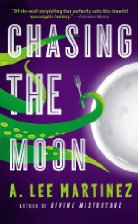
Book Review: Chasing the Moon by A. Lee Martinez (Audiobook narrated by Khristine Hvam)
 Summary:
Diana doesn’t have much going for her–a bad job and perpetual unwanted singledom, plus she’s been sleeping on friend’s couches since losing her apartment. So when a room in a building with a quirky landlord shows up, she grabs it instantly. Only to discover that a monster called Vom the Hungry is in her closet waiting for her to let him out, at which point he will probably eat her. In fact, the whole building is oddly connected to other dimensions full of monsters, creatures, mayhem, and madness….not to mention tentacles.
Review:
I obviously had to read this book. The cover has tentacles on it, and it’s clearly a Lovecraftverse story. These are both basically automatic must reads in Amanda-land.
The storyline is fairly straight-forward as far as the Lovecraftverse goes. There’s a place where the lines between dimensions and reality fade and threaten mere humans with madness. The monsters that Diana meets within her own apartment are fairly creative. There’s Vom the Hungry who is pretty endearing, there’s the hedgehog looking guy (whose name I can’t remember and can’t look up because: audiobook) who spawns copies of himself when he’s upset, and of course there’s the giant floating eye with tentacles who tries very hard to be prim and proper. They’re creative and funny.
The foes–the cult of the moon god–are not so creative. They’re your typical moon-loving shapeshifters, and the moon god even has three forms just like a certain other god of a religion we’re all familiar with. Compared to the creativity of the apartment and the apartment’s monsters, it just doesn’t feel like a worthy foe.
Similarly, although I liked Diana and the world she’s living in, she has basically no backstory. I have a hard time believing she’d have such an easy time mostly abandoning her friends and family from her time prior to the apartment. I can believe she’s not afraid and can handle the horrors, but it’d be nice if we got at least a toss-up to the concept of her having a family or even a mention of estrangement from them, if that’s the case. That doesn’t happen, so I was left feeling that Diana is very two-dimensional.
Given these elements, I’m sure I would have skimmed through it very quickly in print and probably missed the humor that it does contain, except that I read the audiobook. The audiobook narrated by Khristine Hvam. And she is an incredibly talented voice actor.
Every single character had their own entirely unique voice, and the voices perfectly matched the character, even an eyeless faceless omnivorous Vom the Hungry. Hvam is just….just so amazing to listen to! I kept listening more to just hear her perform than due to a true vested interest in the story. In fact, I looked up her voice actor page on Audible after just to maybe get another one of her books. She mostly narrates scifi/fantasy, unfortunately mostly YA, which we all know I don’t like. But I will be keeping my eye out for more of her adult work. She is just so amazingly talented.
So, overall then, the story itself rates 3 stars, but the narration rates 5, so my rating must average those two out. Be aware, though, that I recommend Khristine Hvam over the book, but if you are intrigued by the book and don’t mind a lack of backstory or average villains, then I recommend picking the audiobook for twice the fun.
4 out of 5 stars
Source: Audible

Book Review: Where Late the Sweet Birds Sang by Kate Wilhelm (Audiobook narrated by Anna Fields)
 Summary:
When the world goes through an apocalypse consisting of virulent strains of the flu, lack of food, and nuclear warfare, one wealthy family manages to survive because they saw it coming. Made up of highly intelligent and highly educated people, such as doctors and scientists, the family creates a 200 bed hospital and uses this as their home base. But there is a serious fertility problem, and how they address it just might change the core of humanity.
Review:
I love reading classics of scifi. It’s endlessly fascinating how different people in different times imagine a future (or an apocalypse). This award-winning book had the bonus of being written by a woman, which isn’t always easy to find in older scifi. I also was intrigued by the cloning theme. How would someone in 1977 view something that was, as yet, nowhere near as close to a reality as it is now, with our cloned sheep?
The book starts out incredibly strongly. So strongly, in fact, that I actually had nightmares from it, which never happens to me ever. I am basically a rock of horror and scifi, but this one creeped the bejesus out of me. It’s that creepy combination of incest and cloning. The family are really not people you would want retooling the world. They’re everything that can be (and usually is) bad about the 1%. They’re selfish, self-centered, snobby, and routinely employ nepotism. I found the incest in the first third of the book talking about the first generation of the family to be an interesting metaphor for how the elite can become so backwards and grotesque from sheer isolation. It’s powerful and moving, and a scenario that will remain in my mind.
The second third of the book focuses in on a woman, Molly, from the first generation of clones. This is disturbing in its own way, because they don’t just clone everyone once and have done with it, no. They clone everyone multiple times until there are clusters of the same person at different ages wandering around. They call these clusters “brothers” and “sisters” with the name of the original person as the name of the group, even though the individual ones have their own names. It is profoundly disturbing. This second third looks at the society of clones that the original family unintentionally made. It’s fascinating in its own way and an interesting different way of telling a post-apocalypse story. Often we get only the first generation, but here we get multiple generations.
The last third, unfortunately, didn’t live up to the first two-thirds of the book. Without giving too much away, it looks at a boy who came about by natural methods who gets integrated into the clone society at the age of five. They decide not to clone him and give him brothers for unclear reasons. This last third then looks at his impact on the clone society. I didn’t feel that this worked as well for multiple reasons. For one, it’s almost as if Wilhelm freaked herself out and backed off from the profoundly disturbing story she was telling and went a more conventional direction. That was disappointing. For another, I found it disappointing that she chose to make this game-changer a boy. I expect women scifi authors to be at least a bit cognizant of the need in scifi for more female main characters. In this one, the first third is a man, the second third a woman, and the last third a boy. That is not the best stats from a woman author. I also found certain parts of this to be very boring and slow-moving compared to the first two-thirds. That makes for odd pacing in a book.
Of course, my complaints about the last third backing off, being more conventional, and being rather dull don’t take away from the first two thirds at all. They bring about so many interesting societal questions. For instance, is the incestuous nature of the elite necessarily bad or will it one day save humanity? Will cloning remove something that makes us human, even if they look right? Is it better to cling on to technology at all costs or release it and go back to simpler times? And what about sex? Is monogamy natural and polyamory unnatural? Or is polyamory more welcoming and loving than potentially possessive monogamy? The questions go on and on, which is what is great about scifi.
As for the science itself, it is quite well-done. Wilhelm clearly thought through both keeping a closed-off community alive and cloning and bringing to term embryos. She also put thought into the scientific basis for why clusters of clones would be different from individual humans, touching on psychology and twin studies. I was a bit irritated that she bases the survival of these people on cloning farm animals, when that is not a good use of their limited land resources. Studies have shown many many times that a combination of farming vitamin-rich plants and hunting/gathering are the best use of limited land resources, so this particular element rang a bit of bad science. However, I am not certain how much land usage had been studied in the 1970s, so that could possibly just be a sign of the times.
Now, I did read the audiobook, so I should touch on the narration. Overall, Anna Fields does a very good job. I really enjoyed that they chose a female narrator for a book written by a female author. It let me almost imagine that Kate Wilhelm herself was reading it to me. Fields mostly strikes a good balance of changing voices for different characters without going over the top. The one exception to this is when she narrates children. The voice for that made me cringe, but they mercifully speak only a few times. Mostly, Fields reads smoothly and is easy to follow. She narrates without accidentally putting her own interpretation onto the work, which is ideal for an audiobook.
Overall, then, this is a fascinating classic of scifi. It examines the apocalypse through the lens of the elite, thereby analyzing and critiquing them, but it also looks at possible consequences of cloning and ponders what ultimately makes us human. Although the last third of the book is a bit less creative and more conventional than the first two, it is still a fascinating read. Recommended to scifi fans, particularly those with an interest in group dynamics.
4 out of 5 stars
Source: Audible

Book Review: The Wind Through the Keyhole by Stephen King (Series, #4.5)
 Summary:
There’s a tale we have yet to hear about the ka-tet in the time between facing the man in the green castle and the wolves of the Calla. A time when the ka-tet hunkered down and learned a special billy-bumbler talent, an old tale of Gilead, and the first task Roland faced as a young gunslinger after the events at Mejis.
Review:
When I heard there was going to be a new Dark Tower book, I had basically three reactions. 1) Yay! 2) Shit he better not ruin them. 3) Guess I didn’t actually finish that series after all, did I? May have written the series review a bit too soon…..
But mainly my reaction was a skeptical excitement. I love the world of the Dark Tower and was ecstatic to be able to get more of it (yes, I know there are the young gunslinger comic books, but they feel slightly less the same to me since they are in a different format). However, I was also terrified because well we’ve all been in an instance where we mess with something that was good to the point where it’s not good anymore, right? I was worried King was going to do that to the Dark Tower. I am so so so happy to be able to say that worry was unfounded.
This book goes to show just how clearly the entire world of the Dark Tower series exists in King’s mind. The format is a story within a story within a story. The ka-tet have to hunker down to wait out a storm, so Roland starts to tell them a story from when he was a young gunslinger. Within that story, the young Roland tells someone else an old story of Gilead. The Gilead story wraps up, then the young gunslinger, then the ka-tet. A writer must know his world very well to be able to handle such a structure smoothly without confusing his reader, and King does just that. There was no confusion and each story felt fully told. Or as fully told as anything is in the world of the Dark Tower.
I’ve said before that every book in the series basically is a different genre, which is part of what makes it so fun. So what genre is this one? I’d say it’s fairy tales. Once upon a times. And fairy tales generally have a lesson to be learned within them, so what is it in these three? Well, they vary, but I would say overall it’s about leaving aside childish things and childish ways to become an adult. (And, I might add, that happens much much earlier in the Dark Tower than it does in our particular world).
I will say, although I certainly had the impression that this book was going to be about Jake and Oy, it really isn’t. It isn’t much about the ka-tet at all. It’s about Roland and the role of billy-bumblers in the world. Although, personally I wanted more billy-bumblers, but I *always* want more billy-bumblers, because they are definitely my favorite fantastical creature. I’m still holding out hope that King will write something sometime entirely about Oy or billy-bumblers. But this book is not it.
That said, I was oddly not disappointed to see far less of the ka-tet than I was expecting, because the two stories within the frame of the ka-tet are so strongly told. They are just….wow. Terrifying, horrifying, unpredictable, and hilarious simultaneously.
That’s the thing that makes any Dark Tower book fun. It contains all of those things.
Lines can go from laugh out loud humor (with a touch of truth):
Turn yer ears from their promises and yer eyes from their titties. (page 43)
To the starkly sad truth:
Those were good years, but as we know—from stories and from life—the good years never last long. (page 110)
To the simply universal:
“What if I fail?” Tim cried.
Maerlyn laughed. “Sooner or later, we all do.” (page 255)
*shrugs* I admit I’m a bit of a fan girl of the series, but even a fan girl can be sorely disappointed, and I was really and truly not disappointed at all. I laughed, I nodded, I wondered, I quaked, I wished for an illustration sometime somewhere of billy-bumblers dancing in a clearing in the moonlight. Although, speaking of illustrations, how gorgeous is the US kindle cover?! So fucking gorgeous, that’s how.
Back to the point, I was not disappointed at all. I was ultimately elated and wishing for more. And other fans will be too.
5 out of 5 stars
Source: Amazon
Books in Series:
I’m listing all of the books so you can easily see where The Wind Through the Keyhole
The Gunslinger
The Drawing of the Three
The Waste Lands
Wizard and Glass
The Wind Through the Keyhole
Wolves of the Calla
Song of Susannah
The Dark Tower
Series Review (written before we knew there would be more)
Book Review: Soft Apocalypse by Will McIntosh (Audiobook narrated by Erik Davies)
 Summary:
Jasper can’t believe he’s actually homeless, although a lot more people are homeless now than used to be. But still. He got his BA in sociology. He’s worked hard. How did this happen? He’s living with a tribe of other 20-somethings. They keep hoping things will get better, but somehow they just seem to keep getting worse. The economy doesn’t improve. Home-grown terrorists known as Jumpy-jumps start routinely terrorizing people. Driving anywhere, having dependable food, actual working police forces, they’re all a thing of the past. Not all apocalypses happen overnight.
Review:
I actually hesitated over keeping this book on my wishlist, but I’m very glad I did. I found it to be not quite what I was expecting. In a good way.
I think a lot of men in particular will enjoy it, because it kind of reminds me of a Judd Apatow film. There’s this complete and utter loser guy who you entirely hate (and I suspect McIntosh hates too) but who is just so damn funny you keep reading it. A lot of apocalypse books focus in on a strong leader type, but Jasper is actually a coward who just keeps trying to squeak by. On top of that, he claims to be looking for true love, but is actually completely lacking in any understanding of women. One of his “apt” observations, for instance, consists of stating to a guy friend, “Have you noticed that fat women have been getting hotter?” He’s trying to say that the more starvation threatens, the more attracted he is to women who obviously have enough to eat. But he isn’t philosophical about it at all, and that’s kind of hilarious. He also tries to impress a girl at one point by commenting on the fact that she’s reading a book, but he says it in such a way that it’s obvious he himself doesn’t read at all, which is utterly baffling in a world that no longer has electricity or other entertainment. Basically the whole book is laughing at a cowardly dude-bro, and that’s fun.
The apocalypse itself is quite creative. As the title and blurb imply, it’s a slow one. Gradual. Things get bad and just never get better then more things get bad. It’s a creative mix of economics, homegrown terrorist groups, scientists trying to make things better but actually making it worse, and international politics. None of it came across as utterly absurd or ridiculous, which shows that McIntosh did a good job.
There are two scenes that are truly horrific, which of course I loved. There’s a very creative death scene that I think will haunt me for a long time. (Again, that’s a good thing). The plot overall is a bit meandering, but that makes sense since Jasper isn’t the most focused or proactive dude on the planet. I’m a little sad the book ended when it did. I get why McIntosh ended it there, leaving things open-ended for readers, but….I could have read about Jasper much much longer. Yes, he’s a guy I would hate beyond all reason in real life, but I guess that schadenfreude factor is what makes the book so fun.
Now, I did read the audiobook, and I have to say I was very disappointed in the narration by Erik Davies. It does not live up to the content of the book at all. My main problem with him is that he does that awful thing of putting on what he thinks is a woman’s voice every time one of them speaks, but what actually sounds like a small child and nothing like us. I actually had to stop and rewind a couple of times to double-check if I was angry at how the book was portraying women or if the narrator was making it seem like the book was portraying women as childish idiots. Suffice to say, it’s definitely the narration, not the book. Yes, Jasper objectifies women and basically calls any woman who doesn’t fit into his definition of what a woman should be “crazy,” but the whole book is laughing at him, so really the book is showing how ridiculous it is to view women like that. The narrator reading women in this childish voice really messes with that whole presentation. So, definitely don’t get the audiobook.
Overall, then, this is a fun apocalyptic scifi featuring a cowardly loser who is delightful to follow and laugh at. I highly recommend it to scifi fans who also enjoy slacker flicks, but definitely get the print or ebook versions, not the audio.
4 out of 5 stars
Source: Audible

Book Review: The Outside Boy by Jeanine Cummins (Bottom of TBR Pile Challenge)
 Summary:
Christy is a Traveller, what Irish gypsies call themselves, in the 1950s. He’s eleven, and his family is about to stay in one town for a whole 40 days and 40 nights for Lent so he and his cousin, Martin, can get ready for confirmation. Christy has always thought his mam died giving birth to him, but when his grandda dies, he finds a newspaper clipping that shows his mam holding him when he’s months old. Thus begins a quest to find out who he really is.
Review:
The particular copy I read I won on a book blog somewhere (I’m afraid I didn’t write down the name), but I also received an ARC during one of the holiday swaps one year. It’s interesting to me, then, that this book wound up on my tbr pile both because I was interested and because someone else thought I would enjoy it. And of course I did.
It is honestly, immediately abundantly clear that Christy’s mother isn’t a Pavee (a Traveller). I was thus skeptical that the story would hold my interest, since predictable ones don’t tend to. I am pleased to say that I was wrong about this on both counts. Although it’s true that Christy’s mother isn’t a Traveller, everything else about her and Christy’s history is actually quite surprising and moving. I’m glad I stuck with it.
The book examines many different issues, some universal and others specific to Irish history. There of course is the issue of identity. Who we are and what makes us that. Is it nature or nurture? The often tough relationship between fathers and sons during the son’s adolescence is also wonderfully presented. Of course a book about gypsies also addresses prejudice, stereotyping, and the norm. Cummins doesn’t sugar coat things. She shows the positive and negative aspects of Traveller culture, which is as it should be. No culture is all perfect or all bad. What the book does a great job of doing is showing how kids learn prejudice and how multiculturalism can enrich everyone’s lives. Some people are one way and some another, and neither is necessarily bad. The book also touches on the animosity between Protestants and Catholics in Ireland, as well as the very real issue of Irish society stealing babies from single mothers in that time period. I know that sounds like a lot, and honestly I’m surprised now that it’s all listed out at how much was touched upon. Cummins strikes the perfect balance of touching on real issues without ever seeming pushy or forced.
Although the storyline and characters are good, it didn’t 100% draw me in. I think it moves a bit too slowly for me in the first half or so of the book. I also, honestly, struggled to like Christy. I eventually came to understand his viewpoint and choices, but I still find him kind of annoying. His father, on the other hand, is incredibly interesting and wonderful, and I kind of wish we had a book about him instead of about Christy. But, some readers enjoy more slowly paced books and others might relate better to Christy than I did. It just personally is what made it a book I liked but didn’t love.
Overall, this book is an interesting entry in historic Irish fiction. It looks at Ireland in the 1950s through the eyes of a small band of gypsies, which is certainly a unique viewpoint. The writing is fluid, if a bit slow-moving, and the plot is not as predictable as it seems at first. Recommended to fans of historic fiction and works set in Ireland.
4 out of 5 stars
Length: 360 pages – average but on the longer side
Source: Won on a book blog (If it was yours, let me know, and I’ll link to you!)
Buy It
If you found this review helpful, please consider tipping me on ko-fi, checking out my digital items available in my ko-fi shop, buying one of my publications, or using one of my referral/coupon codes. Thank you for your support!
 Support my work with a tip or browse my shop for curated book club guides, how to guides, cross-stitch patterns, and more!


This work by Amanda Nevius is licensed under a Creative Commons Attribution-Noncommercial-No Derivative Works 3.0 United States License.
 Opinions of a Wolf