
Archive
Book Review: My Life as a White Trash Zombie by Diana Rowland
Summary:
Angel wakes up in the hospital to discover she was found naked and overdosed on drugs on the the side of the road in her small town after a fight with her boyfriend, Randy. Someone mysteriously drops off medicinal energy drinks along with a note that she must work loyally for at least a month at a job newly acquired for her at the city morgue. A high school drop-out living with her alcoholic and periodically abusive father, Angel decides that she should seize this opportunity. It certainly helps that pills and alcohol no longer seem to do anything for her. As her oddly gloppy energy drinks start to run out, though, Angel finds herself having cravings for something found in the morgue–brains.
Review:
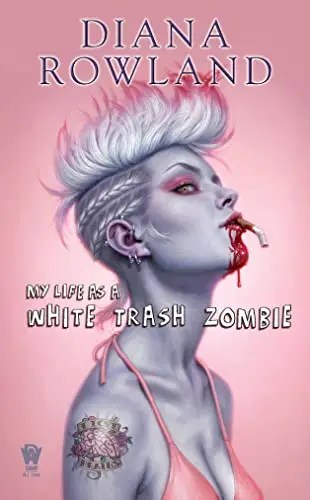
I bought the kindle edition of this book the instant it came out as a birthday present to myself for two reasons. First, the title is amazing. Second, look at that cover! Yeah, the whole thing just screamed my named. My instincts were right, too.
It’s been a long time since I read a book that hits all the elements I love in literature like this one–urban fantasy style horror, a setting that rings familiar to me, a completely relatable main character, and a fun love interest. It’s a world that’s simultaneously familiar and special, which is what makes urban fantasy fun. Angel’s world of trailers, beer cans, and nothing to do reminds me a lot of my childhood growing up in Vermont. On the other hand, Angel has cravings for brains. And she somehow manages to keep this a secret in a small town, certainly a monumental task.
Angel’s problems are a combination or fantastical ones (must find brains to survive) and completely real world ones (a history of an abusive mother and a father with alcoholism). Angel has a lot to overcome even before she gets zombified, but the zombification adds an element of distance that allows tough things to be talked about without that dragging down dullness often found in literary fiction.
Rowland reworks the zombie trope without completely removing the essentials of a zombie. Angel can function in day to day life as long as she has brains once every two days or so. If she doesn’t have them though, her senses slowly dull and she gradually turns into the lurching monster simply desiring brains that we all know from the classic zombie movies. This really works, because it allows Angel to be a part of society, yet still be the monster we’ve all grown to know and love.
That said, I will say that I am getting a bit tired of the monsters surviving by working in a morgue trope. I wish Rowland had come up with something a bit more creative for how Angel gets her hands on brains than that. It’s starting to seem like the staff of the morgues in all of urban fantasy consist entirely of monsters and sociopaths. Thinking more outside the box would have made me love the book instead of really liking it.
Overall, this zombie book gave me thrills, chills, and laughs galore, but it also brought me close to tears. It’s genre fiction with a heart, and I highly recommend it to anyone willing to see zombies (or white trash) in a whole new light.
If you found this review helpful, please consider tipping me on ko-fi, checking out my digital items available in my ko-fi shop, buying one of my publications, or using one of my referral/coupon codes. Thank you for your support!
4 out of 5 stars
Length: 320 pages – average but on the longer side
Source: Purchased

Buy It (Amazon or Bookshop.org)

Counts For:

Book Review: Purple Hibiscus by Chimamanda Ngozi Adichie (Nigerian Independence Day Reading/Reviewing Project)
 Summary:
Kambili’s father, Eugene, is a wealthy businessman and newspaperman focused on telling the truth of the upheaval in Nigeria, but even more focused on his fanatical version of Catholicism. Kambili, her brother Jaja, and their mother all live on edge, walking on eggshells, never knowing when he might snap. In contrast, Eugene’s sister, Kambili’s Aunty Ifeoma, is a university professor and a widow, cheerfully raising her children to be independent. One winter vacation Aunty Ifeoma convinces Eugene to allow Kambili and Jaja to visit. A visit that will change their worlds forever.
Review:
You all know by now that I’m good friends with Amy, so when she asked me to participate in her one-shot project, I couldn’t say no. Although, I was completely at a loss as to what to read. I’ve never read a Nigerian book before. So I asked Amy to help me figure out a book to get my hands on, and she recommended this title to me.
Adichie instantly swept me into a world that is starkly different from, yet surprisingly similar to, my own. The excessive religion and fear of god was something I was raised with myself, so I found myself instantly connecting to Kambili. Indeed, it’s nearly impossible not to connect to her. She is intelligent yet vulnerable. Strong yet terrified. Wise yet naive. She is an ideal main character, because she is so essentially human yet impossible not to root for.
Kambili’s father is an abuser; there is zero doubt about that, yet the perspective of the abused is so eloquently depicted by Adichie. Kambili truly loves her father. She is afraid of him and hurt by him, yet she knows there are good things too. She wants nothing more than to please him. She lives for his kind words. Indeed, even the reader sees that there are good aspects to Eugene in spite of the fact that he’s a horrible abuser. He routinely donates money to the needy in Nigeria, for instance. This is what makes it so powerful and realistic. Abusers aren’t monsters from a fairy tale. They are deeply flawed people who hurt those closest to them.
In contrast to Eugene is Aunty Ifeoma. Aunty Ifeoma is the kind of woman that I believe most modern, strong, educated women want to be. She tries so damn hard to help her kids be strong, to be a good mom, to help save her sister-in-law and niece and nephew from an abusive situation. She tries hard at everything, yet sometimes the civil unrest at the university and the constant struggle to feed her family gets to her, and she snaps a bit. Aunty Ifeoma is the perfect comparison to Eugene. She sometimes snaps at her kids a bit when she’s tired or frustrated from the extreme situations going on around her Nigeria, but she never harms them. Since stress is one of the excuses many abusers use, it is excellent to see this comparison within the story.
Adichie eloquently describes Nigeria as well. I’ve never been to any part of Africa, but I felt myself swept into the hot, dry air. I could almost smell the food they ate and the cashews and oranges on the ground outside. Although Adichie shows the political unrest and civil strife, she also clearly displays the beauty of Nigeria, which is something I’ve never encountered before.
With all this beauty and realism, then, I must say I was a bit thrown by the ending. It almost felt as if it was from a different story. Whereas most of the book was reserved and eloquent in its simple depictions, the ending felt larger than life. I think I was hoping for something more from the ending. Some type of realistic understanding of a tough situation instead of a….deus ex machina style ending.
That said, I am incredibly glad I read this book. I’m glad Amy helped me broaden my horizons to reading from a style of lit outside of my normal comfort zone. This book is incredibly accessible, and I highly recommend it to anyone who is a fan of contemporary, literary stories.
4 out of 5 stars
Source: Public Library
Buy It

Book Review: Labor of Love, Labor of Sorrow by Jacqueline Jones (The Real Help Reading Project)
 Summary:
Professor Jacqueline Jones presents the extensively researched history of the dual working worlds of black American women–at home and in the workforce–from slavery to present. She highlights the ways in which the unique cultural history of slavery as well as being subject to both sexism and racism have impacted black American women’s lives.
Discussion:
This is the second book for the Real Help reading project I’m co-hosting with Amy. I specifically requested that she host the discussion for this book for a special reason. Jacqueline Jones was my professor for one of my classes required for my history major at Brandeis University (she now teaches at University of Texas), and suffice to say, she and I did not get along very well. I was concerned that this history might make it difficult for me to discuss this book, so I asked Amy to host. She obliged. I am going to do my best to discuss this book without bias, but my personal experiences with Jackie Jones (as the Brandeisians called her) definitely gave me my own perspective in reading the book.
I was completely engrossed in the slavery and Jim Crow sections of the book. They taught me a lot I was previously unaware of, as I always kind of avoided the Civil War in my American history classes. (I focused on colonization, Revolutionary War, westward expansion, and WWII). For instance, it was interesting to see how the matriarchy slave owners forced upon slaves affected and impacted black culture even to this day. It was also the first time I saw sharecropping explained and spelled out. It is easy to see how black women, particularly ones widowed or single mothers, would choose to move to a city and become domestic help to escape the back-breaking work of share-cropping.
The book also demonstrates how black American culture has come to depend upon the iconic image of the strong black woman to help them through horrible racism and working conditions. Yet, by the end of the book, we can see that this means a lack of support for black women that is reflected in long-term illnesses and mental illness. Although black women are to be respected and lauded for their role in helping their communities, it is time that less is laid upon them. One obvious thing? Less time spent serving whites.
Since this was read largely to combat The Help, which takes place specifically in a domestic environment during the Civil Rights movement, I want to take a moment to discuss what I learned about that specific era in this book, because the book as a whole obviously covers a very large period of time. The book clearly demonstrates that the Civil Rights movement was BLACK women fighting for BLACK people and sympathetic whites came down from the north to help with things like voter registration, and they were then housed by BLACK women who would literally sit on their porch with a gun to protect the workers. This is in stark contrast to the image laid out in The Help where a WHITE woman comes and convinces the black workers to talk to her for their rights.
Additionally, the book repeatedly demonstrates how black women constantly throughout American history have sought to get out of white homes for any other kind of labor (except in the case of sharecropping). The role of domestic simply rings too close to slavery, and can you blame them? It certainly is apparent that many, if not the majority, of white employers sought to use black domestics as as close an approximation to slave labor as possible. One issue I don’t think the book addressed well enough is that any situation where one is working as a servant in another person’s home serves to antagonize relationships between the two groups. There is no friendliness there. One person is doing a menial chore in the home of another that the other is wealthy enough to not have to do. How could that possibly bring about anything but negative feelings?
Now, ok, here’s my criticism of the book. I feel that in Prof Jones’ passion for the plight of minorities in the US, she can sometimes over-compensate the opposite direction. By that I mean, she sometimes presents minorities as super-human or at no fault for their own actions or she’ll ignore negatives entirely. For instance, we only got two paragraphs out of 480 pages on black women working in prostitution. Personally, I wanted to know more about this, as it is a type of work black women have engaged in (as have every color/race of women ever), and I wanted to know the specific roles sexism, racism, and a hostile culture played in that for them. Specifically, I was interested about how the idea of lighter colored black women being more desirable to white men that we saw in the first book of our challenge might have carried over to prostitution in the 1920s and 1930s. But Jones doesn’t talk about this, and from my own personal experience with her, I speculate this is partly a blinders on her eyes issue.
Similarly, one thing that really irritated me was every time Jones tells a story of a woman working herself to the bone trying to provide for her children only to have her husband abandon her, Jones excuses the man by saying….”Well…..racism,” and moves on. Certainly, I am sure that some of these men were simply stressed out and thus abandoned their families, but I’m also certain that some of them were just assholes and would have done so in a completely non-racist society. To wit, I believe Jones falls too hardly on the nurture side of nature/nurture, when psychiatry has repeatedly demonstrated that it actually is a combination of the two that determines an individual’s behavior. By this I mean, I am certain that a non-racist society would lead to a larger percentage of happy, healthy families, but it by no means would wipe out all questionable behavior by all members of that race. To suggest that all members of a race would be “good” minus racism is just as racist as to suggest that all members of a race are “bad.”
That said, while I enjoyed the earlier portions of the book, as well as the sections on domestic labor in the 1950s and 1960s, I do think the book tries to tackle a bit too much in one entry. The sweep is almost overwhelming at times when reading it. I’d recommend getting a print copy so you can skim for the chapters of most interest to you or so that you can read various sections as questions arise.
Source: Amazon

Please head over to Amy’s post to discuss this book!
Book Review: Point by Thomas Blackthorne (series, #2)
 Summary:
Mysterious cutter circles are showing up in the Britain of the future. Thirteen teenagers gather in a circle, then slice the wrist of the person next to them all the way around the circle. The MI5 recruits a neuroscientist to help figure out the circles before they reach epidemic proportions. Meanwhile, her boyfriend, Josh Cumberland, finds himself sucked back into his old special forces unit when a civilian job reaches a mysterious end. Are the two events connected?
Review:
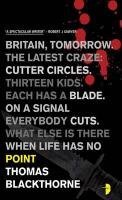
I received an ARC of this book through the Angry Robot Army, and I sort of wish I’d noticed it was the second in a series. I just dislike reading books out of order. Also, I think perhaps if I’d read the first book in the series, I wouldn’t have been so misled by the cover.
In case you can’t see the cover, it says, “Britain, tomorrow. The latest craze: cutter circles. Thirteen kids. Each has a blade. On a signal everybody cuts. What else is there when life has no point.” This makes it seem like this will be a book about depression and suicide in a post-apocalyptic world, right? In fact the people committing suicide have been brainwashed by music in an emotiphone to further a political power move. Which has…..nothing to do with real suicide or depression.
There’s nothing wrong with being a political intrigue book, but I am a bit disturbed at how Blackthorne utilizes psychology, psychiatry, and neuroscience in the book. He makes it look like in the future we’ll be able to just….program people out of it or to do whatever we want them to do. The brain is much more complex than that, and I just don’t like the message that such a plot device sends.
When looking at the book as the political espionage it actually is, as opposed to a book about mental illness in a dystopian world, it’s not a bad book. I have the feeling that those who enjoy political intrigue books will enjoy it. Josh is your typical wounded hero, and I did enjoy the scenes of him training. Blackthorne creatively incorporates reality tv into the plot-line that many readers will enjoy. The characters aren’t flat, but also aren’t particularly well-rounded. That’s ok, though, because the focus of the book is the action and political intrigue.
Overall, the book seems to be an average future political intrigue action flick…in written form. I recommend it to fans of that genre, but others will probably be bored.
3 out of 5 stars
Source: ARC from publisher

Book Review: The Last Werewolf by Glen Duncan
 Summary:
Jacob Marlowe finds out he’s the last werewolf living and has just been informed by the WOCOP that they plan to kill him during the next full moon. That’s just fine with him. He’s been living for almost 200 years and is just plain tired of it. So he plans to let the WOCOP’s tails follow him and just let the death happen. The fates don’t quite see it that way, though, and nothing quite goes according to Jake’s plans.
Review:
Think of this as what would have happened if Anne Rice chose to write about werewolves instead of vampires. The Last Werewolf reads very much like Interview with a Vampire only with the characteristics of werewolves instead of vampires of course. By this I mean that the sentences and story structure are incredibly literary while addressing the highly genre topic of werewolves.
Unlike vampires, werewolves must eat a human during each full moon or they become ill. Animals are no substitute. They cannot take a bite and leave the victim alive. No, they must completely ravish the victim. This is no weak True Blood style werepanther or werewolf that can simply shift at will and avoid killing people. Jake is affected by The Hunger and must eat and kill to stay alive. The rest of the month when he’s not in wolf form he has to come to terms with his actions. The crux and root of the dilemma at the heart of the story is this:
We’re the worst thing because for us the worst thing is the best thing. And it’s only the best thing for us if it’s the worst thing for someone else. (page 197)
It’s quite the moral conundrum and is addressed eloquently in the story.
There is also of course Jake’s suicidal mentality. He wants to die, but he doesn’t want to be the one to do it. He’s completely over life. Life is boring and pointless. There are absolutely some beautifully depressing passages about the emptiness of life that both perfectly depict depression and remind me a bit of the Romantic period of poetry. Think of Lord Byron. That type of thing. Beautifully suicidal. That may bother some readers. To me, it’s often a part of great literature. This overwhelming sadness and feelings of helplessness. They’re common human emotions and lend a great force to the narrative.
Now, I was sent this for review due to how much I enjoyed American Psycho in January, so I was expecting it to be graphically violent and sexual and have the two mixed-up. It is all of those things but–dare I say it–it wasn’t quite violent enough for me. I was expecting something shocking, due to the American Psycho connection, but I can see a lot of people reading this and not being put-off by the amount of violence. Compared to your average R rated action flick, it’s really not that bad. On the other hand, a lot of people are profoundly disturbed by the violence in American Psycho. There’s absolutely nothing wrong with the level of violence in this book, and I think Duncan was probably smart in that, since it will have a wider appeal. What can I say. I was looking forward to something incredibly gross and twisted and instead got a lot of beautiful prose with the occasional murder. It was a happy surprise, absolutely. I just want to make it abundantly clear to potential readers that if you can handle an R rated horror movie, you can definitely handle the violence in this book, so don’t be turned off!
So the prose is beautiful and the topics addressed and discussed are important or at least interesting, so why am I not raving? The ending left me disappointed. It felt rather cliche and expected, and I didn’t like what became the focus in the end. There are so many other ways the ending could have gone that would have been amazing and powerful, but instead I finished this book and basically said, “AGH not this shit again.” *mini-spoiler* It includes pregnancy and babies, and ya’ll know how I feel about that. *end mini-spoiler*
Overall this is a literary take on a genre theme. It is violent and sexual, but not disturbingly so. Recommended to fans of Anne Rice.
4 out of 5 stars
Source: ARC from the publisher in exchange for my honest review

Book Review: The Prometheus Project: Captured by Douglas E. Richards (series, #2)
 Summary:
Brother/sister duo Ryan and Regan are back only this time they’re officially part of the team of scientists working in the top-secret alien city discovered deep underground in Pennsylvania. They rush off every day after school to work in the city of Prometheus. One weekend they convince their parents to let them sleep over in the city, only to wake up to discover all of the adults captured by a ruthless alien escaped convict whose mind control abilities mysteriously fail to work on the kids. It’s up to them to save not just the adults, but the earth itself from alien rule.
Review:
This follow-up to The Prometheus Project: Trapped (review) brings even more action and science than the first time around. It’s also a longer length that is more suitable for the older middle grade crowd.
Ryan and Regan’s relationship with each other has progressed from sibling tolerance to a level of respect for each other clearly due to working together in the city. It’s nice to see a healthy sibling relationship modeled in a middle grade book.
Again the plot fooled me with a twist ending I didn’t see coming, but that made perfect sense when it was revealed. This is the sort of thing I’d have loved as a middle grade reader. A mystery that manages to out-wit me without playing any tricks.
The villain is threatening without being too frightening. Although the kids’ parents are held captive, no undue violence is shown. Predominantly the scientists are held with plastic ties on their wrists and a simple verbal threat of “do this or else….” It seems an appropriate level of suspense for the age-range. The enemy is formidable, but it is possible to out-wit him.
Although the science, plot, and characters are strong, something just couldn’t let me jump from liking it a lot to loving it. Perhaps this is because I am out of the age-range intended, but it does seem to me as though sometimes the story expects a bit too little of the young reader enjoying it. I hope in future books that Richards challenges young readers a bit more with the writing in addition to the science.
Overall, this is another strong entry in this middle grade series. I firmly believe the series will keep young readers with an interest in scifi and secret government operations happily engaged while parents and guardians can have peace of mind about what they are reading.
4 out of 5 stars
Source: Won copy in exchange for my honest review from the author via LibraryThing
Previous Books in Series:
The Prometheus Project: Trapped, review
Buy It

Book Review: Lucky Stiff by Tonia Brown
 Summary:
Peter’s just a young 18 on his first spring break to New Orleans with his friends when he accidentally takes ecstasy instead of sleeping pills and dies. His friends, terrified, drag his corpse off to a local voodoo priestess who raises him with her special kind of magic–tantric magic. Somehow this method of raising Peter combined with the time of year makes Peter into a very special kind of zombie. One who can feed off of female orgasms instead of human flesh if he so chooses.
Review:
In case it’s not abundantly clear from the summary, this is an erotica novel. A zombie erotica novel. Frankly if you’re not grossed out by vampire undead sex, then this book shouldn’t bother you at all. It’s not like Peter decays (don’t worry, Brown takes care of that part logically). So it’s less sex with a decaying corpse and more sex with an undead dude.
Brown’s concept is hilarious and well-executed. Peter is a zombie with a permanent hard-on who can’t come but needs female orgasms to feed off of to keep him from going all cold-blooded killer. Um possibly the best female-friendly set-up for a paranormal erotica ever? Since he died a virgin, he starts off with the Madam learning how to pleasure a lady for five years, then he gets booted out to go find his own way and become a pick-up artist. He’s completely focused on and fascinated with the female orgasm. You might even call it a fetish. ;-)
It doesn’t matter if I can’t come as long as I can be a part of it when you do. (page 15)
On top of the fun and varied sex scenes though there’s lots of well-conceived plot. Peter has issues he has to deal with. He basically has to grow the fuck up enough to be able to handle a monogamous relationship and recognize real love for what it is. For instance, at first he thinks he’s in love with the Madam, but she tells him:
Sex is just sex. Sometimes it’s really good, true, but it’s nothing in da grand scheme a’ things. We may have fucked, but we never made love. (page 87)
In other words, he only thinks he loves her because he lost his virginity to her. He needs to go out and learn what real love is. That combined with navigating morality and your faith (he becomes a voodoo convert loyal to La Croix) are at the center of the plot.
Brown also drops in various witticisms that exhibit wisdom but are simultaneously hilariously dripping in paranormality:
The trick to being undead, much like being monogamous, is keeping everything fresh. (page 33)
Bits like that kept me laughing out loud whenever I wasn’t caught up in the erotica.
Alas, sometimes the dialogue is a bit stiff (haha, sorry, couldn’t resist). Ahem, in all seriousness, sometimes the dialogue felt a bit forced and unnatural. Similarly, I was bothered that, although Peter clearly is bisexual (he makes multiple comments about wanting to try things out with men in addition to women), for some reason male orgasms are too violent or pointed or whatever for him to be able to feed off of them. Um, I’m sorry, but this isn’t logical. At the very least it would make that if Peter gave head to a guy it would feed him, yes? It felt like Brown wanted to be edgy by making Peter almost bi, but refused to really go all the way. A great example of this is that Peter tries sex with a dude once, but only in the context of a threesome, and it’s the only sex scene not written as erotica. It’s simply briefly mentioned in past tense. I really wish Brown had gone all the way and made Peter bi. It’d be interesting to see that here. Alternatively, to just make Peter totally straight would’ve been fine too. This fine walking of the line rubs me the wrong way though.
Overall this is a fun erotica with a unique storyline that manages to make zombies sexy with a heavy dash of voodoo. I recommend it to those who love zombies and erotica fairly equally. I’m betting, knowing the people that I know, that this is not as small a portion of the population as some may think.
If you found this review helpful, please consider tipping me on ko-fi, checking out my digital items available in my ko-fi shop, buying one of my publications, or using one of my referral/coupon codes. Thank you for your support
4 out of 5 stars
Length: 248 pages – average but on the shorter side
Source: purchased
Buy It (Amazon. Not available on Bookshop.org.)
Book Review: Wolf Hunt: The Burning Ages by Sebastian P. Breit (series, #1)
 Summary:
It’s the future, and the world is in another semi-cold war between NATO and BRIC (Brazil, Russia, India, China). A NATO group of British, American, and German naval ships is being sent to Brazil on a mission, but part-way there they are all zapped back in time to 1940. With the chance to change history for the better, what will they decide to do?
Review:
I first want to point out that Breit is German and wrote this in English himself; it is not a translation. I have to say that I wonder why he made that choice as the plot certainly seems to have more of a European than an American appeal, but I am impressed at his effort to write in his second language.
The summary of the book makes the plot sound fast-paced, but in fact it is actually distressingly slow-moving. It takes about 1/3 of the book for the all-important time-traveling event to happen. I spent the whole first part of the book just waiting and wondering when it was going to happen, because once the basic politics of the world and character traits were set up, it’s just a waiting game. The naval mumbo-jumbo filling up the rest of the space just wasn’t necessary. This issue carries on throughout the book with half of the sailors spending a solid amount of their time stranded on an island, for instance. Since this is marketed as a fast-paced historical thriller, perhaps somewhat like the style of The Da Vinci Code it quite simply needs to move along faster. Intense naval specifics and codes are not necessary. Fast-moving plot is.
Breit also needs to invest in a British and American editor each, as the British and American characters say and do things that are just flat-out wrong in British and American English respectively. One that really slapped me across the face is that one of the characters is from Boston, but everyone refers to him as a “Bostoner.” People from Boston are called “Bostonians.” I have never once in my life heard anyone say “Bostoner,” and I live in Boston. Another example is at one point one of the Americans reads another American’s birthdate from off an id and says it the European way “11 September 2001,” instead of the American way “September 11th, 2001.” This is one of those instances where the author needs to have his facts straight in order for the story to be believable. Nothing makes me not believe a character is American quite like having him get a bunch of American English wrong.
Additionally, as a woman and an author, the way the female characters are handled is distressing to me. Just one example is that a bunch of the stranded female sailors are attacked on the island by some of the locals in an attempt at rape. These women who had the exact same training as their male counter-parts are apparently completely incapable of saving themselves, but instead have to be rescued by their male comrades. But it gets worse. Later when the captain of the ship is relating the event to another man, he asks if the women were alright. The captain responds by saying that the doctor said they were fine. The doctor. Apparently nobody bothered to ask these women if they were raped (HINT: I’m pretty sure women can tell if they’ve been raped or not). Plus no one seems to care that these women are clearly not going to be emotionally ok after almost getting raped, and not once do any of the female characters who were attacked say anything about it with their own voices. This is just completely inexcusable. It’s a removal of women’s voices from ourselves, and it’s insulting to a female reader.
There’s the issue of European bias expressed through the American characters. For instance, one American character expresses shame at how Americans only speak one language. First of all, the rate of bilingualism in the US is actually rising, so following the arc of the future, there should be more bilingual Americans, not less. Second, I’ve never once heard an American express woe in an all-encompassing way like that by saying something like “It’s so sad Americans aren’t bilingual.” People say, “I wish I was fluent in another language,” or “I wish I was fluent in Japanese,” but they just don’t put it that way. That whole paragraph sounded like a European using an American character as a puppet to say what Europeans think of Americans. Yeesh.
I also have problems with the German characters though. A bunch of them express the desire to stop the Holocaust not to save lives but to save the German people from harboring the shame and guilt for generations to come. Um, what? That’s your concern oh time-traveling Germans? Having been to Germany myself on a student exchange and visited Dachau, etc… I can say that I have a hard time imagining any of the kids my age at the time (15ish in the early 2000’s) focusing in on that as opposed to stopping a bad thing from happening because it’s evil and wrong. I can only imagine that generations even further along would be even more focused in on stopping a genocide as opposed to saving some broad idea of German honor. It’d be like having a time-traveling modern American decide to stop the Trail of Tears to save us from shame as opposed to doing it to save innocent Cherokees. The whole thought just makes my brain hurt.
To sum up, Breit shows ability as a writer that needs to be worked on and honed. I’d recommend either getting a good editor who can handle both British and American English or switching to writing in German. He also needs to work on tightening up his plot. Normally I’d say, nice first effort keep trying, but due to the opinions and biases and presentation of women present in this first attempt, I’m afraid I can’t say that. It’s readable, but why would you want to read it anyway?
2 out of 5 stars
Source: Ebook from author in exchange for my honest review

Book Review: The Prometheus Project: Trapped by Douglas E. Richards (series, #1)
 Summary:
Ryan and Regan can’t believe their scientist parents made them move from San Diego to the total snoozefest of Pennsylvania practically overnight just so they can work at a boring science corporation, Proact. But when they accidentally overhear their parents talking, they realize there may be more to Proact than meets the eye, and they’re determined to find out!
Review:
I don’t think I realized when I entered the giveaway for this (a really long time ago, sorry about that, Richards!) that it’s a middle grade/children’s series. I don’t usually read below the YA level anymore unless I’m reading to my four year old nephew, but I am a librarian, so I put my librarian cap on for this book. I also tried to hearken back to what I would have enjoyed at the age of eight or nine.
Ryan and Regan are a cute brother/sister pair. Ryan is older and thus underestimates his sister sometimes. They tease each other, but never cruelly, and it is evident that they truly love each other. The sibling dynamic is definitely well-done. It was refreshing to see the adults depicted as adults and not idiots or mean-spirited. What Ryan and Regan accomplish is because they’re the smart kids of smart parents, not out of any short-comings of the adults.
The science is really well-done. Richards’ author bio states that he used to write for National Geographic Kids, and it shows. He explains things eloquently without talking down to kids. All of the science found in the book is factual. I would have loved stumbling upon such learning in fiction as a kid.
The ending has a twist that even I didn’t see coming, and I was sort of expecting to being a grown-up reading it, haha. It’s not cheesy or over-the-top, and I’m betting kids will love the surprise.
My main criticisms are that sometimes the descriptions of the characters focus too much on their hair and eye color to the exclusion of other things, and the book felt too short. It just seemed a bit short for the grade level. Mentally I compared it to Nancy Drew which are generally like 25% longer, and I think that length would be ideal. The sequel is longer though, so that’s a good thing.
Overall I think if you have middle grade reading level kids who like science, mysteries, or scifi you should feel completely confident in handing them this book.
4 out of 5 stars
Source: Won copy in exchange for my honest review from the author via LibraryThing

Book Review: The Craigslist Murders by Brenda Cullerton
 Summary:
Charlotte works as an interior designer to the wealthiest of the wealthy in NYC. She thus has a window into their world and attends their parties, but is not actually a part of it. The wealthy women annoy the crap out of Charlotte as they remind her entirely too much of her cruel, social ladder climbing mother, yet she simultaneously needs the income to stay afloat in notoriously expensive NYC. One day when attempting to purchase a designer item cheap off of craigslist, she finds the solution to her pent-up rage. Periodic murders of the wealthy elite women via responding to craigslist ads.
Review:
I view Charlotte as the female and decidedly less insane version of Patrick Bateman in American Psycho. Both characters are a part of the wealthy, elite world that they simultaneously hate. Both obviously have antisocial personality disorder. Both murder people to deal with it. The similarities end there, though, as Charlotte is decidedly less far gone than Patrick so there are no chapters of non-sensical rants. Also this book is far less violent. Charlotte murders by whapping women in the back of the head with a fire poker. Her murders are about killing the women, not torturing them.
Honestly, this book reads as delicious fantasy to anyone who has ever lived in a city and bumped elbows with the craziness that is the world of the 1% (the wealthy elite). Charlotte’s rage is our rage, and she deals with it in a way no civilized person would, but as Charlotte herself says when discussing the news of a murdered wealthy woman:
She’d been killed by her own personal assistant, news that Charlotte believed had come as a terrible shock to everyone in the city except the thousands of other personal assistants who dreamed, daily, of doing the same thing. (location 1101)
Yes, exactly. This book rages against the privileged in a way most of us can only dream of doing. And it works.
Charlotte is more than a murderer, though. She’s a well-rounded character. The reasons behind her murders and state of mental health are gradually revealed in a skilled manner throughout the book. First we know Charlotte as a frustrated worker. Then we see her murder. Then we gradually start to see the real Charlotte beneath the facade. A woman who was a little girl whose spirit was broken by her mother. No one in her world, not even her therapist, offers her any real help, so Charlotte deals with her issues the only way she knows how. It’s an excellent commentary on why quality mental health care and loving communities are so necessary.
The one issue I had with the book itself is the ending. I won’t spoil it, but basically I’m not sure exactly why Cullerton went there with this narrative. I can’t help but wonder if she’s planning a sequel. I sort of wish she would write one to address some lingering questions I have, but perhaps that’s her point. Perhaps she chose that ending to make the reader continue to think about the situation even after finishing the book. If so, then it definitely worked.
I also find the cover infuriating, because the weapon the woman is holding looks nothing like the weapon used in the book, and that sort of thing that is mentioned repeatedly in the story shouldn’t be messed up on the cover. Obviously that’s not the author’s fault, though.
Overall this contemporary fiction with a twist is a delightful read. If American Psycho intrigued you but the graphic violence and sex turned you off, definitely give this book a read. It features similar themes with less violence and more well-rounded characters.
4 out of 5 stars
Source: Amazon

Counts For:

 Support my work with a tip or browse my shop for curated book club guides, how to guides, cross-stitch patterns, and more!


This work by Amanda Nevius is licensed under a Creative Commons Attribution-Noncommercial-No Derivative Works 3.0 United States License.
 Opinions of a Wolf