
Archive
Book Review: Zelde M’Tana by F. M. Busby (Series, Prequel) (Bottom of TBR Pile Challenge)
 Summary:
Zelde M’Tana is one of the lost children, living away from UET influence and welfare or adults at all in gangs of violent kids. But she gets captured and sent in outerspace on a journey toward being a sex slave on a mining planet. When the ship mutinies, her chances for a future change for the better.
Review:
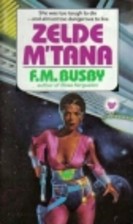
I picked this up because I heard it is the prequel for a black woman spaceship captain from a scifi series in the 70s. I was intrigued (who wouldn’t be by that cover) but I was ultimately disappointed by the characterization of Zelde.
This prequel is designed to be able to be read as a standalone, so that’s how I approached it. It’s not entirely clear what the problem is in this futuristic world, but it appears that an evil corporation known as the UET has taken over governing everybody and generally encourages violence and treats everyone like dirt. There are a few escaped ships and some colonies they have set up on other planets where people live freely. This prequel, then, basically tracks how Zelde comes to be escaped.
I almost stopped reading the book very early on during Zelde’s lost child years. She is a lost child who joins a gang and winds up climbing the ranks. There’s obviously a lot of violence. What I wasn’t expecting was for Zelde to be a rapist. In the context of the gang wars, when her gang overtakes another, she takes the leader of that gang and rapes him in front of everyone. (She achieves this by tying a rope around his penis and tugging on it until he gets hard). In one instance, perhaps in both, I’ve kind of tried to scrub it from my mind, she kills the man right after raping him. Now, the thing to understand is, Zelde is not ever presented as an anti-hero. She is 100% supposed to be a hero that the reader roots for. We want her to escape UET; we want her to succeed. But she’s a rapist. A hero rapist isn’t a character I can get behind, and I wouldn’t want other readers to either.
I kept reading the book because I was wondering if this would ever be addressed. If, perhaps after Zelde escapes and is able to get some education and safety she would realize what she did was wrong. But that never happens anywhere in the book. It’s really disappointing.
The second problem I have with the book, which is somewhat related, is in how it presents female sexuality. Basically, in this world, all women will have sex with other women if a man happens to not be around and convenient right when they get their urge. So, for instance, Zelde prefers men, but she’ll take a woman to pair up with if a man isn’t right handy. She also will dump her female pairing the instant there’s a hint she can get with a man. Similarly, there’s a triad relationship on the ship in which a man, Dopples, is paired with two blonde women. The women read as sisters, although it’s possible they’re not. In any case, this is one of our typical interactions with them:
She [Zelde] could never tell the two blonde women apart. The one who opened the door this time had bangs now–but so did the other, standing behind a little. Both naked, hair messed, a little sweaty and out of breath–were they having somebody else in here? no–not on Dopples; they wouldn’t dare that. Must be playing together, just by themselves. That figured–for two women, one man had to be short rations. (page 127)
It all feels like a misreading of female bisexuality. Female bisexuality isn’t a result of an appetite for sex that is just so high it can’t be satiated by just one person or that must be satiated at every opportunity. Bisexuality is not this idea that women need to have sex constantly and so will take just anyone, with a slight preference toward men. While I appreciate that a book published in 1980 includes the idea that women can be attracted to other women it reads from the perspective of a male gaze idea of female bisexuality instead of the reality. Similarly, not all women are bisexual and yet every single woman in this book seems willing to jump into bed with another woman if a man doesn’t happen to be available or in the context of a M/F/F threesome. Not all women are bisexual. Not all bisexual women prefer to pair up with men (some do, but not all). Not all bisexual women are open to the idea of a threesome. The only hint to the idea that not all women are bisexual that the book concedes to is that one character is asked at one point if she is “all for women” (page 257) as in are you a lesbian. (She is not, if you were wondering). It is just as erasing of bisexuality to operate from the assumption that all women are bisexual (but not all men) as it is to say none are. Some straight men may like the idea that women are off sleeping with each other every time their backs are turned and that of course any woman would want to participate in a M/F/F threesome given the opportunity, but that is not the reality.
One final issue I had with the book, which is a bit minor but is still annoying, is a bit of grammar. Almost every time a character says something like “would’ve” or “could’ve,” it’s spelled as “would of” or “could of.” It does this outside of times the characters speak, so it’s not an attempt at dialect.
A positive to say about the book is the plot is fast-moving and covers a lot of ground. Zelde’s life is eventful, and if a reader isn’t a fan of one phase, it will quickly change. Also, Zelde’s race is not just mentioned and then forgotten. Her existence as a black woman and what that means for her is confronted in the book in various ways. Also, Zelde rocks a natural hairstyle and gauges her ears at one point while still climbing the ranks of the ship.
Overall, this 1980 scifi book contains a fast plot and interesting future but its representation of female sexuality may be bothersome to some readers. Readers who seek to avoid scenes involving rape or being asked to identify with a rapist should avoid it. Recommended to readers of classic scifi and those interested in seeing representations of black women in literature in the 1970s and 1980s.
If you found this review helpful, please consider tipping me on ko-fi, checking out my digital items available in my ko-fi shop, buying one of my publications, or using one of my referral/coupon codes. Thank you for your support!
2 out of 5 stars
Length: 316 pages – average but on the longer side
Source: The now-defunct SwapTree (like PaperBackSwap).

Counts For:
Bottom of TBR Pile Challenge
Book Review: The Keep by F. Paul Wilson (Series, #1) (Bottom of TBR Pile Challenge)
 Summary:
Captain Klaus Woermann isn’t a fan of the Nazis or the SS and doesn’t exactly keep this a secret. But he’s also a hero from the First World War, so the Nazi regime deals with him by sending he and a small troop to Romania to guard a pass the Russians could possibly use. They set up to guard the place in a building known as the keep. It should be a quiet assignment, but when the German soldiers start being killed one a night by having their throats ripped out, the SS is sent to investigate.
SS Major Kaempffer wishes to solve this mystery as soon as possible so he may start his new promotion of running the extermination camp for Romania. He is sure he can solve this mystery quickly.
Professor Cuza and his daughter Magda are Romanian Jews who have already been pushed out of their work in academia. They also just so happen to be the only experts on the keep. When the SS sends for them, they are sure it is the beginning of the end. But what is more evil? The mysterious entity killing the Germans or the Nazis?
Review:
It’s hard not to pick up a book that basically advertises itself as a vampire killing Nazis and the only ones who can stop the vampires are a Jewish professor and his daughter. I mean, really, what an idea! Most of the book executes this idea with intrigue and finesse, although the end leaves a bit to be desired.
The characterization of the Germans is handled well. They are a good mix of morally ethical people who are caught up in a regime following orders and see no way out (the army men) and evil men who enjoy inflicting pain upon others and are taking advantage of the regime to be governmentally sanctioned bullies, rapists, and murderers. Having both present keeps the book from simply demonizing all Germans and yet recognizes the evil of Nazism and those who used it to their advantage.
Similarly, Magda and her father Professor Cuza are well-rounded. Professor Cuza is a man of his time, using his daughter’s help academically but not giving her any credit for it. He also is in chronic pain and acts like it, rather than acting like a saint. Magda is torn between loyalty to her sickly father and desires to live out her own life as she so chooses. They are people with fully developed lives prior to the rise of the Nazis, and they are presented as just people, not saints.
In contrast, the man who arrives to fight the evil entity, Glaeken, is a bit of a two-dimensional deus ex machina, although he is a sexy deus ex machina. Very little is known of him or his motivations. He comes across as doing what is needed for the plot in the moment rather than as a fully developed person. The same could easily be said of the villagers who live near the keep.
The basic conflict of the plot is whether or not to side with the supernatural power that seems to be willing to work against the Nazis. Thus, what is worse? The manmade evil of the Nazis or a supernatural evil? Can you ever use a supernatural evil for good? It’s an interesting conflict right up until the end where a reveal is made that makes everything about the question far too simple. Up until that point it is quite thought-provoking, however.
The plot smoothly places all of these diverse people in the same space. The supernatural entity is frightening, as are the Nazis. These are all well-done.
One thing that was frustrating to me as a modern woman reader was the sheer number of times Magda is almost raped or threatened with rape, and how she only escapes from rape thanks to anything but herself. In one instance, the Nazi simply runs out of time because the train is about to move out. In another, she is saved by a man. In a third, she is saved by supernatural devices. While it is true that rape is a danger in war zones, it would be nice if this was not such a frequently used conflict/plot point for this character. Once would have been sufficient to get the point across. As it is, the situation starts to lose its power as a plot point.
The ending is a combination of a deus ex machina and a plot twist that is a bit unsatisfying. There also isn’t enough resolution, and it appears that the next books in the series do not pick up again with these same characters, so it is doubtful there is more resolution down the road. It is a disappointing ending that takes a turn that is nowhere near as powerful and interesting as the rest of the book.
Overall, this is an interesting fantastical take on a historic time period. The ending could possibly be disappointing and not resolve enough for the reader and some readers will be frustrated with the depiction of the sole female character. However, it is still a unique read that is recommended to historic fiction fans and WWII buffs that don’t mind having some supernatural aspects added to their history.
If you found this review helpful, please consider tipping me on ko-fi, checking out my digital items available in my ko-fi shop, buying one of my publications, or using one of my referral/coupon codes. Thank you for your support!
4 out of 5 stars
Length: 403 pages – average but on the longer side
Source: PaperBackSwap

Book Review: Life As We Knew It by Susan Beth Pfeffer (Series, #1) (Bottom of TBR Pile Challenge)
 Summary:
Miranda’s journal starts out like any other teenage girl’s diary. Worries about school, her after-curricular activities, and wondering how her family will work out with her dad having a brand-new baby with his new wife. But when a meteor strikes the moon things start to change. Slowly at first but with ever-increasing speed. Tsunamis wipe out the coasts. Volcanoes erupt. And soon Miranda finds herself, her mother, and her two brothers struggling to survive in a world that increasingly bares no resemblance to the one she once knew.
Review:
I’m a sucker for journal entry books, even though I know rationally that no diary ever has as much content and exposition as is contained in these fictional works. In addition to the journal format, I liked the premise for the dystopian world Miranda finds herself in. It’s very different from a lot of the other ones out there, since it’s 100% gradual natural disaster. This book lives up to the expectations set by its summary, offering a fun journal entry take on a natural disaster that turns into a dystopia.
Miranda, who lives in semi-suburban Pennsylvania, starts out the journal as a very average teenage girl, adapting to her parents’ divorce and father’s subsequent re-marriage, her older brother being away for his first year of college, and hoping to convince her mother to let her take up ice skating again. The book clearly yet subtly shows her development from this young, carefree teenager through angst and denial and selfishness in the face of the disaster to finally being a young woman willing to make sacrifices for her family. Miranda is written quite three-dimensionally. She neither handles the disaster perfectly nor acts too young for her age. While she sometimes is mature and sees the bigger picture at other times she simply wants her own room and doesn’t understand why she can’t have that. Pfeffer eloquently shows how the changes force Miranda to grow up quickly, and this is neither demonized nor elevated on a pedestal. Miranda’s character development is the best part of the book, whether the reader likes her the best at the beginning, middle or end, it’s still fascinating to read and watch.
Miranda also doesn’t have the perfect family or the perfect parents, which is nice to see a piece of young adult literature. Her parents try, but they make a lot of mistakes. Miranda’s mother becomes so pessimistic about everything that she starts to hone in on the idea of only one of them surviving, being therefore tougher on Miranda and her older brother than on the youngest one. Miranda’s father chooses to leave with his new wife to go find her parents, a decision that is perhaps understandable but still feels like total abandonment to Miranda. Since Miranda is the middle child, she also has a lot of conflict between being not the youngest and so sheltered from as much as possible and also not the oldest so not treated as a semi-equal by her mother like her oldest brother is. This imperfect family will be relatable to many readers.
Miranda’s mother is staunchly atheist/agnostic/humanist and liberal, and this seeps into Miranda’s journal. For those looking for a non-religious take on disaster to give to a non-religious reader or a religious reader looking for another perspective on how to handle disasters, this is a wonderful addition to the YA dystopian set. However, if a reader has the potential to be offended by a disaster without any reliance on god or liberal leanings spelled out in the text, they may want to look elsewhere.
I know much more about medical science than Earth science or astronomy, but I will say that when I was reading this book, the science of it seemed a bit ridiculous. An asteroid knocks the moon out of orbit (maybe) so the tides rise (that makes sense) and magma gets pulled out of the Earth causing volcanoes and volcanic ash leading to temperature drops Earth-wide (whaaaat). So I looked it up, and according to astronomers, an asteroid is too small to hit the moon out of orbit. If it was large enough to, it would destroy the moon in the process. Even if for some reason scientists were wrong and the moon could be knocked out of orbit, even in that scenario, the only thing that would happen would be the tides would be higher. (source 1, source 2) I know dystopian lit is entirely what if scenarios, but I do generally prefer them to be based a bit more strongly in science. I would recommend that reading this book thus be accompanied by some non-fiction reading on astronomy and volcanology. At the very least, it’s good to know that you can safely tell young readers that this most likely would not happen precisely this way, and this book is a great opening dialogue on disasters and disaster preparedness.
Overall, this is a fun take on the dystopian YA genre, featuring the journal of the protagonist and dystopia caused primarily by nature rather than humans. Potential readers should be aware that the science of this disaster is a bit shaky. The story featuring an agnostic humanist post-divorce family makes it a welcome diversifying addition to this area of YA lit.
If you found this review helpful, please consider tipping me on ko-fi, checking out my digital items available in my ko-fi shop, buying one of my publications, or using one of my referral/coupon codes. Thank you for your support!
4 out of 5 stars
Length: 337 pages – average but on the longer side
Source: PaperBackSwap

Book Review: Brains: A Zombie Memoir by Robin Becker (Bottom of TBR Pile Challenge)
 Summary:
Jack Barnes once was a college professor, but now he’s a zombie. A zombie who can think. Think, but not talk. He can, however, still write. So he keeps a memoir of his quest to gather other thinking zombies and bring their case for equality to their creator, the man who started the whole zombie outbreak.
Review:
I picked this up during the height of the zombie craze in the used book basement of a local bookstore for dirt cheap. (It looked brand new but only cost a couple of dollars). I’m glad I got it so cheap, because this book failed to deliver the sympathetic zombies I was looking for.
The idea of thinking zombies who challenge the question of what makes us human is interesting and is one multiple authors have explored before. It’s not easy to make cannibalizing corpses empathetic. Zombies are so naturally not empathetic that to craft one the reader can relate to is a challenge. Without at least one zombie character the reader empathizes with, though, this whole idea of maybe zombies are more than they seem will fail. And this is where this book really flounders. Jack was a horrible person, and he’s a terrible zombie. And this is a real problem when he narrates a whole book whose plot revolves around zombies demanding equal treatment. Jack is a snob, through and through. It feels as if every other sentence out of his mouth is him looking down upon someone or something. This would be ok if he grew over the course of the novel. If his new zombie state taught him something about walking in another person’s shoes. But no. He remains exactly the same throughout the book. He has zero character growth away from the douchey snobby professor who looks down on literally everyone, including those within his own circle. This isn’t a mind it’s fun or even enlightening to get inside of. It’s just annoying. As annoying as fingernails on a chalkboard.
The plot is ok. Jack gathers other thinking zombies and heads for Chicago to find the man who created the zombie virus and convince him to advocate for them. Their standoff is interesting and entertaining. But the ending beyond this standoff is unsatisfying.
It also bugs me that this is a memoir written by this guy but it is never clear how this memoir made it into the reader’s hands. With a fictional memoir, I need to know how I supposedly am now reading something so personal. I also had trouble suspending my disbelief that a slow zombie managed to have time to write such descriptive passages crouched in a corner at night.
Overall, this is an interesting concept that is poorly executed with an unsympathetic main character. Recommended that readers looking for a zombie memoir pick up Breathers: A Zombie’s Lament
If you found this review helpful, please consider tipping me on ko-fi, checking out my digital items available in my ko-fi shop, buying one of my publications, or using one of my referral/coupon codes. Thank you for your support!
2 out of 5 stars
Length: 182 pages – average but on the shorter side
Source: Harvard Books

Counts For:

Book Review: From a Buick 8 by Stephen King (Bottom of TBR Pile Challenge)
 Summary:
When Pennsylvania state troopers are called in for an abandoned car, they expect it to be a simple report and transfer to impound. But instead they find a car that is slightly off. It looks like a Buick 8 but isn’t quite one. Plus its engine by all laws of mechanics should not work. The troopers agree to make the Buick their responsibility, putting it in a shed and keeping an eye on it. Because it’s not just a car. It might not be a car at all.
Review:
I was told before I read this by other Stephen King fans that it’s not one of King’s better books, but I would like to read everything he has written, so I picked it up anyway. This is a book that builds thrills slowly and gently to a conclusion that may not seem satisfying to many readers.
The biggest thing that I think took the thrills out of the book for me is that I am not a car person. When the narrator was describing the Buick 8, I had no idea any of it was off at all, so it didn’t give me the creeps. When they first describe the engine, for instance, I was surprised they were freaked out by it because it just seemed like a mysterious engine to me….like all engines. I definitely think there are more thrills to be found here if the reader is a car person. A car person will get caught up in what’s awry with the Buick, and see it as the mystery that the state troopers recognize it to be immediately.
What this book excels at is what King always excels at. The book establishes the place and feeling of rural Pennsylvania beautifully. The characters all speak in accurate and easily readable dialogue. There is a large assortment of characters, and they are easy to tell apart. The timeline of the book is carefully selected for just the right tempo for the book. These are all wonderful things that kept me reading and made me engaged with characters I might not normally identify with.
Some readers might find that the plot and thrills move too slowly for them. The Buick has issues gradually over time, and the conclusion they build to might not feel like a satisfying conclusion for all readers. Personally, I enjoy slower moving thrillers, so this worked for me, but it might not work for all. Similarly, I believe the ending will be more satisfying to those who have read the entire Dark Tower series than to those who have not. What is going on with the Buick is more understandable and a bigger deal if the reader is aware of all of the context provided by the Dark Tower.
Overall, if you are a car person who will appreciate a car that is slightly off and also enjoys slowly moving thrillers enhanced by a strong sense of place, this will be a great read for you. Similarly, those who have read the Dark Tower may be interested in this book due to some possible connections to that series. If neither of those descriptions fit you, you may want to pick up a different Stephen King book for your thrills. He certainly has plenty to choose from.
If you found this review helpful, please consider tipping me on ko-fi, checking out my digital items available in my ko-fi shop, buying one of my publications, or using one of my referral/coupon codes. Thank you for your support!
3 out of 5 stars
Length: 467 pages – chunkster
Source: Harvard Books

Counts For:
Book Review: A Banquet for Hungry Ghosts by Ying Chang Compestine (Bottom of TBR Pile Challenge)
 Summary:
According to Chinese tradition, those who die hungry or wrongfully come back to haunt the living. Compestine presents here eight different ghost stories, each correlated along with a course in a banquet and richly steeped in Chinese culture and history.
Review:
I picked this up because I had previously read Compestine’s book Revolution Is Not a Dinner Party
The eight short stories are organized into appetizers, main courses, and desserts. The titles are for the food being served that course, such as “Tea Eggs” or “Long-life Noodles.” The food mentioned in the title also appears somewhere in the story as a key part of the plot. It’s a gorgeous way to organize the short stories and makes them also feel like diverse parts of a whole.
The short stories are mostly set in 20th century China, but a couple feature 20th century characters investigating something from the more distant past or being haunted by more ancient ghosts. One story is set in New York City and features a Chinese-American family.
The stories, universally, quickly establish the setting and characters. They all subtly teach some aspect of Chinese culture or history. For instance, one story looks at medicine under Communism in China, while another features preying mantis fights. At the end of each story, a brief blurb gives further details about two to three aspects of Chinese culture or history featured in the story. Most surprising, and incredibly welcome, at the end of each short story, Compestine gives a recipe for the featured food! It reminded me of how cozy mysteries often feature patterns or recipes at the end of the book, only this time the recipes are found in a shorty story horror collection. Brilliant!
What about the horror aspect of the short stories? I found them simultaneously plausible and sufficiently scary. I was a bit on the edge of my seat without being scared out of my wits, which is exactly what I was looking for.
Overall, I immensely enjoyed each of these short stories, from the touch of horror to the settings to the amount I learned about Chinese culture and history to the wonderful recipes. Highly recommended to anyone with even a moderate interest in China, Chinese culture, or Chinese food. Even if horror isn’t usually your genre, give these ghosts a chance. You’ll be glad you did.
If you found this review helpful, please consider tipping me on ko-fi, checking out my digital items available in my ko-fi shop, buying one of my publications, or using one of my referral/coupon codes. Thank you for your support!
5 out of 5 stars
Length: 192 pages – average but on the shorter side
Source: Better World Books

Counts For:
Book Review: Fudoki by Kij Johnson (Bottom of TBR Pile Challenge)
 Summary:
An aging empress decides to fill her empty notebooks before she must get rid of them along with all of her belongings to retire to the convent, as is expected of her. She ends up telling the story of Kagaya-hime, a tortoiseshell cat who loses her cat family in a fire and is turned into a woman by the kami, the god of the road.
Review:
I’m not usually big into fantasy, particularly not ones involving court life, but I am a real sucker for any story involving cats, especially if that cat is a tortoiseshell, since I’m the proud kitty mommy of a talkative tortie. This book didn’t just not disappoint me, it blew me away with two side-by-side, related by different, thoughtful tales.
I had no idea when I picked up the book that the empress would figure into the story quite so much. At first I was a bit irritated that she was a) getting 40% to 50% of the storytime and b) rambling off from one thought to another like elderly people tend to do. But I stayed patient, and I learned that there was more to the empress than met the eye and also that the two stories were actually informing each other. Kagaya-hime’s story shows everything the empress had secretly wished for her whole life, and the empress’s life translated into how Kagaya-hime felt trapped in her human body. It’s artfully done in a subtle way, which is part of what makes it so beautiful.
Kagaya-hime goes from a sad lost kitty with burned paws to a warrior woman, allowed along on a quest for revenge by a moderately elite rural family. She is able to earn respect from the men as a warrior because as a cat she sees no reason not to hunt or defend herself. She is a woman but no one ever took her claws away (though they may be arrows and knives now, instead of claws). Thinking of her is empowering to the empress, who always had an interest in war and politics but was forced to remain literally behind screens in gorgeous gowns that are hard to move in. It’s interesting to note that while the empress may be jealous of Kagaya-hime’s ability to do what she wants and defend herself, Kagaya-hime herself is unhappy because she simply wishes to be a cat again. It is the conclusion to Kagaya-hime’s story that allows the empress to see a conclusion to her own story (her life) that will ultimately make her feel fulfilled.
The details of ancient Japan were clearly meticulously researched. Johnson smoothly writes about the outfits, land, and battles as if she was there for them herself. The information never comes through as an info dump but instead is something that simply is, that the reader learns about naturally just by venturing into Kagaya-hime and the empress’ world. This is what knowing your history inside and out before starting writing does for historic fiction. It makes history come to life.
Overall, this is a stunning piece of historic fiction the reading of which feels like slowly sipping a well-made matcha latte. Fans of historic fiction of all sorts will be engaged, those that love cats will be enthralled, and those with an interest in women’s history will be enamored and touched by how much things change and yet still stay the same for women. Recommended to all who think they might even possibly be interested in a piece of historic fiction set in Japan featuring an aging empress and a shape-changing cat.
If you found this review helpful, please consider tipping me on ko-fi, checking out my digital items available in my ko-fi shop, buying one of my publications, or using one of my referral/coupon codes. Thank you for your support!
5 out of 5 stars
Length: 316 pages – average but on the longer side
Source: Better World Books

Book Review: Charlotte Sometimes by Penelope Farmer (Series, #3) (Bottom of TBR Pile Challenge)
 Summary:
When Charlotte goes away to boarding school for the first time, she’s very excited to get the bed with the particularly pretty wheels right next to the window. When she wakes up, though, the view from the window looks different, and people are calling her Clare! She discovers she’s traveled back in time to the same bed in the same boarding school, but during World War I. The next morning, though, she wakes up in the present again as Charlotte. This pattern continues, meaning both she and Clare are Charlotte….sometimes.
Review:
I picked this book up because I have an affinity for both boarding school books and time-travel books. This looked like the best of both worlds to me. A fun middle grade book that introduces to the reader to two different past time periods–the late 1960s of Charlotte’s present and the nineteen-teens of Clare’s present.
This book is the third in a series, but it is completely possible to read it as a standalone. No mention is made of the events in the first book, and the second book is actually about what Charlotte’s little sister does while she’s away at boarding school.
The concept is intriguing, because instead of time-travel happening once and landing the person stuck in the past (or future), Charlotte keeps switching, spending every other day in the 60s and every other day in the teens. (I get a migraine when the barometric pressure changes….I can only imagine how I’d feel if I time travelled! Do you think I could bring my green lamp therapy with me?)
In addition to the usual issues time-travel books bring up, such as what stays the same and what is actually different throughout time, it also brings up the key question of identity. What makes Charlotte Charlotte? Is she still Charlotte when she’s being called Clare? Why does hardly anyone notice that Clare has changed? Or Charlotte for that matter? The book thus addresses identity issues that middle grade readers might be going through, but in a subtle way through the time-travel trope.
Were you some particular person only because people recognized you as that? (page 66)
The time-travel itself is left as a fantastical mystery, rather than being given a scientific explanation. There’s something magical about the bed that only makes Charlotte and Clare switch places, but no one else. This works without an explanation because the young girls being subjected to the time-travel just accept it without explanation. This is their reality, and it doesn’t matter why it’s happening, they just have to deal with it. Some readers, though, might struggle with the fact that the time-travel itself is never explained.
The one thing that disappointed me about the book, and that I think would have made it a classic and a five star read, is that the book only explores what happens to Charlotte when the girls switch places. Clare, her experiences, and her perspective are only heard about through third parties. The book, while in third person, is entirely Charlotte’s perspective. Clare, a reserved, proper girl from the nineteen-teens must have been shocked by both the technology and the mores of the 1960s she suddenly found herself in. So much more could have been explored by telling both Charlotte’s and Clare’s story. The book misses an opportunity by only focusing on the modern day girl going back in time. The girl being thrust into the future, a future where she finds out Britain wins the war, and there is suddenly no food rationing or flu epidemic, that is such a cool story in and of itself, and Farmer just never ventures out to tell it.
Interestingly, the British band The Cure released a song called “Charlotte Sometimes” that they admitted was pulled directly from this book. Not just the title, but song lyrics are pulled from the first couple of lines of the book. Even the music video features scenes from the book. It seems to be quite a mystery who the actress was who played Charlotte in the video. She wasn’t credited, and there’s a lot of posts on the internet with people speculating about who she might be. In any case, Penelope Farmer was…not amused by the whole thing. But back to the book.
Overall, this is a book that sets up a fantastical world of time-travel within a boarding school. It utilizes the switching of two girls with each other in time to explore questions of identity in a way that surely will appeal to many middle grade readers. The book does not fully explore the story the way it possibly should have, but the young reader will probably enjoy filling in those gaps themselves. Recommended to all fans of boarding school, time-travel, or historic fiction set during World War I’s homefront.
If you found this review helpful, please consider tipping me on ko-fi, checking out my digital items available in my ko-fi shop, buying one of my publications, or using one of my referral/coupon codes. Thank you for your support!
4 out of 5 stars
Length: 174 pages – average but on the shorter side
Source: Better World Books

Previous Books In Series:
The Summer Birds
Emma in Winter


Edit note: Thanks to Vicky for pointing out it was published in 1969.
Book Review: The Edible Woman by Margaret Atwood (Bottom of the TBR Pile Challenge)
 Summary:
It’s the 1960s in Canada, and Marian McAlpin is working writing and analyzing surveys for a marketing research firm. She has a feminist roommate she doesn’t quite understand, and hangs out with the three office virgins for lunch. Her boyfriend is comfortable and familiar. When he proposes to her, the office virgins think she’s hit the jackpot, her roommate questions why she’s following the norm, and her married and very pregnant friend seems hesitant about her fiancee. None of this really bothers Marian, though. What does bother her is that, ever since her engagement, there are more and more things she simply can’t eat. First meat then eggs then even vegetables! She thinks of herself causing them suffering, and she just can’t stomach them. What will happen to her if there’s eventually nothing left for her to eat?
Review:
I’m a fan of a few Margaret Atwood books, and the concept of this book intrigued me. Since I run the Mental Illness Advocacy Reading Challenge, I was also wondering if this might actually be a new take on anorexia. Unfortunately, Marian is not really anorexic, it’s more of an elaborate, overdone metaphor. Perhaps the plot is simply dated, but the interesting concept, when fleshed-out, comes out rather ho-hum.
The novel is divided into three parts, with Marian using first-person narration for the first and third parts, with third person narration taking over for the second. This is meant to demonstrate how Marian is losing herself and not feeling her own identity. It’s an interesting writing device, and one of the things I enjoyed more in the book. It certainly is jarring to suddenly go from first to third person when talking about the main character, and it sets the tone quite well.
It’s impossible to read this book and not feel the 1960s in it. Marian is in a culture where women work but only until marriage, where women attending college is still seen as a waste by some, and where there is a small counter-cultural movement that seems odd to the mainstream characters and feels a bit like a caricature to the modern reader. However, the fact that Marian feels so trapped in her engagement, which could certainly still be the case in the 1960s, doesn’t ring as true, given the people surrounding Marian. Her roommate is counter-cultural, her three office friends claim to want a man but clearly aren’t afraid of aging alone and won’t settle. Her married friend shares household and child rearing with her husband, at least 50/50. It’s hard to empathize with Marian, when it seems that her trap is all of her own making in her own mind. She kind of careens around like aimless, violent, driftwood, refusing to take any agency for herself, her situation, or how she lets her fiancee treat her. It’s all puzzling and difficult to relate to.
The Marian-cannot-eat-plot is definitely not developed as anorexia. Marian at first stops eating certain meats because she empathizes with the animals the meat came from. As a vegetarian, I had trouble seeing this as a real problem and fully understood where Marian was coming from. Eventually, she starts to perceive herself as causing pain when eating a dead plant, bread, etc… The book presents both empathizing with animals and plants as equally pathologic, which is certainly not true. Marian’s affliction actually reminded me a bit of orthorexia nervosa (becoming unhealthily obsessed with healthy eating, source) but the book itself presents eliminating any food from your diet as pathologic. Either Marian eats like everyone else or she is going off the deep-end. There is no moderate in-between.
What the Marian-cannot-eat-plot is actually used for is as a metaphor for how Marian’s fiancee (or her relationship with him) is supposedly consuming her. The more entwined with her fiancee she becomes in society’s eyes, the closer the wedding comes, the less Marian is able to consume, because she herself is being consumed. This would be quite eloquent if Marian’s fiancee or her relationship with him was actually harmful or consuming, but it certainly does not come across that way in what we see of it in the book.
Marian presents herself to her boyfriend then fiancee as a mainstream person, and he treats her that way. He does one thing that’s kind of off-the-rocker (crashes his car into a hedge) but so does she on the same night (runs away in the middle of dinner, across people’s backyards, for no apparent reason and hides under a bed while having drinks with three other people at a friend’s house). The only thing that he does that could possibly be read as a bit cruel is when she dresses up for a party he states that he wishes she would dress that way more often. It’s not a partner’s place to tell the other how they should dress, but it’s also ok to express when you like something your partner is wearing. Personally I thought the fiancee really meant the latter but just struggled with appropriately expressing it, and Marian herself never expresses any wants or desires directly to him on how they interact, what they wear, what they eat, how they decorate, etc…, so how could he possibly know? In addition to never expressing herself to her fiancee, Marian also cheats on him, so how exactly the fiancee ends up the one being demonized in the conclusion of the book is a bit beyond me. He’s bad because he wanted to marry her? Okay…… The whole thing reads as a bit heavy-handed second-wave feminism to me, honestly. Marriage seems to be presented in the book as something that consumes women, no matter if they choose it or are forced into it by society. It is not presented as a valid choice if a woman is able, within her society and culture, to make her own choices.
In spite of these plot and character issues, the book is still an engaging read with an interesting writing style. I was caught up in the story, even if I didn’t really like the ideas within it.
Overall, this is a well-written book with some interesting narrative voice choices that did not age well. It is definitely a work of the 1960s with some second-wave feminism ideas that might not sit well with modern readers. Recommended to those interested in in a literary take on second-wave feminism’s perception of marriage.
3 out of 5 stars
Source: Better World Books

Book Review: Commencement by J. Courtney Sullivan (Bottom of TBR Pile Challenge)
 Summary:
Celia, Bree, Sally, and April wound up on the same small hall their first year at Smith College. Celia is from a traditional Irish Catholic Massachusetts family, although she doesn’t consider herself to be Catholic. Bree arrives at college from the south with an engagement ring on her hand. Sally arrives full of mourning and despair over the recent loss of her mother to breast cancer, and April arrives as the only work-study student on their floor. Paying her own way through school and with a whole slew of issues and causes to fight for. Their friendship is traced from the first weeks at Smith through their late 20s.
Review:
I picked this book up because it was compared favorably to Mary McCarthy’s The Group

What the book does well is evoking the feeling of both being in undergrad and the years immediately after graduation. Sullivan tells the story non-linearly, having the women getting back together for a wedding a few years after college. This lets them reminisce to early years of college and also present current life situations and hopes for the future. After the wedding, the story moves forward to cover the next year. The plot structure was good and kept the story moving at a good pace. It feels homey and familiar to read a book about four women going through the early stages of adulthood. It was hard to put down, and the storytelling and dialogue, particularly for the first half of the book, read like a fun beach read. However, there are a few issues that prevent the book from being the intelligent women’s literature it set out to be.
First, given that the premise of the book is that four very different women become unlikely friends thanks to being on the same hall of a progressive women’s college, the group of women isn’t actually that diverse. They are all white, three of the four are from wealthy or upper-middle-class backgrounds (only one must take out loans and work to pay for school), none are differently abled (no physical disabilities or mental illnesses), and not a single one is a happy GLBTQ person. Given that The Group
The book has a real GLBTQ problem. One of the characters has two relationships. One is with a man and one with a woman. She is happy in both and attracted to both. She takes issue with being called a lesbian, since she states she definitely fantasizes about men and enjoys thinking about them as well. Yet, in spite of the character clearly having both physical and romantic attractions to both men and women, the word bisexual is not used once in the entire book. The character herself never ventures to think she might be bi, and no one else suggests it to her. She struggles with “being a lesbian” and “being out as a lesbian” because she doesn’t think she is a lesbian. The other characters either say she’s in denial in the closet due to homophobia or that she really is straight and she needs to leave her girlfriend. It is clear reading the book that the character struggles with having the label of lesbian forced upon her when she is clearly actually bisexual. This is why she is uncomfortable with the label. But this huge GLBTQ issue is never properly addressed, swept under the rug under the idea that she’s “really a lesbian” and is just suffering from internalized homophobia. The bi erasure in this book is huge and feels purposeful since the character’s bisexual feelings are routinely discussed but the option of being non-monosexual never is. It’s disappointing in a book that is supposed to be progressive and talking about modern young women’s issues to have the opportunity to discuss the issues of being bisexual and instead have the character’s bisexuality erased.
The second half of the book makes some really odd plot choices, showing a highly abusive relationship between one of the characters and her boss. It probably is meant to show the clash between second and third wave feminism, but it feels awkward and a bit unrealistic. Similarly, the book ends abruptly, leaving the reader hanging and wondering what is going to happen to these characters and their friendship. Abrupt endings are good when they are appropriate to the book and mean something, but this ending feels out of place in the book, jarring, and like a disservice to the reader.
Overall, this is a fast-paced book that is a quick, candy-like read. However, it is held back by having the group of women in the core friendship be too similar. Opportunities to explore diverse, interesting characters are missed and bisexual erasure is a steady presence in the book. The ending’s abruptness and lack of closure may disappoint some readers. Recommended to those looking for a quick beach read who won’t mind a lack of depth or abrupt ending. For those looking for the stronger, original story of a group of friends from a women’s college, pick up The Group
3 out of 5 stars
Source: PaperBackSwap
 Support my work with a tip or browse my shop for curated book club guides, how to guides, cross-stitch patterns, and more!


This work by Amanda Nevius is licensed under a Creative Commons Attribution-Noncommercial-No Derivative Works 3.0 United States License.
 Opinions of a Wolf