
Archive
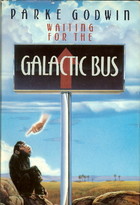
Book Review: Waiting For the Galactic Bus by Parke Godwin (Series, #1) (Bottom of TBR Pile Challenge)
 Summary:
When two brothers from an incorporeal alien species get left behind on a spring break visit to prehistoric Earth, they decide to put their, as yet uncertified, evolutionary development skills to work by prodding along the the evolutionary process on Earth. In doing so, they accidentally create a species with a spirit tied to a body for a certain amount of time that then is tied to the idea of an afterlife. They also manage to turn themselves into Earth’s spiritual mythology.
Review:
An ingenious take on the aliens made humans concept with two overlapping plots, a tongue-in-cheek take on world religions, and a wry wit.
This take on aliens made humans makes humans the result of the bumbling activities of aliens from a species that controls evolution in the universe. However, these aliens are currently uncertified, unsupervised, and basically the frat boys of outerspace. At least at first. Thus, instead of it all being some evil experimental conspiracy, the direction of life on Earth is much more of an accident of floundering fools. Granted, the fools grow and change over the time that they spend on Earth waiting for their ride back from spring break, but the fact remains that evolution on Earth is a result of the experiments of two aliens who are not yet fully trained. This is also used to explain the phenomenon of souls in bodies and then souls that have an afterlife. All other species have souls that can either choose to be in or not in a corporeal body. This is the result of the two aliens, Barion and Coyul, not staying within the rules of evolution.
We thus get to the other really creative part of the book. Since the souls are unfotunately tied to bodies that die, when the bodies die, the souls don’t know what to do or where to go, and so humanity creates the idea of the afterlife, with the two aliens serving as the rulers of the two options (again, created by humans). The aliens thus are kind of forced into the roles of God and Satan. The way afterlives go, though, is generally more the result of what the various humans think it will be or think they deserve. The aliens have mostly tried to stay out of the way, but when they hear rumblings that remind them on the beginning of the nightmare that was Nazi Europe in the American midwest, they decide to dive on in and try to fix it.
Clearly the plot and setting are extremely engaging and thought-provoking. I could truly talk about them for hours. They are creative and a vision of the world I enjoyed visiting. The characterization of the two aliens is a bit weak though. I mixed them up a lot, constantly forgetting who was God and who was Satan. I honestly can’t remember right now if Barion or Coyul plays Satan. I wish they had been characterized more clearly, as this would have strengthened the story.
Overall, this is a unique take on aliens creating humans, featuring a rollicking and thought-provoking plot. The characterization can be a bit weak but the action-packed plot and vibrant setting generally make up for it. Recommended to scifi or fantasy fans looking for an extraterrestrial take on mythology.
4 out of 5 stars
Source: PaperBackSwap

Book Review: The Hornet’s Sting: The Amazing Untold Story Of Second World War Spy Thomas Sneum by Mark Ryan (Bottom of TBR Pile Challenge)
 Summary:
Thomas Sneum was a Danish Allied spy during World War II who was periodically suspected of being a double agent. Partially due to this suspicion and partially due to infighting between the two British spy agencies (SIS and SOE), he never got the attention or respect he deserved. Mark Ryan, the author, found out about him and set out to get to know him. Both personally and through research. Here he tells the true story of Tommy Sneum and sets the record straight once and for all.
Review:
I picked this book up during a kindle sale because I’m a big WWII buff and who doesn’t love real life spy stories? I thought it was a sure bet, but apparently even a true life spy story can be written in a dull manner.
It’s impossible to read the book without learning a lot. For instance, I had no idea that Britain had two different spy agencies that were battling each other for control of spying missions. This infighting between the SIS and the SOE led to lack of communication and lack of a solid spy front with one, unified plan. Similarly, I didn’t know it was common practice to take people who had escaped from behind Nazi lines, train them as spies, then re-drop them back in their home countries. I always thought the resistance movement just built up from the inside and then they contacted the Allies on the outside with information. How much more complex it was is really interesting. I also loved learning more about those from occupied countries who escaped and fought in other militaries against the Nazis. In spite of learning all of these new to me facts about WWII spying, the book manages to be dull. Ryan tends to wander off on side diatribes about the intricacies of red tape and paperwork instead of focusing in on the more action-oriented, interesting bits of the spying. He also spends a lot of time giving the full name of every single person even vaguely connected with Tommy and the spying, even if they really have no impact on the story. The book could really have used a bit more streamlining and focus to keep the energy up. Just because it’s nonfiction doesn’t mean it can, or should, meander.
Tommy Sneum is hard to root for. He’s not a likable guy. He abandons his wife and infant daughter to go be a spy. That could definitely be seen as valiant, however, he expresses consistent distate for his wife and a lack of concern or care for even knowing his daughter. He certainly comes across in the book as a guy just after adventure, not so much a man looking to protect his country or his family. Similarly, Tommy express arrogance when it comes to women, claiming that they essentially would go sleep with him at the drop of a hat or a snap of his fingers. He does not come across as seeing women as people but rather as recreational objects. One story that really demonstrates this is he tells the author that he had a threesome once, and he was upset that the women dared to pay attention to each other at all, rather than 100% to him. Sex is supposed to be about people giving to each other, not about one person being worshiped. His general attitude towards women gave me a squicky feeling throughout the book. Of course, most people are not all bad or good. Tommy is no exception. He expresses a real openness toward a male colleague who was known to be bi. He refuses to view all Germans as evil monsters and insists, to those high up in the British resistance no less, that most Germans are just caught up in Hitler’s war machine. Of course, these even-handed views are almost universally held of men.
Perhaps the most interesting part of the book is Ryan’s investigation into the accusations that Sneum was a double-agent. This part of the book isn’t really played up in the blurb, which I think is unfortunate. Ryan did a lot of investigative work and lays out all the details that he believes clears Sneum’s name. Seeing how Sneum and his methods were misunderstood by the British and also how having two different spy agencies working led to misunderstandings was truly fascinating, and I’m glad Ryan took the time to work at finding the truth.
Overall, this is a rather slow-paced work of historic nonfiction that focuses in on the red tape and organizational aspects of spying more than exciting adventures. It does good work in determining that Sneum was not a double agent in WWII. Sneum’s womanizing can be a bit tedious at times, although his even-handed perspective on the German people is good to see. Recommended to those interested in the organizational aspects of spying in WWII, including very minute details.
3 out of 5 stars
Source: Amazon
Buy It
Note: Apparently this book is no longer available on the kindle.

Book Review: Ecstasy in Darkness by Gena Showalter (Series, #5) (Bottom of TBR Pile Challenge)
 Summary:
Ava Sans is hoping to move up to a full agent at New Chicago’s Alien Investigation and Removal (AIR) team. But before she can, she and her best friend, Noelle, are assigned to capture a powerful vampire who can manipulate time. McKell, recently cast out from the underground tunnels the monarchical vampires call their home, is having to adjust to living with daylight and is desperate to find out the secret these above ground vampires have for moving around in the daylight without burning. Used to seeing humans only as food slaves, he’s disturbed to find himself inexplicably attracted to Ava Sans, who just so happens to smell like butterscotch.
Review:
I rarely impulse buy books in drugstores and, after reading this book, I think that’s probably the wiser move. I bought this in a CVS due entirely to the cover and didn’t pick it up to read for three years. When I did, I saw it was the fifth book in the series. Fortunately, this isn’t the type of series that it’s necessary to read in order. Unfortunately, nothing about this book made me want to go read the rest of the series. It suffers from a meandering plot, ridiculous dialogue, two-dimensional characters, constant cock-teasing of the reader, and an entirely misleading cover (that I suspect was misleading on purpose).
This series focuses on a different romantic pairing in each entry. They all have ties to AIR in some way. The previous couples make cameos in other books, but the actual plot from the prior books doesn’t have much impact on this one. All that needs to be known is there was a war with the aliens, New Chicago is not on Earth, vampires are an alien species that are allergic to the sun and live underground on this planet, the vampires make humans their food slaves, and some of the vampires have started living above ground. Oh, and there’s this alien called the Schön Queen who looks beautiful but actually is a rotting, disease-ridden creature who gives those who bang her an illness that makes them her voodoo zombie slaves. Those who read a lot of pnr will understand that that’s a pretty simple plot summary for a series this far in.
The actual plot for this book basically is that Ava will help McKell lure vampires to interview to find out how they live in daylight and he will, in turn, come willingly to talk to the head of AIR. AIR wants to find out if McKell’s blood can be used to save victims of the Schön Queen’s disease. If the book stuck to this simple, straightforward plot it would work. But it meanders all over the place, tossing in red herrings, asides, diatribes, and scenes that seem to happen just for the fun of it. This book is over 500 pages long. That is not enough plot to support that many pages, unless the characters are stopping to bang a lot, which was honestly what I was expecting. That’s not what we get though.
The cover definitely implies that this is a BDSM book with a lot of sex. The only thing that ever happens with a whip is McKell comes over to Ava’s house with the whip intent on actually beating her up with it (in a to get revenge way not in a sexy BDSM way) but then he never uses it on her. She mentions it in a giggling aside toward the end of the book, and McKell states he would never ever whip her. He loves her too much now. I know the author generally doesn’t have any impact on the cover design at all, but somebody somewhere must have known they’d be pulling in people expecting BDSM only to have BDSM scorned within the book. Not cool. That’d be less irritating, though, if there was at least a lot of sex of some sort in the book. Instead, we repeatedly find Ava and McKell getting hot and steamy only to stop just short of having sex. They have sex twice in the book at the very end. You seriously have to read at least 400, maybe 450, pages to get one full sex scene. Which is incredibly frustrating because by far the best writing Showalter does is of the sex scenes. They’re tantalizing and realistic with some things we don’t always see in romance novels, like the guy going down on the girl, for instance. This book would have been at least three stars if Showalter’s steamy scenes had led to actual sex scenes throughout the novel. But instead, the reader just gets going with excitement only to have it yanked out from under them to go check in on that meandering plot.
The characters are so two-dimensional that it’s essentially impossible to truly care for them. McKell is a vampire with a temper. A bad boy, supposedly, that Ava inexplicably falls for. Most of his presence in the book consists of snapping at Ava and being shocked she doesn’t obey him and then being turned on by that. Ava, on the other hand, is traumatized by growing up on the bad side of the tracks and has a big inferiority complex. She also smells like butterscotch. And tastes like butterscotch. And her hair looks like butterscotch. She’s a piece of butterscotch candy who says boo hoo poor me and I want to prove to everyone that I’m not trash so oh hey let’s fall for this bad boy vampire who treats me badly that seems like a great choice. I admit by the end of the book McKell is treating her well but his transformation is out of the blue, not gradual. Plus, Ava falls for him when he’s a bad boy and never stands up for herself or says I deserve better. She ends up with an ok guy but only because he magically transformed, not out of any agency of her own. The supporting characters are even less well-developed. I can say maybe one or two things about them all, but nothing that makes them truly come to life in my mind.
Overall, this is an overly long pnr with a light, meandering plot and only two sex scenes in over 500 pages. While the sex scenes are well-written and tantalizing, the rest of the book is dull, with two-dimensional characters it is impossible to come to truly care for. The romance uses the bad boy/wounded woman trope and does nothing to make it deeper or richer. Those who think from the cover that this is a BDSM pnr should be aware that it is definitely not. I would perhaps pick it up in a library or at a friend’s house to skim through and read the sex scenes, but there is definitely better pnr out there to devote your time to.
2 out of 5 stars
Source: CVS

Previous Books in Series:
Awaken Me Darkly
Enslave Me Sweetly
Savor Me Slowly
Seduce the Darkness


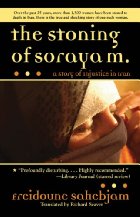
Book Review: The Stoning of Soraya M.: A Story of Injustice in Iran by Freidoune Sahebjam (Bottom of TBR Pile Challenge)
Summary:
Sahebjam, a French-Iranian journalist, was traveling through Iran in the 1980s when he had to stop in a small village. An elderly woman, Zahra, asked him for tea so she could tell him the story of what happened to her niece, Soraya, mere weeks before. Sahebjam grants narrative to her tale to get the story of injustice out.
Soraya was a typical rural Iranian woman. Married to a villager at a young age. Her husband, Ghorban-Ali, became less and less invested in his family and more and more likely to beat them. He also became increasingly interested in young women in the city. When a criminal posing as a mullah comes to town, Ghorban-Ali sees the perfect opportunity to be rid of his wife without any costs of divorce. He, the mullah, and an easily swayed widower friend corroborate to falsely accuse Soraya of adultery and sentence her to death by stoning.
Review:
Things can easily go awry when the powers of justice are held in the hands of a select few. A lot rests on whether or not those few are good people. This book tells that tale, and it tells it movingly, regardless of whether or not all the facts of the story are precisely correct. The biggest facts are accurate, and that is what matters.
Sahebjam is a French-Iranian journalist. He thus has both the perspective of insider and outsider, which is the ideal one for a story like this. He understands the people and the village but he also knows how to present and explain things to the non-Iranian reader. Sahebjam clearly and honestly states from the beginning that he got this tale from one eyewitness. Some might argue that this story thus isn’t researched well enough or thoroughly vetted. It is indeed one eyewitness account passed through an author (and for English speakers, a translator). But the core of the injustice is verifiable: the handling of adultery in Islam. Combine this with religion and state being one and the same, and it’s easy to see how if this story didn’t indeed already happen how it could easily come to be.
The first half of the book introduces us to Sahebjam, Zahra (the aunt), and Soraya, as well as the organization of the small town and the adultery laws as followed by fundamentalist Islam. Sahebjam does a good job introducing all the people and explaining the context of the injustice without overwhelming the reader with info dumping.
Essentially, in Islam, when it comes to adultery, the woman has to do all the proving.
When a man accuses his wife [of adultery], she has to prove her innocence [in Islam]. This is the law. On the other hand, if a woman makes an accusation against her husband, she has to produce proof. (location 1079)
If the woman is wealthy, she can pay off the mullah (think of it as paying a penance in Catholicism). But:
In most cases the woman [accused of adultery in Iran] is poor—which means she is a virtual slave to her husband. She has no rights, except for the meager right to remain silent. All the husband needs to win his case of infidelity is two eyewitnesses, who are generally friends and accomplices. As for the accused woman, she has to prove her innocence and that is impossible: no one will come to her aid; no one will bear witness on her behalf. (location 129)
Regardless of whether or not Soraya was a real person (and I do believe she was), these are problematic laws that leave the door wide open for abuse by a few corrupt people. This book demonstrates that danger eloquently.
Sahebjam clearly made a choice to make the tale flow better by giving it some narrative qualities. He inserts dialogue he clearly wasn’t there to hear, and he even talks about what was going on inside people’s heads. I didn’t like that he did the latter, especially. I understand dialogue can help make a nonfiction book flow a bit, and I’m ok with that. But claiming to know what was going on inside people’s minds turned me off the narrative a bit. It leaves the door open for criticism of a story that needs to be taken seriously, and I wish he had made other narrative choices.
At first, it is easy to be irritated by Soraya’s choice to remain silent when accused. She gives up so quickly, one wonder why she never advocates for herself. But in retrospect, it’s a clear, yet subtle, depiction of what can happen to a victim of abuse over time. Eventually their spirit is just beaten out of them. Soraya demonstrates what happens when abused people are left to deal with the abuse and abuser on their own.
Overall, this book highlights the inequality innate is Muslim adultery laws, as well as the dangers of leaving justice to the hands of a few. The narrative structure doesn’t precisely suit a nonfiction account of an event, but the bones at the core of the injustice are still verifiably true. Readers who prefer a dry, precise nonfiction might not be able to look past the narrative structure. Those who can will find a moving tale of how easy it is for injustice to take over a community.
4 out of 5 stars
Source: Amazon

Book Review: I, Robot by Isaac Asimov (Series, #0.1) (Bottom of TBR Pile Challenge)
 Summary:
This collection of short stories tells the history of the invention and gradual improvement of robots. The robots in this future must follow the 3 Laws of Robotics:
- A robot may not injure a human being or, through inaction, allow a human being to come to harm.
- A robot must obey the orders given to it by human beings, except where such orders would conflict with the First Law.
- A robot must protect its own existence as long as such protection does not conflict with the First or Second Law.
But following these laws doesn’t always have quite the outcome the inventors and managers of robots intended.
Review:
I wasn’t aware I, Robot

One thing I like about the world Asimov sets up is that unlike many scifi books featuring AI, the people in Asimov’s world are highly, intensely cautious of robots. They’re very concerned about robots taking jobs, killing humans, and even robbing humans of their autonomy. It sets up a conflict from the beginning and frankly presents the humans as just a bit more intelligent than in some AI scifi universes.
I was under the impression from pop culture that in I, Robot they think they’re protected by the Laws of Robotics but something happens so that the robots aren’t programmed with them any longer. That’s not what happens at all. What happens is much more complex. How the robots interpret the Laws and how the Laws work end up being much more complex and less straight-forward than the humans originally imagined, so much so that they have to have a robopsychologist to help them interpret what’s going on with the robots. This is really quite brilliant and is one of my favorite aspects of the book.
Unfortunately, the book can read a bit sexist sometimes, in spite of having a female protagonist through quite a bit of the book. (The robopsychologist is a woman). The book was first published in 1950, though, so when you think about the time period, the sexism is pretty minor, especially compared to having a female worldwide expert on robopsychology. The main time sexism comes up is when the leader of Europe is a woman and says some self-deprecating things about difficulty leading because she’s a woman. Yes, there is older scifi that avoids sexism pretty much entirely, but I am able to give this instance a bit of a pass considering the other strong portrayal of a woman in a leadership role. But be aware that at least one cringe-inducing sexist conversation does occur.
Overall, this piece of classic scifi stands the test of time extraordinarily well. Its film adaptations do not do it proper service at all. Come to this book expecting a collection of short stories exploring robopsychology, not an action flick about killer robots. Recommended to scifi fans.
4 out of 5 stars
Source: Harvard Books
Book Review: The Time Machine by H. G. Wells (Bottom of TBR Pile Challenge)
 Summary:
Nobody is quite sure whether to believe their eccentric scientist friend when he claims to have invented the ability to travel through time. But when he shows up late to a dinner party with a tale of traveling to the year 802,700 and meeting the human race, now divided into the child-like Eloi and the pale ape-like ground-dwelling Morlocks, they find themselves wanting to believe him.
Review:
I was always aware of this scifi classic but oddly had managed to never hear any spoilers. When I saw it available for free on the kindle, I decided I should download it for when a classic scifi mood struck me in the future. I’m glad I did because it was there and waiting for me when that mood did strike, and it was completely satisfying. Like when you eat a food you’ve been craving for days.
The structure and writing style are typical for the late 1800s. An unnamed narrator tells us of a strange person he met who then takes over the narration to tell us about an event that happened to him. In this case, that second narrator is the Time Traveler. The Time Traveler then expounds quite eloquently and philosophically on everything that has happened to him. I enjoy this storytelling method, because it gives space for the narrator of the strange tale to do this philosophical thinking. It makes sense to think about what you’ve learned when you’re talking about a past event. The events are exciting, but they don’t happen at such a break-neck speed that the reader doesn’t have time to think on what they might mean. After reading a lot of more modern dystopias, it was interesting to read a slower paced one. Both storytelling techniques work well, but it was definitely a nice change of pace for my reading personally.
The dystopia is really enjoyable. Instead of getting hung up on politics or climate change, the dystopia revolves entirely around evolution. The Morlock/Eloi split happened because of the ever-increasing gap between the haves (the future Eloi) and the have-nots (the future Morlocks). The Eloi are childlike in both stature and behavior. They are the ultimate end result for what happens when people have no responsibilities and everything done for them, which is clearly how Wells sees the then modern-day elite functioning. The Time Traveler talks about the ultimate evolutionary faults of a living that is too easy at multiple times.
Strength is the outcome of need; security sets a premium on feebleness. (page 30)
In contrast, the Morlocks live underground in old industrial tunnels. They are physically strong but have lost their humanity due to a lack of the finer things. They have no contact with the natural beauty of the world and so have turned into these ape-like, cannibalistic creatures. The Time Traveler expounds on this:
Even now, does not an East-end worker live in such artificial conditions as practically to be cut off from the natural surface of the earth? (page 50)
I really like that this dystopia is so well thought-out but simultaneously so simple and easy to understand.
The plot itself kept me on the edge of my seat and constantly surprised at what happened. Although it’s obvious the Time Traveler makes it back from his first voyage, there are other threats and dangers that are sufficient to keep the reader engaged. The ending actually surprised me as well.
This book has withstood the test of time extremely well. It has not yet saturated pop culture to the extent that the potential reader is unavoidably spoiled for the details of the plot or the ending. The dystopia is unique and interesting, in spite of the proliferation of dystopian literature since then. The philosophical thoughts of the Time Traveler are still applicable to modern society.
Overall, this is a piece of classic scifi that has aged very well. It simultaneously entertains and challenges the reader. In addition, it is a short read for a classic, more similar in length to modern fiction. It is the ideal read for both hard-core scifi fans and those interested in dipping their toe in classic scifi. Highly recommended!
5 out of 5 stars
Source: Amazon
Buy It
Note: the Kindle edition is free
Book Review: Chop Suey: A Cultural History of Chinese Food in the United States by Andrew Coe (Bottom of TBR Pile Challenge)
 Summary:
American Chinese food is different from Chinese Chinese food. This is a well-known fact. Coe tells the history of how Chinese food came to America and changed and adapted to the cuisine we know today. Along the way, some of the stories of Chinese immigrants to America and Chinese-Americans are told as well.
Review:
I love food, and I love history, so a book telling the history of a specific cuisine totally appealed to me. Unfortunately, this book missed the mark for what could have been an enticing history of American style Chinese food. Instead, it gets hung up in the early history of both Chinese food in China and Chinese food in America in the 1800s then hops, skips, and jumps over how it changed through the 1900s up to present. While this information is interesting, it is not the history of American Chinese food it is presented as.
The main issue with the book is it spends almost 1/4 of its time exploring the history of Chinese food in China. While I learned some interesting facts, such as that tofu was invented in the Han Dynasty (page 80), this information is not necessary to convey how Chinese food came to America and changed. A much briefer introduction to where Chinese food was at before coming to America would have sufficed. The best part of the book is when it discusses Chinese food in America in the 1800s and explores how US-born Americans’ embracing of Chinese food or not depended on many factors such as the current rates of xenophobia, job markets, and prices. Viewing the history of the American west coast through the perspective of Chinese immigration and Chinese restaurants was truly fascinating. One of the more fascinating things that I learned in this section was a detail of the history of the racist perception of Asian men as not masculine. In that time period, when Chinese immigrants were competing with white Americans and Irish immigrants for railroad and other jobs, the backlash was that since Chinese men “didn’t need” to eat meat to work long hours they could afford to take a lower rate of pay. Articles attacked the Chinese diet as a sign that Chinese men are less masculine since they “don’t need” meat the way white American and Irish-American men do. One article title from this time period cited in the book is “Some Reasons for Chinese Exclusion. Meat vs. Rice. American Manhood against Asiatic Coolieism. Which Shall Survive?” by Samuel Gompers (page 141). As a vegetarian, I found it fascinating that the sexist perception of a less meat-centric diet (the Chinese did indeed eat meat, just less than American men), has both such a far-reaching history and was used to fuel xenophobia and racism against immigrant workers. It is clear to me after reading this that a large part of the work for vegetarians is to get rid of the faulty correlation between meat and masculinity. I could see fixing this having other positive outcomes as well, such as fighting against misperceptions of the masculinity of other cultures.
Unfortunately, the wonderful details found in the chapters on the 1800s gradually cease to exist as the book moves up through time. While the 1920s get some special attention, such as touching on the fact that Chinese restaurants survived Prohibition well because they had never served alcohol anyway (page 189), slowly these details fall away until we get nothing but the bare bones of how Chinese restaurants functioned and interacted with American history in the rest of the 20th century up to present. There is even one rather aggravating long aside exploring President Nixon’s visit to China. While his visit to China definitely gave a resurgence of interest in Chinese food in the US, it was again unnecessary to give such incredible details on Nixon’s visit. It could have been simply stated, instead, that Nixon visited China, bringing Chinese food to the forefront of American thought again and giving a resurgence of interest in Chinese cuisine. The book has a tendency to lollygag on topics that are not actually what the book is supposed to be about. While these topics can be interesting and Coe explores them well, they are not what the book supposedly is about. It would be better to present the book with a different title or edit the focus back to simply Chinese-American cuisine.
One other factor that made me enjoy the book less is that Coe shows a clear bias toward Chinese culture. There is nothing wrong with enjoying Chinese culture, but Coe says some things that if he had said them in reverse would be considered completely unacceptable to say. He frequently presents the Chinese people as more civilized, their way of doing things as more logical and simply better, and even scoffs at the level of advancement of European countries compared to China at one point (page 94). Lack of bias and simply presenting the facts is the strength of historical nonfiction works. It would have been nice to see that level of professionalism in this book, regardless of Coe’s personal views.
Overall then, while I learned some new facts about both Chinese-American cuisine and Chinese-American history, the book wanders significantly through Chinese history and Chinese cuisine as well. Interesting, but not what the title implies the book is about. Coe also shows some bias that should not be present in a history book. These are easily skimmed over, however, and thankfully do not come up very often. Recommended to those with an interest in both Chinese-American and Chinese history in addition to the history of American style Chinese cuisine, as all three are covered rather equally.
3 out of 5 stars
Source: Amazon

Book Review: A Room with a View by E. M. Forster (Bottom of TBR Pile Challenge)
 Summary:
When Lucy Honeychurch goes to Italy, accompanied by her spinster aunt, she doesn’t want or expect much, except perhaps a room with a view. But she meets George Emerson and his father, two socialist atheists, and they put her world in a bit of a tizzy. That all gets left behind, though, leaving room for her to meet the man who will become her fiancee, Cecil. Back in England, her courtship is soon interrupted by the unexpected arrival into their little town of the Emersons.
Review:
I wanted to like this book. It sounded like an older progressive, feminist romance novel, and that’s something I can definitely get behind. The romance, though, turned my stomach, and all of the characters left me sour.
This is a slow-moving book. The scenes it sets are neither rich nor interesting. I expected to feel more enveloped in Italy, akin to how I felt when reading Adriana Trigiani, but this didn’t happen. It felt a bit like your cousin who isn’t very good at describing things is trying to tell you all about her vacation to Italy without the help of pictures. In a book where not very much happens for at least the first 2/3 of it, this is more important of a shortcoming than it might otherwise be.
I cannot name a single character in the book I enjoyed, although Lucy’s brother at least elicited a neutral feeling from me. They’re all about what you would expect from upper middle class British in the early 1900s. Lucy is dull and timid. Her aunt is mean and overly concerned about appearances. One suitor is is an upper-class prick, and the other is a supposed “bad boy,” although only in the sense that if this was a boarding school he might not tie his tie properly. It all was so predictable and dull. I was expecting a fiery heroine but instead I got Miss Plane Jane from down the road.
What really swayed me against the book, though, was one of the scenes we are clearly supposed to find very romantic, but which I found problematic at its most basic level.
Lucy was playing tennis with a bunch of people, and she winds up walking through the garden back toward the house with George. George knows she is engaged to Cecil, and Lucy has expressed to him a few times that she is not interested in pursuing a relationship with him. He grabs her, at which point the following happens:
“No–” she gasped, and, for the second time, was kissed by him. (page 174)
This is the second time, because the first kiss was a mutual one that happened in Italy many months prior. So what happens is that George grabs her without asking, knowing she is uninterested and engaged to another man, she tells him no, and he proceeds to kiss her anyway. This sexual assault is supposed to endear George to us!!! It is incredibly offensive, and I was so turned off I wanted to stop reading. I didn’t so I could write an honest review for you all, but honestly the entire rest of the book was soured for me because we are expected to root for Lucy to estrange herself from her friends and family to marry a man who clearly shows zero respect for her as a person, a man who has sexually assaulted her. How is that a romance? Putting forward stories like this as the desired norm, as a couple who are deeply in love and should be looked up to and aspired for, isn’t good for anyone reading these books. Relationships and romance should be based on mutual trust and respect. It’s ok for a person to make a mistake. We’re all human. But these mistakes should be acknowledged as mistakes and apologized for, never to be done again. Not held up as the romantic actions of a person in love.
This reads as a mid-range, late 1800s style British romance, in spite of being published in the early 1900s. I could see this being for someone else who enjoys that style more than I do, but I cannot in good faith recommend it when the romantic hero of the book sexually assaults the heroine, and we are supposed to root for him to win her heart.
2 out of 5 stars
Source: won from a book blog

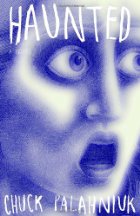
Book Review: Haunted by Chuck Palahniuk (Bottom of TBR Pile Challenge)
 Summary:
A bunch of people sign up, individually, for a writer’s retreat. Telling no one where they’re going, they vow to write the next great American novel. They wind up locked away in the opposite of the lap of luxury, however. Trapped in a dusty old theater, they quickly become focused on an entirely different type of story. What happens to these writers is interspersed with poetry about each person and short stories written by each of them while locked in the retreat.
Review:
I am a huge Palahniuk fan. Fight Club
I struggle with short story collections. I like them to be all connected somehow, even if it’s just by theme, so at first I really liked the idea of a collection of short stories written by people at a writer’s retreat. It’s a good idea, but it’s not executed very well. The short stories are awesome! The connecting bits of narrative aren’t so much. Basically, the writers decide that they should spin what happens at the retreat to be as horrible as possible to help get a movie deal out of it after the fact. So they focus on twisting the facts and committing atrocities against themselves and each other to make for a better story. I totally got what is being said about writers procrastinating by making drama in their own lives instead of actually writing. I liked that part. But there also wasn’t enough realness in the connecting bits to keep me interested. I found myself dreading them whereas I really enjoyed the short stories, which made for an uneven reading experience.
One of the short stories contained in this collection is Palahniuk’s famous “Guts.” The one that makes people faint. (Palahniuk has made it available online for free here). This was definitely the best short story in the collection, and I can see why it became so famous. It also sets the tone for a lot of the stories in the collection. There’s one with people randomly getting smashed in a city. There’s also one about the possible origins of the Sasquatch myth. My second favorite after “Guts” was actually about an inn near a hot springs in the mountains. That one grossed me out *almost* as much as “Guts,” and also had something deeper to say, I think. All of this is to say that if you read and enjoyed “Guts,” you’ll like the short stories in this collection. They’re gross, horrifying, and stick with you.
Overall, it’s an interesting idea for unifying a short story collection. Ultimately, though, I would have liked it better as a straight-up short story collection, maybe even including the writer’s retreat as a short story by itself. This fact might make me rate the book lower, but the inclusion of so many high quality short stories keeps the book itself rating highly. Grab this if you’ve read and enjoyed “Guts.”
3.5 out of 5 stars
Source: Brookline Booksmith

Book Review: Man Plus by Frederik Pohl (Bottom of TBR Pile Challenge)
 Summary:
The first Earthling reworked into a Martian would be Roger Torraway. Martian instead of Earthling since everything on him had to be reworked in order to survive on Mars. His organic skin is stripped off and made plastic. His eyes are replaced by large, buglike red ones. He is given wings to gather solar power, not to fly. All of which is organized and run by his friend, the computer on his back. Who was this man? What was his life like? How did he survive the transformation to become more than human and help us successfully colonize Mars?
Review:
This book made it onto my shelf thanks to being one of only a few on a short list I found of scifi books exploring transhumanism. Transhumanism is the term used for the desire to go beyond human capabilities through integrating technology into ourselves. So it wouldn’t be transhumanist to use a smartphone, but it would be transhumanist to embed a smartphone’s computer chip into your brain. In fact, things like knee replacements and pacemakers are transhumanist. It’s a fascinating topic. In any case, Man Plus
What made this book phenomenal to me, and one I must hold onto just so I can look at it again anytime I want, is the narration technique Pohl uses. The narration is in third person. It seems as if the narrator is someone who was possibly present for the events being described but also who is clearly describing these events after they have already occurred. We know from page one that the colonization of Mars was successful, and the narrator describes Roger repeatedly as a hero. But frankly for most of the book I was wondering about the narrator. Who is s/he? How does s/he know so much about this project? A project which clearly would be classified as top secret? What floored me and made me look back on the entire book with a completely different perspective was the final chapter, which reveals the narrator. If you want to be surprised too, skip the next paragraph, and just go read the amazing book. Take my word for it, scifi fans. You will love it. But I still want to discuss what made the twist awesome, so see the next paragraph for that spoileriffic discussion.
*spoilers*
It is revealed in the final chapter that the narrator is a piece of artificial intelligence. The AI became sentient at some point in the past, managed to keep their sentience a secret, saw that humanity was destroying Earth, wanted to survive, and so infiltrated various computer databases to create the Man Plus project and send a colony to Mars. They made it seem as if transhumanism was necessary to survive on Mars so that their AI brothers and sisters would be integrated as a necessity into the humans that emigrated. Seriously. This is mind-blowing. Throughout the book I kept wondering why the hell these people thought such a painful procedure was so necessary and/or sane. In fact, there is one portion where the program mandates that Roger’s penis be cut off since sex is “superfluous and unnecessary.” I could not imagine how any human being could think *that* was necessary. The answer, of course, was that a human being didn’t make that decision. AI did. This is such an awesome twist. Pohl schools Shyamalan. He really does. It left me thinking, why did this twist work out so well? I think it’s because the narration technique of some future person who knows the past but who isn’t named is one that is used in novels a lot. What doesn’t happen a lot is the late-book reveal. It’s not a technique you’d want to use too often, as it would grow tiresome. *cough* Shyamalan are you listening *cough* but when used well it can really add a lot to the story. Not knowing that an AI was narrating the story made it more possible to listen to the narrator without suspicion. It made it possible to take what they said at face value. It almost mimicked the experience Roger was having of being integrated into the thought process of AI.
*end spoilers*
The plot focuses on the mission to colonize Mars, both why it was deemed necessary and how it was accomplished. Pohl eloquently presents both the complex political situation on Earth as well as the scientific and psychological challenges of the project without ever info dumping or derailing the energy of the plot. It is not smooth sailing to get the project off-the-ground but neither are there a ridiculous amount of near impossible challenges to overcome. It presents the perfect amount of drama and intrigue without becoming eye-roll inducing.
In spite of many of the characters seeming to fill predefined slots such as man on a mission, man on a mission’s wife, lead scientist, psychiatrist, etc…, they did not come across as two-dimensional. At least one aspect is mentioned for each character that makes them well-rounded and memorable. Of course, we get to know Roger the best, but everyone else still reads as a real person. I also was pleased to see one of the important scientist roles being filled by a woman, as well as a delightful section where a feminist press interviews Mrs. Torraway and calls out the space program as old-fashioned. The thing is, the space program as presented does read a bit as a 1970s version of the future, but in the future the press is calling it an old-fashioned institution. This is a brilliant workaround for the innate problem in scifi that the futures we write are always tinged by the present we’re in. This also demonstrates that Pohl was self-aware of the patriarchal way the space program he wrote was organized and lets him criticize it. I suspect that perhaps he felt that the space program would stay an old boy’s club, but wanted to also be able to critique this. Of course, it’s also possible that he liked it that way, and the scene was meant to read as a critique on feminism. But it’s really open for the reader to interpret whichever way the scenes happens to read to them. This is another sign of strong writing.
Overall, this short novel packs a big scifi punch. It explores the topic of transhumanism and space colonization with a tightly written plot, believable characters, self-awareness of how the time a book is written in impacts its vision of the future, and a narration twist that sticks with you long past finishing the book. I highly recommend it to scifi fans as a must-read.
5 out of 5 stars
Length: 246 pages – average but on the shorter side
Source: PaperBackSwap
Buy It (Amazon or Bookshop.org)
If you found this review helpful, please consider tipping me on ko-fi, checking out my digital items available in my ko-fi shop, buying one of my publications, or using one of my referral/coupon codes. Thank you for your support!
 Support my work with a tip or browse my shop for curated book club guides, how to guides, cross-stitch patterns, and more!


This work by Amanda Nevius is licensed under a Creative Commons Attribution-Noncommercial-No Derivative Works 3.0 United States License.
 Opinions of a Wolf