
Archive
Book Review: Where Late the Sweet Birds Sang by Kate Wilhelm (Audiobook narrated by Anna Fields)
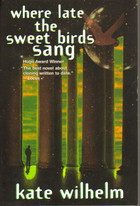 Summary:
When the world goes through an apocalypse consisting of virulent strains of the flu, lack of food, and nuclear warfare, one wealthy family manages to survive because they saw it coming. Made up of highly intelligent and highly educated people, such as doctors and scientists, the family creates a 200 bed hospital and uses this as their home base. But there is a serious fertility problem, and how they address it just might change the core of humanity.
Review:
I love reading classics of scifi. It’s endlessly fascinating how different people in different times imagine a future (or an apocalypse). This award-winning book had the bonus of being written by a woman, which isn’t always easy to find in older scifi. I also was intrigued by the cloning theme. How would someone in 1977 view something that was, as yet, nowhere near as close to a reality as it is now, with our cloned sheep?
The book starts out incredibly strongly. So strongly, in fact, that I actually had nightmares from it, which never happens to me ever. I am basically a rock of horror and scifi, but this one creeped the bejesus out of me. It’s that creepy combination of incest and cloning. The family are really not people you would want retooling the world. They’re everything that can be (and usually is) bad about the 1%. They’re selfish, self-centered, snobby, and routinely employ nepotism. I found the incest in the first third of the book talking about the first generation of the family to be an interesting metaphor for how the elite can become so backwards and grotesque from sheer isolation. It’s powerful and moving, and a scenario that will remain in my mind.
The second third of the book focuses in on a woman, Molly, from the first generation of clones. This is disturbing in its own way, because they don’t just clone everyone once and have done with it, no. They clone everyone multiple times until there are clusters of the same person at different ages wandering around. They call these clusters “brothers” and “sisters” with the name of the original person as the name of the group, even though the individual ones have their own names. It is profoundly disturbing. This second third looks at the society of clones that the original family unintentionally made. It’s fascinating in its own way and an interesting different way of telling a post-apocalypse story. Often we get only the first generation, but here we get multiple generations.
The last third, unfortunately, didn’t live up to the first two-thirds of the book. Without giving too much away, it looks at a boy who came about by natural methods who gets integrated into the clone society at the age of five. They decide not to clone him and give him brothers for unclear reasons. This last third then looks at his impact on the clone society. I didn’t feel that this worked as well for multiple reasons. For one, it’s almost as if Wilhelm freaked herself out and backed off from the profoundly disturbing story she was telling and went a more conventional direction. That was disappointing. For another, I found it disappointing that she chose to make this game-changer a boy. I expect women scifi authors to be at least a bit cognizant of the need in scifi for more female main characters. In this one, the first third is a man, the second third a woman, and the last third a boy. That is not the best stats from a woman author. I also found certain parts of this to be very boring and slow-moving compared to the first two-thirds. That makes for odd pacing in a book.
Of course, my complaints about the last third backing off, being more conventional, and being rather dull don’t take away from the first two thirds at all. They bring about so many interesting societal questions. For instance, is the incestuous nature of the elite necessarily bad or will it one day save humanity? Will cloning remove something that makes us human, even if they look right? Is it better to cling on to technology at all costs or release it and go back to simpler times? And what about sex? Is monogamy natural and polyamory unnatural? Or is polyamory more welcoming and loving than potentially possessive monogamy? The questions go on and on, which is what is great about scifi.
As for the science itself, it is quite well-done. Wilhelm clearly thought through both keeping a closed-off community alive and cloning and bringing to term embryos. She also put thought into the scientific basis for why clusters of clones would be different from individual humans, touching on psychology and twin studies. I was a bit irritated that she bases the survival of these people on cloning farm animals, when that is not a good use of their limited land resources. Studies have shown many many times that a combination of farming vitamin-rich plants and hunting/gathering are the best use of limited land resources, so this particular element rang a bit of bad science. However, I am not certain how much land usage had been studied in the 1970s, so that could possibly just be a sign of the times.
Now, I did read the audiobook, so I should touch on the narration. Overall, Anna Fields does a very good job. I really enjoyed that they chose a female narrator for a book written by a female author. It let me almost imagine that Kate Wilhelm herself was reading it to me. Fields mostly strikes a good balance of changing voices for different characters without going over the top. The one exception to this is when she narrates children. The voice for that made me cringe, but they mercifully speak only a few times. Mostly, Fields reads smoothly and is easy to follow. She narrates without accidentally putting her own interpretation onto the work, which is ideal for an audiobook.
Overall, then, this is a fascinating classic of scifi. It examines the apocalypse through the lens of the elite, thereby analyzing and critiquing them, but it also looks at possible consequences of cloning and ponders what ultimately makes us human. Although the last third of the book is a bit less creative and more conventional than the first two, it is still a fascinating read. Recommended to scifi fans, particularly those with an interest in group dynamics.
4 out of 5 stars
Source: Audible

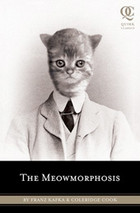
Book Review: The Meowmorphosis by Franz Kafka and Coleridge Cook
 Summary:
Gregor Samsa goes to bed and wakes up as an adorable snuggly kitten! He has trouble making up his mind about anything, though, and is easily distracted by things like dust and canned fish. Plus, his family clearly are not cat people.
Review:
This is the first Quirk Classic that I’ve read, mainly because all the others were based on classics I don’t like to start with (Jane Austen and Anna Karenina). However, “The Metamorphosis” is one of my faaaavorite short stories. Although, I will always insist that Gregor woke up as a grasshopper, not a cockroach. (I was the only one in my AP English class who thought this. Whatever). In spite of its (epically awesome win) name, this actually also incorporates another Kafka story “The Trial,” which I have not read. Anyway, when this came up as an EarlyReviewer I obviously needed to have a copy.
The main problem with reworking “The Metamorphosis” to be a cat is that, well, cats are adorable and playful and perfectly normal household cats whereas a giant insect is not. A lot of the depression, ennui, and conflict in the original story comes from Gregor being an insect. While Cook does a good job showing the internal workings of a cat brain to go with their adorably quirky behavior, the actions of the family are less understandable. What is up with this family hating on their adorable son? Why do they lock him away in a room? What is up with that? Of course this gets addressed later when Gregor grows to a disturbingly large size and can barely move around. I couldn’t help but think of that obese cat that was on the news last year. However, at that point he was sort of just becoming the monster they were treating him as. Ok, I just read what I wrote, and quite possibly that is the point of the story. However, while reading it, it certainly bogged me down.
I also have to say that I didn’t like the illustrations that went with the story. Somehow, the illustrator actually managed to make pictures of cats that I didn’t squee over. There’s something wrong with that picture.
Overall I’d say that I don’t feel like I wasted my time reading this, per se, but I also sort of wish I’d just re-read “The Metamorphosis” and hunted down a copy of “The Trial.” As someone who can be a bit of an emo reader at times, nothing beats Kafka’s brand of ennui and depression. Why brighten it up with a kitty? Just…..why?
I’d recommend this book to that odd juxtaposition of reader who loves depressing European lit and doesn’t mind it being brightened up by an adorable kitty. I think only you will know if that describes you.
3 out of 5 stars
Source: Free copy from the publisher via LibraryThing’s EarlyReviewers in exchange for my honest review
Buy It

Book Review: The Jungle by Upton Sinclair
 Summary:
In the early 1900s Jurgis and his soon-to-be family by marriage decide to immigrate to the US from Lithuania. Having heard from an old friend that Chicago’s Packingtown is where a working man can easily make his way in the world, this is where they head. Soon the family find themselves deep in the horror that is the regulated in name only meat packing plants. Dominated by a society that circulates entirely around greed and wealth for the few at the expense of the many, the family and individuals within it slowly fall apart. But is there a light at the end of the tunnel?
Review:
My high school English teacher strongly recommended to me that I read this book, claiming that I would love it, and I only just now got around to it. I’m glad that her recommendation stuck in my head, though, because this book is flat-out amazing. It may be the best piece of social justice writing I have ever come across.
Of course that wouldn’t be the case if Sinclair’s abilities to craft a piece of fiction with enthralling characters were not up to par. Fortunately, they are. Jurgis and his family are well-rounded. Scenes are set vividly, and time passes at just the right rate. I would be amiss not to mention that Sinclair suffers from some of the racism rampant during his time-period. African-Americans are presented in a very racist light, as are most Irish-Americans. It surprises me that someone so passionate about social justice could simultaneously be racist, but I suppose we are all have our faults. Fortunately the racism makes up a very small portion of the book that is relatively easy to skim over if that sort of thing in historical classics bothers you.
The primary issues Sinclair addresses in the book are: meat eating, the plight of the working class, greed, and socialism.
Although when it was first published The Jungle created an outcry for better regulation of meat production, in fact the book is strongly against the eating of animals at all.
And then again, it has been proven that meat is unnecessary as a food; and meat is obviously more difficult to produce than vegetable food, less pleasant to prepare and handle, and more likely to be unclean. (Locations 5353-5355)
This strongly vegetarian viewpoint is strengthened by a lengthy scene early in the book in which Jurgis and his family take a tour of a packing plant for the first time and witness the slaughter. The family, and indeed everyone on the tour, are distraught and emotional witnessing the taking of so many lives and hearing the pigs squeal in pain and fear. It is here that Sinclair makes a point about what impact slaughterhouses have on the humanity of the workers, for while the visitors are distraught at the scene, it is soon seen that for the workers
Neither squeals of hogs nor tears of visitors made any difference to them; one by one they hooked up the hogs, and one by one with a swift stroke they slit their throats.(Locations 536-540)
Thus it can be seen that not only is meat eating cruel, inefficient, and unhealthy, but it also dehumanizes those who must participate in the process.
Of course a much more prevalent theme in the book is the plight of the working class of which Jurgis and his family are a part. This can be a difficult book to read at times for it shows how solidly these people are trounced upon by society and greed, no matter how hard they try. First Sinclair establishes how the constant worry over money and survival affects the working class:
Such were the cruel terms upon which their life was possible, that they might never have nor expect a single instant’s respite from worry, a single instant in which they were not haunted by the thought of money. (Locations 1585-1586)
Then Sinclair demonstrates how this rough and tumble, cog in the machine existence slowly wears away the humanity of those fated to suffer from it:
She was part of the machine she tended, and every faculty that was not needed for the machine was doomed to be crushed out of existence. (Page 79)
Society, with all its powers, had declared itself his foe. And every hour his soul grew blacker, every hour he dreamed new dreams of vengeance, of defiance, of raging, frenzied hate. (Page 94)
Sinclair then shows how these dehumanized people are essentially in a prison and are slaves to the greed of others:
There is one kind of prison where the man is behind bars, and everything that he desires is outside; and there is another kind where the things are behind the bars, and the man is outside. (Page 164)
I find that all the fair and noble impulses of humanity, the dreams of poets and the agonies of martyrs, are shackled and bound in the service of organized and predatory Greed! (Page 176)
Now that Sinclair has shown through one family how the current system enslaves and dehumanizes the workers, he has a solid stage to argue against the collection of wealth in the hands of the few, in other words, to argue for socialism.
The power of concentrated wealth could never be controlled, but could only be destroyed. (Page 186)
In America every one had laughed at the mere idea of Socialism then—in America all men were free. As if political liberty made wage slavery any the more tolerable! (Page 183)
By putting faces via the characters of Jurgis and family to the plight of the workers suffering at the hands of greed and the imbalance of wealth, Sinclair sets the stage for the most eloquent argument in favor of socialism I have ever read.
This book profoundly demonstrates how fiction can work for a cause and humanize, familiarize, and bring to home the faces and reality behind the issues of the day. I highly recommend this powerful work to all.
5 out of 5 stars
Source: Amazon

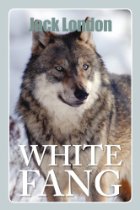
Book Review: White Fang by Jack London
 Summary:
White Fang is born in the wild 1/4 dog and 3/4 wolf. He soon finds himself back in the realm of man when his mother returns to the Indian camp she had left. Thus begins the struggle between White Fang’s desire for the companionship of the human gods and the call of the wild inside him.
Review:
This companion novel to The Call of the Wild flips the original story on its head. Instead of it being a dog feeling the call of the wild, we have a wolf feeling the call of the companionship of man, in spite of mistreatment. The story doesn’t quite work as well when reversed in that way, though.
Both White Fang and Buck suffer mistreatment at the hands of men that is incredibly painful for an animal lover to read about. Whereas this served to make it understandable why Buck leaves for the wild, though, it makes it difficult to understand why White Fang doesn’t do the same. Yes, eventually he meets a master who loves him and cares for him, but for years prior that is not the case. Perhaps London is attempting to demonstrate the intense loyalty of dogs to their masters whether or not they deserve it. It is true that animal rights workers see this sort of situation over and over again, yet White Fang is mostly wolf. It is difficult to believe his wild nature would not take over at some point, particularly when being mistreated. If this story was told of a dog and not a wolf, it would make more sense.
That said, London’s strength at delving into the animal world without personifying them to be more human than they are is still incredibly strong here. The animals are not personified but they are humanized. By that I mean, their personalities and instincts are clear and understandable. It is difficult to imagine anyone reading this book then proceeding to abuse an animal. They are truly remarkable creatures, London excels at demonstrating this.
Overall, this book is not as amazing as The Call of the Wild but it is well-worth the read for more time spent seeing animals through Jack London’s eyes. Recommended.
4 out of 5 stars
Length: 208 pages – average but on the shorter side
Source: Purchased

Buy It (Amazon or Bookshop.org)
Companion Book:
The Call of the Wild, review
If you found this review helpful, please consider tipping me on ko-fi, checking out my digital items available in my ko-fi shop, buying one of my publications, or using one of my referral/coupon codes. Thank you for your support!
Movie Review: Them! (1954)
 Summary:
When a small southwestern town sees a spate of sugar theft mixed with mysterious deaths, a scientist and his daughter are brought in to investigate. They soon discover that a new breed of giant ants have mutated from local nuclear testing and must fight against the odds to preserve the human dominance of earth.
Review:
I watch classic horror movies more for the lols than anything, but every once in a while, one manages to actually stand the test of time and still scare me.
Anyone who knows much about ants knows that they actually are rather awful creatures. They’re vicious, disturbingly strong for their size, and single-minded to the point of obsession. That’s the perfect recipe for a formidable opponent if they were any larger. Combine this with the very real threat of nuclear mutation, and you have the recipe for an ideal horror film.
Something the classic movies did better than today is establish a strong plot-line. The action is not constant. It is interspersed with scenes in which the characters attempt to figure out what is going on and determine what to do about it. This ups the tension for the inevitable “battle the monster” scenes that eventually play out.
Of course a strong idea and plot can still be undermined by outdated special effects. These effects, however, have truly stood the test of time. The ants look frightening, not comical. The scenes are shot in such a way that it all appears to be fairly real, particularly for the decade. When the sound effect given to the ants–a sort of high-pitched squealing–is added in, it becomes quite easy to suspend disbelief.
If you enjoy a good creature feature as well as an old movie periodically, you won’t regret your time spent watching Them!
5 out of 5 stars
Source: Netflix

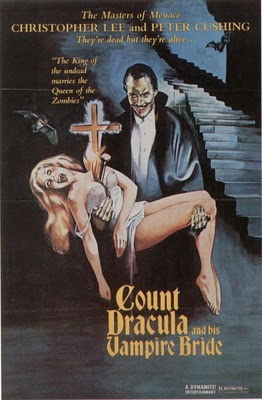
Movie Review: Count Dracula and His Vampire Bride (1973)
 Summary:
A Satanic cult is doing something evil in a castle above a dungeon full of female vampires. Van Helsing is called in to help, and he insists that the king of all vampires, Count Dracula, is back.
Review:
My friend and I decided we wanted to have an old-school horror movie night. We chose the film before seeing it was shot in the 1970s. I immediately informed her that there would be boobies, mark my words. 1970s films are just *rampant* with boobs. Especially horror films. Sure enough, not even 30 seconds into the film, and there’s a naked woman on an altar having rooster blood (*cough* cock blood *cough*) poured onto her.
I honestly came away from this film with three distinct impressions: tits, blood, and vampire teeth. I honestly cannot explain the plot to you, hence the short summary above. It makes very little sense. There are writhing vampire women, Van Helsing, Dracula, some sort of plot to put a super-uber black plague into the world, and an evil bunch of Satanists. How that all fits together remains a mystery. Yet I still found it immensely enjoyable as a giggle-inducing cult classic.
First, there’s the rampant unnecessary nudity so typical of the 1970s. Then there’s the costumes that are obviously trying to be exotic, but just succeed in looking like the 1970s. The insane plot becomes irrelevant when you’re faced with scene after scene of ridiculous costumes, sentences, and moments. Nothing induces hilarity quite like a dungeon full of half-naked writhing vampire women being taken out by a bunch of sprinklers, because apparently any water works not just holy water.
All of which is to say, while I found this film hilarious and entertaining, you have to have a certain personality type to enjoy it. If you like classic, serious old-school horror films, this isn’t for you. If you like plots that make sense, this isn’t for you. However, if you like 1970s romps full of unintentionally hilarious scenes and nudity, then you’ll certainly enjoy this film. The vampires don’t hurt either.
3.5 out of 5 stars
Source: Gift

Book Review: The Turn of the Screw by Henry James
 Summary:
Late at night at a party, a gentleman offers to read a ghost story. He claims this story occurred to a woman he knows personally. The narrative then switches to the governess’s voice, and she tells of going to work at her first job as a governess caring for an absent uncle’s nephew and niece. Upon arriving there, she discovers that the property is haunted by the ghosts of the former governess and her lover….or is it?
Review:
I loved the prologue about the party. It’s full of clearly intelligent and world-wise people, which is rare of the Victorian era. I was then disappointed when it switched to the governess’s voice. She is painfully innocent and frankly annoying. She frequently waxes lyrical about how simply delightful and angelic the children are to an extent that it made me sick to my stomach. I frankly would have given up on the story if it wasn’t for the fact that it was my audiobook download, the reader had a pleasant voice, and it’s very short, so I figured, why not finish it? I now am glad I did.
Upon arriving at the end, I found myself wondering if I’d missed something, as I was a bit confused about what happened, and my mind does wander sometimes when listening to an audiobook. Since it’s a classic, I decided to look a bit at the literature guides online just as I would have gone into lecture in university excited to hear what a professor had to say about a work that I found confusing. Well, lo and behold, apparently critics have had two distinct opinions on what exactly happens in the story pretty much since the day it was published. I don’t think it’s a plot spoiler to say that James intentionally wrote it as ambiguous as to whether the ghosts actually exist or the governess is insane. It can either be read as a straight-up ghost story with some sexual innuendos or as a commentary on the ill effects of the tight-laced Victorian culture on women. That’s kind of cool, and for the record, I prefer the insane governess reading of the story, as I think that’s actually more creepy than the ghosts.
After reading the commentary and about James’ opinions in general, I realized that James probably found the governess as annoying as I did. I enjoyed the prologue, and the prologue was a reflection of James and his friends. This makes so much sense now! I am certain if I had approached this book with the knowledge of James’ criticisms of Victorian society that I would have enjoyed it much more than I did approaching it as a straight-up traditional ghost story.
Overall, this is a story that will be best enjoyed by readers who thrill to the challenge of ambiguous tales and who are critical of Victorian era mores and norms. It is not exactly the right fit for readers looking for a traditional ghost story, however. I also feel it necessary to add that I believe this story is not ideally suited to being an audiobook. Due to the ambiguity, certain passages lend themselves to a desire to be re-read that is not so easily pulled-off when being listened to.
3.5 out of 5 stars
Source: Librivox recording via the Audiobooks app for the iTouch, iPhone, and iPad

Movie Review: Rosemary’s Baby (1968)
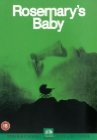
I love horror films, and I’d been meaning to watch this classic for quite some time. Netflix is so good for making you finally get around to seeing movies you’ve always meant to see.
 Summary:
Rosemary and her actor husband move into a new apartment despite protestations from a friend that the building has a bit of a history of odd things happening. Their new neighbors are a friendly, elderly couple. In fact, Rosemary finds them to be a bit too friendly, but her husband likes them and insists the friendship be kept up. Soon Rosemary is pregnant, but there is something odd about her pregnancy she can’t quite put her finger on until it is too late.
Review:
This is the type of horror story I love. Something sinister lurking in the background of the main character’s life. Everyone around her telling her she’s the crazy one or that she’s paranoid with only the main character and the viewer seeing what’s really going on. This gives such a different scared vibe than the more typical, oh we’re in a scary hotel room for one night ahhh.
The cinematography has that classic 1960s feel that I personally love. Maybe there’s a technical term for it, I don’t know, but it’s that awkward shot. Instead of every shot being perfectly clean cut like in modern films, the actors aren’t always in center and focused. People are off to the side. It gives almost a mockumentary film feeling without any of those staged interviews.
Mia Farrow’s acting is truly excellent. Her facial expressions show the wheels turning in her head even when other characters are in the room with Rosemary. You can see how Rosemary senses something is wrong, yet she isn’t sure what exactly.
Ruth Gordon, playing the elderly neighbor woman, also offers up an excellent acting job. She plays to perfection that horribly annoying elderly woman who everyone else finds delightful but you just want to stop touching your throw pillows. It may seem like an easy part to play, but it is a fine line to walk, and she executes it perfectly.
I think what kept me from loving the movie as opposed to just really liking it were the odd dream sequences. These too have a classic 1960s feel, but not in a good way. They feel fake, and jerked me out of the world I had been sucked into. I think most of the dream sequences could have been done without.
There is no way to discuss the social commentary this movie makes without giving away a massive spoiler, so let me just say that women’s agency is central to the plot of this film and is one of the main reasons I liked it.
If you enjoy horror, 1960s cinematography, or subtle social commentary, you will enjoy this film.
4 out of 5 stars
Source: Netflix

 Support my work with a tip or browse my shop for curated book club guides, how to guides, cross-stitch patterns, and more!


This work by Amanda Nevius is licensed under a Creative Commons Attribution-Noncommercial-No Derivative Works 3.0 United States License.
 Opinions of a Wolf