
Archive
Giveaway: The House of Azareal by Erik Dreistadt (INTERNATIONAL)
 This giveaway is now over! Since no one entered, there are no winners.
It’s time for the second giveaway of 2014 here at Opinions of a Wolf. Lots of the indie authors whose books I accepted for review in 2014 also were interested in me hosting a giveaway at the time of my review, so there will be plenty more coming up in the future too.
There is ONE ebook versions of The House of Azareal
What You’ll Win: One ebook copy of The House of Azareal
How to Enter: Leave a comment on this post stating your favorite horror trope.
Who Can Enter: INTERNATIONAL
Contest Ends: March 8th. Two weeks from today!
Disclaimer: The winner will have their ebook sent to them by the author. The blogger is not responsible for sending the book.
Book Review: The House of Azareal by Erik Dreistadt
Summary:
Christopher is so grateful for his twins that seem a true miracle after he and his wife, Annamarie, had trouble conceiving. He can hardly believe it’s their 8th birthday already, and he won’t let anything spoil the celebration, not even an odd nightmare about being eaten by hellhounds he had the night before. But his children wander off into the woods after the party. When Christopher and Annamarie find them, they’ve stumbled upon an abandoned house. The children convince them to explore it. But the house quickly turns into a living nightmare. A nightmare designed and run by Azareal.
Review:
This is my second read of the twelve review copies I accepted for review here this year (see the complete list). I was looking for a shorter read after my previous two chunksters, and this short, fast-paced horror seemed like the perfect fit for my mood. The book puts a fresh twist on both haunted houses and trouble conceiving horror plots, although the writing style and dialogue struggle to support the excellent plot.
The story at first appears to be a straight-forward haunted/evil house plot. Right away, I liked that Azareal’s house isn’t the one the family lives in or one the family has just moved to. Instead, it is a house found in the woods, akin to Hansel and Gretel. That’s a trope I enjoy, and I liked seeing it used in the plot. Having the parents go into the house with the children was the first of several twists on tropes in the plot that made the book so engaging. From the point the family enters the house onward, the plot continues to twist and turn unexpectedly, yet believably. Gradually it becomes apparent that this is more than a haunted house book, it includes the occult, as well as a trouble conceiving plot. The fact that the results of using the occult to aid in conceiving doesn’t have consequences for eight years is a nice twist. Most books show consequences either during the pregnancy or immediately after the baby is born. The inclusion of new twists on both of these horror plots in one book makes the book fast-paced and engaging. It is a quick read that will propel you forward to see how it ends.
Unfortunately, the writing style doesn’t quite live up the high quality of the plot. Some of the dialogue feels forced and awkward. Similarly, while some scenes are set well, others are written in an awkward manner with focus on minute details that are irrelevant to the plot or the setting and not enough focus on other details that are. The writing style is good enough that it doesn’t ruin the enjoyment of the book, but it does knock it down a couple stars. The book is mostly well edited with the exception of one grammar mistake made quite a few times. Either using its for it’s or vice versa. Since it’s the same mistake made repeatedly, it’s easy enough to gloss over when reading it. However, I would advise for future books that the author keep an eye out for this particular issue during the editing process, especially since the rest of the grammar and spelling is so well-edited.
Overall, this is a fast-paced read that combines two horror plots into one book and puts unique twists on both. The writing style isn’t quite as good as the plot, but it’s still an enjoyable read. I’m looking forward to future works by the author. Recommended to horror fans looking for a quick, unique read.
3 out of 5 stars
Source: kindle copy from author in exchange for my honest review
Book Review: The Hornet’s Sting: The Amazing Untold Story Of Second World War Spy Thomas Sneum by Mark Ryan (Bottom of TBR Pile Challenge)
 Summary:
Thomas Sneum was a Danish Allied spy during World War II who was periodically suspected of being a double agent. Partially due to this suspicion and partially due to infighting between the two British spy agencies (SIS and SOE), he never got the attention or respect he deserved. Mark Ryan, the author, found out about him and set out to get to know him. Both personally and through research. Here he tells the true story of Tommy Sneum and sets the record straight once and for all.
Review:
I picked this book up during a kindle sale because I’m a big WWII buff and who doesn’t love real life spy stories? I thought it was a sure bet, but apparently even a true life spy story can be written in a dull manner.
It’s impossible to read the book without learning a lot. For instance, I had no idea that Britain had two different spy agencies that were battling each other for control of spying missions. This infighting between the SIS and the SOE led to lack of communication and lack of a solid spy front with one, unified plan. Similarly, I didn’t know it was common practice to take people who had escaped from behind Nazi lines, train them as spies, then re-drop them back in their home countries. I always thought the resistance movement just built up from the inside and then they contacted the Allies on the outside with information. How much more complex it was is really interesting. I also loved learning more about those from occupied countries who escaped and fought in other militaries against the Nazis. In spite of learning all of these new to me facts about WWII spying, the book manages to be dull. Ryan tends to wander off on side diatribes about the intricacies of red tape and paperwork instead of focusing in on the more action-oriented, interesting bits of the spying. He also spends a lot of time giving the full name of every single person even vaguely connected with Tommy and the spying, even if they really have no impact on the story. The book could really have used a bit more streamlining and focus to keep the energy up. Just because it’s nonfiction doesn’t mean it can, or should, meander.
Tommy Sneum is hard to root for. He’s not a likable guy. He abandons his wife and infant daughter to go be a spy. That could definitely be seen as valiant, however, he expresses consistent distate for his wife and a lack of concern or care for even knowing his daughter. He certainly comes across in the book as a guy just after adventure, not so much a man looking to protect his country or his family. Similarly, Tommy express arrogance when it comes to women, claiming that they essentially would go sleep with him at the drop of a hat or a snap of his fingers. He does not come across as seeing women as people but rather as recreational objects. One story that really demonstrates this is he tells the author that he had a threesome once, and he was upset that the women dared to pay attention to each other at all, rather than 100% to him. Sex is supposed to be about people giving to each other, not about one person being worshiped. His general attitude towards women gave me a squicky feeling throughout the book. Of course, most people are not all bad or good. Tommy is no exception. He expresses a real openness toward a male colleague who was known to be bi. He refuses to view all Germans as evil monsters and insists, to those high up in the British resistance no less, that most Germans are just caught up in Hitler’s war machine. Of course, these even-handed views are almost universally held of men.
Perhaps the most interesting part of the book is Ryan’s investigation into the accusations that Sneum was a double-agent. This part of the book isn’t really played up in the blurb, which I think is unfortunate. Ryan did a lot of investigative work and lays out all the details that he believes clears Sneum’s name. Seeing how Sneum and his methods were misunderstood by the British and also how having two different spy agencies working led to misunderstandings was truly fascinating, and I’m glad Ryan took the time to work at finding the truth.
Overall, this is a rather slow-paced work of historic nonfiction that focuses in on the red tape and organizational aspects of spying more than exciting adventures. It does good work in determining that Sneum was not a double agent in WWII. Sneum’s womanizing can be a bit tedious at times, although his even-handed perspective on the German people is good to see. Recommended to those interested in the organizational aspects of spying in WWII, including very minute details.
3 out of 5 stars
Source: Amazon
Buy It
Note: Apparently this book is no longer available on the kindle.

Book Review: Doctor Sleep by Stephen King (Series, #2) (Audiobook narrated by Will Patton)
 Summary:
Danny Torrance didn’t die in the Overlook Hotel but what happened there haunts him to this day. Not as much as the shining does though. His special mental powers that allow him to see the supernatural and read thoughts lead to him seeing some pretty nasty things, even after escaping the Overlook. He soon turns to drinking to escape the terror. But drinking solves nothing and just makes things worse. When he sees his childhood imaginary friend, Tony, in a small New Hampshire town, he turns to AA to try to turn his life around and learn to live with the shining.
Abra is a middle school girl nearby in New Hampshire with a powerful shine. She sees the murder of a little boy by a band of folks calling themselves the True Knot. They travel in campers and mobile homes, seeking out those who have the shine to kill them for it and inhale it. They call it steam. They’re not human. And they’re coming after Abra. Abra calls out to the only person she knows with a shine too, the man she’s talked to before by writing on his blackboard. Dan.
Review:
A sequel that takes the original entry’s theme on overcoming your family origin and ramps it up a notch, Doctor Sleep
The book begins with a brief visit to Danny as a kid who learns that the supernatural creatures exist in places other than the Overlook, and they are attracted to the shine. This lets the reader first get reacquainted with Danny as a child and also establishes that the supernatural are a potential problem everywhere. The book then jumps aggressively forward to Danny as a 20-something with a bad drinking problem. It’s an incredibly gritty series of scenes, and it works perfectly to make Dan a well-rounded character, instead of a perfect hero of the shine. It also reestablishes the theme from The Shining
The way Dan overcomes both his drinking and his temper, as well as how he learns to deal with his shine, is he joins Alcoholics Anonymous (AA). In contrast to his father who tried to quit drinking on his own, Dan attempts it in a group with accountability. This then shows how much easier it is to overcome a mental illness with community support. I appreciated seeing this. I will say, however, that some of the AA talk in the book can get a bit heavy-handed. Some chapter beginnings include quotes from the book of AA, and Dan can sometimes seem a bit obsessed with it when he relates almost everything to something he learned or heard there. AA definitely plays a vital role in many people’s recovery from addiction, and it’s wonderful to see that in a work of fiction. However, it would have been better for the reader to see the role of AA more than to hear quotes from AA so often.
The big bad in this book is a band of supernatural creatures who were once human and still look human. But they change somehow by taking steam and go on to live almost indefinitely. They can die from stupid accidents and sometimes randomly drop dead. The steam is acquired by torturing children who have the shine. The shine comes out of their bodies as steam when they are in pain. They call themselves The True Knot. This troop is a cartoonish group of evil people who try to look like a troop of retirees and some of their family traveling in a camper caravan. The leader of this group is Rose the Hat–a redheaded woman who wears a top hat at an impossibly jaunty angle. I was pleased to see Rose written quite clearly as a bisexual. Her sexuality is just an aspect of who she is, just like her red hair. Seeing a bi person as the big bad was a delight. Her bisexuality isn’t demonized. Her actions as a child killer and eater of steam are. She is a monster because of her choices, not because of who she is. I alternated between finding The True Knot frightening and too ridiculously cartoonish to be scary. I do think that was partially the point, though. You can’t discredit people who seem ridiculous as being harmless.
How Abra is found by The True Knot, and how she in turn finds Dan, makes sense within the world King has created. It doesn’t come until later in the book, though. There is quite a bit of backstory and build-up to get through first. The buildup is honestly so entertaining that it really didn’t hit me until after I finished the book how long it actually took to get to the main conflict. So it definitely works. Abra is a well-written middle school girl. King clearly did his research into what it’s like to be a middle schooler in today’s world. Additionally, the fact that Abra is so much older than Danny was in The Shining
There is one reveal later in the book in relation to Abra that made me cringe a bit, since it felt a bit cliche. It takes a bit of a leap of faith to believe, and I must admit it made me roll my eyes a bit. However, it is minor enough in the context of the overall story that it didn’t ruin my experience with the book. I just wish a less cliche choice had been made.
The audiobook narrator, Will Patton, does a phenomenal job. It was truly the best audiobook narration I’ve heard yet. Every single character in a very large cast has a completely different voice and style. I never once got lost in who was speaking or what was going on. More importantly to me, as a New England girl born and raised, is that he perfectly executes the wide range of New England accents present in the book. Particularly when he narrates the character, Billy, I thought I was hearing one of my older neighbors speak. I could listen to Will Patton read a grocery list and be entertained. Absolutely get the audiobook if you can.
Overall, this sequel to The Shining
4 out of 5 stars
Source: Audible

Previous Books in Series:
The Shining
Counts For:

Giveaway: The Reflections of Queen Snow White by David C. Meredith (INTERNATIONAL)
 This giveaway is now over! Since no one entered, there are no winners.
I am super-excited to get to offer up my first giveaway of 2014 here at Opinions of a Wolf. Lots of the indie authors whose books I accepted for review in 2014 also were interested in me hosting a giveaway at the time of my review, so there will be plenty more coming up in the future too.
There are TWO ebook versions of The Reflections of Queen Snow White
What You’ll Win: One ebook copy of The Reflections of Queen Snow White
How to Enter: Leave a comment on this post stating your favorite part of the original Snow White fairy tale. Your comment must also contain your EMAIL ADDRESS so you can receive your ebook.
Who Can Enter: INTERNATIONAL
Contest Ends: February 13th. Two weeks from today!
Disclaimer: The winners will have their ebooks sent to them by the author. The blogger is not responsible for sending the books.
Book Review: The Reflections of Queen Snow White by David C. Meredith
Summary:
Snow White lived decades of her happy-ever-after, but when Charming dies she is sent reeling into a depression. Not even their daughter, Raven’s, upcoming marriage can snap Snow White out of it. When wandering the halls of the castle, desperately seeking to be alone, she re-enters her old step-mother’s quarters. Now covered in dust, she discovers her stepmother’s magic mirror, which she never knew about before. The discovery will have far-reaching consequences.
Review:
This is my first read of the 12 indie books I accepted for review here in 2014 (see the whole list). I surprised myself a bit, reaching first for the fantasy, but I was in the perfect mood for a slightly pensive retelling of a fairy tale. The book takes an interesting angle for retelling the story, jumping ahead to Snow White’s elderly years, but it unfortunately doesn’t reimagine Snow White herself quite enough.
The narrative choice of having an elderly Snow White discover her stepmother’s magic mirror that then forces her into introspection on herself and her life is a great idea that works well. We already all know the end of the fairy tale, so flipping it on its head to start at the end addresses that fact head-on. Now the question isn’t, will this fairy tale end the way all the other retellings do. Instead, it looks on a psychological level at the impact of Snow White’s early years on her later ones. It also is an interesting way to address end of life issues. Snow White is elderly and stuck in a bit of a rut. She’s uncertain how to go on without her husband of so many years. These are relevant issues that don’t get addressed often enough in literature, and re-using the Snow White fairy tale to look at them works wonderfully. It thus is a familiar story and setting with a different focus, which is a great tact to take for a fairy tale retelling.
Snow White herself, however, hasn’t been tweaked enough to make for an interesting heroine. I admit, I was hoping for someone who either had found or would find her own strength. The Snow White we see in Disney and other retellings really is a bit of a shrinking violet. This Snow White stays that way. Over and over she is the helpless girl who must be rescued by others. She doesn’t flee the castle, someone else tells her, practically forces her to. She is then saved first by the dwarves and then by Charming. Later in her life, after leaving the official fairy tale, we find that she is a simpering clueless virgin on her wedding night who must be guided by Charming. Then even later she is heinously assaulted by some ladies of her court, and she again must be saved by someone else. Even in the end of her life, she doesn’t pick herself up and continue on. A magic mirror knocks some sense into her. Because fairy tales often remove so much agency from the “good” women in them (only evil women are allowed agency), I prefer to see retellings give the women more agency. Snow White could still have the character flaw of being a bit timid and eventually learn how to save herself. It’s not an all-or-nothing scenario. The way Snow White and her story is presented here reads a bit too traditionally medieval. I want a retelling to take me new places with the character, not extend the same ones.
This issue alone would have led me to give the book 4 stars, but, unfortunately, the book is riddled with spelling and grammar errors. I only marked the most egregious ones, and I still had 12 on my list. Issues such as saying someone laid down in the floor, instead of on the floor (loc 2302), putting the apostrophe in the wrong place (“princes’ tongue” instead of “prince’s tongue” (loc 1315) ), and just flat-out using the wrong word (“followed suite” instead of “followed suit” (loc 1084) ) sorely damaged my enjoyment of the novel. I don’t expect perfection from authors or editors, we are all human, but more than a few errors is something that truly negatively impacts the reading of the novel.
Overall, this retelling of Snow White takes the interesting angle of focusing on the end of her life. This allows the author to explore issues relevant to the elderly, such as losing long-term loved ones and coming to terms with the path your life has taken. Although this plot gives the fairy tale a new focus and extended plot, Snow White herself has not been updated at all. She is still the simpering violet who must be saved by all around her. Some readers may be bothered by the number of errors in the spelling and grammar in the book. Recommended to fans of traditional fairy tales with only a slight twist who won’t be bothered by a lack of editing for spelling and grammar.
3 out of 5 stars
Source: kindle copy from author in exchange for my honest review
Book Review: Who? by Algis Budrys
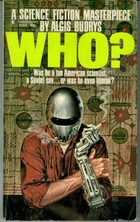 Summary:
In an alternate late 20th century, the Allies are still at a cold war with the Soviets. The Allies’ best scientist, Martino, is working on a secret project called K-88 when there is an explosion. The first rescuers to him are Soviet. The norm is for Allied prisoners to ultimately be returned across the line. But the Soviets claim that Martino’s skull and arm were badly damaged and return him with a metal, robotic head and arm. Is this man really Martino, or is he a Soviet plant?
Review:
I was excited to read this book because the idea of a transhumanist/cyborg American made that way by the Soviets has a James Bond like appeal. Unfortunately, it feels a bit more dated than I was anticipating, as well as compared to other older scifi, and doesn’t fully address some questions it raises.
Immediately, there are a couple of plot holes that aren’t addressed until close to the end of the book, which made it a bit frustrating to read. First, why did the Allies put their best scientist in a lab on the border with the Soviets? The answer to this, given at the end of the book, is pretty flimsy, and only works if you are willing to believe the Allies are very stupid. Second, it makes sense that they can’t verify Martino’s identity with his fingerprints, because the Soviets could have taken off his remaining arm and put it on someone else. However, why can’t they verify who he is with DNA? Presumably, he has some living relatives somewhere they could compare to. DNA was discovered in the 1860s (source) so to never even address why they don’t use it is a bit bizarre. The book mentions toward the end that Martino’s parents and uncle are dead, but you can conduct kinship tests using dead bodies. It still baffles me that the government in the book didn’t simply dig up Martino’s father and run a DNA test. Even if DNA testing wasn’t widely known of when the book was published, one would hope a scifi writer could see its future implications, imagine the applicability, and address the scenario. The fact that DNA wasn’t addressed at all, and Martino’s place near the Soviet border wasn’t satisfactorily addressed really removed a lot of the intensity and interest one should feel from the situation.
Another way Budrys showed a lack of imagination for the future is in the strict gender roles and lack of women in the military or the sciences in the future he has envisioned. Women are only seen in the book in strict 1950s gender roles. As wives and mothers and not once in the military or in the sciences. People in the sciences are referred to as the “men” not even leaving room for the idea of a woman in science. I know this is a symptom of the times, but I also know that more progressive and forward-thinking scifi was written in the same decade. It was a bit jarring to me to read a scifi that excluded women so much, when I’m so used to women being present, at least nominally, in scifi.
All of that said, the writing of individual scenes was quite lovely. Budrys evokes setting and tensity well. I particularly enjoyed the scene of Maybe-Martino running through the streets of New York City, which reminded me of an old noir film. Budrys also shows a good understanding of what it is like for people who are incredibly highly intelligent. He writes Martino at a young age as both brilliant in science but also dumb in interpersonal relations. The fact that he got this and demonstrated it in the 1950s is to be commended. There is also some solid commentary on the American education system and a desire for it to encourage more independent thought.
Look–these guys aren’t morons. They’re pretty damned bright, or they wouldn’t be here. But the only way they’ve ever been taught to learn something is to memorize it. If you throw a lot of new stuff at them in a hurry, they’ll still memorize it–but they haven’t got time to think. (loc 9163)
Overall, this is an interesting concept that wasn’t fully fleshed out nor the possible weaknesses fully addressed. It is definitely a scifi of its time, with its hyper-focus on the Soviets and the Cold War that could almost feel kitschy today. A short read with an interesting premise, albeit a lack of female scientists, soldiers, or government workers. Recommended to scifi fans who enjoy some old-fashioned red scare in their reads and don’t need the science to be perfect.
3 out of 5 stars
Source: Netgalley

Book Review: Sleepless by Charlie Huston (Audiobook narrated by Ray Porter and Mark Bramhall)
 Summary:
In an alternate 2010, the world is slowly falling into disarray, partially due to terrorism, but mostly due to a new deadly illness. SLP makes the sufferer an insomniac, unable to sleep for years, until they fall into a state of insanity known as the suffering. The sleepless, as those with the illness are known, change the structure of society. Movie theaters are now open 24/7, there’s an increase in sales of odd and illicit things, as the sleepless get bored. Most importantly, the sleepless have moved much of their energy into online MMORPGs. Some spending countless hours gold farming there, making a good buck with all their hours of alertness.
Park, an old-fashioned cop, is determined to save the structure of society, one bust at a time. He’s committed to his work, in spite of his wife being sleepless and being increasingly unable to care for their infant daughter. So when his boss asks him to go undercover to look for people illegally selling the one drug that can ease the pain of the sleepless–dreamer–he agrees.
Jasper is an elderly ex-military private investigator without much of an eye for sticking to the rule of the law who is asked by a client to hunt down and return to her a thumb drive that was stolen. He slowly discovers that that thumb drive ended up in the middle of much more than some art thieves and finds himself sucked into the world of illicit dreamer.
Review:
My partner and I both enjoy a good noir story, so when we saw this summary on Audible, we thought it would make an entertaining listen for our 12 hour holiday road trip. The story was so bad, we could only take it for about an hour at a time and eventually just turned it off so I could read out loud to him from a different book. I eventually soldiered on, though, because I honestly just had to finish it so I could review it. In what should be a fast-paced noir, there is instead an overwrought amount of description of unimportant things that slow what could have been an interesting plot down to a crawl.
Noir as a genre is a thriller that generally features a hard-boiled detective (sometimes a hard-boiled criminal). It’s fast-paced and usually short featuring a lot of grit and mean streets. One thing Huston does that puts an interesting twist on the noir is he incorporates both a cop who is being forced to turn detective and a criminal-style private investigator. He features both sorts of main character. This intrigued me from the beginning. However, the writing includes far too much description of unimportant things for a crime thriller. For instance, there is an at least 5 minutes long description of a computer keyboard. I could literally space out for a few minutes and come back to the audiobook that was playing the entire time and miss literally nothing. It would still be describing the same chair. This really slows the plot down.
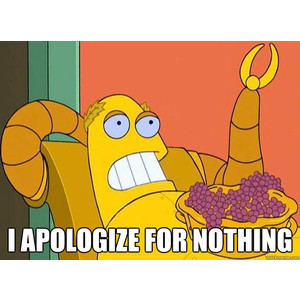
 On top of the overly descriptive writing, the narration is overwrought, like a stage actor trying too hard. The best explanation I can make for the narration is, if you have ever seen Futurama, the narration switches back and forth between being Calculon and being Hedonbot. Now, I admit, the audiobook narrators played these parts perfectly. In fact, I had to check to see if they’re the same voice actors as Calculon and Hedonbot (they’re not). I really think the audiobook narrators are what saved the story enough to keep me reading. I kept laughing at the visual of Calculon and Hedonbot doing this overwrought noir. But that is clearly not what makes for a good noir. The tone and writing style were all wrong for the plot.
In addition to the writing style, there’s the plot. In this world that Huston has imagined, gamers have become all-important. When people go sleepless, they become intense gamers. If they don’t do this then they become zombie-like criminals. I don’t think this is a realistic imagining of what would actually happen if a huge portion of the population became permanent insomniacs. Not everyone is a gamer or a criminal. There’s a lot more options in the world than that. Additionally, in this alternate 2010, the art world now revolves around MMORPGs as well. The art work that is now sold is thumb drives of the characters that people make in the games. There is a long speech in the book about how making a character in an MMORPG is art. Yes, somepeople might think that. But it is incredibly doubtful that the entire world would suddenly overnight start viewing character building in an MMORPG as an art form. I won’t explain how, because it’s a spoiler, but the gamers also come into play in the seedy underworld of illegal drugs. At the expense of a plot that follows the logic of the world the author has created, gamers are made to be inexplicably all-important.
 I also must point out that the science in this book is really shaky. SLP was originally a genetic disease that suddenly becomes communicable. That’s not how diseases work. Communicable and genetic diseases are different, they don’t suddenly morph into one or the other. Additionally, in the real world, there’s no way an illness would be given a scientific name that is an abbreviation for the common name (SLP for sleepless). Think about swine flu. The common name is swine flu, the scientific name is H1N1. Similarly, the drug to treat SLP’s official name is DR33M3R, which is just the street name, dreamer, in leetspeak. This isn’t fiction based in true science.
One thing I did appreciate in the book is that the semi-criminal private investigator, Jasper, is gay. He’s extremely macho, ex-military, and he bangs his also macho helicopter pilot. I like the stereotype-breaking characterization of Jasper. It’s nice to see a gay man given such a strong role in a thriller.
Overall, this alternate 2010 noir gets too caught up in overly long descriptions of mundane things and an overwrought narrative style to keep the plot moving at a thriller pace. The plot features an unrealistic level of importance for MMORPGs and the gamers who play, as well as unsound “science.” One of the hardboiled main characters is a stereotype-breaking gay man, however, which is nice to see. Recommended to those who enjoy an overly descriptive, overacting narration style with gamers featured unrealistically at center stage who don’t mind some shaky science in the plot.
2 out of 5 stars
Source: Audible
Book Review: Ecstasy in Darkness by Gena Showalter (Series, #5) (Bottom of TBR Pile Challenge)
 Summary:
Ava Sans is hoping to move up to a full agent at New Chicago’s Alien Investigation and Removal (AIR) team. But before she can, she and her best friend, Noelle, are assigned to capture a powerful vampire who can manipulate time. McKell, recently cast out from the underground tunnels the monarchical vampires call their home, is having to adjust to living with daylight and is desperate to find out the secret these above ground vampires have for moving around in the daylight without burning. Used to seeing humans only as food slaves, he’s disturbed to find himself inexplicably attracted to Ava Sans, who just so happens to smell like butterscotch.
Review:
I rarely impulse buy books in drugstores and, after reading this book, I think that’s probably the wiser move. I bought this in a CVS due entirely to the cover and didn’t pick it up to read for three years. When I did, I saw it was the fifth book in the series. Fortunately, this isn’t the type of series that it’s necessary to read in order. Unfortunately, nothing about this book made me want to go read the rest of the series. It suffers from a meandering plot, ridiculous dialogue, two-dimensional characters, constant cock-teasing of the reader, and an entirely misleading cover (that I suspect was misleading on purpose).
This series focuses on a different romantic pairing in each entry. They all have ties to AIR in some way. The previous couples make cameos in other books, but the actual plot from the prior books doesn’t have much impact on this one. All that needs to be known is there was a war with the aliens, New Chicago is not on Earth, vampires are an alien species that are allergic to the sun and live underground on this planet, the vampires make humans their food slaves, and some of the vampires have started living above ground. Oh, and there’s this alien called the Schön Queen who looks beautiful but actually is a rotting, disease-ridden creature who gives those who bang her an illness that makes them her voodoo zombie slaves. Those who read a lot of pnr will understand that that’s a pretty simple plot summary for a series this far in.
The actual plot for this book basically is that Ava will help McKell lure vampires to interview to find out how they live in daylight and he will, in turn, come willingly to talk to the head of AIR. AIR wants to find out if McKell’s blood can be used to save victims of the Schön Queen’s disease. If the book stuck to this simple, straightforward plot it would work. But it meanders all over the place, tossing in red herrings, asides, diatribes, and scenes that seem to happen just for the fun of it. This book is over 500 pages long. That is not enough plot to support that many pages, unless the characters are stopping to bang a lot, which was honestly what I was expecting. That’s not what we get though.
The cover definitely implies that this is a BDSM book with a lot of sex. The only thing that ever happens with a whip is McKell comes over to Ava’s house with the whip intent on actually beating her up with it (in a to get revenge way not in a sexy BDSM way) but then he never uses it on her. She mentions it in a giggling aside toward the end of the book, and McKell states he would never ever whip her. He loves her too much now. I know the author generally doesn’t have any impact on the cover design at all, but somebody somewhere must have known they’d be pulling in people expecting BDSM only to have BDSM scorned within the book. Not cool. That’d be less irritating, though, if there was at least a lot of sex of some sort in the book. Instead, we repeatedly find Ava and McKell getting hot and steamy only to stop just short of having sex. They have sex twice in the book at the very end. You seriously have to read at least 400, maybe 450, pages to get one full sex scene. Which is incredibly frustrating because by far the best writing Showalter does is of the sex scenes. They’re tantalizing and realistic with some things we don’t always see in romance novels, like the guy going down on the girl, for instance. This book would have been at least three stars if Showalter’s steamy scenes had led to actual sex scenes throughout the novel. But instead, the reader just gets going with excitement only to have it yanked out from under them to go check in on that meandering plot.
The characters are so two-dimensional that it’s essentially impossible to truly care for them. McKell is a vampire with a temper. A bad boy, supposedly, that Ava inexplicably falls for. Most of his presence in the book consists of snapping at Ava and being shocked she doesn’t obey him and then being turned on by that. Ava, on the other hand, is traumatized by growing up on the bad side of the tracks and has a big inferiority complex. She also smells like butterscotch. And tastes like butterscotch. And her hair looks like butterscotch. She’s a piece of butterscotch candy who says boo hoo poor me and I want to prove to everyone that I’m not trash so oh hey let’s fall for this bad boy vampire who treats me badly that seems like a great choice. I admit by the end of the book McKell is treating her well but his transformation is out of the blue, not gradual. Plus, Ava falls for him when he’s a bad boy and never stands up for herself or says I deserve better. She ends up with an ok guy but only because he magically transformed, not out of any agency of her own. The supporting characters are even less well-developed. I can say maybe one or two things about them all, but nothing that makes them truly come to life in my mind.
Overall, this is an overly long pnr with a light, meandering plot and only two sex scenes in over 500 pages. While the sex scenes are well-written and tantalizing, the rest of the book is dull, with two-dimensional characters it is impossible to come to truly care for. The romance uses the bad boy/wounded woman trope and does nothing to make it deeper or richer. Those who think from the cover that this is a BDSM pnr should be aware that it is definitely not. I would perhaps pick it up in a library or at a friend’s house to skim through and read the sex scenes, but there is definitely better pnr out there to devote your time to.
2 out of 5 stars
Source: CVS

Previous Books in Series:
Awaken Me Darkly
Enslave Me Sweetly
Savor Me Slowly
Seduce the Darkness


Book Review: The Gifts of Imperfection: Let Go of Who You Think You’re Supposed to Be and Embrace Who You Are by Brené Brown
 Summary:
Brené Brown, PhD, LMSW, is a social work research professor. She’s spent years studying vulnerability, courage, worthiness, and shame. In this book, she presents her research on what she calls “Wholehearted living,” a way of living shared by the most content people she has interviewed in her years of research. Dr. Brown argues that the key to a happy, fulfilled life is to engage with the world from a place of worthiness. The book also offers 10 guideposts on how to fully achieve Wholehearted living.
Review:
Dr. Brown was a guest speaker on the only podcast I listen to (On Being with Krista Tippett). Her episode where she discussed the power of vulnerability struck such a chord with me that I sought out one of her books to read. This was the first one I could get my hands on. Although at first the text seems simplistic, particularly compared to the podcast I listened to, with time the overarching picture Dr. Brown is painting becomes clear, and it truly is inspirational.
The guideposts each consist of one thing to cultivate and one thing to let go of. Each guidepost ends with suggestions for working on both. For instance, guidepost two is cultivate self-compassion and let go of perfectionism. The chapter ends with a link to an online quiz to see which areas of self-compassion you need more work on. I like that Dr. Brown gives the reader both something to stop doing and something to replace it with. It’s easy to say, “Don’t do this,” but it’s much harder to give someone something positive to replace it with. Some of the guideposts felt more relevant than others, but that will definitely be a personal thing for each reader. For instance, I didn’t really need someone to tell me to get creative instead of comparing myself to others, but I did need to hear about cultivating calm and stillness and letting go of anxiety. How useful you will find the book will probably be related to how many guideposts are applicable to your own life. Skim through the table of contents and see how the different guideposts resonate with you.
Dr. Brown’s advice is based on scientific research, but she also brings a real person element to her book. She is very honest with the reader about her own vulnerabilities as a person and as a woman and which guideposts she struggles the most with herself. Some of her stories may seem a bit silly at first to the reader, particularly since Dr. Brown’s life seems to be a relatively easy one, but ultimately they lend a sense of connection and realness to the book that allows the reader to ponder the information at a deeper level.
The issues she addresses are quite universal, including: the desire to fit in, shame, authenticity, perfectionism, resilience, hope, addiction, and power. At first what she states may seem obvious or too simple, but the reader will find themselves returning to these simple sentences later on at key moments and saying, “Huh, it’s not as obvious or as simple as I thought at first.” Here are just a few examples:
Because true belonging only happens when we present our authentic, imperfect selves to the world, our sense of belonging can never be greater than our level of self-acceptance. (page 26)
Healthy striving is self-focused–How can I improve? Perfectionism is other-focused–What will they think? (page 5)
I define calm as creating perspective and mindfulness while managing emotional reactivity. (page 106)
When we value being cool and in control over granting ourselves the freedom to unleash the passionate, goofy, heartfelt, and soulful expressions of who we are, we betray ourselves. When we consistently betray ourselves, we can expect to do the same to the people we love. (page 123)
Although the book can at first seem obvious and Dr. Brown’s personal examples overly simple, this book actually takes a complex topic and clearly explains it at a personable level, complete with suggested methods to implement the changes Dr. Brown suggests. This book presents the scientifically-researched fact that a happy, fulfilled life comes from living authentically and being kinder to yourself. Recommended to anyone feeling frazzled, stressed, or generally dissatisfied with their life. Dr. Brown’s book shows another, simpler way to be.
4 out of 5 stars
Source: Library

 Support my work with a tip or browse my shop for curated book club guides, how to guides, cross-stitch patterns, and more!


This work by Amanda Nevius is licensed under a Creative Commons Attribution-Noncommercial-No Derivative Works 3.0 United States License.
 Opinions of a Wolf