
Archive
Announcement: I Am Open to Review Requests Now Through December 30th for Review in 2016
 Hooray!!
I am happy to announce that as of now I am open to review requests for books to be reviewed in 2016!!!
Now through December 30th, feel free to fill out the submission form if you are interested in being reviewed right here on Opinions of a Wolf at some point during 2016.
Here’s how it’s going to work:
- You lovely indie authors and indie publishers read my review policies to determine if your book is a good match for me.
- If it is, fill out the submission form. I do NOT accept submissions via comments or emails.
- Between December 1st and 30th, I go over the submissions and determine which ones I will accept. The number I accept will depend upon both the number that interest me, and the number I feel comfortable committing my time to in 2016.
- I send out acceptance emails to all the accepted authors/publishers anytime between December 1st and January 8th.
- By January 15th, accepted authors/publishers reply to this email either with a copy of the ebook or confirmation that they have sent out the print book to me. If I do not hear back from accepted authors/publishers by January 15th, the review acceptance will be rescinded.
- By January 31st, I will write a post right here announcing the books I have accepted for review. This means that if you are accepted for review, you have the potential for three instances of publicity: 1) the announcement 2) the review 3) a giveaway (if you request one AND your book receives 3 stars or more in the review). You may view 2015’s announcement post here. I highly recommend checking it out, as it reveals some interesting data on genres that have many versus few submissions.
I would like to note that I strongly encourage women writers and GLBTQA writers to submit to me, particularly in genres that do not normally publish works by these authors. I was quite disappointed last year to get only 38% of my submissions from female authors. I would like to get at least 50% of my submissions from women authors. Although I received 14% of my submissions from authors who self-identified as GLBTQA, I would like to see this grow to at least 25%. Please help me get the word out that I am actively seeking works by these authors.
If you are interested in the full breakdown of submissions I received last year and what was ultimately accepted, check out my 2015 accepted review copies post.
Thank you for your interest in submitting your books to Opinions of a Wolf! I’m looking forward to reading through all of the submissions, and I can’t wait to see what review copies I’ll be reading in 2016!
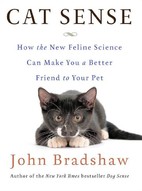
Book Review: Cat Sense: How the New Feline Science Can Make You a Better Friend to Your Pet by John W.S. Bradshaw
 Summary:
John W.S. Bradshaw, PhD, has been studying the behavior of cats and dogs and their people for over 25 years. In this book, he seeks to present the biology behind the modern domestic cat in the hopes of helping their humans understand them better. He also presents theories about the possible future of cats and suggestions as to how to direct that the best way possible for better human/cat relationships.
Review:
I picked this book up because I wanted to understand my adorable talkative tortie fluffball, Ayla, better. I certainly learned a few things about cats that I found useful in relating to my own, but I also learned a lot about the genetics of cats (not sure I really wanted to learn that), the history of human treatment of them, and theories on their future evolution.
The book is divided into 11 chapters, which could be casually grouped into the following general themes:
- the genetic and biological history of the cat or just how did we end up with a domesticated tiger anyway
- how the domestic cat thinks and feels or yes scientists are now proving that cats actually have feelings although maybe not quite to the extent that their most loving owners believe
- how cats relate to each other or cats hate other cats except for random kittens that are dropped into their nest or possibly other females from their own family
- how cats relate to people or cats think you are a giant mother cat who is possibly superior (possibly)
- how cats relate to wildlife or no cats aren’t destroying your precious birds you overly upset cat-haters (um except for possibly the wildlife on small islands but the invasive rats are actually worse and cats hunt them so there)
- the potential future of the cat or for the love of god stop spaying and neutering the bestest most loving kitties in the world and only allowing the anti-social ferals to breed.
Obviously this is a lot of ground, so I’m only going to touch on each one briefly. First though, just let me mention that the author is both a renowned expert in this science (the science of cats), and his book also features extensive references. This is thus a trustworthy source, however, potential readers should be aware that the author (just as every author) has biases, and Bradshaw’s are fairly clear in the book. The man clearly adores cats, and thus sometimes may sway a bit to the side of positive representations of cats and optimistic beliefs about the extent of their feelings and internal lives. Now, I love cats too, so that didn’t bother me in the least, but a reader just looking at the science should note this bias. Additionally, some of the studies he cites for his findings were quite small (under 100 participants, in one case, only 8 cats were tested). Studies this small show definite room for further research. Additionally, all of the cat studies he himself has conducted were in Great Britain, so cultural biases and differences in how cats and people interact should be considered when thinking about how he analyzes cat/human interaction and behavior.
The section about the history of the domestication of the cat and the genetics of the cat is, honestly, a bit of a heavy place to start for the average person just looking to get along with their cat better. There are sentences that go far more in-depth into the genetics of a cat than I really ever cared to know. Given that this book is marketed toward the average cat owner, it may have been better to dial down the genetic information just a bit to make it easier and also speedier to read in the lead-in into the more modernly relevant information. The most interesting things I learned in this section were that domestication of the cat happened in multiple different times and places, meaning multiple cultures saw the potential of the cat and domesticated them (loc 267). There is Egyptian temple art of cats sitting in baskets (loc 634), something I found to be pretty adorable. The genetics of just how we wind up with torties, which I admit to only being interested in because my own cat is a tortie:
If a cat carries one orange and one brown version of the gene, then both appear in the coat, in random patches: in one part of the skin, the chromosome with the orange version has been switched on, and in another it is it eh brown-black pattern that “wins,” producing a tortoiseshell-tabby (or “torbie”) cat. (loc 772)
If you found that quote a bit tedious to read, just bare in mind that that is the most interesting to me of the genetics information in this section. The cat is a “hypercarnivore” (loc 1176), meaning that unlike the dog, it has lost the ability to live on plants. Cats, unlike dogs, must eat meat. I also finally learned why I shouldn’t worry too much if my cat doesn’t drink very much water:
Cats do have two notable nutritional advantages over humans. First, their kidneys are very efficient, as expected for an animal whose ancestors lived on the edge of deserts, and many cats drink little water, getting all the moisture they need from the meat they eat. Second, cats do not require vitamin C. Taken together, these make cats well suited to shipboard life: they don’t compete with sailors for precious drinking water, getting all they need from the mice they catch, and they are not afflicted by scurvy. (loc 1192)
The next four sections often blurred together, since how a cat thinks and feels directly relates to how cats relate to each other, humans, and wildlife.
Cats can develop a cat form of PTSD if they are abandoned by their mothers early in life:
Kittens that are abandoned by their mothers and are then hand-raised can become excessively attention seeking toward their first owners, though some subsequently seem to “grow out of” this. Based on what we know about other mammals in similar situations, we can assume that after the mother’s departure, the kittens’ brains endure high levels of stress hormones. These consistently high levels cause permanent changes in their developing brains and stress hormone systems, such that they may overreact to unsettling events later in life. (loc 1371)
I found this particularly interesting, since I know my cat was abandoned by her first owners in their apartment when they moved away, and it took weeks for anyone to find her. I’ve often suspected my cat has some form of kitty PTSD, and I think this scientific information would support that, although the specific type of abandonment was different.
Cats can’t focus on anything closer than a foot from their nose. Your cat is not being stupid when it can’t spot a piece of food on the floor, she really can’t see it. It helps to move it around or tap the floor next to it, to get the cat to sniff that area. (loc 1644)
This section also addresses why cats are harder to train than dogs:
Cats are much more difficult to train than dogs are for at least three reasons. First, their behavior shows less intrinsic variety than that of dogs, so there is less raw material with which to work….Second, and perhaps most important, cats are less naturally attentive toward people than dogs are….Third, although dogs are powerfully rewarded by simple physical contact from their owner, few cats are. (loc 2086)
It goes on to explain how to do basic training with your cat, adapted to cats’ specific needs, primarily using a clicker (a device that makes a noise).
Feral cats have shown us that cat society is a matriarchy, with the females of the family sticking together and the toms getting booted out to go roam and make more kittens, although there are certain scenarios in which toms are tolerated living in close proximity, generally in a situation where the tom is valuable for protection of the kittens if the space is at a premium. (loc 2426)
In spite of the ability of feral cats to live in matriarchies, cats are not well-suited for a bunch of unrelated and gender-mixed cats living in one small space. Cats generally don’t like most other cats, and Bradshaw talks some about how forcing cats to live with other cats they are not related to or don’t particularly like can put undue stress on the cats.
Cats appear to be incapable of sustaining a large number of friendly relationships, even when all their neighbors are close relatives. (loc 2438)
However, the bond the cat feels with its immediate family is strong, and scientists believe they extend that bond to their owners, who they perceive of as being a sort of mother cat. (loc 3080) This section also offers potential reasons for why a cat may purr or lick their owner, but there is no definitive scientific answer yet. It is also noted that cat personalities are the result of a mix of nature and nurture, and affectionate owners tend to have affectionate cats but whether they pick out affectionate cats or cats become affectionate in response to the owner is uncertain.
Bradshaw then addresses the concern some groups have that domestic cats are hurting native wildlife populations, particularly birds. It’s clear that Bradshaw believes that this is mostly a bunch of hokum created by cat-haters as a way to get rid of cats. This is potentially true, and Bradshaw does cite some good studies about the actual impact cats have on wildlife (very small, and in some cases, helpful since they eat the invasive predator of a native species). However, it is difficult to believe everything he cites, since his bias in favor of cats is so clear, and I am saying this as a cat-lover myself. I would find it more useful for his evidence to be presented in a more balanced fashion, as I would then feel more confident citing it to people who are concerned about cat impact on wildlife.
Finally, Bradshaw looks at the potential future of the cat. He is clearly quite concerned that our current method of neutering pet cats will hurt future cats.
Because neutering inevitably targets those cats that are being best cared for, it must logically hand the reproductive advantage to those cats that are least attached to people, many of which are genetically predisposed to remain unsocialized. We must consider the long-term effects of neutering carefully: for example, it might be better for the cats of the future as a whole if neutering programs were targeted more at ferals, which are both the unfriendliest cats and also those most likely to damage wildlife populations. (loc 4039)
I found this argument to be quite moving and logical. Bradshaw suggests both that owners might let their pet cats breed once before neutering/spaying them and also that breeders could begin to work at breeding pet cats with an eye on personality rather than looks. He also suggests focusing spay/neuter programs on feral populations. This is definitely food for thought, and I certainly will consider letting a future pet cat have a litter of kittens.
Bradshaw ends his book with this statement:
Cats need our understanding–both as individual animals that need our help to adjust to our ever-increasing demands, and also as a species that is still in transition between the wild and the truly domestic. If we can agree to support them in both these ways, cats will be assured a future in which they are not only popular and populous, but are also more relaxed, and affectionate, than they are today. (loc 4072)
A good summary of the overall themes of the book.
Overall, this book will definitely teach cat owners and lovers some new things both about the science of cats and cat behaviors. Sometimes the science can veer a bit too in-depth for the audience of the book, and also sometimes the author’s love of cats can make him seem a bit biased in favor of them. However, readers who are willing to skim over the science that they are not so into will still be able to gleam lots of information from this book that will be directly helpful to them with their pet cats. Also, this audience probably won’t mind the love of cats bias in the science. ;-)
If you found this review helpful, please consider tipping me on ko-fi, checking out my digital items available in my ko-fi shop, buying one of my publications, or using one of my referral/coupon codes. Thank you for your support!
4 out of 5 stars
Length: 307 pages – average but on the longer side
Source: NetGalley

Book Review: Rewinder by Brett Battles (Audiobook narrated by Vikas Adam)
 Summary:
It’s 2015, and Denny Younger of New Cardiff, California, is a caste of 8. He loves reading and studying but he knows he will probably end up working in the shops just like his father. But when he takes his placement test, he’s offered a position that he is promised is better, but he can’t know anything about it until he starts working, and he must leave his family behind. Denny’s family life is in pieces, so he eagerly agrees. Before he knows it, he is re-caste as a 5 and soon discovers that he will be traveling through time as an observer, recording family histories for the elite. Even the smallest error in time-travel can have far-reaching consequences, and before he knows it, Denny finds himself racing against time (and other time-travelers) to fix everything. But what does fixing everything actually mean?
Review:
I love a good time-travel book, so when Audible offered this one up to me for review, I eagerly agreed. This is an action-packed book but with far less time-travel than it originally appears and much more parallel universes.
The basic premise of the book is that this is the year 2015 in a wold where the American Revolution never occurred. Without the American Revolution, the British Empire ended up taking over most of the world (except East Asia). Everyone is sorted into extremely strict castes, and family history is everything. These people haven’t made it to the moon yet, but they have managed to discover time-travel. And they use this discovery solely to send people called “rewinders” back in time to verify people’s ancestry to solidify their ranking in this world. Now, this was my first major problem with the book, and it’s a plot point I just never was able to let go of. This society acknowledges the risk of the butterfly effect and yet they brazenly send people willy-nilly through time risking everything for what? Geneaology. And this has been going on for decades with no ill effects. Perhaps other readers can get past the idea that a federally (er, royally) backed agency would do this, but I simply could not.
Naturally, when our brave hero goes back in time, he is the first to woops his way into a butterfly effect. He knows he’s probably done it (he causes someone to leave a location 12 seconds late), but he still pops back up into the present to check on things. Once there, it takes him days to figure out that he’s changed history. Daaaaays. It should really not take him this long to figure this thing out. Denny causes a change. Denny pops up to the present. Denny has troubling connecting to his companion (a person in the present who grounds the person time-traveling), so he gets sick for a few days. Denny then wanders through our universe’s New York City and can’t figure out what’s going on. It takes traveling to California’s New Cardiff (in our world, Los Angeles) and seeing that his family home is gone to figure out what’s happened. Really? A person who has been trained in time-travel takes this long to figure out this very basic time-travel problem? It’s hard to believe, especially after we’ve been told repeatedly how smart Denny is, that he could be that stupid.
Denny then starts living in Los Angeles to investigate this parallel universe. He naturally meets a girl and falls for her. He then has trouble deciding whether to put everything back or not. And of course there are other rewinders out there he must contend with.
The basic plot idea is interesting. What would have happened if there had been no American Revolution and how would a person from that society react if they discovered a different option for their lives? But how the author gets there isn’t fully thought-out or fleshed-out enough. There are too many logical fallacies, such as the ones I’ve laid out above. That said, it was a fun read with a different plot than what has been coming from a lot of YA recently. I was glad to see a scifi that contains some history for YA readers. I also appreciated how many women characters are present in the book, including Denny’s trainer and his nemesis. Similarly, Denny’s world is extremely lacking in diversity due to the success of the British empire and its traditionalism. When he travels to our world, he immediately encounters greater diversity, both of race and of sexuality, and he seems to appreciate that, which is a nice touch.
The narrator does a good job both keeping a good pace and setting the tone for the book. While I understand why the narrator uses a British accent for the British characters from the 1700s, the history geek in me was frustrated, since the stereotypical modern “British accent” didn’t exist back then. (I knew this from my History BA, but here’s an article that explains what I’m talking about).
Overall, this book has an interesting premise and fast-moving plot. It has some romance, but is thankfully free of any love triangles. Time-travel fans may be frustrated by how easily characters brush off the real presence of time-travel issues. The science of time-travel is simply not explored enough, nor is history. However, YA readers looking for a quick read and something different in the genre will most likely enjoy it.
If you found this review helpful, please consider tipping me on ko-fi, checking out my digital items available in my ko-fi shop, buying one of my publications, or using one of my referral/coupon codes. Thank you for your support!
3 out of 5 stars
Length: 300 pages – average but on the shorter side
Source: Free download from Audible in exchange for my honest review

Book Review: Liar, Temptress, Soldier, Spy: Women Undercover in the Civil War by Karen Abbott
 Summary:
Abbott looks at the little discussed role of women in the Civil War by highlighting the lives of four different women spies, two with loyalties to the South and two to the North. By following their lives through the Civil War, Abbott demonstrates the critical role women played in the Civil War that is too often silenced.
Review:
Doing Dewey’s review of this book landed it on my wishlist, and I was really pleased to receive it for Christmas. It was everything I’d expected it to be. A look at the Civil War through a women’s history perspective and told in an easy to follow style with lots of respect for the historical source material.
Abbott notes at the beginning of the book that she only uses quotation marks around information she is directly quoting from source material. I knew from that second forward I was going to enjoy this work of nonfiction, because too often authors stray either too far toward hearsay and imagining how people felt or too far toward distancing themselves from anything other than the driest facts. Abbott beautifully switches among the four different women, following the timeline of the Civil War and telling their stories simultaneously. This lends a clearer perspective on the Civil War than I had before. It puts a humanizing eye on real events.
So who are the four women highlighted in this book? On the side of the North, there’s Emma Edmonds, who had already been living as a man to escape a marriage being forced upon her by her family. Emma enlisted as a Union soldier and soon wound up spying for them — pretending to be a man pretending to be a woman to cross the lines. There’s also Elizabeth Van Lew and her freed slave Mary Bowser in Richmond who worked together to spy on the Confederate president. On the side of the South there’s Rose O’Neale Greenhow, a socialite in DC who used her affairs with Northern politicians to spy. There is also Belle Boyd, a boisterous woman at first more interested in notoriety than in helping any cause but whose loyalty to the South became ever more strong.
This book makes it clear that women made ideal spies thanks to sexism. The men of the North and South both viewed women as the “delicate sex” that would never actually participate in anything so soiled as war, so when they attempted to cross the lines, they would be let through without being searched. The more high class a woman, the more protection she was afforded, so even though women were under suspicion, they were always treated better than men under the same suspicion. For instance, Belle Boyd was caught red-handed as a spy once. The penalty for a man would be death, but she was sent to prison and then later paroled and sent back to the South, basically with a slap on the wrist and demand she not do that again. Another example, in the case of Elizabeth Van Lew,
For now, at least, her social position and gender served as her most convincing disguise. No one would believe that a frail, pampered spinster was capable of plotting treasonous acts, let alone carrying them out right under the government’s nose. (page 47)
Abbott does a good job of presenting the reality of these women’s lives and their politics matter-of-factly with little judgment from the future. The women are allowed to basically speak for themselves, and the reader can ultimately decide how they feel about them. Abbott maintains the historic feel by referring to African-Americans as “Negroes.” This may bother some readers, and they should be aware to expect it.
The only element of the book that disappointed me was how the author handled Mary Bowser. First, this woman is not one of the four featured in the book description or the title, and yet she served as a spy inside the Confederacy presidential household. Mary Bowser was freed from slavery at a young age by Van Lew’s family. The Van Lew’s sent her North to be educated and kept her on in the household as a free servant. When Elizabeth heard that Confederate President Davis’s household needed more servants, she talked to Mary about her serving there. This educated and highly intelligent woman (she was rumored to have a photographic memory) proceeded to pretend to be the stupid, subservient person the Davises were expecting through their racism, and thus was able to do things like dust President Davis’s desk and memorize upcoming troop movements to report later. It was thanks to her work in conjunction with Elizabeth, who organized how to get the information out of the South to the North, that the Union was able to know so many of the Confederacy moves ahead of time. Yet, she is not featured as one of the four main women in the book. She is not listed as one of the women spies. The end of her life after the Civil War is not mentioned, not even to say whether or not Abbott was able to find any information about her. For a book highlighting the lives of those often erased from history, writing Mary as Elizabeth’s sidekick was quite disappointing.
The book ends by telling the reader what ultimately happened in these women’s lives after the Civil War. It’s a bit of a sad note, particularly for the Union women who fought for freedom and yet wound up with little of it themselves.
At last Elizabeth retreated, withdrawing entirely from public life. She had no target for her ferocious will. Her one political act was to attach a note of “solemn protest” to her annual tax payment, declaring it unjust to tax someone who was denied the vote. (page 426)
Overall, this book covers the history of the Civil War from the unique women’s history perspective of women spies. Those looking for an engaging alternate way to learn about Civil War history will enjoy this book and learning about the women who had an impact on history.
If you found this review helpful, please consider tipping me on ko-fi, checking out my digital items available in my ko-fi shop, buying one of my publications, or using one of my referral/coupon codes. Thank you for your support!
4 out of 5 stars
Length: 533 pages – chunkster
Source: Gift

2014’s 5 Star Reads!
Since 2011, I’ve been dedicating a separate post from my annual reading stats post to the 5 star reads of the year. I not only thoroughly enjoy assembling the 5 star reads posts, but I also go back to them for reference periodically. It’s just useful and fun simultaneously! Plus it has the added bonus of giving an extra signal boost to the five star reads of the year. You may view the 5 star reads for 2011, 2012, and 2013 by clicking on the years.
With no further ado, presenting Opinions of a Wolf’s 5 Star Reads for 2014!

A Banquet for Hungry Ghosts
By: Ying Chang Compestine
Publication Date: 2009
Publisher: Henry Holt and Co.
Genre: Horror, Short Story Collection
Themes: Chinese history, food
Summary:
According to Chinese tradition, those who die hungry or wrongfully come back to haunt the living. Compestine presents here eight different ghost stories, each correlated along with a course in a banquet and richly steeped in Chinese culture and history.
Current Thoughts:
A cute book that I think of fondly. I really need to make at least one of the recipes in this book! This short story collection is presented in just the way that I most enjoy. Different stories surrounding one unifying theme. Plus, I learned something.
Full Review


Fudoki
By: Kij Johnson
Publication Date: 2003
Publisher: Tor
Genre: Fantasy
Themes: the meaning of family, identity, duty
Summary:
An aging empress decides to fill her empty notebooks before she must get rid of them along with all of her belongings to retire to the convent, as is expected of her. She ends up telling the story of Kagaya-hime, a tortoiseshell cat who loses her cat family in a fire and is turned into a woman by the kami, the god of the road.
Current Thoughts:
Warrior woman who was once a cat. Set in ancient Japan. What is not to love about that? My only regret is I waited so long to read this book. It languished on my TBR pile for far too long.
Full Review

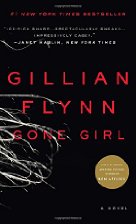
Gone Girl
By: Gillian Flynn
Publication Date: 2012
Publisher: Broadway Books
Genre: Thriller, Contemporary
Themes: be careful who you marry, not everything is as it first appears
Summary:
On Nick and Amy Dunne’s fifth wedding anniversary, Nick comes home from working at the bar he co-owns with his sister to find his wife gone. The door is wide open, furniture is overturned, and the police say there is evidence that blood was cleaned up from the floor of the kitchen. Eyes slowly start to turn toward Nick as the cause of her disappearance, while Nick slowly starts to wonder just how well he really knows his wife.
Current Thoughts:
It’s hard to give thoughts without revealing spoilers so let me just say that I still love the twist in this book, and I found the writing style to be perfect for a thriller. It’s a book that really curled my toes, and I’m glad it exists and has become so popular, and I’m looking forward to reading more Gillian Flynn this year.
Full Review


My Big Fat Demon Slayer Wedding
By: Angie Fox
Publication Date: 2013
Publisher: Indie, Self-Published
Genre: Urban Fantasy
Themes: weddings are hell but lifetime partnership is amazing
Summary:
Lizzie Brown, once preschool teacher turned demon slayer, is extremely excited to be marrying her true love, Dimitri Kallinikos, who just so happens to also be a magical shape-changing griffin. And she’s also fine with letting her adoptive mother run the whole show, even though her mother wants to make the wedding into a week-long event. She’s not so ok with having to tell her mother about being a demon slayer, though. Or about integrating her mother’s posh southern lady lifestyle with her recently discovered blood-related grandmother’s biker witch gang. She’s pleasantly surprised that her mother found a goth-style mansion to rent for the wedding. Maybe the magical and the non-magical can integrate fairly well, after all. But then it becomes evident that someone in the wedding is trying to kill her. Plus, they find demonic images around the property….
Current Thoughts:
I read this right after I got engaged, so I was in just the right frame of mind for an urban fantasy featuring a wedding. But even if I hadn’t just gotten engaged before reading it, I still would have loved it. This book knocks it out of the park with everything that makes urban fantasy delightful. A normal event kicked up a notch by fantastical characters and happenings. It also communicates the odd combination of the horror that is wedding planning and the pure joy that is finding your lifelong partner. Plus it’s hilarious and romantic.
Full Review

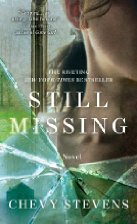
Still Missing
By: Chevy Stevens
Publication Date: 2010
Publisher: St. Martin’s Press
Genre: Thriller, Contemporary
Themes: be careful who you trust, hope and healing
Summary:
Annie O’Sullivan extremely forcefully declares in her first therapy session that she doesn’t want her therapist to talk back to her; she just wants her to listen. And so, through multiple sessions, she slowly finds a safe space to recount her horrible abduction from an open house she was running as an up-and-rising realtor, her year spent as the prisoner of her abductor, and of her struggles both to deal with her PTSD now that she’s free again and to deal with the investigation into her abduction.
Current Thoughts:
This book features a realistic depiction of PTSD plus it scared the pants off of me. Still does if I think about it too much.
Full Review

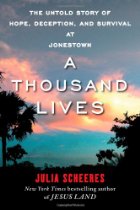
A Thousand Lives: The Untold Story of Hope, Deception, and Survival at Jonestown
By: Julia Scheeres
Publication Date: 2011
Publisher: Free Press
Genre: Nonfiction – History
Themes: understanding a tragedy, when spirituality goes awry
Summary:
On November 18, 1978, 918 people, mostly Americans, died on a commune named Jonestown and on a nearby airstrip in Guyana. The world came to know this event as that time that crazy cult committed mass suicide by drinking poisoned Kool-Aid. However, that belief is full of inaccuracies. Scheeres traces the origins of Jonestown, starting with its leader, Jim Jones, and his Christian church in Indiana, tracing its development into the People’s Temple in California, and then into Jonestown in Guyana. Multiple members’ life stories are traced as well, including information from their family members who, perplexed, watched their families give everything over to Jones.
Current Thoughts:
I am so glad I read this. I feel so much more informed and knowledgeable about Jonestown. It’s sad to me that the cultural myth of Jonestown is so different from what actually happened, particularly with regards to the mass suicide, when in many cases it was murder not suicide. This book presents an event that would be easy to brush off as “those people were just crazy” in a way that humanizes it and makes it more real.
Full Review

Book Review: Eighty Days: Nellie Bly and Elizabeth Bisland’s History-Making Race Around the World by Matthew Goodman
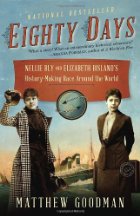 Summary:
In 1889, the world was obsessed with Jules Verne’s fictional work Around the World in 80 Days
Review:
With my interest in women’s history, I was surprised when I saw this title on Netgalley that I had never heard of this race around the world, although I had heard of Nellie Bly, due to her investigative report into Bellevue Hospital (a mental institution). I knew I had to request it, and I’m quite glad I got a review copy. Goodman tells not just the story of these two women but also immerses the reader into the newly global world of the late 1890s, both the good and the bad.
Goodman starts the book by introducing us to the two women who will race around the world. He does an excellent job using primary source materials to give us both how others saw these women and how they saw themselves. For instance, in describing Elizabeth Bisland, Goodman writes:
One of her admirers, the writer Lafcadio Hearn, whom she had befriended in New Orleans, called her “a sort of goddess” and likened her conversation to hashish, leaving him disoriented for hours afterward. Another said, about talking with her, that he felt as if he were playing with “a beautiful dangerous leopard,” which he loved for not biting him. (loc 241)
While introducing the women, Goodman also talks at length about the role of women in journalism in the late 1800s and how hard it was for them to break into real reporting. Jumping off from Bisland and Bly, describes how women were blocked from many journalism positions with excuses such as that the newsroom needed to be free to swear and not worry about a lady’s sensibilities. Women were often barred to what was deemed the ladylike journalism of the society pages. The hardest part of being a hardhitting female journalist at the time wasn’t the actual reporting but instead the reception of women in the newsroom.
The successful female journalist, McDonald suggested, should be composed of “one part nerve and two parts India rubber.” (loc 465)
Bisland and Bly and their race came at the beginning of having women journalists do some form of stunt journalism, which is how they started to break into hardhitting journalism. Editors and owners discovered that readers enjoyed reading about women in stunt situations, such as learning how to stunt ride a horse, so this was their way in. Thus, even if the reader dislikes the personalities of either or both of the racers, they come away with some level of respect for them both breaking into the business.
From here, Goodman starts following the women on their race around the world. He takes the different legs of their journeys as a jumping-off point to discuss something historically relevant to that portion of the journey. For instance, during Bly’s trip on the ocean liner to Europe, he discusses how the steamships worked, from the technical aspects of the steam to the class aspects of first class down to steerage. During Bisland’s railroad trip across the United States, he discusses the railroad barons and the building of the transcontinental railroad. Thus, the reader is getting both the story of the race and historical context. It’s a wonderful way to learn, as the historical explanations flesh out the settings around and expectations of the women, and the women lend a sense of realness to the historical situations and settings being described.
After the completion of the trip (and, no, I won’t tell you who won), Goodman explores the impact of the trip on the women’s lives and follows the rest of their lives to their deaths. This part may feel a bit long and irrelevant to some readers, however often when people become famous for doing something, no one talks about the long-lasting impact of that fame or what the rest of their lives are like. Seeing how both women reacted to the trip, their careers, and others puts them in a more complete light, giving the reader a complete picture of what the race did in their lives. This complete picture of both of their lives is something I really appreciated and that also demonstrated that one shouldn’t judge people too fast. They and their lives may turn out differently than you expect at first.
What would have made me love the book is if I had come away feeling like I could respect or look up to either woman. Unfortunately, by the time I heard the full story of both of their lives, I found them both to be so deeply flawed that I couldn’t do that. I respect them for breaking into the newspaper business, and perhaps if I was a journalist myself that would be enough to make me look up to them. But each had a fatal flaw that made this not be a book about two role models but instead a book about two women. There’s nothing wrong with that, but it does keep it from being a book I would return to over and over again.
Overall, Goodman does an excellent job using the true story of two female journalists’ race around the world in 1889 to 1890 to build a solid picture of the increasingly global world of that time. The reader will come away both with having learned an incredible true story and details about the 1800s they might not have known before, told in a delightfully compelling manner. Some readers might be a bit bothered by how flawed the two women journalists are or by the fact that the book goes on past the race to tell about the end of their lives in detail. However, these are minor things that do not distract too much from the literary qualities of this historical nonfiction. Recommended to those interested in an easy-to-read, engaging historical nonfiction book focusing in on women’s history. Particularly recommended to modern, women journalists.
If you found this review helpful, please consider tipping me on ko-fi, checking out my digital items available in my ko-fi shop, buying one of my publications, or using one of my referral/coupon codes. Thank you for your support!
4 out of 5 stars
Length: 480 pages – chunkster
Source: Netgalley

Book Review: A Thousand Lives: The Untold Story of Hope, Deception, and Survival at Jonestown by Julia Scheeres (Audiobook narrated by Robin Miles)
 Summary:
On November 18, 1978, 918 people, mostly Americans, died on a commune named Jonestown and on a nearby airstrip in Guyana. The world came to know this event as that time that crazy cult committed mass suicide by drinking poisoned Kool-Aid. However, that belief is full of inaccuracies. Scheeres traces the origins of Jonestown, starting with its leader, Jim Jones, and his Christian church in Indiana, tracing its development into the People’s Temple in California, and then into Jonestown in Guyana. Multiple members’ life stories are traced as well, including information from their family members who, perplexed, watched their families give everything over to Jones.
Review:
I have a fascination with cults and groupthink. In spite of not being born until the 1980s, I definitely was always vaguely aware of this cult that committed suicide in the 70s, always commentated on with great disdain. I had previously read Julia Scheeres’ memoir, Jesus Land
Scheeres possesses a great talent at presenting people and events as they are with understanding for common humanity but also disdain for atrocious acts. Scheeres excels at never turning a person into a monster, but rather exposing monstrous acts and asking how things became so messed up that something like that could happen. Scheeres clearly did painstaking research for this book, reading through the FBI’s extensive archives on the People’s Temple and Jim Jones, interviewing survivors, and interviewing family members of the deceased, not to mention reading members’ journals. The facts are presented in an engaging, storytelling, slightly non-linear way, which works excellently at drawing the reader in. The book starts on the boat to Guyana, then flashes back to the origins of Jim Jones. The members of People’s Temple are carefully presented as the well-rounded people they truly were with hopes and dreams and who made some mistakes. They are not ever presented as just a bunch of crazies. Even Jones is allowed a time as a preacher passionate for social justice before he turned into the control freak, whose paranoid delusions were exacerbated by drug addiction. Scheeres takes an event that it is far too easy to put the stamp of crazy on, and humanizes it, drawing out the gray areas. And this is all done while telling an engaging, well-written, factual story.
There are an incredible number of facts in this book, and the reader learns them while hardly even realizing it, since this work of nonfiction is so readable. Among the things I never knew, I found out that the People’s Temple originally was a Christian church that was heavily socialist and then slowly turned into its own religion as Jones pulled away from the Bible, eventually declaring himself god. When Jones was in California, he was heavily involved in politics, sponsoring people such as Harvey Milk for office, and breaking voting laws by sending his church en masse to vote in districts they didn’t live in. Jones enacted weekly corporate punishment of individual members in front of all the other members. He was bisexual, having sex with both male and female members of the People’s Temple. He became obsessed with the idea of suicide to make a statement and routinely badgered the higher members of the People’s Temple into accepting suicide if he ordered it. He even tricked them multiple times into thinking that he had given them poisoned drinks, just to see who would obey and drink it. The members came to Jonestown in Guyana expecting a utopia, since Jones had lied to them, and instead got a struggling farm on the brink of disaster, being run by a man increasingly paranoid and delusional and ever more addicted to drugs. Once members were in Jonestown, they were not allowed to leave. And many wanted to. Last, but most important, the mass suicide was not a mass suicide. It was a murder-suicide. Some of the members committed suicide willingly, but others, including over 300 children, were force-fed or injected with the poison. Those who drank it drank it mixed with Flavor-Aid, a generic knock-off brand of Kool-Aid. It astounds me how much the facts of these events from as recent as 1978 are now misremembered in the collective consciousness, especially considering the fact that documentation such as the Jonestown death tape are available for free in the public archive.
Overall, this book takes a misremembered event in recent history and exposes the facts in an incredibly readable work of nonfiction. Scheeres presents the people who died in Jonestown with empathy and understanding, seeking to tell their whole life story, rather than one moment. A fascinating look at a horrible event, and a moving reminder to never give too much power or faith to one person, and how very easy it is for groupthink to take over. Highly recommended.
5 out of 5 stars
Source: Audible
Book Review: The Emerald Diamond: How the Irish Transformed America’s Greatest Pastime by Charley Rosen
 Summary:
Did you know baseball has been entwined with Irish-Americans from the very beginning of the sport? Rosen goes through the history of baseball, focusing in on how Irish-American players, managers, and owners impacted the game.
Review:
I picked this up from my pile of older review copies to read in honor of St. Patrick’s Day. I’m part Irish myself and was a US History major in undergrad, so the concept of the book definitely appealed to me. The book addresses the interesting topic of Irish-Americans in baseball but unfortunately presents the history in an only sometimes interesting way and utilizes sloppy research.
The book starts in the 1800s and works its way up through time, ending many chapters with a modern day interview to reflect upon the ideas presented in the chapter. The earliest chapters are the most interesting. They take the events and use them to tell the story of how Irish-Americans broke into baseball partly because many careers were closed off to them due to anti-Irish discrimination in America (No Irish Need Apply). Originally, the game was much less regulated, and the Irish-American players brought with them a willingness to be sly and rough that added an element of excitement to the game that brought out more viewers. Reading about how the rules slowly changed and how Irish-Americans impacted those changes was definitely fascinating. It was also disturbing to discover how many players in the early years had serious addiction problems, not to mention the presence of multiple suicides. Unfortunately, the opportunity to analyze this phenomenon and discuss it in depth is passed by, as is most true historical analysis.
Starting in the early 20th century, the formatting of the book changes so that instead of telling a story, the heading of a year is given and bullet-points of events for that year are listed. Some of these bullet-points break out to be actual stories, instead of just pure listing of facts, and that is what kept me reading. But mostly about half the book is just lists of baseball facts. It reminded me of reading Chronicles in the Bible (so-and-so begat so-and-so). There are some interesting tidbits in there, but they are few and far between.
I was truly appalled when I flipped back to check the references in the back that almost all of them are secondary sources, and a significant number are Wikipedia. It’s one thing to start your research at Wikipedia to familiarize yourself with the topic and then broaden out to more scholarly work and primary sources. It’s another thing entirely to publish an entire book that basically just sums up Wikipedia. A work of historic nonfiction should seek out as many primary sources as possible, read secondary analyses, and provide analysis both of the primary and secondary sources. What Rosen has done is mostly to regurgitate what Wikipedia and other secondary sources have already said. The exception to this is the modern day interviews Rosen conducted, but they make up a small portion of the book. Perhaps 15%. If the book had consisted of interviews with modern Irish-American players and descendants of Irish-American players and managers, complete with analysis and investigation using primary and secondary materials, that would have been a fantastic book. Instead we get a relisting of information already gathered (and better sourced) in secondary sources spiced up with a few interviews. If I had bought this book, I would have returned it.
Overall, there are some interesting tidbits about how Irish-Americans impacted the game of baseball. Unfortunately, large parts of the book are lists of facts, with no analysis or storytelling, Additionally, Rosen relied primarily on secondary source materials, mostly Wikipedia, to research his book. The reader could get similar information from Wikipedia themself and have the ability to click through to the source materials. I would suggest doing that over buying this book. For those seeking a book on the topic, I recommend The Irish in Baseball: An Early History
2 out of 5 stars
Source: Print copy from publisher in exchange for my honest review

Book Review: The Hornet’s Sting: The Amazing Untold Story Of Second World War Spy Thomas Sneum by Mark Ryan (Bottom of TBR Pile Challenge)
 Summary:
Thomas Sneum was a Danish Allied spy during World War II who was periodically suspected of being a double agent. Partially due to this suspicion and partially due to infighting between the two British spy agencies (SIS and SOE), he never got the attention or respect he deserved. Mark Ryan, the author, found out about him and set out to get to know him. Both personally and through research. Here he tells the true story of Tommy Sneum and sets the record straight once and for all.
Review:
I picked this book up during a kindle sale because I’m a big WWII buff and who doesn’t love real life spy stories? I thought it was a sure bet, but apparently even a true life spy story can be written in a dull manner.
It’s impossible to read the book without learning a lot. For instance, I had no idea that Britain had two different spy agencies that were battling each other for control of spying missions. This infighting between the SIS and the SOE led to lack of communication and lack of a solid spy front with one, unified plan. Similarly, I didn’t know it was common practice to take people who had escaped from behind Nazi lines, train them as spies, then re-drop them back in their home countries. I always thought the resistance movement just built up from the inside and then they contacted the Allies on the outside with information. How much more complex it was is really interesting. I also loved learning more about those from occupied countries who escaped and fought in other militaries against the Nazis. In spite of learning all of these new to me facts about WWII spying, the book manages to be dull. Ryan tends to wander off on side diatribes about the intricacies of red tape and paperwork instead of focusing in on the more action-oriented, interesting bits of the spying. He also spends a lot of time giving the full name of every single person even vaguely connected with Tommy and the spying, even if they really have no impact on the story. The book could really have used a bit more streamlining and focus to keep the energy up. Just because it’s nonfiction doesn’t mean it can, or should, meander.
Tommy Sneum is hard to root for. He’s not a likable guy. He abandons his wife and infant daughter to go be a spy. That could definitely be seen as valiant, however, he expresses consistent distate for his wife and a lack of concern or care for even knowing his daughter. He certainly comes across in the book as a guy just after adventure, not so much a man looking to protect his country or his family. Similarly, Tommy express arrogance when it comes to women, claiming that they essentially would go sleep with him at the drop of a hat or a snap of his fingers. He does not come across as seeing women as people but rather as recreational objects. One story that really demonstrates this is he tells the author that he had a threesome once, and he was upset that the women dared to pay attention to each other at all, rather than 100% to him. Sex is supposed to be about people giving to each other, not about one person being worshiped. His general attitude towards women gave me a squicky feeling throughout the book. Of course, most people are not all bad or good. Tommy is no exception. He expresses a real openness toward a male colleague who was known to be bi. He refuses to view all Germans as evil monsters and insists, to those high up in the British resistance no less, that most Germans are just caught up in Hitler’s war machine. Of course, these even-handed views are almost universally held of men.
Perhaps the most interesting part of the book is Ryan’s investigation into the accusations that Sneum was a double-agent. This part of the book isn’t really played up in the blurb, which I think is unfortunate. Ryan did a lot of investigative work and lays out all the details that he believes clears Sneum’s name. Seeing how Sneum and his methods were misunderstood by the British and also how having two different spy agencies working led to misunderstandings was truly fascinating, and I’m glad Ryan took the time to work at finding the truth.
Overall, this is a rather slow-paced work of historic nonfiction that focuses in on the red tape and organizational aspects of spying more than exciting adventures. It does good work in determining that Sneum was not a double agent in WWII. Sneum’s womanizing can be a bit tedious at times, although his even-handed perspective on the German people is good to see. Recommended to those interested in the organizational aspects of spying in WWII, including very minute details.
3 out of 5 stars
Source: Amazon
Buy It
Note: Apparently this book is no longer available on the kindle.

Book Review: Chop Suey: A Cultural History of Chinese Food in the United States by Andrew Coe (Bottom of TBR Pile Challenge)
 Summary:
American Chinese food is different from Chinese Chinese food. This is a well-known fact. Coe tells the history of how Chinese food came to America and changed and adapted to the cuisine we know today. Along the way, some of the stories of Chinese immigrants to America and Chinese-Americans are told as well.
Review:
I love food, and I love history, so a book telling the history of a specific cuisine totally appealed to me. Unfortunately, this book missed the mark for what could have been an enticing history of American style Chinese food. Instead, it gets hung up in the early history of both Chinese food in China and Chinese food in America in the 1800s then hops, skips, and jumps over how it changed through the 1900s up to present. While this information is interesting, it is not the history of American Chinese food it is presented as.
The main issue with the book is it spends almost 1/4 of its time exploring the history of Chinese food in China. While I learned some interesting facts, such as that tofu was invented in the Han Dynasty (page 80), this information is not necessary to convey how Chinese food came to America and changed. A much briefer introduction to where Chinese food was at before coming to America would have sufficed. The best part of the book is when it discusses Chinese food in America in the 1800s and explores how US-born Americans’ embracing of Chinese food or not depended on many factors such as the current rates of xenophobia, job markets, and prices. Viewing the history of the American west coast through the perspective of Chinese immigration and Chinese restaurants was truly fascinating. One of the more fascinating things that I learned in this section was a detail of the history of the racist perception of Asian men as not masculine. In that time period, when Chinese immigrants were competing with white Americans and Irish immigrants for railroad and other jobs, the backlash was that since Chinese men “didn’t need” to eat meat to work long hours they could afford to take a lower rate of pay. Articles attacked the Chinese diet as a sign that Chinese men are less masculine since they “don’t need” meat the way white American and Irish-American men do. One article title from this time period cited in the book is “Some Reasons for Chinese Exclusion. Meat vs. Rice. American Manhood against Asiatic Coolieism. Which Shall Survive?” by Samuel Gompers (page 141). As a vegetarian, I found it fascinating that the sexist perception of a less meat-centric diet (the Chinese did indeed eat meat, just less than American men), has both such a far-reaching history and was used to fuel xenophobia and racism against immigrant workers. It is clear to me after reading this that a large part of the work for vegetarians is to get rid of the faulty correlation between meat and masculinity. I could see fixing this having other positive outcomes as well, such as fighting against misperceptions of the masculinity of other cultures.
Unfortunately, the wonderful details found in the chapters on the 1800s gradually cease to exist as the book moves up through time. While the 1920s get some special attention, such as touching on the fact that Chinese restaurants survived Prohibition well because they had never served alcohol anyway (page 189), slowly these details fall away until we get nothing but the bare bones of how Chinese restaurants functioned and interacted with American history in the rest of the 20th century up to present. There is even one rather aggravating long aside exploring President Nixon’s visit to China. While his visit to China definitely gave a resurgence of interest in Chinese food in the US, it was again unnecessary to give such incredible details on Nixon’s visit. It could have been simply stated, instead, that Nixon visited China, bringing Chinese food to the forefront of American thought again and giving a resurgence of interest in Chinese cuisine. The book has a tendency to lollygag on topics that are not actually what the book is supposed to be about. While these topics can be interesting and Coe explores them well, they are not what the book supposedly is about. It would be better to present the book with a different title or edit the focus back to simply Chinese-American cuisine.
One other factor that made me enjoy the book less is that Coe shows a clear bias toward Chinese culture. There is nothing wrong with enjoying Chinese culture, but Coe says some things that if he had said them in reverse would be considered completely unacceptable to say. He frequently presents the Chinese people as more civilized, their way of doing things as more logical and simply better, and even scoffs at the level of advancement of European countries compared to China at one point (page 94). Lack of bias and simply presenting the facts is the strength of historical nonfiction works. It would have been nice to see that level of professionalism in this book, regardless of Coe’s personal views.
Overall then, while I learned some new facts about both Chinese-American cuisine and Chinese-American history, the book wanders significantly through Chinese history and Chinese cuisine as well. Interesting, but not what the title implies the book is about. Coe also shows some bias that should not be present in a history book. These are easily skimmed over, however, and thankfully do not come up very often. Recommended to those with an interest in both Chinese-American and Chinese history in addition to the history of American style Chinese cuisine, as all three are covered rather equally.
3 out of 5 stars
Source: Amazon

 Support my work with a tip or browse my shop for curated book club guides, how to guides, cross-stitch patterns, and more!


This work by Amanda Nevius is licensed under a Creative Commons Attribution-Noncommercial-No Derivative Works 3.0 United States License.
 Opinions of a Wolf