
Archive
Book Review: A Sunny Place for Shady People by Mariana Enríquez, translated by Megan McDowell

A chilling yet deeply human collection of short stories where ghosts, goblins, and the macabre collide with everyday life—showcasing a rising star in Argentinian literature.
Summary:
Welcome to Argentina and the fascinating, frightening, fantastical imagination of Mariana Enriquez. In twelve spellbinding new stories, Enriquez writes about ordinary people, especially women, whose lives turn inside out when they encounter terror, the surreal, and the supernatural. A neighborhood nuisanced by ghosts, a family whose faces melt away, a faded hotel haunted by a girl who dissolved in the water tank on the roof, a riverbank populated by birds that used to be women—these and other tales illuminate the shadows of contemporary life, where the line between good and evil no longer exists.
Lyrical and hypnotic, heart-stopping and deeply moving, Enriquez’s stories never fail to enthrall, entertain, and leave us shaken. Translated by the award-winning Megan McDowell, A Sunny Place for Shady People showcases Enriquez’s unique blend of the literary and the horrific, and underscores why Kazuo Ishiguro, winner of the Nobel Prize for Literature, calls her “the most exciting discovery I’ve made in fiction for some time.”
Review:
This diabolical collection of 12 horror stories, each with at least a touch of the supernatural, blends the speculative with the deeply human. While steeped in Argentinian culture, the themes—grief, fear, injustice—resonate universally.
My favorite stories in this collection explore women’s suffering and resilience. “Metamorphosis” follows a woman undergoing a hysterectomy as she confronts medical misogyny, while “Different Colors Made of Tears” examines the far-reaching impact of domestic violence, even on those who haven’t experienced it firsthand. Other stories explore moral dilemmas, like the tension between wanting to help others while maintaining personal safety, or the existential fear of cancer.
The speculative elements vary in intensity—some stories lean fully into the fantastical, while others offer just a whisper of the supernatural. In “Different Colors Made of Tears,” a vintage clothing shop buys dresses from an elderly man—only to later discover that rumor has it he was abusive to his ex-wife. When women try on the dresses, they see horrific injuries appear on their own bodies, disappearing once the garments are removed. In contrast, “Metamorphosis” unfolds primarily as a starkly realistic medical narrative, with the speculative twist emerging only at the end, when a woman considers an unconventional body modification procedure to reclaim part of her lost uterus.
At times, I found the endings too abrupt. While this can work, in this case, I frequently felt like I was just settling in when the narrative was yanked away too soon. One small nitpick: a story features a character’s uncle who emigrated from Argentina to Vermont, where he became wealthy working for Boeing. Having grown up in Vermont and now working in the nonprofit sector here, I found this detail unrealistic. Vermont has exactly four Boeing employees—it’s just not a company with a presence in the state. A medical center, insurance company, or even Ben & Jerry’s would have been a more believable employer.
While most of the horror is not overly explicit, some stories do push boundaries. On-page content includes death, murder, torture, addiction, medical trauma, and the killing of a cat, while mentions of rape and confinement in tight spaces also appear. The collection is largely set in Argentina, with one story taking place in the U.S. To my understanding, all the characters appear to be white Argentines. Some disabilities, such as endometriosis, are explored, and one story features a gay couple. (Information on the current state of LGBTQIA+ rights in Argentina.) Another follows a woman reflecting on her codependent relationship with a partner struggling with Substance Use Disorder and being unhoused.
Overall, this is a dark, thought-provoking collection that blends psychological and supernatural horror with a sharp social lens. It tackles unsettling themes in ways that are both intimate and chilling. Recommended for readers who enjoy horror that lingers long after the final page.
If you found this review helpful, please consider tipping me on ko-fi, checking out my digital items available in my ko-fi shop, buying one of my publications, using one of my referral/coupon codes, or signing up for my free microfiction monthly newsletter. Thank you for your support!
4 out of 5 stars
Length: 257 pages – average but on the shorter side
Source: Library
Buy It (Amazon or Bookshop.org)
Get the Book Club Discussion Guide
A beautifully graphic designed 2 page PDF that contains: 1 icebreaker, 9 discussion questions arranged from least to most challenging, 1 wrap-up question, and 3 read-a-like book suggestions
View a list of all my Book Club Guides.
5 Short LGBT Book Club Books

So, you want to bring an LGBTQIA+ book to your book club. But Pride month is already upon us, so it needs to be short! Or maybe reading an LGBTQIA+ book will be a bit of a stretch for your group so you want to entice them into it by promising a short read.
Never fear, your friendly queer and bisexual book blogger has your back with 5 books all under 300 pages. Plus, I have discussion guides available for each and every one of them.
Let’s take a look at them from shortest to longest.

On a Grey Thread by Elsa Gidlow
Coming in at just 73 pages, this is also in the public domain – meaning everyone in your book club can read it on Archive.org for free. (They can also get it on Amazon or Bookshop.org if they prefer.)
Published in 1923, this poetry collection was the first in North American history to openly express lesbian desire. Both personal and political, Gidlow’s poems express the poet’s complex feelings as a young woman whose political ideology and sexual identity ran counter to the traditional values of her time. Whether or not this will work for your book club depends on everyone’s feelings about poetry. But it’s a nice, quick read with historical value.
Get the Discussion Guide
A beautifully graphic designed 2 page PDF that contains: 1 icebreaker, 9 discussion questions arranged from least to most challenging, 1 wrap-up question, and 3 read-a-like book suggestions.
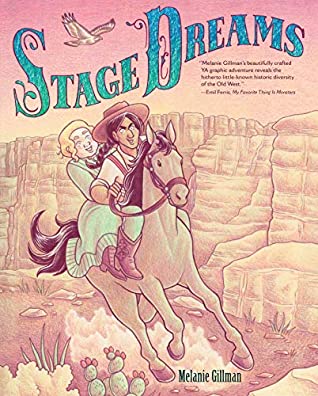
Stage Dreams by Melanie Gillman
While technically more pages than the poetry book with 104, this is a graphic novel, so it’s possible it’s actually an even quicker read. Get it on Amazon or Bookshop.org.
In this rollicking queer western adventure, acclaimed cartoonist Melanie Gillman (Stonewall Award Honor Book As the Crow Flies) puts readers in the saddle alongside Flor and Grace, a Latina outlaw and a trans runaway, as they team up to thwart a Confederate plot in the New Mexico Territory. When Flor—also known as the notorious Ghost Hawk—robs the stagecoach that Grace has used to escape her Georgia home, the first thing on her mind is ransom. But when the two get to talking about Flor’s plan to crash a Confederate gala and steal some crucial documents, Grace convinces Flor to let her join the heist.
Get the Discussion Guide
A beautifully graphic designed 2 page PDF that contains: 1 icebreaker, 9 discussion questions arranged from least to most challenging, 1 wrap-up question, and 3 read-a-like book suggestions.

Solo Dance by Lit Kotomi, translated by Arthur Reiji Morris
This 149 page read is more of a contemporary, literary selection, translated from its original Japanese. Get it on Amazon or Bookshop.org.
Cho Norie, twenty-seven and originally from Taiwan, is working an office job in Tokyo. While her colleagues worry about the economy, life-insurance policies, marriage, and children, she is forced to keep her unconventional life hidden—including her sexuality and the violent attack that prompted her move to Japan. There is also her unusual fascination with death: she knows from personal experience how devastating death can be, but for her it is also creative fuel. Solo Dance depicts the painful coming of age of a queer person in Taiwan and corporate Japan. This striking debut is an intimate and powerful account of a search for hope after trauma.
Get the Discussion Guide
A beautifully graphic designed 2 page PDF that contains: 1 icebreaker, 9 discussion questions arranged from least to most challenging, 1 wrap-up question, and 3 read-a-like book suggestions.

The Gilda Stories by Jewelle Gómez
If your book club likes the paranormal or urban fantasy genres, then this 252 page read should be right up their alley. Get it on Amazon or Bookshop.org.
A young Black girl escapes slavery in the 1850s United States. When she grows up, she is made into a vampire with her consent. We see her immortal life and her perspective of the US through an imagined 2050.
Get the Discussion Guide
A beautifully graphic designed 2 page PDF that contains: 1 icebreaker, 9 discussion questions arranged from least to most challenging, 1 wrap-up question, and 3 read-a-like book suggestions.

Coffee Will Make You Black by April Sinclair
At 256 pages, this will be a great fit for a book club that likes historic fiction set in the mid-20th century. Get it on Amazon or Bookshop.org.
Set on Chicago’s Southside in the mid-to-late 60s, following Jean “Stevie” Stevenson, a young Black woman growing up through the Civil Rights and Black Power movements. Stevie longs to fit in with the cool crowd. Fighting her mother every step of the way, she begins to experiment with talkin’ trash, “kicking butt,” and boys. With the assassination of Dr. King she gains a new political awareness, which makes her decide to wear her hair in a ‘fro instead of straightened, to refuse to use skin bleach, and to confront prejudice. She also finds herself questioning her sexuality. As readers follow Stevie’s at times harrowing, at times hilarious story, they will learn what it was like to be Black before Black was beautiful.
Get the Discussion Guide
A beautifully graphic designed 2 page PDF that contains: 1 icebreaker, 9 discussion questions arranged from least to most challenging, 1 wrap-up question, and 3 read-a-like book suggestions.
Bonus Suggestion:

Bloemetje: a speculative retelling of Hans Christian Andersen’s Thumbelina fairy tale by Amanda McNeil
Of course, I must also mention my own queer-inclusive retelling of Thumbelina, coming in at 121 pages. Available on Amazon.
A Dutch company known as The Bedrijf commences colonizing Venus via the construction of a dome filled with plants that convert its natural air into something breathable by humans. Since all workers are granted permission to bear a child, a woman and her spouse join the crew. But the woman soon discovers she is plagued with infertility. When her spouse illegally brings home a tulip from the garden, they discover a miniature baby inside who they name Bloemetje – little bloom. As the baby grows in mere days into a teenager, pushing her boundaries, she illuminates the true horrors of colonization and leads them all on a journey to decolonize.
If you’re interested in reading this for your book club, drop me a note at mcneil.author@gmail.com. I’d be happy to make a discussion guide and/or talk to your book club via Zoom or similar software.
Book Review: The Unit by Ninni Holmqvist
 Summary:
In the Sweden of the near future women who reach the age of 50 and men who reach the age of 60 without having successfully acquired a partner or had children are deemed “dispensable” and sent to live in “a unit.” These units appear at first glance to be like a high-class retirement home, and indeed they have all the amenities. The residents, however, are required both to participate in medical experiments and to donate various organs and body parts up until their “final donation” of their heart anywhere from a year or a few years after their arrival in the unit. Dorrit arrives at the unit depressed, but accepting of her fate as the result of her independent nature, but when she falls in love, she starts to question everything.
Review:
The entire concept of this book intrigued me as it is clearly a dystopia whose focus is on the older generations instead of teenagers and young people. The concept itself is of course frightening to any of us who have come to grips with the fact that some day we will be elderly too. This dystopia is also unique though in that it examines the possible future movement of Swedish society, which is vastly different from American society.
The writing is entirely from the perspective of Dorrit. Although it is clear she is writing from some point after the events occurred, Holmqvist eloquently allows her voice to change to reflect her changing ideas on society, her friends, her family, and her own life. When Dorrit first arrives in the unit, she attempts to defend herself saying that women used to be raised to be independent instead of with such a high focus on producing children that will add product to the GNP. It’s not as if she didn’t want a partner, she did, but it didn’t happen. So why is that her fault? Deeper issues are addressed too such as why does only a new family unit count and not siblings? What about pets? Don’t they need us? The vast implications of such a focus on interpersonal relationships found in the traditional family unit are subtly addressed. What type of people tend to be alone family-less by the age of 50 or 60? One resident in the unit’s library, for instance, points out that
“People who read books…tend to be dispensable. Extremely.” (Page 26)
Of course the setting of this dystopia also brings up other interesting issues that Holmqvist handles quite well. The dystopian setting allows the author to address the perpetual loss of friends that the elderly face as well as seeing themselves and their friends sicken mentally and physically. Placing it in a society in which this is exacerbated by science naturally gives it another level as well as a welcome distance for the elderly reader. This of course is a large part of what makes this dystopia different from the typical YA version. Instead of dramatizing the challenges young people typically face such as their world widening and new knowledge being imparted, this one shows how the world becomes smaller and acceptance that it’s too late to change the world becomes the norm.
Perhaps the most universally interesting issue this dystopia addresses is how much the individual should be willing to sacrifice for the greater good. The residents in the unit are constantly being told that their discomfort in an experiment could improve the lives of hundreds of needed people. Or that they should be perfectly fine with “donating” one of their corneas and going half-blind if it means that a nurse with three children can remain a contributing member of society. While some of the residents grow resentful of this concept, referring to the unit as a free-range organ farm, Dorrit finds leaning on this perceived value helps her with her depression in the unit.
“Otherwise I would feel powerless, which I essentially am, but I can cope with that as long as it doesn’t feel that way too.” (Page 71)
Clearly this book makes one think not just about the issues the elderly face but also about how society as a whole treats them and makes them feel. It also firmly addresses just how much individuality and choice it is justifiable to give up for the greater good. The ending completely shocked me and has left me with even more to ponder than the points given above, but I want to leave those for the future reader to discover.
I am incredibly glad this work was translated into English, and I highly recommend it to everyone, but especially to dystopia and scifi lovers, as well as those interested in sociology and psychology.
5 out of 5 stars
Source: Amazon

 Support my work with a tip or browse my shop for curated book club guides, how to guides, cross-stitch patterns, and more!


This work by Amanda Nevius is licensed under a Creative Commons Attribution-Noncommercial-No Derivative Works 3.0 United States License.
 Opinions of a Wolf