
Archive
Book Review: Soul Surfer: A True Story of Faith, Family, and Fighting to Get Back on the Board by Bethany Hamilton

A powerful disability memoir about faith, resilience, and healing after a shark attack.
Summary:
They say Bethany Hamilton has saltwater in her veins. How else could one explain the passion that drives her to surf? How else could one explain that nothing—not even the loss of her arm—could come between her and the waves? That Halloween morning in Kauai, Hawaii, Bethany responded to the shark’s stealth attack with the calm of a girl with God on her side. Pushing pain and panic aside, she began to paddle with one arm, focusing on a single thought: “Get to the beach….” And when the first thing Bethany wanted to know after surgery was “When can I surf again?” it became clear that her spirit and determination were part of a greater story—a tale of courage and faith that this soft-spoken girl would come to share with the world.
Soul Surfer is a moving account of Bethany’s life as a young surfer, her recovery after the attack, the adjustments she’s made to her unique surfing style, her unprecedented bid for a top showing in the World Surfing Championships, and, most fundamentally, her belief in God. It is a story of girl power and spiritual grit that shows the body is no more essential to surfing—perhaps even less so—than the soul.
Review:
In many of the circles I’m in, “recovery” means recovery from addiction. But it can also mean recovery from trauma—and for many of us (studies suggest around 75%), those things are intertwined. That’s part of why memoirs about recovering from trauma resonate so deeply with me. I’m especially drawn to the ones that focus not on the traumatic event itself, but on the response to it—the healing, the resilience, the rebuilding. This is that kind of memoir.
I remember when the news broke in 2003: a teenage surfer in Hawaii had lost her arm to a shark attack. I was in high school myself, and even though I lived in Vermont (far from any waves), I immediately felt heartbroken for her, losing not just a limb, but the ability to pursue something she loved. Years later, when I learned Bethany was not only surfing again but competing professionally, I was stunned—and moved.
Bethany knows that readers will come to her story expecting to read about the shark attack, and she doesn’t shy away from it. But she also doesn’t sensationalize it. It’s described early in the book with striking clarity and calm. There’s no melodrama—just presence, perspective, and truth. It’s a credit to both her and her editorial team that this tone is preserved. Her calm focus in the water (“Get to the beach…”) is echoed in how she writes.
What carries Bethany through, more than anything, is her deep faith. She was a girl of faith before the attack, during recovery, and continues to lean on her faith throughout her life. Her story isn’t preachy, but it is grounded in that spiritual strength. Her family, too—supportive parents and brothers—play a major role, along with a strong friend group that surrounds her in the aftermath.
One of my favorite moments in the book is her description of working with a blind therapist during her recovery. That peer connection—being guided by someone who also lives with a disability—felt powerful and familiar. Coming from the world of recovery, I saw that moment as a type of peer support. Rather than being told how to heal by someone without shared experience, Bethany was supported by someone who understood. It’s a powerful reminder of why peer-based healing matters.
Bethany also takes care to honor Hawaiian culture. As a white surfer growing up in Hawaii, she shares what she’s learned about the Indigenous roots of surfing, respectfully credits Hawaiian words and traditions, and speaks with admiration about her Hawaiian coach. This kind of cultural awareness—especially in faith-based memoirs—is both rare and welcome.
Later in the memoir, she explores what it was like to become famous almost overnight. From media appearances to a Hollywood movie adaptation, Bethany shares the highs and lows with honesty—including awkward encounters with strangers and challenging public questions.
I listened to the audiobook, which includes a charming guitar riff at the end of each chapter—a small touch that added to the overall tone and kept me engaged.
Overall, this is an uplifting, engaging memoir of trauma, recovery, and spiritual grit. It doesn’t just tell the story of a shark attack. It tells how we can recover. If you’re interested in memoirs, faith-based stories of resilience, or narratives about disability and healing, this one’s worth the read.
If you found this review helpful, please consider tipping me on ko-fi, checking out my digital items in my ko-fi shop, buying one of my publications, using one of my referral or coupon codes, signing up for my free microfiction monthly newsletter, or tuning into my podcast. Thank you for your support!
4 out of 5 stars
Length: 222 pages – average but on the shorter side
Source: Library
Buy It (Amazon or Bookshop.org)
Book Review: Steering the Craft by Ursula K. Le Guin
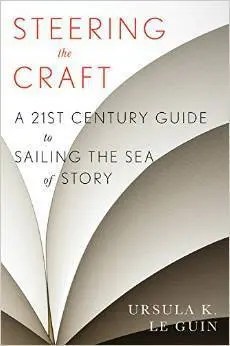
An essential, genre-inclusive writing guide packed with practical advice and thoughtful exercises for writers at any stage.
Summary:
From the celebrated Ursula K. Le Guin, “a writer of enormous intelligence and wit, a master storyteller” ( Boston Globe ), the revised and updated edition of her classic guide to the essentials of a writer’s craft.
Completely revised and rewritten to address modern challenges and opportunities, this handbook is a short, deceptively simple guide to the craft of writing.
Le Guin lays out ten chapters that address the most fundamental components of narrative, from the sound of language to sentence construction to point of view. Each chapter combines illustrative examples from the global canon with Le Guin’s own witty commentary and an exercise that the writer can do solo or in a group. She also offers a comprehensive guide to working in writing groups, both actual and online.
Masterly and concise, Steering the Craft deserves a place on every writer’s shelf.
Review:
Ten chapters. Ten essential elements of writing craft. Each paired with clear, focused exercises designed to sharpen your skills—no matter your genre.
I first borrowed the ebook from my library, but found it so helpful I requested the print version as a holiday gift. Now it lives on the shelf with my most trusted writing resources, right alongside The Emotion Thesaurus.
Despite her legendary status, Le Guin never talks down to the writer. Her tone is accessible, encouraging, and—when needed—direct. It’s the kind of guidance that feels both generous and grounded. Though best known for speculative fiction, she pulls examples from across genres and even tailors prompts for nonfiction writers, especially memoirists.
The topics span everything from grammar and punctuation to big-picture fundamentals like point of view. One of my favorite prompts came from Chapter 1, “The Sound of Your Writing.” I used it to write Pumas, Coffee, and Writing About Grief, a microfiction piece that became one of the most popular episodes on my podcast. That’s the power of this book—it doesn’t just teach; it unlocks ideas.
The final chapter on running peer workshops is full of practical wisdom. If you’re thinking of starting a group (or reviving one that’s fizzled), it’s worth reading for that section alone.
Overall, this is a resource I’ll return to again and again. If you’re a writer at any stage of the journey, I can’t recommend it enough.
If you found this review helpful, please consider tipping me on ko-fi, checking out my digital items in my ko-fi shop, buying one of my publications, using one of my referral or coupon codes, signing up for my free microfiction monthly newsletter, or tuning into my podcast. Thank you for your support!
5 out of 5 stars
Length: 160 pages – average but on the shorter side
Source: Gift
Buy It (Amazon or Bookshop.org)
Book Review: The Dragon from Chicago: The Untold Story of an American Reporter in Nazi Germany by Pamela D. Toler

Discover the untold story of Sigrid Schultz, the fearless American journalist who exposed the rise of Nazi Germany—at a time when women were underrepresented in jouranlism.
Summary:
Schultz was the Chicago Tribune ‘s Berlin bureau chief and primary foreign correspondent for Central Europe from 1925 to January 1941, and one of the first reporters—male or female—to warn American readers of the growing dangers of Nazism.
Drawing on extensive archival research, Pamela D. Toler unearths the largely forgotten story of Schultz’s years spent courageously reporting the news from Berlin, from the revolts of 1919 through Nazi atrocities and air raids over Berlin in 1941. At a time when women reporters rarely wrote front page stories, Schultz pulled back the curtain on how the Nazis misreported the news to their own people, and how they attempted to control the foreign press through bribery and threats.
Review:
This wasn’t on my TBR or wishlist, but when I saw the cover and subtitle at the library, I had to pick it up. I love a troublemaking woman journalist trope—and this was that trope in real life, plus WWII! This nonfiction history book delivers, and in a reader-friendly way.
Despite its depth, this book reads almost as easily as fiction. The author takes care not to put words in the mouths of historical figures—every direct quote comes from letters, interviews, or official documents—yet the scenes are vivid and easy to follow. Each phase of Sigrid Schultz’s life gets just the right amount of attention, from her childhood in Chicago, to her teen years in Europe, to her time as a pioneering journalist. There’s even a well-developed chapter about her post-journalism years in Connecticut, which many historical biographies tend to gloss over.
When I review historical nonfiction, I like to share a few standout insights without giving away everything—so here’s what stuck with me the most.
Sigrid’s sense of identity was deeply American—despite living abroad from age 8 onward. She was so committed to her citizenship that she turned down a full-ride scholarship for singing because accepting it would have required her to renounce her U.S. citizenship.
Her personal life was shaped by loss. Sigrid lost her fiancé in WWI and her second great love to illness in the 1930s. It’s a stark reminder of how much death and grief defined the early 20th century. She didn’t choose to be an independent woman supporting herself and her mother—it was a necessity.
The 1916–1917 German food crisis led to absurd propaganda. Wartime shortages meant that Germans were forced to survive almost entirely on rutabagas. The government tried to spin it, dubbing them “Prussian Pineapples” and publishing recipes for rutabaga soups, casseroles, cakes, bread, coffee, and even beer (yes, rutabaga beer). (📖 page 17).
Although Sigrid’s reporting on the Nazis’ rise to power was the most gripping part of the book—especially during the 1936 Berlin Olympics, when the world was watching—what lingered with me was the story of her later years.
After WWII, Sigrid lost out on professional opportunities because she opposed the Allied occupation of Germany, believing that “any army of occupation is apt to be fascist in its tendencies”—regardless of the occupier’s intent. While I support people having strong ethical stances, her unwavering focus on this issue contributed to a series of choices that prevented her from adapting to the postwar world.
She struggled to transition from journalism to writing for magazines and books, finding it difficult to adjust her style. While the world moved on to focus on the Red Scare, she remained laser-focused on the rise of fascism, convinced it would resurface again. Her stubbornness and focus were, in many ways, her strengths—she even fought off eminent domain in Connecticut, keeping her home from being turned into a parking lot until her death. But they were also a hindrance. It’s real food for thought: when should we adapt, and when should we hold our ground? The balance between the two can shape an entire life.
The book primarily touches on diversity through Sigrid’s observations of the Jewish persecution during the rise of the Nazi regime. Unlike figures such as Corrie ten Boom or Oskar Schindler, she wasn’t someone routinely saving Jewish lives—but she did take small, meaningful actions when possible. One notable example: she convinced a friend to “buy” a Jewish man’s library, allowing him to falsely appear financially stable enough to get a green card—effectively saving his life.
She was also among the first reporters at the liberation of concentration camps and covered the Dachau war crimes trials. The book also explores the possibility that her mother was secretly Jewish, though it remains uncertain.
That said, the book is overwhelmingly told through a white woman’s lens, with little focus on wider global perspectives beyond Sigrid’s own.
Overall, this is an engaging, accessible read, written for popular audiences rather than academic historians. It offers fresh insights into WWII journalism, even for those already familiar with the era, and provides a fascinating look at a pioneering woman in media history. Recommended for readers interested in WWII, investigative journalism, and women’s history. For a more lighthearted take on trailblazing women in journalism, check out Eighty Days, the story of investigative journalist Nellie Bly’s race around the world.
If you found this review helpful, you might also enjoy my podcast, where I explore big ideas in books, storytelling, and craft. You can also support my work by tipping me on ko-fi, browsing my digital items available in my ko-fi shop, buying one of my publications, using one of my referral/coupon codes, or signing up for my free microfiction monthly newsletter. Thank you for supporting independent creators!
4 out of 5 stars
Length: 288 pages – average but on the shorter side
Source: Library
Buy It (Amazon or Bookshop.org)
Book Review: My Body Is Not a Prayer Request: Disability Justice in the Church by Amy Kenny

A disabled Christian woman shares her experiences with ableism in the church and offers solutions and actionable steps for fostering disability justice and inclusion.
Summary:
Much of the church has forgotten that we worship a disabled God whose wounds survived resurrection, says Amy Kenny. It is time for the church to start treating disabled people as full members of the body of Christ who have much more to offer than a miraculous cure narrative and to learn from their embodied experiences. Written by a disabled Christian, this book shows that the church is missing out on the prophetic witness and blessing of disability. Kenny reflects on her experiences inside the church to expose unintentional ableism and cast a new vision for Christian communities to engage disability justice. She shows that until we cultivate church spaces where people with disabilities can fully belong, flourish, and lead, we are not valuing the diverse members of the body of Christ. Offering a unique blend of personal storytelling, fresh and compelling writing, biblical exegesis, and practical application, this book invites listeners to participate in disability justice and create a more inclusive community in church and parachurch spaces. Engaging content such as reflection questions and top-ten lists are included.
Review:
Intertwining memoir, Biblical commentary, and disability justice scholarship, the author explores disability within the US American Christian church.I picked this book up as research for the second book in my closed-door paranormal romance series, which uses werewolfism as a metaphor for disability (look for it this year!). You can grab the first book on Amazon, Bookshop.org, or other retailers, or request an advanced copy of the sequel.
The book is organized into ten chapters—seven of which start with the title “disability” and three with “disabled.” Each chapter begins with a memoir vignette and delves into the theme of the chapter. One chapter I particularly resonated with is “Disability Blessings.” It opens with the author singing a pop song during a medical procedure, before discussing the societal pressure to “fix” disabled bodies rather than support them. She then brings the conversation to the Bible, exploring the story of Jacob, who becomes disabled after wrestling with God. This disability, Kenny argues, is a sign of blessing, not something to be eradicated.
Faith, then looks like wrestling–all night long–and emerging with a healing limp….I treasure this image, because it allows me to envision my limp as part of my healing instead of something that must be cured or killed off in hopes of inspiring nondisabled people. (page 51)
She ends each chapter with bullet-point listed calls to action for disability justice. For example, in this chapter, the reader is invited to re-explore disability narratives in the Bible and view them through a lens of celebrating disabled people. After this, she features a “top ten” list of things people have actually said to her as a disabled person with each chapter on a theme. The theme of this chapter is “I know how you feel,” with the message being, of course, no one really knows how anyone else actually feels to live in their body.
The themes of the rest of the chapters are curatives, discrimination, doubters, justice, mosquitoes, lessons, disabled foundations, disabled God, and disabled church. The most controversial seems to be that of disabled God, but I found it rather inspiring. For example, the resurrected Christ, God incarnate, has the marks of the nails on his hands and a hole in his side. He invites Thomas to touch these places. Jesus was not resurrected with a “perfect” body, so why is there so much pressure on disabled Christians to “faith their way” to one?
Sometimes the author’s writing challenged me, but I viewed it as an invitation to sit with the discomfort. Why was what the author was saying making me uncomfortable? Was it really how she was saying it or was it just an entirely new perspective being brought to me? For example, I didn’t like that she didn’t disclose exactly what condition she has. But I sat with that and wondered why I felt the right to know?
As someone who is writing about disability through metaphor myself, this book encouraged me to consider my character viewing his werewolfism as a blessing, not a curse. Of course, there is nuance to this. For example, Kenny points out that of course she would prefer to not be in pain. But it’s possible to both dislike the negatives of a disability while also seeing the blessings that come with it. This is a perspective I’m striving to bring to my own book.
Overall, this is an interesting mix of memoir, Christian exegesis, and disability justice. Recommended to Christian readers looking to become better disability justice advocates and disability justice advocates looking to understand the Christian perspective.
If you found this review helpful, please consider tipping me on ko-fi, checking out my digital items available in my ko-fi shop, buying one of my publications, using one of my referral/coupon codes, or signing up for my free microfiction monthly newsletter. Thank you for your support!
4 out of 5 stars
Length: 208 pages – average but on the shorter side
Source: Library
Buy It (Amazon or Bookshop.org)
Book Review: How Far the Light Reaches: A Life in Ten Sea Creatures by Sabrina Imbler

A powerful blend of memoir and marine biology exploring environmentalism, queer theory, and biracial identity through the lens of deep-sea creatures and personal reflection.
Summary:
A queer, mixed race writer working in a largely white, male field, science and conservation journalist Sabrina Imbler has always been drawn to the mystery of life in the sea, and particularly to creatures living in hostile or remote environments. Each essay in their debut collection profiles one such creature: the mother octopus who starves herself while watching over her eggs, the Chinese sturgeon whose migration route has been decimated by pollution and dams, the bizarre Bobbitt worm (named after Lorena), and other uncanny creatures lurking in the deep ocean, far below where the light reaches. Imbler discovers that some of the most radical models of family, community, and care can be found in the sea, from gelatinous chains that are both individual organisms and colonies of clones to deep-sea crabs that have no need for the sun, nourished instead by the chemicals and heat throbbing from the core of the Earth. Exploring themes of adaptation, survival, sexuality, and care, and weaving the wonders of marine biology with stories of their own family, relationships, and coming of age, How Far the Light Reaches is a book that invites us to envision wilder, grander, and more abundant possibilities for the way we live.
Review:
A queer memoir intertwined with fascinating ocean facts? Yes, please! This is a beautifully written exploration where each chapter examines a unique sea creature and, surprisingly, connects it to the author’s own life.
I learned so much about marine biology in an easily digestible way, and here are three of my favorite facts:
- Octopuses die after spawning and starve themselves while incubating their eggs.
- Hydrothermal vents come and go across the ocean floor, creating temporary ecosystems.
- Selps, a type of jellyfish, move together, but at different speeds.
What really stood out to me, though, was Sabrina Imbler’s introspective and self-aware reflections on their life. As a white person, I was moved by how candid they were about their experiences of being biracial. I appreciated how they expressed that being mixed-race is an identity that doesn’t need to be “resolved”—“I am Chinese. I am white.” This honest exploration of their mixed-race identity resonated with me far more than their exploration of queerness, which, while meaningful, didn’t linger as strongly in my memory. If you’re drawn to memoirs that delve deeper into queer identity, check out my review of A Queer and Pleasant Danger.)
Please be aware that this book addresses the sensitive topics of racism, environmental injustice, and animal abuse. Sabrina also explores an instance of sexual violence they experienced as a youth, reflecting on how it shifted from being a “joke” to something they realized was deeply troubling.
I listened to the audiobook version, narrated by Sabrina themselves, which was stellar. Their narration felt like listening to a close friend, making the experience even more immersive.
Overall, this is an incredibly moving and educational memoir. It’s a unique blend of personal reflection and marine biology, offering readers a fresh way to explore the world. Highly recommended for those interested in memoirs with a scientific twist and a deep dive into the complexities of identity.e of the author’s favorite subjects – marine biology. Recommended to those interested in a unique storytelling method in a memoir, as well as those with a personal interest in marine biology.
If you found this review helpful, please consider tipping me on ko-fi, checking out my digital items available in my ko-fi shop, buying one of my publications, using one of my referral/coupon codes, or signing up for my free microfiction monthly newsletter. Thank you for your support!
5 out of 5 stars
Length: 263 pages – average but on the shorter side
Source: Library
Buy It (Amazon or Bookshop.org)
Book Review: Slacks and Calluses: Our Summer in a Bomber Factory by Constance Bowman Reid & Clara Marie Allen

Explore the world of women working on airplane factory lines in this memoir with hand-drawn illustrations from 1944.
Summary:
In 1943 two spirited young teachers decided to do their part for the war effort by spending their summer vacation working the swing shift on a B-24 production line at a San Diego bomber plant. Welding torches and climbing into bomb bays, they learned to use tools that they had never seen before, live with aluminum shavings in their hair, and get along with supervisors and coworkers from all walks of life.
They also learned that wearing their factory slacks on the street caused men to treat them in a way for which their “dignified schoolteacher-hood” hadn’t prepared them. At times charming, hilarious, and incredibly perceptive, Slacks and Calluses brings into focus an overlooked part of the war effort, one that forever changed the way the women were viewed in America.
Review:
I knew the instant I flipped this book open it would be a new favorite. Two teacher friends set out to help the war effort in WWII in their summer off and document it. Constance was a writer, and Clara Marie (fondly called C.M. in the book) was an artist. The book maintains an upbeat tone throughout, in spite of being written prior to the authors having any knowledge of how the war would turn out.
This is an easy read. It feels like chatting with a friend about their unique summer. It starts off with a brief description of their friends’ reactions to their plan for their summer. It then goes through the process of signing up and their first day on the line. Subsequent chapters talk about specific issues. For example, the time the factory tried to make all the women employees fully cover their hair. Or what it was like to commute in pants. C and C.M. were surprised to find how differently they were treated in public in pants.
The characters are memorable, even with the authors doing due diligence to anonymize real people. In From the foremen to women colleagues to men colleagues to the folks they encounter on their commute. Everyone feels real. Some are of course more well-rounded than others. (The foremen or “Red Buttons” are particularly flat.) But this simply adds to the realness of the memoir. Isn’t that how we all encounter people in our lives? With some developing into full-fledged members of our lives and others staying two-dimensional background characters.
The illustrations are utterly charming and are throughout the book.

The authors reflect on things like the fact that while they will be returning to school in the fall, others will be working on factory lines throughout their life. They also consider the impact the war is having on gender roles in society, although not in academic language. They simply discuss things like how more women are wearing pants and how men treat them when they do. In general, though, the women try to keep the tone light.
Overall, this is a compelling primary document in memoir form of the women on the factory lines in WWII. It’s interesting they had the foresight to realize this was an important moment in history. Immediately writing the book and finding a publisher. They were published in 1944. Their factory work was just the year before in 1943. An easy gift for any WWII aficionado. Also, check out my other reviews of books dealing with WWII.
If you found this review helpful, please consider tipping me on ko-fi, checking out my digital items available in my ko-fi shop, buying one of my publications, using one of my referral/coupon codes, or signing up for my free microfiction monthly newsletter. Thank you for your support!
5 out of 5 stars
Length: 200 pages – average but on the shorter side
Source: Gift
Buy It (Amazon or Bookshop.org)
Book Review: Peace Child by Don Richardson

Part history of the 20th century for the Sawi people of New Guinea, part personal memoir by the first missionary to live with them.
Summary:
In 1962, Don and Carol Richardson risked their lives to share the gospel with the Sawi people of New Guinea. Peace Child tells their unforgettable story of living among these headhunters and cannibals, who valued treachery through fattening victims with friendship before the slaughter. God gave Don and Carol the key to the Sawi hearts via a redemptive analogy from their own mythology. The “peace child” became the secret to unlocking a value system that had existed through generations. This analogy became a stepping-stone by which the gospel came into the Sawi culture and started both a spiritual and a social revolution from within. With an epilogue updating how the gospel has impacted the Sawi people, this missionary classic will inspire a new generation of readers who need to hear this remarkable story and the lessons it teaches us about communicating Christ in a meaningful way to those around us.
Review:
There’s a lot of controversy about modern mission work. Not to mention the known atrocities committed by missionaries in the US, Canada, and other places in historic times. I support Indigenous peoples and condemn the horrific means used by these supposed “missionaries.” (I personally do not consider these people to be true believers bringing the gospel but rather colonizers acting on behalf of a nation. For example, Jesus loved children and yet these people murdered them.) So I approached this book with quite a bit of trepidation. Yet slowly over the course of it, I came to see the picture of a very different type of mission work.
Unlike many missionary memoirs, the perspective of the first third of the book is actually that of a historical account of approximately one year in the life of the Sawi before the missionaries arrived. It immerses you into the world of New Guinea and also gives a neutral depiction of the cannibalism as it existed at that point in time. Because Sawi culture honored duplicitousness and treachery, the different villages were quite isolated and small. Betrayal with the end result being death and, yes, cannibalized, was a real consistent threat. There was a Sawi saying about honoring this treachery – “fatten with friendship for the slaughter.” Starting the book from the Sawi perspective sets the expectation that this book is really about the Sawi, not Don and his wife Carol.
Something Don makes clear early on is that other cultures were encroaching on the Sawi. They were not going to continue to be left untouched for long due to the political situation in New Guinea. Essentially, the people with the hands-off approach were departing. It was clear the ones incoming were going to go into the jungles themselves but also allow hunters, prospectors, etc… in. Don’s belief was that the first people the Sawi encountered shouldn’t be out to exploit them for anything but rather should be there to help them in as many ways as possible, not solely with the gospel but also to adjust to their world shifting more dramatically than it had in generations. Don and his wife brought medical care and information on how the outside world that was coming into contact with them would work. A story that particularly struck me was how Don and Carol taught Sawi how to be shopkeepers. You might, like me, think at first, oh no, he’s destroying their hunter/gather society with money. But when he explained his reasoning, I was humbled at how forward-thinking and selfless it was.
Educating Papuans without training some of them to be shopkeepers invites non-Papuans to come in and take control fo the supply and pricing of manufactured goods. As non-Papuans enrich themselves, they eventually gain ownership of land bequeathed to Papuans by their ancestors. Papuans thus tend to end up as exploitable cheap labor or, worse yet, as beggars foraging on garbage cast off by non-Papuans. Hoping to spare our Sawi friends such a fat, we trained some of them to be, yes, shopkeepers! Shopkeepers who charge prices lower than non-Papuans care to compete with! Shopkeepers who see no need to sell their land because their shops are doing quite well, thank you!
location 3632
Beyond helping the Sawi to prepare for meeting the world, Don’s perspective on mission work is essentially that the culture you are visiting already has inbuilt messaging from God about Jesus. You just have to find what it is to help them see it, since they haven’t heard the message before. In the case of the Sawi, that is the cultural tradition of the peace child. I won’t go into the details of how the peace child works in Sawi culture. I think that is most impactful by actually reading the book. What is interesting to me to note, however, is how his method of missions doesn’t supplant the culture or force another culture upon it. It rather takes an aspect of the culture that already exists and builds upon it. Now, all cultures have good and bad aspects. Essentially what Don does is he tries to help enhance what is good within the culture and tamp down what is only hurting the people. The Sawi inability to trust anyone because of treachery being so upheld as a positive trait is an easy to understand example of this. Once the Sawi understanding of a peace child was uplifted higher instead and became more achievable for anyone, then the Sawi were able to start trusting each other and uniting so that they might remain that way when facing the world. I frankly found myself wishing someone could come help my own culture in such a way to help us be better, more communal, versions of ourselves!
I was also surprised by how things turn out. Ultimately, the mission group withdraws from the Sawi villages, not in defeat, but because they feel the Sawi are ready to stand on their own within the extended world they now find themselves in. Updates on the Sawi indicate they are still doing well and have even sent their own missionaries to another Indigenous group, the Sumo, further inland. This article also talks about the fact that Don use the Indonesian characters to write down Sawi and translate the New Testament. This means that when the Sawi were newly required to go to government schools and learn Indonesian they could also automatically read Sawi, helping to preserve the language.
Overall, this is a very engaging and informative read about one Indigenous nation encountering the larger world in the 20th century. It also gave me a new appreciation for how mission work can be done ethically. While I understand that some may disagree and say there is no such thing as ethical mission work, I think how Don and his wife Carol helped the Sawi maintain control of their land and literacy in their own language is a strong counterpoint.
If you found this review helpful, please consider tipping me on ko-fi, checking out my digital items available in my ko-fi shop, buying one of my publications, using one of my referral/coupon codes, or signing up for my free microfiction monthly newsletter. Thank you for your support!
4 out of 5 stars
Length: 256 pages – average but on the shorter side
Source: Library
Buy It (Amazon or Bookshop.org)
Book Review: Last Train to Memphis: The Rise of Elvis Presley by Peter Guralnick

Considered by many to be book one of the quintessential Elvis biography duology.
Summary:
Based on hundreds of interviews and nearly a decade of research, it traces the evolution not just of the man but of the music and of the culture he left utterly transformed, creating a completely fresh portrait of Elvis and his world.
This volume tracks the first twenty-four years of Elvis’ life, covering his childhood, the stunning first recordings at Sun Records (“That’s All Right,” “Mystery Train”), and the early RCA hits (“Heartbreak Hotel,” “Hound Dog,” “Don’t Be Cruel”). These were the years of his improbable self-invention and unprecedented triumphs, when it seemed that everything that Elvis tried succeeded wildly. There was scarcely a cloud in sight through this period until, in 1958, he was drafted into the army and his mother died shortly thereafter. The book closes on that somber and poignant note.
Review:
If you know you’d be into an in-depth Elvis biography, I can tell you that this one is widely acknowledged as the best starting place for its depth of research and attempt to present a neutral viewpoint – neither one of a fan nor one of a naysayer. It’s out to find the middle-ground, and the the truth does often lie somewhere in the middle.
If you think you wouldn’t be into an Elvis biography, there’s more to this book than Elvis. It’s also the story of the American music industry in the 1950s. I learned so much about how music was made and marketed at that time, and how rock n roll changed it. It wasn’t just about the sound but about how the music was actually sold. For example, I didn’t realize how at the tie going on near-constant tour to small music venues was considered the best way to market yourself. The chapters about how Elvis’s manager, the Colonel, got him onto television and how television really started to change the music industry were fascinating. It was like an echo of TikTok in some ways. I also really enjoyed learning about Sun Records – the small, independent label that gave both Elvis and Johnny Cash their starts.
I’d previously heard a lot of the very bad things about the Colonel. It made me wonder how Elvis fell for using him as his manager to begin with. This book really brought to light the why. The Colonel may have taken a much larger percent (25%) than was usual (10%), but he also had a great business mind and really got things done. It was the Colonel who got Elvis on television and in the movies. I’d always thought the Colonel pushed Elvis into the movies but this book showed from its extensive interviews that Elvis himself was quite interested in being like James Dean. The relationship, at least at the beginning, was a lot more give and take than I’d thought. Another example is that it’s clear from the interviews that Elvis was ok with letting the Colonel be “the bad guy.” He didn’t protest or get in the way when the Colonel did something that those around him thought was squidgy. In fact, it seems like he was kind of ok with letting the Colonel be the scapegoat.
I knew from previously reading The Gospel Side of Elvis that Elvis loved gospel music and considered it his first music love. I hadn’t realized, though, how almost indifferent he felt about the music he did play. He was professional about it, but he didn’t love it the way he loved gospel. From my understanding of the book he seemed to pursue the music he thought would be the most likely to lead to success, not the one he was passionate about. It always makes me a little sad to hear of someone making a choice based on potential success than passion, although I do understand why people do that. How different things would have been if he’d pursued gospel though, huh?
This book was a little slow-going for me because I kept stopping to listen to the songs mentioned or watch the television appearances as they came up. I think that enhanced the book, and if you have the chance to read the digital book with the audio/video enhancements, I would.
Overall, this book delivers what it promises – an in-depth look at Elvis based on extensive research and interviews. But it also goes further, illuminating America’s music scene in the 1950s, and how it changed, putting us on the trajectory to the modern music scene.
If you found this review helpful, please consider tipping me on ko-fi, checking out my digital items available in my ko-fi shop, buying one of my publications, or using one of my referral/coupon codes. Thank you for your support!
4 out of 5 stars
Length: 560 pages – chunkster
Source: Library
Buy It (Amazon or Bookshop.org)
Publication Announcement: Nonfiction “These Boots Were Made for Who?”

I am thrilled to announce the publication of my first nonfiction piece in Just Femme & Dandy – a biannual literary arts magazine on fashion for and by queer trans, two-spirit, non-binary, and intersex people.
This magazine is free to read in two different formats.
- digital magazine version (looks like a print magazine) – find me on page 105
- html/accessible version
Here’s a blurb about my piece.
“These Boots Were Made for Who?” explores how my favorite pair of thrifted boots helped me develop my queer, bisexual fashion sense and sustained me throughout the pandemic.
Please be sure to check out my Publications Page for my other work.
Book Review: Hitler’s Forgotten Children by Ingrid von Oelhafen and Tim Tate

Summary:
Created by Heinrich Himmler, the Lebensborn program abducted as many as half a million children from across Europe. Through a process called Germanization, they were to become the next generation of the Aryan master race in the second phase of the Final Solution.
Ingrid is shocked to discover in high school that her parents are actually her foster parents and struggles, like many in post-war Germany, to get official documentation of who she is. When the Red Cross contacts her, she slowly starts to realize her connection to the Lebensborn program. Though the Nazis destroyed many Lebensborn records, Ingrid unearths rare documents, including Nuremberg trial testimony about her own abduction.
Review:
There can sometimes be this misconception that society immediately dealt with all of the fall-out of WWII. Germany does do an admirable job of directly confronting genocide and fascism. But, as this book demonstrates, not everything was in fact dealt with right away. There were intentions to, but other things like the Cold War got in the way. One of the things that got swept under the rug until the early 2000s (!!) was the Lebensborn program.
Ingrid speaks eloquently about the rumors in the 90s especially about an SS “breeding program.” I actually remember hearing these rumors. Ingrid does a good job of describing how she felt realizing she might have a connection to Lebensborn in the face of these rumors. In fact, there was no “breeding program” aspect to Lebensborn. At least, not in the way the rumor mill said it. Women were not kept in breeding houses with SS members sent to them. But women were encouraged to sleep with SS members, regardless of their own coupled or marital state, to make more Aryan babies for Hitler. Where Lebensborn came in was that if a pregnant woman and the father of the baby fit the Aryan bill sufficiently, she could come to Lebensborn to be cared for until her baby was born. Then she might keep the baby or she might give it to “suitable” foster parents, usually high-ranking officials.
But the actual war crime part of Lebensborn was the other aspect. The SS abducted children from largely Eastern European occupied territories, sending them to Lebensborn to be Germanized and given to foster parents. They literally would put out a call ordering all families to report with their children to a center, check them for “racially desirable” qualities, and then take the children that “had potential” for Germanization, returning the rest. They also used this as a punishment against resistance fighters, only they would abduct all of their children, sending the “undesirable” ones to work camps and the rest to Lebensborn. It’s this latter aspect of Lebensborn that Ingrid discovers her connection to.
The book begins with a scene of a child abduction and then switches to Ingrid’s memories of her early life immediately post-war and her discovery that she was a foster child. Then many decades are skipped because in reality Ingrid discovered nothing new about her childhood until she was an older woman starting to think about retirement. The earliest part of the book is quite engaging because her foster mother escapes from East to West Germany right before the Iron Curtain closes. The rest is engaging because, of course, we are alongside with Ingrid as she discovers the truth of her early life.
Ingrid’s early investigations in the early 2000s are hampered by intentional resistance and red tape. Even though on paper it should have been easy for her to get assistance going through the voluminous archives (the Nazis kept meticulous records of everything), she actually met foot dragging and even downright lies from those who should have been helping her. Essentially, some people didn’t want the truth of Lebensborn to get out. But Ingrid finds help along the way from those who want to see the truth come out and justice, what little is available at this point in time, done.
Ingrid is quite honest about her difficult feelings during all of this. She ultimately decides she’s not defined by her origins. While I absolutely agree that “the choices we make throughout our life” (page 267) are essential in defining us, I also think where we come from does as well. The two go hand-in-hand. It saddens me that she seems to need to distance herself from that, although I understand why it helps her to do so.
Overall, this is an engaging book that is a quick read. The pairing of the historical facts with the memoirs of an innocent person who discovers her connection to this program works well for the delivery of these facts. It helps the reader remember that these were real events impacting real people who were just starting to discover the truth of their early childhood in the early 2000s.
If you found this review helpful, please consider checking out my digital items available in my ko-fi shop, buying one of my publications, using one of my referral/coupon codes, or tipping me on ko-fi. Thank you for your support!
4 out of 5 stars
Length: 276 pages – average but on the shorter side
Source: purchased
Buy It (Amazon or Bookshop.org)
 Support my work with a tip or browse my shop for curated book club guides, how to guides, cross-stitch patterns, and more!


This work by Amanda Nevius is licensed under a Creative Commons Attribution-Noncommercial-No Derivative Works 3.0 United States License.
 Opinions of a Wolf