
Archive
Book Review: I Am Legend by Richard Matheson
 Summary:
A worldwide virus pandemic has turned most of the world’s population into vampires–both alive and undead. Robert Neville might, quite possibly, be the only uninfected left. Every day he goes out on his quest to simply kill the vampires while they sleep. Every night he curls up in sound-proofed home drinking whiskey and listening to records. Will anything ever save him from this monotonous existence?
Review:
It’s difficult to read a highly influential scifi book that inspired both the trend of writing of a worldwide pandemic and the original Night of the Living Dead and find that you actually are a bit unimpressed by it. I was simply expecting more from such an influential book.
Claustrophobic. That is the best word to describe the book, and it is also what Matheson excels at. Depicting the effects of painful ostracism and loneliness on a person’s psyche. For Robert isn’t alone per se. He is surrounded by those infected with the virus. Yet he can’t hang out with them or converse logically with them. They are entirely at odds, and whereas the infected have each other, Neville has no one. What this book depicts is what happens when the world moves on, and someone is left behind. This is truly well done and what makes the book periodically powerful.
Yet it struggles with things, particularly the most simple story-telling and pacing. The order of events is disjointed and difficult to make sense of. Neville is a rather unsympathetic character because we only get rare glimpses into his past life before the apocalypse. His relationship with Ben Cortman, an infected neighbor, is built up to be important and influential, yet it is dropped at the last minute. One plot point in particular toward the end of the book truly makes very little sense. The actions of the infected seem to be ludicrous at best. At the base of it, we see Neville’s insanity much more clearly than we see his previous sanity, which makes his gradual changes due to loneliness less powerful. Thus, both the characterization and the plot suffer from a certain ever-present disjointedness.
This reads as a great idea that was a bit poorly executed. Perhaps this is why it has inspired so much other creativity. The germ of the idea is excellent and easy to ponder upon in spite of a far less sophisticated story-telling. I thus mostly recommend this to fans of the worldwide pandemic or Night of the Living Dead franchise to see where it all started. Those who are intrigued by the look at ostracism may enjoy it as well, but others probably should steer clear.
3 out of 5 stars
Source: Borrowed

Book Review: Thinner by Stephen King
 Summary:
Billy Halleck is an overweight, high-powered lawyer in a wealthy Connecticut town. He’s getting a bit irritated at his wife and a bit frustrated with his weight, but he loves his teenage daughter. One day, a band of gypsies come to town, and Billy accidentally runs one of them down with his car, killing her. His law firm and the cops, naturally, get him out of the manslaughter charge, but nobody can protect him from the lead gypsy’s curse, uttered while stroking one finger down his cheek, “Thinner.” Now he’s dropping weight no matter how much he eats, and he must race against the clock in an attempt to save himself.
Review:
A book about gypsy curses could easily slide into racist territory, but in fact Thinner actually criticizes the treatment the gypsies have received in the United States over the years, in spite of them not always being the most sympathetic characters in the book. They may be a bit non-mainstream and overly quick to exact their own vengeance, but Billy Halleck and his cronies are a much more frightening type of bad. They’re the bad that comes from too much money and power. The bad that comes from being so self-centered and over-indulgent that you’ve stopped noticing the rest of the world exists.
So, the social commentary is good and not offensive, what about the horror and thrills? That is, after all, what one reads a King novel for. The grotesqueness definitely builds gradually over time, making this much more of a thriller than a horror. At first Billy’s weight loss is welcomed. He was, after all, overweight before. Gradually, though he starts to freak out about how much weight he’s consistently losing in spite of eating as much as he possibly can. He starts to investigate and discovers two others with their own unique and, frankly, much more frightening curses. Although the beginning may feel a bit slow, that is exactly as it should be. Billy goes from normal life to life under a curse to racing against the clock to save his own life. The horror builds perfectly.
That said, this still doesn’t quite read as sophisticated as some of King’s later work. It does almost seem like a bit too obvious an allegory. A bit too obvious a statement being made. In spite of the story providing chills, it’s not quite terrifying or mind-blowing. It’s a fun read, but it’s no Dark Tower.
Overall this thriller provides chills, horror, and a good social commentary. I recommend it to fans of horror and thrillers alike, although slightly more to fans of thrillers.
4 out of 5 stars
Source: Harvard Book Store

Book Review: Mr. Monster by Dan Wells (Series, #2)
 Summary:
John Wayne Cleaver, diagnosed sociopath and assistant in his family’s morgue, is trying to recover from the aftermath of the demonic serial killer that was haunting Clayton County until a few months ago. A few months ago when he let loose his own inner sociopath, otherwise known as Mr. Monster, and killed the demon. For the sake of the town. Now he is struggling to get Mr. Monster back under control as well as deal with new feelings for his neighbor, Brooke, both of which would be easier if the demon hadn’t killed his therapist. In spite of all this, things seem to be slowly calming down–until new dead bodies start showing up.
Review:
In a series such as this, the second book is rather crucial. In the first book, we see John trying to deal with his mental illness in the normal ways, only to be confronted with an abnormal solution. He takes it. The next book must then show not only if John continues down this path, but also why, not to mention set up the structure so that he may continue down this path indefinitely for most of the rest of the series. Wells definitely accomplishes this tough task, although not quite as smoothly or uniquely as he set up the initial plot and character of John in the first book.
One thing that this book suffers from is uneven pacing. Whereas the first book used the classic thriller scenario of gradually amping up the tension, here the tension rises and falls so frequently and to such different levels that it’s a bit off-putting. It provides too many moments where it’s not too distressing to put the book down and go do something else. It is only the last few chapters of the book that hold the same tension as in the first entry in the series. This is problematic when this is supposed to be a thriller, but understandable given all of the set-up and developments that Wells must pull off.
The new demon is definitely well-done and scary in his own way, although I must say I guessed who he was pretty much the instant he showed up in the book. Thus, what was shocking was not who the demon is, but what he does to his victims, why, and how he pulls it off. This part is creative and thankfully it is evident that the demons in the series will be variable and non-formulaic. This is essential if the elements of surprise, disgust, horror, and delight are to remain.
Yet the focus is not just on the demons, thankfully. Wells skillfully still includes the issues John faces as someone struggling with a rather non-sympathetic mental illness, making him alternately relatable and grotesque. John struggles. He is sometimes unlikable, but he tries so damn hard. Similarly, Wells continues to develop the messed-up family structure John has to deal with, an issue that is absolutely relatable to most readers of YA lit. There is much more going on here than demon fighting. Indeed, even John’s first romantic interest is addressed.
I feel the need to say to animal lovers, particularly ones who love the wonderful kitties among us, that there is a very distressing scene in this book involving a cat that almost made me stop reading it. I do think Wells handles it well, including the aftermath, but if you find animal cruelty incredibly upsetting, um, either skip this book or skim that section. You’ll know when it’s coming.
Overall, this entry in the series does well for all the tasks it had to do to smoothly connect the set-up in the first book to the running themes of the rest of the series. Although the pacing struggles a bit, characterization is still strong, as are surprising plot points. I’m interested to see what Wells does with the next book in the series, and I recommend this one to fans of psychological and paranormal thrillers alike.
4 out of 5 stars
Source: PaperBackSwap

Previous Books in Series:
I Am Not a Serial Killer, review
Counts For:
Movie Review: Thor 3D (2011)
 Summary:
Thor, the son of Odin of Asgard, is more than ready to take the throne, but his father, not to mention his younger brother Loki, believes he’s too arrogant. Thor gets banished to earth and finds himself at the mercy of a young astrophysicist studying what appear to be wormholes.
Review:
Thor had a huge opening weekend and with good reason. The classic mythology mixed with science is an interesting change from the machine suits of Iron Man and the web spinning of Spiderman, yet it still allows for awe-inducing action sequences that put the 3D technology to good use.
The storyline isn’t incredibly complex, but it is unpredictable enough to remain entertaining. The movie definitely ends with enough strings left hanging to easily make a sequel, as indeed Hollywood is probably planning on doing. Although strings left untied usually annoy me in movies, they simply don’t bother me in the Marvel movies. These are huge series they’re adapting, and it honestly makes me happy to think that I’ll have more and more Thor movies to go see.
The acting was quite good, if we ignore the hideous fake British accents all gods in Hollywood movies seem to be forced to use. What is with that? Is it supposed to make us think they’re older or something? It was kind of giggle-inducing, which wasn’t entirely a bad thing. In any case, the acting was very good with a fairly decent cast including Natalie Portman and Anthony Hopkins. Chris Hemsworth certainly did his part in beefing up for the role of a hunky Norse god. Ladies and gay gentlemen, you will not be disappointed in getting to watch him run around the screen for a couple of hours.
The special effects were very good. Things fly at the screen, but the director doesn’t go out of the way to make that happen. The storm clouds look amazing, as do the Ice Giants. Frankly, I could find nothing wrong with the special effects.
Overall, although Thor is a bit kitschy, it’s still a highly enjoyable start to the summer action blockbusters. I highly recommend it to anyone who enjoys a good action flick with a side of kitsch.
4 out of 5 stars
Source: Movie theater
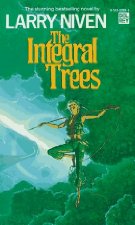
Book Review: The Integral Trees by Larry Niven (Series, #1)
 Summary:
Humans settled on a planet far from Earth after mutinying from their spaceship. Generations later, their descendants have formed various tribes and cities ranging in civilization from tribal to bronze age level of technology. What makes the planet unique is its lack of gravity. Most people live in “integral trees” or in “jungle clouds” with varying amounts of pull (gravity) due to the presence of the tree. In this peek at their existence, we follow a bunch of intrepid people who survive when their tree dies only to find themselves marooned in the sky, along with the flying animals, pools of water, flying fish, and more.
Review:
This book is the definition of classic hard scifi. The world is complex, alien, and unique. It manages to simultaneously be barbaric and technologically advanced in some ways. Everything is as alien from our own lives as we could possibly imagine, from what the people eat to how their cultures are to how people interact.
It takes a bit to get into the book. At first the concept of the planet and how people live on it is overwhelming. But Niven introduces things slowly, so by the time you’re reading about a jungle cloud with people with prehensile toes, it’s easy to imagine and doesn’t slow you down at all in the story. Yet simultaneously it is obvious from looking back to the beginning of the book that Niven always has a clear understanding of how his world works, even if it’s not entirely clear to the reader yet. This is the definition of good writing, and especially good scifi.
The characters have a tendency to be a bit one-dimensional and flat. This is possibly due to all of the attention being paid to the world the story is set in. However, the story still would be improved with more three-dimensional characters. One character in particular goes from a female warrior to a married woman to a concubine and seems to take it all a bit too much in stride for someone who started out as a woman warrior. It felt a bit as if Niven was changing the characters to fit the situation rather than seeing how the characters he had already developed actually would react.
There is definitely a bit of a tinge of male fantasy to the whole story. Even the jungle cloud women who participate equally in their society end up being sister wives to one guy. Personally, I thought given the way women were treated in the story that it must have come out in the 1950s or 1960s, but a quick check shows it came out in 1984. That’s a bit….disturbing. While it’s certainly logical that some cultural things will not be ideal on a foreign planet such as this, the status of women in the novel reads less as a commentary and more as something the author would very much like the world to look like.
Overall, this is an enjoyable hard scifi novel with a rich setting, weak characters, and questionable mores. I recommend it to lovers of hard scifi, but most others probably would not enjoy it.
3 out of 5 stars
Source: PaperBackSwap

Movie Review: Zombie Strippers (2008)
 Summary:
In the near future, a team of American soldiers are sent to stop the outbreak of a zombie virus designed to make for super undead soldiers. Naturally, one of the infected people escapes and in turn infects a stripper in an illegal strip-joint, leading to the most interesting strip-teases in the history of stripping.
Review:
Imagine dark comedy. Toss in a handful of zombies and gore. Now top it off with some of the best strip-teases you’ve ever seen, and you have this movie. I feel like that should be enough to tell you if you’ll enjoy this movie, and honestly I’m still speechless at some parts of it, but I suppose I should do a bit more to review it.
The dialogue is gut-bustingly funny. I haven’t heard dialogue this funny since….Noises Off? In any case, the dialogue is witty, self-aware, and spot-on.
The plot-line is a bit loose, but really, you don’t watch a movie called Zombie Strippers for the plot. Yadda yadda, there are zombies, there are strippers, let’s get this show on the road.
The special effects are awesome. Personally, I found the zombies eating lap dance customers scenes to be incredibly realistic looking. (Perhaps too realistic looking?) But when you have a movie with a disembodied zombie head in a trash bag that’s a running gag, well, realistic looking gore helps.
Now, not that I particularly have experience watching a strip tease, but I ceratinly found the strip tease scenes to be enjoyable and moved the plot right along. Plus, Jenna Jameson is the lead stripper. Chew on that for a while.
Overall this movie is a random justaposition of two entirely different genres of movies, and it totally works. Yes, it would have moved into epic realm if the plot made a wee bit more sense, but it is still one of the most humorous movies I’ve seen in a while. If you like your dark humor, definitely check this one out.
4 out of 5 stars
Source: Netflix

Book Review: The Summoner by Layton Green (Series, #1)
 Summary:
Dominic Grey is a rogue US government agent currently assigned to Zimbabwe when a friend of the US Ambassador disappears in the middle of a tribal religious ceremony. Grey finds himself investigating the disappearance under the watchful eye of the beautiful Zimbabwean government official, Nya and with the aid of a religious studies professor aka cult-buster, Viktor. The investigation soon leads them deep into the dark world of Juju–the religion from which Voodoo originates–not to mention the seedy underbelly of Harare.
Review:
Take Raymond Chandler, transplant him to Africa, update mores to modern liberal ones, toss in some African Juju, and you have Green’s first entry in the Dominic Grey series. If that combination doesn’t make detective mystery fans sit up and say “yes please,” then I don’t know what will.
Dominic is the classic wounded and dark but ultimately has a heart of gold detective hero. He broods. He has far more energy than is logical. He is missing the classic addiction to alcohol of yore, but the side-kick Viktor has that (to absinthe no less), so that is easily forgiven. His backstory is unique, yet relatable, plus there’s Japan and jiujitsu tossed in, which is never a minus.
The love interest is, refreshingly, a bi-racial, self-reliant woman with her own issues and priorities. She is smart, yet not lacking in vulnerabilities. Nya was a refreshing depiction of a female character in a detective mystery, and seeing an inter-racial relationship develop in a book that is not a romance novel was fresh and exciting.
The plot is complex and actually fairly terrifying, even for this hardened horror fan. I did figure it out before it was revealed, but only just barely. I did not, however, predict the ending, which is a definite plus. Those who like some horror and torture in their mysteries will certainly enjoy the plot.
The one draw-back is that Green’s writing struggles a bit on the sentence level. Sometimes the sentences are too simplistic, or he tells the reader a bit too much instead of showing. There are also times when his descriptors are a bit off. For instance, at one point the reader is told that the room smells of vivisection. Most readers do not know what vivisection smells like (thank goodness), so that kind of leaves a blank for the scent in the room. Instead, Green could have said something like, “The room smelled of vivisection–a dark musk mixed with the unmistakable scent of blood.” These issues are less of a flaw than weak characterization or bad plot, though, and I have no doubt that Green’s writing on the sentence level will improve with time and exposure.
Overall, this is an excellent first foray into the world of modern detective mysteries. Grey is an intriguing main character, the plots are unique and modern, and I’m already anticipating the next entrance in the series. I highly recommend it to fans of Raymond Chandler and detective mysteries in general.
4 out of 5 stars
Source: Free kindle copy from the author in exchange for review

Movie Review: Metropolis Restored (1927)
 Summary:
Fritz Lang’s classic silent film tells of a future dystopia in which the elite few who live in a shining city are supported by the low-class masses in the depths of the earth performing mundane jobs. Joh, the son of the mayor, becomes curious and goes to the slums below where he becomes infatuated with Maria, a peace-loving woman the masses look up to and adore. The mayor along with the sinister inventor, Rotwang, decide to steal her likeness for a robot in order to bring the masses back under control.
Review:
This classic film has inspired art, music, and other films for decades, so I suppose I was expecting something mind-blowing. Instead I found myself and my friend creating a drinking game to go with watching it, because it is just that ridiculous of a movie.
Now I have an appreciation for older films, including silent ones. What made the film disappointing had nothing to do with the trappings of the time–the overly expressive facial cues, the odd choice of dress, the exaggerated movements. It had entirely to do with the plot.
Supposedly the “moral” of the story is “between the brain and the hands there must be the heart–the mediator.” Ok, so, this whole incredibly unequal society is a-ok and the only thing that will work for everyone, it’s just that there has to be a mediator between the elite and the lower class? That’s a bit….depressing. One wonders why such a film has remained so popular for so long with such an awful final message.
Plus there’s the whole Maria and her double plot that makes almost zero sense. Although the robot double was supposedly made in order to make the lower class rise up to give the elite an excuse to be violent against them, her first task is to go to an elite club and dance sexually before the men causing them to abandon the women they usually sleep with. What does that have to do with anything? Why was that even included in the film?
In the end, I’m a bit baffled as to how this has remained such an inspiring classic over time. Although it wasn’t dull to watch, there was nothing mind-blowing about it. Overall I would recommend it to fans of silent films and those wondering what the fuss over Metropolis is all about, just don’t expect to be blown away by it.
3 out of 5 stars
Source: Netflix

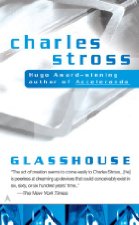
Book Review: Glasshouse by Charles Stross
 Summary:
Robin lives in the 27th century where your consciousness can be switched from body to body (and not just ortho-human ones) indefinitely. Frequent back-ups in an A-gate protect you from ever really dying. Of course, sometimes people go in to get some memories wiped. This is the closest thing to a chance at a new life. Robin wakes up in one of these facilities with a far more extensive memory wipe than usual. People are trying to kill him, and he finds himself signing up for a social experiment where the experimenters are attempting to recreate the second dark ages–the end of the 20th and beginning of the 21st century. He thinks he’ll be safe here, but he might not be. Is he really at risk though or is he just messed up in the head?
Review:
This future where Earth no longer exists and a person is a person because of their consciousness and not their bodies is incredibly richly imagined. It is abundantly clear that Stross has a clearly laid out society in mind when writing. This is all taking place within a world within a certain timeline within a certain culture. That is what makes for the best scifi reading experience, and Stross pulls it off quite well.
The plot is endlessly surprising and nearly impossible to predict until the last few chapters. Of course any plot involving people who can change bodies with a complex civil war previously fought involving a computer virus that enters people’s consciousness via the A-gates would be complex. But don’t be deterred! It is really not difficult to follow, although you may have to stop to think about it a few times.
I also want to say kudos to Stross for writing such an incredibly GLBTQ friendly piece of scifi that isn’t necessarily about gender or sexuality. It’s the first time I’ve ever seen the terms “cis-gendered and trans-gendered” used in a scifi book. In this future where people can pick whatever body they want, it’s natural for everyone to spend at least a few lifetimes as both a male and a female, although they all ultimately tend to choose one over the other. In fact, a plot-point for the book involves the researchers randomly placing someone who identifies predominantly as female in a male body and the resulting depression from that. Similarly, characters identify as mono or poly, meaning both monogamous and polyamorous sexualities are recognized as equally valid. It is an incredibly welcoming environment where people are encouraged to be themselves that only makes the experiment set during our own time period all the more jolting. I could see any queer person finding this story very relatable.
Unfortunately, the strong set-up kind of lost me toward the end. I’m still not quite sure exactly what I should have taken from the ending, but I felt that it didn’t live up to the incredibly high bar Stross set for himself early on. I’m still glad I read it as it was a very different, unique experience, but I do wish he’d spent a bit more time figuring out an ending worthy of the meat of the book.
Overall, I recommend this to scifi fans, and highly recommend it to GLBTQ readers and advocates.
4 out of 5 stars
Source: PaperBackSwap

 Support my work with a tip or browse my shop for curated book club guides, how to guides, cross-stitch patterns, and more!


This work by Amanda Nevius is licensed under a Creative Commons Attribution-Noncommercial-No Derivative Works 3.0 United States License.
 Opinions of a Wolf
Movie Review: Dawn of the Dead (1978)
The zombie uprising has struck, and chances of survival are looking dire. Two American soldiers, a newscaster, and a helicopter pilot go on the lam looking for a place to hole up and hopefully survive. They find it in a classic suburban mall, but how long will they be able to hold off the hordes–not just of zombies, but of other survivors?
Review:
This Romero classic is the follow-up to Night of the Living Dead (review). Some similar themes may be found–holding off both the zombies and fear–but new ones exist as well, such as the danger presented by groups of other survivors. Perhaps most interestingly, the question of how much does this apocalypse create a new world and how much of the old world should be held onto.
The beginning sequence in this film is less strong than in the previous one. It is jumbled and confusing as we land right in the middle of the uprising, as opposed to at the beginning of it. Everyone is talking at once, and it takes the viewer a bit to get acclimated. Additionally, the scene in which the soldiers are introduced is confusing. Plot-wise, it makes perfect sense, but logically, it makes no sense why the people the soldiers are going after are refusing to kill the zombies. It does not seem like it should even be a problem, and yet it is. This hesitance at killing zombies as if they were still people is present throughout the film. Perhaps this reflects the ideals of the 1970s, but as a modern-day woman, I was completely unable to relate.
After the opening scenes, however, the story quickly picks up. The four main characters are all well-rounded and interact well together. Moving the plot to the mall was a brilliant choice on Romero’s part. Much could be said about the commentary on the zombie movements through a shopping center, relentlessly wandering, up and down, around and around, surrounded by consumerism. In fact, after the opening scenes, the entire film seems to be a commentary on consumerism. Characters get into trouble when they want too much or try for too much. In any case, the scenes of zombies wandering through the mall are incredible and clearly became iconic for a reason.
The concept of being able to have fun in the middle of a zombie uprising shows up here. The characters run around the mall, blasting zombies, looting, learning to shoot, and more, and mostly seem to have fun doing so. The distress mostly comes from boredom and feeling trapped, not so much from the zombies themselves. This theme is certainly its own special section of zombie stories. There are the stories that focus on the virus and the being eaten alive, and then there are the stories that focus on being trapped.
The special effects are dismal. In fact, they are worse than in a black and white film because in color, it’s easy to see that the colors are off. Obvious face-paint is used on the zombies. Incredibly fake-looking blood that flows too slowly is present throughout the film. One does wonder why they couldn’t at least get realistic-looking blood.
Overall, although the reasons this became iconic are abundantly evident, I still did not fall in love with it. The plot was rather meandering, followed-up by a cliche ending, and there were portions that were just too illogical to suspend disbelief. It is a fun watch for fans of zombies curious to see how they have developed over time, and it is those people to whom I recommend it.
4 out of 5 stars
Source: Netflix
Buy It