
Archive
Movie Review: When In Rome (2010)
 Summary:
Beth loves her career as a curator at the Guggenheim, and she’s told her friends that when she meets a man she loves more than her career that’s when she’ll know he’s the one. She, therefore, is shocked when her sister meets an Italian man on a plane and gets engaged to him two weeks later. Off to Rome for the wedding, and Beth hits it off with a guy. But when she sees him kissing an Italian woman, she gets drunk on champagne and takes four coins from the love fountain in front of the wedding. Uh-oh! Taking a coin from the fountain makes the thrower fall instantly in love with you, and when Beth gets back to NYC, she winds up with four very determined suitors.
Review:
Yes, I actually do watch a chick flick periodically. ;-) This one is quite stereotypical, complete with Beth declaring she’s starving and proceeding to grab a salad to eat. Oy. There’s also the usual slap-stick humor, such as the main suitor falling down a hole in the streets of NYC. It also takes quite a bit of suspension of disbelief to believe that Beth randomly grabbed four coins, all of which happened to have belonged to men. Uh-huh. Somehow I feel like the statistics of that actually happening are unlikely.
However, the story itself is a bit unique, what with the inclusion of magic. Although it’s obvious who Beth will end up with, the way they wind up together was not entirely predictable, so that was nice. The cinematography is visually very appealing. For instance, the scene of Beth drunk in the fountain is just gorgeous.
The acting ranges from cringe-inducing to excellent. Danny DeVito’s presence as one of the suitors really saves the film. That man is just always so believable in whatever film he’s in. Kristen Bell, who plays the lead, also does a good job, although the supporting characters are a bit iffy.
Overall, it’s a fun way to pass an hour and a half if you have a soft spot for romcoms and enjoy Italian scenery.
3 out of 5 stars
Source: Netflix

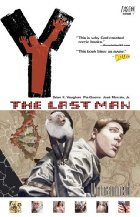
Book Review: Y: The Last Man: Unmanned by Brian K. Vaughan (Graphic Novel) (Series, #1)
 Summary:
The world is changed overnight when all the men and boys in the world mysteriously drop dead. Factions quickly develop among the women between those who want the world to remain all female and those who would like to restore the former gender balance. One man is mysteriously left alive though–Yorick. A 20-something, underachieving magician with a girlfriend in Australia. He desperately wants to find her, but the US government and the man-hating Amazons have other ideas.
Review:
As soon as I heard the concept for this series, I knew I had to read it. Plenty of scifi books have explored other planets consisting entirely of women or an Earth of just women decades after the men died out, but very few go to the immediate after-math of the loss of men. I like that one man is left alive. It lends a scientific mystery to the social aspects of a planet suddenly full of just women. Yorick’s characterization is perfect. He’s laid back enough that there’s not constant angst over the situation, but intelligent enough that he gives the different factions a run for their money. I also appreciate that Vaughan didn’t have all the women suddenly singing kumbaya and holding hands. The fighting, violence, and disagreements among the women are honestly a far more accurate representation of how things work. Women are people, and people fight and disagree. That certainly isn’t a realm that belongs to just men. Vaughan gives an even-handed, fair representation of women covering everyone from women mourning the loss of rock stars to women set world domination and everything in between. I commend Vaughan for that.
The art work is full-color and impactful. Periodically there are full-page illustrations instead of panels. This apocalytpic world isn’t dark. It’s full of light, passion, and energy. Everyone is drawn consistently, and it is not at all difficult to tell people apart. One of the most impactful pages features a close-up of one of the Amazon women with one of her breasts cut (or burnt) off. It’s a very powerful image.
I also appreciated that around 1/4 of this issue takes place in Boston, and Boston is accurately drawn and represented. I love that Boston is key to the story for the scientific community here. It’s tiring always seeing us represented as just the center of the Irish-American mafia. I hope Boston pops up again in future installments. It’s nice seeing my city in print.
Unmanned does an excellent job of quickly setting up the dystopian world where only one man is left alive. The artwork is compelling, and the storyline fairly represents the broad spectrum of female personalities. If the basic concept of this dystopia intrigues you at all, I highly encourage you to try it out.
4 out of 5 stars
Source: Amazon

Movie Review: The Host (2006) South Korea Gwoemul
 Summary:
In the city of Seoul a haughty American military officer makes a Korean worker pour formaldehyde down the drain, which empties into the River Han. Shortly a creature mutates and turns into a beast that comes up out of the river and terrorizes the peaceful people living and working beside the river. The government cracks down on everyone who came into contact with the beast, claiming that the mutation is contagious. Meanwhile, the beast captures a little girl, and her whole family escapes quarantine and goes in pursuit of her.
Review:
I’ve developed a fondness for foreign movies, but this one was epically confusing. In fact, I live tweeted it, and my tweets were mostly ones of confusion. I’m really not sure how this movie crossed over abroad the way it did. Think of the worst American horror movie you’ve seen in the last couple of years and think about someone bothering to translate it into Korean. That’s what watching this was like.
First, there’s the main issue of formaldehyde turning only one creature in the whole River Han into a beast. That doesn’t make any sense at all. Period. Then there’s the beast itself. Although the cgi is very good, how it just doesn’t look particularly frightening. It can run around on land, swim, and hang by its tail off the bridges. It frankly looks a lot like a giant fetus running around. I couldn’t stop laughing.
Then there were just a bunch of odd, confusing moments. Maybe it was a cultural thing? Maybe the translation was bad? I’m really not sure. For instance, when the beast first appears, someone calls out that it’s a dolphin and gets all excited. I’m sorry; it looks nothing like a dolphin at any point in time. Wtf? Then there’s the main family. For the longest time, I thought that the little girl and her father were actually brother and sister with a slightly incestuous relationship. They look practically the same age! He gives her beer because she’s “in middle school now.” In fact, the whole family’s relationships with one another were completely baffling. Then there’s one of the weapons used against the beast that was some sort of inflated thing hanging down from a beam or something, and it, swear to god, just looked like a giant, yellow penis. Wtf? There were just too many wtf moments to get into the movie.
The one good thing I can say about the movie is that it reveals quite clearly the anti-American feelings in South Korea. I’m sure it would be interesting as a cultural study for that alone. I guess it was also entertaining, ableit in a wtf way. Given that, I’d recommend it to people with an interest in Korean culture or an enjoyment of bad horror movies.
2 out of 5 stars
Source: Netflix

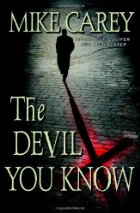
Book Review: The Devil You Know (Felix Castor) by Mike Carey
 Summary:
In the near future London, supernatural creatures, particularly ghosts, zombies, and demons, have suddenly shown themselves. Naturally the religious find this to be a sign of the coming apocalypse, but most people take it all in good stride. Some even discover that they have exorcism abilities. Felix Castor is one of these people. A staunch atheist, he works for hire, rather like a private detective in a Raymond Chandler novel. He takes a case of a haunting in an archive, but gets more than what he bargained for in the form of an overly-interested pimp, a succubus, and a competing exorcist who oddly bound the ghost so she can’t speak in lieu of sending her off to the after-life. Although his employers just want him to exorcise the ghost and be done with it, Castor refuses to do so until he discovers just what exactly is going on…., and he just might become a ghost himself in the process.
Review:
This book held a lot of promise to me. I’m a big fan of both the old-school private detective novels and the more modern paranormal books, so I thought this would be right up my alley. It fell flat for me, though, although I think that has more to do with me than the book.
First, it contains a very British sense of humor instead of the American kind found in Chandler books. I know some people find British humor absolutely hilarious, but it always completely fails to strike my funny bone. I’d read sentences in Carey’s book and know they were supposed to be funny, but they just aren’t to me. That becomes frustrating the more times it happens in a book, and it happened a lot.
I also, frankly, didn’t like the whole archives setting. Maybe it’s that I’m in library science and know archivists personally, but it just wasn’t escapist enough for me. The extensive descriptions of the archives, reading room, and storage, and the librarians’ spaces were dull to me. I wonder if this is the case for anybody reading a book that takes place largely in a location similar to where they work? It could also just be that I find archives dull. I am a reference librarian, after all.
The mystery itself was good and kept me guessing, although I slightly suspect that part of that was due to the fact that the rules of the supernatural are unclear and so Carey has some leeway in taking unexpected turns. It was the mystery that kept me reading, though, so it was well-written.
Overall, although this book wasn’t for me, it was well-written, and I recommend it to anyone who enjoys British humor, detective novels, archive settings, and the paranormal.
3 out of 5 stars
Source: PaperBackSwap

Book Review: Room by Emma Donoghue
 Summary:
Most of the time it’s just Jack and Ma in Room. Jack likes watching shows on the planets on the television, but Ma only lets him watch two a day. She says his brain will turn to mush if he watches it too much. So instead they have phys ed where they run track in a smile around the bed or Jack plays trampoline while Ma calls out his moves. Sometimes Ma reads to Jack or they lay in the sun that comes in through the skylight. All day things are good in Room. But every night Old Nick comes, and Jack has to stay in Wardrobe while Old Nick spends time with Ma. Ma doesn’t like it when Old Nick comes. Neither does Jack. Jack’s whole life Ma has told him only they are real, and everything on television and in books is just stories. But one day she tells him those were lies. And now she’s unlying. Because they have to escape soon to Outside. Outside Room.
Review:
This is a mind-blowingly powerful book. I totally devoured it. It was impossible to put it down. Told entirely from the perspective of 5 year old Jack who was born in Room, it puts an incredibly heart-wrenching and revealing look into what has unfortunately been all over the news in recent years. Cases of women kidnapped and then locked up to be used by their kidnappers as, essentially, sex slaves. These cases often result in the births of children, and although stories have been told from the woman’s point of view, I am unaware of any others that tell them from the child’s point of view.
I have no idea how Donoghue was able to sound so completely like an actual 5 year old, but not just a 5 year old. A 5 year old going through such a unique and painful situation. From the very first page, I entirely believed that I was listening to what was going on inside Jack’s head. That means sometimes there are a few paragraphs about playing, and how Jeep and Remote Control play and fight with each other. But it also reveals what incredible insight children can have into life. That children are in fact little people and should be respected as such. For example, at one point Jack says:
I have to remember they’re real, they’re actually happening in Outside all together. It makes my head tired. And people too, firefighters teachers burglars babies saints soccer players and all sorts, they’re all really in Outside. I’m not there, though, me and Ma, we’re the only ones not there. Are we still real? (Location 1257-1261)
Jack is simultaneously childlike and insightful, and that lends a powerfully unique touch to a tale of evil inflicted on others. I honestly cannot think of anyone I would not recommend this book to, except perhaps someone for whom the events in it might be triggering. Beyond that, everyone should have the experience of reading it.
5 out of 5 stars
Source: Amazon

Book Review: The Windup Girl by Paolo Bacigalupi
 Summary:
In this steampunk vision of a possible dystopian future, carbon usage and genetic engineering caused the world to nearly collapse. Whole nations have been lost to starvation due to exorbitant prices charged by the genetic engineering calorie companies and also due to the rising seas from global warming caused by carbon usage. Domestic cats have been wiped out by cheshires–genetically engineered cats that can appear and disappear, just like the cat in Alice in Wonderland. Thailand, through strict military enforcement of calorie and carbon consumption, has managed to hold back both the sea with a sea wall and starvation. The Thai work diligently to rid their nation of windups–genetically engineered living creatures. As Buddhists, they believe these windups have no souls. Within this world we see glimpses of five very different lives. There’s Anderson, a foreigner from Detroit who claims to be running a factory but is actually a calorie company spy. His manager, Hock Seng, is a survivor of the Malaysian civil war where Muslim fundamentalists attempted to kill all the Chinese immigrants. Jaidee and Kanya work for the Environment Ministry, also known as white shirts. They are the military enforcers of all the environmental laws, but they are struggling against the Trade Ministry that wants to open their borders back up to foreign trade. Finally, there’s Emiko. She is a Japanese windup girl. The Japanese created windups due to a severe lack of young people to care for the old. She came over both as a secretary and lover of her owner who had to do business in Thailand, but he then decided it would be cheaper to leave her behind than to take her on the return trip. She now is a spectacle in sex shows in the ghetto of Krung Thep. These lives slowly intertwine, and through them, Bacigalupi shows how easily civil war can erupt.
Review:
I fully admit that this book was out of my comfort zone. I don’t normally read books on political intrigue and intertwining lives. I tend to stick to ones that talk about one individual person, and that’s what I was expecting from a book called The Windup Girl. That’s why I took the time to write a detailed summary, so you all would have a clearer picture of what this book is about than I did. This is another one of those books that I almost gave up on early in. Bacigalupi doesn’t take the time to truly set up the world. Things have names and are briefly or not at all described, so you have to fill in the gaps yourself. I think if I hadn’t read steampunk before, I would have been at a loss. For instance, he never explains exactly what a dirigible is, although we know they are sky ships. It is not until the end of the book when one gets blown up and a character refers to it as a creature that it becomes apparent that they are living creatures used as sky ships. This is just one example of many ways in which the world building is sloppy. It takes until solidly halfway through the book for a clear picture of Krung Thep to emerge. Additionally, this is one of those books that tosses around non-English words where English ones would entirely suffice. For example, all of the foreigners are called farang, not foreigners. It makes sense to use a Thai word where there is no English equivalent, but it’s just superfluous to toss them around when there is one. Technically these characters are supposedly speaking entirely in Thai. We know that. Bacigalupi doesn’t need to throw Thai words in periodically just to remind us. Still, though, I kept reading beyond the first couple of chapters, mainly because I bought the book on my Kindle app, and I don’t tend to waste money. In the end, I’m glad I kept reading.
Although the setting and world building is rough, the story itself is quite interesting. Many perspectives are offered on these issues that potentially could become issues in real life. What are the rights and roles of genetically engineered living beings? Is nature the way it’s always been better or genetic engineering the next step in evolution? One of the pro-genetic engineering characters states:
We are nature. Our every tinkering is nature, our every biological striving. We are what we are, and the world is ours. We are its gods. Your only difficulty is your unwillingness to unleash your potential fully upon it. (Location 6347-6350)
It is an interesting question. Will our next phase of evolution happen in the traditional manner, or is the next phase actually us using our brains to improve?
The Buddhist concepts sprinkled throughout the text are also quite enjoyable. The characters struggle to maintain their belief in karma and reincarnation in spite of the issues of windups. It clearly depicts how religion must struggle to adapt to change. Additionally, the concepts of fate and karma and how much one can actually do to improve one’s lot in life are explored in an excellent manner through multiple characters. It reminded me a lot of how the Dark Tower series explores the similar idea of ka (fate). One sentence that really struck me on this theme was:
He wonders if his karma is so broken that he cannot every truly hope to succeed. (Location 8388-8393)
I was just discussing a similar concept with a friend the other day, so it really struck me to see it in print.
Additionally, the ending truly surprised me, even though it’s evident throughout most of the book that a civil war is coming. I always enjoy it when a book manages to surprise me, and this one definitely did.
Overall, although Bacigalupi struggles with world building, his intertwined characters and themes are thought-provoking to read. I’m glad I went out of my comfort zone to read this book, and I would recommend it to anyone who enjoys the themes of fate, evolution, nature, karma, or political intrigue.
3.5 out of 5 stars
Source: Amazon

Movie Review: The Human Centipede: First Sequence (2009)
 Summary:
Two American girls on a road trip through Europe get a flat tire late at night in Germany. They walk to find help, and stumble upon the residence of Dr. Heiter, a first-class surgeon who separates Siamese twins. He promptly kidnaps them, along with an unfortunate Japanese tourist, and announces to them that they will become part of a first-time experiment. He will fuse them together mouth to anus to create the human centipede.
Review:
This independent film mixes two great horror movie classics–kidnapping and a deranged doctor–and combines them into a great idea. It doesn’t quite attain the heights such a great idea should have, but I can easily see it becoming a cult classic.
Dieter Laser, who plays Dr. Leiter, does an excellent job. His facial expressions are magnificently creepy. He is actually German, so his German is perfect, as well as his German accent. Akihiro Kitamura’s performance was also well-done, particularly given that he mostly just gets to yell in Japanese and whimper. The actresses who play the two girls–Ashley C. Williams and Ashlyn Yennie–have painfully annoying voices. It was a blessing that they were the two end sections of the human centipede, because it shut them up.
Given how incredibly idiotic and annoying the two girls are in the beginning of the film, I can’t help but suspect that the writer was trying to make us feel less sympathy for them. Possibly with the hope that it would soften the blow of the gross idea? Maybe.
As far as the grossness inherent in three people being sewed together mouth to anus, they could have taken it much further than they did in the film. Only bits and pieces of the operation are shown, and the human centipede wears bandages so strategically that you don’t really see much of the actual connection. It’s more about the viewer imagining it than actually seeing it. Although the scene where the front unit of the human centipede (the Japanese man, Katsuro) must first *ahem* use the restroom post-surgery is quite gross, it is simultaneously hilarious. If you have a bit of a quirky sense of humor, the horror and gross-out factors of this film are greatly lessened. In fact, I found The Fly to be much more disturbing and disgusting than this film.
Overall, if you enjoy gross-out, B-level horror films, you will have a fun time watching this movie. It’s short, interesting, and different.
4 out of 5 stars
Source: Netflix

Series Review: The Dark Tower Series by Stephen King (spoiler warning)
Introduction:
I post series reviews after completing reading an entire series of books. It gives me a chance to reflect on and analyze the series as a whole. These series reviews are designed to also be useful for people who: A) have read the series too and would like to read other thoughts on it or discuss it with others OR B) have not read the series yet but would like a full idea of what the series is like, including possible spoilers, prior to reading it themselves or buying it for another. Please be aware that series reviews necessarily contain some spoilers.
 Summary:
“The man in black fled across the desert, and the gunslinger followed.” This famous opening line begins the distinctly American fantasy epic tale of Roland the gunslinger’s quest for the Dark Tower. In this fantasy, there are multiple parallel universes, referred to as whens and wheres. The one Roland inhabits that is home to the Dark Tower and beams that keep all the worlds together and operating functionally just so happens to distinctly resemble the old American wild west. Gunslingers in this world are like the knights of the round table in old England, and Roland is the last of his kind. He’s on a quest both to reach the Dark Tower and save it and the beams, as  they seem to be breaking. Through the course of his quest, Roland draws three new gunslingers and a billy-bumbler to become his ka-tet–his family bound by ka (fate) not blood. These new gunslingers all come from America, but from different whens and versions of America. Eddie is a heroin addict. Susannah is an African-American woman from the 1960s who is missing both of her legs from the knees down and has Dissociative Identity Disorder (more commonly known as multiple personality disorder). Jake is a boy from a wealthy family in NYC that hardly pays attention to him. Oy is a billy-bumbler; a creature from Roland’s world that looks a bit like a dog with a long snout and a curly tail but is able to talk. After training and bonding together, they continue on their quest for the Dark Tower. A quest that leads them through old ruined cities in Roland’s world, gangster territory
  and rural Maine in America, a countryside farming community where almost all births are twins, and much much more. The ultimate questions of ka, how the worlds are bound together, and just what role this gunslinger has to play in all of it loom at the center of this epic tale.
Review:
The interesting thing about the Dark Tower series is that each book has its own unique vibe, feel, and style to it, yet they together work to make up a complete whole that has its own unique feel to it too. Because of this, certain entries  in the series may appeal less to some people than others. For instance, I did not enjoy Wizard and Glass, because it was essentially a slow-paced wild west romance story, yet I know some readers enjoy that entry immensely. Similarly, I love Song of Susannah for both its horror and the way King structured it using song stanzas to correlate with the sections of the book, yet I know some people who found it too dense for one entry in the series. The thing is though, to me, the Dark Tower is more about the experience of reading the series as a whole than the individual books. I’m perfectly willing to work through a book or a few chapters that aren’t quite the genre I prefer, because I know that will change up later on and whatever is being discussed is important to the story as
  a whole. It frankly is interesting to read a series that explores so many different genres within itself. It makes the whole concept of parallel worlds more believable as each area they go through feels different.
The characterization at first seems simplistic. There’s Roland the gunslinger. He’s got a one-track mind in pursuit of the tower. He’ll do anything to reach it, even if it’s questionable. Is he justified in his vehemence? It’s hard to tell at first. Similarly, the man in black who he is originally pursuing is extraordinarily one-dimensional. He is just an evil magician, and that is all. Similarly, when Eddie, Susannah, and Jake are first drawn into Roland’s world, they are also one-dimensional. Eddie is just the junky. Susannah is the crazy woman with multiple  personalities. Jake is a lonely, frightened little boy. Yet as the series progresses, King gradually develops the characters to be rich and multi-dimensional. Their characters are so intensely vivid, including even Oy, that I actually found myself crying as bad things happened to various members of the ka-tet. Eddie overcomes his addiction, as well as the emotional wounds inflicted on him by his older brother to grow up and become a true man. Susannah does not lose her multiple personalities, but she learns to work with them. They are a part of her, and she grows to accept that. She stops being bitter about her accident and her lot in life and comes to be self-sufficient and caring of those around her. Jake quickly grows to become a confident young man who cares for his ka-tet, but especially Oy and Roland. Finally, Roland gradually learns to open himself up to relationships. Although
  the tower still calls to him, he finds himself questioning if maybe the ka-tet is better than the tower.
The horror elements in the series definitely live up to what one would expect from King. There are disgusting moments, such as a man sick from the weed drug in Roland’s world that makes users go insane. There are also truly terrifying moments such as when a baby boy turns into a spider and eats his own mother via her breast. Then there are mentally disturbing themes such as the children who get stolen by the wolves and are returned with their brains completely ruined. It is later discovered that their brain power was fed to telepaths in service of the Crimson King who is seeking to destroy all the worlds. Whatever flavor of horror suits you best, you will find it in the series.
The themes of love and building your own family and being at the hands of fate are what truly carry the series, though. These themes are what make the reader care about the horrors that are happening to Roland and his ka-tet. They’re what makes it possible to suspend disbelief about multiple worlds being held together by a tower, a rose, and beams. The ideas of self-sacrifice, serving your purpose, and caring for others who ka has brought into your life are powerful and subtly expressed. To me the whole concept of making your own family is the most endearing part of the series, and I loved seeing it portrayed in such a subtle, tender manner.
Of course what really brought the series to a whole new level for me is the ending. It blew me away. It was completely unexpected. Roland reaches the tower after having lost his ka-tet. He goes in and climbs with each floor displaying items and smells to represent each year of his life. He reaches the top door and pulls it open only to realize, horrified at the last moment, that he is being pulled through back to the desert where the series began. The voice of the tower speaks to him about his journey. That he’s done it before. That he’s learning a little each time. It points out that Roland realized his mistake in not taking a few moments to pick up the horn of Eld, so this time, it is strapped to Roland’s side, where it wasn’t originally. For a moment Roland remembers what has just occurred, but soon he just feels it was all a mirage. A heat-induced daydream of finally reaching the dark tower. He continues on, ending the series with the same sentence it began with.
Personally, I feel that this puts the series in a whole new light. Who exactly is this Roland that he is so important that he has to redo this quest until, presumably, he gets it right? Why did King choose to tell us about one of the times he didn’t get it right? What did he get wrong? What lessons is Roland supposed to be learning? Will Roland ever escape the cycle or is it some sort of hell punishment he’s doomed to repeat forever? Of course, it all reads a bit like the belief in reincarnation and learning something each life cycle. In any case, it made me personally want to immediately start rereading the series, searching for clues about the repetition of the journey. It brings the series to a whole new philosophical level that truly elevated it in my mind from a fun fantasy to an epic.
Overall, there are parts of the series I didn’t enjoy, and due to the vast variety of genres represented in the series, most people will probably dislike or struggle with at least bits of it. However, when the series is put together and all the pieces click together in your mind, it becomes an unforgettable, completely American epic. A wild west fantasy is unique, and the themes and philosophical questions explored underneath the entertaining prose make for something even deeper than that. I am incredibly glad I took the time to read this series, and I would recommend it to anyone. It is well worth the time invested.
5 out of 5 stars
Source: borrowed, Harvard Book Store
Books in Series:
The Gunslinger, review, buy it
The Drawing of the Three, review, buy it
The Waste Lands, review, buy it
Wizard and Glass, review, buy it
Wolves of the Calla, review, buy it
Song of Susannah, review, buy it
The Dark Tower, review , buy it


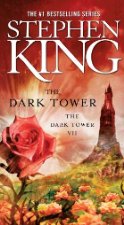
Book Review: The Dark Tower by Stephen King, (Series, #7)
 Summary:
Roland and his ka-tet face their greatest challenges yet. First they must successfully save the rose in NYC. Then they must find each other, and Susannah and Jake need to escape the low men who would harm them. Also on their list before continuing to pursue the Dark Tower is to stop the breakers who mean to destroy the beam, thereby leading the worlds to ruin. Can they save the beam? Will Roland reach his beloved Dark Tower with his ka-tet whole or shattered? Will he reach it at all? The Dark Tower looms with a far greater presence than ever before, calling to both Roland and reader commala-come-come.
Review:
Now I understand why people who’ve read the entire Dark Tower series rant with showers of praise about it. This final entry in the series totally blew my mind. The settings were perfectly drawn and easy to visualize. The multiple plot lines were all complex and yet simultaneously easy to follow. I cried multiple times reading this book, including in public, and those who know me know that I generally don’t cry at stories. All of the characters of the ka-tet are treated with full-formed character development. They are richly drawn, but it is also easy to see how they have grown and changed throughout the series. The multiple, inter-locking worlds of Roland and his ka-tet suddenly snap into place in the reader’s mind, and suddenly everything is nearly as clear as it probably is for King.
This book is quite long, but it didn’t feel like it. I wanted to read it nearly constantly, yet I had to put it down periodically due to the emotional wringer King was bringing me through. It’s been so long since I read a series that wasn’t either a trilogy or a serial romance that I’d forgotten how emotional it can get to have a long, fully realized tale told with characters you’ve grown to know and care for. These people read as real people, and the world feels real. It makes me want to go look for my own unfound door to journey to a parallel reality. Even though at first I kind of laughed at the idea of a rose and a tower and beams somehow controlling and seeing over multiple worlds, at some point I bought into it. I suspended my disbelief, and that’s exactly what a spinner of tales is supposed to be able to help his readers do.
What made me truly fall in love with the story and make me want to instantly start re-reading the series over again from the beginning is the ending. I wouldn’t give it away and ruin the experience of discovering it yourself for anybody, so just let me say, it totally blew my mind. I did not see it coming. It made my perspective on the whole tale change, which explains why I want to re-read it so much. (Maybe next year). I can also say that the ending makes reading the rest of the long series entirely worth it. Definitely don’t give up on the series part-way through. Continue all the way to the end.
If you’ve been reading the Dark Tower series and are uncertain about continuing, absolutely do. I don’t hesitate to say that the last entry in the series is tied for the best and will totally blow your mind. I highly recommend the whole series, but I especially encourage anyone who has started it to finish it. It’s well worth your time.
5 out of 5 stars
Source: Harvard Book Store
Previous Books in Series:
The Gunslinger, review
The Drawing of the Three, review
The Waste Lands, review
Wizard and Glass, review
Wolves of the Calla, review
Song of Susannah, review
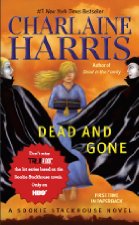
Book Review: Dead and Gone by Charlaine Harris (Series, #9)
 Summary:
Now that the pieces seem to have been picked up from the bombing at Rhodes, Sookie is hoping to just get back to her normal life and adjust to living with her two roommates, the witches Amelia and Octavia. Of course, that can’t last for long. After seeing how well things are going for the vampires being out, the shifters decide to come out as well. Soon there’s what appears to be a hate crime against a shifter Sookie knows, and the FBI comes knocking wondering how Sookie was able to find survivors at Rhodes. On top of everything, a fae war is brewing, and Sookie can no longer hide from the fact that she’s part fae.
Review:
This is without a doubt my favorite Sookie Stackhouse book so far. It’s dark and (I know this sounds odd to say about a paranormal story) realistic. Harris doesn’t let Sookie hide from her problems. She has to truly face reality and deal with it in a way she’s never had to previously in her life. She can’t hide from her telepathy, her exes, her friendships, her coworkers, or her enemies. In a way this book is all about Sookie having to grow up and deal with it.
Readers who started out loving the beginning of the series might not like the dark direction Harris has turned. I for one love dark, disturbing tales, but those who don’t should be aware that there are a few scenes they may find upsetting. I thought these scenes were quite creative, particularly for a series that is being told in the first person.
Of course, this book still faces the writing issues seen in the earlier books in the series. Mainly, some of the writing is painfully simplistic or uses the obvious analogies. Then again, Sookie isn’t exactly super-intelligent, so it fits her voice. Additionally, the sex scenes continue to be a bit cringe inducing. I know other reviewers have pointed out multiple times how the sex scenes are a bit ridiculous. That continues to be true, but they aren’t exactly the focus of the series, so I’m ok with that myself.
Overall, Harris has taken an idea that could have worn out quickly and moved it gradually to a much darker tale that is quite thrilling. The series continues to be complex, and readers who’ve enjoyed the series thus far won’t be disappointed as long as they can handle some disturbing scenes.
4 out of 5 stars
Source: PaperBackSwap

Previous Books in Series:
Dead Until Dark
Living Dead in Dallas
Club Dead
Dead To The World
Dead as a Doornail
Definitely Dead
All Together Dead
From Dead to Worse
 Support my work with a tip or browse my shop for curated book club guides, how to guides, cross-stitch patterns, and more!


This work by Amanda Nevius is licensed under a Creative Commons Attribution-Noncommercial-No Derivative Works 3.0 United States License.
 Opinions of a Wolf