
Archive
Book Review: The Shade of the Moon by Susan Beth Pfeffer (Series, #4)
 Summary:
Jon Evans has spent the last two years living in an enclave as a slip — someone who received a VIP pass to get into an enclave that was originally intended for someone else. His stepmother and half brother live there as well, while his mother and older sister, Miranda, and her husband, Alex, live just outside of the enclave, working and serving it while living in filth. Jon isn’t like the rest of them. He can barely remember a time before the apocalypse of the moon being hit out of orbit. The enclave and its ways seem increasingly normal, even if he is haunted by the memories of what happened in the years between the apocalypse and the arrival at the enclave.
Review:
I was a bit startled to see that this book featured yet another new perspective, particularly after the return to Miranda’s diary in the third book. I was expecting a turn back to Alex, but instead we get Miranda’s little brother Jon’s perspective. I can understand the reasoning for this shift. Jon is the only young person from the original group living in the enclave. He is a bit of an antihero throughout most of the book, providing a unique look at the privileged elite in this post-apocalyptic society but one that could be alienating to some readers.
Whereas the first two books focused on the actual apocalypse and the third on the immediate aftermath, this book looks at the new society emerging from that wasteland, and it’s not good. It’s quite dystopian. Not everyone who enjoys apocalyptic and post-apocalyptic worlds also enjoy dystopian ones, so this is a bit of a risky move for a series, although it makes logical sense for the plot to progress this way. The dystopia that Pfeffer imagines is interesting. The elite have built up enclaves and use those who are not elite to work supporting them, basically killing themselves slowly mining coal and growing food while the elite stay safe and educated in the enclaves. It allows for a look at social class taken to the extreme while still seeming realistic within the world Pfeffer has created.
Jon also is a realistic character. He’s a bit spoiled rotten, after all, his brother, sister, and mother all routinely gave him extra food while they starved when the apocalypse first occurred. He’s the result of all the coddling they gave the youngest in an effort to keep him alive and healthiest. That said, some readers will be turned off by Jon. He’s unequivocally a jerk throughout at least half of the book before he eventually snaps out of it. While I personally enjoy a good antihero every now and then, not all readers will like visiting one, particularly after the more heroic presence of Miranda and Alex in the first two books.
There is one aspect of Jon’s character that really bothers me, and it has nothing to do with his snobbishness and antihero nature early on in the book.
*spoilers*
He lets on early on in the book that something bad happened to Alex’s sister Julie. He at one point misleads a female character to believe that he raped Julie to drive her away from him. This is done to protect her, and the reader is led to believe through this scene that Jon obviously didn’t rape Julie. Yet when we find out what actually happened, it’s not quite so crystal clear. Jon basically was making out with Julie and not stopping when she asked him to the first time. She then runs out into the storm and is killed in the tornado. Jon states that of course he would have stopped, he was just slow about it and reluctant because he didn’t think Julie’s protests were real. He thought she wanted him but wasn’t letting herself want him because of her religion. This is clearly many levels of fucked up. The reader is supposed to just believe Jon that he would have stopped because he says so? The reader is supposed to believe that Julie 100% over-reacted because Jon claims she did? It’s a squicky scene to read about, partially because it comes across as that the reader is supposed to absolve Jon from any guilt since he clearly didn’t rape Julie. He’s also upsetting because no one in the book treats this like the serious issue it is. Everyone just kind of shrugs and goes oh Julie over-reacted and goes on their merry way. Even if Jon really was about to stop when Julie ran out, he clearly needs to be spoken to about listening to your partner immediately, about seeking out enthusiastic consent, and about not victim blaming. Particularly given that this is a YA book and what an important issue this is, the way it’s glossed over left a really sour taste in my mouth.
*end spoilers*
I’m not against the presence of an antihero, including in a YA book, but I do think that Jon’s worse qualities could have been handled with a bit more deftness. His presence instead dances around the edges of certain issues, rather than drawing them out for examination within the context of a fun dystopia.
The plot gets a bit nuts, and one character in particularly has an ending that is rather anticlimactic. However, the plot does eventually move everyone into a new area of the dystopia that is quite fascinating and sets the series up well for another book that will hopefully be free of Jon’s perspective, if Pfeffer does decide to write one.
Overall, readers of the beginning of the series will enjoy seeing what ultimately happens to Miranda and Alex, although they may be frustrated to have to do it through Jon’s eyes. Jon is an antihero who may irritate some readers, and his presence brings up some issues that are then glossed over, rather than dealt with. Recommended to readers who really want to see more of Miranda and Alex who don’t mind spending some time with an antihero.
If you found this review helpful, please consider tipping me on ko-fi, checking out my digital items available in my ko-fi shop, buying one of my publications, or using one of my referral/coupon codes. Thank you for your support!
2 out of 5 stars
Length: 304 pages – average but on the longer side
Source: Library
Buy It (Amazon or Bookshop.org)
Previous Books in Series:
Life As We Knew It
The Dead and The Gone
This World We Live In
Book Review: This World We Live In by Susan Beth Pfeffer (Series, #3)
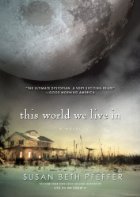 Summary:
Miranda and her mother and brothers have barely survived the long winter that came right after the moon was knocked out of orbit by an asteroid, bringing an apocalypse. She’s been wondering for months what happened to her father and his pregnant new wife. She’s thrilled when they show up on the doorstep when her newborn half brother, but she’s not so sure about the three extra people they’ve brought with them — an adult man and a teenage boy and his little sister.
Review:
The third book in this series reverts back to the Miranda’s journal format of the first. While I appreciate bringing the diverse characters from the first two books in the series together, the use of Miranda’s journal exclusively in telling the story renders the tale a bit less interesting and strong than it could have been.
It should come as no surprise that a YA series featuring a girl in the first book and a boy in the second will bring the two together in the third. I must admit that although when I finished the first book I was very eager to read more about Miranda, when I finished the second I was intrigued at the idea of a series that saw the same apocalypse lived out in different places by different people throughout. That said, getting to know the extensive background of the love interest is appreciated and different but it is a bit jarring to go back to Miranda’s diary after getting to know Alex so thoroughly in the second book. The book could have been much more powerful if Miranda’s journals were interspersed with chapters from Alex’s perspective. Getting this perspective would have helped make their love seem more real, as opposed to just convenient. (Alex is the only teenage boy Miranda has seen in a year). Additionally, in spite of Miranda falling for Alex so fast, he mostly comes across as cold and overly religious in this book, whereas in his own book he was much more empathetic. Certainly the need for survival will make him come across stern, and we know that Alex has a tendency to say important things in Spanish, which Miranda cannot understand. Both of these facts means it would have worked much better to have alternating perspectives, rather than just Miranda’s.
The plot, with the exception of the instant love between Alex and Miranda, is good. It brings everyone into one place in a way that seems natural. The addition of new characters also breathes new life into Miranda’s situation. Plus, Pfeffer does a good job of forcing the family out of their stasis in the home, something that both makes logical sense (these people were not preppers, they are not equipped to stay in their home forever in the apocalypse) and also keeps the plot interesting (one can only read about people holed up in a house for so long). The plot developments also make more sense, scientifically, than in the previous books.
Religion is handled less smoothly here than in the previous two books. Everyone but Miranda’s mother and Miranda has church on Sunday (Protestant or Catholic), and Miranda doesn’t have enough of a reaction to or thoughts about this. She doesn’t really think about faith or spirituality. Church is just something some other people do. This is unrealistic. A teen who has just gone through a disaster and sees her father suddenly take up faith would definitely at the very least have some questions. Given that Alex has a very strong faith and they are interested in each other, one would think they would have some conversations about religion that go beyond whether or not they can have sex before they get married, yet they don’t. The first two books sets a great stage to talk about faith in its many forms, as well as lack of faith, yet the book backs away from actually tackling this issue. If it had, it would have offered something truly thought-provoking in the read. Instead it’s a post-apocalyptic survivor romance. Not a bad thing but not what I was expecting based on the first two books.
Overall, this is an interesting next entry in the series that brings Miranda and Alex back to the readers and moves the plot forward. However, it dances around the issue of faith vs. lack of faith brought up in the first two books, eliminates Alex’s voice from the story, and suffers from some instant romance. Those already invested in the series will still enjoy seeing what happens to Alex and Miranda, although skimming for plot points is recommended.
If you found this review helpful, please consider tipping me on ko-fi, checking out my digital items available in my ko-fi shop, buying one of my publications, or using one of my referral/coupon codes. Thank you for your support!
3 out of 5 stars
Length: 261 pages – average but on the shorter side
Source: Library
Previous Books in Series:
Life As We Knew It
The Dead and The Gone
Book Review: The Dead and the Gone by Susan Beth Pfeffer (Series, #2)
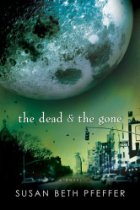 Summary:
Seventeen-year-old Alex Morales works hard with his eyes on a good college. He even works in a local pizza joint to pay for his own private Catholic school uniforms to help his Mami and Papi. Papi is in Puerto Rico for his mother’s funeral and Mami is working late when an asteroid strikes the moon and everything changes. New York City is struck by flooding and loss of infrastructure. Alex is left alone to care for his two younger sisters, Julie and Briana, and slowly he begins to think that maybe things will always be this bad. Maybe Mami and Papi will never come back, the moon will never look right again, and there will never be a world where he can go to college and not be left caring for his little sisters.
Review:
I inhaled the first book in this series, in spite of the scientific flaws (which I addressed in my review of the first book). Miranda’s journal ends so abruptly that I was eager to get to the next book right away. I was surprised, then, when the second book starts back before the moon is struck with an entirely different family in a different area of the country. This book shows Pfeffer’s abilities as a writer by showing the same apocalyptic event seen in the first book from the perspective of an entirely different family.
Miranda’s family is suburban-rural, agnostic/atheist humanist, blended (divorced parents with one remarried), and white. Alex’s family is urban (NYC), Latino, and devotedly Catholic. Both families are given room to have strengths and flaws, most of which have nothing to do with where they live, their ethnicities, or their religions (or lack of one). I honestly was startled to see Alex and his and his sisters’ strong faith treated with such respect in this book after Miranda’s lack of faith was treated with equal respect in the first. It’s easy, particularly in a book written as a journal, to mistake a character’s beliefs for an author’s, and Miranda, a teenage girl, has very strong beliefs. This book reminded me that those beliefs were just Miranda’s, just as Alex’s beliefs are just his, and it shows how well Pfeffer is able to write characters.
Some readers may find it odd and frustrating to go back in time to relive the apocalypse over again with different characters. I personally enjoyed it, because the world falling apart is one of the best parts of post-apocalyptic fiction for me. I also liked having the opportunity to see differences in how the apocalypse plays out based both on the location (suburban/rural versus urban) and the characters’ personalities and reactions. However, that said, I can see how this set-up of two vastly different sets of characters in books one and two could be off-putting to certain readers. Some religious readers may be turned off by the first book and Miranda’s staunch atheism. Those who read the first book and enjoy it for precisely that reason may similarly be turned off by the second book’s heavy Catholicism and faith. The diversity is a good thing but it also makes it hard to pinpoint an audience for the series. Those who are open to and accepting of other belief systems would ultimately be the best match but that’s a demographic that can sometimes be difficult to find or market to. However, if a reader is particularly looking for a diverse set of viewpoints of the apocalypse that is more than just characters’ appearances, this series will be a great match for them.
It should also be mentioned that this book is not a journal. It is told in third person, from Alex’s viewpoint, although the dates are still mentioned. It makes sense to do it this way, since Alex definitely does not come across as a character with the time or the inclination to keep a journal. It would have been interesting to view the apocalypse from the viewpoint of a boy who did keep a journal, however.
The plot makes sense and brings in enough danger without being overly ridiculous. It would have been nice to have maybe started the book just a bit earlier in the week to see more of Alex’s day-to-day life before the disaster. Instead, we learn about it through flashbacks, which makes it a bit harder to get to know him than it was to get to know Miranda.
Overall, this is a surprising and enjoyable second book in this post-apocalyptic series that lets readers relive the apocalypse from the first book over again with a different set of characters. This approach lends diversity to the series, as well as bringing in a greater variety of scenarios for those who enjoy the apocalypse process. Recommended to those looking for a diverse presentation of beliefs and how those impact how characters deal with an apocalypse.
If you found this review helpful, please consider tipping me on ko-fi, checking out my digital items available in my ko-fi shop, buying one of my publications, or using one of my referral/coupon codes. Thank you for your support!
4 out of 5 stars
Length: 341 pages – average but on the longer side
Source: Library
Previous Books in Series:
Life As We Knew It
Book Review: Life As We Knew It by Susan Beth Pfeffer (Series, #1) (Bottom of TBR Pile Challenge)
 Summary:
Miranda’s journal starts out like any other teenage girl’s diary. Worries about school, her after-curricular activities, and wondering how her family will work out with her dad having a brand-new baby with his new wife. But when a meteor strikes the moon things start to change. Slowly at first but with ever-increasing speed. Tsunamis wipe out the coasts. Volcanoes erupt. And soon Miranda finds herself, her mother, and her two brothers struggling to survive in a world that increasingly bares no resemblance to the one she once knew.
Review:
I’m a sucker for journal entry books, even though I know rationally that no diary ever has as much content and exposition as is contained in these fictional works. In addition to the journal format, I liked the premise for the dystopian world Miranda finds herself in. It’s very different from a lot of the other ones out there, since it’s 100% gradual natural disaster. This book lives up to the expectations set by its summary, offering a fun journal entry take on a natural disaster that turns into a dystopia.
Miranda, who lives in semi-suburban Pennsylvania, starts out the journal as a very average teenage girl, adapting to her parents’ divorce and father’s subsequent re-marriage, her older brother being away for his first year of college, and hoping to convince her mother to let her take up ice skating again. The book clearly yet subtly shows her development from this young, carefree teenager through angst and denial and selfishness in the face of the disaster to finally being a young woman willing to make sacrifices for her family. Miranda is written quite three-dimensionally. She neither handles the disaster perfectly nor acts too young for her age. While she sometimes is mature and sees the bigger picture at other times she simply wants her own room and doesn’t understand why she can’t have that. Pfeffer eloquently shows how the changes force Miranda to grow up quickly, and this is neither demonized nor elevated on a pedestal. Miranda’s character development is the best part of the book, whether the reader likes her the best at the beginning, middle or end, it’s still fascinating to read and watch.
Miranda also doesn’t have the perfect family or the perfect parents, which is nice to see a piece of young adult literature. Her parents try, but they make a lot of mistakes. Miranda’s mother becomes so pessimistic about everything that she starts to hone in on the idea of only one of them surviving, being therefore tougher on Miranda and her older brother than on the youngest one. Miranda’s father chooses to leave with his new wife to go find her parents, a decision that is perhaps understandable but still feels like total abandonment to Miranda. Since Miranda is the middle child, she also has a lot of conflict between being not the youngest and so sheltered from as much as possible and also not the oldest so not treated as a semi-equal by her mother like her oldest brother is. This imperfect family will be relatable to many readers.
Miranda’s mother is staunchly atheist/agnostic/humanist and liberal, and this seeps into Miranda’s journal. For those looking for a non-religious take on disaster to give to a non-religious reader or a religious reader looking for another perspective on how to handle disasters, this is a wonderful addition to the YA dystopian set. However, if a reader has the potential to be offended by a disaster without any reliance on god or liberal leanings spelled out in the text, they may want to look elsewhere.
I know much more about medical science than Earth science or astronomy, but I will say that when I was reading this book, the science of it seemed a bit ridiculous. An asteroid knocks the moon out of orbit (maybe) so the tides rise (that makes sense) and magma gets pulled out of the Earth causing volcanoes and volcanic ash leading to temperature drops Earth-wide (whaaaat). So I looked it up, and according to astronomers, an asteroid is too small to hit the moon out of orbit. If it was large enough to, it would destroy the moon in the process. Even if for some reason scientists were wrong and the moon could be knocked out of orbit, even in that scenario, the only thing that would happen would be the tides would be higher. (source 1, source 2) I know dystopian lit is entirely what if scenarios, but I do generally prefer them to be based a bit more strongly in science. I would recommend that reading this book thus be accompanied by some non-fiction reading on astronomy and volcanology. At the very least, it’s good to know that you can safely tell young readers that this most likely would not happen precisely this way, and this book is a great opening dialogue on disasters and disaster preparedness.
Overall, this is a fun take on the dystopian YA genre, featuring the journal of the protagonist and dystopia caused primarily by nature rather than humans. Potential readers should be aware that the science of this disaster is a bit shaky. The story featuring an agnostic humanist post-divorce family makes it a welcome diversifying addition to this area of YA lit.
If you found this review helpful, please consider tipping me on ko-fi, checking out my digital items available in my ko-fi shop, buying one of my publications, or using one of my referral/coupon codes. Thank you for your support!
4 out of 5 stars
Length: 337 pages – average but on the longer side
Source: PaperBackSwap
Book Review: The Kitchen Witch by Annette Blair (Series, #1)
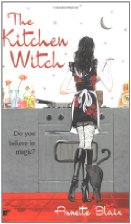 Summary:
Logan finds himself a single dad after his young son’s mother abandons him on his doorstep, so he moves back to his hometown of Salem, Massachusetts, looking to provide his young son with some stability. He has a bad rep from his teen years in Salem to get over, though, and he hopes his new job as a television producer at the local tv station will help. He wasn’t expecting his downstairs neighbor Melody Seabright, however.
Melody, who seems incapable of holding onto a job for any length of time, gets him to get her a meeting with the owner of the tv station and somehow convinces him to give her her own tv show, The Kitchen Witch. The only problem is she can’t cook, and whether or not she’s really a witch is up for debate.
Can Melody learn how to cook and hold onto the job? Or are both of their jobs now in jeopardy? And why does Logan keep thinking about such an unpredictable woman when he knows he needs to provide stability for his son?
Review:
I picked this up on a free book cart at a local library because the cover and title were cute, and I definitely am periodically in the mood for some lighthearted paranormal romance. I was a bit disappointed to find this isn’t really a paranormal romance, but I still enjoyed the contemporary tale it told, primarily due to its featuring a good-hearted single dad.
Logan is a contemporary romance character who will make many readers’ hearts beat a bit faster. He’s cute, young, has a high-powered job, lives in the quirky town of Salem and enjoys it, and is an awesome single dad to his young son. Having him be a bad boy who overcame it for his son is the perfect last touch for a contemporary romance. I can see many readers enjoying fantasizing about him.
Melody may be a bit more hit and miss with readers. The delightfully clumsy bit has been used a lot in romance recently and may feel a bit been there done that. Her apartment is divinely adorable, though, and she has some curves that are always looked upon as a good thing. Her difficult relationship with her own father adds some depth to the character, but some readers might have trouble sympathizing with a poor little rich girl, although I do think that Blair handled this particular aspect well.
Blair also writes children characters beautifully. The son sounds like a child, and yet still has the proper astuteness and vocabulary for his age. The only negative I can say about him is that I honestly already forgot his name. However, I enjoyed his presence every time he popped up into the story.
The plot is where things get a bit shaky. The book is definitely marketed as a paranormal romance, and there are hints at the beginning of the book that Melody might be a witch, but that never comes to fruition. The best I can tell is that she’s learned how to act and sound like a witch by virtue of living and working in Salem. There’s nothing wrong with this, but it was disappointing given that I thought I was getting a paranormal story. I also thought that if the book is going to have Logan suspicious Melody is a witch, at some point he should definitely find out once and for all whether she is one. I think perhaps the book was trying to say she’s just a regular girl with some knowledge of Wicca (which isn’t the same thing as being a paranormal romance witch, since Wicca is a religion and doesn’t actually involve paranormal romance style magic but it’s still a reveal I would have been happier with). However, that also is never firmly revealed. Just what type of witch, if any, Melody is is just a plot idea that is dropped and never fully dealt with, which is a bit frustrating.
A bigger plot issue to me though is that this book falls into the romance trope of everyone can see the couple should be together but the couple makes up fake obstacles to stand in their way and they just have to come to their senses and deal with their own stupidity to get over it. (I really wish there was a shorter way to describe that particular trope…..) It is just a trope that really bugs me. I don’t mind real obstacles in the way of a couple, but the couple just being idiotic and making up their own obstacles feels to me like the author stirring up fake drama to make the book longer. Also, I am 100% a-ok with a couple meeting, working out some realistic difficulties, and then being together. Things that are overly dramatic for the sake of drama just rub me the wrong way. Some readers may be ok with this trope, but for those who aren’t, be aware that this is where the plot eventually goes.
Having been to Salem multiple times, I can say that the author clearly did her research, as she depicts the culture and feel of Salem quite well. She also understands the layout of the town and even gives a realistic vague-ish location for Logan and Melody’s house. (In the few blocks nearish the House of the Seven Gables, in case you’re wondering).
The sex scenes were good, not ridiculous. They weren’t mind-blowingly hot, but they were fun to read and well-written.
Overall, this is a good contemporary romance featuring a lovable single dad love interest that is mismarketed as a paranormal romance. Those looking for paranormal romance should be aware that this fits in much better with the contemporary romance crowd. Additionally, those who are frustrated by couples keeping themselves apart for no reason should be aware that this is the romance trope found in this particular book. Recommended to those looking for a steamy contemporary read featuring a heartthrob single dad and a realistically quirky New England town.
If you found this review helpful, please consider tipping me on ko-fi, checking out my digital items available in my ko-fi shop, buying one of my publications, or using one of my referral/coupon codes. Thank you for your support!
3 out of 5 stars
Length: 320 pages – average but on the longer side
Source: Library free book cart

Book Review: Beverly Hills Demon Slayer by Angie Fox (Series, #6)
 Summary:
Lizzie and Dimitri are back from their honeymoon and are all moved in to their new California oceanfront home. Lizzie is loving married life, even if she has to deal with keeping her talking dog Pirate’s pet dragon out of trouble. But one night someone dumps a purgatory creature on their beach, and their search for who did it and why leads Lizzie right back to two of her worst nemeses: a big bad demon and her birth father.
Review:
I was really excited to be able to get an advanced reading copy of this book, since I’ve been a fan of the series from book one. I also was happy to see that Fox wasn’t going to stop the series just because Lizzie got married. I think more urban fantasy needs to acknowledge that you don’t have to be single or have a dramatic love life in order to be bad-ass. This book demonstrates quite well that just because Lizzie got married doesn’t mean that the series will stagnate.
The book’s strength is its opening sequences demonstrating Lizzie’s married life, as well as the first time we see the biker witches’ new permanent digs. Both show that while everyone is still the characters we first met and fell for, they are also progressing and changing as their life situations change. The scenes of Lizzie and Dimitri’s new married life are a pleasure to read, seeing them settled into being a partnership and Pirate accepting of the fact that he is now banned from the bedroom. It’s also pretty hilarious to see them trying to hide the supernatural from their homeowner’s association. Similarly, the biker witches are still quirky and funny but now they have made a real home out of a motel, including a surprisingly beautiful magical courtyard out back. These are the characters we love in new situations, and it’s quite well done.
The plot is a bit meh this time around. We’ve seen this big bad demon multiple times before, as well as the problems with Lizzie’s birth family. It feels a bit like a recycled plot, in spite of some of the finer details being different. I think it’s high time Lizzie gets a new big bad to fight. Additionally, I think a lot of readers will have a problem with the direction the plot goes at the end of the book. Fox pulls up this thing that is earth-shattering to readers, and should be to the characters, but they kind of just brush it off and don’t really deal with the consequences. I’m hoping that they will in the next book, but even if they do, it’s still a rough plot for this book. It starts out ho-hum as something we’ve seen before then in the final third goes suddenly off the rails in a direction a lot of readers won’t like. Kind of a difficult plot to deal with when it’s wrapped in such cute characters, scenes, and overarching series developments.
*spoilers*
For those who’ve read it, I seriously question the plot having Lizzie kill Pirate with such vehemence when she’s possessed, only to have him brought right back to life. Now, don’t get me wrong, I appreciate the idea of having Lizzie possessed after all of her loved ones were possessed by the same demon in the prior book. That’s an interesting direction to go. But having Lizzie actually kill Pirate? Gut-wrenching to read. And then she faces no consequences because he is just brought back to life, and everyone instantly forgives her? It felt like Fox ripped my heart out for no reason, and then I didn’t forgive Lizzie as fast as her family and friends seemed to. It was a tough ending to the book.
*end spoilers*
The sex scenes are the perfect level of sexy and romantic. They feel just right for newlyweds but also don’t overwhelm the plot. One character from a prior book is explored more in-depth, and a new character is added. I wasn’t a fan of the latter, but I enjoyed the former.
Overall, this book handles its urban fantasy heroine’s new married life quite well, balancing the romance with the fighting, dangers, and sexiness readers expect. Some readers may be bothered by the fact that the plot starts out feeling like a do-over of previous plots, and some may be bothered by the ending of the book. However, fans of the series should definitely pick this one up to see where Lizzie and the gang are heading, and they will be left wanting to pick up the next one as quickly as possible.
If you found this review helpful, please consider tipping me on ko-fi, checking out my digital items available in my ko-fi shop, buying one of my publications, or using one of my referral/coupon codes. Thank you for your support!
4 out of 5 stars
Length: 308 pages – average but on the longer side
Source: Netgalley

Previous Books in Series:
The Accidental Demon Slayer, review
The Dangerous Book for Demon Slayers, review
A Tale of Two Demon Slayers, review
The Last of the Demon Slayers, review
My Big Fat Demon Slayer Wedding
Counts For:

Book Review: I’ll Sleep When You’re Dead by E. A. Aymar (Series, #1)
 Summary:
Tom Starks has not been the same since his wife, Renee, was brutally murdered with a baseball bat in a parking lot. He’s been struggling for the last three years to raise her daughter, who he adopted when he married Renee. When Renee’s killer is released after a retrial finds insufficient evidence to hold him, Tom becomes obsessed with dealing out justice himself.
Review:
I was so excited that two of my 2014 accepted review copies fit into the RIP IX reading challenge! This book’s title jumped out at me immediately when it was submitted, and I had been saving it up specifically to read in the fall. I’m glad to say that this thriller does not disappoint, although it goes in a bit of a different direction than I originally anticipated. And that’s a good thing.
The main character is not who you usually see from a thriller with a person seeking violent justice. He’s bookish. Rather weak and simpering. Afraid of his own brother-in-law, who used to be a boxer. But he was madly in love with Renee, and so when her supposed killer is released, he becomes obsessed with making him dead. The catch is, Tom quickly figures out that maybe he’s not cut out to do the killing himself, and that’s where the book gets unique and interesting. I was expecting from the title and description to see a typical bad-ass main character chase down a killer around the country (or the world) and ultimately get his revenge. That is not at all the story we get, and yet, it is still thrilling. There is still violence and chase scenes, it’s just they aren’t the ones you usually see in a book like this. And that helps it. That helps keep the thrill level up, since it’s so much harder to predict what’s going to come next. Tom, with his weakness and inability to parent well, is almost an anti-hero, and yet we keep rooting for him because his grief for his wife is so powerful and relatable. It’s strong characterization and plotting mixed into one.
The scenes where Tom is seen teaching The Count of Monte Cristo at the community college where he works slow the thrill down. They feel a bit too aware of themselves, with comparison between The Count of Monte Cristo and the plot in this book. Plus scenes of classroom literary analysis simply slow the thrilling plot of the book down. The one scene where it really works is one scene in which Tom is freaking out about his own life so much that he fails at teaching well. This establishes that Tom’s life is starting to get out of control. Overall, though, there are just too many scenes of him teaching for a thriller.
The setting of Baltimore is interesting, and I was glad to see that it wasn’t set in the more stereotypical Washington D.C. Aymar writes Baltimore beautifully. I’ve never been there, but I truly felt as if I was there, seeing both the run-down aspects, as well as the beauty. I often end up skimming over setting descriptions, but Aymar’s drew me in.
The plot has just enough twists and turns to keep the reader guessing, but not so many that the reader feels jerked around. Also, the plot twists stay rooted in reality. I could truly see this happening in the real world, and that makes a thriller more thrilling.
Overall, this is a unique thriller, with its choice to cast the opposite of a bad-ass in the role of the main character. This grounds the typical revenge plot into reality, lends itself to more interesting, unique plot twists, and has the interesting aspect of a flawed, nearly anti-hero main character that the reader still roots for. Recommended to thriller fans looking for something different and those interested in first dipping their toe into the thriller genre.
If you found this review helpful, please consider tipping me on ko-fi, checking out my digital items available in my ko-fi shop, buying one of my publications, or using one of my referral/coupon codes. Thank you for your support!
4 out of 5 stars
Length: 318 pages – average but on the longer side
Source: Kindle copy from author in exchange for my honest review

Counts For:
Book Review: Old Man’s War by John Scalzi (Series, #1)
 Summary:
John Perry joined the Colonial Defense Force on his 75th birthday. Americans aren’t allowed to be colonists in outer space, but they can defend the colonies in the outer space army. Old folks join for many reasons from boredom to having always wanted to see outer space, even though details of what goes on out there are kept secret from Earth. In spite of all the secrecy, the rumor is that those who join the CDF get to be young again, and who wouldn’t want a second chance at life?
Review:
Multiple friends have read this book and loved it, and of course I found the idea intriguing, who wouldn’t? So when a friend offered to loan me his copy, I took him up on it right away. I was not disappointed in the world Scalzi has created, it is endlessly fascinating, but the main character’s arc failed to be quite so interesting to me.
I can’t imagine how anyone would not find the basic premise of this book interesting. Outer space colonies that are kept a mystery from Earth. Only certain countries allowed to colonize (primarily those suffering from population overload). Top it off with a colonial army made entirely up of old people who supposedly get to be young again? Completely. Fascinating. And Scalzi really comes through on the science of all of this, the politics, and manages to have some surprises in there, in spite of the what seems to be very straight-forward book summary. And the world beyond the soldiers and the colonists is utterly fascinating as well. The aliens are incredibly creatively imagined, not just in their looks but in their cultures. They feel real. And that extends to the battles and spaceships as well. The worldbuilding here is phenomenal. It is an example of how scifi worlds should be built.
The main character, though, as well as his character development arc, fail to live up to the incredible worldbuilding. John Perry, from early on, is talented at war, in spite of having only been an advertising slogan writer for his whole life. He has no real life experience that would make one think he would be good at war. Additionally, even when he is doing battle, he’s kind of flat on the page. He doesn’t jump off as the leader he supposedly is supposed to naturally be. Other characters feel that way, but not John. In fact, I frequently found myself far more interested in the secondary characters around John than in John himself. I was willing to give this a bit of a pass since, well, the character has to live for us to continue to see the wars he’s fighting, and maybe Scalzi has a thing for unlikely heroes. But his character arc takes an odd turn at the end that really bothered me.
*spoiler warning*
John meets a special forces woman who is in his dead wife’s body. Basically, his dead wife’s DNA was used as a base to build a genetically enhanced body. Ok, I’m fine with that, even if it seems unnecessary. But then John becomes obsessed with her, and she with him, even though she is very clearly NOT his wife. Then at the end, he asks her to move to a colonial farm with him when they retire. And she says yes. Whaaaaat?! This isn’t romance; this is gross! The special forces woman has as much in common with John’s wife as her sister would at this point, since they have messed with the DNA so much. This is like John pursuing his dead wife’s sister, who is emotionally only 6, since she was put into a fully adult body 6 years ago and had no life prior to that. It’s gross. It is not romantic. And I really think the reader is supposed to see it as romantic, when instead it squicked me out far more than any of the aliens in the book, including the ones with slimy appendages or the ones who eat humans.
*end spoilers*
Overall, this is an utterly fascinating scifi world with a bit of a ho-hum main character. The ending may disappoint some readers, and Scalzi’s politics can come through a bit obviously sometimes. However, those at all intrigued by the plot summary or interested in high quality scifi world building should check it out.
If you found this review helpful, please consider tipping me on ko-fi, checking out my digital items available in my ko-fi shop, buying one of my publications, or using one of my referral/coupon codes. Thank you for your support!
4 out of 5 stars
Length: 355 pages – average but on the longer side
Source: Borrowed

Book Review: The Walking Dead: The Fall of the Governor: Part One by Robert Kirkman and Jay Bonansinga (Series, #3) (Audiobook narrated by Fred Berman)
 Summary:
In the aftermath of her rebellion attempt against The Governor, Lilly Caul is starting to see him as a man who does what it takes to protect the citizens of Woodbury. So when strangers in riot gear and prison suits underneath show up at Woodbury, she believes The Governor that they’re out to get their supplies and that the woman, unprovoked, bit his ear. But not everyone believes The Governor, and The Governor starts to think he can use the doubters to his advantage.
Review:
This non-graphic novel series telling the backstory of the big bad villain of the graphic novel Walking Dead series started off incredibly strong but, unfortunately, each new entry in the series gets worse and worse. Instead of lending new light to the backstory of The Governor and Woodbury, this entry retells scenes readers of the graphic novel have already seen, simply from The Governor and other residents of Woodbury’s perspectives.
While I understand that some things readers of the graphic novel series already know may need to be briefly mentioned again for those who are only reading the print books, a sizable portion of this book features scenes already told once in the graphic novels. Many of these scenes were disturbing enough in the graphic novels, such as the scene in which Michonne is repeatedly raped and beaten by The Governor. Retelling them from the perspective of The Governor just felt unnecessary and was frankly difficult to listen to. It would have been better to have left out showing that scene again and instead showed the, well-told and well-done scene of The Governor after her rapes Michonne back in his apartment where he tries to rationalize his behavior. This lends new insight into the character without forcing the readers to, essentially, re-read.
The characterization of Lilly Caul continued to bother me. First she hates The Governor and leads a rebellion, then turns right around and becomes loyal to him? What? This makes zero sense and is never fleshed out enough to make sense. Similarly, how she handles one particular plot development feels like lazy, cliched writing of women, which bothered me.
Speaking of writing of women, while I understand that the third person narration is supposed to simultaneously be from an evil guy’s perspective, how the narrator talked about Michonne really bothered me. We are constantly reminded that she is black. She is never just “the woman” she is always “the black woman” or “the dark woman.” Her dreadlocks are mentioned constantly. Whereas white characters, Latino characters, and male characters are referred to once with descriptors about how they look, her looks are constantly described. I understand looks need to be described periodically, but this is far too heavy-handed and in such a way that it feels like the narrator feels it necessary to constantly remind the reader that she is “other” and “different from us.” Worse, she is also referred to as a “creature,” etc…, particularly during her rape scenes. I never felt Michonne was mishandled in the graphic novels. She’s a bad-ass woman who just happens to be black in the graphic novels. Here, though, the descriptions of her feel like they are exoticized, which feels entirely wrong for a book in which we mostly just see her being raped. She is depicted so animalistically, it made my stomach turn. Even when she is among her friends, the narrator feels it necessary to constantly refer to her otherness.
So what’s done well in this book? The scenes where we finally learn how the double-cross happens and see it plotted and carried out from the bad guys’ perspective is chilling and enlightening. It’s also really nice to get to actually see the scene where Michonne beats the crap out of The Governor. If other scenes had been left out, the characterization of Lilly Caul and descriptions of Michonne handled better, and the whole book tightened up (and probably part two included here), it could have been a strong book.
Overall, fans of the series will be disappointed by the repetition of scenes they’ve already seen and the overall shortness and lack of new information in this book. Some may be bothered both by how Michonne is presented in this book, far differently from how she is in the graphic novel series, as well as by seeing some of the rapes from The Governor’s perspective. Recommended to hard-core fans who feel they need to complete reading the companion series to the graphic novels.
If you found this review helpful, please consider tipping me on ko-fi, checking out my digital items available in my ko-fi shop, buying one of my publications, or using one of my referral/coupon codes. Thank you for your support!
2 out of 5 stars
Length: 256 pages – average but on the shorter side
Source: Audible

Previous Books in Series:
The Walking Dead: Rise of the Governor, review
The Walking Dead: The Road to Woodbury
Counts For:
Book Review: Lana’i of the Tiger by JoAnn Bassett (Series, #3)
 Summary:
Maui wedding planner, Pali Moon, wound up as a key witness against a drug ring, and now she’s been whisked into witness protection, sent to the small boring island of Lana’i, and right at the holidays no less! The feds seem to be taking their sweet time getting the case to court, and Pali is bored out of her mind, used to the hustle and bustle of wedding planning. When a small local bed and breakfast advertises looking for temporary help while they go to the main island to have their baby, it seems like the ideal situation. But when a famous guest’s fiancee turns up dead, Pali finds herself right in the thick of things again.
Review:
I picked this mystery up when I saw it on sale (for free) in the kindle store, in spite of it being midseries. The punny title made me think it was probably a cozy, and I know those series are totally fine to read out of order. I was right in that I never felt lost in the story due to starting mid-series, but I wasn’t right about it being a cozy. Pun-filled title aside, this is an easy-going mystery, ideal for a beach read, but missing the appendixes of add-ons such as recipes or patterns found in cozy mysteries
Pali is a three-dimensional character who jumps off the page, and the supporting characters, while not necessarily three-dimensional, each have enough different quirks and personalities that they are memorable. That said, Pali may be three-dimensional but she’s sure not likable. One example, she kisses someone on Lana’i, and then later finds out that her boyfriend may be cheating on her and flips out. But wasn’t she just cheating by kissing someone else? The hypocrisy left a really sour taste in my mouth for Pali. Characters don’t have to be likable, but in light-hearted mysteries where we’re supposed to be rooting for the non-professional PI, it really helps for them to be.
The mystery was fairly good. I certainly didn’t figure it out until right before the reveal, and the ultimate solution made sense. This is all I really look for in a mystery.
The setting was probably the best part. Bassett evokes (what I can only imagine is) the real feel of Hawaii. Each island visited has its own feel, Hawaiian culture is solidly represented with things like islanders calling all the elderly women “aunty” and locals being able to talk their way onto a ferry for free. What kept me reading the book was my desire to spend time in Hawaii, combined with a mystery I was interested in the solution to.
Overall, the rich Hawaiian setting and actually mysterious mystery make this a fun beach read. The main character is three-dimensional but could rub some readers the wrong way. Those looking for a traditional cozy should be forewarned that this book doesn’t come with any traditional cozy extras. Recommended to those looking for a light mystery set in Hawaii.
If you found this review helpful, please consider tipping me on ko-fi, checking out my digital items available in my ko-fi shop, buying one of my publications, or using one of my referral/coupon codes. Thank you for your support!
3 out of 5 stars
Length: 306 pages – average but on the longer side
Source: Amazon

Previous Books in Series:
Maui Widow Waltz
Livin’ Lahaina Loca
 Support my work with a tip or browse my shop for curated book club guides, how to guides, cross-stitch patterns, and more!


This work by Amanda Nevius is licensed under a Creative Commons Attribution-Noncommercial-No Derivative Works 3.0 United States License.
 Opinions of a Wolf