
Archive
Book Review: Reader, I Murdered Him by Betsy Cornwell
A YA romp told from the perspective of Mr. Rochester’s ward gives a new view of both Jane Eyre and London’s queer underground.

Summary:
Adéle grew up watching her mother dance in Le Moulin in Paris but soon found herself sent away to England with the man her mother said was her father. Mr. Rochester. Soon she meets her governess Jane Eyre and begins her own series of adventures.
Review:
If you have a love/hate relationship with Charlotte Bronte’s Jane Eyre, then this book is for you. If you love your YA with sapphic romance in period costumes, then get this book immediately.
The thing about Jane Eyre is…Mr. Rochester is terrible. Yet she’s still attracted to him. (This was beautifully summed up in the web comic Hark! A Vagrant). Shifting to Adéle’s perspective gives a whole new angle on just how deliciously insidious Mr. Rochester is. Adéle does not pull any punches when it comes to him. It’s downright cathartic for everyone who tears their hair out about Jane’s love for him.
There’s much more in this story than a shift of perspective on Jane Eyre though. Adéle is well-rounded, and we have entire chapters where Mr. Rochester and Jane aren’t mentioned at all or only in passing. My favorite part is when Adéle goes to a finishing school in London, because this is when the sapphic subtext becomes blatant. Adéle has the hots for more than one other teenage girl. (Both of whom are excellent choices, by the way). There’s cross-dressing! There’s scuttling around on the streets of London late at night in widow’s clothes! But also Adéle has feelings for Mr. Rochester’s nephew she’s been exchanging letters with since she first came to England. What to do. what to do. I loved seeing representation of a bisexual woman who leans more in a certain direction usually. I really like that even though she is capable of attraction to men that the sexist society fizzles it for her, making her a bisexual that leans toward women. What a fun twist on what we usually see in period pieces with fluid sexuality.
The book does start slow. The first chapter in Le Moulin was rough with overly flowery language and stirred up drama. But this drops out as Adéle ages and comes into her own. Perhaps some of this was meant to show how she is a little too idealistic in how she remembers her early years. I suspect the first chapter may have served better as flashbacks from her early time in England, rather than linear.
Please do take a moment to check out the content notes on StoryGraph. The ones listed as of the day I was writing this post are accurate.
Overall, this is a fun twist on Jane Eyre that gives agency to Mr. Rochester’s ward Adéle. Come for the twist, stay for the YA sapphic heart-throbbing.
If you found this review helpful, please consider tipping me on ko-fi, checking out my digital items available in my ko-fi shop, buying one of my publications, or using one of my referral/coupon codes. Thank you for your support!
4 out of 5 stars
Length: 288 pages – average but on the shorter side
Source: NetGalley
Buy It (Amazon or Bookshop.org)
Book Review: The Gilda Stories by Jewelle Gómez

Summary:
A young Black girl escapes slavery in the 1850s United States. When she grows up, she is made into a vampire with her consent. We see her immortal life and her perspective of the US through an imagined 2050.
Review:
The author herself stated in a recent article that she wrote this because she wanted “to see a lesbian of color embark on the adventure of eternal life.” This was something that was hard to find in 1991 when it first came out, and is only a little easier to find even now. There’s more of a twist to this, though, than a Black lesbian vampire.
How vampires work in this story is perhaps the most unique take I’ve read. They usually glamor their sources of blood while they are asleep. They come into their dreams and see something they wish for and leave something behind to help. An example is one time a teenager is hoping to do well on a test, so Gilda clarifies some of his mathematics homework for him. They also don’t use their teeth to draw blood but rather make a slice with a fingernail and then heal the wound magically without a trace. Most fascinatingly, these vampires must always keep their “home earth” close to themselves, or they will lose their powers. They must take large pallets of dirt from their home and sew it into their blankets, clothes, and shoes. One complain I have is that it was unclear to me if this dirt was from where they grew up or from where they were turned. It seems sometimes it’s one and sometimes the other. They also are weakened by all water, not just holy water.
Each of the chapter is set in a different year and place in Gilda’s life. It reads almost like a series of interconnected short stories more than a novel. I was reticent to ever stop in he middle of a chapter. I felt compelled to read each in its entirety in one sitting. This blipping in and out of Gilda’s life helps give the reader a sense of the jarringness of immortality. We just get to know a human, and then they’re gone. But that’s how it is for Gilda too.
This is not an erotic book. Gilda’s maker and another vampire named Bird (who also helps make her) are a couple when we first meet them. Gilda repeatedly becomes infatuated with women, both human and vampire, throughout the book. But we only rarely see any sexual interactions. I’m including even kissing here. The book is less about the sexuality and more about the community formed by queer people, often necessarily in the shadows. The often unrequited yearning. Gilda also has a vampiric encounter with a man that some readers view as sexual. I didn’t read it that way myself. I viewed it as a purely vampiric encounter. But you might feel differently.
Gilda’s perspective as a Black woman is ever-present, as it should be. She is othered by white society even when they don’t sense her vampire nature because of her blackness. But she also finds belonging in a variety of Black communities ranging from rural activists to singing nightclubs. Gilda also later in the book is left wondering how humans can feel such atrocities as slavery are so far in the past when for her it was a blink of an eye. An artful way of getting the reader to question how much time and distance is really between us and our history.
Overall, this is a unique take on vampire lore that centers a Black lesbian. It delivers both fantastic historic fiction and Afrofuturism in the same read. An engaging read for lovers of either.
If you found this review helpful, please consider tipping me on ko-fi, checking out my digital items available in my ko-fi shop, buying one of my publications, or using one of my referral/coupon codes. Thank you for your support!
4 out of 5 stars
Length: 252 pages – average but on the shorter side
Source: Library
Buy It (Amazon or Bookshop.org)
Get the Reading Group / Book Club Discussion Guide
A beautifully graphic designed 2 page PDF that contains: 1 icebreaker, 9 discussion questions arranged from least to most challenging, 1 wrap-up question, and 3 read-a-like book suggestions
View a list of all my Discussion Guides.
Counts For:

Book Review: A Dowry of Blood by S.T. Gibson

Summary:
You saved my life when I was on the brink of death, and I became your vampire bride. But we’ve lived many centuries past those days in Romania. I think your way of loving might be more than I can bear.
Review:
I picked this up because I heard that in spite of the husband/wife part of the summary that there’s a significant sapphic subplot. I’m not sure I’d call it significant so much as being one of the three parts of the book.
It’s written as a letter from the vampire bride Constanta to her vampire husband. In the first part, we learn how Constanta became a vampire and her early years with him. In the second, he adds a second wife, Magdalena. But this is true polyamory in that everyone sleeps with everyone. In the third part, he adds a husband, Alexi. Again, everyone has sex with everyone, although this is not the amicable threesome (and sometimes twosomes in both combinations) it once was. It’s clear that while the sire is fine with Magdalena and Alexi sleeping together, he’s less ok with Constanta and Alexi.
But what is the plot of the book? It’s basically Constanta realizing over time just how cruel her husband is and trying to decide if she should try to escape. The most unique part of this was the second part where Magdalena and Constanta both feel an immediate attraction to each other and then proceed to form a romantic bond as their husband perpetually abandons them for his research. I don’t say this just because it’s sapphic but rather because I think polyamory as opposed to polygamy has less representation in literature. Not that either have a lot.
I want to be clear this is not erotica. If it wasn’t for all the vampire feeding blood, I’d say it could probably pull off a PG13 rating for the sexual content. A lot occurs off-screen or is only vaguely described. There’s really only one scene that I think might warrant an R rating for the sex. This in fact is not a story about sex but one about many centuries of abuse and how the persons being victimized finally break free. The thing is…I was here for romance. And I wouldn’t say that’s what this is.
The language is overwrought in a self-aware way. Constanta is old world. These are her words. She sounds like an 1800s teenager who takes everything far too seriously and has some hilarious turns of phrase. I’m sure some readers would read this as gorgeous as opposed to silly. When I say overwrought 1800s language, I’m sure you can tell how well that will work for you.
While the book engaged me enough to finish it, here wasn’t enough unique about it to make me rate it above average. I wanted more of what makes this vampire bride different and less of the usual tropes. But if you’re a person who loves Old Europe style vampires and wants a dash of f/f love and polyamory in there, then this will likely work quite well for you.
If you found this review helpful, please consider tipping me on ko-fi, checking out my digital items available in my ko-fi shop, buying one of my publications, or using one of my referral/coupon codes. Thank you for your support!
3 out of 5 stars
Length: 248 pages – average but on the shorter side
Source: Library
Buy It (Amazon or Bookshop.org)
Counts For:
Book Review: The Dark Between the Trees by Fiona Barnett

Summary:
Northern England’s Moresby Wood. The locals call it an unnatural place of witchcraft where the devil walks by moonlight. Five women head into it on a historian’s academic expedition to discover what happened to a unit of 17 Parliamentarian soldiers in 1643. Only 2 soldiers survived the wood. How many women will?
Review:
This is a book for those steeped in academia who want the mystery to remain a mystery.
The telling alternates between the perspective of the five modern day women and the 17 soldiers in 1643. I liked how the journeys of the two groups paralleled each other while having enough different things occurring to remain engaging. But I never felt like I truly got to know any one character in a well-rounded way. They all felt like two-dimensional drawings. I don’t mind this in a traditional horror/thriller. The point isn’t the characters. But this story struck me as a less traditional mystery that remains unsolved. It’s not like Scream or Cabin in the Woods. It takes itself seriously and, thus, my standards for characterization are higher and remain unmet.
I like the monster in the woods. It has a cool name – the Corrigal. It’s deliciously creepy. But it’s essentially dropped in the last few chapters as a red herring. That would be fine if something scarier replaced it. But it doesn’t.
As someone who spent many years in academia, this book reads like a speculative wish fulfillment. The lead historian is a woman who others in her department think is wrongfully obsessed with the woods. She struggles to win awards when the man in her department does. It took her years to fund this trip. The narrative tells us this over and over again. The book tries to show us that the historian was right. If a bit cruel to her postdoc student. But I was left feeling like this was a speculative exploration of everything wrong with academia without the text being self-aware that this is what it was doing.
I’ve categorized it a mystery, because to me it wasn’t thrilling or horrific. It was a puzzle the women set out to solve and fail to do so in any satisfying way. The bit of chills that built in the beginning fizzle by the end.
If you enjoy 1600s history interspersed with modern day academics flailing helplessly about in the woods and don’t mind an unresolved mystery, then this will be a great match for you.
If you found this review helpful, please consider tipping me on ko-fi, checking out my digital items available in my ko-fi shop, buying one of my publications, or using one of my referral/coupon codes. Thank you for your support!
3 out of 5 stars
Length: 304 pages – average but on the longer side
Source: NetGalley
Buy It (Amazon or Bookshop.org)
Announcement: Shop My Halloween Notebooks
For the past few months, I’ve been designing and selling blank, lined notebooks. Each has 100 sheets (200 pages) and is a handy carry size of 6″ wide x 9″ high (slightly larger than A5 size at 152.4mm x 228.6mm). One notebook costs just $5.99.
For most of them, I find vintage art in the public domain then edit and transform it in various combinations into notebook covers. But sometimes I draw the art myself or use public domain images to illustrate a text phrase.
I love Halloween, so to celebrate, I created a line of Halloween themed vintage notebooks.
There’s my series of four rooster themed ones, largely running off of puns and parodies.
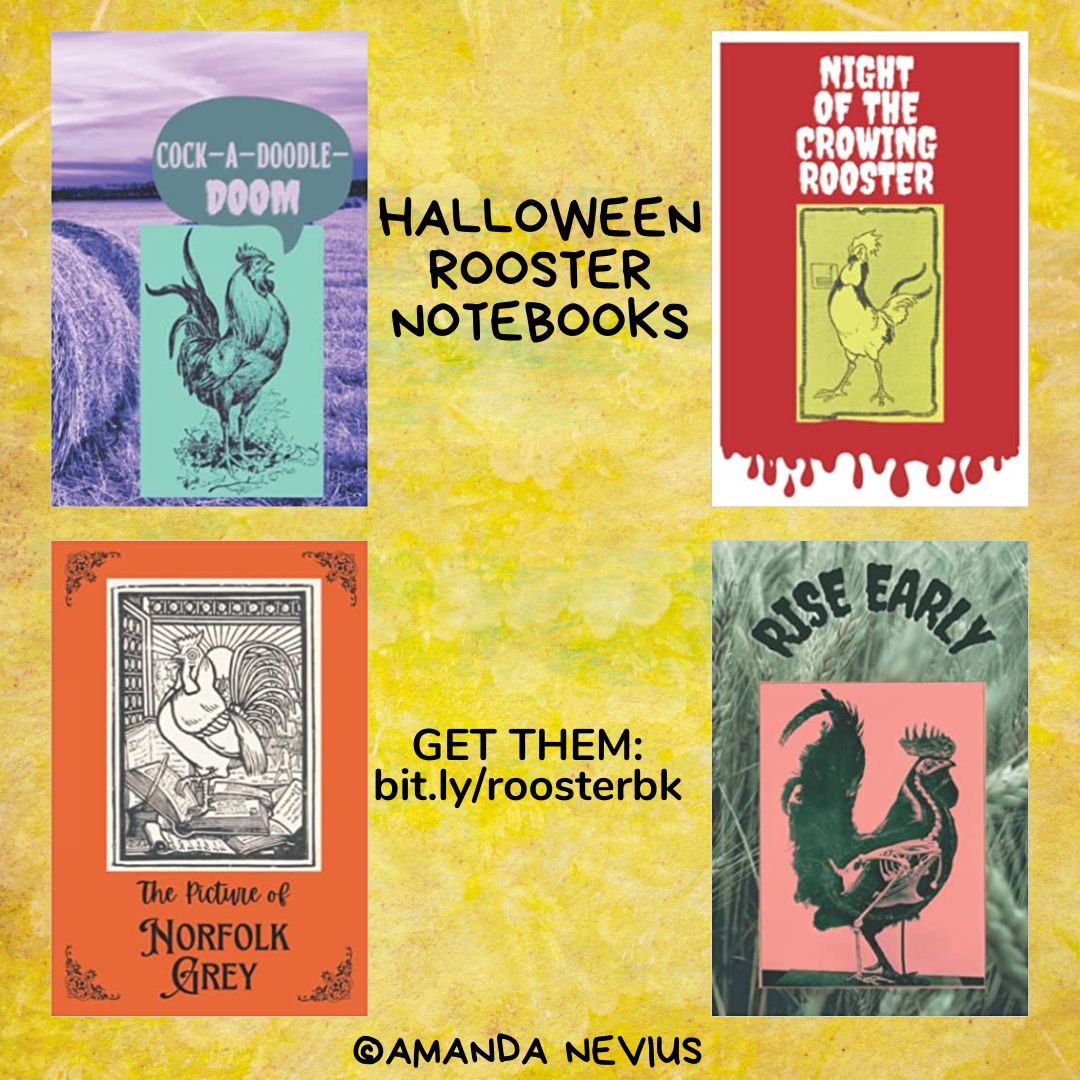
Then there’s my series of vintage greeting card inspired Halloween notebooks.

Finally, there’s my vintage style scares series.
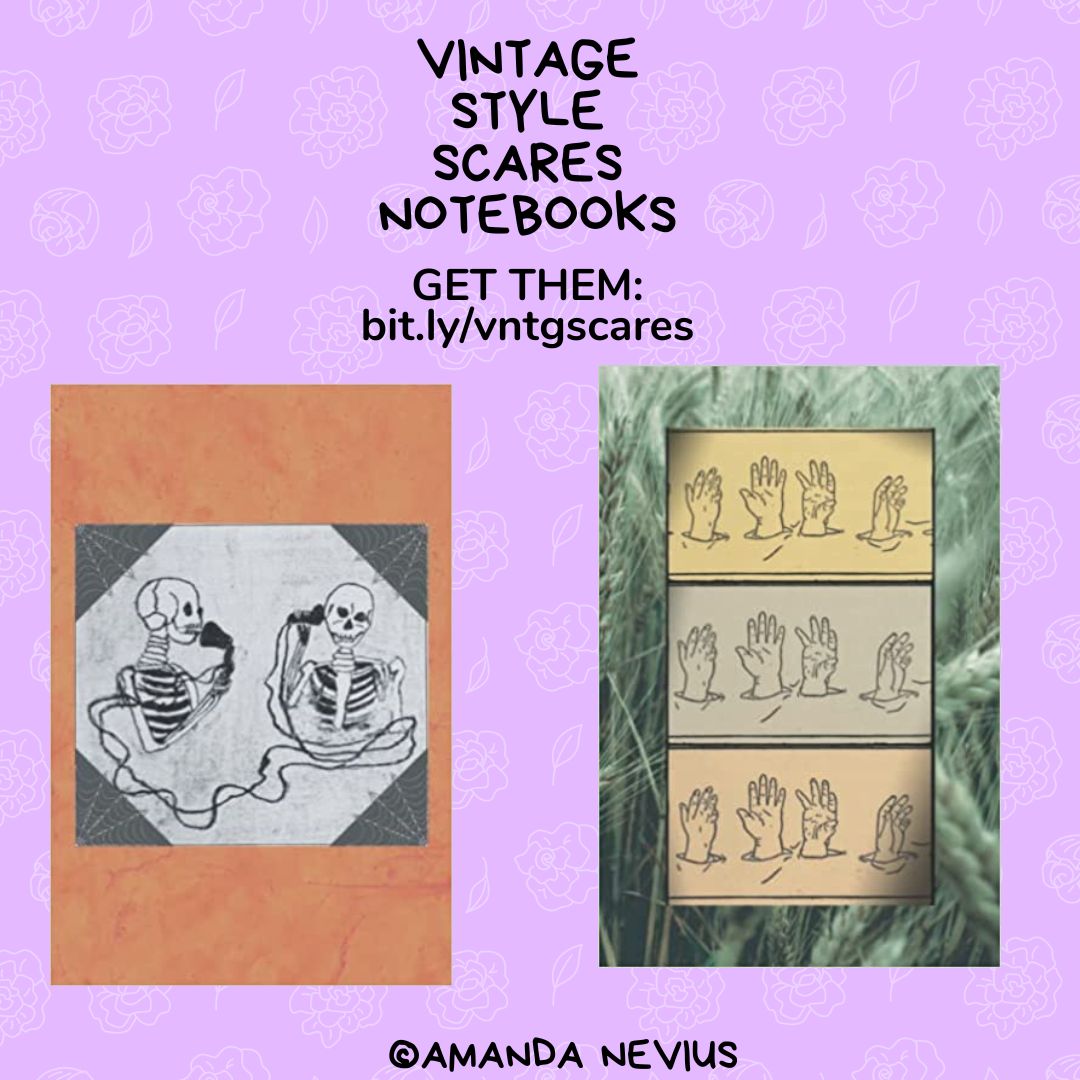
I hope you’ve enjoyed getting to see a part of my new notebook adventure. You can browse all of my notebooks, including many non-Halloween ones (like my currently best selling Heart Sutra one) here.
If you have any suggestions or requests for a notebook, drop them in the comments below!
Book Review: Station Eternity by Mur Lafferty

Summary:
Mallory is constantly embroiled in murder cases that only she has the insight to solve. But outside of a classic mystery novel, being surrounded by death makes you a suspect and a social pariah. So when she gets the opportunity to take refuge on a sentient space station, she takes it. Surely the murders will stop if her only company is aliens. But when the station agrees to allow additional human guests, humans and aliens alike begin to die…
Review:
A scifi mystery with creative imaginings of multiple alien species and a queer cast.
My favorite part of this book is the various alien species present on the space station. The Gneiss formed from rocks. They don’t ever really die but hibernate then come back in a new form. They can be pebbles, humanoids, or even shuttles. The Phantasmagore have a symbiont vine growing on their ankles that let them camouflage into their surroundings. The Sundry are a hivemind of bee-like creatures that are mysteriously divided into blue and grey factions. Most interesting is that all alien species evolved to have a symbiont. This is another species that merges with them for a mutually beneficial relationship. Only humans didn’t. Why they don’t have one is one of the mysteries of the book.
In spite of the fact that many of the characters are aliens, this still manages to be a diverse book. Multiple characters are Black, one is Korean-American, and the automatic translator uses human names from around the globe to substitute for alien names that humans couldn’t possibly pronounce. (For reasons like that they can’t vibrate to communicate like the Gneiss do).
The marketing I saw was Agatha Christie in space. The storytelling isn’t comparable. Agatha Christie novels are mostly one pov. Third person from the detective’s perspective. This book uses multiple povs. This annoyed me, because at many times, we the readers know things Mallory doesn’t. It removes a lot of the mystery. We end up just sitting there waiting for her to find out something we already know. And it’s not just switching pov in a seen. There are multiple flashback chapters where we go and see a character’s whole backstory. It’s important for an author to know all this detailed information, but not for the reader to. An example is one character who the military recruits to something. We have a whole chapter of flashback to the military recruiting her. Then later Mallory finds out. We didn’t need this chapter about the recruitment. We could have just seen Mallory find it out. More suspense and less dead time (pun intended) waiting for flashbacks to be over. While I liked the story itself, the style of telling it wasn’t for me.
The queer content is that Mallory is bisexual. Another character is a trans gay guy. Another minor character is gay. I appreciate that these identities are not a big deal and mentioned in passing like a character’s hair color. I was a little uncomfortable with one scene with the trans character, Phineas. His brother is trying to reassure him that they’re definitely related. For some reason, the way he reassures him of this is to say his deadname and explain why their father gave him that name. It just seemed like a completely unnecessary use of the deadname to me. (Could have just said…dad named you what he did because of X and that’s why he’s definitely your dad too). I don’t mind characters making mistakes. But it would have been nice to have established Phineas doesn’t mind hearing his deadname. Or to have his brother realize his mistake and apologize.
Recommended for mystery readers who like scifi and multiple povs.
If you found this review helpful, please consider tipping me on ko-fi, checking out my digital items available in my ko-fi shop, buying one of my publications, or using one of my referral/coupon codes. Thank you for your support!
3 out of 5 stars
Length: 336 pages – average but on the longer side
Source: NetGalley
Buy It (Amazon or Bookshop.org)
Book Review: Paper Is White by Hilary Zaid

Summary:
Oral historian Ellen and her girlfriend decide to get married in 1990s San Francisco. As they beat an early path to marriage equality, a Holocaust survivor draws Ellen into a secret. How much do you need to share to be true to the one you love?
Review:
This is a rich exploration of two things simultaneously. What it meant to be in a same-sex relationship in the 1990s before marriage equality. And what it means to be Jewish in the shadow of the Holocaust.
There is a sad beauty in how Ellen and Francine find a way to experience the joy of being brides even in the face of rejection and homophobia from many sides. The fact that their wedding can’t be legally recognized. How that is most people’s first reaction. Their parents struggle with accepting and loving them as they are. There’s a real ache to how their parents come down on, essentially, well a lesbian daughter is better than no daughter at all. As a child of the 90s, I recall how that was often viewed as the pinnacle of acceptance from a parent. How sad that was. How well-represented here. But there are still scenes of delightfully bride moments, like Ellen struggling to get the shoes she wants. Or the rabbi who agrees to marry them getting serious about how marriage is about sticking through the hard things too.
I am not Jewish myself, but I did attend a historically Jewish university, and one of my closest friends is Jewish. (She had an interfaith same-sex wedding). So I do have some familiarity with Judaism, while still acknowledging my position as an outsider. From my perspective, this book does a great job depicting the struggle to be Jewish in a way that works for you while under the shadow of the Holocaust. The weight of responsibility many Jewish people feel to carry Judaism forward while also being true to themself.
Something that shows how this can be a struggle is how Ellen and Francine attend a meeting with well-meaning Reform rabbis. They say they want to help same-sex couples have marriages. But Ellen and Francine notice how they keep talking about commitment and not marriages or weddings. They then meet with a different rabbi at the suggestion of a friend. They’re surprised to discover he is part Chinese. And he is more than happy to give them a Jewish wedding. He is non-traditionally Jewish but still Jewish. This is an aha moment for Ellen. Over the course of the book, she comes to talk more about how the Judaism she’s living isn’t what her ancestors would have imagined, but it is still Judaism.
Ellen’s grandmother was someone she had a special relationship with. At the start of the book, her grandmother has been dead for years. Her grandmother was not a Holocaust survivor, as she was an American Jewish person. But Ellen in some way seeks to bond with her grandmother through her work interviewing Holocaust survivors. I won’t spoil the surprise in the book. But I will say that how Ellen comes to terms with her relationship with her grandmother is eloquently handled.
Overall, this is a book that manages a delicate balance. It’s realistic about what it was to be a Jewish lesbian in the 1990s while also depicting both queer and Jewish joy. I highly recommend it.
If you found this review helpful, please consider tipping me on ko-fi, checking out my digital items available in my ko-fi shop, buying one of my publications, or using one of my referral/coupon codes. Thank you for your support!
5 out of 5 stars
Length: 318 pages – average but on the longer side
Source: Library
Buy It (Amazon or Bookshop.org)
Get the Reading Group / Book Club Discussion Guide
A beautifully graphic designed 2 page PDF that contains: 1 icebreaker, 9 discussion questions arranged from least to most challenging, 1 wrap-up question, and 3 read-a-like book suggestions
View a list of all my Discussion Guides.
5 Sapphic Dark Fantasies for Halloween
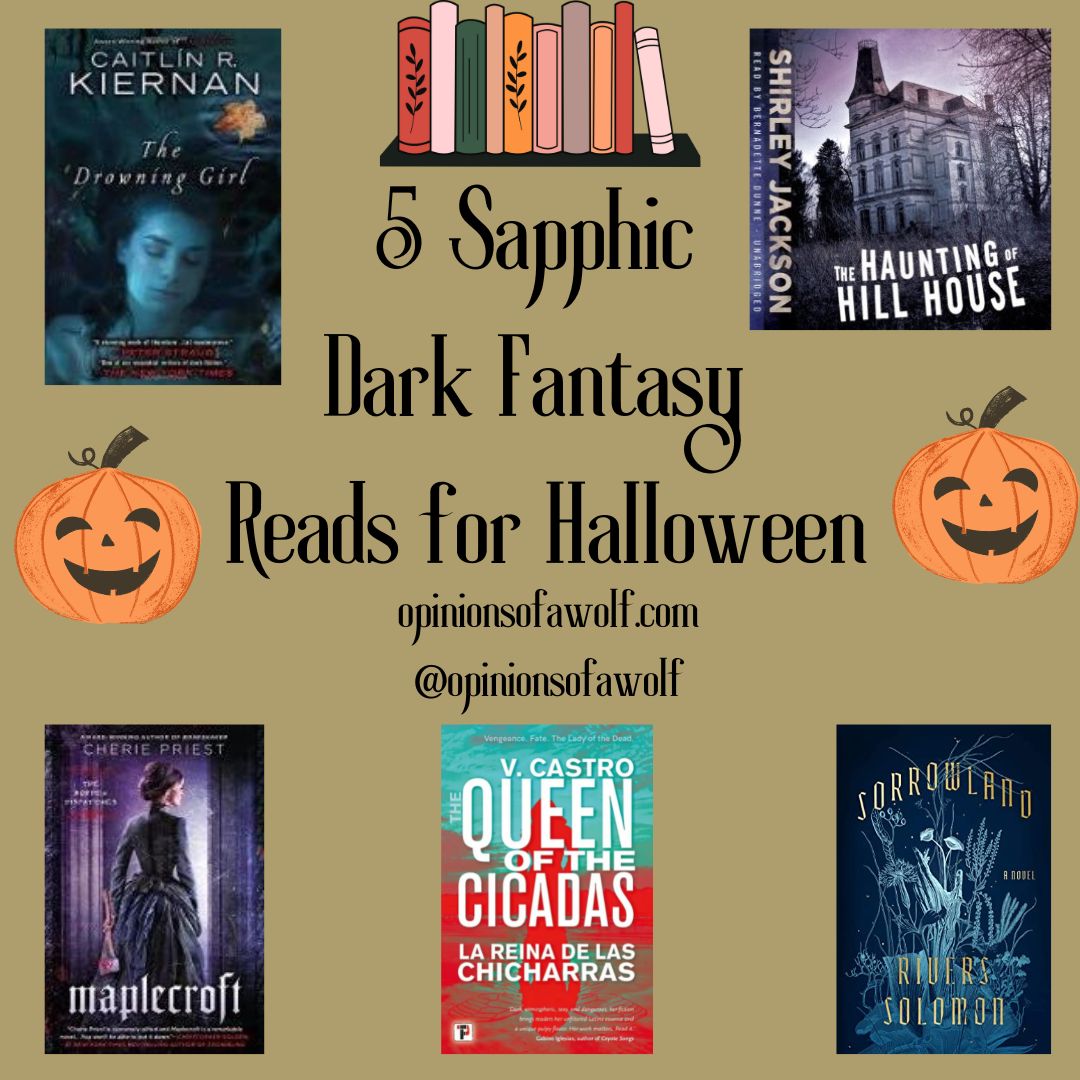
I am running A Very Sapphic Halloween Reading Challenge, which isn’t just for reading and reviewing new books but also for highlighting books you’ve read before (or hope to read) that fit the challenge. Something Halloweeny featuring women loving women.
This is my first list of suggested reads – 5 dark fantasies.
The Drowning Girl by Caitlin R. Kiernan
India Morgan Phelps, Imp to her friends, is sure that there were two different Eva Cannings who came into her life and changed her world. And one of them was a mermaid (or perhaps a siren?) and the other was a werewolf. But Imp’s ex-girlfriend, Abalyn, insists that no, there was only ever one Eva Canning, and she definitely wasn’t a mermaid or a werewolf. Dr. Ogilvy wants Imp to figure out for herself what actually happened. But that’s awfully hard when you have schizophrenia.
A beautiful thing about this book is how it’s up to the reader to decide if fantastical things actually happened or if they’re all symptoms of Imp’s schizophrenia. Told in the first person from Imp’s perspective, it’s a uniquely different mystery. (my full review)
The Haunting of Hill House by Shirley Jackson
Dr. Montague is a scholar of the occult, and he invites three other people to stay with him in Hill House, which is notorious for being haunted. There’s jovial Theodora, timid Eleanor, and the future heir of the house, Luke. What starts as a light-hearted adventure quickly turns sinister in this horror classic.
This is considered a sapphic classic, but it was published in the 1950s so the sapphic part is pure subtext, due to censorship at the time. A haunted house story that’s not too scary to most modern readers but a fun, quick read. (my full review)
Maplecroft by Cherie Priest
“Lizzie Borden took an axe; gave her mother forty whacks….”
Any New Englander knows the nursery rhyme based on the true crime story of Mr. and Mrs. Borden who were murdered with an axe in 1892. In spite of being tried and acquitted for the murders, their daughter (in the case of Mrs. Borden, step-daughter), was widely believed to actually be responsible for the murders. In this book, she definitely was, but maybe not for the reasons you might think.
A darkness is trying to take over Fall River, Massachusetts, and Lizzie and her ailing sister Emma are all that might stand between the town and oblivion, with Lizzie’s parents being the first casualties in the battle.
Lizzie Borden’s axe murder actually had to do with an eldritch horror, plus Lizzie has a girlfriend, Nance. Think Stranger Things but in the 1890s and the lesbian is the main character instead of the sidekick. (my full review)
The Queen of the Cicadas / La Reina de las Chicharras by V. Castro
You’ve heard of Bloody Mary and Candyman but have you heard of La Reina de las Chicharras? The legacy says she’s a Mexican farmworker named Milagros who was brutally murdered in 1950s Texas then given new supernatural life by the Aztec goddess of death, Mictecacíhuatl. In 2018, Belinda Alvarez arrives in Texas for a friend’s wedding on the farm that inspired the legacy of La Reina de las Chicharras. But is it just a legacy or is it real?
This struck me as a Latina version of Candyman, where the wrongs instigating the righteous vengeance are colonization and taking advantage of migrant farm workers. I can’t reveal the sapphic content without spoilering, but trust me, it’s there. (my full review)
Sorrowland by Rivers Solomon
Vern desperately flees the strict, religious, Black Power compound she was raised on while she is heavily pregnant with twins. Giving birth shortly thereafter and raising her babies in the woods, she finds herself transforming inexplicably. But what is she transforming into? Why? And can she protect her children from both the compound and the world?
This is a beautifully grotesque book that reminded me of watching season 1 of Hannibal – but with a Black lead with albinism who is a woman who loves women. (my full review)
Do you have suggested sapphic dark fantasy reads not on this list? Let us know in the comments!
If you found this list helpful, please consider tipping me on ko-fi, checking out my digital items available in my ko-fi shop, buying one of my publications, or using one of my referral/coupon codes. Thank you for your support!
A Very Sapphic Halloween Reading Challenge
I am pleased to announce that I will be hosting a brand-new reading challenge – A Very Sapphic Halloween Reading Challenge!
Goal of the Challenge
Celebrate women loving women in books that also make you feel like you’re celebrating Halloween.
When Does it Run?
Now through the end of October!
What Books Count?
Any book that feels Halloweeny to you that also has at least one character (main or secondary) who is a woman who expresses a sexual or romantic interest in women.
What makes a book Halloweeny? It could be a thriller, mystery, or horror. It could have paranormal elements. But it also could be a cozy romance set during the fall season. If it makes you feel in the mood for Halloween, then it counts.
If you don’t have time to read and review something new but still want to participate, you can also post suggested reading lists to participate in the challenge. Hype up your favorite sapphic Halloween reads!
How Do I Participate?
You have three options:
- Blog/Website – write a sign-up post on your blog or website linking back to my post here. That way I can find you and follow along. It can be fun to write up a tbr or a list of books you own that could count to pull from for the challenge. Feel free to grab the image from this post for your own!
- Instagram – Post your intent to participate in the challenge. Tag me (@opinionsofawolf) and use the hashtag #sapphichalloweenreading. You can feel free to use the image on this page in your posts, or you can grab it from my Instagram.
- Twitter – Tweet your intent to participate. Provide a link to this page and tag me (@McNeilAuthor) so I can find you and follow along.
If you write individual reviews or lists, it’s helpful to link back to this page, tag me, or use the hashtag #sapphichalloweenreading both to help spread the word and to help us find each other and cheer each other on.
I’ll be posting my first list of reading suggestions next week, if you’re looking for possible reads. Keep an eye out for that!
My Sign-Up TBR
These are the books from my TBR that I think I will likely be reading for this challenge:
- A Dowry of Blood by S.T. Gibson – vampires
- The Gilda Stories by Jewelle L. Gómez – horror, vampires
I hope you’ll be joining me on this fun fall celebration!
Book Review: Buffalo Is the New Buffalo by Chelsea Vowel

Summary:
Inspired by classic and contemporary speculative fiction, this collection of eight short stories explores science fiction tropes through a Metis lens: Nanites babble to babies in Cree, virtual reality teaches transformation, foxes take human form and wreak havoc on hearts, buffalo roam free, and beings grapple with the thorny problem of healing from colonialism.
Review:
This collection contains nine short stories by Indigenous (Métis) author Chelsea Vowel. The Métis are a recognized Indigenous people with a unique culture descended from the pairings of Indigenous with European fur traders (usually, but not always, First Nations women with French men). Most of the stories are set in the same region of Canada, and all of the stories are speculative, containing some fantastical element, whether they are set in the past, present, or future.
The author is queer, and queerness is clearly present in five of the nine stories. These include: a historical woman figure who identifies as a woman, is interested in women, and dresses in male clothing; a woman character who becomes interested in a fox presenting as a woman; a woman character who is in lockdown without her girlfriend who ended up trapped in another town after she went to visit her family; a queer poly family raising a child together in a collective; and a nonbinary femme-presenting character who uses Métis gender-neutral pronouns.
My favorite story of the collection is “Maggie-Sue.” This is the story where an Indigenous woman becomes interested in a beautiful Cree woman she sees but realizes is actually a fox disguised as a woman (this is revealed very early on, so not a spoiler). I loved everything about the fox woman, the mystical adventure the main character goes on, and the ending was a delight to imagine. I also really appreciated the play on words in the title (which I won’t reveal, because it’s more fun for you to realize it when you’re reading it yourself). I thought this story also offered solid critique on the difficulties of being a survivor of ongoing colonization on your ancestral lands, without that criticism ever feeling like telling instead of showing or like academic language sneaking in where a character wouldn’t use it.
The latter is my main complaint for the story I liked least – “Unsettled.” There is a scene where five characters, none of whom are established as academics, sit around having a highly academic conversation for many pages. The story felt more like an academic thought experiment than a story with unique characters and perspectives. I also struggled a little bit with the first story in the book, “Buffalo Bird.” its pacing was slow, which is a challenge for me. I think I would have liked it more further into the collection. I personally need to kind of “know” a writer to trust that a story will ultimately go into an interesting place if it has a slow start.
Something else interesting about this collection is that it has footnotes throughout, where the author explains things or gives historical context. I enjoyed these and felt they added to the stories. They’re not used all the time, sometimes you as the reader do need to figure things out from context for yourself if you’re not Métis (which I, to be clear, am not). But I thought the footnotes struck a nice balance.
The other thing is after each story there’s a short reflection from the author about the story. On the one hand, I liked these because I learned more from them. As an author myself, also, it was interesting to hear from the author on what her goals were and compare them to my actual experience as the reader. On the other hand, I could see some readers not enjoying this aspect of the book, wanting to be left with their own experience with the story and leave it at that. But you can always skip over these essays if you prefer not to have the inside story.
Related to the essays, I do also want to note one additional thing. I do think that an author’s beliefs and politics tend to make it into their writing, whether they intend that or not. I’m not saying every character reflects the author’s worldview, absolutely not, but the more you read an individual author’s work, the more you come to see how they likely see the world. This is even more clear in this collection where each story is paired with a nonfiction reflective essay by the author. The author is an academic Indigenous queer woman, and definitely leans very left. I’m not saying this is a good or a bad thing. But I do think it shows through more clearly in some stories than others, and is very present in the essays. Only you, the potential reader, can know if this would be a plus, negative, or neutral for you.
Overall, this is an interesting collection of speculative short stories from a queer Indigenous woman author. I’m glad I took the time to read them and see a different way of storytelling and views on the world within the speculative framework I personally enjoy.
Please note, I calculate a rating for a short story collection by individually rating each story then reporting out the average. This came out to 3.7, so I rounded up to 4.
If you found this review helpful, please consider tipping me on ko-fi, checking out my digital items available in my ko-fi shop, buying one of my publications, or using one of my referral/coupon codes. Thank you for your support!
4 out of 5 stars
Length: 272 pages – average but on the shorter side
Source: Library
Buy It (Amazon or Bookshop.org)
 Support my work with a tip or browse my shop for curated book club guides, how to guides, cross-stitch patterns, and more!


This work by Amanda Nevius is licensed under a Creative Commons Attribution-Noncommercial-No Derivative Works 3.0 United States License.
 Opinions of a Wolf