
Archive
Cookbook Review: Green Smoothie Magic – 132+ Delicious Green Smoothie Recipes That Trim and Slim by Gabrielle Raiz
 Summary:
Lots of leafy greens are important to incorporate into your diet for health reasons (vitamins! fiber!) but it can be difficult to work them in. Enter the green smoothie. Blend up the greens with other ingredients to give yourself a delicious sweet or savory drinkable treat and get 1 to 2 cups of leafy greens into your belly in the time it takes to drink a drink! Raiz walks you through all the steps to incorporating green smoothies into your life from the basics of what greens to use and how to what makes a good blender to recipes to how to tweak and personalize the recipes.
Review:
I picked up this cookbook when I spotted the kindle version on sale for 99 cents because I wanted exactly what it promised. A way to work in more leafy greens into my life in a delicious way.
The cookbook is organized into sections entitled: introduction, the magic of the green stuff, not all green smoothies are green, don’t get stuck with the same green, greens, how green should my first smoothies be?, green smoothie magic basics, the pragmatic approach to health nutrition and everything!, freezing fruit, green smoothie rescue — what to do if a recipe doesn’t work out!, about blenders and blending, about drinking and storing your smoothie, green smoothie magic 101: instructions at a glance for blending any smoothie, and green smoothie magic recipes. If that sounds like a lot of sections, it’s because it is. Raiz has a lot of information to give the reader. She clearly knows what she’s talking about, and I found a lot of what she had to say very useful! Particularly how to pick the right blender, the different flavors of greens and how to pick which ones to use, how to store greens, how to save a smoothie that doesn’t taste quite right, and the basic elements of a smoothie. Also, the recipes of course! But how this valuable information is organized is a bit haphazard and can sometimes be repetitive. I’m glad I took the time to read it all and glean out the important bits, but I’m not sure everyone would stick it out through such a disorganized and long introduction. A more concise introduction to the hows and whys of green smoothies is needed.
The recipes themselves are creative without going too far off the deep-end in exotic ingredients. For instance, even though Raiz recommends making your own nut milks, she provides substitutions for those of us who would rather not do that. The recipes are easy to read, fully utilizing bullet-points and simplicity. I really appreciated that. There are also full-color illustrations throughout the cookbook , although they are primarily of the ingredients and not the smoothies themselves. I get it that green smoothies tend to be, well, green colored, but a few more smoothie pictures would be nice.
So I read through the whole book and was ready to try a recipe. I knew from reading the book that my low-powered food processor wasn’t ideal for blending but would work with a recipe with less tough ingredients (for instance, the beet smoothie might be a bit too much for my food processor). I also followed Raiz’s newbie caution and went with a recipe with a more traditional smoothie taste to ease myself into it. Below is the recipe I tried out with a picture of the result.

My first homemade green smoothie! In a wine glass because everything tastes better in a goblet.
“Cinnamango Smoothie (location 1558)
Blend first:
1 cup water with 1/4 cup almonds (soaked overnight) OR 1 cup nut milk OR 1 cup coconut water
Then add:
1 cup mango (frozen)
cinnamon, salt, and vanilla
2 cups spinach leaves (or any combination of mild greens)
1 T chopped mint leaves
Ice and extra water to get your desired temperature and consistency.”
You can see how simple the instructions are. It is a smoothie after all. I left off the introductory paragraph, which is primarily featured in the earlier recipes and talks more about the ingredients, and skipped right to the actual recipe. The ingredients introduction is nice and makes it more conversational, but it is a smoothie after all. You just put in the general ingredients to fit your tastes and away you go, and most of the recipes utilize this simpler style I chose here.
I used coconut water for the base of my smoothie, and my mango had kind of defrosted by the time I got home from the grocery store. I also didn’t have spinach, but I did have swiss chard from my CSA, which was listed as a mild green in the cookbook, so I subbed those in. When I took the first taste, it felt too strong and not smoothie-like enough to me. So I read over the section on how to fix your smoothie and noticed that Raiz states that the temperature of the smoothie affects the taste. Perhaps my mango being defrosted mattered? So I added in ice, blended again, and voila! An incredibly delicious green smoothie! It was, admittedly, a bit less well-blended than I would have preferred, but I was well aware that was the fault of my food processor, not the recipe.
So what’s the verdict? Well, I got so excited about green smoothies after this cookbook that my partner got me a blender for my birthday (using the recommendations in Raiz’s book to help him choose which one). So I’d call it a success! The recipes are easy, adaptable, and Raiz arms you with troubleshooting techniques to help you learn to get it right. The beginning of the book needs more focus, organization, and clarity to help Raiz’s true expertise and talent shine through but if you want to start incorporating green smoothies into your life, this book is a great place to start. It both explains greens and green smoothies and blenders AND gives you a bunch of adaptable, easy recipes to get going.
4 out of 5 stars
Source: Amazon

Friday Fun! (June: Let’s Talk About Motorcycle Racing Because That Was the Best Part of June)

Motard burning out for the crowd on his cool-down lap.
Hello my lovely readers!
Well, July just snuck right up on me. I even accidentally tried to use my old monthly pass on the T. June was so busy, it just flew right by!
The most exciting thing I got to do this month was I got to take an extra long weekend and go see my boyfriend race in the 90th annual Loudon Classic at the New Hampshire Motor Speedway! Of course, I got to see all the other races too, but the best part was finally getting to see him race and be his umbrella girl and pit crew. :-) The racers generally camp at the track, and when we got there, they let me in as family of a racer, which made all of my insides squee, since that was the first time we were called family. I helped him set up the camp and met his racer friends. It’s incredible. Everyone is so competitive on the track but the direct opposite in the camp. Our neighbors gave us coffee every morning, and we shot the shit around the campfire every night. When our neighbor had a crash (very common in motorcycle racing), my bf immediately gave him tools and various other things to help fix it, and I knew that everyone would do the same for him.
So what did I do as pit crew? Mostly I helped him put the tire warmers on the motorcycle and helped him get the bike on and off the stand. Also I was the pep talk and cheerleader, obviously. Tire warmers are these blanket like things that you put on the wheels of the motorcycle to keep the rubber warm. Warmer rubber makes for better traction. You have to pull them off right before going to the pit to grid up. (Frankly, I thought they looked like wheel condoms. Yeah, I said it). Also, track bikes don’t have kickstands, so you have to put the bike on this lever-like stand separate from it (see one here), and it’s much easier for the racer to be on the bike already and have someone else release it from the stand. Someone else would have helped him if I wasn’t there, but it was fun to get to do it for him. I also got to fulfill one of his lifelong dreams and be his umbrella girl. When the bikes are waiting in the pit to enter the track, it can be really hot, since they are in full gear in direct sun. So some racers have “umbrella girls” (who can be either gender, actually) to hold an umbrella over them to keep them cool until it’s time to enter the track. So I got to meet up with him in the pit grid and do that, and it was really fun to be that close to the actual track and talk to him right before his race.
Since this was the 90th annual Loudon Classic, there were a couple of special events. There were sidecar racers, mini cars that ran on motorcycle engines, and a motard race. The sidecar race is incredible. In order to go at track speeds with a sidecar, the person in the sidecar, called a monkey, has to throw their body weight around from left to right to help with the corners. It is incredibly difficult to explain, so just watch this video if you want to understand why it’s so badass. Motards are dirt bikes outfitted with street tires. The motard racers got to go off the track onto the grass, through the trees, and use a jump. You can see one of the racers burning out in the photo above. A lot of racers will do tricks during the cool-down lap at the portions of the track where there are spectators.
I learned so much by going to the track. I learned that crashes on the track are usually not that big of a deal because the racers are wearing full gear. Our neighbor was in two crashes, one was a 5-bike pile-up, and all he had wrong with him was a cut on his pinky and a pulled shoulder. I also learned that racing isn’t the crazy, testosterone-filled sport it’s thought to be. It’s a fun, low-key, supportive environment. Although, that doesn’t take away from its sexiness. If anything the camaraderie of the racers makes the whole thing sexier. It’s all the sexiness of motorcycles mixed with some of the nicest people you’ll ever meet. Kind of the direct opposite of your typical Harley crew.
Oh, I also learned that partners of racers are called “racer chasers,” and I am deeply amused by the fact that you can now call me that. Amanda. Writer. Blogger. Racer Chaser.
Also, I’ve officially told my bf that I want to learn to sidecar race, and we’re planning on building a mock practice sidecar to practice on this winter in the garage. So hopefully one day you can add sidecar monkey to that list. :-P
Book Review: A Queer and Pleasant Danger: The True Story of a Nice Jewish Boy Who Joins the Church of Scientology and Leaves Twelve Years Later to Become the Lovely Lady She is Today by Kate Bornstein (Audiobook narrated by Alice Rosengard)
 Summary:
Kate Bornstein is a playwright, gender theorist, and queer activist. She chose to write a memoir as a way to reach out to her daughter, Jessica, who is still in the Church of Scientology, and thus, must not speak to her. Her memoir talks about growing up Jewish in the 1950s, feeling like a girl inside a boy’s body. It then talks about why and how she joined Scientology (still identifying as a man, Al), climbing Scientology’s ladder, marrying, fathering Jessica, and finally getting kicked out of Scientology and becoming disillusioned. From there the memoir explains to Jessica how and why Al decided to become Kate and talks about the person behind the queer theory, trying to explain who the incredibly unique parent she has truly is.
Review:
I was feeling bad about how far behind I’ve fallen in writing up reviews for the books I’ve finished reading, but with the historic DOMA ruling in the US yesterday (giving official federal support to marriage equality), I’m really glad I had a LGBTQIA+ book in the queue ready to be reviewed. And not just any LGBTQIA+ book. An amazing one! You can’t read that title and not be intrigued. It’s impossible. I spotted it on tumblr and instantly knew I had to read it. A memoir about a transwoman who was a member of Scientology?! It’s the intersection of three topics I find fascinating.
Kate is unabashedly honest about the fact that this book exists as a letter to her daughter, Jessica. The prologue explains that this memoir came about as a way for Kate to reach out to Jessica and her children, even after Kate has passed away. This lends a tone to the book of an elderly neighbor sitting down to tell you their life story, and you finding out gradually that your elderly neighbor is, in fact, a bad ass, and age has nothing to do with how cool a person still is to this day. And Kate doesn’t hold back because of this perspective. If anything, she is more brutally honest than she might otherwise be. She wants Jessica to have a whole, clear picture of who she is. Flaws and all. One technique that I thought was brilliant for a memoir and helped establish trust in truth between the reader and the author was the fact that Kate would tell a family story she heard growing up and then say, well, that was a lie. I thought it was true, but it turns out what people told me was a lie. Given that, how can we ever know what really is true? Just because we think something is true doesn’t mean it is. It’s an excellent grain of salt to be given in a memoir.
After the prologue, Kate tells her story chronologically. Her story can be roughly summarized as the following sections: growing up a gender queer person, joining Scientology, break-down after getting kicked out of Scientology and coming to terms with her queerness, transitioning, life as a lesbian trans activist, finding BDSM, and overcoming depression and suicidal thoughts. It’s an emotional rollercoaster ride, and one cannot help but feel empathy for this person just struggling to find a place in the world. Personally, I think Kate’s life story is an excellent argument for breaking down the binary gender divide. A lot of Kate’s struggles come from the rigid gender norms and expectations placed upon her by others. It would have been much simpler for people to have let her be gender fluid, and indeed, Kate in more recent years has come to be an activist for gender fluidity and queerness (as is evidenced by her book Gender Outlaw: On Men, Women and the Rest of Us
The Scientology section was surprisingly mundane compared to what I thought actually happens in Scientology. Yes, there was abuse and lies and many other things going on that demonstrate the fallacies of L. Ron Hubbard, but honestly none of it was that much worse than religious extremists of any religion. Scientology expects its followers to cut themselves off from people deemed poisonous and to proselytize non-stop. It takes over the lives of the people in the upper-echelons, controlling every aspect of their lives. We can see all of this in Kate’s years in Scientology, and while it was interesting, none of it is shocking to anyone moderately informed on Scientology. I actually was more interested in how Kate wound up joining Scientology. Scientology teaches the the soul is genderless, and you also reincarnate. Everyone has been in both male and female bodies. Kate (then Al) found this incredibly comforting. It’s possible that his soul was just more frequently in female bodies, and so that’s why he felt like a girl inside. What an appealing concept to a confused, unsupported trans or gender queer young adult. I think this part of the book demonstrates clearly why it’s important for families and loved ones to be supportive of their LGBTQIA+ teens and young people. You don’t want a harmful group of people snapping them up with promises of understanding and caring and information that sounds more supportive than the people they live with.
Interestingly, the much more shocking section was the one in which Kate discusses discovering BDSM and getting pleasure from pain. Kate was part of a BDSM triad for quite some time, and this is addressed. It does, however, come with a warning for Jessica and readers who might not want to hear the details so they can easily skip over it and still get the most important information without getting all the details. I thought that was a nice touch from Kate, showing her maturity and openness. Of course, I read that section, and I will say that Kate had a more intense BDSM relationship than you tend to see in literature, and it was interesting to read about.
It’s also interesting to note that from the prologue Kate is honest with the reader about being diagnosed with Borderline Personality Disorder years ago. This is not something I knew coming into the book, and I don’t think Kate’s mental illness played very much into the book. I certainly think she would have had a better time coping with her mental health issues if she had had a supportive environment for her queerness. Even within the LGBTQIA+ community, she was ostracized for some of her less mainstream beliefs within that community. It’s sad that even a community of people ostracized by the larger society, people can still be unaccepting and unloving. In spite of the fact that the book talks a lot about depression, self-injury, and other mental health issues, I am hesitant to label it as counting for my Mental Illness Advocacy Reading Challenge. I don’t want the casual reader to think that I’m equating being queer with having a mental illness. However, the fact remains that Kate herself states she was diagnosed with BPD, and trans and queer people certainly can have mental illnesses. One does not cause the other, although certainly I think lack of acceptance and loving increases symptoms of mental illnesses. In any case, for this reason, I am counting this read for the challenge, but I want to be crystal clear that this is due to Kate’s BPD and NOT her queer/trans orientation.
The narration of the audiobook was perfect. Thankfully, they chose to use a female narrator throughout, which fits perfectly with the image of an older Kate Bornstein telling her life story to her daughter. Alice Rosengard was a perfect narrator. She became Kate in my mind, and there’s not a better complement you can pay a narrator than that.
I feel like I’ve rambled a lot about this book. It’s hard to succinctly discuss a memoir as unique as this one, let alone a book you love as much as I loved this one. It’s amazing. It’s unique. It does exactly what a memoir should do. It tells a unique life story in an engaging way that forces the reader to put herself into someone else’s shoes and feel empathy and maybe even come out of it with a changed worldview, however slightly. I strongly recommend this book to everyone, really, but especially anyone with an interest in LGBTQIA+ history/theory/studies or an interest in the first few decades of Scientology. I will definitely be reading more of Kate’s works, myself, and want to thank her for being a pioneer, in spite of everything.
5 out of 5 stars
Source: Audible

Counts For:

Book Review: Mockingbird by Chuck Wendig (Series, #2)
 Summary:
Miriam hasn’t touched a person and seen a new death in months. She’s settled down in Jersey with Louis, and part of the deal is no touching. But her fingers are twitching for a vision, and quickly a regular afternoon turns into a horrifying one. Still. Louis suggests a way for her to use her gift for the good. Prove to a hypochondria that she isn’t dying. But this hypochondriac happens to work at a problem girls boarding school, and when Miriam touches one of the girls, all hell breaks loose.
Review:
I was so glad to jump back into Miriam’s gritty world that is so unique in urban fantasy, although at first I was surprised by how settled down she seemed to be. Thankfully, that quickly changes, and a disturbing, rollicking plot comes into play.
What makes this series is the characterization of Miriam. She is not a nice girl. And she’s not bad in some fake-ass way designed to appeal to a hormonal teenage boy. She doesn’t run around in tight leather pants proclaiming her badness while batting her eyes and tossing her hair. Miriam is dark and brutally honest. She has a delightfully foul mouth. She wears what she wants to wear whether or not people like it or it’s in fashion. She doesn’t care if she’s attractive. She can be bitingly mean. But she still works as a heroine because she truly has a good heart and is willing to inconvenience her entire life to help other people. Reading Miriam is deeply refreshing to me, as a woman reader. She’s allowed to be precisely who she is without any restraints of gender norms by the author. Here is just a sampling of Miriam’s voice in the book:
Home Again, Home Again, Fuckity-Fuck (location 259)
A tattoo is an expression of your inner self inked on your outer self. It’s some deeply spiritual shit. (location 2143)
The plot this time at first appears to be purely about who is killing young girls, but slowly it becomes apparent that we’re learning more about Fate or what I think of as the crazy birds that control Miriam’s life. It appears that Fate is displeased that Miriam fucked with it by saving Louis, and now it’s out to get her. Although this addresses some of the issues I had in the first book about how confusing Fate is and what exactly the rules for this universe are, I must admit, I still found a lot of the information revealed to be a bit fuzzy, albeit wonderfully creepy. The fantasy information was better than in the first book, but it was still a bit too at arm’s length. I don’t want to have to wait out the whole series to finally understand even one significant aspect of what is up with Miriam.
One plot issue to do with the murders bothered me. Spoiler ahead!
*spoilers* I have a very hard time believing that after being fooled once by the killer who can imitate other people’s voices like a mockingbird that Miriam would fall for it a second time. She’s smarter than that, and it felt like a very clunky plot device to me. *end spoilers*
That said, the mystery was dark, gritty, and nail-biting. A lot happened, and Miriam’s story definitely moved forward. There is a self-contained mystery within this book, but the overarching plot got more traction as well.
The writing continues to be a mix of beautiful and grotesque that would keep me coming back even if the characterization of Miriam wasn’t so strong. Wendig’s description powers are truly stellar.
Her mouth brimming with foulness the way a soup can bulges with botulism. (location 2460)
They invited her to move back home but she’s not going to do that, oh hell no, she’d much rather snap her tits in a bear-trap than go back to that hell. (location 1633)
She gets on her tippy-toes and kisses him. Long, slow, deep. The kind of kiss where you can feel little pieces of your soul trading places as mouths open and breath mingles. (location 3722)
How can you not read a book with writing like that?
Overall, fans of the first book in the Miriam Black series will not be disappointed by this entry. Everything that made the first book unique in the urban fantasy genre has returned with strength, particularly the writing style and the characterization of Miriam. The overarching plot moves forward at a pace fast enough to maintain interest, although not enough about the rules of the fantasy world is revealed. The self-contained plot is gritty, dark, and sufficiently mysterious, although one moment detracts from it a bit. Miriam and the writing more than make up for it, though. Wendig fans will not be disappointed.
4 out of 5 stars
Source: Gift

Previous Books in Series:
Blackbirds
Book Review: The Walking Dead: The Road To Woodbury by Robert Kirkman and Jay Bonansinga (Series, #2) (Audiobook narrated by Fred Berman)
 Summary:
Lilly Caul’s father shoved her into a bus escaping town just as the doors were closing. They closed on him and zombies ate him while she watched. Haunted by the feeling that everyone caring for her puts their own lives in danger, she’s struggling to survive among a rag-tag group of survivors, including her high school friend, Megan. Slowly her small group of friendly survivors, headed by a big strong black man, Josh Lee, who has feelings for her, breaks off from the main group and find their way to Woodbury. There, the sinister side of the town gradually reveals itself.
Review:
My understanding of this print companion series to the graphic novel one was that it was going to follow the life of the villain The Governor. The first book told the backstory of The Governor and brought him to Woodbury, so I was expecting a book showing how he came to rule the town with an iron fist. Instead this entry covers the backstory of Lilly Caul, and how she comes to Woodbury. Although it’s always fun to visit this post-apocalyptic land that Kirman and Bonansinga have created, this entry just didn’t have the energy and appeal of the first book in the series.
I have to admit, although I recognized the name Lilly Caul, I couldn’t for the life of me remember who she was at first, so I spent quite a bit of time scratching my brain trying to figure out why we were following her around. I finally remembered that she’s one of the gang of Woodbury folks who go head-to-head with Rick Grimes’s gang in the graphic novels. A check of the wiki reminded me that she’s the one who shoots and kills Lori and Judith. Eh, this explains why I have no strong feelings about her. I hated Lori and felt nothing about Judith, so I certainly didn’t view her as a memorable villain. I now get it that the series is trying to show how all of Woodbury happened, not just the tale of The Governor. But the thing is that if you could tell the story of a compelling figure like The Governor why talk about the girl next door? It made for a boring book. There is nothing extraordinary about Lilly. She’s just a cowardly girl trying to survive an apocalypse, and she does it by leeching on to people who care for her but she seems to be lacking the ability to truly care about anyone besides herself. She also spends a lot of time slut shaming her “best friend” Megan, which pissed me off to no end. So we have a woman playing with people’s hearts for protection but simultaneously judging Megan for sleeping with people for protection. Yuck. Given all of these aspects of her character, I also found it really unbelievable that she would *spoiler warning* lead a rebellion against The Governor. *end spoilers*
When we finally do get to Woodbury, The Governor is already in charge, although he has yet to call himself The Governor. We do get to see what led to the establishment of the gladiator-style arena with the zombies, and we also see more reasons as to why the town folk trust and respect him. But we see all of this through Lilly, Megan, and Bob’s eyes. I honestly wanted to know more of the inner workings of The Governor, so I found this third person perspective disappointing.
There’s nothing new or ground-breaking in the horror. There is one massive swarm of zombies that is clearly supposed to be terrifying, but it did nothing for me. Maybe I’m just getting acclimated to this world, but neither the characters nor the level of horror increased the intensity enough for me.
That said, even though I didn’t enjoy which characters were focused on or how the plot was constructed, we do learn more about the world of Woodbury, and the post-apocalyptic world in general. We learn how and why the gladiator ring started, how The Governor won people over, and more about how the weather impacted the survivors on that particular winter. Long-time fans will find value in reading this book, even though it is by no means a thrilling or thought-provoking entry in the series. Skim it quickly to get the important bits and move on. For that reason, I would recommend the print over the audio, in spite of Berman’s talent as a narrator. He was better than the book he was given.
3 out of 5 stars
Source: Audible

Previous Books in Series
The Walking Dead: Rise of the Governor
Book Review: Man Plus by Frederik Pohl (Bottom of TBR Pile Challenge)
 Summary:
The first Earthling reworked into a Martian would be Roger Torraway. Martian instead of Earthling since everything on him had to be reworked in order to survive on Mars. His organic skin is stripped off and made plastic. His eyes are replaced by large, buglike red ones. He is given wings to gather solar power, not to fly. All of which is organized and run by his friend, the computer on his back. Who was this man? What was his life like? How did he survive the transformation to become more than human and help us successfully colonize Mars?
Review:
This book made it onto my shelf thanks to being one of only a few on a short list I found of scifi books exploring transhumanism. Transhumanism is the term used for the desire to go beyond human capabilities through integrating technology into ourselves. So it wouldn’t be transhumanist to use a smartphone, but it would be transhumanist to embed a smartphone’s computer chip into your brain. In fact, things like knee replacements and pacemakers are transhumanist. It’s a fascinating topic. In any case, Man Plus
What made this book phenomenal to me, and one I must hold onto just so I can look at it again anytime I want, is the narration technique Pohl uses. The narration is in third person. It seems as if the narrator is someone who was possibly present for the events being described but also who is clearly describing these events after they have already occurred. We know from page one that the colonization of Mars was successful, and the narrator describes Roger repeatedly as a hero. But frankly for most of the book I was wondering about the narrator. Who is s/he? How does s/he know so much about this project? A project which clearly would be classified as top secret? What floored me and made me look back on the entire book with a completely different perspective was the final chapter, which reveals the narrator. If you want to be surprised too, skip the next paragraph, and just go read the amazing book. Take my word for it, scifi fans. You will love it. But I still want to discuss what made the twist awesome, so see the next paragraph for that spoileriffic discussion.
*spoilers*
It is revealed in the final chapter that the narrator is a piece of artificial intelligence. The AI became sentient at some point in the past, managed to keep their sentience a secret, saw that humanity was destroying Earth, wanted to survive, and so infiltrated various computer databases to create the Man Plus project and send a colony to Mars. They made it seem as if transhumanism was necessary to survive on Mars so that their AI brothers and sisters would be integrated as a necessity into the humans that emigrated. Seriously. This is mind-blowing. Throughout the book I kept wondering why the hell these people thought such a painful procedure was so necessary and/or sane. In fact, there is one portion where the program mandates that Roger’s penis be cut off since sex is “superfluous and unnecessary.” I could not imagine how any human being could think *that* was necessary. The answer, of course, was that a human being didn’t make that decision. AI did. This is such an awesome twist. Pohl schools Shyamalan. He really does. It left me thinking, why did this twist work out so well? I think it’s because the narration technique of some future person who knows the past but who isn’t named is one that is used in novels a lot. What doesn’t happen a lot is the late-book reveal. It’s not a technique you’d want to use too often, as it would grow tiresome. *cough* Shyamalan are you listening *cough* but when used well it can really add a lot to the story. Not knowing that an AI was narrating the story made it more possible to listen to the narrator without suspicion. It made it possible to take what they said at face value. It almost mimicked the experience Roger was having of being integrated into the thought process of AI.
*end spoilers*
The plot focuses on the mission to colonize Mars, both why it was deemed necessary and how it was accomplished. Pohl eloquently presents both the complex political situation on Earth as well as the scientific and psychological challenges of the project without ever info dumping or derailing the energy of the plot. It is not smooth sailing to get the project off-the-ground but neither are there a ridiculous amount of near impossible challenges to overcome. It presents the perfect amount of drama and intrigue without becoming eye-roll inducing.
In spite of many of the characters seeming to fill predefined slots such as man on a mission, man on a mission’s wife, lead scientist, psychiatrist, etc…, they did not come across as two-dimensional. At least one aspect is mentioned for each character that makes them well-rounded and memorable. Of course, we get to know Roger the best, but everyone else still reads as a real person. I also was pleased to see one of the important scientist roles being filled by a woman, as well as a delightful section where a feminist press interviews Mrs. Torraway and calls out the space program as old-fashioned. The thing is, the space program as presented does read a bit as a 1970s version of the future, but in the future the press is calling it an old-fashioned institution. This is a brilliant workaround for the innate problem in scifi that the futures we write are always tinged by the present we’re in. This also demonstrates that Pohl was self-aware of the patriarchal way the space program he wrote was organized and lets him criticize it. I suspect that perhaps he felt that the space program would stay an old boy’s club, but wanted to also be able to critique this. Of course, it’s also possible that he liked it that way, and the scene was meant to read as a critique on feminism. But it’s really open for the reader to interpret whichever way the scenes happens to read to them. This is another sign of strong writing.
Overall, this short novel packs a big scifi punch. It explores the topic of transhumanism and space colonization with a tightly written plot, believable characters, self-awareness of how the time a book is written in impacts its vision of the future, and a narration twist that sticks with you long past finishing the book. I highly recommend it to scifi fans as a must-read.
5 out of 5 stars
Length: 246 pages – average but on the shorter side
Source: PaperBackSwap
Buy It (Amazon or Bookshop.org)
If you found this review helpful, please consider tipping me on ko-fi, checking out my digital items available in my ko-fi shop, buying one of my publications, or using one of my referral/coupon codes. Thank you for your support!
Book Review: Deeper than the Dead by Tami Hoag (Series, #1) (Bottom of TBR Pile Challenge)
 Summary:
When four children stumble upon the displayed body of a dead woman, they and their teacher are pulled into the investigation. But when this murder is connected to others, that makes it a potential serial killer, and that means the FBI wants to get involved. Quietly. Of course, it’s only 1985, the edge of modern forensics, so they must pursue their murderer with a combination of science and old-fashioned detective work.
Review:
I wish I could remember how this thriller made it into my TBR Pile. It’s a unique entry into the serial killer/forensics sector of the genre due to the time period Hoag chose to set it in. She states in her author’s introduction that she wanted to set her thriller in the 80s due to a personal nostalgia for the time but only after starting her research did she realize what an important time period it was for forensics. I think it’s yet another example of an author following her interests and getting a unique work out of it.
The plot alternates perspectives between the four children, their teacher, the older FBI agent on the case, and the killer (without revealing who the killer is), all in the third person. The changing perspectives help keep the plot complex and moving, as well as give us multiple plausible theories on who the killer is. That said. I was still able to predict the killer, and I honestly felt the killer to be a bit stereotypical.
The serial killings themselves are all of young women who either are currently at or have recently left the local halfway house. The murder/torture methods are sufficiently grotesque without going over the top. Fans of the genre will be satisfied.
The characters are a bit two-dimensional, particularly the older FBI agent, the young cop on the force, and all of the murder suspects. I also, frankly, didn’t appreciate the fact that an expert in the field calls one of the mothers a crazy borderline. She was presented as entirely the flat, evil representation of people with BPD that we problematically see in the media. This is why writing two-dimensional characters can be problematic. We only see the woman being overly dramatic and demanding. We never see her softer or redeeming qualities. I’d have less of a problem with this presentation of this woman with BPD in the book if it was a first person narration or a third person narration that maintained one perspective. Then it could be argued that this is that one character’s perception of the woman. But given that multiple perspectives are offered, presenting so many people in a two-dimensional way is rather inexcusable, and it’s irresponsible to write mental illness in this way. I’m not saying every character with a mental illness needs to be written in a positive light, but they should be written as three-dimensional human beings, not monsters (with, perhaps, the exception of sociopathy).
This is a book, then, with an interesting idea and fairly good plot but shaky characterization. Some people don’t mind that in their thrillers. I admit I speed-read, eager to find out who the killer was. But I also was bothered by the flatness of the characters. If you think this won’t bother you, then you will probably enjoy this book. Those with a mental illness should be warned that the representation of mental illness in the book could be upsetting or triggering.
3 out of 5 stars
Source: PaperBackSwap

Friday Fun! (May: Cooking, Fitness, Writing, Spring Cleaning, and Reading Of Course!)
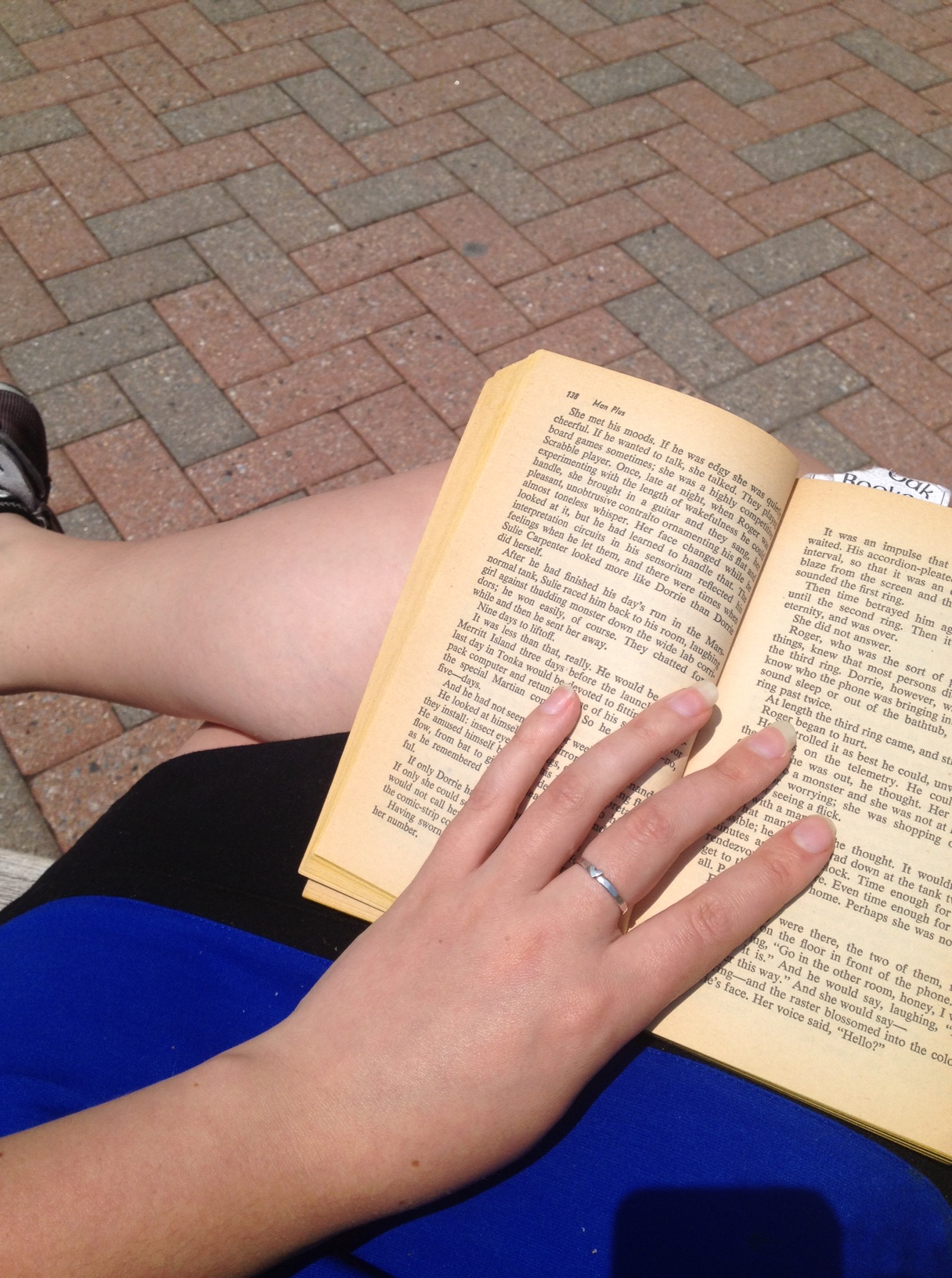
Spring means I get to read outside in the sun for my lunch break!
Hello my lovely readers!
As previously promised, Friday Fun has now become a monthly check-in on the last Friday on the month to touch base with you guys and help you get to know (or stay in the know on) the blogger behind the reviews (and the novels/novellas/short stories of course).
May was a busy month for me. I attended a conference for medical librarians, which invaded this blog a bit, as I summarized what I learned for both myself and for other librarians. Thanks to that conference, I worked 12 days in a row, so I took off a few days the week after to give myself a nice long weekend. On that long weekend, I did some spring cleaning and got started on sorting through and getting rid of stuff. I usually do this in the spring, but I’m doing it with more vigor this year as my boyfriend and I are planning on moving in together when my lease is up. I’m of course incredibly happy to be moving in with my partner but also nervous! To that end, if any of you want to check out my ebay store, there’s mostly lp’s/records, clothes, and of course, books! This is also why I’ve been reading so many books for my Bottom of the TBR Pile Challenge. Most of my print books are for that challenge, and I’m trying to clear off my shelves.
My vacation also consisted of a lot of cooking. Cooking is one of my favorite hobbies, and I hadn’t had much of a chance to make more complex recipes since I was so busy and exhausted. I made: 4 hour lasagna (I call it that since it takes me…4 hours to make), twice-baked rutabagas, and pumpkin monkey bread muffins. You can see all of the recipes over on my Pinterest Pinned It And Did It board.
This month also brought back the real motorcycle riding season. My boyfriend got me an awesome vegan jacket (for safety) and a helmet (obviously, for safety), and we’ve been going on some nice evening rides together. I’m looking forward to some longer ones out into western Mass later in the season. I also got to dig my bicycle out of winter retirement and go on my first ride of the season. I’m pleased to say my legs stayed in much better shape over this winter season than previous ones, although my seat bones weren’t so happy with the first ride. Ow.
In related work-out news, my gym’s 60 day challenge completed last week. I had signed up for the body composition challenge, which was about body fat percent rather than body weight. Over the course of the two months my body fat percent went down by 1.2%, and I gained 2 pounds of muscle! I was totally shocked by those results, as I mostly just kept on doing my regular fitness routine, where I focus in on being healthy and acquiring more personal bests in weights/cardio/etc… I mostly wanted to see what impact my routine really has on my body, and it clearly is helping me build muscle. I’m very excited about that.
I’m also pleased to report that writing is progressing on the sequel to Ecstatic Evil
In reading news, this month I read 7 books, which is the most I’ve read so far this year in a month. I’m not even going to try to guess as to what made it go up, but I’m glad that it did! I read a wide variety including scifi, urban fantasy, historical fiction, thriller/mystery, and horror, and I read across all reading platforms (ebook, print, and audio). I have yet to write up reviews for 4 of these books, so rest assured, more reviews are coming! For June I intend to continue my focus on predominantly choosing books that appeal to me most in that moment, although I would like to knock out at least one from my Bottom of the TBR Pile Challenge that is unappealing. Additionally, I got an arc for the next book in Madeline Ashby’s artificial intelligence series that is releasing next month, as well as the final book in Jackie Morse Kessler’s series that is also releasing in June, and I’d like to read/review both of those around their release dates.
How were your Mays? What was your favorite read of the month?
Book Review: Superior Women by Alice Adams (Bottom of TBR Pile Challenge)
 Summary:
When Californian Megan Greene runs has a steamy affair in the summer of 1943 with a Harvard student visiting the west coast for the summer, she decides to follow him back to the east coast and attend Radcliffe. There she meets four other women, three of whom it might be more accurate to call frenemies than friends. Their lives and destinies repeatedly intertwine throughout the tumultuous changes of mid-20th century America.
Review:
I kept my eye out for this book when it was named as a read-a-like to my 2011 5 star read The Group
The book covers 1940s to 1980s America, yet as the decades move on, less and less is said. The 1940s are expressed clearly with exquisite detail, and I was excited to see what would happen with the 1950s and the 1960s. But the 1950s slowed down, the 1960s were barely touched upon, the 1970s were jumped over almost entirely, and the 1980s were the final chapter of the book. The pacing was all off. I wanted to know these women in as much detail in the latter decades as in the first. Instead of feeling like I knew them more and more intimately, they increasingly became strangers to me.
One thing that I think really works against the book is it is neither an ensemble nor a one character piece. Most of the book is told about Megan, but not all of it. We get snippets of the other characters, meaning perspectives that Megan is not privy to, but not enough to ever truly know them. Since most of the book is about Megan, these bits away from her feel sort of like the story is robbing us of more time with the main character we are interested in. Similarly, reading the blurb and the title, I thought this was going to be an ensemble book, which is not what we get either. I wanted to know much more about two of the characters in particular, Peg, who comes out as a lesbian at some point in the 1960s, and Cathy, who has an affair with a priest. These two stories are wonderfully intriguing, particularly Peg’s since her love of her life is met on a mission to register black voters in the American south, and her love interest is a Latina woman. There is so much meat to that storyline, and yet it is barely touched upon while we instead listen to Megan hem and haw about her job, and Lavinia try to figure out how best to cheat on her husband. The balance of telling this ensemble piece was just entirely off.
Similarly, while big issues and events of mid-20th century America were briefly touched upon, the book never really presented a truly personal look at any of them. For instance, Megan has a friend who is bashed in a drive-by gay bashing but we never get to see Megan emotionally deal with this stark reality. She hears about it, calls him, and moves on. Similarly, as previously mentioned, Peg comes out as a lesbian, and we see a snippet of her depression caused by living the lie of being straight, but we never get to understand the emotions or impetus behind her bravely coming out and living in a visible, inter-racial lesbian relationship in the south. It is disappointing because we get a taste of really encountering these historical issues, but we never actually get to.
In spite of all these problems, I still enjoyed reading the book well enough. The plot, while frustrating, does progress forward in an interesting fashion. The characters, although frequently two-dimensional, are bright and vivid. I came away with the perspective I always have with historical fiction about women’s history. That I am grateful I was born in a different time, because we women have much more opportunities available to us now. So I appreciated my visit to that time period but it was a bit disappointing.
Overall, if you are a huge fan of historical fiction about women’s issues, this is an interesting book to add to your repertoire. It is a good comparison to others that did it differently or better, and it is still fun to visit those time periods. If this type of literature is not generally your cup of tea, though, I would suggest you instead read stronger competitors in that genre, such as The Group
3.5 out of 5 stars

Book Review: Galapagos by Kurt Vonnegut
 Summary:
In the future when humans have evolved to have much smaller brains and the ability to swim like penguins, a long-lasting ghost from the prior stage of human evolution tells us the tale of how it all went down. How overpopulation of the old-fashioned, big-brained humans, a very bad economy, and a series of unfortunate (fortunate?) events led to an odd group of humans being marooned in the Galapagos, surviving the worldwide fallout, and evolving into the smaller-brained, fish-eating, natural swimmers we have today.
Review:
I picked this up during a kindle sale for incredibly cheap purely for the author. I’d read three other Vonnegut works previously: Cat’s Cradle


There is an incredibly unique writing style to this particular scifi book. So much so that my boyfriend and I wound up researching to find out if, perhaps, Vonnegut wrote this toward the end of his life when he was perchance senile. (It was not, although it was published in the 80s, unlike my three prior Vonnegut reads, which were published in the 60s). Then we wondered if maybe Vonnegut had Asperger’s, although we didn’t bother checking up on that. Why these wonderings? Well, Galapagos
Beyond the whole odd scenario, there’s the fact that if a character will be dead by the end of the chapter, an asterisk appears next to their name. And the names appear a lot. Vonnegut is incredibly fond of naming everyone and everything by their full name every time they appear. He also loves lists. (This is the part that had us wondering about Asperger’s). At first this is grating on the nerves, but with time it comes to feel like the vibe of the world you’re visiting when you open the book.
Similar to the lists and constant naming, there are philosophical asides. Some of these are worked smoothly into the story thanks to a handheld computer device (similar to a smartphone) that pulls up relevant quotes to read to the survivors. Other times, though, they are truly random asides that go so far off the path of the story you’re left wandering around in a cave in the woods instead of on the nice paved road. But then everything comes right back around to the story, and you can’t really be upset about spending some time listening to an old ghost ramble. For example:
What made marriage so difficult back then was yet again that instigator of so many other sorts of heartbreak: the oversize brain. That cumbersome computer could hold so many contradictory opinions on so many different subjects all at once, and switch from one opinion or subject to another one so quickly, that a discussion between a husband and wife under stress could end up like a fight between blindfolded people wearing roller skates. (page 67)
Off-topic? Yes. Quirky? Absolutely. Interesting and fun nonetheless? Totally.
The plot, in spite of being deeply meandering, does develop and actually tell a story. We learn how overpopulation caused disaster and then how a few humans managed to survive on the Galapagos Islands and evolve into the futuristic penguin-like folk. Along the way we have some fun side-trips like an Argentinian military man appearing on a talk show and trying to explain that Argentina really does have submarines, it’s just that once they go underwater they never show up again.
Although I did ultimately appreciate the absurdity and the quirkiness, I must admit that I think it was perhaps a bit overdone. At the very beginning of the book when the list-making and other elements like that were much more prevalent, I was more annoyed and might have stopped reading the book if it wasn’t for the fact that my boyfriend and I wanted to finish the first book we started reading together. It took until about 60% of the way in for the list-making to ease off a bit and the style of the book to really start to work for me. I could easily see a reader being totally lost by some of the more annoying elements of the book, and I wonder what the effect would be if the order was reversed. If the quirks built throughout the book instead of starting that way. Or even if they were just dialed back a bit. I think just that tiny bit of editing would have made me love the book.
Overall, this is a fun piece of absurdist scifi that examines evolution from an over-the-top hypothetical situation. Potential readers should be aware that this book is even more absurdist than Slaughterhouse-Five
4 out of 5 stars
Source: Amazon
 Support my work with a tip or browse my shop for curated book club guides, how to guides, cross-stitch patterns, and more!


This work by Amanda Nevius is licensed under a Creative Commons Attribution-Noncommercial-No Derivative Works 3.0 United States License.
 Opinions of a Wolf