
Archive
Book Review: A Bánh Mì for Two by Trinity Nguyen
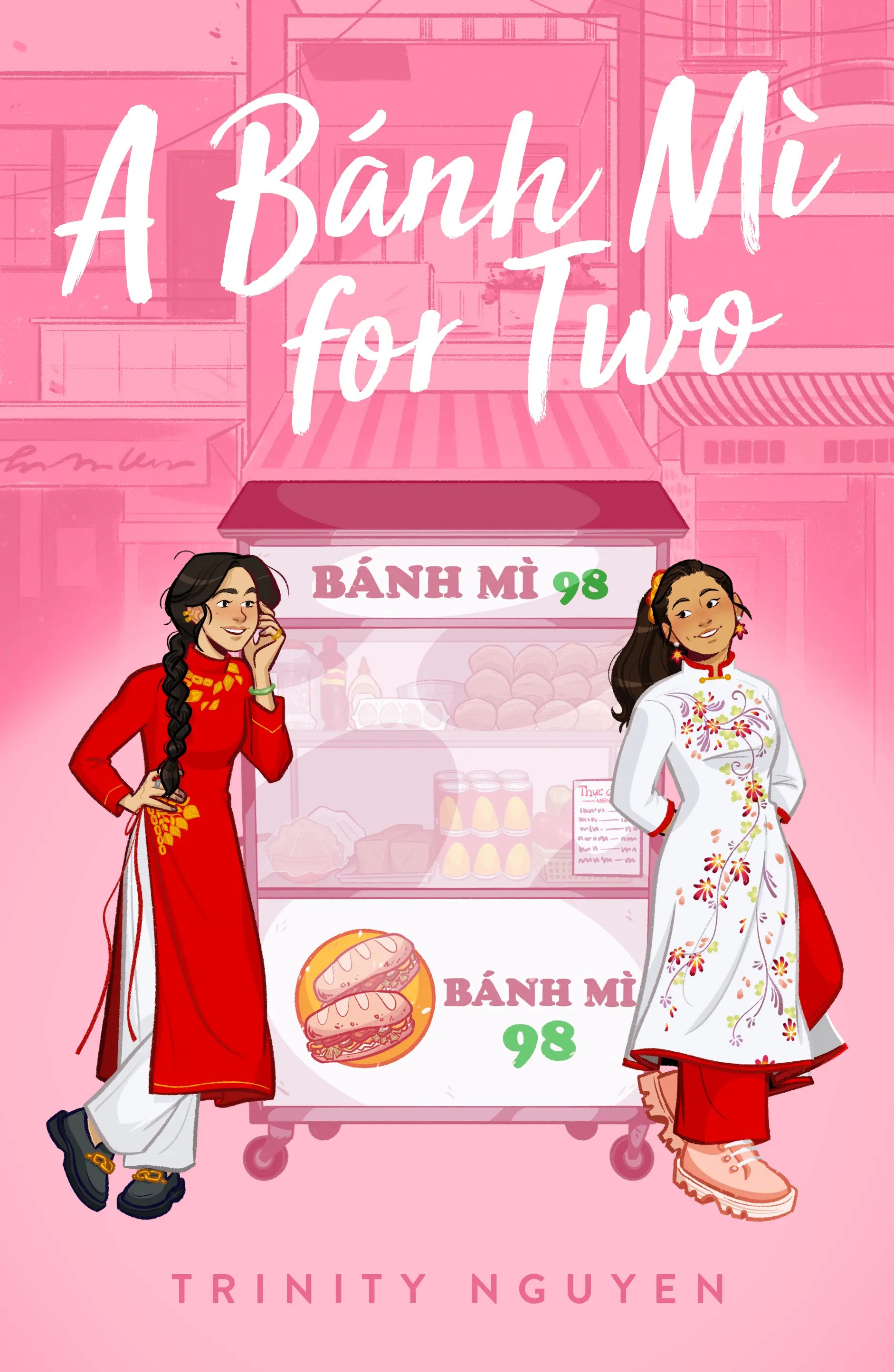
A sweet, closed-door sapphic romance set in Sài Gòn, where two foodie 18-year-olds fall for each other while uncovering family secrets and rekindling a love of food writing.
Summary:
In Sài Gòn, Lan is always trying to be the perfect daughter, dependable and willing to care for her widowed mother and their bánh mì stall. Her secret passion, however, is A Bánh Mì for Two, the food blog she started with her father but has stopped updating since his passing.
Meanwhile, Vietnamese American Vivi Huynh, has never been to Việt Nam. Her parents rarely talk about the homeland that clearly haunts them. So Vivi secretly goes to Vietnam for a study abroad program her freshman year of college. She’s determined to figure out why her parents left, and to try everything she’s seen on her favorite food blog, A Bánh Mì for Two.
When Vivi and Lan meet in Sài Gòn, they strike a deal. Lan will show Vivi around the city, helping her piece together her mother’s story through crumbling photographs and old memories. Vivi will help Lan start writing again so she can enter a food blogging contest. And slowly, as they explore the city and their pasts, Vivi and Lan fall in love.
Review:
I love a sweet, closed-door sapphic romance (see my review of Hani and Ishu’s Guide to Fake Dating), so when I heard about A Bánh Mì for Two, it was an easy add to my wishlist. The focus on food blogging and Vietnamese street food—both eating it and running a street food cart—was just the icing on the cake. This story strikes a delicate yet exquisite balance between lighthearted sweetness and the very real multigenerational trauma caused by the Vietnam War (referred to in Vietnam as The War Against the Americans to Save the Nation).
Told in alternating first-person perspectives between Lan and Vivi, the book avoids the common pitfall of muddled voices. While both characters are kind and thoughtful, they each have distinct ways of seeing the world, which keeps their narration clear and engaging. The romance is a sweet, slow burn, beginning with Vivi’s admiration of Lan’s food blog and blossoming into real-world chemistry after a chance encounter in Sài Gòn.
I especially appreciated the queer representation. There’s no on-page angst about being queer. Vivi does talk briefly with her friend Cindy (a Mexican American character) about how coming out can be complicated with conservative parents, but by the time the story begins, both girls’ families are accepting. It was also refreshing to see Vivi clearly identify as bisexual—representation that could’ve been easily overlooked since her only relationship in the book is with Lan. It’s affirming and intentional, which I loved.
The food descriptions are vivid but never overdone. They strike just the right balance between informing the reader (especially for dishes that might be unfamiliar) and keeping the flow natural. (I’ve eaten many a bánh mì in my life, and still found the food writing delightful!) I also really appreciated that this is a story about two 18-year-olds, and college isn’t presented as the only post–high school option. Lan’s mom encourages her to pursue school if she wants to, but also supports her jumping right into a career—a rare and welcome take in YA-adjacent fiction.
Vivi’s experience as a Vietnamese American studying abroad in Vietnam adds a beautiful emotional layer. She’s not a tourist—she’s searching for a kind of homecoming. She’s exploring why her mother kept so many details about Vietnam and their family a secret. This process is a powerful lens for the reader to learn about the war’s impact on Vietnamese families without the book ever feeling preachy. The historical context emerges naturally—through conversations, shared meals, and street encounters. It’s excellent writing.
The romantic progression between Lan and Vivi is tender and believable. One of my favorite parts was the motorbike rides around Sài Gòn—evocative, cinematic, and intimate. Even the third-act conflict felt justified. It wasn’t a contrived misunderstanding but a believable clash of cultural differences and personal pain. No one is villainized, and the resolution feels earned.
That said, a few elements pulled me out of the story. For example, Vivi’s study abroad program is mentioned as her reason for being in Vietnam, but we never actually see her attend class or study. This absence feels like a missed opportunity—readers might expect the study abroad setting to include some academic context. Similarly, while the book opens with several references to Vivi lying to her mom about her location—including photoshopping photos—the tension fades away later in the book. I found it a bit hard to believe that her mom wouldn’t catch on sooner.
The book is richly diverse, featuring Vietnamese and Vietnamese American characters, a Mexican American side character, and a sapphic romance at the center. Lan’s mother has a chronic illness, and her father passed away young from a stroke. The book also explores difficult family dynamics, grief, and healing across generations.
Overall, this is a fun, sweet sapphic romance featuring the beloved tropes of slow burn and study abroad, while offering thoughtful reflections on Vietnamese culture, family history, and the legacy of war. It’s beautifully steeped in food, healing, and love. Recommended for anyone looking for a sweet, queer romance with emotional depth, cross-cultural exploration, and heartwarming food moments.
If you found this review helpful, please consider tipping me on ko-fi, checking out my digital items in my ko-fi shop, buying one of my publications, using one of my referral or coupon codes, signing up for my free microfiction monthly newsletter, or tuning into my podcast. Thank you for your support!
4 out of 5 stars
Length: 224 pages – average but on the shorter side
Source: Library
Buy It (Amazon or Bookshop.org)
Book Review: Fruit of the Dead by Rachel Lyon

A contemporary retelling of Demeter and Persephone featuring a Hades who is a pharmaceutical company executive with a private island.
Summary:
Camp counselor Cory Ansel, eighteen and aimless, afraid to face her high-strung single mother in New York, is no longer sure where home is when the father of one of her campers offers an alternative. The CEO of a Fortune 500 pharmaceutical company, Rolo Picazo is middle-aged, divorced, magnetic. He is also intoxicated by Cory. When Rolo proffers a childcare job (and an NDA), Cory quiets an internal warning and allows herself to be ferried to his private island. Plied with luxury and opiates manufactured by his company, she continues to tell herself she’s in charge. Her mother, Emer, head of a teetering agricultural NGO, senses otherwise. With her daughter seemingly vanished, Emer crosses land and sea to heed a cry for help she alone is convinced she hears.
Alternating between the two women’s perspectives, Rachel Lyon’s Fruit of the Dead incorporates its mythic inspiration with a light touch and devastating precision. The result is a tale that explores love, control, obliteration, and America’s own late capitalist mythos. Lyon’s reinvention of Persephone and Demeter’s story makes for a haunting and ecstatic novel that vibrates with lush abandon. Readers will not soon forget it.
Review:
I’ve seen some reviews from folks who entered this book clearly not knowing anything about the myth of Demeter and Persephone. I think that’s a mistake. Knowing the myth helps you know what vibes to expect from this book at least. It helps match the book properly with the readers who might enjoy it. So if you’re not already familiar, take a moment to read a quick summary. Ok. This is not a romance. This is a story of a young girl who gets abducted by the literal god of the underworld and tricked into eating something while there that will make her always have to return. It’s also the story of her mother’s desperate quest to find her.
This is a modern retelling devoid of fantasy. It takes the myth and places it in our modern world. Hades is a pharmaceutical company executive. A billionaire. He’s currently going through a legal battle to do with his very addictive pain pills. (He’s clearly an allusion to the Sackler family.) Personally, I loved the choice of a billionaire drug pusher as the stand-in for Hades.
Persephone is Cory. A just barely turned 18-year-old whose high-achieving mother wants desperately for her to go to college but who did not get in anywhere she applied. She and her mother are not getting along right now. (There are reasons for this rift beyond college that are a spoiler and are revealed later in the book.) She goes to be a camp counselor where she went to summer camp in essentially a huff. At the end of summer camp, the father of one of the children shows up to pick up the child and asks her to come to his private island to nanny the son and a daughter for a month. She has to sign an NDA. She cannot tell her mother where, exactly she is. This is the getting ripped into the underworld bit. nstead of the pomegranate seeds, what Cory is given is, naturally, the pain killing drugs. Her mother, after a bit of time and one very weird phone call, cannot shake the feeling something is wrong, and drops everything to go after her daughter. It’s kind of Taken but with a mom.
I really enjoyed the vibes of this book. It oozed danger even when nothing super insidious was happening. While things do escalate, for a lot of the book it’s not that anything is technically wrong, it just feels wrong. It’s an art form to be able to mimic that gut reaction in fiction. This was one of the stronger parts of the book. I also really enjoyed a part where different plot points came together in what one could have called a coincidence, but also could be called the gods interfering. It was astutely (and kindly) done.
However. This book chose to never use quotation marks for dialogue. Not once. This is a stream of consciousness writing technique. It’s becoming more common in modern books, although you can also see it in James Joyce, for instance. The reasons given by modern authors – like “removing the hierarchy between author and reader” – frankly make me raise my eyebrows in doubtful question. (It sounds like something a dinner party guest of Frasier’s would suggest.) It strikes me as a full-of-oneself literary technique that just forces the reader to work harder. What’s wrong with reading quickly and with easy interpretation? I found it quite distracting in this book. I had to re-read certain passages to try to figure out who said what and whether it was a thought or actually spoken out loud.
Of course the Persephone and Demeter myth is dark. It stands to reason that Hades forces himself on Persephone, and this book doesn’t shy away from that. So there are two sexual assaults. One is described as a memory. The other is described in the moment as the character is living it. There’s also a child sexual assault hinted at in flashbacks but not described in any detail. It’s more that the character is remembering how she felt when it happened than what actually happened. Finally, there’s a self-injury described.
I realize that in the myth Persephone is doomed to return to Hades for half the year forever. This can be a tricky thing to address in an updated retelling. But some aspect of what next could have been addressed. I would like to have seen just a hint of how the mother/daughter were going to try to work through this, even if they might not be successful.
Overall, this is an interesting modern retelling of the Persephone and Demeter myth. It admirably writes pharmaceutical companies as the underworld and a CEO billionaire as their god. Potential readers should be aware that this is a dark story, not a romance. It contains sexual assault. Some readers may not enjoy the complete lack of quotation marks. Recommended to readers interested in modern day retellings of mythology.
If you found this review helpful, please consider tipping me on ko-fi, checking out my digital items available in my ko-fi shop, buying one of my publications, using one of my referral/coupon codes, or signing up for my free microfiction monthly newsletter. Thank you for your support!
4 out of 5 stars
Length: 320 pages – average but on the longer side
Source: NetGalley
Buy It (Amazon or Bookshop.org)
Book Review: Maame by Jessica George

When Maddie’s mother returns from Ghana to London, she encourages her to take a break from caregiving for her father with Parkinson’s by moving out. She does, but things don’t go according to plan.
Summary:
It’s fair to say that Maddie’s life in London is far from rewarding. With a mother who spends most of her time in Ghana (yet still somehow manages to be overbearing), Maddie is the primary caretaker for her father, who suffers from advanced stage Parkinson’s. At work, her boss is a nightmare and Maddie is tired of always being the only Black person in every meeting.
When her mum returns from her latest trip to Ghana, Maddie leaps at the chance to get out of the family home and finally start living. A self-acknowledged late bloomer, she’s ready to experience some important “firsts”: She finds a flat share, says yes to after-work drinks, pushes for more recognition in her career, and throws herself into the bewildering world of internet dating. But it’s not long before tragedy strikes, forcing Maddie to face the true nature of her unconventional family, and the perils—and rewards—of putting her heart on the line.
Review:
I picked this book up because I heard it compared to Bridget Jones’s Diary (one of my all-time favorite reads). While I don’t think that comparison is fair, I did enjoy Maddie’s much more raw story.
The comparison seems to largely exist because Maddie is a woman in London navigating her life. But, unlike Bridget Jones, which is a romcom, this is a story largely about grief, mental health, and navigating work, dating, and roommates as a Black woman.
Be warned this is a slight spoiler but important to discussing this book. The tragedy is that Maddie’s father dies from Parkinson’s complications shortly after she moves out. The book largely explores grief, and how Maddie moves through it as a twenty-something who was the primary caregiver for her father for years. As someone who also lost my father in my twenties, I found the explorations of her grief to be raw and beautiful. I read this as an audiobook, so I can’t find the exact quote, but at one point someone says that we can’t ever really understand someone else’s grief even when we’ve been through it ourselves because it’s a unique experience for each person. How true that is.
The book also explores the specific struggles Maddie faces as a Black woman. Some of these it does directly, such as how Maddie feels as the only Black woman in her workplace. But others are seen just in passing. Maddie doesn’t linger on them (this is narrated in first person) but it’s still impactful to the reader. For example, Maddie moves in with two white roommates. One of them touches her hair when it’s half-done on wash day. The other roommate immediately scolds her and tells her to never touch a Black woman’s hair without asking. The first roommate pushes back that it’s ok because they’re roommates. Maddie doesn’t say anything, but we see how she then proceeds to finish her wash day in such a way that the reader knows she’s not enjoying it anymore like she was.
Something I wasn’t expecting in this book was the three sex scenes. They’re not written in a particularly spicy manner. But they are detailed. Closed door is a personal preference to me, and I think we could have still understood the emotional impact of the sex scenes without seeing them fully. I also think two of the three are clearly not written for reader enjoyment (because Maddie herself doesn’t enjoy them), so I’m not sure what benefit there is to having them there for the reader either. Some readers may feel that one of these scenes veers in SA, in spite of the fact that Maddie herself doesn’t feel that way. I’m happy to go into more details in the comments if a reader needs to know before reading.
One thing that surprised me in a good way in this book was how Maddie’s relationship with her mother evolves over the course of the book. I was honestly expecting the relationship to fall apart. Instead, they both work to better understand and relate to each other. That was very nice to see. I also like that her mother is religious, and Maddie never mocks her mother for this. Maddie herself goes to church sometimes, even when she struggles to know exactly how she feels about her faith. It’s not the focus of the book but it’s a part of who she is, and I like that the characters are allowed to have that in a mainstream book.
Overall, this is an emotional read featuring some heavy topics. While it’s not a twenty-something romcom, it is a realistic depiction of what life can be like in your twenties for many women around the world. Recommended for readers looking to get a bit deeper in their reading, as well as those looking for own voices representation. The audiobook format is particularly well narrated.
If you found this review helpful, please consider tipping me on ko-fi, checking out my digital items available in my ko-fi shop, buying one of my publications, using one of my referral/coupon codes, or signing up for my free microfiction monthly newsletter. Thank you for your support!
4 out of 5 stars
Length: 320 pages – average but on the longer side
Source: Library
Buy It (Amazon or Bookshop.org)
Book Review: Positively, Penelope by Pepper D. Basham

A grumpy/sunshine, no spice romance set in the theater world.
Summary:
Penelope Edgewood is practically positive in every way, so when, fresh out of college, she is awarded a paid internship to help save a century-old theater on the island of Skymar, she jumps at the chance. After all, a crumbling theater needs the special touch of someone who reveres all things vintage and adores the stage.
Unfortunately, not everything is as it seems at Darling House Theatre. Finances are in shambles, the local theater group is disenchanted, and the two brothers, Matt and Alec Gray, can’t seem to see eye-to-eye about how to run their theatrical business. So, of course, it’s the perfect place for Penelope to shine her own personal brand of sunshine.
With a little help from GK, the person emailing her encouragement along the way, she puts all her heart into helping the Grays save Darling House. But between Matt’s ever-present skepticism, Alec’s tendency to treat Penelope a little too much like the “princess” she thinks she wants to be (until someone actually started treating her that way), a grandfather who is stuck in his grief, and a mysterious person stealing Penelope’s marketing ideas, she’s not sure her optimism is enough to make a happily-ever-after of her own story, let alone The Darling House’s.
Between an adorable little girl, a matchmaker, a sea monster or two, and a copious amount of musical references, can Penelope draw enough confidence from her faith, her family, and her adoration of all things Julie Andrews, to find the thief and save the theater . . . without getting her heart broken in the process?
Review:
This book is presented as a Christian fiction romance told “mostly” in an epistolary style, but I found it to be neither of those things.
This is definitely a light-hearted, no spice romance. I found Penelope endearing, and her love interest just the appropriate amount of grumpy with a reason. As a musical theater geek myself, I absolutely loved all of the references to classic musicals and how the male main character alludes to Gene Kelly. I also like that while Penelope is a sunshine character, we get to see how she has to actively choose to be happy and optimistic. It’s not her natural default. She’s given a depth.
Now, I love epistolary books, and I didn’t notice that the book said only that it was “mostly” epistolary, so I was jarred the first time there was a non-epistolary scene. I was willing to give it a pass, though, since it was a phone call scene. In fact, I could see how a phone call scene might work in a modern epistolary novel. However, by about two-thirds of the way through the book, most of the writing was typical book – not epistolary. It wasn’t even phone call scenes. It was basically like any modern book that includes some text messages and such. I like both styles of writing for different reasons, but I found the mixing the total flip-flop from one to the other jarring to say the least.
I realize this book is from a Christian publishing house, but I think it’s a marketing flaw to market it as “Christian fiction.” The characters’ religious beliefs played almost no role in the book. They mention God a few times, and the characters mention having gone to church a couple of times, but no scenes are set in a church. They mention praying but never actually pray on-screen. Also, in spite of being Christians, they never mention Jesus or the Holy Spirit, and we never see them reading the Bible. The blurb says that her faith guides Penelope’s decisions, but I absolutely did not see that in the book. I found Hani and Ishu’s Guide to Fake Dating (review), published by a mainstream publishing house, to have more issues of religion and faith in it. One of the main characters is Muslim, and her faith impacts her relationships with her friends, we see her praying, we see her reading the Quran, we see her go to the mosque. All of which is to say, if you’re interested in the romance but turned off by the idea that it’s “Christian romance” – don’t be. On the other hand, if you’re interested in seeing faith represented in what you read, you won’t get that here.
This book is set on a fictional island colonized by the UK. The Indigenous people are mentioned in passing a couple of times (as “natives”), but we never actually meet one or see their culture. This is extra bizarre since The Darling House is a community-based theater. Why is it only celebrating the colonizer’s culture? There’s also a royal family that’s not tied to the UK anymore. There’s no exploration, even in passing, of the ethical issues in colonization or even a whiff of a suggestion of decolonization. I get wanting to set your romance in a fantasy land, but the way to do that is like the fake country of Genovia or the fake royalty in a fake country in Never Ever Getting Back Together (review). Why imagine additional colonization tragedies if you’re not going to explore them and broach the topic of decolonizing? The way the book is written, it’s clear none of the characters see any problems with colonizing or issues for the Indigenous peoples, and that’s not the sort of fantasy land I personally want to visit. This is also another example of how, in my opinion, this book is not really rooted in strong Christian theology, as social justice is a key Christian issue.
Overall, this is a lighthearted, no spice grumpy/sunshine romance. It focuses on the grumpy character’s heart warming up over time. The book itself makes some comparisons of the romance to The Sound of Music but the von Trapp’s resisted an invading fascist force whereas these characters celebrate a colonizing royalty.
If you found this review helpful, please consider tipping me on ko-fi, checking out my digital items available in my ko-fi shop, buying one of my publications, using one of my referral/coupon codes, or signing up for my free microfiction monthly newsletter. Thank you for your support!
3 out of 5 stars
Length: 416 pages – average but on the longer side
Source: Library
Buy It (Amazon or Bookshop.org)
Book Review: The Road to Roswell by Connie Willis

When a woman who doesn’t believe in aliens comes to Roswell for her college roommate’s UFO-themed wedding, she’s shocked to find herself abducted by an alien and driving all over the southwest at his tentacled bidding.
Summary:
When level-headed Francie arrives in Roswell, New Mexico, for her college roommate’s UFO-themed wedding—complete with a true-believer bridegroom—she can’t help but roll her eyes at all the wide-eyed talk of aliens, which obviously don’t exist. Imagine her surprise, then, when she is abducted by one.
Odder still, her abductor is far from what the popular media have led her to expect, with a body like a tumbleweed and a mass of lightning-fast tentacles. Nor is Francie the only victim of the alien’s abduction spree. Before long, he has acquired a charming con man named Wade, a sweet little old lady with a casino addiction, a retiree with a huge RV and a love for old Westerns, and a UFO-chasing nutjob who is thoroughly convinced the alien intends to probe them and/or take over the planet.
But the more Francie gets to know the alien, the more convinced she becomes that he’s not an invader. That he’s in trouble and she has to help him. Only she doesn’t know how—or even what the trouble is.
Part alien-abduction adventure, part road trip saga, part romantic comedy, The Road to Roswell is packed full of Men in Black, Elvis impersonators, tourist traps, rattlesnakes, chemtrails, and Close Encounters of the Third, Fourth, and Fifth kind. Can Francie, stuck in a neon green bridesmaid’s dress, save the world—and still make it back for the wedding?
Review:
Connie Willis’s To Say Nothing of the Dog is one of my favorite scifi/romance/comedy reads of all time (review). I’m also a huge fan of the American Southwest, so when I heard about this book, it went on my wishlist immediately. (Shout-out to my siblings-in-law for the birthday present). This was definitely a rollicking, feel-good read, which was just what I needed.
Francie is a fun main character. Jumping right into her being at the airport on her way to a wedding she wants to help her old college roommate see is probably a bad idea builds up the identification and empathy right away. Who among us hasn’t had a friend in a questionable relationship? She doesn’t believe the alien stuff of everyone else at Roswell, but she’s kind about it. (She doesn’t go around calling them names in her head).
When she is abducted by an alien who looks like a tumbleweed who can’t speak but can only force her to drive with his tentacles and gesturing seriously in the direction he wants to go, I was hooting. What a fun idea for an alien species Indy is! I also like how the crux of the issue between humans and Indy is the difficulty in communication. Unlike a lot of scifi, he doesn’t just show up with a translator. Communication is a big problem and leads to a lot of comedic situations (including the, ahem, abduction). I was particularly fond of how Indy keeps semi-accidentally adding more people to his collection of abductees due to miscommunication.
The American Southwest is lovingly depicted from the glorious sunsets to the shocking vast emptiness, not to mention the overwhelming situation that is Las Vegas (right on down to an Elvis impersonator). Dusted on top of these depictions are quotes from various westerns (including a lot from one of my favorites, Support Your Local Sheriff). Movie westerns and how they reflect (accurately and inaccurately) the American Southwest are cleverly added via a character who is obsessed with them.
So I loved the setting, the plot, Francie, and Indy. The humor wasn’t quite working for me in the way it has in other books of hers, though. It didn’t ever bother me it just didn’t tickle my funny bone. That didn’t matter, because the book was still feel-good for me. But it did keep it from rocketing up to new favorite territory. There is also one infuriating scene where Francie is trying to get in touch with other people without Indy hearing and she, bafflingly, calls and leaves voicemails rather than texting. I just cannot think of a single person Francie’s age I know who would ever default to calling and not texting in a regular situation, let alone one where you want to not be overheard. (I mean, you can even text 911 these days….) I understand for the point of the plot that calling needed to happen but then we needed a reason for it. Maybe Francie’s texts wouldn’t go through. Maybe she lost her smartphone in the airport and had to borrow her friend’s old flip-phone. Something. This is a minor quibble though in a book that was generally a delight.
Overall, this a feel-good scifi read with a dash of romance and a very lovable alien. Perfect for scifi lovers wanting an escapist read or romance readers wanting a no spice read with a dash of something different.
If you found this review helpful, please consider tipping me on ko-fi, checking out my digital items available in my ko-fi shop, buying one of my publications, or using one of my referral/coupon codes. Thank you for your support!
4 out of 5 stars
Length: 405 pages – average but on the longer side
Source: Gift
Buy It (Amazon or Bookshop.org)
Book Review: Hani and Ishu’s Guide to Fake Dating by Adiba Jaigirdar

In this Bangladeshi-Irish YA romance, Hani needs to convince her two best friends that she’s really bisexual. She lies and tells them she’s dating academically focused and acerbic Ishu who agrees to fake date in exchange for help being elected Head Girl.
Summary:
Everyone likes Humaira “Hani” Khan—she’s easy going and one of the most popular girls at school. But when she comes out to her friends as bisexual, they invalidate her identity, saying she can’t be bi if she’s only dated guys. Panicked, Hani blurts out that she’s in a relationship…with a girl her friends absolutely hate—Ishita “Ishu” Dey. Ishu is the complete opposite of Hani. She’s an academic overachiever who hopes that becoming head girl will set her on the right track for college. But Ishita agrees to help Hani, if Hani will help her become more popular so that she stands a chance of being elected head girl.
Despite their mutually beneficial pact, they start developing real feelings for each other. But relationships are complicated, and some people will do anything to stop two Bengali girls from achieving happily ever after.
Review:
I have a soft spot for Irish literature, and when I heard about this book by a Bangladeshi-Irish queer Muslim author with a bisexual main character, it landed on my tbr list very quickly. This was a quick read with an easy to follow story and a sweet, very low spice romance.
I enjoyed Hani and Ishu each separately as character. They take turns narrating in the first person, and I never lost track of who was speaking. This book uses the grumpy/sweet trope quite well. Ishu is only grumpy because she’s focused and willing to speak her mind. Hani quickly sees through that. Hani and Ishu’s cultures are intertwined beautifully in the book. I like it when a book doesn’t feel the need to stop and explain cultural things to the reader. It’s on us to look it up if we want to, and that’s when I really learn things. (Like when Hani makes Ishu porota for breakfast. I looked that up right away. Yum!)
As a bisexual person, I appreciated how the story highlights the specific issues for Hani in coming out as bisexual. It’s clear that her friends would have fairly rapidly accepted her as a lesbian, but they view bisexual as being either confused or attention-seeking. They also don’t believe her because they’ve never seen her date a girl. This is a very realistic depiction of biphobia. Hani is quite confident about who she is and what labels she chooses. In contrast, Ishu is uninterested in labels, although she’s definitely attracted to Hani. It’s not clear if she’s only ever been interested in girls or more or if it’s just that Hani is the first person she’s ever been interested in. But that doesn’t matter to Ishu, and it doesn’t matter to Hani either.
When this book first came out, it was praised for depicting a queer Muslim character. (This article goes into depth about representation for South Asian queer women and interviews the author as well.) There is a perception that you cannot be both queer and Muslim. Both Muslims and non-Muslims hold this viewpoint. Yet people like Jaigirdar are both and depicting this in her books is important to Jaigirdar. Thus, we see Hani engaging with her faith. She goes to the Mosque. She reads the Quran. She eats halal. There is also a perception among many non-Muslims that if someone is serious about Islam and a woman then they will wear the hijab. But it is possible for someone to be devoutly engaging with her faith and also not wearing hijab. The author depicts this in Hani, as well as how she must struggle against the perception that she must not be a “serious” Muslim because she doesn’t wear hijab.
So this book covers a lot of seriously important representation well, and the romance is sweet and believable. What didn’t work for me was the secondary characters. Whereas Hani and Ishu felt well-rounded and interesting, everyone else felt flat and two-dimensional. There also were some kind of big issues that Hani and Ishu seemed to just gloss over. Now, they’re teenagers, so maybe that’s realistic. But Ishu having to hide the relationship from her parents long-term was concerning to me. Also, we never see the characters talk about being in an interfaith relationship. We do hear that Ishu appreciates Hani’s devotion to her faith as part of her. But Ishu is atheist, and we never really hear Hani’s thoughts on that.
Overall, this was a fun read with a lot of important representation. Recommended to readers who enjoy the fake dating and/or grumpy/sweet tropes.
If you found this review helpful, please consider tipping me on ko-fi, checking out my digital items available in my ko-fi shop, buying one of my publications, or using one of my referral/coupon codes. Thank you for your support!
3 out of 5 stars
Length: 352 pages – average but on the longer side
Source: Library
Buy It (Amazon or Bookshop.org)
Get the Reading Group / Book Club Discussion Guide
A beautifully graphic designed 2 page PDF that contains: 1 icebreaker, 9 discussion questions arranged from least to most challenging, 1 wrap-up question, and 3 read-a-like book suggestions
View a list of all my Discussion Guides.
Book Review: The Sentence by Louise Erdrich
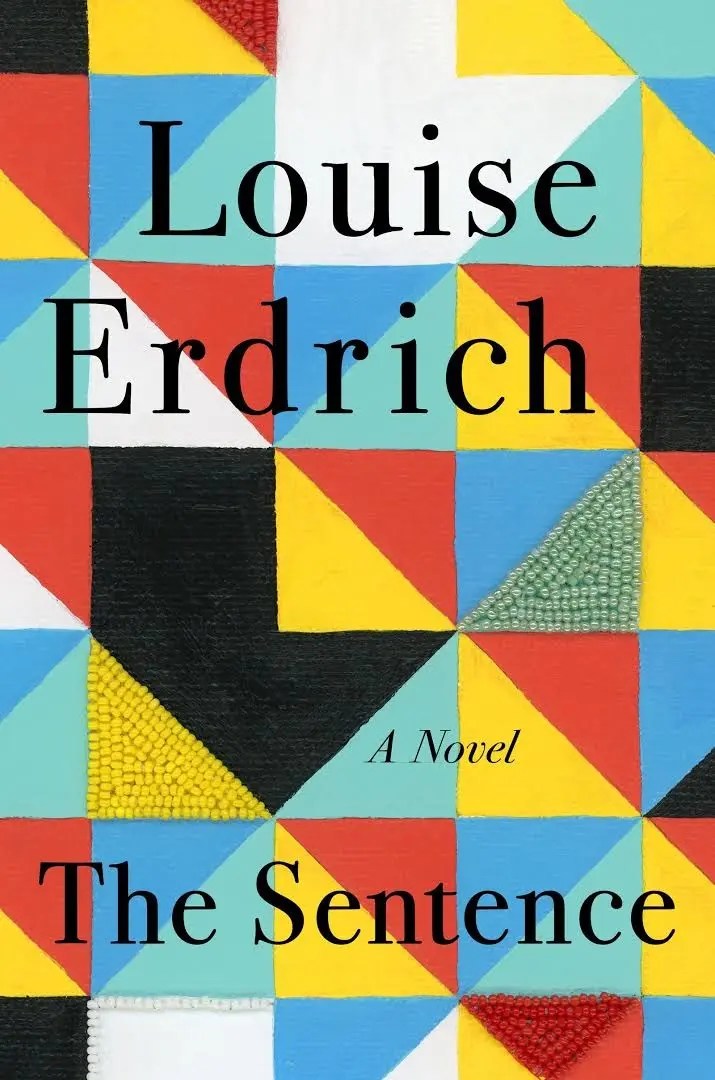
A previously incarcerated Indigenous woman loves her job at an independent bookstore focused on Indigenous literature right up until the store’s most annoying customer dies and begins haunting it.
Summary:
A small independent bookstore in Minneapolis is haunted from November 2019 to November 2020 by the store’s most annoying customer. Flora dies on All Souls’ Day, but she simply won’t leave the store. Tookie, who has landed a job selling books after years of incarceration that she survived by reading with murderous attention, must solve the mystery of this haunting while at the same time trying to understand all that occurs in Minneapolis during a year of grief, astonishment, isolation, and furious reckoning.
Review:
It’s a good thing I didn’t see that this book is magical realism or I wouldn’t have picked it up. You see, I had a serious misunderstanding of what magical realism is and thought I didn’t like it. In fact, I like it very much. I only wish I had first been introduced to it by the excellent explanation from Master Class originally. I’m excited that this book has helped me see past the magical realism label.
The thing that I love structurally about this book is how the title has so many different meanings. There’s the sentence that Tookie serves for her crime. There’s the sentence found within the book that Flora is reading when she dies. And there’s many other sentences throughout the book. I love when one title has many meanings.
The book starts with Tookie thinking back briefly on her incarceration and what landed her there. Part of what made the beginning so readable was how Tookie told this story. It was like speaking with a friend about a piece of their past. Raw and real but quick and to the point. It got me invested in the book right away. Then we jump to Tookie’s present, working in the bookstore, and the haunting, and this is utterly engaging right away as well. Tookie is flawed but so relatable. I think most readers will find her to be this way because she’s such a huge reader herself.
I also found her relatable because she’s in long-term recovery. I like how she sometimes thinks about how she was but it’s not like any single bad day gives her an urge she has to fight. A lot of times in literature and movies only early sobriety is shown, and the fact is, the experience in long-term recovery is different. I was so glad to see that in Tookie, and to see her breaking the multi-generational disease. But I also appreciated the very realistic depiction of her being concerned about talking about the haunting with her husband, Pollux, for fear he would think she had relapsed. I also should mention that both Tookie and her niece are bisexual. Their sexual fluidity is never judged or questioned. It’s just a part of who they are, which I really appreciated.
The book centers around a difficult question that it doesn’t provide answers for. Flora is a “wannabe Indian.” She’s a white woman who claims Indigenous heritage based on one photo she says is of a great-grandparent. The Indigenous community is dubious but doesn’t want to tell her she can’t belong. She spends much of her life working for the betterment of Indigenous people, including even taking in an unhoused teenager and caring for her so much that when she’s grown she refers to her as mother. So everyone has complex feelings about her. There are also some scenes that show white people behaving in offensive ways and smoothly depict how hard it is for Indigenous people to deal with these aggressions on a regular basis. One that really stuck in my mind was the white woman who shows up at the Indigenous bookstore and talks about her grandmother reassembling Indigenous bones she found on her land and winning a blue ribbon for it. She doesn’t understand why this is offensive to the Indigenous people she’s speaking with. To me the examples like this throughout the book demonstrate two types of white people who are hurtful to Indigenous people. The book is never preachy with these scenes. They come across as very realistic depictions of, unfortunately, regular interactions between Indigenous people and white people. If you yourself aren’t sure why these two types of interactions are hurtful, then I think this book would show you.
I wasn’t sure how I would feel reading a fictional book set during the first year of the pandemic. Overall, even though Tookie’s experiences and mine were different from each other (she was much older than me and had an essential worker, public facing job), I still found it realistic and relatable. The book never dwelled too much on any individual aspect of the pandemic but had scenes that were necessary reminders of how things were in the early days, like when Tookie goes to the grocery store to stock up just in case and ends up buying the best she can from what’s left, such as a tube of cookie dough. Similarly, Minneapolis was where George Floyd was killed and followed by the protests that spread throughout the country in 2020, and so this had to be a part of the book. At the start of the book it’s established that Tookie’s husband, Pollux, is who actually arrested her. By the time she was out of prison, he had left the tribal police force. But her household still must deal with the complex situation of having a previously incarcerated person and an ex-cop in the same household during this tumultuous time. There’s also the nice addition of Pollux’s niece, Hetta, living with them and, as a young person, being more involved in the protests. This thoughtful characterization allowed for multiple perspectives on the protests. For example, while there is support, there is also sadness and concern about the small businesses being impacted.
In spite of all that comes in the middle, the last part of the book deals mainly with Tookie’s relationship with Pollux and Tookie dealing with Flora’s ghost. This provides closure even while the reader knows the difficulties didn’t end in November 2020. In many ways I found this to be a story about relationships and reconciliation.
Overall, this is a strong piece of contemporary magical realism. If you’re ready to read a book featuring the pandemic while not being about the pandemic itself, this is a great place to begin.
If you found this review helpful, please consider tipping me on ko-fi, checking out my digital items available in my ko-fi shop, buying one of my publications, or using one of my referral/coupon codes. Thank you for your support!
4 out of 5 stars
Length: 387 pages – average but on the longer side
Source: Library
Buy It (Amazon or Bookshop.org)
Get the Reading Group / Book Club Discussion Guide
A beautifully graphic designed 2 page PDF that contains: 1 icebreaker, 9 discussion questions arranged from least to most challenging, 1 wrap-up question, and 3 read-a-like book suggestions
View a list of all my Discussion Guides.
Book Review: The Thorn Puller by Hiromi Itō

One of Japan’s most prominent women writers writes of a contemporary woman’s life split between caring for her much older British husband in California and her aging parents in Japan and her three daughters in both places.
Summary:
The first novel to appear in English by award-winning author Hiromi Ito explores the absurdities, complexities, and challenges experienced by a woman caring for her two families: her husband and daughters in California and her aging parents in Japan. As the narrator shuttles back and forth between these two starkly different cultures, she creates a powerful and entertaining narrative about what it means to live and die in a globalized society.
Ito has been described as a “shaman of poetry” because of her skill in allowing the voices of others to show through her. Here she enriches her semi-autobiographical novel by channeling myriad voices drawn from Japanese folklore, poetry, literature, and pop culture. The result is a generic chimera—part poetry, part prose, part epic—a unique, transnational, polyvocal mode of storytelling. One throughline is a series of memories associated with the Buddhist bodhisattva Jizo, who helps to remove the “thorns” of human suffering.
Review:
I picked this up from my library’s new books shelf, and for some reason I misunderstood and thought it was creative nonfiction. Since the main character shares the author’s first name, I stayed under this belief for quite some time, right up until the main character does something that shocked me. Then I investigated and realized it’s fiction heavily inspired by the author’s own life. I mention this to say that this reads like very modern creative nonfiction. It’s a mix of poetry, vignettes, and factual asides and doesn’t use quotation marks ever. Each chapter ends with a note of what works inspired that particular chapter. I was honestly impressed at this fictional creative nonfiction.
While each chapter vaguely goes in order of a year or two or Hiromi’s life, each also explores other parts of her life. And some weeks may be dropped in-between. The point isn’t a linear story but rather an exploration of how Hiromi deals with being in the sandwich generation with the added factor of her husband being at least 20 years older than her and so, he is aging more rapidly than she and requires more caregiving than he might otherwise. Hiromi thus deals with universal themes of caring for others while struggling to care for yourself. Of trying to give space to others to make their own decisions about their lives while worrying about them and wanting them to stick around.
Another major theme is Hiromi’s global life. She’s Japanese, living part-time in California, raising three daughters all of whom are American, one of whom is biracial (it’s unclear from the story if the older two daughters are biracial or not), living with a husband who is a British immigrant to the US who is also an older generation than her. There are so many cultural and generational differences for Hiromi to deal with. She struggles with Japanese perceptions of her husband, her husband’s perceptions of Japan, her own daughter’s difficulties to speak Japanese fluently, and more. What I found the most interesting was her husband’s misguided belief that because she was Japanese she wasn’t religious at all, only to become very angry at her when he finds out she took their daughter to visit a shrine. He thinks of this as religious. She thinks of it as simply a way of being. This thus explores the very interesting question of how much, if any, of spirituality is cultural?
Jizo and Jizo’s shrine are interwoven throughout the book. Hiromi feels a particular affinity for Jizo and so we see her memories of the shrine and also see her visiting the shrine in present time. Jizo is a Bodhisattva who is believed to help relieve suffering. Bodhisattva is a term used in two ways. It can mean anyone who is working in this life toward enlightenment. But it also can mean souls that have attained enlightenment but delays going to nirvana to help ease the suffering of others. This book takes up the latter definition, because the main character most strongly identifies with Pure Land Buddhism, which is a branch of Mahayana Buddhism that uses this definition of Bodhisattva. Although I have familiarity with Buddhism (as you can see in one of my short stories), I don’t think you have to in order to appreciate how Jizo is interwoven in the story. Hiromi is dealing with very difficult aspects of life, and when she’s struggling, she leans on a comfort from childhood – Jizo and his shrine. This is a very relatable emotional choice. It’s so relatable, in fact, that one cannot help but empathize with Hiromi when her husband struggles to understand why she feels an attachment to Jizo’s shrine when she’s dealing with her father’s aging and her mother’s slow death from a stroke. (Honestly, her husband is infuriating, even while you can see that he does indeed love Hiromi.)
As you can probably tell, this book does deal with difficult topics. Be aware that Hiromi’s mother’s stroke and its impact on her body is quite central to the story. Her father’s aging is depicted honestly, without any gentling of the more difficult aspects. Hiromi mentions in passing having had multiple miscarriages and abortions in the past. A character has a cancer scare that leads to a rather graphic scene of bleeding. Another character has a heart issue. Eating disorders are mentioned although not depicted graphically. Racism and xenophobia are both depicted on screen. Finally, and what was to me the most shocking, Hiromi engages in a violent act against her husband at one point. I thought all of these were dealt with in an even-handed and fair way except for how Hiromi treats her husband. That I felt was glossed over a bit too easily, especially for a character who believes suffering can come from a human killing spiders. Her lack of guilty feelings felt out of character to me.
Overall, this is an engaging read that merges creative nonfiction and fiction in fascinating ways and provides perspective on Japanese, American, and British cultures. For those less familiar with Japan, the translator offers an introduction to help understand what you might need to in order to enjoy the book fully. I also appreciate the translator’s note at the end that describes the translation process and how the author had some say in it.
If you found this review helpful, please consider tipping me on ko-fi, checking out my digital items available in my ko-fi shop, buying one of my publications, or using one of my referral/coupon codes. Thank you for your support!
4 out of 5 stars
Length: 300 pages – average but on the shorter side
Source: Library
Buy It (Amazon or Bookshop.org)
Book Review: She and Her Cat by Makoto Shinkai and Naruki Nagakawa
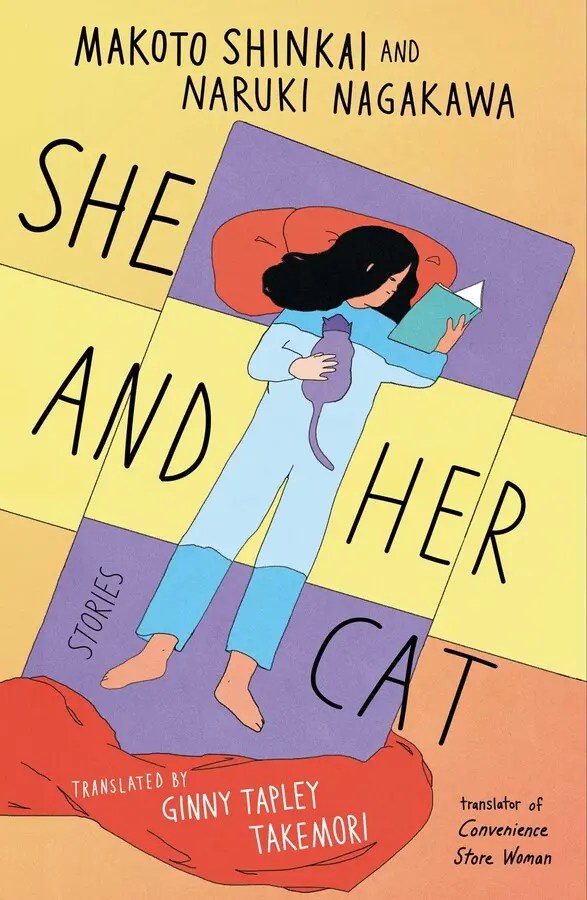
Interconnected short stories explore the relationships between women and their cats in a Japanese city.
Summary:
Lying alone on the edge of the sidewalk in an abandoned cardboard box, a nameless narrator contemplates the indifferent world around him. With his mother long gone, his only company is the sound of the nearby train. Just as he fears that the end is near, a young woman peers down at him, this fateful encounter changing their lives forever.
So begins the first story in She and Her Cat, a collection of four interrelated, stream-of-conscious short stories in which four women and their feline companions explore the frailty of life, the pain of isolation, and the limits of communication.
With clever narration alternating between the cats and their owners, She and Her Cat offers a unique and sly commentary on human foibles and our desire for connection.
Review:
When I saw this collection of interconnected short stories about women and their cats, I couldn’t hit the request button fast enough. One of my favorite short story collections is James Herriott’s Cat Stories. I’m always on the lookout for something similar. This delivered in more ways than I was anticipating. I didn’t realize the stories would be interconnected, and that really adds something to the collection as a whole. Makoto Shinkai is a well-known animator and filmmaker. His most recent anime is Suzume no Tojimari but this book was actually originally an anime short in 1999 as well.
The stories alternate between a human and a cat perspective. Whether it’s a human or a cat is indicated by the section break. If it’s a human, it’s a usual decorative scene break. If it’s a cat, it’s the silhouette of a cat. The first story opens from the perspective of a cat who is the runt of a litter in a cardboard box listening to the sound of a train. The cat is clearly about to die but then a woman’s face appears and takes him in. He becomes an indoor/outdoor cat. I won’t spoil the trajectory of the whole story, but where the interconnectedness comes in is that this cat (Chobi) meets a young cat while outside who shows him a woman who feeds her fish when she shows up in her yard. The next story is then this cat’s perspective. And so all of the stories have these connections between the cats, but also slowly the humans come to be connected, largely thanks to their cats.
The stories offer subtle but insightful commentary both into universal aspects of human nature and into more specific aspects of Japanese culture that impacts these women’s lives. I’m not an expert by any means on Japan, but I do know, for example, that there’s a problem with toxic work cultures where people stay at the office overnight and don’t come home. This is one of the issues addressed in the stories. The animals also offer commentary on human nature and bigger life questions (like what happens after we die). it reminded me a little of animal fables in that it was the animals offering these lessons to each other, wanting to help humans, and yet the humans couldn’t understand them.
Where the stories really shine, though, is in showing the relationship between, as the book says, she and her cat. The unconditional love of the cats for their owners is heart-wrenching and left me near tears. This line in particular shone to me. It’s from the perspective of a cat with an owner who is struggling with loneliness.
I couldn’t do anything about her problems. I just lived my days at her side.
loc 443
There were two things that held me back from five stars. First, sometimes I did get confused about who was speaking. This is because in some stories it’s not just the owner who is a human perspective. So it’s not a straightforward swap back and forth between the cat and her owner – sometimes there were other humans in there too. Second, one male cat calls his owner his girlfriend and that gave me the heebie-jeebies. Perhaps that was a translation issue, though.
Overall, this is a delightful collection of short stories that is sure to please any cat lover. With full page illustrations throughout, it would make a great gift.
If you found this review helpful, please consider tipping me on ko-fi, checking out my digital items available in my ko-fi shop, buying one of my publications, or using one of my referral/coupon codes. Thank you for your support!
4 out of 5 stars
Length: 144 pages – novella
Source: NetGalley
Buy It (Amazon or Bookshop.org)
Book Review: Maybe in Another Life by Taylor Jenkins Reid

Revisit the land of Sliding Doors in this exploration of two different paths one life can take due to one decision.
Summary:
At the age of twenty-nine, Hannah Martin still has no idea what she wants to do with her life. She has lived in six different cities and held countless meaningless jobs since graduating college. On the heels of leaving yet another city, Hannah moves back to her hometown of Los Angeles and takes up residence in her best friend Gabby’s guestroom. Shortly after getting back to town, Hannah goes out to a bar one night with Gabby and meets up with her high school boyfriend, Ethan.
Just after midnight, Gabby asks Hannah if she’s ready to go. A moment later, Ethan offers to give her a ride later if she wants to stay. Hannah hesitates. What happens if she leaves with Gabby? What happens if she leaves with Ethan?
In concurrent storylines, Hannah lives out the effects of each decision.
Review:
I consider the 1998 movie Sliding Doors to be a cult classic. Whether or not you agree, the term “a sliding doors moment” has entered the lexicon, meaning a moment in a character’s life where their seemingly innocuous decision has far-reaching impact on how their life plays out. I had been curious to read a Taylor Jenkins Reid book. The mention of her name stirs up controversy. Some folks love her work. Others find it problematic. I wanted to read one for myself to see. I thought it would be the most fair to read the one that appealed to me the most, and that was this one.
I found it to be an enjoyable piece of contemporary chick lit. To be fair, it’s hard for a book with a sliding doors moment to turn me off. I just love the idea so much. Evidence of this fact is how much time this book spends in a location I dislike, the fact that I didn’t like either of the potential love interests, and that health sciences careers are featured prominently…which is something I prefer not to visit in my leisure reading. But I still gave it four stars. Because I just love the sliding doors moment so much. So for me it was an enjoyable read. But after the fact, I did get to thinking about the things I didn’t like, and it left me kind of scratching my head as to why I enjoyed it so much. Beyond the fact it was simply just really lighthearted, which I needed at the moment.
A non-controversial issue I had with it is that I don’t think the sliding doors moment is really in the spirit of a sliding doors moment. In the movie that gave us the phrase, it’s literally simply whether or not Gwyneth Paltrow’s character catches a subway train or has to wait for the next one. Whether the doors slide closed in her face or not. In this one, it’s whether or not the main character stays at a bar with her high school ex-boyfriend after not seeing him for years and moving back to town. That just simply feels like a life-defining moment in a way that catching or missing a subway train (that usually come a few minutes apart) does not.
To address some of the criticism about how Taylor Jenkins Reid, a white woman writer, handles race. I want to be crystal clear – I’m a white woman author too. So this is not a critique from a BIPOC voice. I can see what the author is trying to do. She’s trying to be inclusive and accurately reflect the diverse world of LA. But I can also see why how she depicts race rubs some people the wrong way – and this isn’t one of the books where the main character is a woman of color. Hannah is white. So I can see how it would be more of an issue in one of those books. The biggest issue in this book to me is that characters are default white unless Taylor Jenkins Reid describes them as not white. (Andrea J. Johnson discusses this in point 3 of her very insightful post from the perspective of a Black woman author on writing race.) She does mention Hannah is white, but every other character defaults to white unless described otherwise. Hannah’s best friend is Black, and there is a cringe moment where Hannah asks her in a flashback if her new college friend is a closer friend because she’s Black too. On the one hand, I appreciate flawed characters. On the other hand, I’m not sure why that scene was even included. It was part of introducing how Hannah and Gabby are best friends but Hannah is white and Gabby is Black and it’s no big deal. Interracial friendships are great and belong in literature! But how it was handled in this book definitely made me cringe.
A related moment that made me cringe, is when Hannah and Gabby lay in a bed together and just wish they weren’t straight so they could just simplify their lives and remove all men and just be together tee-hee! As a bisexual, queer woman this makes me see red. It’s not an endearing moment. It’s not cute. I absolutely loathe it when straight women do things like this. Because, as someone who is capable of being attracted to many genders, what keeps a friendship from progressing to a romantic relationship isn’t at all simply what body parts someone has. With my really good friends whose sexual orientations line up with mine, what kept us from becoming romantic partners was far more nuanced than that. At its simplest, it’s that romantic love and friend love are not the same thing, and I’m not in romantic love with them. (I am in romantic love with my spouse.) I have to admit, I didn’t read The Seven Husbands of Evelyn Hugo because it has a bisexual main character, and I knew Taylor Jenkins Reid is straight, and I just was not in the mood for dealing with questionable representation. Having read this book and this moment, I think I made the right choice for me.
I was also left confused about what the book’s message is about fate. Without spoilers, there are three hugely impactful aspects of a person’s life – whether or not they partner, if they do with whom, and what their career is. Some of these are the same in both lives and some of them are not. What is this saying about fate, then? I found the mixed message puzzling, especially when Gabby’s life seemed nearly identical in both storylines.
Overall, while I found this to be a fluffy and very readable book, in retrospect I’m left wondering how I managed to enjoy it so much. There are cringey moments in it, and even the sliding doors moment itself is a bit too big to really count. From what I’ve seen in this book, I can see why there’s controversy. I think I’ll be getting my fluffy reads from other sources in the future. Recommended if you’re a sliding doors moment enthusiast who really wants to have consumed all the media out there with such a moment.
If you found this review helpful, please consider tipping me on ko-fi, checking out my digital items available in my ko-fi shop, buying one of my publications, or using one of my referral/coupon codes. Thank you for your support!
3 out of 5 stars
Length: 342 pages – average but on the longer side
Source: Library
Buy It (Amazon or Bookshop.org)
 Support my work with a tip or browse my shop for curated book club guides, how to guides, cross-stitch patterns, and more!


This work by Amanda Nevius is licensed under a Creative Commons Attribution-Noncommercial-No Derivative Works 3.0 United States License.
 Opinions of a Wolf