
Archive
Book Review: Peace Child by Don Richardson

Part history of the 20th century for the Sawi people of New Guinea, part personal memoir by the first missionary to live with them.
Summary:
In 1962, Don and Carol Richardson risked their lives to share the gospel with the Sawi people of New Guinea. Peace Child tells their unforgettable story of living among these headhunters and cannibals, who valued treachery through fattening victims with friendship before the slaughter. God gave Don and Carol the key to the Sawi hearts via a redemptive analogy from their own mythology. The “peace child” became the secret to unlocking a value system that had existed through generations. This analogy became a stepping-stone by which the gospel came into the Sawi culture and started both a spiritual and a social revolution from within. With an epilogue updating how the gospel has impacted the Sawi people, this missionary classic will inspire a new generation of readers who need to hear this remarkable story and the lessons it teaches us about communicating Christ in a meaningful way to those around us.
Review:
There’s a lot of controversy about modern mission work. Not to mention the known atrocities committed by missionaries in the US, Canada, and other places in historic times. I support Indigenous peoples and condemn the horrific means used by these supposed “missionaries.” (I personally do not consider these people to be true believers bringing the gospel but rather colonizers acting on behalf of a nation. For example, Jesus loved children and yet these people murdered them.) So I approached this book with quite a bit of trepidation. Yet slowly over the course of it, I came to see the picture of a very different type of mission work.
Unlike many missionary memoirs, the perspective of the first third of the book is actually that of a historical account of approximately one year in the life of the Sawi before the missionaries arrived. It immerses you into the world of New Guinea and also gives a neutral depiction of the cannibalism as it existed at that point in time. Because Sawi culture honored duplicitousness and treachery, the different villages were quite isolated and small. Betrayal with the end result being death and, yes, cannibalized, was a real consistent threat. There was a Sawi saying about honoring this treachery – “fatten with friendship for the slaughter.” Starting the book from the Sawi perspective sets the expectation that this book is really about the Sawi, not Don and his wife Carol.
Something Don makes clear early on is that other cultures were encroaching on the Sawi. They were not going to continue to be left untouched for long due to the political situation in New Guinea. Essentially, the people with the hands-off approach were departing. It was clear the ones incoming were going to go into the jungles themselves but also allow hunters, prospectors, etc… in. Don’s belief was that the first people the Sawi encountered shouldn’t be out to exploit them for anything but rather should be there to help them in as many ways as possible, not solely with the gospel but also to adjust to their world shifting more dramatically than it had in generations. Don and his wife brought medical care and information on how the outside world that was coming into contact with them would work. A story that particularly struck me was how Don and Carol taught Sawi how to be shopkeepers. You might, like me, think at first, oh no, he’s destroying their hunter/gather society with money. But when he explained his reasoning, I was humbled at how forward-thinking and selfless it was.
Educating Papuans without training some of them to be shopkeepers invites non-Papuans to come in and take control fo the supply and pricing of manufactured goods. As non-Papuans enrich themselves, they eventually gain ownership of land bequeathed to Papuans by their ancestors. Papuans thus tend to end up as exploitable cheap labor or, worse yet, as beggars foraging on garbage cast off by non-Papuans. Hoping to spare our Sawi friends such a fat, we trained some of them to be, yes, shopkeepers! Shopkeepers who charge prices lower than non-Papuans care to compete with! Shopkeepers who see no need to sell their land because their shops are doing quite well, thank you!
location 3632
Beyond helping the Sawi to prepare for meeting the world, Don’s perspective on mission work is essentially that the culture you are visiting already has inbuilt messaging from God about Jesus. You just have to find what it is to help them see it, since they haven’t heard the message before. In the case of the Sawi, that is the cultural tradition of the peace child. I won’t go into the details of how the peace child works in Sawi culture. I think that is most impactful by actually reading the book. What is interesting to me to note, however, is how his method of missions doesn’t supplant the culture or force another culture upon it. It rather takes an aspect of the culture that already exists and builds upon it. Now, all cultures have good and bad aspects. Essentially what Don does is he tries to help enhance what is good within the culture and tamp down what is only hurting the people. The Sawi inability to trust anyone because of treachery being so upheld as a positive trait is an easy to understand example of this. Once the Sawi understanding of a peace child was uplifted higher instead and became more achievable for anyone, then the Sawi were able to start trusting each other and uniting so that they might remain that way when facing the world. I frankly found myself wishing someone could come help my own culture in such a way to help us be better, more communal, versions of ourselves!
I was also surprised by how things turn out. Ultimately, the mission group withdraws from the Sawi villages, not in defeat, but because they feel the Sawi are ready to stand on their own within the extended world they now find themselves in. Updates on the Sawi indicate they are still doing well and have even sent their own missionaries to another Indigenous group, the Sumo, further inland. This article also talks about the fact that Don use the Indonesian characters to write down Sawi and translate the New Testament. This means that when the Sawi were newly required to go to government schools and learn Indonesian they could also automatically read Sawi, helping to preserve the language.
Overall, this is a very engaging and informative read about one Indigenous nation encountering the larger world in the 20th century. It also gave me a new appreciation for how mission work can be done ethically. While I understand that some may disagree and say there is no such thing as ethical mission work, I think how Don and his wife Carol helped the Sawi maintain control of their land and literacy in their own language is a strong counterpoint.
If you found this review helpful, please consider tipping me on ko-fi, checking out my digital items available in my ko-fi shop, buying one of my publications, using one of my referral/coupon codes, or signing up for my free microfiction monthly newsletter. Thank you for your support!
4 out of 5 stars
Length: 256 pages – average but on the shorter side
Source: Library
Buy It (Amazon or Bookshop.org)
Book Review: Daniel Boone’s Own Story & The Adventures of Daniel Boone by Daniel Boone and Francis L. Hawks

This book presents Daniel Boone’s summary of his adventures in the late 1700s and early 1800s plus a biography of his life first published in 1844.
Summary:
Daniel Boone blazed the Wilderness Road through the Cumberland Gap. Thousands followed, settling in Boonesborough, Kentucky, to form one of the first English-speaking communities west of the Appalachians. This two-part tale of the legendary frontiersman’s life begins with a brief profile by Boone himself, covering his exploits in the Kentucky wilderness from 1769 to 1784. The second part chronicles Boone’s life from cradle to grave, with exciting accounts of his capture and adoption by the Shawnee and his service as a militiaman during the Revolutionary War.
Review:
Growing up, I’d heard the legends of Daniel Boone and saw a few episodes of the (wildly historically inaccurate) tv show. I was raised with the mainstream US belief that westward expansion and colonization was great. It wasn’t until I was in college that I started to really learn about the true history of colonization. So I wasn’t too surprised when I read these period accounts to find that things were not the glowing hero account I’d heard. Not even when you take what happened at face value from the mouth of the man who lived it or from the biography that came shortly after his death.
Let’s start with what was true. Daniel Boone was, by all accounts, a talented hunter. He didn’t like to have many people around him, so he was constantly on the lookout for land that appeared to him to be empty (more on that later). He was taken captive by the Shawnee and adopted by them, living with them for two years before escaping. He was a critical tipping point person in the settlement (and stealing) of Kentucky by white Americans.
Here’s what stuck out to me when reading these accounts, though, with my twenty-first century eye. Daniel Boone and the other settlers considered Kentucky to be open space and fair game. However, even the early 1800s biographer pointed out that this land was being used as hunting grounds by multiple different Indigenous nations. So even folks of the time realized that the land was in use, just not in the same way as how white people would use it. When I dug into this more, though, I found this fascinating article about the idea of Kentucky being a “dark and bloody ground” aka land that was being fought over and contested by Indigenous nations with no one really living on it the way European settlers viewed living on land, as a myth propagated to be able to view the land as “free game” to then sell to settlers without even the pretense of a treaty with or purchasing from the Indigenous folks.
Reader should be aware that these period pieces use multiple slurs to refer to Indigenous peoples. Beyond the slurs, there’s this odd depiction of Indigenous peoples. On the one hand, they’re depicted as backwards and not very bright. But on the other hand they’re depicted as terrifying enemies difficult to overcome.
It’s interesting to me how both authors consistently view white folks as superior and more “civilized,” in spite of telling stories that make it look very much the contrary. For example, there’s a scene in which an Indigenous group of warriors takes a bunch of white women captive. They are in a boat and they line the women around the edges of the boat. The narrator says that they did such a thing to ensure safe passage for themselves, assuming the white men would never fire on the white women. But the white men do, and the narrator defends this, saying it’s better for the white women to be dead than to be held captive by the Indigenous people. This statement is extra confusing as we had just seen earlier in the book that Daniel Boone was taken captive and then adopted and treated as one of the tribe. Now, of course, not all captives were adopted. Some were murdered and, yes, some were tortured. (How captives were treated varied wildly.) But the point remains that the men fired on their own women and considered that to be a “civilized” act.
As it is women’s history month, I wanted to draw out some information on Daniel Boone’s wife, Rebecca. He brought her out to Kentucky, and on the trip there, one of their children is killed by Indigenous folks defending their land. (Because it WAS their land.) Then later her daughter is kidnapped. (Daniel retrieves her.) Ultimately, six of their ten children died early deaths, largely in the war between the Indigenous and the settlers. We also can’t forget when Daniel was captured and adopted. He was gone for so long that Rebecca gave up hope and went home to North Carolina, only to have Daniel show up, back from what she thought was the dead, and bring her back to the frontier. I can’t imagine living my life that way. I realize she had her own agency, and we must acknowledge the complicity of white women in the theft of the land. But I do wonder what it must have felt like to give birth to ten children, only to have six of them die in the bloody battle for land. Did she think it was worth it? What made her go back with Daniel when he showed up after being missing for two years? These are things we’ll never know because women’s stories simply were not recorded for us.
I would not call this a fun or easy read. It was an informative one. There’s a lot of value in reading firsthand accounts of history. Of course we’ll never get the whole truth from any one such account. But it is informative into how people in that time period thought and behaved. How they perceived it then and how we perceive it now.
Recommended to those with an interest in primary resources from the colonization of the US.
If you found this review helpful, please consider tipping me on ko-fi, checking out my digital items available in my ko-fi shop, buying one of my publications, using one of my referral/coupon codes, or signing up for my free microfiction monthly newsletter. Thank you for your support!
3 out of 5 stars
Length: 128 pages – short nonfiction
Source: Gift
Buy It (Amazon or Bookshop.org)
Book Review: Last Train to Memphis: The Rise of Elvis Presley by Peter Guralnick

Considered by many to be book one of the quintessential Elvis biography duology.
Summary:
Based on hundreds of interviews and nearly a decade of research, it traces the evolution not just of the man but of the music and of the culture he left utterly transformed, creating a completely fresh portrait of Elvis and his world.
This volume tracks the first twenty-four years of Elvis’ life, covering his childhood, the stunning first recordings at Sun Records (“That’s All Right,” “Mystery Train”), and the early RCA hits (“Heartbreak Hotel,” “Hound Dog,” “Don’t Be Cruel”). These were the years of his improbable self-invention and unprecedented triumphs, when it seemed that everything that Elvis tried succeeded wildly. There was scarcely a cloud in sight through this period until, in 1958, he was drafted into the army and his mother died shortly thereafter. The book closes on that somber and poignant note.
Review:
If you know you’d be into an in-depth Elvis biography, I can tell you that this one is widely acknowledged as the best starting place for its depth of research and attempt to present a neutral viewpoint – neither one of a fan nor one of a naysayer. It’s out to find the middle-ground, and the the truth does often lie somewhere in the middle.
If you think you wouldn’t be into an Elvis biography, there’s more to this book than Elvis. It’s also the story of the American music industry in the 1950s. I learned so much about how music was made and marketed at that time, and how rock n roll changed it. It wasn’t just about the sound but about how the music was actually sold. For example, I didn’t realize how at the tie going on near-constant tour to small music venues was considered the best way to market yourself. The chapters about how Elvis’s manager, the Colonel, got him onto television and how television really started to change the music industry were fascinating. It was like an echo of TikTok in some ways. I also really enjoyed learning about Sun Records – the small, independent label that gave both Elvis and Johnny Cash their starts.
I’d previously heard a lot of the very bad things about the Colonel. It made me wonder how Elvis fell for using him as his manager to begin with. This book really brought to light the why. The Colonel may have taken a much larger percent (25%) than was usual (10%), but he also had a great business mind and really got things done. It was the Colonel who got Elvis on television and in the movies. I’d always thought the Colonel pushed Elvis into the movies but this book showed from its extensive interviews that Elvis himself was quite interested in being like James Dean. The relationship, at least at the beginning, was a lot more give and take than I’d thought. Another example is that it’s clear from the interviews that Elvis was ok with letting the Colonel be “the bad guy.” He didn’t protest or get in the way when the Colonel did something that those around him thought was squidgy. In fact, it seems like he was kind of ok with letting the Colonel be the scapegoat.
I knew from previously reading The Gospel Side of Elvis that Elvis loved gospel music and considered it his first music love. I hadn’t realized, though, how almost indifferent he felt about the music he did play. He was professional about it, but he didn’t love it the way he loved gospel. From my understanding of the book he seemed to pursue the music he thought would be the most likely to lead to success, not the one he was passionate about. It always makes me a little sad to hear of someone making a choice based on potential success than passion, although I do understand why people do that. How different things would have been if he’d pursued gospel though, huh?
This book was a little slow-going for me because I kept stopping to listen to the songs mentioned or watch the television appearances as they came up. I think that enhanced the book, and if you have the chance to read the digital book with the audio/video enhancements, I would.
Overall, this book delivers what it promises – an in-depth look at Elvis based on extensive research and interviews. But it also goes further, illuminating America’s music scene in the 1950s, and how it changed, putting us on the trajectory to the modern music scene.
If you found this review helpful, please consider tipping me on ko-fi, checking out my digital items available in my ko-fi shop, buying one of my publications, or using one of my referral/coupon codes. Thank you for your support!
4 out of 5 stars
Length: 560 pages – chunkster
Source: Library
Buy It (Amazon or Bookshop.org)
Book Review: The Saga of the Bloody Benders by Rick Geary

A true crime graphic novel telling of a family of serial killers in the 1870s.
Summary:
Out on a deserted stretch of Kansas road linking newly forming towns, a mysterious family stakes a claim and builds an inn for weary visitors. Soon, reports multiply of disappearances around that area. Generally, those who disappear have plenty of cash on them. A delicious tale of a gruesome family fronted by a beguiling lass who led their victims on…
Review:
I first heard about the Bloody Benders in an American Indians in Children’s Literature blog post about what Laura Ingalls Wilder left out of the Little House books. Essentially, Laura said she left out some aspects of her childhood because she didn’t think they belonged in a book written for children,…one of which is how Pa probably participated in mob justice against the Benders. American Indians in Children’s Literature does a great job breaking down how problematic it is that depicting white serial killers in her books wasn’t ok but depicting the horrifying treatment of Indigenous peoples was. In any case, I got curious about the Bloody Benders, and the internet said this was one of the better books written about the topic, so I picked it up from my public library.
The artwork is nice. I particularly enjoyed this depicted of the Bender family’s one-room grocery and inn to demonstrate how they pulled off the serial killings.

The content is factual and is careful to steer clear of using quotes in the panels when we don’t actually know what anyone said.
What made me dislike the book, though, was how it treated both Indigenous peoples and women. I understand that sometimes in historic nonfiction if a quote is being used or documents from the time period that it will use offensive language. However, this book used offensive language in parts that were narration written by the modern day author. It was published in 2007, and I truly feel someone on this book team should have been more thoughtful. A near-victim of the Benders was a Catholic missionary to the Osage people. Instead of saying it this way, though, the book says he, “dedicated his life to converting the savages.” This is the use of both a dehumanizing term and a glossing over of how missionary work was used as a weapon against Indigenous peoples in the Americas. This is a book about serial killers – I think whoever is reading it should be able to handle at least a footnote illuminating the complexities of this person’s missionary work.
With regards to the treatment of women, this is mostly in regards to how Kate Bender is discussed in the book. She is one of the four Bloody Benders, so I certainly don’t expect her to be discussed kindly, however while most of the book strives to stick closely to the truth as far as we know it, there is one part of the book that breaks down how folks determined the Benders pulled off their killings, based on the layout of the room, the trap door found, and reports of survivors. Most of this sticks to the facts, but then it gets to the part where Kate feeds the person sitting down at the guest table and says, “Does Kate also offer sexual favors as part of the package? No certain answer will ever be known.” What an unnecessarily and misogynistic supposition. Nothing that we know about Kate from survivors and those who knew her suggests she was promiscuous at all. In fact, earlier in the book it mentions she entertained suitors who ran errands for her but the suitors were never successful with her. Later when the book discusses possible endings for the various Benders that the rumor mills supposed, one proposed for Kate is as “a whore in Montana.” I trust that this was a true rumor, but it could have very easily said prostitute or sex worker.
True crime writing has the opportunity to analyze a crime and the society that surrounded it through a current lens. It can highlight both the good and the bad of that society and look at how this crime managed to occur, and, in the case of some crimes, go unstopped for so long. This book doesn’t do that, making it a beautifully illustrated reporting of what happened, lacking any analytical meat.
If you found this review helpful, please consider tipping me on ko-fi, checking out my digital items available in my ko-fi shop, buying one of my publications, or using one of my referral/coupon codes. Thank you for your support!
2 out of 5 stars
Length: 76 pages – short nonfiction
Source: Library
Buy It (Amazon or Bookshop.org)
Book Review: The Path to Peace: A Buddhist Guide to Cultivating Loving-Kindness by Ayya Khema

Learn about the Buddhist 15 Wholesome qualities and a collection of visualization-based loving-kindness meditations lovingly transcribed from talks given by Ayya Khema.
Summary:
Having escaped Nazi Germany in 1938, Ayya Khema has singularly profound perspective on creating peace, unconditional love, and compassion. She gently teaches that inner peace is not necessarily natural or innate. Instead, peace should be considered a skill that needs intentional practice—every day. Peace is the sum of many parts, namely the fifteen wholesome qualities the Buddha himself noted in the Metta Sutta, including usefulness, mildness, humility, contentment, receptivity, and others. In the first part of the book, Ayya Khema expertly guides us through each individual condition, using her trademark humor and personal narrative, to help each reader shape their own path to self-transformation. The second part of the book includes an eye-opening discussion of metta (loving-kindness) as both a morality and concentration practice, as well as ten meditation practices using visualizations.
Review:
Ayya Khema was an impactful Buddhist nun, who established a forest monastery in Australia, a training center for Sri Lankan nuns in Colombo, and a monastery and Buddhist center in Germany. Ayya Khema’s early life, escaping Nazi Germany with her Jewish family, could easily have led to bitterness. Instead she worked out of love to help others. While she wrote many books during her lifetime, this book was put together posthumously as transcripts from some of her talks.
The first part of the book is a transcript from a talk she gave on the Buddhist 15 Wholesome Qualities. I found this section to be ideal to read right before bed. Each Wholesome Quality was like reading a short devotion, and each section gave me something to think about as I fell asleep. Here is an example of the sort of discourse found in each section, from the section on the sixth Wholesome Quality – Mild:
Not looking after oneself, both mind and body is a lack of compassion, a lack of compassion for this person who is having all sorts of difficulties. And if we don’t look after ourselves, and aren’t mild towards ourselves, then it will be difficult to do this with others.
loc 324
This section also introduced to me to a new sutta I’d not heard of before – the Maha-Mangala sutta, which Ven. Khema states is popular in Asian Buddhist communities. Something I liked about how this speech is structured is while some content is there in its fullness, others are mentioned in passing, and if you’re interested you need to go look it up for yourself and study it. These aren’t talks for beginners – for instance, dukkha is never explained (it is the Buddhist term for suffering), but they helped me dive deeper into my studies in new ways.
The visualization-based loving-kindness meditations in the second part were interesting. I have seen some visualization-based loving-kindness meditations before, but I particularly liked “The Golden Light” and “Forgiveness” versions given here. This section is useful to both new and established meditators, as visualization is one of the more engaging forms of meditation for beginners, but also the different structure can introduce some variety to established meditators.
There were a few statements Ven. Khema made that I disagreed with, but that’s to be expected from any discourse. We don’t all agree on everything, that’s why it’s discourse. Nothing she said was something I found majorly disagreeable, just minor things like why people are shy, for example.
Overall, this was an interesting book of discourses from a well-respected Buddhist nun. The first part is perfect for bedtime reading, and the second part may be used either as an introduction to loving-kindness meditation or a way to introduce some variety to an already established practice.
If you found this review helpful, please consider tipping me on ko-fi, checking out my digital items available in my ko-fi shop, buying one of my publications, or using one of my referral/coupon codes. Thank you for your support!
4 out of 5 stars
Length: 173 pages – average but on the shorter side
Source: NetGalley
Buy It (Amazon or Bookshop.org)
Book Review: Deep Work: Rules for Focused Success in a Distracted World by Cal Newport
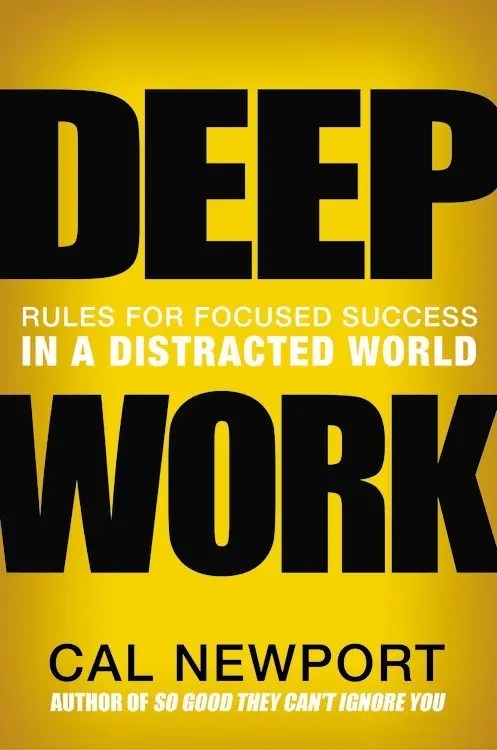
A computer science professor discusses why working distraction-free can set you apart and how he applied these techniques in his own career.
Summary:
Deep work is the ability to focus without distraction on a cognitively demanding task. Dividing this book into two parts, the author first makes the case that in almost any profession, cultivating a deep work ethic will produce massive benefits. He then presents a rigorous training regimen, presented as a series of four “rules,” for transforming your mind and habits to support this skill.
A mix of cultural criticism and actionable advice, Deep Work takes the reader on a journey through memorable stories-from Carl Jung building a stone tower in the woods to focus his mind, to a social media pioneer buying a round-trip business class ticket to Tokyo to write a book free from distraction in the air-and no-nonsense advice, such as the claim that most serious professionals should quit social media and that you should practice being bored.
Review:
A drive for traditional academic and corporate success tinges the majority of this book. But if you are able to see past it, there are some good facts and tips as well.
It’s easy to feel plagued by distraction in this world, no matter if your goals are traditional or nontraditional. Part of that is by design. Most of us at this point carry a smartphone, and they’re designed to be addictive. Even if your goal is to relax watching a movie with a loved one, you might find yourself reaching for your smartphone repeatedly throughout the movie instead of focusing on enjoying simply the movie and the moment with your loved one. Times of deep focus is what this book terms “deep work.”
A strength of this book is the discussion of the benefits of spending some time in a deep work (focus) state. It lets you master difficult things at a faster rate. It leads to greater satisfaction because when we’re unfocused we skew more toward pessimism rather than optimism. And, something I personally think should be talked about more, our worldview is based on what we pay attention to. So, we should be more mindful about what we are paying attention to. These are all good points and motivators to take the power back from addictive devices over our time. But then the author goes into a work-obsessed left field.
There is a palpable sense throughout this book that any negativity a worker may feel about their workplace is all down to the worker not focusing in the correct way. Even a simple mismatch between the worker and the work’s goals is somehow something the worker can just focus past in the author’s mind.
You don’t need a rarified job; you need instead a rarified approach to your work.
loc 1012
People deserve to do work that makes them feel good. And we are all blessed with different talents, skills, and gifts. A job might not suit one person but suit another. A job doesn’t need to be rarified to be satisfying. And a worker doesn’t need to be rarified to excel at their job. I might also question, why the pressure to excel? Why can’t we simply do our jobs well and complete the day satisfied?
Toward the end of the book, the author describes a year in which he really pushed himself as he was about to come up for tenure. He states that during this year he was “a deep work machine” (loc 2908). He literally thought about work in every spare moment – when going on walks, when raking leaves. He had at least one young child at home, and he still spent all this time engaged in deep thinking…about work. Why? Because he didn’t get an opportunity his colleagues did. He does at one point express that maybe he went a little too far, but he also discusses how much work success it brought him and seems generally pleased with the outcome. I find it interesting that he talks so much about bringing focus to his job but not about spending focused time with his child or wife, for example. In spite of the fact that the same techniques for focus he uses for work could be applied to many other aspects of our lives. But he only seems to see their use in climbing the academic crab bucket.
If we choose to see past the toxic application of focus in only career, what are the tips given in this book for developing focus? These are what stuck out to me. Schedule times of deep focus. When in your scheduled deep focus times, focus on things that are, to you, wildly important. Keep a tally of the deep focus time you have accomplished – not the tasks, but the time. Review this weekly to help yourself understand what’s interfering with your deep focus time and adapt. On the flip-side of scheduled focus times, schedule times for distraction. So, for example, pick a 30 minute window where you will browse Instagram, and that’s the only time you do it that day. To hone your skills, select a task you want to accomplish and set a timer for slightly less time to finish it than you think you will need. See if you can beat that time. This will help you focus more deeply and become faster over time.
Overall this book has some interesting explanations of why focus matters and tips on how to bring more focus into your life. But you will need to look past the lack of work/life balance present in many of the examples given, instead extracting solely what is best for your own focus goals in your own, well-balanced life.
If you found this review helpful, please consider tipping me on ko-fi, checking out my digital items available in my ko-fi shop, buying one of my publications, or using one of my referral/coupon codes. Thank you for your support!
3 out of 5 stars
Length: 296 pages – average but on the shorter side
Source: Library
Buy It (Amazon or Bookshop.org)
Book Review: Broke the Bread, Spilled the Tea by Mitchell Kesller

A bisexual, Christian man explores how he came to a queer-affirming version of his faith.
Summary:
The Christian Church has long been one of the most influential institutions in society. Self-proclaimed as God’s representatives on earth, it is ironic to see how a faith of love and inclusion has been the source of wars, genocides, slavery, and oppression throughout the ages. In an era of misinformation and blind faith, maybe it’s time to take a closer look at the Bible and “judge by the fruits” of what is real and what is not. Broke the Bread, Spilled the Tea aims to explore one of Christianity’s most marginalized groups and breaks down exactly what the Bible says about queerness through a contextual, historical, and lexicological lens. Bridging the gap between identity and faith is possible when we conclude that perhaps the God preached on the Sunday pulpits isn’t the fullness of who He actually is.
From an author deep in the trenches,
I’ve broken the bread,
it’s time to spill the tea.
Review:
There’s a big divide in the various sects of Christianity about what to say and do about us queer people. Some say simply being queer is an abomination. Some say it’s ok to be queer but you must not act on it. And some are affirming churches – that say being queer is how God made us, and He loves us just the way we are. Catholicism’s response to queerness is a mixture of tradition, catechism, and what the Pope says. (It has tended to come down on it’s ok to be queer as long as you’re celibate.) Protestant sects, in contrast, make their decisions based on interpretations of the Bible. Mitchell was raised Protestant, and this is a Protestant exploration of queerness. Thus, it is largely rooted in interpretations of the Bible and focuses a large part on the clobber passages. These are 6 (or 7, depending on who you ask) passages in the Bible that non-affirming interpretations view as condemning queerness, whereas affirming churches view as not doing that. I tried to find a neutral explanation of the clobber passages but could not. So here is one from a non-affirming viewpoint. Here is one from an affirming viewpoint.
Kesller starts the book with a memoir chapter, explaining who he is, his upbringing, and how he came to his affirming viewpoint (without the fine details – those are covered later in the book). I found it particularly interesting that his perspective is of a bisexual person. I know as a bisexual person myself that often people find it difficult to understand why I couldn’t just let go of my queer identity and pass. Kesller does a great job of articulating why that wasn’t possible for him, and I found it quite relatable. Another interesting aspect of his perspective is that he immigrated to the US from Brazil as a child, so his childhood church experience wasn’t the pasty-white version of Evangelicalism you usually see on the news. In general, Kesller has a humble, relatable tone throughout the book. He’s not preachy. He’s just trying to share his own journey of how he personally came to understand the Bible and Christianity generally and the clobber passages specifically.
After the memoir section, the chapters explore the ancient church, how we got the Bible, and how God is represented in the Bible. Only then does Kesller go into the clobber passages. I like that he gives context to this exploration. Too often people dive right into Bible verses with no surrounding context whatsoever. I appreciate how Kesller tries to focus on the big picture of who Jesus is, what his message was, and what that means for Christians. I think some of his points on the clobber passages are stronger than others – and that’s coming from an affirming person. This is to say….I think some of the apologetics need some work. But that’s not really a critique because this is his own personal journey, not an apologetics book. There are other books out there if that’s what you’re looking for. (Clobber the Passages or UnClobber spring to mind.)
Interestingly, I think the greatest strength of this book is in calling out modern day Protestant churches for falling into Pharisee like behavior – being focused on religiosity rather than living lives of radical caring. The two quotes that I think really demonstrate this are these:
More often than not, we see Jesus living out a ministry of relationships rather than one of religiousness.
loc 299
The Church often tries to eliminate a symptom without treating the underlying cause.
loc 1829
I also think this book could be really useful in trying to help build a bridge between a non-affirming family member and an affirming one. It answers the question of “how can you both be happily queer and a Christian” in a gentle manner.
Overall, I appreciate Kesller’s bravery in writing this book and being so open about his own life and faith journey.
If you found this review helpful, please consider tipping me on ko-fi, checking out my digital items available in my ko-fi shop, buying one of my publications, or using one of my referral/coupon codes. Thank you for your support!
4 out of 5 stars
Length: 157 pages – average but on the shorter side
Source: NetGalley
Buy It (Amazon or Bookshop.org)
Book Review: Through Forests of Every Color: Awakening with Koans by Joan Sutherland

Learn about Zen Buddhist koans – both their history and how to use them in your practice – in this approachable introduction from a nearly lifelong Zen practitioner.
Summary:
Renowned Zen teacher Joan Sutherland reimagines the koan tradition with allegiance to the root spirit of the koans and to their profound potential for vivifying, subverting, and sanctifying our lives. Her decades of practicing with koans and of translating them from classical Chinese imbues this text with a warm familiarity, an ease still suffused with awe.
Interlinked essays on “koans as art,” “keeping company with koans,” and “walking the koan way” intersperse with beautifully translated renditions of dozens of traditional Zen koans. Sutherland also shares innovative koans culled from Western literature, as well as teachings on how to create idiosyncratic koans or turning words from the circumstances of one’s own life.
Review:
I came into this book with some trepidation. My previous experiences with koans were frustrating, and not in a way that I felt lent itself to enlightenment. I hoped this introductory guide to koans would hep me to engage with them better. This book certainly met that goal. I now have a desire to work with koans in my own practice. Although, I won’t be jumping right into The Gateless Gate. I plan to pick up another book that moves slowly and with guidance.
Indeed, learning the history of how koans have traditionally been engaged with helped me. You wouldn’t enter koan study alone but rather with a teacher who helps you learn how to engage with them. The author does not feel this can be entirely replicated with books and encourages finding a teacher. I will carry on with books for now as finding a teacher seems an insurmountable task at the moment to me. Sutherland also discusses how traditionally there was a “right” answer to koans but in modern times there’s more consideration for alternative interpretations – as long as they hold meaning to the practitioner. So you might not make a student wrestle with a koan until they come upon “the” answer but rather until they come upon an answer that leads them further down the path toward enlightenment.
Sutherland also discusses the reputation of Zen for being rude. She points out how in the culture rudeness was basically unheard of. So the point wasn’t the rudeness. The point was startling the student out of their cultural expectations. She suggests that other methods might be best depending upon the culture you’re currently working in. This was a real “aha” moment for me. Startling as the goal is something I can understand as being an impetus to break out of your current mindset.
I also appreciated coming to understand that the goal isn’t to solve a koan immediately. Rather, the goal is to live with the koan, day in and day out. In this way your own life helps you understand the koan, and the koan helps you understand your own life. This reminded me of how I was encouraged to engage with Scripture as a child. To memorize a verse and consider it for a full week or a month to see what else may be revealed.
One thing that disappointed me in this book was the discussion of writing your own koans was sparse. It was the aspect I was looking forward to the most. In all honesty, I can’t remember any part of the book directly discussing it. I don’t believe the blurb would mention it if it wasn’t there, though, so I’m assuming it’s very fleeting. I was expecting an entire chapter, perhaps with suggested exercises.
I want to leave you with my favorite koan from the book.
Someone asked Yunmen, “What is reaching the light?
loc 185
Yunmen replied, “Forget the light, First give me the reaching.”
Overall, this is a nice introduction to koans, both how to use them in practice and their history. Recommended to anyone looking to learn more about koan.
If you found this review helpful, please consider tipping me on ko-fi, checking out my digital items available in my ko-fi shop, buying one of my publications, or using one of my referral/coupon codes. Thank you for your support!
4 out of 5 stars
Length: 192 pages – average but on the shorter side
Source: NetGalley
Buy It (Amazon or Bookshop.org)
Book Review: The Trauma of Caste: A Dalit Feminist Meditation on Survivorship, Healing, and Abolition by Thenmozhi Soundararajan

Indian people are born into a specific, unchangeable caste. People of the lowest caste – Dalits – suffer discrimination and injustice. Here a Dalit feminist Buddhist author explores how Dalits can survive and heal from this trauma and allies can work toward justice.
Summary:
“Dalit” is the name that we chose for ourselves when Brahminism declared us “untouchable.” Dalit means broken. Broken by suffering. Broken by caste: the world’s oldest, longest-running dominator system…yet although “Dalit” means broken, it also means resilient.
Despite its ban more than 70 years ago, caste is thriving. Every 15 minutes, a crime is perpetrated against a Dalit person. The average age of death for Dalit women is just 39. And the wreckages of caste are replicated here in the U.S., too—erupting online with rape and death threats, showing up at work, and forcing countless Dalits to live in fear of being outed.
Dalit American activist Thenmozhi Soundararajan puts forth a call to awaken and act, not just for readers in South Asia, but all around the world. She ties Dalit oppression to fights for liberation among Black, Indigenous, Latinx, femme, and Queer communities, examining caste from a feminist, abolitionist, and Dalit Buddhist perspective—and laying bare the grief, trauma, rage, and stolen futures enacted by Brahminical social structures on the caste-oppressed.
Review:
I read and enjoyed Radical Dharma. It is a Black Buddhist exploration of systemic racial injustice against Black folks. It also uses Buddhist thought to progress toward liberation. The publisher recommended this book to readers of Radical Dharma, and I could tell from the title alone the parallels. Indian society oppresses Dalit peoples in very similar ways to how US American society oppresses Black folks. For example, they were both the source of enslaved labor in the 1800s. The author, a Dalit American woman, offers a very personal exploration of what it is to be a part of the Dalit diaspora. She also explores how her Buddhist belief system helps her navigate her trauma and advocate for societal change.
The author divides the book into four sections she calls mediations – The Existence of Caste, The Source of Caste, From Wounds to Liberation, and The End of Caste. There are also two appendixes that I found so meaningful I think they’re better thought of as part of the main book. The first explores Dalit social justice activists throughout time like B.R. Ambedkar and Phoolan Devi. The second is healing meditations for those truamatized by caste.
If you have ever heard of an “untouchable” caste this book makes it clear that this is not the name that members of this caste chooses for themselves. Many choose the name “Dalit” instead. Some choose other names, but Dalit is the most common.
Dalit means broken. Broken by suffering. Broken by caste.
loc 268
Another way of referring to those traumatized by caste is casteoppressed.
There is some controversy on exactly where caste came from. The author makes it clear she believes it came from the traditional faith of Hinduism. Caste was then weaponized by British colonizers to further divide those they colonized and make it easier to maintain dominance over them. However, the author acknowledges some people believe otherwise. I myself am not a scholar in this area. But however it began, caste is intermingled with Hinduism and Indian society across the diaspora. A person born into a lower caste is told they deserve to be at the lowest level of society because of sins they committed in a past life. That all of their suffering is their own fault, and they don’t deserve to rise out of it. The message also is that those in higher castes deserve to be there. Any suffering they put on those of lower castes is simply what those of the lower caste “deserve.” If you are at all familiar with the history of racism in the US, then it is immediately quite clear how damaging these societal beliefs are. It is also clear why they need to be overcome.
The pain and suffering for Dalit peoples is not of the past – it is now. The author offers sobering statistics (with references). They include:
- 54% of Dalit children are undernourished (loc 500)
- 83 of every 1,000 Dalit children die before their first birthday (loc 500)
- more than 67% of Dalit women have experienced sexual violence (loc 509)
- the average age of death for a Dalit woman is 39 (loc 509)
- 45% of Dalits do not know how to read and write (loc 3327)
- 48% of villages deny Dalits access to water (loc 3330)
The author explores how we can all begin to fight for freedom, justice, and equality. She talks about how important it is for oppressed people to be able to begin to imagine being free as the first step. She also speaks to allies about being aware that a move toward equality might feel like discomfort to us. She also speaks about the importance of supporting the experiences of the oppressed. Being cautious and mindful in our words and deeds is a message we all can benefit from.
An area that could have been improved on is where the author speaks about other religions in India and Dalit participation in them. While the section on Islam is well-written, making it clear how caste is not a part of Islam but can end up being enacted upon Dalit Muslims anyway, the same clarity is not brought to the section on Christianity. It makes it sound like social justice is a focus of only specifically Dalit led Christian sects. The section ignores other sects that follow similar mores and even the Bible verse Galatians 3:28 “…ye are all one in Christ Jesus.” Similarly, Judaism is skipped over, but Dalit Jewish people do exist. I wished these had been explored more. I appreciate that the author is careful to encourage and support Dalits in whatever faith they choose – including remaining Hindu. But I would have liked either a more even-handed representation of other faiths or a purely Buddhist perspective.
I empathize very much with the author’s concerns about modern-day genocides. It is absolutely correct that society at large is not taking these atrocities seriously the way we should. But the author mentions that we went to war in WWII over the Holocaust. That’s inaccurate. Nations went to war to protect their own nations. While the Holocaust was taken seriously after the fact, it’s not why nations went to war. Indeed, most nations turned away Jewish refugees at the time. What we are seeing with the general ignoring of current genocidal atrocities is sadly a repeat of how nations reacted in the past. We haven’t learned what we should have from the horrors of the Holocaust.
Overall, this is an eye-opening book about caste-based oppression throughout the South Asian diaspora. It offers healing for the casteoppressed and asks us all to become allies in the work to liberate these people. It is a meaningful introduction to this liberating labor for both casteoppressed people and allies.
If you found this review helpful, please consider tipping me on ko-fi, checking out my digital items available in my ko-fi shop, buying one of my publications, or using one of my referral/coupon codes. Thank you for your support!
4 out of 5 stars
Length: 256 pages – average but on the shorter side
Source: NetGalley
Buy It (Amazon or Bookshop.org)
2022 Award Eligibility

I have four pieces eligible for awards during the 2022 award season in three categories.
All of these were first published during 2022.
For the paid stories, I am able to provide author copies for award consideration purposes only. Please email me at mcneil.author [at] gmail.com to request one.
Short Stories
“The University of Late-Night Moans” in Decoded Pride: A science fiction, fantasy, and horror story-a-day anthology for Pride month
June 9, 2022, issue 3, $14.99 digital
fantasy romance (sapphic / wlw)
It’s 1998, and Leonora’s friend Virginia is helping her investigate the moans coming from the cemetery across the train tracks from her dorm.
“Sister Prudence on the Beach” in Solarpunk Magazine
Issue #6, Lunarpunk Special, Nov/Dec 2022, $6 digital
hopepunk (speculative scifi)
Sister Prudence settles down for her full moon meditation on the beach. But a young one passing by interrupts not just her meditation but perhaps her retirement as well.
Drabble
“Bostonians Aren’t Friends With Our Neighbors” in Wyrms: An Anthology of Dragon Drabbles
July 1, 2022, $3 digital, $6 print
fantasy
The first line is “Deadrodents.com said the box on the triple-decker’s porch next door.”
Creative Nonfiction
“These Boots Were Made for Who?” in Just Femme & Dandy
July 4, 2022, issue 3, free
digital magazine version (page 105) or html/accessible version
literary fashion magazine through a queer lens
I explore how my favorite pair of thrifted boots helped me develop my queer, bisexual fashion sense and sustained me throughout the pandemic.
 Support my work with a tip or browse my shop for curated book club guides, how to guides, cross-stitch patterns, and more!


This work by Amanda Nevius is licensed under a Creative Commons Attribution-Noncommercial-No Derivative Works 3.0 United States License.
 Opinions of a Wolf