
Archive
Book Review: Still Missing by Chevy Stevens
 Summary:
Annie O’Sullivan extremely forcefully declares in her first therapy session that she doesn’t want her therapist to talk back to her; she just wants her to listen. And so, through multiple sessions, she slowly finds a safe space to recount her horrible abduction from an open house she was running as an up-and-rising realtor, her year spent as the prisoner of her abductor, and of her struggles both to deal with her PTSD now that she’s free again and to deal with the investigation into her abduction.
Review:
I was intrigued by the concept of this book. Yes, it’s another abduction story, but wrapping it in the therapy sessions after she escapes was an idea I had not seen before. So when I saw this on sale for the kindle, I snatched it up. I’m glad I did, because this is a surprisingly edge-of-your-seat thriller.
Stevens deals with the potential issue of back-and-forth with the therapist by having Annie say in her first session that in order to feel safe talking about what happened to her, she needs the therapist to say very little back to her. It is acknowledged that the therapist says some things to Annie, but it appears that she waits to talk until the end of the session when Annie is done talking. What the therapist says isn’t recorded but Annie does sometimes respond to what she suggested in later sessions. This set-up has the potential to be clunky, but Stevens handled it quite eloquently. It always reads smoothly.
The plot itself starts out as a basic abducted/escaped one, with most of the thriller aspects of the first half of the book coming from slowly finding out everything that happened to Annie when she was abducted. The second half is where the plot really blew me away, though. The investigation into her kidnapping turns extremely exciting and terrifying. I don’t want to give too much away. Suffice to say that I wasn’t expecting most of the thrills to come from the investigation after the kidnapping and yet they did.
Annie is well-developed. Her PTSD is written with a deep understanding of it. For instance, she both needs human connection and is (understandably) terrified of it, so she pushes people away. Stevens shows Annie’s PTSD in every way, from how she talks to her therapist to how she behaves now to subtle comparisons to how she used to be before she was traumatized.
Other characters are well-rounded enough to seem like real people, including her abductor, yet it also never seems like Annie is describing them with more information than she would logically have.
I do want to take just a moment to let potential readers know that there are graphic, realistic descriptions of rape. Similarly, the end of the book may be triggering for some. I cannot say why without revealing what happens but suffice to say that if triggers are an issue for you in your recovery from trauma, you may want to wait until you are further along in your recovery and feel strong enough to handle potentially upsetting realistic descriptions of trauma.
Overall, this is a strong thriller with a creative story-telling structure. Those who enjoy abduction themed thrillers will find this one unique enough to keep them on the edge of their seat. Those with an interest in PTSD depicted in literature will find this one quite realistic and appreciate the inclusion of therapy sessions in the presentation.
If you found this review helpful, please consider tipping me on ko-fi, checking out my digital items available in my ko-fi shop, buying one of my publications, or using one of my referral/coupon codes. Thank you for your support!
5 out of 5 stars
Length: 411 pages – average but on the longer side
Source: Amazon

Counts For:


Book Review: A Banquet for Hungry Ghosts by Ying Chang Compestine (Bottom of TBR Pile Challenge)
 Summary:
According to Chinese tradition, those who die hungry or wrongfully come back to haunt the living. Compestine presents here eight different ghost stories, each correlated along with a course in a banquet and richly steeped in Chinese culture and history.
Review:
I picked this up because I had previously read Compestine’s book Revolution Is Not a Dinner Party
The eight short stories are organized into appetizers, main courses, and desserts. The titles are for the food being served that course, such as “Tea Eggs” or “Long-life Noodles.” The food mentioned in the title also appears somewhere in the story as a key part of the plot. It’s a gorgeous way to organize the short stories and makes them also feel like diverse parts of a whole.
The short stories are mostly set in 20th century China, but a couple feature 20th century characters investigating something from the more distant past or being haunted by more ancient ghosts. One story is set in New York City and features a Chinese-American family.
The stories, universally, quickly establish the setting and characters. They all subtly teach some aspect of Chinese culture or history. For instance, one story looks at medicine under Communism in China, while another features preying mantis fights. At the end of each story, a brief blurb gives further details about two to three aspects of Chinese culture or history featured in the story. Most surprising, and incredibly welcome, at the end of each short story, Compestine gives a recipe for the featured food! It reminded me of how cozy mysteries often feature patterns or recipes at the end of the book, only this time the recipes are found in a shorty story horror collection. Brilliant!
What about the horror aspect of the short stories? I found them simultaneously plausible and sufficiently scary. I was a bit on the edge of my seat without being scared out of my wits, which is exactly what I was looking for.
Overall, I immensely enjoyed each of these short stories, from the touch of horror to the settings to the amount I learned about Chinese culture and history to the wonderful recipes. Highly recommended to anyone with even a moderate interest in China, Chinese culture, or Chinese food. Even if horror isn’t usually your genre, give these ghosts a chance. You’ll be glad you did.
If you found this review helpful, please consider tipping me on ko-fi, checking out my digital items available in my ko-fi shop, buying one of my publications, or using one of my referral/coupon codes. Thank you for your support!
5 out of 5 stars
Length: 192 pages – average but on the shorter side
Source: Better World Books

Counts For:
Book Review: I’ll Sleep When You’re Dead by E. A. Aymar (Series, #1)
 Summary:
Tom Starks has not been the same since his wife, Renee, was brutally murdered with a baseball bat in a parking lot. He’s been struggling for the last three years to raise her daughter, who he adopted when he married Renee. When Renee’s killer is released after a retrial finds insufficient evidence to hold him, Tom becomes obsessed with dealing out justice himself.
Review:
I was so excited that two of my 2014 accepted review copies fit into the RIP IX reading challenge! This book’s title jumped out at me immediately when it was submitted, and I had been saving it up specifically to read in the fall. I’m glad to say that this thriller does not disappoint, although it goes in a bit of a different direction than I originally anticipated. And that’s a good thing.
The main character is not who you usually see from a thriller with a person seeking violent justice. He’s bookish. Rather weak and simpering. Afraid of his own brother-in-law, who used to be a boxer. But he was madly in love with Renee, and so when her supposed killer is released, he becomes obsessed with making him dead. The catch is, Tom quickly figures out that maybe he’s not cut out to do the killing himself, and that’s where the book gets unique and interesting. I was expecting from the title and description to see a typical bad-ass main character chase down a killer around the country (or the world) and ultimately get his revenge. That is not at all the story we get, and yet, it is still thrilling. There is still violence and chase scenes, it’s just they aren’t the ones you usually see in a book like this. And that helps it. That helps keep the thrill level up, since it’s so much harder to predict what’s going to come next. Tom, with his weakness and inability to parent well, is almost an anti-hero, and yet we keep rooting for him because his grief for his wife is so powerful and relatable. It’s strong characterization and plotting mixed into one.
The scenes where Tom is seen teaching The Count of Monte Cristo at the community college where he works slow the thrill down. They feel a bit too aware of themselves, with comparison between The Count of Monte Cristo and the plot in this book. Plus scenes of classroom literary analysis simply slow the thrilling plot of the book down. The one scene where it really works is one scene in which Tom is freaking out about his own life so much that he fails at teaching well. This establishes that Tom’s life is starting to get out of control. Overall, though, there are just too many scenes of him teaching for a thriller.
The setting of Baltimore is interesting, and I was glad to see that it wasn’t set in the more stereotypical Washington D.C. Aymar writes Baltimore beautifully. I’ve never been there, but I truly felt as if I was there, seeing both the run-down aspects, as well as the beauty. I often end up skimming over setting descriptions, but Aymar’s drew me in.
The plot has just enough twists and turns to keep the reader guessing, but not so many that the reader feels jerked around. Also, the plot twists stay rooted in reality. I could truly see this happening in the real world, and that makes a thriller more thrilling.
Overall, this is a unique thriller, with its choice to cast the opposite of a bad-ass in the role of the main character. This grounds the typical revenge plot into reality, lends itself to more interesting, unique plot twists, and has the interesting aspect of a flawed, nearly anti-hero main character that the reader still roots for. Recommended to thriller fans looking for something different and those interested in first dipping their toe into the thriller genre.
If you found this review helpful, please consider tipping me on ko-fi, checking out my digital items available in my ko-fi shop, buying one of my publications, or using one of my referral/coupon codes. Thank you for your support!
4 out of 5 stars
Length: 318 pages – average but on the longer side
Source: Kindle copy from author in exchange for my honest review

Counts For:
Book Review: The Walking Dead: The Fall of the Governor: Part One by Robert Kirkman and Jay Bonansinga (Series, #3) (Audiobook narrated by Fred Berman)
 Summary:
In the aftermath of her rebellion attempt against The Governor, Lilly Caul is starting to see him as a man who does what it takes to protect the citizens of Woodbury. So when strangers in riot gear and prison suits underneath show up at Woodbury, she believes The Governor that they’re out to get their supplies and that the woman, unprovoked, bit his ear. But not everyone believes The Governor, and The Governor starts to think he can use the doubters to his advantage.
Review:
This non-graphic novel series telling the backstory of the big bad villain of the graphic novel Walking Dead series started off incredibly strong but, unfortunately, each new entry in the series gets worse and worse. Instead of lending new light to the backstory of The Governor and Woodbury, this entry retells scenes readers of the graphic novel have already seen, simply from The Governor and other residents of Woodbury’s perspectives.
While I understand that some things readers of the graphic novel series already know may need to be briefly mentioned again for those who are only reading the print books, a sizable portion of this book features scenes already told once in the graphic novels. Many of these scenes were disturbing enough in the graphic novels, such as the scene in which Michonne is repeatedly raped and beaten by The Governor. Retelling them from the perspective of The Governor just felt unnecessary and was frankly difficult to listen to. It would have been better to have left out showing that scene again and instead showed the, well-told and well-done scene of The Governor after her rapes Michonne back in his apartment where he tries to rationalize his behavior. This lends new insight into the character without forcing the readers to, essentially, re-read.
The characterization of Lilly Caul continued to bother me. First she hates The Governor and leads a rebellion, then turns right around and becomes loyal to him? What? This makes zero sense and is never fleshed out enough to make sense. Similarly, how she handles one particular plot development feels like lazy, cliched writing of women, which bothered me.
Speaking of writing of women, while I understand that the third person narration is supposed to simultaneously be from an evil guy’s perspective, how the narrator talked about Michonne really bothered me. We are constantly reminded that she is black. She is never just “the woman” she is always “the black woman” or “the dark woman.” Her dreadlocks are mentioned constantly. Whereas white characters, Latino characters, and male characters are referred to once with descriptors about how they look, her looks are constantly described. I understand looks need to be described periodically, but this is far too heavy-handed and in such a way that it feels like the narrator feels it necessary to constantly remind the reader that she is “other” and “different from us.” Worse, she is also referred to as a “creature,” etc…, particularly during her rape scenes. I never felt Michonne was mishandled in the graphic novels. She’s a bad-ass woman who just happens to be black in the graphic novels. Here, though, the descriptions of her feel like they are exoticized, which feels entirely wrong for a book in which we mostly just see her being raped. She is depicted so animalistically, it made my stomach turn. Even when she is among her friends, the narrator feels it necessary to constantly refer to her otherness.
So what’s done well in this book? The scenes where we finally learn how the double-cross happens and see it plotted and carried out from the bad guys’ perspective is chilling and enlightening. It’s also really nice to get to actually see the scene where Michonne beats the crap out of The Governor. If other scenes had been left out, the characterization of Lilly Caul and descriptions of Michonne handled better, and the whole book tightened up (and probably part two included here), it could have been a strong book.
Overall, fans of the series will be disappointed by the repetition of scenes they’ve already seen and the overall shortness and lack of new information in this book. Some may be bothered both by how Michonne is presented in this book, far differently from how she is in the graphic novel series, as well as by seeing some of the rapes from The Governor’s perspective. Recommended to hard-core fans who feel they need to complete reading the companion series to the graphic novels.
If you found this review helpful, please consider tipping me on ko-fi, checking out my digital items available in my ko-fi shop, buying one of my publications, or using one of my referral/coupon codes. Thank you for your support!
2 out of 5 stars
Length: 256 pages – average but on the shorter side
Source: Audible

Previous Books in Series:
The Walking Dead: Rise of the Governor, review
The Walking Dead: The Road to Woodbury
Counts For:
Book Review: Fudoki by Kij Johnson (Bottom of TBR Pile Challenge)
 Summary:
An aging empress decides to fill her empty notebooks before she must get rid of them along with all of her belongings to retire to the convent, as is expected of her. She ends up telling the story of Kagaya-hime, a tortoiseshell cat who loses her cat family in a fire and is turned into a woman by the kami, the god of the road.
Review:
I’m not usually big into fantasy, particularly not ones involving court life, but I am a real sucker for any story involving cats, especially if that cat is a tortoiseshell, since I’m the proud kitty mommy of a talkative tortie. This book didn’t just not disappoint me, it blew me away with two side-by-side, related by different, thoughtful tales.
I had no idea when I picked up the book that the empress would figure into the story quite so much. At first I was a bit irritated that she was a) getting 40% to 50% of the storytime and b) rambling off from one thought to another like elderly people tend to do. But I stayed patient, and I learned that there was more to the empress than met the eye and also that the two stories were actually informing each other. Kagaya-hime’s story shows everything the empress had secretly wished for her whole life, and the empress’s life translated into how Kagaya-hime felt trapped in her human body. It’s artfully done in a subtle way, which is part of what makes it so beautiful.
Kagaya-hime goes from a sad lost kitty with burned paws to a warrior woman, allowed along on a quest for revenge by a moderately elite rural family. She is able to earn respect from the men as a warrior because as a cat she sees no reason not to hunt or defend herself. She is a woman but no one ever took her claws away (though they may be arrows and knives now, instead of claws). Thinking of her is empowering to the empress, who always had an interest in war and politics but was forced to remain literally behind screens in gorgeous gowns that are hard to move in. It’s interesting to note that while the empress may be jealous of Kagaya-hime’s ability to do what she wants and defend herself, Kagaya-hime herself is unhappy because she simply wishes to be a cat again. It is the conclusion to Kagaya-hime’s story that allows the empress to see a conclusion to her own story (her life) that will ultimately make her feel fulfilled.
The details of ancient Japan were clearly meticulously researched. Johnson smoothly writes about the outfits, land, and battles as if she was there for them herself. The information never comes through as an info dump but instead is something that simply is, that the reader learns about naturally just by venturing into Kagaya-hime and the empress’ world. This is what knowing your history inside and out before starting writing does for historic fiction. It makes history come to life.
Overall, this is a stunning piece of historic fiction the reading of which feels like slowly sipping a well-made matcha latte. Fans of historic fiction of all sorts will be engaged, those that love cats will be enthralled, and those with an interest in women’s history will be enamored and touched by how much things change and yet still stay the same for women. Recommended to all who think they might even possibly be interested in a piece of historic fiction set in Japan featuring an aging empress and a shape-changing cat.
If you found this review helpful, please consider tipping me on ko-fi, checking out my digital items available in my ko-fi shop, buying one of my publications, or using one of my referral/coupon codes. Thank you for your support!
5 out of 5 stars
Length: 316 pages – average but on the longer side
Source: Better World Books

Reading Challenge: R.eaders I.mbibing P.eril (RIP) IX
Hello my lovely readers! Many book bloggers are already familiar with Carl of Stainless Steel Droppings’ RIP Challenge. For those who aren’t familiar, it’s a reading challenge, covering the months of September and October, during which you read delightfully creepy / horror books to go along with the feelings of fall. The books can be in any of the following genres:
Mystery.
Suspense.
Thriller.
Dark Fantasy.
Gothic.
Horror.
Supernatural.
Or anything sufficiently moody that shares a kinship with the above.
There are multiple different ways to participate, including reading short stories and watching movies, plus there’s now a readalong you can participate in. I’ve participated twice before purely in the book reading portion of the challenge, and that’s what I’m going to be doing again. I’ll be doing Peril the First, for which you read four books that broadly fit in any of the categories above.
Books I already own that I could select for the challenge are listed below. I’d love to hear from you in the comments if there’s one you’d particularly like to recommend to me from my list!
- A Banquet for Hungry Ghosts by Ying Chang Compestine
- Barely Breathing by Michael J. Kolinski
- Beverly Hills Demon Slayer by Angie Fox
- Brains: A Zombie Memoir by Robin Becker
- Breed by Chase Novak
- Cycle of the Werewolf by Stephen King
- Deadtown by Nancy Holzner
- Disclosure by Michael Crichton
- From a Buick 8 by Stephen King
- I’ll Sleep When You’re Dead by E. A. Aymar
- The Keep by Paul F. Wilson
- The Kitchen Witch by Annette Blair
- Nightmare Fuel: Volume 1 by Bliss Morgan
- The Shimmer by David Morrell
- Smokin’ Six Shooter by B. J. Daniels
- A Spell of Winter by Helen Dunmore
- State of Decay by James Knapp
- Still Missing by Chevy Stevens
- The Strain by Guillermo Del Toro and Chuck Hogan
- Tales of the Chtulhu Mythos by H. P. Lovecraft
- Unshapely Things by Mark Del Franco
- The Veiled Mirror: The Story of Prince Vlad Dracula’s Lost Love by Christine Frost
- The Walking Dead, Volume 16 by Robert Kirkman
- Wanted Woman by B. J. Daniels
I think I should be able to find four books from a list that large, don’t you?
PS If anyone is doing the short story challenge, I have two short stories published that fit within the parameters (and are free!). Also, my published novel fits into the challenge too. Check them all out on my publications page.
Book Review: The Drowning Girl by Caitlin R. Kiernan (Audiobook narrated by Suzy Jackson)
 Summary:
India Morgan Phelps, Imp to her friends, is sure that there were two different Eva Cannings who came into her life and changed her world. And one of them was a mermaid (or perhaps a siren?) and the other was a werewolf. But Imp’s ex-girlfriend, Abalyn, insists that no, there was only ever one Eva Canning, and she definitely wasn’t a mermaid or a werewolf. Dr. Ogilvy wants Imp to figure out for herself what actually happened. But that’s awfully hard when you have schizophrenia.
Review:
I’d heard that this book was a chilling mystery featuring queer characters and mental illness. When I discovered it on Audible with an appealing-sounding narrator, I knew what I was listening to next. This book is an engaging mystery that also eloquently captures the experience of having a mental illness that makes you question yourself and what you know while simultaneously giving a realistic glance into the queer community.
Imp is an unreliable first person narrator, and she fully admits this from the beginning. She calls herself a madwoman who was the daughter of a madwoman who was a daughter of a madwoman too. Mental illness runs in her family. She states that she will try not to lie, but it’s hard to know for sure when she’s lying. This is due to her schizophrenia. Imp is writing down the story of what she remembers happening in journal style on her typewriter because she is trying to figure out the mystery of what exactly happened for herself. The reader is just along for this ride. And it’s a haunting, terrifying ride. Not because of what Imp remembers happening with Eva Canning but because of being inside the mind of a person suffering from such a difficult mental illness. Experiencing what it is to not be able to trust your own memories, to not be sure what is real and is not real, is simultaneously terrifying and heart-breaking.
Imp’s schizophrenia, plus some comorbid anxiety and OCD, and how she experiences and deals with them, lead to some stunningly beautiful passages. This is particularly well seen in one portion of the book where she is more symptomatic than usual (for reasons which are spoilers, so I will leave them out):
All our thoughts are mustard seeds. Oh many days now. Many days. Many days of mustard seeds, India Phelps, daughter of madwomen, granddaughter, who doesn’t want to say a word and ergo can’t stop talking. Here is a sad sad tale, woebegone story of the girl who stopped for the two strangers who would not could not could not would not stop for me. She. She who is me. And I creep around the edges of my own life. Afraid to screw off the mayonnaise lid and spill the mustard seeds. (Part 2, loc 55:35)
The thing that’s great about the writing in the book is that it shows both the beauty and pain of mental illness. Imp’s brain is simultaneously beautiful for its artistic abilities and insight and a horrible burden in the ways that her mental illness tortures her and makes it difficult for her to live a “normal” life. This is something many people with mental illness experience but find it hard to express. It’s why many people with mental illness struggle with drug adherence. They like the ability to function in day-to-day society and pass as normal but they miss being who they are in their own minds. Kiernan eloquently demonstrates this struggle and shows the beauty and pain of mental illness.
Dr. Ogilvy and the pills she prescribes are my beeswax and the ropes that hold me fast to the main mast, just as my insanity has always been my siren. (Part 1, loc 4:08:48)
There is a lot of queer representation in the book, largely because Kiernan is clearly not just writing in a token queer character. Imp is a lesbian, and her world is the world of a real-to-life lesbian. She is not the only lesbian surrounded by straight people. People who are part of the queer community, in multiple different aspects, are a part of Imp’s life. Her girlfriend for part of the book is Abalyn, who is transwoman and has slept with both men and women both before and after her transition. She never identifies her sexuality in the book, but she states she now prefers women because the men tend to not be as interested in her now that she has had bottom surgery. The conversation where she talks about this with Imp is so realistic that I was stunned. I’m not sure I’ve ever seen a conversation about both transitioning and the complicated aspects of dating for trans people that was this realistic outside of a memoir. Eva Canning is bisexual. It’s difficult to talk about Eva Canning in-depth without spoilers, so, suffice to say, Eva is out as bisexual and she is also promiscuous. However, her promiscuity is not presented in a biphobic way. Bisexual people exist on the full spectrum from abstinent to monogamous to poly to promiscuous. What makes writing a bisexual character as promiscuous biphobic is whether the promiscuity is presented as the direct result of being bi, and Kiernan definitely does not write Eva this way. Kiernan handles all of the queer characters in a realistic way that supports their three-dimensionality, as well as prevents any queerphobia.
The plot is a difficult one to follow, largely due to Imp’s schizophrenia and her attempts at figuring out exactly what happened. The convoluted plot works to both develop Imp’s character and bring out the mystery in the first two-thirds of the book. The final third, though, takes an odd turn. Imp is trying to figure out what she herself believes actually happened, and it becomes clear that what she ultimately believes happened will be a mix of reality and her schizophrenic visions. That’s not just acceptable, it’s beautiful. However, it’s hard to follow what exactly Imp chooses to believe. I started to lose the thread of what Imp believes happens right around the chapter where multiple long siren songs are recounted. It doesn’t feel like Imp is slowly figuring things out for herself and has made a story that gives her some stability in her life. Instead it feels like she is still too symptomatic to truly function. I never expected clear answers to the mystery but I did at least expect that it would be clear what Imp herself believes happened. The lack of this removed the gut-wrenching power found in the first two-thirds of the book.
The audiobook narration by Suzy Jackson is truly stellar. There are parts of Imp’s journal that must truly have been exceedingly difficult to turn into audio form, but Jackson makes them easy to understand in audio form and also keeps the flow of the story going. Her voice is perfect for Imp. She is not infantilized nor aged beyond her years. She sounds like the 20-something woman she is. I’m honestly not sure the story would have the same power reading it in print. Hearing Imp’s voice through Jackson was so incredibly moving.
Overall, this book takes the traditional mystery and changes it from something external to something internal. The mystery of what really happened exists due to Imp’s schizophrenia, which makes it a unique read for any mystery fan. Further, Imp’s mental illness is presented eloquently through her beautiful first-person narration, and multiple queer characters are present and written realistically. Recommended to mystery fans looking for something different, those seeking to understand what it is like to have a mental illness, and those looking to read a powerful book featuring queer characters whose queerness is just an aspect of who they are and not the entire point of the story.
If you found this review helpful, please consider tipping me on ko-fi, checking out my digital items available in my ko-fi shop, buying one of my publications, or using one of my referral/coupon codes. Thank you for your support!
4 out of 5 stars
Length: 332 pages – average but on the longer side
Source: Audible

Counts For:
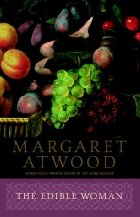
Book Review: The Edible Woman by Margaret Atwood (Bottom of the TBR Pile Challenge)
 Summary:
It’s the 1960s in Canada, and Marian McAlpin is working writing and analyzing surveys for a marketing research firm. She has a feminist roommate she doesn’t quite understand, and hangs out with the three office virgins for lunch. Her boyfriend is comfortable and familiar. When he proposes to her, the office virgins think she’s hit the jackpot, her roommate questions why she’s following the norm, and her married and very pregnant friend seems hesitant about her fiancee. None of this really bothers Marian, though. What does bother her is that, ever since her engagement, there are more and more things she simply can’t eat. First meat then eggs then even vegetables! She thinks of herself causing them suffering, and she just can’t stomach them. What will happen to her if there’s eventually nothing left for her to eat?
Review:
I’m a fan of a few Margaret Atwood books, and the concept of this book intrigued me. Since I run the Mental Illness Advocacy Reading Challenge, I was also wondering if this might actually be a new take on anorexia. Unfortunately, Marian is not really anorexic, it’s more of an elaborate, overdone metaphor. Perhaps the plot is simply dated, but the interesting concept, when fleshed-out, comes out rather ho-hum.
The novel is divided into three parts, with Marian using first-person narration for the first and third parts, with third person narration taking over for the second. This is meant to demonstrate how Marian is losing herself and not feeling her own identity. It’s an interesting writing device, and one of the things I enjoyed more in the book. It certainly is jarring to suddenly go from first to third person when talking about the main character, and it sets the tone quite well.
It’s impossible to read this book and not feel the 1960s in it. Marian is in a culture where women work but only until marriage, where women attending college is still seen as a waste by some, and where there is a small counter-cultural movement that seems odd to the mainstream characters and feels a bit like a caricature to the modern reader. However, the fact that Marian feels so trapped in her engagement, which could certainly still be the case in the 1960s, doesn’t ring as true, given the people surrounding Marian. Her roommate is counter-cultural, her three office friends claim to want a man but clearly aren’t afraid of aging alone and won’t settle. Her married friend shares household and child rearing with her husband, at least 50/50. It’s hard to empathize with Marian, when it seems that her trap is all of her own making in her own mind. She kind of careens around like aimless, violent, driftwood, refusing to take any agency for herself, her situation, or how she lets her fiancee treat her. It’s all puzzling and difficult to relate to.
The Marian-cannot-eat-plot is definitely not developed as anorexia. Marian at first stops eating certain meats because she empathizes with the animals the meat came from. As a vegetarian, I had trouble seeing this as a real problem and fully understood where Marian was coming from. Eventually, she starts to perceive herself as causing pain when eating a dead plant, bread, etc… The book presents both empathizing with animals and plants as equally pathologic, which is certainly not true. Marian’s affliction actually reminded me a bit of orthorexia nervosa (becoming unhealthily obsessed with healthy eating, source) but the book itself presents eliminating any food from your diet as pathologic. Either Marian eats like everyone else or she is going off the deep-end. There is no moderate in-between.
What the Marian-cannot-eat-plot is actually used for is as a metaphor for how Marian’s fiancee (or her relationship with him) is supposedly consuming her. The more entwined with her fiancee she becomes in society’s eyes, the closer the wedding comes, the less Marian is able to consume, because she herself is being consumed. This would be quite eloquent if Marian’s fiancee or her relationship with him was actually harmful or consuming, but it certainly does not come across that way in what we see of it in the book.
Marian presents herself to her boyfriend then fiancee as a mainstream person, and he treats her that way. He does one thing that’s kind of off-the-rocker (crashes his car into a hedge) but so does she on the same night (runs away in the middle of dinner, across people’s backyards, for no apparent reason and hides under a bed while having drinks with three other people at a friend’s house). The only thing that he does that could possibly be read as a bit cruel is when she dresses up for a party he states that he wishes she would dress that way more often. It’s not a partner’s place to tell the other how they should dress, but it’s also ok to express when you like something your partner is wearing. Personally I thought the fiancee really meant the latter but just struggled with appropriately expressing it, and Marian herself never expresses any wants or desires directly to him on how they interact, what they wear, what they eat, how they decorate, etc…, so how could he possibly know? In addition to never expressing herself to her fiancee, Marian also cheats on him, so how exactly the fiancee ends up the one being demonized in the conclusion of the book is a bit beyond me. He’s bad because he wanted to marry her? Okay…… The whole thing reads as a bit heavy-handed second-wave feminism to me, honestly. Marriage seems to be presented in the book as something that consumes women, no matter if they choose it or are forced into it by society. It is not presented as a valid choice if a woman is able, within her society and culture, to make her own choices.
In spite of these plot and character issues, the book is still an engaging read with an interesting writing style. I was caught up in the story, even if I didn’t really like the ideas within it.
Overall, this is a well-written book with some interesting narrative voice choices that did not age well. It is definitely a work of the 1960s with some second-wave feminism ideas that might not sit well with modern readers. Recommended to those interested in in a literary take on second-wave feminism’s perception of marriage.
3 out of 5 stars
Source: Better World Books

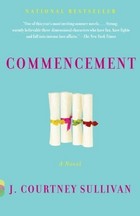
Book Review: Commencement by J. Courtney Sullivan (Bottom of TBR Pile Challenge)
 Summary:
Celia, Bree, Sally, and April wound up on the same small hall their first year at Smith College. Celia is from a traditional Irish Catholic Massachusetts family, although she doesn’t consider herself to be Catholic. Bree arrives at college from the south with an engagement ring on her hand. Sally arrives full of mourning and despair over the recent loss of her mother to breast cancer, and April arrives as the only work-study student on their floor. Paying her own way through school and with a whole slew of issues and causes to fight for. Their friendship is traced from the first weeks at Smith through their late 20s.
Review:
I picked this book up because it was compared favorably to Mary McCarthy’s The Group

What the book does well is evoking the feeling of both being in undergrad and the years immediately after graduation. Sullivan tells the story non-linearly, having the women getting back together for a wedding a few years after college. This lets them reminisce to early years of college and also present current life situations and hopes for the future. After the wedding, the story moves forward to cover the next year. The plot structure was good and kept the story moving at a good pace. It feels homey and familiar to read a book about four women going through the early stages of adulthood. It was hard to put down, and the storytelling and dialogue, particularly for the first half of the book, read like a fun beach read. However, there are a few issues that prevent the book from being the intelligent women’s literature it set out to be.
First, given that the premise of the book is that four very different women become unlikely friends thanks to being on the same hall of a progressive women’s college, the group of women isn’t actually that diverse. They are all white, three of the four are from wealthy or upper-middle-class backgrounds (only one must take out loans and work to pay for school), none are differently abled (no physical disabilities or mental illnesses), and not a single one is a happy GLBTQ person. Given that The Group
The book has a real GLBTQ problem. One of the characters has two relationships. One is with a man and one with a woman. She is happy in both and attracted to both. She takes issue with being called a lesbian, since she states she definitely fantasizes about men and enjoys thinking about them as well. Yet, in spite of the character clearly having both physical and romantic attractions to both men and women, the word bisexual is not used once in the entire book. The character herself never ventures to think she might be bi, and no one else suggests it to her. She struggles with “being a lesbian” and “being out as a lesbian” because she doesn’t think she is a lesbian. The other characters either say she’s in denial in the closet due to homophobia or that she really is straight and she needs to leave her girlfriend. It is clear reading the book that the character struggles with having the label of lesbian forced upon her when she is clearly actually bisexual. This is why she is uncomfortable with the label. But this huge GLBTQ issue is never properly addressed, swept under the rug under the idea that she’s “really a lesbian” and is just suffering from internalized homophobia. The bi erasure in this book is huge and feels purposeful since the character’s bisexual feelings are routinely discussed but the option of being non-monosexual never is. It’s disappointing in a book that is supposed to be progressive and talking about modern young women’s issues to have the opportunity to discuss the issues of being bisexual and instead have the character’s bisexuality erased.
The second half of the book makes some really odd plot choices, showing a highly abusive relationship between one of the characters and her boss. It probably is meant to show the clash between second and third wave feminism, but it feels awkward and a bit unrealistic. Similarly, the book ends abruptly, leaving the reader hanging and wondering what is going to happen to these characters and their friendship. Abrupt endings are good when they are appropriate to the book and mean something, but this ending feels out of place in the book, jarring, and like a disservice to the reader.
Overall, this is a fast-paced book that is a quick, candy-like read. However, it is held back by having the group of women in the core friendship be too similar. Opportunities to explore diverse, interesting characters are missed and bisexual erasure is a steady presence in the book. The ending’s abruptness and lack of closure may disappoint some readers. Recommended to those looking for a quick beach read who won’t mind a lack of depth or abrupt ending. For those looking for the stronger, original story of a group of friends from a women’s college, pick up The Group
3 out of 5 stars
Source: PaperBackSwap
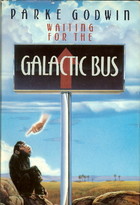
Book Review: Waiting For the Galactic Bus by Parke Godwin (Series, #1) (Bottom of TBR Pile Challenge)
 Summary:
When two brothers from an incorporeal alien species get left behind on a spring break visit to prehistoric Earth, they decide to put their, as yet uncertified, evolutionary development skills to work by prodding along the the evolutionary process on Earth. In doing so, they accidentally create a species with a spirit tied to a body for a certain amount of time that then is tied to the idea of an afterlife. They also manage to turn themselves into Earth’s spiritual mythology.
Review:
An ingenious take on the aliens made humans concept with two overlapping plots, a tongue-in-cheek take on world religions, and a wry wit.
This take on aliens made humans makes humans the result of the bumbling activities of aliens from a species that controls evolution in the universe. However, these aliens are currently uncertified, unsupervised, and basically the frat boys of outerspace. At least at first. Thus, instead of it all being some evil experimental conspiracy, the direction of life on Earth is much more of an accident of floundering fools. Granted, the fools grow and change over the time that they spend on Earth waiting for their ride back from spring break, but the fact remains that evolution on Earth is a result of the experiments of two aliens who are not yet fully trained. This is also used to explain the phenomenon of souls in bodies and then souls that have an afterlife. All other species have souls that can either choose to be in or not in a corporeal body. This is the result of the two aliens, Barion and Coyul, not staying within the rules of evolution.
We thus get to the other really creative part of the book. Since the souls are unfotunately tied to bodies that die, when the bodies die, the souls don’t know what to do or where to go, and so humanity creates the idea of the afterlife, with the two aliens serving as the rulers of the two options (again, created by humans). The aliens thus are kind of forced into the roles of God and Satan. The way afterlives go, though, is generally more the result of what the various humans think it will be or think they deserve. The aliens have mostly tried to stay out of the way, but when they hear rumblings that remind them on the beginning of the nightmare that was Nazi Europe in the American midwest, they decide to dive on in and try to fix it.
Clearly the plot and setting are extremely engaging and thought-provoking. I could truly talk about them for hours. They are creative and a vision of the world I enjoyed visiting. The characterization of the two aliens is a bit weak though. I mixed them up a lot, constantly forgetting who was God and who was Satan. I honestly can’t remember right now if Barion or Coyul plays Satan. I wish they had been characterized more clearly, as this would have strengthened the story.
Overall, this is a unique take on aliens creating humans, featuring a rollicking and thought-provoking plot. The characterization can be a bit weak but the action-packed plot and vibrant setting generally make up for it. Recommended to scifi or fantasy fans looking for an extraterrestrial take on mythology.
4 out of 5 stars
Source: PaperBackSwap

 Support my work with a tip or browse my shop for curated book club guides, how to guides, cross-stitch patterns, and more!


This work by Amanda Nevius is licensed under a Creative Commons Attribution-Noncommercial-No Derivative Works 3.0 United States License.
 Opinions of a Wolf