
Archive
Book Review: Jaws by Peter Benchley
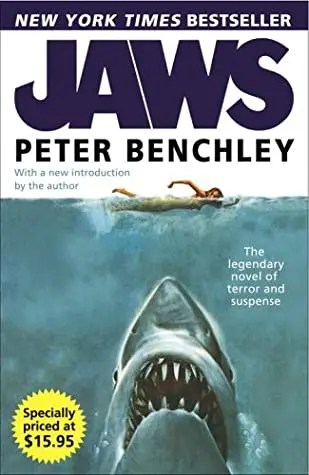
Get ready for shark week with this 1970s classic!
Summary:
A great white shark starts terrorizing a coastal town just as the money-making summer season begins. The classic, blockbuster thriller of man-eating terror that inspired the Steven Spielberg movie and made millions of beachgoers afraid to go into the water. Experience the thrill of helpless horror again—or for the first time!
Review:
As a New England girl born and raised, I can’t tell you how many times I’ve watched Jaws the movie. Everything about it is just so *chef’s kiss* perfectly small New England beach town. (The movie is set on Long Island, New York, but was filmed on Martha’s Vineyard, Massachusetts, and, let me tell you, everything about it reads New England to me.) Plus, my cat absolutely adores watching Jaws. She’s obsessed with that shark. With summer rolling around once again, I decided it was high time I read the book. The book is almost always better than the movie, right? Well, in this case, that almost really comes into play. (Spoilers ahead for both the movie and the book. If you haven’t seen this classic yet, please go watch it then come back to the book review.)
The book starts off strong with a close omniscient perspective of the shark getting ready to eat the drunk lady swimming in the ocean. The book could easily sway into anthropomorphizing territory, imagining the viciousness of the shark. But it consistently describes a creature whose instinct is to feed. What, exactly, made it come in to Amity and stick around is a mystery that is never solved. This first scene is one of the strongest in the book. But I have to admit I was hearing the absolutely classic movie soundtrack in my head while I was reading it, and we all know how essential that is at building suspense. So I’m not sure it’s safe to say I felt engaged purely because of the book.
But it didn’t take too long for the book to showcase itself as…worse than the movie. When we meet Sheriff Brody, he mentions a problem they had the previous summer where a Black gardener sexually assaulted six white women, none of whom would press charges. The only point of this from a narrative perspective is to demonstrate how the police department will keep things under wraps in order to protect the summer season. But it’s a hatefully racist way to establish this, narratively. Even if I charitably imagine that this is supposed to be pointing out the racial divide in Amity that is later even clearer in the book, there are better ways to do that than to play into this horribly racist myth of the serial Black assaulter of white women.
There are two other plot points in the book that weren’t in the movie at all. First, there’s that Brody’s wife cheats on him with Hooper because she feels some weird Feminine Mystique style ennui about her life as a housewife at a lower social class than she was before she got married. (We only see the sex in flashbacks she has about it and how strange and scary Hooper was). There is a large scene where she has lunch with Hooper first and talks about her sexual fantasies. Kind of slows down the pace of the suspense from the shark attacks.
The other additional plot point is that the mayor of the town is mixed up with the mafia because he had to take out a loan from a loan shark (har har) to pay his wife’s cancer treatment medical bills. (What on earth do other countries with nationalized health care do to justify characters taking out unwise loans? This is such a common plot device…but I digress.) The mafia wants the beaches to be kept open. This is a big motivator for why the mayor keeps insisting on it. But I don’t think this motivator is necessary. The economic pressure and need of a tourist town to keep their main tourist attraction open is more than enough motivation. Anyone who has any familiarity with a town that depends on seasonal tourism gets that. Spielberg was right to cut this from the movie. This also brings about a scene I found much more disturbing than any shark attack, which is that the mafia kills Brody’s son’s cat in front of his son, and then Brody takes the dead cat and throws it in the mayor’s face.
The final act where Quint, the old-time fisherman, takes Brody and Hooper out on his boat to hunt the shark is overall pretty good. There’s some nice tension between the three of them, and Quint really has to eat his words about the shark not being intelligent. It does not end with the 70s style bang of the movie. But I kind of liked the simplicity of the ending, leaving Brody to swim to shore and deal with the aftermath on his own without any reader audience.
I’ve seen some lists of the differences between the book and the movie with mistakes and inaccuracies on them, so I do want to clear up a couple of things. Brody is afraid of the water in the book. This is well-established; I’m not sure how people missed that. Mrs. Kintner does slap Brody in the book when she confronts him about the shark killing her son.
The version of the book I read also had an introduction by the author where we find out that he was, basically, a “summer person” himself – from a wealthy family and a legacy graduate of Harvard (his father also went to Harvard). His father was a novelist, and because of that connection, Benchley got an agent before he even had a book written. By Benchley’s own recollection, he sold the idea for Jaws and then they told him he needed to write the book, and the screenplay was sold before the book was even written. He took a first shot at the script, and Spielberg told him to throw out a lot of the stuff that I mentioned in my review as things I didn’t like. Moral of the story being privileged dude sold an admittedly solid idea based on the idea alone to someone else who directed it into it being a classic.
Overall, it was interesting to read the book behind the movie, but I also now have the perfect answer for the next time someone asks me, “When is the movie ever better than the book?”
If you found this review helpful, please consider tipping me on ko-fi, checking out my digital items available in my ko-fi shop, buying one of my publications, or using one of my referral/coupon codes. Thank you for your support!
3 out of 5 stars
Length: 320 pages – average but on the longer side
Source: Library
Buy It (Amazon or Bookshop.org)
Get the Book Club Discussion Guide
A beautifully graphic designed 2 page PDF that contains: 1 icebreaker, 9 discussion questions arranged from least to most challenging, 1 wrap-up question, and 3 read-a-like book suggestions
View a list of all my Book Club Guides.
Book Review: Lana’i of the Tiger by JoAnn Bassett (Series, #3)
 Summary:
Maui wedding planner, Pali Moon, wound up as a key witness against a drug ring, and now she’s been whisked into witness protection, sent to the small boring island of Lana’i, and right at the holidays no less! The feds seem to be taking their sweet time getting the case to court, and Pali is bored out of her mind, used to the hustle and bustle of wedding planning. When a small local bed and breakfast advertises looking for temporary help while they go to the main island to have their baby, it seems like the ideal situation. But when a famous guest’s fiancee turns up dead, Pali finds herself right in the thick of things again.
Review:
I picked this mystery up when I saw it on sale (for free) in the kindle store, in spite of it being midseries. The punny title made me think it was probably a cozy, and I know those series are totally fine to read out of order. I was right in that I never felt lost in the story due to starting mid-series, but I wasn’t right about it being a cozy. Pun-filled title aside, this is an easy-going mystery, ideal for a beach read, but missing the appendixes of add-ons such as recipes or patterns found in cozy mysteries
Pali is a three-dimensional character who jumps off the page, and the supporting characters, while not necessarily three-dimensional, each have enough different quirks and personalities that they are memorable. That said, Pali may be three-dimensional but she’s sure not likable. One example, she kisses someone on Lana’i, and then later finds out that her boyfriend may be cheating on her and flips out. But wasn’t she just cheating by kissing someone else? The hypocrisy left a really sour taste in my mouth for Pali. Characters don’t have to be likable, but in light-hearted mysteries where we’re supposed to be rooting for the non-professional PI, it really helps for them to be.
The mystery was fairly good. I certainly didn’t figure it out until right before the reveal, and the ultimate solution made sense. This is all I really look for in a mystery.
The setting was probably the best part. Bassett evokes (what I can only imagine is) the real feel of Hawaii. Each island visited has its own feel, Hawaiian culture is solidly represented with things like islanders calling all the elderly women “aunty” and locals being able to talk their way onto a ferry for free. What kept me reading the book was my desire to spend time in Hawaii, combined with a mystery I was interested in the solution to.
Overall, the rich Hawaiian setting and actually mysterious mystery make this a fun beach read. The main character is three-dimensional but could rub some readers the wrong way. Those looking for a traditional cozy should be forewarned that this book doesn’t come with any traditional cozy extras. Recommended to those looking for a light mystery set in Hawaii.
If you found this review helpful, please consider tipping me on ko-fi, checking out my digital items available in my ko-fi shop, buying one of my publications, or using one of my referral/coupon codes. Thank you for your support!
3 out of 5 stars
Length: 306 pages – average but on the longer side
Source: Amazon

Previous Books in Series:
Maui Widow Waltz
Livin’ Lahaina Loca
Book Review: Stinger Stars by Paul Bussard
 Summary:
Maria is working on her thesis at a genetics research lab specializing in looking for ways to get human limbs to regenerate. When the owner’s son brings back a new species from Peru, a tiny worm-like creature with pyramidal tentacles, she discovers that the larger clones made from them are intelligent. But the owner’s son wants to conduct brutal experiments on them, involving cutting off their appendages, which grow back. Can Maria strike the balance between life-changing science for humans suffering from disabled or missing limbs and respecting the lives of an intelligent species?
Review:
Near-future books that question where to draw the line in research are a particular favorite of mine. It’s a gray area in many people’s minds, and scifi lets us explore the myriad possibilities and options at a bit of a distance, which allows for clearer thought. This book does an admirable job setting up a realistic near-future world to explore this issue, although the characters don’t quite live up to the world-building and story.
The near-future world of genetics research is established both clearly and with subtlety early on in the book. There are two competing genetics research organizations, and rather than looking into something monstrous or far-flung, they are looking into regenerating limbs. It’s a logical next-step for a near-future book. The research labs themselves, as well as how they are run, including the field-work, have a real-world, logical feel to them.
At first I was concerned from the book’s official description that the creatures discovered would be aliens, since alien experimentation would be less of a gray area to explore. They are not, in fact, aliens, they are a newly discovered species originating on Earth. The mystery is whether they were always sentient or if something in the modification and cloning process made them sentient. This makes the conflict of how to use the creatures to help humans without harming them better, because exactly what they are is a bit unclear. It’s not as simple as if they were simply aliens or some sort of cute, fuzzy creature. They’re these slightly creepy worm-like things with tentacles, and the conflict is do we still respect these kind of ugly, cloned creatures for their intelligence, or do they need to look cuter or more humanoid to gain that respect?
The plot is complex and keeps the reader guessing. Even though I was fairly certain things would ultimately end up ok, I wasn’t sure how they were going to get there. This made it an engaging and quick read.
Unfortunately, the characters are rather weak and two-dimensional. I never was able to truly connect to any of the characters. If anything, I connected to the creatures a bit more than the main characters. There are also a few instances that feel out of character for the small amount of characterization done. For instance, Maria thinks she can’t date because her family wants her to have an arranged marriage to keep the family Spanish. This type of arranged marriage situation could definitely happen, but I had a hard time believing that a woman so strong in the sciences, with so much agency for her career and for her grandmother’s well-being would actually even think about not seeing someone she cares for in order to have an arranged marriage. It felt out of character and simply forced upon her to add conflict. Similarly, there is an incident that at first is considered a rape and then later brushed off as not a rape. Without giving anything away, I agree it wasn’t a rape, but I also don’t think the character who at first mistook it for a rape would have made that error in judgment. It was out of character for their level of intelligence. This again felt forced to provide extra conflict that wasn’t needed. The main plot had plenty of interest and conflict to keep the book going without these out-of-character moments. I also felt the accent written for one of the characters was badly done and distracting. This character is a scientist with an advanced degree, yet he speaks in an informal, unrealistic accent that primarily consists of him dropping g’s and using a lot of contractions.
In spite of these characterization short-comings, the book still tells a unique near-future genetics research story with a quick-moving, engaging plot. Recommended to those looking for a scifi-style beach read.
If you found this review helpful, please consider tipping me on ko-fi, checking out my digital items available in my ko-fi shop, buying one of my publications, or using one of my referral/coupon codes. Thank you for your support!
3 out of 5 stars
Length: 206 pages – average but on the shorter side
Source: kindle copy from author in exchange for my honest review

Book Review: Commencement by J. Courtney Sullivan (Bottom of TBR Pile Challenge)
 Summary:
Celia, Bree, Sally, and April wound up on the same small hall their first year at Smith College. Celia is from a traditional Irish Catholic Massachusetts family, although she doesn’t consider herself to be Catholic. Bree arrives at college from the south with an engagement ring on her hand. Sally arrives full of mourning and despair over the recent loss of her mother to breast cancer, and April arrives as the only work-study student on their floor. Paying her own way through school and with a whole slew of issues and causes to fight for. Their friendship is traced from the first weeks at Smith through their late 20s.
Review:
I picked this book up because it was compared favorably to Mary McCarthy’s The Group

What the book does well is evoking the feeling of both being in undergrad and the years immediately after graduation. Sullivan tells the story non-linearly, having the women getting back together for a wedding a few years after college. This lets them reminisce to early years of college and also present current life situations and hopes for the future. After the wedding, the story moves forward to cover the next year. The plot structure was good and kept the story moving at a good pace. It feels homey and familiar to read a book about four women going through the early stages of adulthood. It was hard to put down, and the storytelling and dialogue, particularly for the first half of the book, read like a fun beach read. However, there are a few issues that prevent the book from being the intelligent women’s literature it set out to be.
First, given that the premise of the book is that four very different women become unlikely friends thanks to being on the same hall of a progressive women’s college, the group of women isn’t actually that diverse. They are all white, three of the four are from wealthy or upper-middle-class backgrounds (only one must take out loans and work to pay for school), none are differently abled (no physical disabilities or mental illnesses), and not a single one is a happy GLBTQ person. Given that The Group
The book has a real GLBTQ problem. One of the characters has two relationships. One is with a man and one with a woman. She is happy in both and attracted to both. She takes issue with being called a lesbian, since she states she definitely fantasizes about men and enjoys thinking about them as well. Yet, in spite of the character clearly having both physical and romantic attractions to both men and women, the word bisexual is not used once in the entire book. The character herself never ventures to think she might be bi, and no one else suggests it to her. She struggles with “being a lesbian” and “being out as a lesbian” because she doesn’t think she is a lesbian. The other characters either say she’s in denial in the closet due to homophobia or that she really is straight and she needs to leave her girlfriend. It is clear reading the book that the character struggles with having the label of lesbian forced upon her when she is clearly actually bisexual. This is why she is uncomfortable with the label. But this huge GLBTQ issue is never properly addressed, swept under the rug under the idea that she’s “really a lesbian” and is just suffering from internalized homophobia. The bi erasure in this book is huge and feels purposeful since the character’s bisexual feelings are routinely discussed but the option of being non-monosexual never is. It’s disappointing in a book that is supposed to be progressive and talking about modern young women’s issues to have the opportunity to discuss the issues of being bisexual and instead have the character’s bisexuality erased.
The second half of the book makes some really odd plot choices, showing a highly abusive relationship between one of the characters and her boss. It probably is meant to show the clash between second and third wave feminism, but it feels awkward and a bit unrealistic. Similarly, the book ends abruptly, leaving the reader hanging and wondering what is going to happen to these characters and their friendship. Abrupt endings are good when they are appropriate to the book and mean something, but this ending feels out of place in the book, jarring, and like a disservice to the reader.
Overall, this is a fast-paced book that is a quick, candy-like read. However, it is held back by having the group of women in the core friendship be too similar. Opportunities to explore diverse, interesting characters are missed and bisexual erasure is a steady presence in the book. The ending’s abruptness and lack of closure may disappoint some readers. Recommended to those looking for a quick beach read who won’t mind a lack of depth or abrupt ending. For those looking for the stronger, original story of a group of friends from a women’s college, pick up The Group
3 out of 5 stars
Source: PaperBackSwap
 Support my work with a tip or browse my shop for curated book club guides, how to guides, cross-stitch patterns, and more!


This work by Amanda Nevius is licensed under a Creative Commons Attribution-Noncommercial-No Derivative Works 3.0 United States License.
 Opinions of a Wolf