
Archive
Book Review: Sula by Toni Morrison

A lyrical and haunting novel about two Black women whose lifelong friendship is tested by betrayal, love, and the weight of their small-town community’s judgment.
Summary:
Sula and Nel are two young black girls: clever and poor. They grow up together sharing their secrets, dreams and happiness. Then Sula breaks free from their small-town community in the uplands of Ohio to roam the cities of America. When she returns ten years later much has changed. Including Nel, who now has a husband and three children. The friendship between the two women becomes strained and the whole town grows wary as Sula continues in her wayward, vagabond and uncompromising ways.
Review:
This was my second Toni Morrison novel—the first being The Bluest Eye, which I read back in college. Morrison’s prose is deeply lyrical, which makes her books swift reads on the surface, even when they delve into painful and challenging themes. Sula is no exception.
Each chapter is titled with the year it takes place in, but only covers a brief vignette from that year. Despite spanning several decades, this is a short novel, structurally and in page count. Though the title suggests a singular character focus, Sula is as much about a place—the Bottom, a Black neighborhood in a Southern state situated on the hillside, land the white residents had no interest in. The reason for its ironic name is revealed in the first chapter through a racist tale, setting the tone for the book’s critique of systemic racism.
Indeed, one of the novel’s most striking accomplishments is how clearly it shows that systemic racism ruins lives, whether characters comply with social expectations or resist them. For me, Nel represents compliance while Sula represents defiance—yet neither of them leads a life free from pain. Every person in their orbit suffers in some way, and that suffering is deeply entangled with the racist systems surrounding them.
The edition I read included an introduction in which Morrison writes: “Female freedom always means sexual freedom, even when—especially when—it is seen through the prism of economic freedom.” While I respect Morrison’s craft, I don’t personally agree with this framing. Throughout the book, the freest female characters are also the most sexually unrestrained, choosing partners without regard to consequences. For me, this reflects the central tensions I’ve often felt when reading Morrison’s work: I recognize the literary prowess but don’t agree with this belief. As someone who values intentionality in relationships and ethical sexuality, I believe there is freedom in discernment. My personal worldview differs from Morrison’s here, and I think that’s worth naming—especially since this quote helped me finally articulate why I sometimes feel at odds with what I’m “supposed” to take away from her narratives.
Of course, I also acknowledge that I am not Morrison’s intended audience. She has stated clearly that she writes for Black people—and I am a white woman. I honor that intention, while also appreciating the beauty, lyricism, and cultural specificity of this novel. Morrison evokes a place, a time, and a community with precision and poetry, showing rather than telling how racial injustice permeates generations.
For readers in recovery, or those who love someone with substance use disorder or alcohol use disorder, be advised that this book contains a disturbing scene involving the violent death of a character who struggles with addiction. A mother sets her son on fire, intentionally killing him because of his drug use. It’s a horrific and deeply stigmatizing portrayal. While I understand that literature doesn’t require characters to always make the “right” choices, scenes like this can be deeply harmful and may reinforce stigma around addiction. To anyone reading this who is struggling: You don’t deserve to die. You are not disposable. You can recover. We do recover. I acknowledge that the story is set in a time when resources for addiction recovery were nearly nonexistent, especially for a Black man. But violence is never the answer, and stories like this can perpetuate dangerous beliefs about addiction and worth.
With regards to diversity, the book explores colorism in the Black community, as well as racism faced by Black folks coming from immigrant white communities. It has multiple characters who fought in World War I who struggle with mental health afterwards. It also has a character who uses a wheelchair and is missing a limb. There is not any LGBTQIA+ representation that I noticed.
This is a novel that quietly devastates, not through high drama, but through its unflinching portrayal of how systemic racism, personal grief, and societal expectations shape lives over time. It’s beautifully written, deeply character-driven, and emotionally complex. Whether or not you’re part of Morrison’s intended audience, Sula is a compelling and powerful read. If you’re in recovery or close to someone who is, approach with care due to the painful and stigmatizing depiction of addiction. For those looking for fiction that treats mental health and recovery with care, check out my novel Waiting for Daybreak.
If you found this review helpful, please consider tipping me on ko-fi, checking out my digital items in my ko-fi shop, buying one of my publications, using one of my referral or coupon codes, signing up for my free microfiction monthly newsletter, or tuning into my podcast. Thank you for your support!
3 out of 5 stars
Length: 174 pages – average but on the shorter side
Source: Library
Buy It (Amazon or Bookshop.org)
Get the Book Club Discussion Guide
A beautifully graphic designed 2 page PDF that contains: 1 icebreaker, 9 discussion questions arranged from least to most challenging, 1 wrap-up question, and 3 read-a-like book suggestions
View a list of all my Book Club Guides.
Book Review: A Sunny Place for Shady People by Mariana Enríquez, translated by Megan McDowell

A chilling yet deeply human collection of short stories where ghosts, goblins, and the macabre collide with everyday life—showcasing a rising star in Argentinian literature.
Summary:
Welcome to Argentina and the fascinating, frightening, fantastical imagination of Mariana Enriquez. In twelve spellbinding new stories, Enriquez writes about ordinary people, especially women, whose lives turn inside out when they encounter terror, the surreal, and the supernatural. A neighborhood nuisanced by ghosts, a family whose faces melt away, a faded hotel haunted by a girl who dissolved in the water tank on the roof, a riverbank populated by birds that used to be women—these and other tales illuminate the shadows of contemporary life, where the line between good and evil no longer exists.
Lyrical and hypnotic, heart-stopping and deeply moving, Enriquez’s stories never fail to enthrall, entertain, and leave us shaken. Translated by the award-winning Megan McDowell, A Sunny Place for Shady People showcases Enriquez’s unique blend of the literary and the horrific, and underscores why Kazuo Ishiguro, winner of the Nobel Prize for Literature, calls her “the most exciting discovery I’ve made in fiction for some time.”
Review:
This diabolical collection of 12 horror stories, each with at least a touch of the supernatural, blends the speculative with the deeply human. While steeped in Argentinian culture, the themes—grief, fear, injustice—resonate universally.
My favorite stories in this collection explore women’s suffering and resilience. “Metamorphosis” follows a woman undergoing a hysterectomy as she confronts medical misogyny, while “Different Colors Made of Tears” examines the far-reaching impact of domestic violence, even on those who haven’t experienced it firsthand. Other stories explore moral dilemmas, like the tension between wanting to help others while maintaining personal safety, or the existential fear of cancer.
The speculative elements vary in intensity—some stories lean fully into the fantastical, while others offer just a whisper of the supernatural. In “Different Colors Made of Tears,” a vintage clothing shop buys dresses from an elderly man—only to later discover that rumor has it he was abusive to his ex-wife. When women try on the dresses, they see horrific injuries appear on their own bodies, disappearing once the garments are removed. In contrast, “Metamorphosis” unfolds primarily as a starkly realistic medical narrative, with the speculative twist emerging only at the end, when a woman considers an unconventional body modification procedure to reclaim part of her lost uterus.
At times, I found the endings too abrupt. While this can work, in this case, I frequently felt like I was just settling in when the narrative was yanked away too soon. One small nitpick: a story features a character’s uncle who emigrated from Argentina to Vermont, where he became wealthy working for Boeing. Having grown up in Vermont and now working in the nonprofit sector here, I found this detail unrealistic. Vermont has exactly four Boeing employees—it’s just not a company with a presence in the state. A medical center, insurance company, or even Ben & Jerry’s would have been a more believable employer.
While most of the horror is not overly explicit, some stories do push boundaries. On-page content includes death, murder, torture, addiction, medical trauma, and the killing of a cat, while mentions of rape and confinement in tight spaces also appear. The collection is largely set in Argentina, with one story taking place in the U.S. To my understanding, all the characters appear to be white Argentines. Some disabilities, such as endometriosis, are explored, and one story features a gay couple. (Information on the current state of LGBTQIA+ rights in Argentina.) Another follows a woman reflecting on her codependent relationship with a partner struggling with Substance Use Disorder and being unhoused.
Overall, this is a dark, thought-provoking collection that blends psychological and supernatural horror with a sharp social lens. It tackles unsettling themes in ways that are both intimate and chilling. Recommended for readers who enjoy horror that lingers long after the final page.
If you found this review helpful, please consider tipping me on ko-fi, checking out my digital items available in my ko-fi shop, buying one of my publications, using one of my referral/coupon codes, or signing up for my free microfiction monthly newsletter. Thank you for your support!
4 out of 5 stars
Length: 257 pages – average but on the shorter side
Source: Library
Buy It (Amazon or Bookshop.org)
Get the Book Club Discussion Guide
A beautifully graphic designed 2 page PDF that contains: 1 icebreaker, 9 discussion questions arranged from least to most challenging, 1 wrap-up question, and 3 read-a-like book suggestions
View a list of all my Book Club Guides.
Book Review: The Exorcist by William Peter Blatty

The book that came before the classic horror movie featuring a little girl who may or may not be possessed by a demon and the priest struggling with his faith called upon to help her.
Summary:
Actress and divorced mother Chris MacNeil starts to experience ‘difficulties’ with her usually sweet-natured eleven-year-old daughter Regan. The child becomes afflicted by spasms, convulsions and unsettling amnesiac episodes; these abruptly worsen into violent fits of appalling foul-mouthed curses, accompanied by physical mutation. Medical science is baffled by Regan’s plight and, in her increasing despair, Chris turns to troubled priest and psychiatrist Damien Karras, who immediately recognises something profoundly malevolent in Regan’s distorted fetures and speech. On Karras’s recommendation, the Church summons Father Merrin, a specialist in the exorcism of demons . . .
Review:
I’d seen the classic horror movie and, while I thought certain shots were gorgeous and the soundtrack was beautiful, I felt rather ho-hum about the story overall. Imagine my surprise when I found the book version simultaneously thrilling and intellectually engaging. A difference even more interesting since Blatty wrote both. (It’s more common for a different author to write the screenplay adaptation of a book.)
From the beginning of the book, there are three story threads. First there’s Chris, the divorced, wealthy, actress mother who is an atheist and her daughter who starts acting funny. Second, there’s Father Karras, a psychiatrist and a priest who is having a crisis of faith. Third, there are recent desecrations in a local church that a detective is investigating. These three threads merge by the end of the book. But their separate developments kept me simultaneously intellectually engaged and thrilled.
While there absolutely is the thrilling aspect of what is wrong with Regan and can she be healed/saved from it, I was drawn in by the exploration of faith. How it presents in different people, even those we assume must have a very strong faith or none at all. What it means to have faith. How having faith impacts people. How evil forces can use someone’s doubts and misunderstandings against them. (This part of the book reminded me of a more subtle version of The Screwtape Letters.)
I really felt both for Father Karras and for Regan. For the former, I understood how adult life had slowly worn down his youthful faith. How it was easier for him to believe in things when he was young than it was now in middle-age. And I also felt for Regan, whose mother left her completely unequipped to protect herself against forces of darkness. The fact that her mother forbid the nanny to mention God to her but also simultaneously allowed her to play with a Ouija board. If she’s so atheist as to not want a child to even know the concept of God, shouldn’t she also ban all religious items, including ones used for witchcraft, from her home? I don’t view this as a writing flaw but rather an accurate assessment of how often atheism attacks the concept of God but not of other supernatural forces. Indeed, I think demonstrating this was probably a part of the point.
The book does a good job of leaving it up to the reader to decide if Regan was actually possessed by a demon or having a psychosomatic experience in response to the trauma from her parents’ divorce. I’m sure you can tell from my review that I fall on the she was possessed side. You can see from the book how much more traumatic the 1970s viewed divorce for children than we do now. The 1970s brought no-fault divorce, and so the divorce rate went up, but there was still social stigma. So even though for the modern reader a simple, relatively amicable divorce with a bit of an absent father is nowhere near enough trauma for a child to have a psychotic break, for the audience in the 1970s with the stigma still fresh, it was. And the scientific side of why they think this might be is well-explained. It’s just to me it’s very clear this is a demon.
My experience of the book being about faith matches what Blatty said in interviews in his life. It’s interesting how that has been overshadowed by the cultural experience of the movie as a horror classic. Perhaps the book can be both. Indeed, theological horror is a genre.
The reason it’s not a full five stars for me is I felt like the last third of the book wasn’t as strong as the first two-thirds.
Let me leave you with my favorite quote from the book.
I think the demon’s target is not the possessed; it is us … the observers … every person in this house. And I think—I think the point is to make us despair; to reject our own humanity, Damien: to see ourselves as ultimately bestial, vile and putrescent; without dignity; ugly; unworthy. And there lies the heart of it, perhaps: in unworthiness. For I think belief in God is not a matter of reason at all; I think it finally is a matter of love: of accepting the possibility that God could ever love us.
page 345
Overall, this is a complex book of theological horror. It keeps the plot moving forward with multiple threads and compelling scenes while also taking the time to contemplate big questions about faith. Well worth the read, even if you have seen the movie, as it is a different experience altogether.
If you found this review helpful, please consider tipping me on ko-fi, checking out my digital items available in my ko-fi shop, buying one of my publications, using one of my referral/coupon codes, or signing up for my free microfiction monthly newsletter. Thank you for your support!
4 out of 5 stars
Length: 403 pages – average but on the longer side
Source: Library
Buy It (Amazon or Bookshop.org)
Get the Book Club Discussion Guide
A beautifully graphic designed 2 page PDF that contains: 1 icebreaker, 9 discussion questions arranged from least to most challenging, 1 wrap-up question, and 3 read-a-like book suggestions
View a list of all my Book Club Guides.
Book Review: Jaws by Peter Benchley
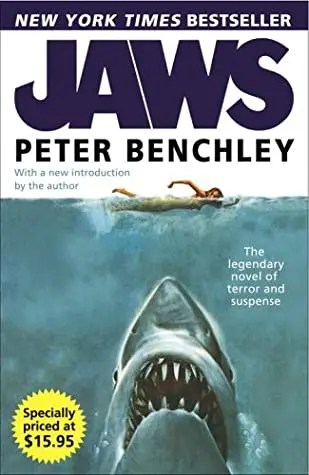
Get ready for shark week with this 1970s classic!
Summary:
A great white shark starts terrorizing a coastal town just as the money-making summer season begins. The classic, blockbuster thriller of man-eating terror that inspired the Steven Spielberg movie and made millions of beachgoers afraid to go into the water. Experience the thrill of helpless horror again—or for the first time!
Review:
As a New England girl born and raised, I can’t tell you how many times I’ve watched Jaws the movie. Everything about it is just so *chef’s kiss* perfectly small New England beach town. (The movie is set on Long Island, New York, but was filmed on Martha’s Vineyard, Massachusetts, and, let me tell you, everything about it reads New England to me.) Plus, my cat absolutely adores watching Jaws. She’s obsessed with that shark. With summer rolling around once again, I decided it was high time I read the book. The book is almost always better than the movie, right? Well, in this case, that almost really comes into play. (Spoilers ahead for both the movie and the book. If you haven’t seen this classic yet, please go watch it then come back to the book review.)
The book starts off strong with a close omniscient perspective of the shark getting ready to eat the drunk lady swimming in the ocean. The book could easily sway into anthropomorphizing territory, imagining the viciousness of the shark. But it consistently describes a creature whose instinct is to feed. What, exactly, made it come in to Amity and stick around is a mystery that is never solved. This first scene is one of the strongest in the book. But I have to admit I was hearing the absolutely classic movie soundtrack in my head while I was reading it, and we all know how essential that is at building suspense. So I’m not sure it’s safe to say I felt engaged purely because of the book.
But it didn’t take too long for the book to showcase itself as…worse than the movie. When we meet Sheriff Brody, he mentions a problem they had the previous summer where a Black gardener sexually assaulted six white women, none of whom would press charges. The only point of this from a narrative perspective is to demonstrate how the police department will keep things under wraps in order to protect the summer season. But it’s a hatefully racist way to establish this, narratively. Even if I charitably imagine that this is supposed to be pointing out the racial divide in Amity that is later even clearer in the book, there are better ways to do that than to play into this horribly racist myth of the serial Black assaulter of white women.
There are two other plot points in the book that weren’t in the movie at all. First, there’s that Brody’s wife cheats on him with Hooper because she feels some weird Feminine Mystique style ennui about her life as a housewife at a lower social class than she was before she got married. (We only see the sex in flashbacks she has about it and how strange and scary Hooper was). There is a large scene where she has lunch with Hooper first and talks about her sexual fantasies. Kind of slows down the pace of the suspense from the shark attacks.
The other additional plot point is that the mayor of the town is mixed up with the mafia because he had to take out a loan from a loan shark (har har) to pay his wife’s cancer treatment medical bills. (What on earth do other countries with nationalized health care do to justify characters taking out unwise loans? This is such a common plot device…but I digress.) The mafia wants the beaches to be kept open. This is a big motivator for why the mayor keeps insisting on it. But I don’t think this motivator is necessary. The economic pressure and need of a tourist town to keep their main tourist attraction open is more than enough motivation. Anyone who has any familiarity with a town that depends on seasonal tourism gets that. Spielberg was right to cut this from the movie. This also brings about a scene I found much more disturbing than any shark attack, which is that the mafia kills Brody’s son’s cat in front of his son, and then Brody takes the dead cat and throws it in the mayor’s face.
The final act where Quint, the old-time fisherman, takes Brody and Hooper out on his boat to hunt the shark is overall pretty good. There’s some nice tension between the three of them, and Quint really has to eat his words about the shark not being intelligent. It does not end with the 70s style bang of the movie. But I kind of liked the simplicity of the ending, leaving Brody to swim to shore and deal with the aftermath on his own without any reader audience.
I’ve seen some lists of the differences between the book and the movie with mistakes and inaccuracies on them, so I do want to clear up a couple of things. Brody is afraid of the water in the book. This is well-established; I’m not sure how people missed that. Mrs. Kintner does slap Brody in the book when she confronts him about the shark killing her son.
The version of the book I read also had an introduction by the author where we find out that he was, basically, a “summer person” himself – from a wealthy family and a legacy graduate of Harvard (his father also went to Harvard). His father was a novelist, and because of that connection, Benchley got an agent before he even had a book written. By Benchley’s own recollection, he sold the idea for Jaws and then they told him he needed to write the book, and the screenplay was sold before the book was even written. He took a first shot at the script, and Spielberg told him to throw out a lot of the stuff that I mentioned in my review as things I didn’t like. Moral of the story being privileged dude sold an admittedly solid idea based on the idea alone to someone else who directed it into it being a classic.
Overall, it was interesting to read the book behind the movie, but I also now have the perfect answer for the next time someone asks me, “When is the movie ever better than the book?”
If you found this review helpful, please consider tipping me on ko-fi, checking out my digital items available in my ko-fi shop, buying one of my publications, or using one of my referral/coupon codes. Thank you for your support!
3 out of 5 stars
Length: 320 pages – average but on the longer side
Source: Library
Buy It (Amazon or Bookshop.org)
Get the Book Club Discussion Guide
A beautifully graphic designed 2 page PDF that contains: 1 icebreaker, 9 discussion questions arranged from least to most challenging, 1 wrap-up question, and 3 read-a-like book suggestions
View a list of all my Book Club Guides.
Holiday Sale! All Digital Items 80% Off (Or More!)

My Kofi shop features entirely digital downloads as pdfs. Now through the holiday season, everything is on sale for 80% off or more! Once you purchase a pdf, you can download it and then provide it to your intended recipient however you chose. Send an email, send a DropBox link, or go old school and load up a usb drive with files and gift that. An ideal stocking stuffer.
I have 15 book club guides available for just $1.99 each. They are beautifully graphic designed 2 page PDFs that contain:
- An icebreaker specific to this book
- 9 discussion questions based out of this specific book arranged from least to most challenging.
Choose as many or as few as you wish to discuss. - A wrap-up question specific to this book
- 3 read-a-like book suggestions
I also have 2 cross-stitch patterns available featuring native New England plants. These are on sale for 99 cents.
Also for 99 cents I have a homework helper. It’s a how to guide for writing a book review of a play. It features the entire text of a review of the play “A Dolls House” by Henrik Ibsen with instructional offering guidance on how and why the review works.
Everything is set to pay what you can with the minimum price being the sale price. This means you can choose to pay more if you so wish, but the sale will go through with the minimum sale price as well.
If you have any questions please don’t hesitate to ask in the comments.
I wish a very happy holiday season to all!
Book Review: Getting Clean with Stevie Green by Swan Huntley

Summary:
At thirty-seven, Stevie Green has had it with binge drinking and sleeping with strange men. She’s confused about her sexuality and her purpose in life. When her mother asks her to return to her hometown of La Jolla to help her move into a new house, she’s desperate enough to say yes. The move goes so well that Stevie decides to start her own decluttering business. She stops drinking. She hires her formerly estranged sister, Bonnie, to be her business partner. She rekindles a romance with her high school sweetheart, Brad. Things are better than ever—except for the complicated past that Stevie can’t seem to outrun.
Who was responsible for the high school scandal that caused her life to take a nosedive twenty years earlier? Why is she so secretive about the circumstances of her father’s death? Why are her feelings for her ex-best friend, Chris, so mystifying? If she’s done drinking, then why can’t she seem to declutter the mini wine bottles from her car?
Review:
I smashed the request button on NetGalley when I read this description. A mixture of quit lit (literature about addiction and recovery) and decluttering? Sign me up! And it did not disappoint. In fact, it surprised me with delightful queer content I wasn’t expecting.
It’s important to know that Stevie’s ex-best friend Chris is a woman. Chris also came out in high school as a lesbian around the time of the scandal that so traumatized Stevie. Stevie has also slept with women, although only the men are mentioned in the description. The only hang-ups about Stevie’s sexuality seen in her circle of family, friends, and even lovers, come from Stevie herself. This is a great example of how addiction can freeze someone’s self-awareness and self-acceptance. Stevie began drinking in high school, and it’s a trueism in recovery circles that you freeze at the age of development you were at when you began drinking until you stop. Then you can begin maturing again. So is it a bit frustrating that Stevie is 37 and kind of acting like a teenager? Yes. But is it realistic? Also yes.
When we meet Stevie she is newly sober and running her decluttering business. I loved the depiction of how Type A Stevie is about her days and routines. This is so accurate to early recovery. One of my favorite parts is how she starts every day by standing in a Wonder Woman pose and saying affirmations to herself repeatedly.
How had I become a woman who chanted affirmations to herself while doing this ridiculous pose? Because it was supposed to make me feel better. I would have done anything to feel better.
location 806
Early recovery really is this incredible moment of being willing to do anything to feel better, and this is wonderfully depicted here.
The scenes with Stevie decluttering with her clients also shine. I’m a fan of decluttering YouTube videos and tv shows, and these gave me the same thrill as watching those. I loved seeing the variety of types of clutter the clients had, their personalities, and how Stevie interacted with them. She also quickly ends up working with her sister, Bonnie, who is also going through it after her boyfriend of 15 years left her for a younger woman. Bonnie and Stevie have great sisterly chemistry, and her addition to the business helps keep the pace moving forward.
Ultimately, it’s only when Stevie fully faces both her past and her father’s death that she can really begin to heal and move on. I thought this requirement hit her in the right way and with the right force. The pacing of this book really was quite good. And while there’s always the concern when reading queer lit that there will be a tragic ending, don’t worry, readers, there’s a happy ever after for Stevie. This is truly a lighthearted queer romance that also tackles the serious topic of recovery. It was like eating a salted caramel ice cream – sweet with just the right amount of savory.
4 out of 5 stars
Length: 304 pages – average but on the longer side
Source: NetGalley
Buy It (Amazon or Bookshop.org)
Get the Reading Group / Book Club Discussion Guide
A beautifully graphic designed 2 page PDF that contains: 1 icebreaker, 9 discussion questions arranged from least to most challenging, 1 wrap-up question, and 3 read-a-like book suggestions
View a list of all my Discussion Guides.
If you found this review helpful, please consider tipping me on ko-fi, checking out my digital items available in my ko-fi shop, buying one of my publications, or using one of my referral/coupon codes. Thank you for your support!
 Support my work with a tip or browse my shop for curated book club guides, how to guides, cross-stitch patterns, and more!


This work by Amanda Nevius is licensed under a Creative Commons Attribution-Noncommercial-No Derivative Works 3.0 United States License.
 Opinions of a Wolf