
Archive
Book Review: I’ll Sleep When You’re Dead by E. A. Aymar (Series, #1)
 Summary:
Tom Starks has not been the same since his wife, Renee, was brutally murdered with a baseball bat in a parking lot. He’s been struggling for the last three years to raise her daughter, who he adopted when he married Renee. When Renee’s killer is released after a retrial finds insufficient evidence to hold him, Tom becomes obsessed with dealing out justice himself.
Review:
I was so excited that two of my 2014 accepted review copies fit into the RIP IX reading challenge! This book’s title jumped out at me immediately when it was submitted, and I had been saving it up specifically to read in the fall. I’m glad to say that this thriller does not disappoint, although it goes in a bit of a different direction than I originally anticipated. And that’s a good thing.
The main character is not who you usually see from a thriller with a person seeking violent justice. He’s bookish. Rather weak and simpering. Afraid of his own brother-in-law, who used to be a boxer. But he was madly in love with Renee, and so when her supposed killer is released, he becomes obsessed with making him dead. The catch is, Tom quickly figures out that maybe he’s not cut out to do the killing himself, and that’s where the book gets unique and interesting. I was expecting from the title and description to see a typical bad-ass main character chase down a killer around the country (or the world) and ultimately get his revenge. That is not at all the story we get, and yet, it is still thrilling. There is still violence and chase scenes, it’s just they aren’t the ones you usually see in a book like this. And that helps it. That helps keep the thrill level up, since it’s so much harder to predict what’s going to come next. Tom, with his weakness and inability to parent well, is almost an anti-hero, and yet we keep rooting for him because his grief for his wife is so powerful and relatable. It’s strong characterization and plotting mixed into one.
The scenes where Tom is seen teaching The Count of Monte Cristo at the community college where he works slow the thrill down. They feel a bit too aware of themselves, with comparison between The Count of Monte Cristo and the plot in this book. Plus scenes of classroom literary analysis simply slow the thrilling plot of the book down. The one scene where it really works is one scene in which Tom is freaking out about his own life so much that he fails at teaching well. This establishes that Tom’s life is starting to get out of control. Overall, though, there are just too many scenes of him teaching for a thriller.
The setting of Baltimore is interesting, and I was glad to see that it wasn’t set in the more stereotypical Washington D.C. Aymar writes Baltimore beautifully. I’ve never been there, but I truly felt as if I was there, seeing both the run-down aspects, as well as the beauty. I often end up skimming over setting descriptions, but Aymar’s drew me in.
The plot has just enough twists and turns to keep the reader guessing, but not so many that the reader feels jerked around. Also, the plot twists stay rooted in reality. I could truly see this happening in the real world, and that makes a thriller more thrilling.
Overall, this is a unique thriller, with its choice to cast the opposite of a bad-ass in the role of the main character. This grounds the typical revenge plot into reality, lends itself to more interesting, unique plot twists, and has the interesting aspect of a flawed, nearly anti-hero main character that the reader still roots for. Recommended to thriller fans looking for something different and those interested in first dipping their toe into the thriller genre.
If you found this review helpful, please consider tipping me on ko-fi, checking out my digital items available in my ko-fi shop, buying one of my publications, or using one of my referral/coupon codes. Thank you for your support!
4 out of 5 stars
Length: 318 pages – average but on the longer side
Source: Kindle copy from author in exchange for my honest review

Counts For:

Book Review: Old Man’s War by John Scalzi (Series, #1)
 Summary:
John Perry joined the Colonial Defense Force on his 75th birthday. Americans aren’t allowed to be colonists in outer space, but they can defend the colonies in the outer space army. Old folks join for many reasons from boredom to having always wanted to see outer space, even though details of what goes on out there are kept secret from Earth. In spite of all the secrecy, the rumor is that those who join the CDF get to be young again, and who wouldn’t want a second chance at life?
Review:
Multiple friends have read this book and loved it, and of course I found the idea intriguing, who wouldn’t? So when a friend offered to loan me his copy, I took him up on it right away. I was not disappointed in the world Scalzi has created, it is endlessly fascinating, but the main character’s arc failed to be quite so interesting to me.
I can’t imagine how anyone would not find the basic premise of this book interesting. Outer space colonies that are kept a mystery from Earth. Only certain countries allowed to colonize (primarily those suffering from population overload). Top it off with a colonial army made entirely up of old people who supposedly get to be young again? Completely. Fascinating. And Scalzi really comes through on the science of all of this, the politics, and manages to have some surprises in there, in spite of the what seems to be very straight-forward book summary. And the world beyond the soldiers and the colonists is utterly fascinating as well. The aliens are incredibly creatively imagined, not just in their looks but in their cultures. They feel real. And that extends to the battles and spaceships as well. The worldbuilding here is phenomenal. It is an example of how scifi worlds should be built.
The main character, though, as well as his character development arc, fail to live up to the incredible worldbuilding. John Perry, from early on, is talented at war, in spite of having only been an advertising slogan writer for his whole life. He has no real life experience that would make one think he would be good at war. Additionally, even when he is doing battle, he’s kind of flat on the page. He doesn’t jump off as the leader he supposedly is supposed to naturally be. Other characters feel that way, but not John. In fact, I frequently found myself far more interested in the secondary characters around John than in John himself. I was willing to give this a bit of a pass since, well, the character has to live for us to continue to see the wars he’s fighting, and maybe Scalzi has a thing for unlikely heroes. But his character arc takes an odd turn at the end that really bothered me.
*spoiler warning*
John meets a special forces woman who is in his dead wife’s body. Basically, his dead wife’s DNA was used as a base to build a genetically enhanced body. Ok, I’m fine with that, even if it seems unnecessary. But then John becomes obsessed with her, and she with him, even though she is very clearly NOT his wife. Then at the end, he asks her to move to a colonial farm with him when they retire. And she says yes. Whaaaaat?! This isn’t romance; this is gross! The special forces woman has as much in common with John’s wife as her sister would at this point, since they have messed with the DNA so much. This is like John pursuing his dead wife’s sister, who is emotionally only 6, since she was put into a fully adult body 6 years ago and had no life prior to that. It’s gross. It is not romantic. And I really think the reader is supposed to see it as romantic, when instead it squicked me out far more than any of the aliens in the book, including the ones with slimy appendages or the ones who eat humans.
*end spoilers*
Overall, this is an utterly fascinating scifi world with a bit of a ho-hum main character. The ending may disappoint some readers, and Scalzi’s politics can come through a bit obviously sometimes. However, those at all intrigued by the plot summary or interested in high quality scifi world building should check it out.
If you found this review helpful, please consider tipping me on ko-fi, checking out my digital items available in my ko-fi shop, buying one of my publications, or using one of my referral/coupon codes. Thank you for your support!
4 out of 5 stars
Length: 355 pages – average but on the longer side
Source: Borrowed

Book Review: The Walking Dead: The Fall of the Governor: Part One by Robert Kirkman and Jay Bonansinga (Series, #3) (Audiobook narrated by Fred Berman)
 Summary:
In the aftermath of her rebellion attempt against The Governor, Lilly Caul is starting to see him as a man who does what it takes to protect the citizens of Woodbury. So when strangers in riot gear and prison suits underneath show up at Woodbury, she believes The Governor that they’re out to get their supplies and that the woman, unprovoked, bit his ear. But not everyone believes The Governor, and The Governor starts to think he can use the doubters to his advantage.
Review:
This non-graphic novel series telling the backstory of the big bad villain of the graphic novel Walking Dead series started off incredibly strong but, unfortunately, each new entry in the series gets worse and worse. Instead of lending new light to the backstory of The Governor and Woodbury, this entry retells scenes readers of the graphic novel have already seen, simply from The Governor and other residents of Woodbury’s perspectives.
While I understand that some things readers of the graphic novel series already know may need to be briefly mentioned again for those who are only reading the print books, a sizable portion of this book features scenes already told once in the graphic novels. Many of these scenes were disturbing enough in the graphic novels, such as the scene in which Michonne is repeatedly raped and beaten by The Governor. Retelling them from the perspective of The Governor just felt unnecessary and was frankly difficult to listen to. It would have been better to have left out showing that scene again and instead showed the, well-told and well-done scene of The Governor after her rapes Michonne back in his apartment where he tries to rationalize his behavior. This lends new insight into the character without forcing the readers to, essentially, re-read.
The characterization of Lilly Caul continued to bother me. First she hates The Governor and leads a rebellion, then turns right around and becomes loyal to him? What? This makes zero sense and is never fleshed out enough to make sense. Similarly, how she handles one particular plot development feels like lazy, cliched writing of women, which bothered me.
Speaking of writing of women, while I understand that the third person narration is supposed to simultaneously be from an evil guy’s perspective, how the narrator talked about Michonne really bothered me. We are constantly reminded that she is black. She is never just “the woman” she is always “the black woman” or “the dark woman.” Her dreadlocks are mentioned constantly. Whereas white characters, Latino characters, and male characters are referred to once with descriptors about how they look, her looks are constantly described. I understand looks need to be described periodically, but this is far too heavy-handed and in such a way that it feels like the narrator feels it necessary to constantly remind the reader that she is “other” and “different from us.” Worse, she is also referred to as a “creature,” etc…, particularly during her rape scenes. I never felt Michonne was mishandled in the graphic novels. She’s a bad-ass woman who just happens to be black in the graphic novels. Here, though, the descriptions of her feel like they are exoticized, which feels entirely wrong for a book in which we mostly just see her being raped. She is depicted so animalistically, it made my stomach turn. Even when she is among her friends, the narrator feels it necessary to constantly refer to her otherness.
So what’s done well in this book? The scenes where we finally learn how the double-cross happens and see it plotted and carried out from the bad guys’ perspective is chilling and enlightening. It’s also really nice to get to actually see the scene where Michonne beats the crap out of The Governor. If other scenes had been left out, the characterization of Lilly Caul and descriptions of Michonne handled better, and the whole book tightened up (and probably part two included here), it could have been a strong book.
Overall, fans of the series will be disappointed by the repetition of scenes they’ve already seen and the overall shortness and lack of new information in this book. Some may be bothered both by how Michonne is presented in this book, far differently from how she is in the graphic novel series, as well as by seeing some of the rapes from The Governor’s perspective. Recommended to hard-core fans who feel they need to complete reading the companion series to the graphic novels.
If you found this review helpful, please consider tipping me on ko-fi, checking out my digital items available in my ko-fi shop, buying one of my publications, or using one of my referral/coupon codes. Thank you for your support!
2 out of 5 stars
Length: 256 pages – average but on the shorter side
Source: Audible

Previous Books in Series:
The Walking Dead: Rise of the Governor, review
The Walking Dead: The Road to Woodbury
Counts For:
Book Review: Fudoki by Kij Johnson (Bottom of TBR Pile Challenge)
 Summary:
An aging empress decides to fill her empty notebooks before she must get rid of them along with all of her belongings to retire to the convent, as is expected of her. She ends up telling the story of Kagaya-hime, a tortoiseshell cat who loses her cat family in a fire and is turned into a woman by the kami, the god of the road.
Review:
I’m not usually big into fantasy, particularly not ones involving court life, but I am a real sucker for any story involving cats, especially if that cat is a tortoiseshell, since I’m the proud kitty mommy of a talkative tortie. This book didn’t just not disappoint me, it blew me away with two side-by-side, related by different, thoughtful tales.
I had no idea when I picked up the book that the empress would figure into the story quite so much. At first I was a bit irritated that she was a) getting 40% to 50% of the storytime and b) rambling off from one thought to another like elderly people tend to do. But I stayed patient, and I learned that there was more to the empress than met the eye and also that the two stories were actually informing each other. Kagaya-hime’s story shows everything the empress had secretly wished for her whole life, and the empress’s life translated into how Kagaya-hime felt trapped in her human body. It’s artfully done in a subtle way, which is part of what makes it so beautiful.
Kagaya-hime goes from a sad lost kitty with burned paws to a warrior woman, allowed along on a quest for revenge by a moderately elite rural family. She is able to earn respect from the men as a warrior because as a cat she sees no reason not to hunt or defend herself. She is a woman but no one ever took her claws away (though they may be arrows and knives now, instead of claws). Thinking of her is empowering to the empress, who always had an interest in war and politics but was forced to remain literally behind screens in gorgeous gowns that are hard to move in. It’s interesting to note that while the empress may be jealous of Kagaya-hime’s ability to do what she wants and defend herself, Kagaya-hime herself is unhappy because she simply wishes to be a cat again. It is the conclusion to Kagaya-hime’s story that allows the empress to see a conclusion to her own story (her life) that will ultimately make her feel fulfilled.
The details of ancient Japan were clearly meticulously researched. Johnson smoothly writes about the outfits, land, and battles as if she was there for them herself. The information never comes through as an info dump but instead is something that simply is, that the reader learns about naturally just by venturing into Kagaya-hime and the empress’ world. This is what knowing your history inside and out before starting writing does for historic fiction. It makes history come to life.
Overall, this is a stunning piece of historic fiction the reading of which feels like slowly sipping a well-made matcha latte. Fans of historic fiction of all sorts will be engaged, those that love cats will be enthralled, and those with an interest in women’s history will be enamored and touched by how much things change and yet still stay the same for women. Recommended to all who think they might even possibly be interested in a piece of historic fiction set in Japan featuring an aging empress and a shape-changing cat.
If you found this review helpful, please consider tipping me on ko-fi, checking out my digital items available in my ko-fi shop, buying one of my publications, or using one of my referral/coupon codes. Thank you for your support!
5 out of 5 stars
Length: 316 pages – average but on the longer side
Source: Better World Books

Book Review: The Diabolist by Layton Green (Series, #3)
 Summary:
Dominic Gray, ex-government worker, ex-military, and once professional jiu-jitsu fighter, is seeing a lull in his work as assistant to Professor Viktor Radek on private detective cases involving religious mysteries and the occult. He’s set up shop in New York City, teaching jiu-jitsu to inner-city youth. But when a high-ranking Satanist is murdered in front of his entire congregation by a mysterious figure who sets him on fire at a distance and then disappears himself, Dominic is quickly pulled into a new case with Viktor. High-ranking Satanists worldwide keep dying in the same, or similar, mysterious ways, and the odd thing is, it’s not the Christians doing it.
Review:
I’ve enjoyed this series from the very beginning. The combination of religious studies, private detectives, and international intrigue suck me in every time. This latest entry in the series does not fail to deliver, bringing once again the perfect combination of religious philosophy, mystery, and private detective intrigue.
This entry brings us back to the more mystical origins of the series. Rather than biomedicine as in the second book, what’s involved here is ancient occultism and what may or may not be magic tricks. I was happy to see this occult mysticism represented in the developed world this time, pointing out that it’s not just surviving in developing countries in modern times. The actual religion of Satanism is well explained and given room for both good-hearted followers and evil fanatics, just as may be seen in every religion. Green keeps an even hand when writing about religion, even when writing about Satanism, and that’s to be commended. A drop of mysticism is provided, and it’s left up to the reader to decide if it was science or magic ultimately responsible for the mysterious occurrences, which is ideal for this type of book.
The entwining of Viktor’s backstory with the mystery was well-done, and it was certainly time for the reader to learn more about Viktor. Unfortunately, I must say that Viktor’s backstory made me dislike him more than I had previously, but it certainly also helps form him into a more well-rounded character. There’s a delightful femme fatale, enshrouded in both beauty and mystery. Her ending, however, did feel a bit abrupt. Dominic goes very quickly from one opinion of her to another, and not enough known, factual information is provided for the reader to keep up with this. On the other hand, the ending was surprising and also made logical sense, and it also put the main characters in a frightful level of mortal danger. Exactly the kind of ending one looks for in this type of book.
Overall, the third entry in the series continues to deliver the private detective exploration of moral and mystical gray areas. Those who enjoyed the first entry in the series more than the second will be happy to see the return to the mysticism found in the first book. Those who enjoyed the science of the second will be glad to see the science of magic covered extensively in this entry. Recommended to fans of the series to pick it up as soon as possible.
If you found this review helpful, please consider tipping me on ko-fi, checking out my digital items available in my ko-fi shop, buying one of my publications, or using one of my referral/coupon codes. Thank you for your support!
4 out of 5 stars
Length: 375 pages – average but on the longer side
Source: Netgalley

Previous Books in Series:
The Summoner
The Egyptian
Book Review: Raptor Red by Robert T. Bakker
 Summary:
Raptor Red is one of the utahraptors who’ve newly arrived in what will one day be the western United States. Follow a year of her life as faces being both a predator and, as one of the smaller predator dinosaurs, prey.
Review:
I love dinosaurs. Who doesn’t? When I saw that this book was written by a paleontologist, I immediately was intrigued. Who better to tell a story about dinosaurs than someone who studies them extensively? The book certainly presents a realistic view of dinosaurs based on science, but sometimes the story suffers as a result of the intense attention paid to science.
First I just want to say my absolute favorite part of the book is the beginning of each chapter. Each chapter beginning has a small note in the corner about what month it is, but more importantly, it has a hilarious drawing of a dinosaur (or a few) along with a tongue-in-cheek chapter title.
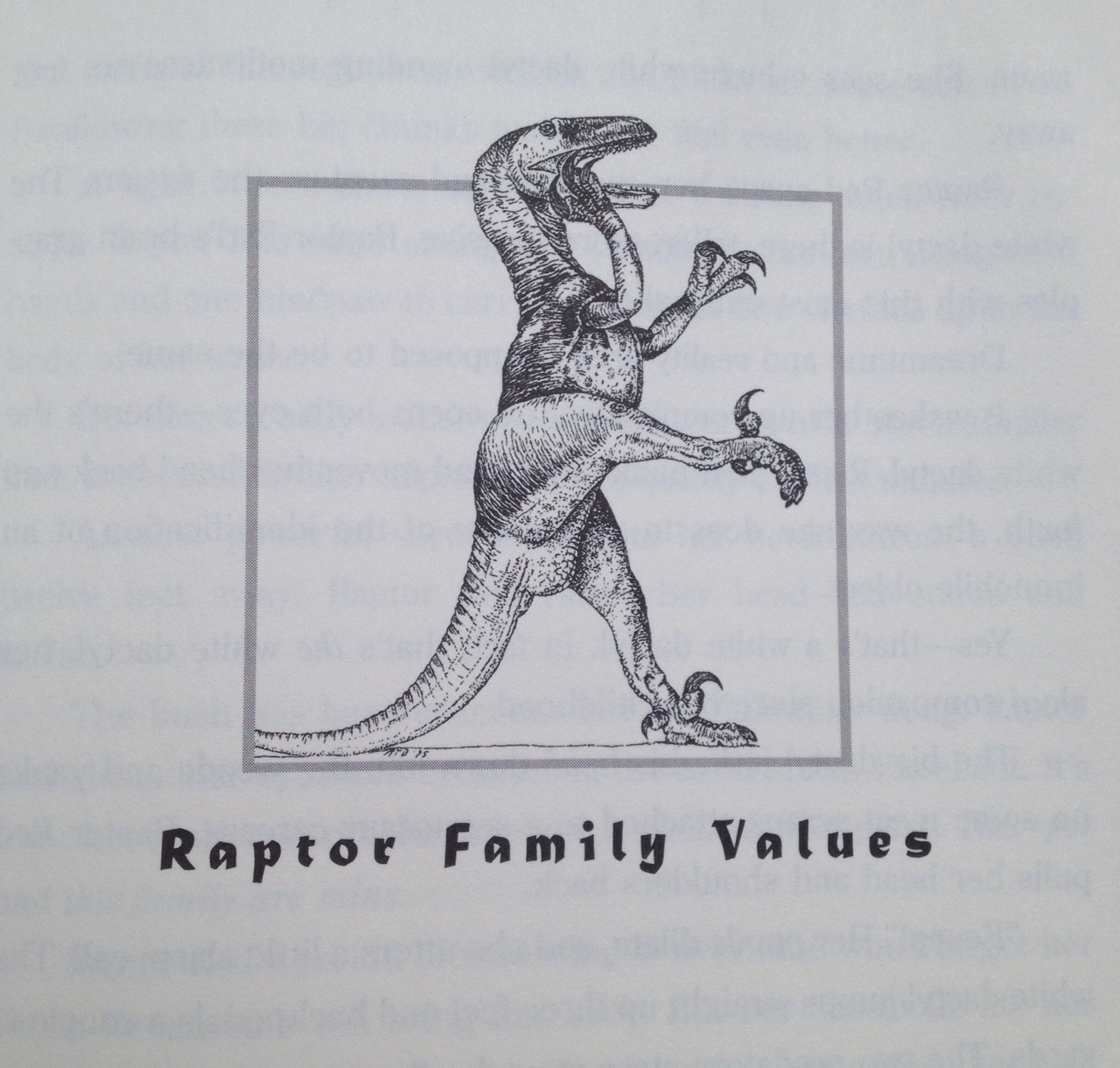
Look at that adorable dinosaur! Just look at him!
I wish that this ability to both present scientifically realistic dinosaurs and be humorous/cartoonish about them simultaneously had carried through to the writing. The overarching story that the book tells is sound. Raptor Red’s mate dies, and she reunites with her similarly widowed sister while simultaneously looking for a new mate. (This is not a spoiler, it is well-established in the first chapter). But the story on the sentence level is belabored by the author’s apparent need to couch everything in speculations. For instance, instead of just saying Raptor Red stamped her foot angrily, he’ll say something like Raptor Red was probably angry because she stamped her foot, and we know that dinosaurs stamping their foot indicated impatience, and if we believe that higher-thinking animals can feel emotions, then it was probably anger she was feeling. Passages like that really gum up the storytelling. The story would have worked better if he had some disclaimer at the beginning regarding emotions in animals, literary license, etc…, and then just ran with putting emotions on the extremely well-researched animal behavior.
The book teaches the reader a lot about dinosaurs in the context of the story, but the storytelling manner makes the reader get bogged down and realize they’re learning, instead of enjoying a story and happening to get some knowledge about dinosaurs in the process. The former makes for a tough read, in spite of enjoyable illustrations.
Overall, dinosaur enthusiasts will enjoy both the illustrations and the high level of science present in the story. Some may be frustrated by the author’s insistence on not personifying the dinosaurs, in spite of telling a very emotional story of being widowed and finding a new mate. Recommended primarily to those with a vested interest in reading everything dinosaur who won’t mind that the story sometimes suffers at the hands of science.
If you found this review helpful, please consider tipping me on ko-fi, checking out my digital items available in my ko-fi shop, buying one of my publications, or using one of my referral/coupon codes. Thank you for your support!
3 out of 5 stars
Length: 246 pages – average but on the shorter side
Source: PaperBackSwap

Book Review: The Postmortal by Drew Magary (Bottom of TBR Pile Challenge)
 Summary:
John Farrell got The Cure before it was legal. Three painful shots, and now he’ll never age, although he can still be killed by accidents, murder, and disease. It doesn’t take long before public pressure forces governments to legalize The Cure, in spite of the concerns, sometimes expressed in the form of terrorist acts, of those who believe in natural aging. Of course, nobody listens, because who wants to age? But slowly the world starts to change in more ways than becoming increasingly overpopulated. We’ve reassembled what happened when The Cure was legal through combining John’s blog entries with news articles from his time period, as a cautionary tale.
Review:
I actually bought this when it was released because it sounded so intriguing to me. A futuristic epistolary novel looking at overpopulation is right up my alley. Unfortunately, I got so busy that I didn’t have time to read it right away. I was happy to be able to finally pick it up. The book presents an interesting dystopia but the storytelling struggles increasingly throughout the book, falling flat at the end.
The book starts out incredibly strong. Magary strikes the right balance of realistic personal blog entries with snippets of news, twitter/facebook feeds, etc… to tell the early story of The Cure. The world building doesn’t suffer at all, with a clear near-future established, and John’s character is immediately easy to understand. The years immediately after The Cure is legalized are similarly well-told, with Magary choosing interesting and realistic consequences to The Cure, including violent anti-Cure extremists, peaceful anti-Cure moderates, bohemian everlasting youth, those who build fortresses around themselves and their families, and even internet trolls who take their trolling out into real life.
The world slowly establishes to the point where it’s clearly too overpopulated, and various governments make various choices about how they’re going to deal with that, and John gets caught up in the control side of the US government’s choices. It is here, midway through the book, where things stop being so well-written and thought out and stop working quite so well.
First, the parameters of The Cure seem clear early on in the book. It appears that it cures not just aging but any illness that could be correlated to being the result of aging, such as heart disease. It is clearly listed out that The Cure protects you from many things but not extreme things like AIDS or being smashed by a safe. Later on in the book, though, those who have The Cure but have a real age of elderly start having diseases that tend to show up late in life, such as cancer and heart disease. This shakiness of exactly what The Cure does is a real problem in the book’s world building. The reader expects one set of parameters but then gets a different one.
Second, although early in the book Magary strikes a great balance of realistic blog entries, news articles, and twitter/facebook feeds, as the book continues on, this balance drops off, and the book reads more and more like a straight-forward first-person narration, with only the occasional news article. This makes it harder to believe these are real blog entries, particularly as they get more and more unrealistically long as John becomes busier and does more dangerous tasks.
Similarly, as the world becomes more complex, some of the world building choices make less and less sense. For instance, a certain country chooses to periodically blow up its cities with nuclear bombs in order to control its population. It’s hard to imagine any country dumping nuclear waste into itself just to control population. Surely even just bombs with less environmental impact would be chosen. Similarly, a certain type of violent gang becomes rampant across the US but their motivations or reasons for turning so violent and bloody are never examined. Are they striving to be the only people left? Do they just enjoy causing chaos? Dehumanizing them makes it easy to other them, which in turn makes the dystopic future less frightening, as it’s only the crazy, monstrous people who form into violent gangs. Some of these limits come from the fact that our main character, whose blog entries we’re reading, isn’t a particularly inquisitive person. He tumbles along and doesn’t seem to care much about anything, particularly in the final portions of the book. Yes, he is probably depressed, but even early on he never seems that interested in other viewpoints. The rare two occasions where we get glimpses into something besides his day-to-day life are once at the behest of his job, and once because his son implores him to come to his church. In other words, it takes extraordinary circumstances for John, our narrator, to investigate anything other than what is right in front of his face, which makes for a story that’s missing a lot of information about this dystopic future, particularly when we only get John’s perspective for hundreds of years. The story would probably have been better served by analyzing multiple different people’s blogs. Perhaps John’s, his son’s mother’s, his son’s, his partner’s at work, a troll’s, etc…. This would have given the same epistolary feel but also more information about the dystopic world and more depth.
Finally, the ending takes a sharp turn into manic pixie dream girl land, that I found incredibly frustrating. John makes a sudden, completely inexplicable, unrealistic change in personality thanks to a manic pixie dream girl showing up (a female character who exists only to show up and show a depressed male character the meaning of life. Full exploration of this trope). Given the whole rest of the book, the ending was completely out of left field, and frankly felt lazy. A much richer, deeper ending could have been written that went right into the depth and darkness of John’s soul, giving him no miraculous last-minute redemption. Instead his character does a complete 180 and gives the reader an unexpected, and unearned, ending.
Given all of these complaints, why am I still giving the book three stars? The world it sets up is awesome. It’s a dystopia I want to visit again and again. The first third of the book handles the futuristic, tech-savvy epistolary novel really well, and that’s hard to do. Finally, most of my complaints have to do with the author not giving me enough, not taking things deep enough, dark enough, not living up to the writing in the first third of his own book. It’s a sign of a good book to leave me wanting more, and that’s why I’m still happy I read it. It’s a creative vision of a dystopic future that I hadn’t seen before, and I would love to see more books set in it. Recommended to fans of dystopias who won’t mind a frustrating ending.
If you found this review helpful, please consider tipping me on ko-fi, checking out my digital items available in my ko-fi shop, buying one of my publications, or using one of my referral/coupon codes. Thank you for your support!
3 out of 5 stars
Length: 369 pages – average but on the longer side
Source: Amazon

Book Review: Lana’i of the Tiger by JoAnn Bassett (Series, #3)
 Summary:
Maui wedding planner, Pali Moon, wound up as a key witness against a drug ring, and now she’s been whisked into witness protection, sent to the small boring island of Lana’i, and right at the holidays no less! The feds seem to be taking their sweet time getting the case to court, and Pali is bored out of her mind, used to the hustle and bustle of wedding planning. When a small local bed and breakfast advertises looking for temporary help while they go to the main island to have their baby, it seems like the ideal situation. But when a famous guest’s fiancee turns up dead, Pali finds herself right in the thick of things again.
Review:
I picked this mystery up when I saw it on sale (for free) in the kindle store, in spite of it being midseries. The punny title made me think it was probably a cozy, and I know those series are totally fine to read out of order. I was right in that I never felt lost in the story due to starting mid-series, but I wasn’t right about it being a cozy. Pun-filled title aside, this is an easy-going mystery, ideal for a beach read, but missing the appendixes of add-ons such as recipes or patterns found in cozy mysteries
Pali is a three-dimensional character who jumps off the page, and the supporting characters, while not necessarily three-dimensional, each have enough different quirks and personalities that they are memorable. That said, Pali may be three-dimensional but she’s sure not likable. One example, she kisses someone on Lana’i, and then later finds out that her boyfriend may be cheating on her and flips out. But wasn’t she just cheating by kissing someone else? The hypocrisy left a really sour taste in my mouth for Pali. Characters don’t have to be likable, but in light-hearted mysteries where we’re supposed to be rooting for the non-professional PI, it really helps for them to be.
The mystery was fairly good. I certainly didn’t figure it out until right before the reveal, and the ultimate solution made sense. This is all I really look for in a mystery.
The setting was probably the best part. Bassett evokes (what I can only imagine is) the real feel of Hawaii. Each island visited has its own feel, Hawaiian culture is solidly represented with things like islanders calling all the elderly women “aunty” and locals being able to talk their way onto a ferry for free. What kept me reading the book was my desire to spend time in Hawaii, combined with a mystery I was interested in the solution to.
Overall, the rich Hawaiian setting and actually mysterious mystery make this a fun beach read. The main character is three-dimensional but could rub some readers the wrong way. Those looking for a traditional cozy should be forewarned that this book doesn’t come with any traditional cozy extras. Recommended to those looking for a light mystery set in Hawaii.
If you found this review helpful, please consider tipping me on ko-fi, checking out my digital items available in my ko-fi shop, buying one of my publications, or using one of my referral/coupon codes. Thank you for your support!
3 out of 5 stars
Length: 306 pages – average but on the longer side
Source: Amazon

Previous Books in Series:
Maui Widow Waltz
Livin’ Lahaina Loca
Book Review: Nexus by Ramez Naam (Series, #1)
 Summary:
Science is moving forward to and through transhumanism to posthumanism, and no society seems to quite know how to handle it. China is using the tech in their armies, Thailand is interested in its use to enhance meditation and zen, and the US government banned many of the different treatments and drugs after they were used by cults to make cloned children into killing machines. Kaden Lane knows about the potential dangers, but he and his lab partners are still invested in making their brain nanotechnology drug, Nexus, work. It makes minds meld together, able to feel others’ suffering, and they think it will lead to world peace. Samantha Cataranes was a victim of a transhumanist mind control cult as a child, now she fights on the side of the FBI putting a stop to any science deemed too dangerous. When Samantha and Kaden meet, their worlds and worldviews start colliding.
Review:
I had honestly kind of forgotten what this book was about, beyond it being scifi, by the time I picked it up to read it. I thus was able to experience most of it as a surprise. It’s a book that’s a modern twist on cyberpunk with plenty of action to boot.
Jumping far enough ahead that some transhumanist elements already exist is a smart move. It lets the book think forward further than the initial transhumanist elements that it’s generally easy to see the advantages of, like fully functional robotic hands, into the grayer areas with things like cloning and mind control and making soldiers who are super-soldiers. This is a more interesting ethical dilemma, and the book doesn’t take very long to set up the world and get into it.
Nexus itself is a fascinating drug that combines nanotech and drugs. It’s easy to see that the author knows his science and has extrapolated into a possible future with a lot of logic based on current science. That’s part of what makes reading the book so fascinating and slightly frightening. It feels like an actual possibility.
The world building is done smoothly, incorporating both in-plot mentions and newspaper clippings and internal briefings to establish what is going on in the greater world around Kaden and Samantha.
The characterizations are fairly strong. Even if some of the secondary characters can seem two-dimensional, the primary characters definitely are not. Seeing a woman as the world-wise, transhuman strong fighter, and the man as the physically weaker brains was a nice change of pace. Additionally, the book embraces the existence of gray areas. “Bad guy” characters aren’t necessarily bad, and “good guys” aren’t necessarily good. This characterization helps tell the nuanced gray area story of the overarching plot.
The beginning of the book was weaker than the middle and the end. The first chapter that has a character testing out Nexus by using it to land sex with a hot woman almost made me stop reading the book entirely. It felt like some pick-up artist douchebro was imagining a future where tech would make him irresistible to women. Frankly, that whole first chapter still feels extremely out of place to me now. It doesn’t fit into the rest of the presentation of the character throughout the book. It feels like an entirely separate story altogether. I would encourage potential readers to skim it, since it barely belongs, then get to the rest of the book.
After the first chapter, the next few chapters feel a bit overly rose-colored lenses at first. Almost as if the author sees no gray areas and only the potential good in humans. Thankfully, this is mostly the rose-colored lenses of a main character that quickly fall away for the more nuanced storytelling of the rest of the book. But it did induce a few eye-rolls before I got further along.
The middle and end of the book look at human potential for both good and evil within the context of both science and Buddhism. It’s fascinating stuff, and makes a lot of sense since quite a bit of modern psychiatry is working hand-in-hand with ideas from Buddhism, particularly about meditation. This is where the more interesting insights occurred, and also where I felt I could embrace the book a bit more.
Each of us must walk our own ethical path. And together, men and women of ethics can curb the damage of those without. But for you…if you keep vital knowledge from others, then you are robbing them of their freedom, of their potential. If you keep knowledge to yourself, then the fault is not theirs, but yours. (loc 5597)
Overall, this cyberpunk scifi that mixes transhumanism and posthumanism with nanotechnology, fighting big governments, and Buddhism tells a fascinating tale full of gray areas that will appeal to scifi fans. Some may be turned off by the first few chapters that lack the nuance and likeable and strong characterization of the rest of the book, but it’s worth it to skim through the first few chapters to get to the juicier middle and end.
If you found this review helpful, please consider tipping me on ko-fi, checking out my digital items available in my ko-fi shop, buying one of my publications, or using one of my referral/coupon codes. Thank you for your support!
4 out of 5 stars
Length: 460 pages – average but on the longer side
Source: Netgalley

Book Review: The Running Game by L. E. Fitzpatrick (Series, #1)
 Summary:
Rachel is a doctor in the slums outside of London. It’s not a great place to live, but it’s safer than a lot of the other options available. She’s also a Reacher with telepathic powers. Since she was a young girl, she learned to hide her abilities and always know her exits so she could run at any time. But when two brothers show up, one a wounded Reacher, and tell her a mobster sent them looking for her, she has to decide whether to run again or trust the brothers.
Review:
Near-future dystopias will never cease in their appeal to me, and so I was fairly quick to accept this one when I was choosing ARCs to read for 2014. The book offers a grim dystopia but far less running than one would imagine from the title.
The book establishes the overall dreary setting of a dystopia fairly quickly. Rachel’s work at the hospital and commuting home from it is dirty and grimy. Society is clearly barely functioning, a fact that is smoothly and clearly established. It takes a bit more time to learn more about the over-arching world, and the fact that Rachel is a “Reacher,” a person with some form of telepathic powers. For some reason, the government is seeking to eradicate all Reachers, whereas the church, which is illegal, views them as angels sent from above, metaphorically speaking. It’s an interesting world but our view into it is quite narrow, so there’s a lot of questions left unanswered.
Rachel is a good, strong character who is well-rounded in spite of knowing little of her backstory. The brothers, on the other hand, are kind of annoying and two-dimensional. They and the general crime lords/corrupt cops feel much more cookie cutter than Rachel does. In a way, they drag her down. It’s hard to root for her when she chooses to cast in lots with this bunch.
Similarly, the plot focuses in on what feels more like a standard crime thriller plot, rather than a dystopian one. It’s a good crime plot, but it’s not a dystopian one. The title implies a much more dystopian style book, such as Rachel using her powers to outwit the government and start a new colony or something like that. Instead it feels a bit more like an urban fantasy style crime plot that just so happens to be surrounded by society breaking down, somewhere out there. I think marketing it as a running game, rather than as the crime mystery plot it really is hinders the book a bit. Readers who would like an urban fantasy style futuristic crime novel might miss it, because it sounds so dystopian. The title and summary give the vibe of a Logan’s Run or Maze Runner style book, when that’s not what it is. What it is is a perfectly good futuristic crime novel, but that’s not what it sounds like.
Overall, this is a quick-moving tale of futuristic crime with a dash of telepathic powers and an easily imagined setting. Fans of near future, fantasy, and crime will enjoy seeing the three intertwine. Those looking for more of a scifi or dystopian focus should look elsewhere.
If you found this review helpful, please consider tipping me on ko-fi, checking out my digital items available in my ko-fi shop, buying one of my publications, or using one of my referral/coupon codes. Thank you for your support!
3 out of 5 stars
Length: 228 pages – average but on the shorter side
Source: kindle copy from author in exchange for my honest review

 Support my work with a tip or browse my shop for curated book club guides, how to guides, cross-stitch patterns, and more!

This work by Amanda Nevius is licensed under a Creative Commons Attribution-Noncommercial-No Derivative Works 3.0 United States License.

