
Archive
Book Review: The Cormorant by Chuck Wendig (Series, #3)
 Summary:
Miriam Black is on her own once again after sending her truck driver boyfriend to the curb. She’s taken to periodically messing with fate by killing the killers she sees in her visions of the deaths of the people she touches. When she gets an offer on Craigslist to read someone’s future death in Florida, it comes at a time when she can’t pass it up, as a recently homeless person. She heads to Florida figuring she might also tackle the demon of her relationship with her mother. Two birds, one stone. But Florida ends up being much more than a quick job and a quick visit.
Review:
I snatch up a new Miriam Black book the first chance I get because I so love the prose style of the books (I’m uncertain if Wendig’s other books read similarly, as I haven’t read any), and I also love Miriam as a character very much (I would definitely run the other way if I spotted her on the street at night). This third entry in the series didn’t disappoint, although I periodically wondered if Miriam’s bad-assness would be sacrificed for character growth.
The urban fantasy world of Miriam Black continues to be slowly fleshed out in this book. We meet a couple more characters with supernatural abilities, not exactly Miriam’s but similar in that they function in the mind. We also start to understand what might cause such a thing to happen. And how Wendig presents this information is beautifully crafted. It is a part of the story, a wonderful example of showing not telling.
Miriam doesn’t just cause chaos and get away with it, and this book fairly clearly exists to show us that Miriam is not invincible, even if she may sometimes seem it in earlier books. She’s a tough broad with a mental gift brutally acquired, and she’s trying to figure out how to function and do the right thing in this incredibly fucked up situation where she is battling unknown forces, particularly fate.
The plot forces Miriam to confront two bad specters from her past: an ex lover and her mother. I was fine with confronting the ex lover, and how it went down made sense. I was incredibly wary of her confrontations with her mother. Her mother was established as a fundamentalist abusive ball of shit in the previous books, and I was deeply concerned that Wendig was going to try to either make it seem like it was all in Miriam’s head or offer redemption for her. And the plot does sometimes dance on the edge of doing one or the other of these. But the way Miriam reacts to her mother in their confrontations help keep it grounded and realistic that not all mothers are great people. In one confrontation she tells her mother,
Don’t act surprised that I have this cyanide cocktail in my heart. Like they say on that old dumb-ass drug commercial: I learned it by watching you. (loc 1824)
On the other hand, an awful lot of the plot revolves around Miriam saving her mother from her untimely death at the hands of a kidnapper. I just have a hard time believing, especially given the vitriol Miriam has felt for her mother this entire time, that she would actually care that much if her mother dies. I get it that Miriam might very much not want the kidnapper to get away with it, because she hates him and he’s fucking with her, but I don’t think Miriam would actually get misty-eyed at the thought of her mother’s untimely demise. It felt forced instead of being Miriam. That said, the plot does manage to stick to its guns enough that Miriam comes out of the situation still seeming like her cyanide-filled self, so I can’t fault it too much for veering that close to the edge.
I would be amiss not to mention the fact that his book establishes the fact that Miriam is bisexual. Of course, she refuses to use the term herself, and I’m fairly certain no one actually ever calls her bi. Normally a bi character refusing to call herself bi would drive me batty, but Miriam refusing labels fits 100% into her character. She doesn’t see the need to label who she fucks and other characters’ attempts to figure her out are met with disgust on her part but that’s how she feels about everything about herself. Yes, I wish more functional non-cyanide cocktail hearted characters were bi, but I also am pretty darn happy that a character I enjoy so much is bi. Plus, scenes of Miriam banging a woman were an unexpected utter delight.
The plot does a great job of being both a single book conflict and something that ultimately propels the overarching plot forward, which is exactly what one hopes for from a series book.
The writing style maintains its gritty sharpness that the series has enjoyed from the beginning. Both the narration and the conversations are a pleasure to read. Passages like those listed below are peppered throughout the book, accosting the reader with the knowledge that we are in Miriam’s world now.
Meetings are like black holes: they eat up the hours, they suck in the light, they gorge on his productivity. (loc 92)
I’m a certified bad-ass indestructible bitch. The sun tries to burn me, I’ll kick him in his fiery balls. I don’t need no stinking suntan lotion. (loc 2787)
Overall, this book brings most things readers have come to expect from a Miriam Black book. A gritty female main character with hard-hitting prose and a plot with a touch of the fantastic and grotesque. Some fans might be a bit disappointed by the direction Miriam’s relationship with her mother goes, but all readers will be pumped by the ending and eagerly anticipating the next entry. Recommended that fans of the first two books pick this one asap.
If you found this review helpful, please consider tipping me on ko-fi, checking out my digital items available in my ko-fi shop, buying one of my publications, or using one of my referral/coupon codes. Thank you for your support!
4 out of 5 stars
Length: 384 pages – average but on the longer side
Source: Gift

Previous Books in Series:
Blackbirds, review
Mockingbird
Giveaway Winner: Stinger Stars by Paul Bussard (US and Canada Only)
 The giveaway winner of one signed print copy of Stinger Stars (review) by Paul Bussard, courtesy of Paul Bussard himself is…….
Comment #1 Laurie C!!!
Laurie, I will be in touch with you shortly to acquire your mailing address.
Thanks for entering!
Book Review: Tower of Glass by Robert Silverberg (Audiobook narrated by Stefan Rudnicki)
 Summary:
Simeon Krug, creator of androids, has a new vision. Earth is receiving a transmission from deep space, and he’s determined to answer it. He’s building a tower in the Arctic tundra, a tall tower that reminds many of the Tower of Babel. With this tower he will send a return transmission to whoever is sending the message to Earth. He also has his androids building a spaceship, to be entirely manned by androids, to try to reach those sending the transmission. However, the androids he designed that now outnumber and serve humans have other things on their minds. They want to be recognized as equal to humans, their brothers of the womb. While some seek this politically, others seek it spiritually, worshiping their creator Krug.
Review:
Robert Silverberg wrote one of my all-time favorite books (The World Inside
I loved the idea of this book, and I love books about ai/androids/robots. I thus was horrified when within the first chapter we discover that the “androids” are, in fact, clones. They’re not machines at all. They are genetically engineered humans, created in vats, and whose genetic code is changed enough to give them plasticine skin so that humans can tell themselves apart from them. I like the concept of GMO humans vs non-GMO humans. I like the idea of the vat versus the womb. I cannot, however, tolerate the fact that everyone calls these folks androids. That is not what an android is! (Merriam-Webster definition of android). It really put a sour note on the whole book for me, and the misnomer is never explained. Did Krug just call them androids to make people think of them as robots when they actually aren’t? If that’s the case, he himself would not think of them as androids. But he does. He calls them machines. What scientist would genetically manipulate humans and then call the outcome machines? It just makes no sense, and in a scifi book, it’s something I can’t look past.
The plot is a bit of a bait-and-switch. The reader thinks it’s going to be about the tower, the possible aliens, etc… In fact this is the backdrop to the story of the “androids” fighting to have their humanity recognized. I liked that the book was ultimately not the Tower of Babel retelling I originally thought it was going to be, but potential readers might want to know that the “androids” and their fight for human rights are actually the focus of the book.
Readers should also be ready to have every minute detail of the “android” religion worshiping Krug outlined for them. While that type of scifi book definitely has its audience, it might be different from the one expecting the tower story. The one aspect of the telling of the “android” religion that I found incredibly annoying was how they recite their DNA strands as prayer. Think of it as like a Catholic person saying the rosary. Only instead of words, it’s series like “AAA-ABA-ACA-CCC-BBB-AAA,” and it goes on for a very long time. Perhaps this is less annoying to read in print than to hear in an audiobook, but going on for such long stretches of time each time an “android” prays seems unnecessary.
The characters are all fairly well-rounded. There is Krug, his son, a high-ranking “android,” Krug’s son’s “android” mistress, a couple of “android” politicians, and more. There are enough characters to support the complex plot, and it’s fairly easy to get to know all of them. The “androids” are also given the same amount of characterization as the humans.
The audiobook narrator was somewhere between pleasant and unpleasant to listen to. He has a very deep voice that doesn’t fluctuate much for various characters or narration. It works really well for Krug but not so great for the female characters. If the narrator’s female voices were better and if he emoted more for emotional scenes, his narration would be more enjoyable. Between this fact and the reading of the DNA mentioned earlier, I definitely recommend picking up the print over the audiobook version.
Overall, the book presents an interesting world of GMO humans worshiping their creator and seeking freedom while he is entirely focused on the project of communicating with the stars. The misuse of the term “android” throughout the book will likely bother most scifi readers. Some readers may find some aspects of the “android” religion a bit dull. Recommended to scifi readers more interested in the presentation of future religions than in contacting deep space or hard science.
If you found this review helpful, please consider tipping me on ko-fi, checking out my digital items available in my ko-fi shop, buying one of my publications, or using one of my referral/coupon codes. Thank you for your support!
3 out of 5 stars
Length: 208 pages – average but on the shorter side
Source: Audible

Book Review: My Big Fat Demon Slayer Wedding by Angie Fox (Series, #5)
 Summary:
Lizzie Brown, once preschool teacher turned demon slayer, is extremely excited to be marrying her true love, Dimitri Kallinikos, who just so happens to also be a magical shape-changing griffin. And she’s also fine with letting her adoptive mother run the whole show, even though her mother wants to make the wedding into a week-long event. She’s not so ok with having to tell her mother about being a demon slayer, though. Or about integrating her mother’s posh southern lady lifestyle with her recently discovered blood-related grandmother’s biker witch gang. She’s pleasantly surprised that her mother found a goth-style mansion to rent for the wedding. Maybe the magical and the non-magical can integrate fairly well, after all. But then it becomes evident that someone in the wedding is trying to kill her. Plus, they find demonic images around the property…..
Review:
This remains one of my most enjoyed urban fantasy series. The world Fox has created is bright, witty, imaginative, and a real pleasure to visit, even though sometimes the main character can rub me the wrong way (she’s a bit too straight-laced for me sometimes). Urban fantasy books can either keep the main character perpetually single or have her get married. If they choose to get married, the wedding book winds up with a lot on its plate. It’s hard to integrate the world of urban fantasy with the wedding scene a lot of readers enjoy reading about. Fox achieves this integration eloquently, presenting an intriguing urban fantasy mystery, the clash of urban fantasy magical folks and real world expectations, and manages to show the wedding is about the marriage, not the party.
My main gripe with the previous book was Dimitri and Lizzie’s relationship. Primarily that they don’t appreciate what they have, and how annoying that is. I think the events of the previous book really snapped them out of it, because here, Lizzie and Dimitri have taken their relationship to another level. They have a trust in and intimacy with one another that manages to withstand some pretty tough tests, and is a pleasure to read about. It’s easy to see that this is a couple that is ready for a marriage. It’s a healthy relationship that’s rare to see in urban fantasy. At this point in the series, I can appreciate that Dimitri and Lizzie aren’t perfect in the earlier books. Relationships change and grow with time, and Fox demonstrates that beautifully. Of course, it’s still more fun to read about a happy couple than one bickering with each other over minor things. But those hiccups in the relationship in earlier books helps make it (and the marriage) seem more real.
Similarly, Lizzie has grown with the series. Where at first she’s annoyingly straight-laced, now she is not just starting to break out of that but is enjoying breaking out of it. Seeing her adoptive mother pushes this issue to the forefront. Lizzie is finally coming into her own, and she, and her loving mother, have to confront that.
[Lizzie’s mother] paused, straightened her already squared shoulders. “Is this type of style…” she waved a hand over me, “appealing to you? You look like a hooligan.” I let out a sigh. “Try biker.” (page 16)
Whereas this confrontation between Lizzie and her mother could have led to the mother looking like a bad guy, Fox leaves room for Lizzie’s mom to be different from her but still a good person and a loving parent. They butt heads over different opinions, just as real-life parents and adult children do, but they both strive to work through them and love each other for who they are. It’s nice to see how eloquently Fox handles that relationship, particularly with so many other plot issues going on at the same time.
The plot is a combination of wedding events and demon problems. Both ultimately intertwine in a scene that I’m sure is part of many bride’s nightmares. Only it really happens because this is urban fantasy. How Fox wrote the plots to get to that point is enjoyable, makes sense, and works splendidly. The climax perfectly demonstrates how to integrate urban fantasy and real life situations. Plus, I did not come even close to guessing the ending, which is a big deal to me as a reader.
The wit and sex scenes both stay at the highly enjoyable level that has been present throughout the series. Dimitri and Lizzie are hot because they are so hot for and comfortable with each other. The humor is a combination of slapstick and tongue-in-cheek dry humor that fits the world perfectly. I actually laughed aloud quite a few times while reading the book.
Overall, this is an excellent entry in this urban fantasy series. It tackles the wedding of the main character with a joyful gusto that leaves the reader full of wedding happiness and perhaps breathing a sigh of relief that no matter what may go wrong at their wedding, it couldn’t possibly be as bad as what can go wrong at an urban fantasy wedding. Highly recommended to fans of the series. You won’t be disappointed in Lizzie’s wedding, and you’ll be left eager to see her marriage.
If you found this review helpful, please consider tipping me on ko-fi, checking out my digital items available in my ko-fi shop, buying one of my publications, or using one of my referral/coupon codes. Thank you for your support!
5 out of 5 stars
Length: 270 pages – average but on the shorter side
Source: Gift

Previous Books in Series:
The Accidental Demon Slayer
The Dangerous Book for Demon Slayers
A Tale of Two Demon Slayers
The Last of the Demon Slayers
Giveaway: Stinger Stars by Paul Bussard (US and Canada Only)
This giveaway is now over! Thank you all for entering!
It’s time for the fifth giveaway of 2014 here at Opinions of a Wolf. Lots of the indie authors whose books I accepted for review in 2014 also were interested in me hosting a giveaway at the time of my review, so there will be plenty more coming up in the future too.
There is ONE signed PRINT version of Stinger Stars
What You’ll Win: One signed print copy of Stinger Stars
How to Enter: Leave a comment on this post stating what creature you think might secretly be more intelligent than we give it credit for.
Who Can Enter: US and Canada only
Contest Ends: August 5th. Two weeks from today!
Disclaimer: The winner will be contacted via email by the blogger to acquire their mailing address to send the print book. The blogger will then provide the mailing address to the author. The author will send the winner the print book. The blogger is not responsible for sending the book. Void where prohibited by law.
Book Review: Stinger Stars by Paul Bussard
Summary:
Maria is working on her thesis at a genetics research lab specializing in looking for ways to get human limbs to regenerate. When the owner’s son brings back a new species from Peru, a tiny worm-like creature with pyramidal tentacles, she discovers that the larger clones made from them are intelligent. But the owner’s son wants to conduct brutal experiments on them, involving cutting off their appendages, which grow back. Can Maria strike the balance between life-changing science for humans suffering from disabled or missing limbs and respecting the lives of an intelligent species?
Review:
Near-future books that question where to draw the line in research are a particular favorite of mine. It’s a gray area in many people’s minds, and scifi lets us explore the myriad possibilities and options at a bit of a distance, which allows for clearer thought. This book does an admirable job setting up a realistic near-future world to explore this issue, although the characters don’t quite live up to the world-building and story.
The near-future world of genetics research is established both clearly and with subtlety early on in the book. There are two competing genetics research organizations, and rather than looking into something monstrous or far-flung, they are looking into regenerating limbs. It’s a logical next-step for a near-future book. The research labs themselves, as well as how they are run, including the field-work, have a real-world, logical feel to them.
At first I was concerned from the book’s official description that the creatures discovered would be aliens, since alien experimentation would be less of a gray area to explore. They are not, in fact, aliens, they are a newly discovered species originating on Earth. The mystery is whether they were always sentient or if something in the modification and cloning process made them sentient. This makes the conflict of how to use the creatures to help humans without harming them better, because exactly what they are is a bit unclear. It’s not as simple as if they were simply aliens or some sort of cute, fuzzy creature. They’re these slightly creepy worm-like things with tentacles, and the conflict is do we still respect these kind of ugly, cloned creatures for their intelligence, or do they need to look cuter or more humanoid to gain that respect?
The plot is complex and keeps the reader guessing. Even though I was fairly certain things would ultimately end up ok, I wasn’t sure how they were going to get there. This made it an engaging and quick read.
Unfortunately, the characters are rather weak and two-dimensional. I never was able to truly connect to any of the characters. If anything, I connected to the creatures a bit more than the main characters. There are also a few instances that feel out of character for the small amount of characterization done. For instance, Maria thinks she can’t date because her family wants her to have an arranged marriage to keep the family Spanish. This type of arranged marriage situation could definitely happen, but I had a hard time believing that a woman so strong in the sciences, with so much agency for her career and for her grandmother’s well-being would actually even think about not seeing someone she cares for in order to have an arranged marriage. It felt out of character and simply forced upon her to add conflict. Similarly, there is an incident that at first is considered a rape and then later brushed off as not a rape. Without giving anything away, I agree it wasn’t a rape, but I also don’t think the character who at first mistook it for a rape would have made that error in judgment. It was out of character for their level of intelligence. This again felt forced to provide extra conflict that wasn’t needed. The main plot had plenty of interest and conflict to keep the book going without these out-of-character moments. I also felt the accent written for one of the characters was badly done and distracting. This character is a scientist with an advanced degree, yet he speaks in an informal, unrealistic accent that primarily consists of him dropping g’s and using a lot of contractions.
In spite of these characterization short-comings, the book still tells a unique near-future genetics research story with a quick-moving, engaging plot. Recommended to those looking for a scifi-style beach read.
If you found this review helpful, please consider tipping me on ko-fi, checking out my digital items available in my ko-fi shop, buying one of my publications, or using one of my referral/coupon codes. Thank you for your support!
3 out of 5 stars
Length: 206 pages – average but on the shorter side
Source: kindle copy from author in exchange for my honest review
Giveaway Winners: One Death at a Time by Thomas M. Hewlett (INTERNATIONAL)
 The giveaway winners of one ebook version of One Death at a Time (review) by, Thomas M. Hewlett, courtesy of Thomas M. Hewlett himself are…….
Comment #1 Kathryn Houk AND Comment #2 Amanda Ramsay McNeill!
Kathryn and Amanda, your emails as entered in the comment form have been provided to Thomas who will send along the ebook to you.
Thanks for entering!
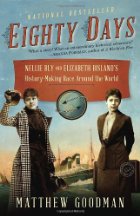
Book Review: Eighty Days: Nellie Bly and Elizabeth Bisland’s History-Making Race Around the World by Matthew Goodman
 Summary:
In 1889, the world was obsessed with Jules Verne’s fictional work Around the World in 80 Days
Review:
With my interest in women’s history, I was surprised when I saw this title on Netgalley that I had never heard of this race around the world, although I had heard of Nellie Bly, due to her investigative report into Bellevue Hospital (a mental institution). I knew I had to request it, and I’m quite glad I got a review copy. Goodman tells not just the story of these two women but also immerses the reader into the newly global world of the late 1890s, both the good and the bad.
Goodman starts the book by introducing us to the two women who will race around the world. He does an excellent job using primary source materials to give us both how others saw these women and how they saw themselves. For instance, in describing Elizabeth Bisland, Goodman writes:
One of her admirers, the writer Lafcadio Hearn, whom she had befriended in New Orleans, called her “a sort of goddess” and likened her conversation to hashish, leaving him disoriented for hours afterward. Another said, about talking with her, that he felt as if he were playing with “a beautiful dangerous leopard,” which he loved for not biting him. (loc 241)
While introducing the women, Goodman also talks at length about the role of women in journalism in the late 1800s and how hard it was for them to break into real reporting. Jumping off from Bisland and Bly, describes how women were blocked from many journalism positions with excuses such as that the newsroom needed to be free to swear and not worry about a lady’s sensibilities. Women were often barred to what was deemed the ladylike journalism of the society pages. The hardest part of being a hardhitting female journalist at the time wasn’t the actual reporting but instead the reception of women in the newsroom.
The successful female journalist, McDonald suggested, should be composed of “one part nerve and two parts India rubber.” (loc 465)
Bisland and Bly and their race came at the beginning of having women journalists do some form of stunt journalism, which is how they started to break into hardhitting journalism. Editors and owners discovered that readers enjoyed reading about women in stunt situations, such as learning how to stunt ride a horse, so this was their way in. Thus, even if the reader dislikes the personalities of either or both of the racers, they come away with some level of respect for them both breaking into the business.
From here, Goodman starts following the women on their race around the world. He takes the different legs of their journeys as a jumping-off point to discuss something historically relevant to that portion of the journey. For instance, during Bly’s trip on the ocean liner to Europe, he discusses how the steamships worked, from the technical aspects of the steam to the class aspects of first class down to steerage. During Bisland’s railroad trip across the United States, he discusses the railroad barons and the building of the transcontinental railroad. Thus, the reader is getting both the story of the race and historical context. It’s a wonderful way to learn, as the historical explanations flesh out the settings around and expectations of the women, and the women lend a sense of realness to the historical situations and settings being described.
After the completion of the trip (and, no, I won’t tell you who won), Goodman explores the impact of the trip on the women’s lives and follows the rest of their lives to their deaths. This part may feel a bit long and irrelevant to some readers, however often when people become famous for doing something, no one talks about the long-lasting impact of that fame or what the rest of their lives are like. Seeing how both women reacted to the trip, their careers, and others puts them in a more complete light, giving the reader a complete picture of what the race did in their lives. This complete picture of both of their lives is something I really appreciated and that also demonstrated that one shouldn’t judge people too fast. They and their lives may turn out differently than you expect at first.
What would have made me love the book is if I had come away feeling like I could respect or look up to either woman. Unfortunately, by the time I heard the full story of both of their lives, I found them both to be so deeply flawed that I couldn’t do that. I respect them for breaking into the newspaper business, and perhaps if I was a journalist myself that would be enough to make me look up to them. But each had a fatal flaw that made this not be a book about two role models but instead a book about two women. There’s nothing wrong with that, but it does keep it from being a book I would return to over and over again.
Overall, Goodman does an excellent job using the true story of two female journalists’ race around the world in 1889 to 1890 to build a solid picture of the increasingly global world of that time. The reader will come away both with having learned an incredible true story and details about the 1800s they might not have known before, told in a delightfully compelling manner. Some readers might be a bit bothered by how flawed the two women journalists are or by the fact that the book goes on past the race to tell about the end of their lives in detail. However, these are minor things that do not distract too much from the literary qualities of this historical nonfiction. Recommended to those interested in an easy-to-read, engaging historical nonfiction book focusing in on women’s history. Particularly recommended to modern, women journalists.
If you found this review helpful, please consider tipping me on ko-fi, checking out my digital items available in my ko-fi shop, buying one of my publications, or using one of my referral/coupon codes. Thank you for your support!
4 out of 5 stars
Length: 480 pages – chunkster
Source: Netgalley

Book Review: One Death at a Time by Thomas M. Hewlett (Series, #1)
Summary:
Jack Strayhorn is a private eye and a member of Alcoholic’s Anonymous. Only, he’s not an alcoholic, he’s one of the vampires who meet in a secret vampire group that exists under the umbrella of AA to learn how to control their urges and feed on humans without killing them. He’s just returned to LA, his death site that he hasn’t been back to since he had to run in 1948 after becoming a vampire. When his current missing person case shows up dead next to a Fae politician, Jack gets dragged into a mixed-up underworld of Faes, werewolves, drugs, and a group of vampires determined to rule the world.
Review:
This is one of the twelve indie books I accepted to be reviewed on my blog in 2014 (complete list). I was immediately intrigued by the summary, due to its delightful urban fantasy/paranormal take on AA. The book delivers exactly what it promises, spiced with a noir writing style.
Jack Strayhorn is the perfect paranormal version of the noir-style hardboiled detective. He’s got a biting, snarky wit, a handsome presence, a sharp mind, and is a bit distant and mysterious. It’s just in this case he’s distant and mysterious because he’s a vampire. Making the private eye a vampire makes his character unique in noir, and, similarly, making the vampire a private eye with his focus primarily on crime solving and not paranormal politics gives the urban fantasy vampire a unique twist. Jack is presented as a complex character, one who we could not possibly get to know fully in just the first entry in the series. It’s easy to see how he will manage to carry the proposed 12 entries in the series.
Supporting Jack is a wide range of characters who accurately portray the diversity in a large town like LA, as well as the diversity one expects in a paranormal world. The characters are multiple races and classes. Whereas some urban fantasy books slowly reveal the presence of more and more paranormal races throughout the series, this book starts out with quite a few, and that is a nice change of pace. Most urban fantasy readers expect there to be more than just vampires, and the book meets the urban fantasy reader where they’re at. Even though the book has a large cast, the secondary characters never blend together. They are easily remembered, and the diversity probably helps with that.
I like the idea of vampires having an AA-like group, but I’m still not sure how I feel about this group existing as some secret under the umbrella of AA itself. The book even goes so far as to say the the founder of AA was a vampire himself, and used the human illness of alcoholism as a cover for the vampire group. I like and appreciate vampirism as a disease that some people just mysteriously have at birth as an analogy for alcoholism, but I feel that having it present in the same group as the real life AA groups dampens the realness of actual AA, weakening the analogy instead of strengthening it. I’ve seen books before have paranormal people get together in AA-style groups (zombies anonymous springs to mind), and in real life AA has spinoffs such as Narcotics Anonymous and Overeaters Anonymous. Prior to reading the book I thought maybe something might be added by having the vampires be a secret organization under AA, but after reading the book, I don’t think it did. I think the analogy would have been stronger if vampires spotted the similarities of their genetic vampirism with alcoholism and formed a “vampires anonymous” group, inspired by AA. Something about vampires creating AA themselves as a cover hits a bit of a sour note and weakens the analogy.
The plot is complex, with just enough twists and surprises. There were parts of the ending that I was unable to predict. The plot contained within the book was wrapped up sufficiently, and the overarching plot intending to cover the whole series was well-established and filled me with the desire to keep reading. Unfortunately, the second book isn’t out yet, so I will just have to wait!
Overall, this is a delightful mix of urban fantasy and noir and is a strong first entry for a new series. Some readers might dislike the paranormal take on Alcoholic’s Anonymous found within the book, but it is secondary to the mystery/noir plot and easy to gloss over if necessary. Recommended to urban fantasy readers looking to venture into noir or vice versa, as well as anyone who enjoys both urban fantasy and noir.
If you found this review helpful, please consider tipping me on ko-fi, checking out my digital items available in my ko-fi shop, buying one of my publications, or using one of my referral/coupon codes. Thank you for your support!
4 out of 5 stars
Length: 216 pages – average but on the shorter side
Source: kindle copy from author in exchange for my honest review

Book Review: Hang Wire by Adam Christopher
 Summary:
Ever since his birthday party when a fortune cookie exploded in his face, professional blogger of all things San Francisco, Ted Hall, has been passing out, sleeping 12 hours, and waking up exhausted. It’s disconcerting, especially since there’s a serial killer on the loose.
The circus is in town, and the highwire workers are frustrated with the star of the act, who never rehearses and periodically disappears. And no one understands why the manager isn’t reporting their missing highwire wire to the authorities, especially since the serial killer is stringing up his victims with a strong, thin wire that sounds an awful lot like a highwire wire.
Bob the beach-living, ballroom-dancing attraction, used to be the god Kanaloa, but the immortals have abandoned humans to their own devices, and he’s not supposed to interfere. But he just may be the key to all the mysteries occurring in San Francisco.
Review:
I picked this up because it sounded like an urban fantasy serial killer mystery, which is just my speed. Unfortunately, I found a book with a discombobulated world and plot that builds confusion rather than tension.
If my summary above seems disjointed and confusing that’s because that’s precisely what this book is. Multiple different extremely odd plots are going on that ultimately do have some relation to each other, but the relation takes far too long to establish or understand. The book starts with a flashback to the San Francisco earthquake of 1906 and introduces us to Bob/Kanaloa. It then jumps forward to the completely dull Ted and the exploding fortune cookie. It then jumps backward in time again to an entirely different character, who is tied to the circus, eventually. It takes quite a while to find out what his relation is. These three disparate storylines that seems to have no relation to each other continue throughout the book. Bob/Kanaloa’s journey from immortal god to just immortal beach bum would be an interesting book. But his plot keeps getting abandoned for the other two plots, so all tension and interest is lost. Similarly, the evil circus organizer would be interesting, but only if his plot was handled with more detail and finesse. As it is, what he is doing and why he is evil is just confusing, not interesting. Ted’s plot would not be interesting, even on its own with more detail, because Ted is a two-dimensional, boring character.
Beyond the three disjointed, confusing plots, nothing in this story is ever fully fleshed-out. There’s the vague idea that immortals were once on Earth and involved but now have left, but the details of the hows, whys, and how this has affected Bob/Kanaloa is left out. We’re told the organizer of the circus is evil, but we never see his fall from grace. We see him as a poor pioneer then later as an evil circus worker. The interesting part of how he got sucked into this evil is left out. Similarly, two people ultimately become human hosts for gods, but this is basically just announced and moved on from. The intricacies of how this feels for the human and for the god, why it might be effective or not, etc… is all left out. This is a bare-bones, confusing plot with little development, which ruins all possible tension.
Just as the plot is created in broad, sloppy strokes, so are the characters. The closest any come to being three-dimensional is Bob/Kanaloa, which at least made the story readable. But the rest are quickly laid out with broad character traits, and the story moves on. There is, for instance, no depth to Ted’s relationship with his girlfriend. We’re told she’s his girlfriend and he loves her, but we never truly see them together and functioning as a couple. We get no flashbacks to times prior to the supernatural craziness to see them in a non-stressful situation. Ted’s girlfriend is there as a plot device, nothing more.
I understand that this is an advanced copy and there will be another editing pass, etc…, however this is the most errors I have ever seen in an ARC. It was rife with typos, use of the wrong word, and format issues. Most egregious to me is the Britishisms used by American characters, such as “prawns” for “shrimp.” ARCs should have already had at least one editing pass. A reasonable amount of errors could slip through, but not this many. There were errors on approximately every other page. Hopefully the final version received a heavy final edit. Check reviews of the final version to be certain.
This book reads like an extremely rough first draft that badly needs an editor to come through and fix, not just minor typos and grammar, but also plot and characters problems. It could be an interesting story if it was more fleshed-out, with some storylines dropped in favor of a more solid main one, and with at least a couple of three-dimensional characters the reader can really relate to and root for. As it stands, there are certain scenes that are well-written and engaging, but together they do not make an engaging, readable mystery. I normally love books published by Angry Robot, so I found this particularly disappointing.
If you found this review helpful, please consider tipping me on ko-fi, checking out my digital items available in my ko-fi shop, buying one of my publications, or using one of my referral/coupon codes. Thank you for your support!
2 out of 5 stars
Length: 373 pages – average but on the longer side
Source: NetGalley

 Support my work with a tip or browse my shop for curated book club guides, how to guides, cross-stitch patterns, and more!

This work by Amanda Nevius is licensed under a Creative Commons Attribution-Noncommercial-No Derivative Works 3.0 United States License.

