
Archive
Celebrate Pride! 5 Unexpected Fantasy Reads Featuring Bisexual Characters
The month of June in the United States is Pride Month, celebrating LGBTQIA+ people, culture, and history. In Boston, the culmination of Pride is this weekend, with the Pride Parade and block parties. I wanted to contribute to my local celebration with a little something on my own blog–obviously a reading list! There are a lot of good reading lists out there for LGBTQIA+ reads, so I wanted to do something a little different. First, I wanted to feature one of the letters not featured very much — the B for bisexual. Second, I wanted to to highlight both that bisexual people are everywhere and the issue of bi invisibility (more info on that term and issue here) by featuring books that have bisexual characters but that don’t mention that in their blurbs. You’d be amazed how hard it can be to just find books with bisexual characters. It’s usually downplayed or not named. So, here is my list, in alphabetical order, with a mention as to which character is bi and whether the book ever actually uses the term “bisexual.”
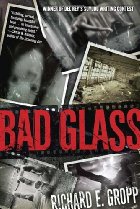 Bad Glass
by Richard E. Gropp
Genre: Fantasy, Horror, Lovecraftian
Brief Blurb:
Something strange is happening in Spokane, and the US military has taken control of the city, closing it and its happenings to the press. Dean sees this as the perfect opportunity to break into photography before he graduates from college and is forced into giving up on his artistic dreams to work a regular 9 to 5 job. So he sneaks into Spokane, where he meets an intriguing young woman and her rag-tag household of survivors, and quickly starts to see the inexplicable things that are going on inside the city.
Who’s bi? Dean, the main character, is bi. He at first appears to be straight but later it is revealed he also sometimes is interested in men.
My Full Review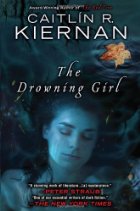 The Drowning Girl
by Caitlin R. Kiernan
Genre: Fantasy, Psychological
Brief Blurb:
India Morgan Phelps, Imp to her friends, is sure that there were two different Eva Canning who came into her life and changed her world. And one of them was a mermaid (or perhaps a siren?) and the other was a werewolf. But Imp’s ex-girlfriend, Abalyn, insists that no, there was only ever one Eva Canning, and she definitely wasn’t a mermaid or a werewolf. Dr. Ogilvy wants Imp to figure out for herself what actually happened. But that’s awfully hard when you have schizophrenia.
Who’s bi? Eva Canning (both iterations of her). Also, Abalyn, a transwoman who is also Imp’s girlfriend at one point. She states that she likes both men and women but currently prefers women because men in her experience tend to negatively react to her now that she has had bottom surgery.
My Full Review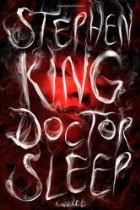 Doctor Sleep
by Stephen King
Genre: Fantasy, Thriller
Brief Blurb:
Danny Torrance didn’t die in the Overlook Hotel but what happened there haunts him to this day. Not as much as the shining does though. His special mental powers that allow him to see the supernatural and read thoughts lead to him seeing some pretty nasty things, even after escaping the Overlook. He soon turns to drinking to escape the terror. But drinking solves nothing and just makes things worse. When he sees his childhood imaginary friend, Tony, in a small New Hampshire town, he turns to AA to try to turn his life around and learn to live with the shining.Abra is a middle school girl nearby in New Hampshire with a powerful shine. She sees the murder of a little boy by a band of folks calling themselves the True Knot. They travel in campers and mobile homes, seeking out those who have the shine to kill them for it and inhale it. They call it steam. They’re not human. And they’re coming after Abra. Abra calls out to the only person she knows with a shine too, the man she’s talked to before by writing on his blackboard. Dan.
Who’s bi? Rose, the main antagonist. What makes her the antagonist or the “big bad” has absolutely nothing to do with her sexuality. She’s just an antagonist who happens to be bi.
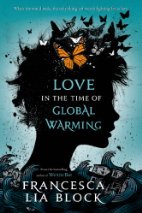
My Full Review Love in the Time of Global Warming
by Francesca Lia Block
Genre: Fantasy, YA
Brief Blurb:
Her life by the sea in ruins, Pen has lost everything in the Earth Shaker that all but destroyed the city of Los Angeles. She sets out into the wasteland to search for her family, her journey guided by a tattered copy of Homer’s Odyssey. Soon she begins to realize her own abilities and strength as she faces false promises of safety, the cloned giants who feast on humans, and a madman who wishes her dead. On her voyage, Pen learns to tell stories that reflect her strange visions, while she and her fellow survivors navigate the dangers that lie in wait.
Who’s bi? Pen, the main character. She has a crush on one of her best female friends in the time before the disaster, and then later falls for a transman. There is one particularly beautiful scene where she talks about being afraid of telling her friends that she likes girls the way she likes boys.
My Full Review not yet posted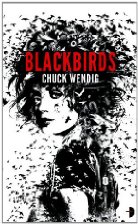 The Miriam Black Series
by Chuck Wendig
Genre: Fantasy/Urban Fantasy
Brief Blurb:
Miriam Black is an early 20-something drifter with bleach blonde hair and a surprising ability to hold her own in a fight. She also knows when and precisely how you’re going to die. Only if you touch her skin-on-skin though. And it’s because of this skill that Miriam became a drifter. You try dealing with seeing that every time you touch someone. But when a kind trucker gives her a lift and in her vision of his death she hears him speak her name, her entire crazy life takes an even crazier turn.
Who’s bi? Miriam, the kick-ass main character. Miriam uses no labels for herself whatsoever (she would probably hate even being called a brunette, to a certain extent), so she also refuses to label her sexuality. However, she also states she enjoys being with all genders. It’s interesting to note that the first time Miriam’s sexuality comes up is not until the third book in the series, and only because she (minor spoiler warning) breaks up with her boyfriend. A great example of how bisexual people’s sexuality can be erased when they’re in a monogamous relationship.
My Full Review of the first book in the series




Book Review: Maplecroft by Cherie Priest (Series, #1)
 Summary:
“Lizzie Borden took an axe; gave her mother forty whacks….”
Any New Englander knows the nursery rhyme based on the true crime story of Mr. and Mrs. Borden who were murdered with an axe in 1892. In spite of being tried and acquitted for the murders, their daughter (in the case of Mrs. Borden, step-daughter), was widely believed to actually be responsible for the murders. In this book, she definitely was, but maybe not for the reasons you might think.
A darkness is trying to take over Fall River, Massachusetts, and Lizzie and her ailing sister Emma are all that might stand between the town and oblivion, with Lizzie’s parents being the first casualties in the battle.
Review:
I grew up chanting the nursery rhyme about Lizzie Borden the first half of which is quoted above (this perhaps says an awful lot about New Englanders, but I digress), and I also love tales from the Lovecraft universe, which also originated in New England. When I heard about this book that mashed up the two, I put it on my wishlist. Lo and behold, my future sister-in-law, who had never even seen my wishlist, bought it for me for Christmas last year. I thought this would be the perfect read for the fantasy challenge, and although it was a bit different than what I was expecting, I still enjoyed the mix of Lovecraft and women’s history that Priest has woven and am eagerly anticipating reading the sequel.
The story is told through a combination of first person accounts from Lizzie, Emma, and Nance, diary-style entries by their neighbor doctor, letters, police and fire reports, and first person ramblings of a professor from Miskatonic University (another Lovecraft element). Some readers may be put off by the combination of first person perspectives, but I’ve always enjoyed this style, particularly when it includes things like letters and police reports. I felt that it was one of the strengths of the book, and I also particularly enjoyed getting to see both Emma’s and Lizzie’s perspectives, as well as that of Lizzie’s lover, Nance.
The Lovecraft mash-up basically is that some sort of Dark One in the deep is out to turn everyone on the seacoast either into worshippers or victims or literally turn them into monstrous ones who live in the deep. Emma and Lizzie’s parents were among the first to begin succumbing to this infection and that is why Lizzie had to kill them. Lizzie and Emma now are conducting research, trying to figure out how to prevent the Dark One from actually rising up. This is all extremely Lovecraftian, including the fact that some of these developments don’t make a ton of sense, but things just don’t make sense in the dark fantasy world of Lovecraft, so I was ok with that. Readers new to the world of Lovecraft might be a bit more frustrated by how inexplicable most things to do with the Dark Ones and the deep are, however.
I particularly enjoyed how Priest explores how societal and cultural norms of 1890s New England affects women’s lives. Emma could be a scientist now that women are being accepted into colleges, but she chooses to instead write her scientific papers under a male pseudonym because she believes she would never garner respect otherwise. Lizzie and Nance are in love and must hide it, although Lizzie often feels why should she bother when she is already disgraced after the trial. The clashes between Lizzie and Emma regarding both her affair with Nance and the fact that Lizzie believes in trying out magical and fantastical defenses against the Dark One whereas Emma believes purely in science are interesting reading. They are two very different people who are thrust together both by virtue of being siblings and by the fact that as women in the 1890s their lives are limited.
On the other hand, in spite of liking the characters of the neighbor doctor and the Miskatonic professor and enjoying the exploration of Lizzie’s and Emma’s relationship and getting to see some of Emma’s character, I couldn’t help but feel that Lizzie didn’t get a chance to be enough in this book. Lizzie Borden is such a looming large figure in local history, even on the book cover she presents as a bad-ass in a period skirt holding a bloody axe. In contrast in the book she spends a lot of time dealing with her annoying sister. Similarly, I’m not a fan of the fact that Lizzie does very little of rescuing herself in this book, which is, I believe, if the historic Lizzie really did kill her parents, what she actually did in real life. To me Lizzie has always been a woman who said fucking enough and took an axe and dealt violently and finally with her problems. Whereas in the book, she starts off off-screen that way (we don’t actually see her kill her parents) and she sort of tapers off. Much as I enjoyed seeing her messed up relationship with Emma, I couldn’t help but feel it would have ended more powerfully if she’d said fucking enough and whacked Emma through the skull for being such an insufferable bitch and in the way all the time. This was my main issue with the book.
My second, more minor, issue is that I felt the plot takes too long to build up to actual horrifying events and/or murders. The first murders, as I mentioned before, happened off-screen. The beginning of the book then is a build-up of a lot of tension with not much actual gore or murder occurring. I should mention that I was watching “The Lizzie Borden Chronicles” on tv at the same time as I was reading this book. In that show, Lizzie kills at least one person an episode. Now, some of that gets over the top, but it does get the idea of the pacing one would expect from this type of story right. More mayhem. More murder. More danger. More often.
On a positive note, the scenes between Lizzie and Nance are beautifully done, and while I was frustrated to see Lizzie turn a bit into a lovesick fool, I was very glad it was happening with Nance. Their relationship and dynamic jumped off the page and really brightened up the book for me.
The set-up at the end of the book for the sequel is well-done, although I’m uncertain how the series can proceed forward so far removed from the actual historical event, I am excited to read it and see what happens.
Overall, this Lovecraft fantastical take on the Lizzie Borden of history and what led to the murders of her parents hits just the right note for Lovecraft fans. Readers who are new to the dark fantasy world of Lovecraft may be a bit surprised by the slow burn of the horror and how much of it winds up not making much sense, but those readers who can embrace this style of dark fantasy will enjoy it. Those looking for a bad-ass Lizzie should be aware that this Lizzie only acts when absolutely necessary and then with restraint, and they should perhaps tune into the made for tv movie Lizzie Borden Took An Ax instead. Recommended to fans of Lovecraft who are interested in getting some local history woven in to the New England settings they are familiar with from the Lovecraft universe.
If you found this review helpful, please consider tipping me on ko-fi, checking out my digital items available in my ko-fi shop, buying one of my publications, or using one of my referral/coupon codes. Thank you for your support!
4 out of 5 stars
Length: 435 pages – average but on the longer side
Source: Gift

Counts For:

Book Review: The Years of Rice and Salt by Kim Stanley Robinson
 Summary:
Imagine a world where the Black Death of the 14th century wiped out the majority of the European population, rather than one-third of it. This is the world Robinson imagines, one where Buddhism and Islam rise as the two major religions of the world (with no religion a close third). See the history of the world through the eyes of two souls who keep reincarnating in different cultures, struggling to better both themselves and their world that could easily have been ours.
Review:
I originally picked this book up because I have long held a fascination with the various religions of the world (I was actually a Religious Studies minor in undergrad). The “what if” at the center of the book seemed like a great starting place to me. Indeed, what if most of the followers of currently largest faith (Christianity, source) had died off? What things would change and what would have stayed the same? Robinson chooses to tell this tale through reincarnating souls, which sometimes gives us a lot of access to these changes but other times leaves the reader feeling like they got just a passing breath of a culture and a century.
I didn’t realize going into this that Robinson had chosen to tell this story through the eyes of the same souls reincarnating over and over again. It’s an interesting choice that I am uncertain about as it lends a sort of “this much we know” to the spiritual side of the story. We, the readers, know that the souls of people in this world definitely exist, they go to the bardo to await judgment and reincarnation. The bardo they go to appears to reflect whatever faith they had (Muslims have their own, Buddhists have their own, etc…) The idea is also put out there that each of the faiths is a different path to the same end (enlightenment). Much as I may personally believe this idea, I’m not sure how I feel about this particular story being so mythology heavy. The History BA in me very much wanted to see a more analytical power-structure play-out, which we do get some of, but not as much as we get of the how to better our souls question. I suppose what I am trying to say is that, although I was anticipating a book that was scholarly with a dash of spiritual, what I got instead was the reverse. That’s not a bad thing, and I still enjoyed it, but it definitely wasn’t what I was expecting, and I do wonder how the story may have played out differently if Robinson wasn’t so tied to the same souls over and over again.
One aspect of the same souls reincarnating that niggled at me a bit was that throughout history, no matter where they were born (or what gender or species), their names always started with the same letters. So a character whose first name in the first incarnation started with the letter K always had a name that started with the letter K. It got so I could predict who was who and, to a certain extent, how they would act in each incarnation. On the one hand, it was a cool idea, although highly unlikely someone’s name would start with the same letter throughout time and cultures and languages. On the other hand, it distracted me from the more interesting story of the different world developing with the rise of different cultures than actually appeared in our own history.
Similarly, I think there is far too much story and richness in this idea and timeline to limit it to one book. There were multiple incarnations that I really wanted to know more of. I wanted to know the whole story of these lives and this place. Instead, the reader gets a quick glimpse into one time in their lives, and then we are left jumping ahead to the bardo to find out how they died and oh here comes the next incarnation. Perhaps the point was to make the reader feel as if each life is only a blink, but the scholar in me was left wanting to know so much more about every area and life the book briefly visited. It was like getting only a small morsel of each chocolate in a box of delicious chocolates, instead of getting to savor them all over a long period of time.
All of this said, let me now discuss the parts of the book I really enjoyed (and would have liked to have seen more of). My favorite is how Robinson reimagined the Americas. The same essential problem of real history still exists for the Native Americans even with the change of the Christians mostly dying off. Mainly, they lacked easily sourced heavy metals to make higher-tech weapons and they were susceptible to all of the germs European explorers brought with them. (I learned about this in my classes in US History for my BA, but my professors told me this whole idea is also presented in the book Guns, Germs, and Steel
Robinson does a much better job painting Islam and Buddhism with a nuanced brush. Since their cultures dominate the book, this means most of the book is much more gray area, rather than presenting everything as black and white. One element that demonstrates this, is how Robinson handles Islam and women. All sides of the arguments about Islam and women are presented here. There are incarnations of the souls that are Muslim women who argue strongly that the men are misinterpreting the Quran, what Mohammed said, etc… There are of course other incarnations that say no, the extreme fundamentalism is the right interpretation. Through showing Islam through many different lenses in a world that is different from our own, Robinson demonstrates how religion is so incredibly open to interpretation, and good and bad people can shape it to their own agendas. One passage that I think demonstrates how well Robinson walks this line is a conversation some characters have about the women wearing the veil or not:
The veil has a kind of power, in certain situations. All such signs stand for other things; they are sentences spoken in matter. The hijab can say to strangers, ‘I am Islamic and in solidarity with my men, against you and all the world.’ To Islamic men it can say, ‘I will play this foolish game, this fantasy of yours, but only if in return you do everything I tell you to.’ For some men this trade, this capitulation to love, is a kind of release from the craziness of being a man. So the veil can be like putting on a magician queen’s cape…. Or it can be like putting on a slave’s collar, certainly. (page 592)
If this passage appeals to you in how it presents the various nuances and gray areas of religion and culture, then a lot of this book will appeal to you.
One final issue with the book I will note that may turn off some readers is that out of all the many incarnations, only two are in Native American bodies (and then, they are both Native Americans in North America. South America is completely left out for incarnations, although incarnations visit there). Similarly, there are no incarnations to Australia, New Zealand, Central America, or any island nation anywhere (Caribbean, Pacific Islands, United Kingdom, Iceland). There is only one incarnation where one of the souls is in an African, and that African is a slave on a Chinese slave ship who then goes to China (we thus spend very little time in Africa, just at the beginning on the slave ship). One character in an incarnation mentions that in the past she went to Africa but the reader does not see her time there. I definitely think that it’s a weakness that so many areas of the world are left out. For instance, I have zero idea what happened in Australia now that it clearly was never a penal colony of the UK (since the UK never existed). Similarly, it seems Africa would be very different with all the changes in global power, and yet the only passing mention we get of modern Africa in the later incarnations is that one of the characters visits there to fight against Female Genital Mutliation (FGM). If so much else changed, why not in Africa?
I know it may seem like I listed out a lot of issues, but it is a very long book that tackles a huge task. My review is almost as if I was reviewing an entire series in one fell swoop. Each individual part had issues, as did some of the overarching ideas, but I mostly really did enjoy reading it. It’s a fascinating thought experiment that wasn’t as well executed as it could have been, but parts of it were brilliant. I also enjoyed the feminist themes throughout. Men and women are both just souls, reincarnating into a woman is not a punishment. In fact, neither gender nor race is a punishment for previous incarnations, just species. Similarly, the more a society advances the more equal their genders and races are. There is a lot of thought given to what it means to be a woman in various areas of the world, which could easily have been passed over or not handled well.
Overall, this is a book that tackles a huge philosophical question in a fantastical way. It is a large task that probably would have been better suited to a series to fully flesh-out the world, the lives, and the nuances in both. Readers interested in spiritual questions with a tendency to view all religions as different paths to the same enlightenment and a curiosity about how the world might be different with different religions in the lead will be most suited to the book. Readers interested in a more thorough exploration of an alternate history will most likely be disappointed by the reincarnation aspect and the brief time spent in each time period and culture.
If you found this review helpful, please consider tipping me on ko-fi, checking out my digital items available in my ko-fi shop, buying one of my publications, or using one of my referral/coupon codes. Thank you for your support!
4 out of 5 stars
Length: 763 pages – chunkster
Source: PaperBackSwap

Counts For:
Bottom of TBR Pile Challenge
and
Book Review: Bits of Bliss – Volume 1 by Andrea Trask (Series, #1)
 Summary:
A collection of nine erotica short stories, mostly featuring elements of fantasy. Covering everything from fairy tale retellings to vampires to a bit of scifi.
Review:
This erotica short story collection was quite hit or miss for me. The stories that excelled were creative and unique, but the stories that did not featured some problematic elements that prevented me from enjoying the erotica.
When I read a short story collection, I always individually rate the stories. My rating of the collection as a whole is just the average of those ratings. The highest rating any story in this collection received from me was four stars. There were three stories I gave four stars, and two of them were the first two stories in the collection, so it definitely started out strong for me. One is a F/F story featuring a woman who is also a flower (or a flower who is also a woman). It is poetic and heart-quickening. The second story features a sentient house that has missed its owner and demands attention. This made me laugh, and I enjoyed the oddity. It read like a lighter-hearted, erotica version of dark fantasies where there is an evil house–this one is just horny. The third four star read was enjoyable for a different reason. It’s a scifi erotica where two lovers are in a spaceship that is running out of air. They decide to make love, even though they will die quicker. It was so heart-breaking and beautiful that I wished it was a whole book.
Four of the stories received three stars. In each case I felt the story either didn’t take an idea far enough or the story wasn’t long enough to tell the story. Take it farther, and these all could be just as good as the first three I discussed.
Unfortunately, there were two stories that were big clunkers for me, with each receiving only one star, and they both had almost the same problem. “Hunting Hound” has a woman mating with a werewolf. She meets him when she is out riding, and they start making out against a tree, with her a willing participant. Then this happens.
“Stop” she said, and his face darted in toward her own with a low growl. “Too late to stop.” (loc 1650)
He proceeds to penetrate her. There is nothing sexy about a woman asking a man to stop and him claiming it’s too late and proceeding to rape her. It is never too late to stop, and it’s never too late for a partner to change their mind. It really bothers me that this type of scene is still being presented as sexy. I know everyone gets off to their own thing, but this is such a clear scene of consent being removed and then ignored that I just cannot say to each their own in this case. I also want to mention that the book blurb claims that this story features “consensual sexual violence” but it definitely did not read that way to me.
“Summer Nights,” which also received one star, has a similar problem. This story features a woman who keeps seeing the same mysterious man at parties. She goes out to the woods behind the house at one of these parties, and he follows her. She finds out he’s a vampire. She stands in the woods talking to him, holding a wineglass, when this happens:
“he struck like a train, his swinging backhand sending the wineglass flying toward the treeline, and I faintly registered the tinkling shatter of it, perhaps hitting a rock, or a fallen log.” (loc 5654)
She finds the fact that he just hit a glass out of her hand to be massively sexy and proceeds to bang him. This is, again, something I feel like I shouldn’t need to say, but there is nothing sexy about a partner violently hitting something out of your hand. Nothing. Sexy. This is not a sign that oh man she should totally bang this vampire. It is a sign she should run because she is alone in the woods with a violent motherfucker. This could have so easily been foreplay if, instead of hitting a glass out of her hand, he said something like, “I want you now,” and he gently took the glass from her hand and tossed it away. Or if she said, “I want you so much,” and tossed the glass over her shoulder. It would be so easy to have the same erotica about a powerful vampire alone in the woods with a woman without it turning into problematic territory.
I truly wish these last two stories were not in the collection. The rest of the collection is creative, features some fun queer content (the F/F story and a gender-swapping story), and in the case of the best three stories, has some unique ideas. Where the collection flounders is, interestingly enough, with the two most mainstream stories that take the agency out of the hands of the women in them and instead retreats to the tired idea of violent men being sexy.
Overall, if a reader is looking for some quick fantasy erotica, most of the stories in this book will satisfy this need, although I would recommend skipping over “Hunting Hound” and “Summer Nights.” The reader who enjoys the other stories for their uniqueness will most likely be disappointed by the “sexy violence” in these two.
If you found this review helpful, please consider tipping me on ko-fi, checking out my digital items available in my ko-fi shop, buying one of my publications, or using one of my referral/coupon codes. Thank you for your support!
3 out of 5 stars
Length: 53 pages – novella
Source: Kindle copy from author in exchange for my honest review

2014’s 5 Star Reads!
Since 2011, I’ve been dedicating a separate post from my annual reading stats post to the 5 star reads of the year. I not only thoroughly enjoy assembling the 5 star reads posts, but I also go back to them for reference periodically. It’s just useful and fun simultaneously! Plus it has the added bonus of giving an extra signal boost to the five star reads of the year. You may view the 5 star reads for 2011, 2012, and 2013 by clicking on the years.
With no further ado, presenting Opinions of a Wolf’s 5 Star Reads for 2014!

A Banquet for Hungry Ghosts
By: Ying Chang Compestine
Publication Date: 2009
Publisher: Henry Holt and Co.
Genre: Horror, Short Story Collection
Themes: Chinese history, food
Summary:
According to Chinese tradition, those who die hungry or wrongfully come back to haunt the living. Compestine presents here eight different ghost stories, each correlated along with a course in a banquet and richly steeped in Chinese culture and history.
Current Thoughts:
A cute book that I think of fondly. I really need to make at least one of the recipes in this book! This short story collection is presented in just the way that I most enjoy. Different stories surrounding one unifying theme. Plus, I learned something.
Full Review


Fudoki
By: Kij Johnson
Publication Date: 2003
Publisher: Tor
Genre: Fantasy
Themes: the meaning of family, identity, duty
Summary:
An aging empress decides to fill her empty notebooks before she must get rid of them along with all of her belongings to retire to the convent, as is expected of her. She ends up telling the story of Kagaya-hime, a tortoiseshell cat who loses her cat family in a fire and is turned into a woman by the kami, the god of the road.
Current Thoughts:
Warrior woman who was once a cat. Set in ancient Japan. What is not to love about that? My only regret is I waited so long to read this book. It languished on my TBR pile for far too long.
Full Review

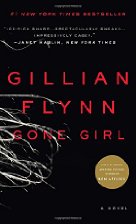
Gone Girl
By: Gillian Flynn
Publication Date: 2012
Publisher: Broadway Books
Genre: Thriller, Contemporary
Themes: be careful who you marry, not everything is as it first appears
Summary:
On Nick and Amy Dunne’s fifth wedding anniversary, Nick comes home from working at the bar he co-owns with his sister to find his wife gone. The door is wide open, furniture is overturned, and the police say there is evidence that blood was cleaned up from the floor of the kitchen. Eyes slowly start to turn toward Nick as the cause of her disappearance, while Nick slowly starts to wonder just how well he really knows his wife.
Current Thoughts:
It’s hard to give thoughts without revealing spoilers so let me just say that I still love the twist in this book, and I found the writing style to be perfect for a thriller. It’s a book that really curled my toes, and I’m glad it exists and has become so popular, and I’m looking forward to reading more Gillian Flynn this year.
Full Review

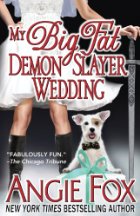
My Big Fat Demon Slayer Wedding
By: Angie Fox
Publication Date: 2013
Publisher: Indie, Self-Published
Genre: Urban Fantasy
Themes: weddings are hell but lifetime partnership is amazing
Summary:
Lizzie Brown, once preschool teacher turned demon slayer, is extremely excited to be marrying her true love, Dimitri Kallinikos, who just so happens to also be a magical shape-changing griffin. And she’s also fine with letting her adoptive mother run the whole show, even though her mother wants to make the wedding into a week-long event. She’s not so ok with having to tell her mother about being a demon slayer, though. Or about integrating her mother’s posh southern lady lifestyle with her recently discovered blood-related grandmother’s biker witch gang. She’s pleasantly surprised that her mother found a goth-style mansion to rent for the wedding. Maybe the magical and the non-magical can integrate fairly well, after all. But then it becomes evident that someone in the wedding is trying to kill her. Plus, they find demonic images around the property….
Current Thoughts:
I read this right after I got engaged, so I was in just the right frame of mind for an urban fantasy featuring a wedding. But even if I hadn’t just gotten engaged before reading it, I still would have loved it. This book knocks it out of the park with everything that makes urban fantasy delightful. A normal event kicked up a notch by fantastical characters and happenings. It also communicates the odd combination of the horror that is wedding planning and the pure joy that is finding your lifelong partner. Plus it’s hilarious and romantic.
Full Review

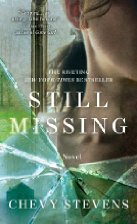
Still Missing
By: Chevy Stevens
Publication Date: 2010
Publisher: St. Martin’s Press
Genre: Thriller, Contemporary
Themes: be careful who you trust, hope and healing
Summary:
Annie O’Sullivan extremely forcefully declares in her first therapy session that she doesn’t want her therapist to talk back to her; she just wants her to listen. And so, through multiple sessions, she slowly finds a safe space to recount her horrible abduction from an open house she was running as an up-and-rising realtor, her year spent as the prisoner of her abductor, and of her struggles both to deal with her PTSD now that she’s free again and to deal with the investigation into her abduction.
Current Thoughts:
This book features a realistic depiction of PTSD plus it scared the pants off of me. Still does if I think about it too much.
Full Review

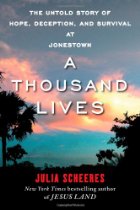
A Thousand Lives: The Untold Story of Hope, Deception, and Survival at Jonestown
By: Julia Scheeres
Publication Date: 2011
Publisher: Free Press
Genre: Nonfiction – History
Themes: understanding a tragedy, when spirituality goes awry
Summary:
On November 18, 1978, 918 people, mostly Americans, died on a commune named Jonestown and on a nearby airstrip in Guyana. The world came to know this event as that time that crazy cult committed mass suicide by drinking poisoned Kool-Aid. However, that belief is full of inaccuracies. Scheeres traces the origins of Jonestown, starting with its leader, Jim Jones, and his Christian church in Indiana, tracing its development into the People’s Temple in California, and then into Jonestown in Guyana. Multiple members’ life stories are traced as well, including information from their family members who, perplexed, watched their families give everything over to Jones.
Current Thoughts:
I am so glad I read this. I feel so much more informed and knowledgeable about Jonestown. It’s sad to me that the cultural myth of Jonestown is so different from what actually happened, particularly with regards to the mass suicide, when in many cases it was murder not suicide. This book presents an event that would be easy to brush off as “those people were just crazy” in a way that humanizes it and makes it more real.
Full Review

Book Review: The Keep by F. Paul Wilson (Series, #1) (Bottom of TBR Pile Challenge)
 Summary:
Captain Klaus Woermann isn’t a fan of the Nazis or the SS and doesn’t exactly keep this a secret. But he’s also a hero from the First World War, so the Nazi regime deals with him by sending he and a small troop to Romania to guard a pass the Russians could possibly use. They set up to guard the place in a building known as the keep. It should be a quiet assignment, but when the German soldiers start being killed one a night by having their throats ripped out, the SS is sent to investigate.
SS Major Kaempffer wishes to solve this mystery as soon as possible so he may start his new promotion of running the extermination camp for Romania. He is sure he can solve this mystery quickly.
Professor Cuza and his daughter Magda are Romanian Jews who have already been pushed out of their work in academia. They also just so happen to be the only experts on the keep. When the SS sends for them, they are sure it is the beginning of the end. But what is more evil? The mysterious entity killing the Germans or the Nazis?
Review:
It’s hard not to pick up a book that basically advertises itself as a vampire killing Nazis and the only ones who can stop the vampires are a Jewish professor and his daughter. I mean, really, what an idea! Most of the book executes this idea with intrigue and finesse, although the end leaves a bit to be desired.
The characterization of the Germans is handled well. They are a good mix of morally ethical people who are caught up in a regime following orders and see no way out (the army men) and evil men who enjoy inflicting pain upon others and are taking advantage of the regime to be governmentally sanctioned bullies, rapists, and murderers. Having both present keeps the book from simply demonizing all Germans and yet recognizes the evil of Nazism and those who used it to their advantage.
Similarly, Magda and her father Professor Cuza are well-rounded. Professor Cuza is a man of his time, using his daughter’s help academically but not giving her any credit for it. He also is in chronic pain and acts like it, rather than acting like a saint. Magda is torn between loyalty to her sickly father and desires to live out her own life as she so chooses. They are people with fully developed lives prior to the rise of the Nazis, and they are presented as just people, not saints.
In contrast, the man who arrives to fight the evil entity, Glaeken, is a bit of a two-dimensional deus ex machina, although he is a sexy deus ex machina. Very little is known of him or his motivations. He comes across as doing what is needed for the plot in the moment rather than as a fully developed person. The same could easily be said of the villagers who live near the keep.
The basic conflict of the plot is whether or not to side with the supernatural power that seems to be willing to work against the Nazis. Thus, what is worse? The manmade evil of the Nazis or a supernatural evil? Can you ever use a supernatural evil for good? It’s an interesting conflict right up until the end where a reveal is made that makes everything about the question far too simple. Up until that point it is quite thought-provoking, however.
The plot smoothly places all of these diverse people in the same space. The supernatural entity is frightening, as are the Nazis. These are all well-done.
One thing that was frustrating to me as a modern woman reader was the sheer number of times Magda is almost raped or threatened with rape, and how she only escapes from rape thanks to anything but herself. In one instance, the Nazi simply runs out of time because the train is about to move out. In another, she is saved by a man. In a third, she is saved by supernatural devices. While it is true that rape is a danger in war zones, it would be nice if this was not such a frequently used conflict/plot point for this character. Once would have been sufficient to get the point across. As it is, the situation starts to lose its power as a plot point.
The ending is a combination of a deus ex machina and a plot twist that is a bit unsatisfying. There also isn’t enough resolution, and it appears that the next books in the series do not pick up again with these same characters, so it is doubtful there is more resolution down the road. It is a disappointing ending that takes a turn that is nowhere near as powerful and interesting as the rest of the book.
Overall, this is an interesting fantastical take on a historic time period. The ending could possibly be disappointing and not resolve enough for the reader and some readers will be frustrated with the depiction of the sole female character. However, it is still a unique read that is recommended to historic fiction fans and WWII buffs that don’t mind having some supernatural aspects added to their history.
If you found this review helpful, please consider tipping me on ko-fi, checking out my digital items available in my ko-fi shop, buying one of my publications, or using one of my referral/coupon codes. Thank you for your support!
4 out of 5 stars
Length: 403 pages – average but on the longer side
Source: PaperBackSwap

10 Last-Minute Ebook Gifts For Under $5
It’s time for the second gift list here at Opinions of a Wolf (see the first, 10 Non-book Gifts for Book Lovers here). I thought with Hanukkah next week and some holiday parties already happening that it would be interesting to provide a list of cheap ebooks. Ebooks make great last-minute gifts, as you can purchase them literally on your phone on the way to the party and have them arrive in your recipient’s email with them none the wiser that you waited until the last minute. Since you can schedule when the gift email arrives, no one needs to know that you scheduled it only 5 minutes ago. Ebooks are also great because you can find them for very cheap but a reader who loves ebooks doesn’t care how much the ebook cost. A book is a book is a book! I’m not just going to tell you a list of cheap ebooks though. I’m also going to give you a little reader’s advisory–tell you who the book would be best for. Without further ado, here is the list, in order of cost from least to most.
For the lover of YA who enjoys a touch of fantasy:

Initiate
$0
Dindi is about to undergo her people’s initiation test and ceremony that not only welcomes her to adulthood but also will determine whether or not she is a member of the Tavaedi. The Tavaedi are a mix of religious leader, healer, and warrior who cast magic spells by dancing. Since Dindi can see the pixies and other fae, she thinks she has a chance. But no one in her clan has ever successfully become a Tavaedi. Meanwhile, an exiled warrior, Kavio, is attempting to shed his old life and the haunting of his father’s wars and his mother’s powers. But he slowly discovers a deadly plot that brings him directly to Dindi’s initiation ceremony.
This is a unique piece of YA fantasy set in a tribal world inspired by Polynesia. The romance is light and slow-building, and the focus is primarily on growing up and becoming an adult. See my full review here.
For the urban fantasy reader without a lot of time:
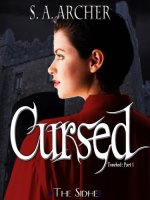
Cursed
$0
London works for hire doing investigations mostly for parahumans, and her best friend is a vampire who keeps hoping she’ll consent to being turned. Her life isn’t run-of-the-mill, but it isn’t too bad either, until one day she gets Touched by a Sidhe and finds herself sucked into the Fey world bubbling just beneath the surface of the regular one.
This fast-paced novella is perfect for the reader without a lot of time who still wants to get some urban fantasy into their day. See my full review here.
For the lover of the style of classic scifi:

The Coin
99 cents
When Richard’s physicist professor uncle dies tragically in a plane crash and leaves him his coin collection, he is shocked to find a brand-new dime from 2012. The only thing is, it’s 1989. A note from his uncle states that the coin is important. Richard thinks the answer to the mystery might be in his uncle’s personal diaries he also left him, but he’s not a physicist and can’t decipher them. As the year 2012 approaches, Richard increasingly wonders what the coin is all about.
This novella is a fun new take on the storytelling methods of classic scifi. The science is strong enough to be interesting but not too challenging, and the result of the mystery is surprising. See my full review here.
For zombie fans who enjoy a touch of romance:
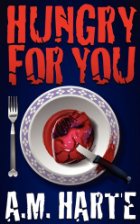
Hungry For You
$2.50
A collection of zombie-themed short stories and poetry with the twist that they all have to do with romantic relationships in some way, shape, or form.
This short story collection is different and fun simultaneously. It will appeal to zombie pans, particularly women. See my full review here.
For the reader of lesbian romance who loves fairy tale retellings:

Braided: A Lesbian Rapunzel
$2.99
A lesbian retelling of Rapunzel. Gray, a witch’s daughter, visits Zelda every day. The witch switched Gray’s fate into Zelda, so now Zelda is the one entwined with the spirit of the tree that the people worship. She must live on the platform and every day lower her hair for people to tie ribbons and prayers into. Gray feels horrible guilt over their switched fates, but she’s also falling in love with Zelda.
this is a fun retelling of Rapunzel, particularly if you’re looking for a non-heteronormative slant or enjoy a more magical feel. Note that this is part of a series entitled Sappho’s Fables, which consists of lesbian retellings of fairy tales. The novellas may be mixed and matched. See my full review here.
For the reader of women’s fiction with an interest in Scotland:
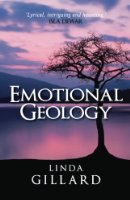
Emotional Geology
$2.99
Rose is a textile artist with bipolar disorder who for years found her medication dulled her ability to work. After a stunning betrayal that landed her in a mental hospital, she has moved to a quiet, extraordinarily rural island in Scotland in an attempt to control her illness with as little medication as possible so she may still create her art. Her life isn’t quite as quiet as she imagined it would be, though, with a warm neighbor, Shona, who introduces her to her brother, a teacher and poet.
This is an emotional, challenging, touching read for fans of contemporary fiction with a heart. See my full review here.
For the horror fan:
 Gargoyles
$2.99
Amoreena is determined to be a doctor and help people. She’s a hard-working, scholarship student on the pre-med track in her third year of college. Unfortunately, her single mother just got diagnosed with metastatic cancer and lost her health insurance. With no time for a job and no money for the bills, Amoreena is grateful when she is approached by a surrogacy clinic to be a surrogate for $50,000 with payments upon successful insemination and each trimester. But after she’s successfully inseminated, Amoreena becomes increasingly concerned that something is not quite right with her baby.
If your horror fan loves Rosemary’s Baby and is particularly freaked out by evil pregnancies, they will love this book. See my full review here.
For the lover of noir and urban fantasy:
 One Death at a Time
$2.99
Jack Strayhorn is a private eye and a member of Alcoholic’s Anonymous. Only, he’s not an alcoholic, he’s one of the vampires who meet in a secret vampire group that exists under the umbrella of AA to learn how to control their urges and feed on humans without killing them. He’s just returned to LA, his death site that he hasn’t been back to since he had to run in 1948 after becoming a vampire. When his current missing person case shows up dead next to a Fae politician, Jack gets dragged into a mixed-up underworld of Faes, werewolves, drugs, and a group of vampires determined to rule the world.
This is a delightful mix of urban fantasy and noir and is a strong first entry for a new series. See my full review here.
For the reader of thrillers and fans of Gone Girl:
 I’ll Sleep When You’re Dead
$3.03
Tom Starks has not been the same since his wife, Renee, was brutally murdered with a baseball bat in a parking lot. He’s been struggling for the last three years to raise her daughter, who he adopted when he married Renee. When Renee’s killer is released after a retrial finds insufficient evidence to hold him, Tom becomes obsessed with dealing out justice himself.
This is a unique thriller, with its choice to cast the opposite of a bad-ass in the role of the main character. This grounds the typical revenge plot into reality, lends itself to more interesting, unique plot twists, and has the interesting aspect of a flawed, nearly anti-hero main character that the reader still roots for. See my full review here.
For readers of multi-generational family dramas and GLBTQ lit:
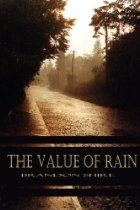 The Value Of Rain
$4.99
Charles hasn’t been home since his mother and uncle sent him away to an insane asylum at the age of fourteen after he was found in the embrace of his first love–Robert. Now, ten years later, his mother, Charlotte, is dying, and he comes back to take his revenge.
This is one of those genre-defying books. Shire explores the devastating effects of prejudice, hate, secrets, and lies throughout family generations, and that is something that is simultaneously universal and tragic. See my full review here.
I hope this list helps you find a read for yourself or a gift for another. Feel free to ask questions about any of these books or ask for recommendations for books for particular recipients in the comments!
Book Review: Fudoki by Kij Johnson (Bottom of TBR Pile Challenge)
 Summary:
An aging empress decides to fill her empty notebooks before she must get rid of them along with all of her belongings to retire to the convent, as is expected of her. She ends up telling the story of Kagaya-hime, a tortoiseshell cat who loses her cat family in a fire and is turned into a woman by the kami, the god of the road.
Review:
I’m not usually big into fantasy, particularly not ones involving court life, but I am a real sucker for any story involving cats, especially if that cat is a tortoiseshell, since I’m the proud kitty mommy of a talkative tortie. This book didn’t just not disappoint me, it blew me away with two side-by-side, related by different, thoughtful tales.
I had no idea when I picked up the book that the empress would figure into the story quite so much. At first I was a bit irritated that she was a) getting 40% to 50% of the storytime and b) rambling off from one thought to another like elderly people tend to do. But I stayed patient, and I learned that there was more to the empress than met the eye and also that the two stories were actually informing each other. Kagaya-hime’s story shows everything the empress had secretly wished for her whole life, and the empress’s life translated into how Kagaya-hime felt trapped in her human body. It’s artfully done in a subtle way, which is part of what makes it so beautiful.
Kagaya-hime goes from a sad lost kitty with burned paws to a warrior woman, allowed along on a quest for revenge by a moderately elite rural family. She is able to earn respect from the men as a warrior because as a cat she sees no reason not to hunt or defend herself. She is a woman but no one ever took her claws away (though they may be arrows and knives now, instead of claws). Thinking of her is empowering to the empress, who always had an interest in war and politics but was forced to remain literally behind screens in gorgeous gowns that are hard to move in. It’s interesting to note that while the empress may be jealous of Kagaya-hime’s ability to do what she wants and defend herself, Kagaya-hime herself is unhappy because she simply wishes to be a cat again. It is the conclusion to Kagaya-hime’s story that allows the empress to see a conclusion to her own story (her life) that will ultimately make her feel fulfilled.
The details of ancient Japan were clearly meticulously researched. Johnson smoothly writes about the outfits, land, and battles as if she was there for them herself. The information never comes through as an info dump but instead is something that simply is, that the reader learns about naturally just by venturing into Kagaya-hime and the empress’ world. This is what knowing your history inside and out before starting writing does for historic fiction. It makes history come to life.
Overall, this is a stunning piece of historic fiction the reading of which feels like slowly sipping a well-made matcha latte. Fans of historic fiction of all sorts will be engaged, those that love cats will be enthralled, and those with an interest in women’s history will be enamored and touched by how much things change and yet still stay the same for women. Recommended to all who think they might even possibly be interested in a piece of historic fiction set in Japan featuring an aging empress and a shape-changing cat.
If you found this review helpful, please consider tipping me on ko-fi, checking out my digital items available in my ko-fi shop, buying one of my publications, or using one of my referral/coupon codes. Thank you for your support!
5 out of 5 stars
Length: 316 pages – average but on the longer side
Source: Better World Books
Giveaway: The Running Game by L. E. Fitzpatrick (INTERNATIONAL)
 It’s time for the sixth giveaway of 2014 here at Opinions of a Wolf. Lots of the indie authors whose books I accepted for review in 2014 also were interested in me hosting a giveaway at the time of my review, so there will be plenty more coming up in the future too.
There are TWO ebook versions of The Running Game
What You’ll Win: One ebook copy of The Running Game
How to Enter: Leave a comment on this post stating what is the first thing you would do with your powers if you were telepathic.
Who Can Enter: INTERNATIONAL
Contest Ends: August 26th. Two weeks from today!
Disclaimer: The winners will have their ebook sent to them by the author. The blogger is not responsible for sending the book. Void where prohibited by law.
Book Review: The Running Game by L. E. Fitzpatrick (Series, #1)
Summary:
Rachel is a doctor in the slums outside of London. It’s not a great place to live, but it’s safer than a lot of the other options available. She’s also a Reacher with telepathic powers. Since she was a young girl, she learned to hide her abilities and always know her exits so she could run at any time. But when two brothers show up, one a wounded Reacher, and tell her a mobster sent them looking for her, she has to decide whether to run again or trust the brothers.
Review:
Near-future dystopias will never cease in their appeal to me, and so I was fairly quick to accept this one when I was choosing ARCs to read for 2014. The book offers a grim dystopia but far less running than one would imagine from the title.
The book establishes the overall dreary setting of a dystopia fairly quickly. Rachel’s work at the hospital and commuting home from it is dirty and grimy. Society is clearly barely functioning, a fact that is smoothly and clearly established. It takes a bit more time to learn more about the over-arching world, and the fact that Rachel is a “Reacher,” a person with some form of telepathic powers. For some reason, the government is seeking to eradicate all Reachers, whereas the church, which is illegal, views them as angels sent from above, metaphorically speaking. It’s an interesting world but our view into it is quite narrow, so there’s a lot of questions left unanswered.
Rachel is a good, strong character who is well-rounded in spite of knowing little of her backstory. The brothers, on the other hand, are kind of annoying and two-dimensional. They and the general crime lords/corrupt cops feel much more cookie cutter than Rachel does. In a way, they drag her down. It’s hard to root for her when she chooses to cast in lots with this bunch.
Similarly, the plot focuses in on what feels more like a standard crime thriller plot, rather than a dystopian one. It’s a good crime plot, but it’s not a dystopian one. The title implies a much more dystopian style book, such as Rachel using her powers to outwit the government and start a new colony or something like that. Instead it feels a bit more like an urban fantasy style crime plot that just so happens to be surrounded by society breaking down, somewhere out there. I think marketing it as a running game, rather than as the crime mystery plot it really is hinders the book a bit. Readers who would like an urban fantasy style futuristic crime novel might miss it, because it sounds so dystopian. The title and summary give the vibe of a Logan’s Run or Maze Runner style book, when that’s not what it is. What it is is a perfectly good futuristic crime novel, but that’s not what it sounds like.
Overall, this is a quick-moving tale of futuristic crime with a dash of telepathic powers and an easily imagined setting. Fans of near future, fantasy, and crime will enjoy seeing the three intertwine. Those looking for more of a scifi or dystopian focus should look elsewhere.
If you found this review helpful, please consider tipping me on ko-fi, checking out my digital items available in my ko-fi shop, buying one of my publications, or using one of my referral/coupon codes. Thank you for your support!
3 out of 5 stars
Length: 228 pages – average but on the shorter side
Source: kindle copy from author in exchange for my honest review
 Support my work with a tip or browse my shop for curated book club guides, how to guides, cross-stitch patterns, and more!


This work by Amanda Nevius is licensed under a Creative Commons Attribution-Noncommercial-No Derivative Works 3.0 United States License.
 Opinions of a Wolf