
Archive
Book Review: Chasing the Moon by A. Lee Martinez (Audiobook narrated by Khristine Hvam)
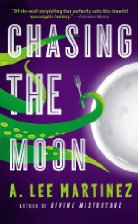 Summary:
Diana doesn’t have much going for her–a bad job and perpetual unwanted singledom, plus she’s been sleeping on friend’s couches since losing her apartment. So when a room in a building with a quirky landlord shows up, she grabs it instantly. Only to discover that a monster called Vom the Hungry is in her closet waiting for her to let him out, at which point he will probably eat her. In fact, the whole building is oddly connected to other dimensions full of monsters, creatures, mayhem, and madness….not to mention tentacles.
Review:
I obviously had to read this book. The cover has tentacles on it, and it’s clearly a Lovecraftverse story. These are both basically automatic must reads in Amanda-land.
The storyline is fairly straight-forward as far as the Lovecraftverse goes. There’s a place where the lines between dimensions and reality fade and threaten mere humans with madness. The monsters that Diana meets within her own apartment are fairly creative. There’s Vom the Hungry who is pretty endearing, there’s the hedgehog looking guy (whose name I can’t remember and can’t look up because: audiobook) who spawns copies of himself when he’s upset, and of course there’s the giant floating eye with tentacles who tries very hard to be prim and proper. They’re creative and funny.
The foes–the cult of the moon god–are not so creative. They’re your typical moon-loving shapeshifters, and the moon god even has three forms just like a certain other god of a religion we’re all familiar with. Compared to the creativity of the apartment and the apartment’s monsters, it just doesn’t feel like a worthy foe.
Similarly, although I liked Diana and the world she’s living in, she has basically no backstory. I have a hard time believing she’d have such an easy time mostly abandoning her friends and family from her time prior to the apartment. I can believe she’s not afraid and can handle the horrors, but it’d be nice if we got at least a toss-up to the concept of her having a family or even a mention of estrangement from them, if that’s the case. That doesn’t happen, so I was left feeling that Diana is very two-dimensional.
Given these elements, I’m sure I would have skimmed through it very quickly in print and probably missed the humor that it does contain, except that I read the audiobook. The audiobook narrated by Khristine Hvam. And she is an incredibly talented voice actor.
Every single character had their own entirely unique voice, and the voices perfectly matched the character, even an eyeless faceless omnivorous Vom the Hungry. Hvam is just….just so amazing to listen to! I kept listening more to just hear her perform than due to a true vested interest in the story. In fact, I looked up her voice actor page on Audible after just to maybe get another one of her books. She mostly narrates scifi/fantasy, unfortunately mostly YA, which we all know I don’t like. But I will be keeping my eye out for more of her adult work. She is just so amazingly talented.
So, overall then, the story itself rates 3 stars, but the narration rates 5, so my rating must average those two out. Be aware, though, that I recommend Khristine Hvam over the book, but if you are intrigued by the book and don’t mind a lack of backstory or average villains, then I recommend picking the audiobook for twice the fun.
4 out of 5 stars
Source: Audible

Book Review: The Wind Through the Keyhole by Stephen King (Series, #4.5)
 Summary:
There’s a tale we have yet to hear about the ka-tet in the time between facing the man in the green castle and the wolves of the Calla. A time when the ka-tet hunkered down and learned a special billy-bumbler talent, an old tale of Gilead, and the first task Roland faced as a young gunslinger after the events at Mejis.
Review:
When I heard there was going to be a new Dark Tower book, I had basically three reactions. 1) Yay! 2) Shit he better not ruin them. 3) Guess I didn’t actually finish that series after all, did I? May have written the series review a bit too soon…..
But mainly my reaction was a skeptical excitement. I love the world of the Dark Tower and was ecstatic to be able to get more of it (yes, I know there are the young gunslinger comic books, but they feel slightly less the same to me since they are in a different format). However, I was also terrified because well we’ve all been in an instance where we mess with something that was good to the point where it’s not good anymore, right? I was worried King was going to do that to the Dark Tower. I am so so so happy to be able to say that worry was unfounded.
This book goes to show just how clearly the entire world of the Dark Tower series exists in King’s mind. The format is a story within a story within a story. The ka-tet have to hunker down to wait out a storm, so Roland starts to tell them a story from when he was a young gunslinger. Within that story, the young Roland tells someone else an old story of Gilead. The Gilead story wraps up, then the young gunslinger, then the ka-tet. A writer must know his world very well to be able to handle such a structure smoothly without confusing his reader, and King does just that. There was no confusion and each story felt fully told. Or as fully told as anything is in the world of the Dark Tower.
I’ve said before that every book in the series basically is a different genre, which is part of what makes it so fun. So what genre is this one? I’d say it’s fairy tales. Once upon a times. And fairy tales generally have a lesson to be learned within them, so what is it in these three? Well, they vary, but I would say overall it’s about leaving aside childish things and childish ways to become an adult. (And, I might add, that happens much much earlier in the Dark Tower than it does in our particular world).
I will say, although I certainly had the impression that this book was going to be about Jake and Oy, it really isn’t. It isn’t much about the ka-tet at all. It’s about Roland and the role of billy-bumblers in the world. Although, personally I wanted more billy-bumblers, but I *always* want more billy-bumblers, because they are definitely my favorite fantastical creature. I’m still holding out hope that King will write something sometime entirely about Oy or billy-bumblers. But this book is not it.
That said, I was oddly not disappointed to see far less of the ka-tet than I was expecting, because the two stories within the frame of the ka-tet are so strongly told. They are just….wow. Terrifying, horrifying, unpredictable, and hilarious simultaneously.
That’s the thing that makes any Dark Tower book fun. It contains all of those things.
Lines can go from laugh out loud humor (with a touch of truth):
Turn yer ears from their promises and yer eyes from their titties. (page 43)
To the starkly sad truth:
Those were good years, but as we know—from stories and from life—the good years never last long. (page 110)
To the simply universal:
“What if I fail?” Tim cried.
Maerlyn laughed. “Sooner or later, we all do.” (page 255)
*shrugs* I admit I’m a bit of a fan girl of the series, but even a fan girl can be sorely disappointed, and I was really and truly not disappointed at all. I laughed, I nodded, I wondered, I quaked, I wished for an illustration sometime somewhere of billy-bumblers dancing in a clearing in the moonlight. Although, speaking of illustrations, how gorgeous is the US kindle cover?! So fucking gorgeous, that’s how.
Back to the point, I was not disappointed at all. I was ultimately elated and wishing for more. And other fans will be too.
5 out of 5 stars
Source: Amazon
Books in Series:
I’m listing all of the books so you can easily see where The Wind Through the Keyhole
The Gunslinger
The Drawing of the Three
The Waste Lands
Wizard and Glass
The Wind Through the Keyhole
Wolves of the Calla
Song of Susannah
The Dark Tower
Series Review (written before we knew there would be more)
Book Review: Claws and Saucers by David Ellroy Goldweber
 Summary:
An alphabetical guide to scifi, horror, and fantasy movies made between 1902 and 1982.
Review:
One thing I have learned from the two movie reference guides I’ve received for review since starting this book blog is that movie reference guides are not for me. Frankly with things like, oh, the internet, they’re just not useful the way they were back when I was in undergrad and professors wouldn’t accept IMDB as a reference in your English paper comparing books to their movie versions. But I digress.
Putting on my librarian cap then why does this reference guide get 2 and not 3 stars? (3 indicating not for me but maybe for others). It frankly bothers me how not academic it is. It essentially reads as a list randomly assembled by some random dude down the road, not a professor of the history of film or a film critic or anything like that really. This would be great for a blog, but not for a serious reference book. Additionally, maybe the print edition is better, but the ebook version is badly formatted and contains none of the pictures promised in the blurb.
The book basically then is your neighbor yammering in alphabetical order about random movies he selected from the early 1900s with all of the natural individual prejudices and caveats that go along with that. There’s nothing academic about it, and when push comes to shove, it’s something that would be better off as a blog than a book. I will give it this though: the title and cover are excellent.
2 out of 5 stars
Source: Netgalley

Book Review: Haunted by Glen Cadigan
 Summary:
Mark is an Iraq War vet with PTSD, so he counts himself lucky when a Gulf War vet gives him the chance to be a security guard at an office tower. Unfortunately, he’s the night watchman, and he doesn’t seem to be alone in the tower.
Review:
This is a unique, sympathetic story idea that is not as well-executed as it deserves.
Mark is ultimately a well-rounded character, but it takes too long to get to know him in this novella. Since it is in first-person narrative, he has the option of holding off on telling us about his PTSD symptoms and how they affect him. While a soldier would certainly most likely be more stoic in a traditionally masculine way, it gets in the way of the reader understanding where Mark is coming from and empathizing with him. He *tells* us that his PTSD makes his life difficult, but we don’t really ever see it.
Because this is a first person novella, this problem with the characterization gets in the way of the strengths of the scifi/fantasy plot, which is honestly fairly unique. I was glad I got to the end and saw the surprise reveal, but I certainly wasn’t expecting such a good twist from the rest of the book.
Essentially, the scifi/fantasy element of the book is strong, but the characterization at the center of the first person narrative is weak. Although Mark is a soldier, Cadigan shouldn’t be afraid to let us see the vulnerability of his PTSD. Recommended to fans of a unique ghost story looking for a quick read.
3 out of 5 stars
Source: Kindle copy from author in exchange for my honest review

Counts For:
Book Review: Acacia: The War With the Mein by David Anthony Durham (Series, #1) (Bottom of TBR Pile Challenge)
 Summary:
The Akarans have ruled the Known World for twenty-two generations, but the wrongfully exiled Meins have a bit of a problem with that. They enact a take-over plot whose first action is assassinating the king. Suddenly his four children are flung to different parts of the Known World in exile where they will need to come to terms with who they are, who the Mein are, and the wrongs past generations of Akarans committed in order to help the Known World make a change for the better.
Review:
I have a big announcement to make. Huge even. THIS IS THE FIRST HIGH FANTASY BOOK I HAVE LOVED. There. I said it! And it’s true.
I wish I had some vague idea of how this ended up on my TBR pile. The only clue I have is that I acquired it via PaperBackSwap, so I know I got it very intentionally after reading a review or something somewhere. But where? And why? Who knows! It was entirely out of my comfort zone, took me much longer than my norm to read (over two weeks according to GoodReads), and yet. I loved every moment of it.
A momentous occasion such as this obviously leaves me asking why. Why when I generally am irritated by most high fantasy did this one not just not bug me but worm its way into my heart? This is a key question, because it’s something that helps stories cross genres. I do have an answer, but of course it has many elements.
First, although this primarily depicts a war, no side is depicted as pure evil or good. Both sides have good points and flaws. Good people work for both. Bad people work for both. The Akaran king isn’t a bad guy per se, but he’s allowing things to happen under his rule that are bad. The Meins have a just cause, but they do horrible things in the process of achieving that cause. This realistic complexity is something that I have found to be sorely missing in other fantasy. The Known World is its own fantastical place with its own cultures and history, but it is realistic in the fact that everything is complex and nothing is clear-cut.
Second, the female characters are incredibly well-written. They are well-rounded, strong and yet vulnerable. Beautiful and yet terrifying. They are innately a part of the world depicted, not just princesses in a tall tower or the girl at the side of the field whose beauty inspires the men. Women are historically a part of the Akaran army, and the two Akaran princesses have strengths and flaws of PEOPLE. They are not “female flaws.” They are people who happen to have vaginas. It is some of the best writing of women I’ve seen from a male writer in a while.
Third, the Known World is complex and eloquently imagined, yet clear and easy to understand. It is its own thing, but it is similar enough to our own real world that I wasn’t left grasping for straws trying to understand things. People in cold climates are pale, and people in deserts are dark. The animals range from recognizable horses and monkeys to fantastical creatures that are a mix of rhinoceroses and pigs. It is creative yet fathomable.
Finally, the storyline is complex. I could not predict what was going to happen next at any moment, really. The ending caught me completely by surprise, and I am baffled as to what Durham will be doing with the middle book of the trilogy. Baffled and impatient.
My god. I love a fantasy story.
Overall, this is now the book I will hold up when people ask me what is good fantasy. It is what leaves me with hope for the genre that it can be more than pasty white men wishing for a patriarchal past of quivering ladies in waiting and knights fighting dragons. Fantasy can imagine a world where some things are better than ours, and yet other things are worse. It can be a reflection of our own world through a carnival mirror. Something that makes us think hard while getting lost. I highly recommend it to anyone looking for those things in their reading.
5 out of 5 stars
Source: PaperBackSwap


Friday Fun! (Cool People I Follow!)
Hello my lovely readers! I don’t have too terribly much to update you on today since I managed to get bronchitis “with a touch of strep” and have been down for the count all week. I am on antibiotics now. They are a beautiful beautiful thing. Anyway, so since my life this week has mostly consisted of laying around with a fever watching Big Bang Theory and Battlestar Galactica on repeat, I thought I’d do something different today and let you guys know about a few unique folks I follow in my GoogleReader that you might want to check out.
ANZ LitLovers LitBlog is a book blog I just recently discovered that focuses in on the literature of Australia and New Zealand. The instant I saw the title of the blog I went, “Wow, duh, what a gap in my reading!” She has a great page featuring a listing of must read ANZ lit titles.
Joe’s Blog is one of the few author blogs I follow (as opposed to authors who happen to have book blogs. I follow a few of those). Joseph Robert Lewis is an indie author whose books are available as ebooks, and he is a smart dude. Not only does he write scifi/fantasy/steampunk with a feminist slant out of a desire to write the types of books he wants to be available for his daughters to read, he’s also a really giving guy. He has a great section of advice for fellow writers looking to self-publish and maintains a great relationship with his readers (um, including me). His blog itself is an awesome mix of posts on what inspires his scifi/fantasy/steampunk worlds, his own life, and musings on writing. Oh, also, he came up with this awesome idea for a series co-written by a bunch of authors who have never met before all set in the same universe, and he’s actually pulling it off. The dude is creative and productive. Check him out, even if his books aren’t your genre.
Native Appropriations is run by fellow Boston gal, Adrienne, who is a member of the Cherokee tribe and currently studying for her PhD. Her posts discuss representation and appropriation of Native American culture in American pop culture and media. Her posts are thought-provoking and eloquent. Seriously, get rid of your People Magazine and Cosmo subscriptions and read what this smart lady has to say instead.
No Meat Athlete is run by a male vegan who also is, you guessed it, an athlete. He primarily runs marathons, but his posts feature great information for any type of athlete or fitness fan who is plant-based. I particularly found his post 7 Secrets of Post Work-out Recovery super useful for this plant-based weight-lifting lady. He’s also going to be doing the Boston Marathon. Yeahhhhh!
Finally, for everything vegan from vegans in the news to animal rights to product reviews, definitely follow Vegansaurus. They are my go-to site for sane animal rights coverage (unlike PETA *cough*). They also feature real life help this one situation here this one time if you can shout-outs that help me feel connected to the animal rights community. (Like one time we all got together to help a gal get her pup needed surgery, because, you know, who actually has insurance for their pets?) Between that, the cookbook reviews, the recipes, the products, and the news bits, it’s one of my favorite news sources.
I hope you all found some new reading material. Happy weekends!
Book Review: The Broken Sword by Joseph Robert Lewis (Series, #2)
 Summary:
The international bunch from the first book is back, this time with their lives intersecting in Espani. Taziri is now flying the Halycon 2, which is an airplane instead of an airship. Major Zidane is working as flight security, and Keenan is her copilot. Qhora and Lorenzo are married and living in Madrid running a fencing school. One day, Taziri’s flight drifts a bit off-course, while bringing passengers from Italia to Mazigh, and they happen to spot a brand-new Espani warship that promptly shoots at them. Forced down over Espani, Taziri takes her passengers to Lorenzo’s home, where they stumble into the middle of his personal quest to find the skyfire stone. A stone that fell from heaven in the frigid northern part of Espani, and that is supposed to emit heat that Lorenzo hopes will save the faith of his fellow Espanis.
Review:
In the first book, Lewis surprised me by writing a steampunk that I actually enjoyed. In this one, he managed to do that with a fantasy. Definitely impressive.
Whereas the first book focused on Taziri and the Mazigh steampunk science, this one focuses in on Espani–a culture that shuns science and instead trusts in faith. This is certainly not a set-up that would lead me to be sympathetic toward Lorenzo at all, and yet. It’s hard to blame someone for having faith in a country where people routinely interact with ghosts and water spirits. Eventually it comes to make sense why the Espani are so steeped in their faith and why it’s important to Lorenzo. It is his culture, after all. His culture, his land, his people. He’s afraid that the steampower and innovations from the southern nations are going to overpower and ruin Espani. It’s a culture clash from history only turned a bit on its head with Europe being the one to cling to the old ways. I think addressing the issue this way makes it more understandable and thought-provoking for the reader.
My complaint in the first book was there was too much exposition and it took too long to get the action going. Not a problem here! The plot jumps right in with both feet and sweeps along at a good, steady pace. The method of switching character perspectives in each chapter also works better in this book than in the first one. Perhaps this is because we know and understand them better, but I also think that the overall plot is just better and more tightly structured this time around.
The settings evoked are again stunning, only this time the direct opposite of Mazigh. The frozen north is something I have an affinity for myself, having grown up near the Canadian border in Vermont, and Lewis demonstrates how weather affects culture quite well.
Not to be outdone, Syfax imitated her [taking a shot of vodka] and almost choked on the burning in his throat, but he held it back and managed a grin. “You drink this for fun?”
“No, I drink it to get drunk, major. When you live in a climate like this, some nights are best spent with your brain on fire, burning your blood from the inside out.” (location 1929)
Can I also say, this book has a very hot, sex-positive, sex scene, and I like it, and can we get more of that please? ;-)
Two things I didn’t like quite so much. First, Taziri’s plot again mostly involves her wanting to get back to her family and missing her daughter. This feels a bit too much like a repeat of the first book. Second, where were all the Espani women? I cannot think of a single significant one encountered in a whole book set there. This made me sad after the large presence of females in the first book. Qhora talks about Espani female gentility and such, but we don’t ever really see it.
Overall, this is a fulfilling follow-up to the first book that does not suffer from the middle book in the trilogy plight that so often occurs to book two. The setting is different, and the action is tighter. I’m excited to read the final book in the trilogy and am certain fans of the first book will not be disappointed by this one.
Oh, and Lewis? Can you please write something set in the New World? I need more giant, purring tigers in my life.
4 out of 5 stars
Source: Kindle copy from the author in exchange for my honest review

Previous Books in Series:
The Burning Sky
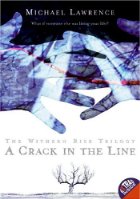
Book Review: A Crack in the Line by Michael Lawrence (Series, #1) (Bottom of TBR Pile Challenge)
 Summary:
Alaric lives in the crumbling Withern Rise house with his widowed father. Nothing has been the same since his mother’s death in a train accident two years ago. Now his dad is off helping his girlfriend get ready to move in with them, and his crazy Aunt Liney is there to keep an eye on him. Miserable, he touches a carving his mother made of the house from wood from the family tree years ago and finds himself transported to a parallel universe where a girl, Naia, is living his life–only with their mother still alive.
Review:
This may be one of those YA books that only someone in the midst of teen angst can truly appreciate, or perhaps an adult with a strong fear of losing their mother.
Alaric is an angsty teen, perhaps with good reason, but he’s annoying nonetheless. Thankfully, his Aunt Liney is present, and she is a breath of fresh air. The long-suffering, quirky aunt who was almost aborted and does not exist in the alternate reality is clearly important, but we never find out why. Probably this is key later in the trilogy, but I doubt I’ll struggle through simply to find out just how she’s a key factor. I also must admit that I find the obvious pro-life slant in Aunt Liney’s storyline annoying.
Although Alaric’s motivation for coming to and continually returning to the Naia’s parallel universe is clear, her motivations are not. Her world seems quite ideal, and Alaric is an unwelcome intrusion into it. She does not seem to possess a naturally curious or quizzical nature. This leaves half of the plot, Naia’s part in it, unclear.
The parallel worlds are interesting, but not nearly as creative as, say, Stephen King’s. The differences are all incredibly minor, based off of decisions and chances playing out in two different scenarios. A baby could be a boy or a girl. A mother could live or die. A sister could be aborted or kept. Yet how Lawrence draws the line on what counts as a chance or a decision is very unclear. Is every single choice and instance a decision? That would make the universes go on forever, which just seems highly illogical and improbable. I simply could not sustain my disbelief quite enough to get into it.
All of that said, I could see a teenager enjoying this story. Particularly one upset with his parents or wishing his life was minutely different in some way. I thus recommend it to a teen into fantasy and the concept of parallel universes.
3 out of 5 stars
Source: PaperBackSwap

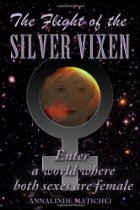
Book Review: The Flight of the Silver Vixen by Annalinde Matichei (series, #1)
 Summary:
Somewhere in outer space is an alien race consisting entirely of females. It’s not that the men are missing; they never existed. This race is known as intermorph, and those like our own are schizomorph. A teenage hover bike gang steals a space craft and finds themselves on a troubled intermorph planet where they must band together and fight as warriors against demons, internal enemies, and a neighboring aggressive schizomorph race.
Review:
This book reads distinctly like what would happen if you gave a bunch of ten year old girls the ability to record their imaginary playtime into a book and try to sell it. Everything from the dialogue to the plot screams, “A bunch of ten year old girls who like being girls but still think boys have cooties wrote this one day playing in their back yard.”
The writing is really bad. Clear characterization is almost non-existent. I was still uncertain as to who exactly various people were at the end of the book. The dialogue reads as so fake that it makes you cringe. It’s full of made-up words and ways of speaking that aren’t explained at all until a glossary at the end of the book. For example, the intermorphs don’t swear, but they do exclaim “g’doinking” when upset. See what I mean about ten year old girls? If I was, for instance, a middle school English teacher, I could see some merit in the writing and would encourage the young person to continue. This, however, is not a middle school English class. This is supposed to be a well-written, well-realized, novel. It is not.
Then there is the whole entire concept in and of itself. A race of just women absolutely can be a creative way to explore gender and sexuality, and I’ve seen it done well by famous feminist scifi authors. This is not done well, however. The intermorphs are all either brunettes or blondes with the brunettes fulfilling the traditional male role, and the blondes fulfilling the traditional female role. Everything about how they interact is a carbon copy of a traditional patriarchy. Just because both genders have vaginas doesn’t make how the brunettes treat the blondes less offensive. I also was incredibly disturbed at how the female main characters talked about the male schizomorphs. They referred to them as “it” and as animals. Even beards on men were degraded and feared. It’s the first time I’ve seen a book somehow manage to be both misogynistic and misandrist. This in and of itself is enough to warrant one star from me, even if the writing was good. This is not a healthy way to perceive men, women, gender, or sexuality.
I absolutely cannot recommend a piece of bad writing full of unhealthy perceptions of gender and sexuality to anyone. My hope is that the author is still quite young and with time will grow to more mature opinions, as well as more mature writing.
1 out of 5 stars
Source: Kindle copy received from author in exchange for my honest review

 Support my work with a tip or browse my shop for curated book club guides, how to guides, cross-stitch patterns, and more!


This work by Amanda Nevius is licensed under a Creative Commons Attribution-Noncommercial-No Derivative Works 3.0 United States License.
 Opinions of a Wolf