
Archive
Book Review: Siren by John Everson
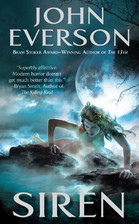 Summary:
Evan walks the seacoast of his small town every night reliving the horror of watching his son drown. But one night he hears a beautiful song and discovers a perfectly naked, perfectly beautiful woman attached to it. As he begins an affair, willfully oblivious to anything about the woman beyond her beauty, he fails to realize he is falling for the siren of Delilah.
Review:
I picked this up during one of the monthly kindle book sales on a whim, and am I glad I did! This book was simultaneously terrifying and electrifying. The flip-flop between fear and titillation was a truly delightful reading experience, and it came with a well thought-out plotline and delicious settings to boot.
Evan is not a likeable guy. In fact, Ligeia, the Siren, is more likable than he is, and she routinely rips people’s throats out with just her teeth. But disliking Evan works for the story. It lets the reader invest in Ligeia and see her side of things. There are ways in which she is a monster, yes, but there are also ways in which she is quite human. Having a deeply flawed male “victim” to her charms allows the reader to see the monster in us all.
Both the horror and the sex scenes are adeptly written. The sex scenes are titillating without being too much, and, similarly, the horrific scenes are grotesque without going too far. The presence of both in the story makes for an ever-changing, exciting read. Similarly, the plot is complex without being overly so and managed to keep me guessing. It also strikes the balance quite well.
I also really enjoyed the light commentary on hunting and eating another species. It provides a depth to the story beyond simply lust leading one astray.
Kind of puts a whole new spin on fishing, doesn’t it? Here you men are always out there reeling in the fish, and here’s a half-fish woman who’s reeling in the men. (page 146)
Of course, there is also commentary on cheating and the other woman. There has to be, since Ligeia is Evan’s mistress. I must admit that that basic plot can sometimes upset me, so I do think it distracted me a bit from enjoying the book as much as I would have otherwise. On a similar note, the ending is not quite what I would have hoped for, although it did make sense in the context of the story.
Overall, this is an interesting mix of horror and erotica that is fast-paced and enjoyable. Those sensitive to cheating as a plot device or explicit deaths may want to exercise caution. Recommended to those who would enjoy their horror and erotica together.
4 out of 5 stars
Source: Amazon

Book Review: Oranges Are Not the Only Fruit by Jeanette Winterson
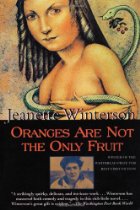 Summary:
Jeanette has the dubious distinction of being raised by one of the most vocal women in the fire-brand style Evangelical church in a small British town. Although she at first is different among her school chums for her beliefs, soon she becomes marked as different in her church for her homosexuality. Her journey from differently religious to outcast young adult is chronicled here.
Review:
I picked this up when I heard that it’s a lesbian classic that simultaneously addresses being raised fundy. Having been raised fundy myself (and left), I tend to find these leaving the faith stories highly relatable, and I knew the added queer element would just make it all the more interesting of a read for me.
One interesting thing to note about this book is that no one can quite agree if it’s a novel or a memoir. Winterson herself says that while this was inspired by her own childhood, it is the lite version. Hers was much worse. Given this statement, I choose to respect the author and view this as a novel, but potential readers may want to be aware of this element of the book.
Jeanette (the character) is immediately immensely likeable. Whereas her mother is overbearing and negative, Jeanette is highly intelligent and witty. Her observations on the Bible and religion in the early parts of the book before she realizes she is gay are hilarious, particularly to anyone raised in a fundamentalist faith.
I didn’t know quite what fornicating was, but I had read about it in Deuteronomy, and I knew it was a sin. But why was it so noisy? Most sins you did quietly so as not to get caught. (location 533)
As the book moves from Jeanette’s early life to her adolescence the writing style changes a bit. Winterson inserts various fantastical fancies of Jeanette’s that are clearly her way of trying to discover who she is and explore her options. Some readers might be thrown by these, but I found them delightful. It’s a coping mechanism that I think many people use but few authors put down on paper.
Through these periodic fantastical tales combined with the more traditional narrative, we slowly see Jeanette fall in love with another girl at her church. We then see the fall-out. The two girls torn apart. The attempts at exorcisms. Jeanette is left bereft and confused because, unlike myself, she still wanted her faith. She wanted to believe in God the way she was raised to and to be allowed to love women. She can’t figure out why she can’t have both and thus is left wandering lost and confused.
The novel never makes it clear if Jeanette comes to terms with her lesbianism by letting go of her religion or by finding a more accepting one. It kind of ends on an uncertain, agnostic if you will, note. But that’s really irrelevant. What matters is how beautifully the novel shows the pain that adolescents are needlessly put through when those around them won’t love them for who they are.
At last she put on her gloves and beret and very lightly kissed me goodbye. I felt nothing. But when she’d gone, I pulled up my knees under my chin, and begged the Lord to set me free. (location 1180)
It’s not a book with a clear ending or easy answers, but neither is life really, is it? What it does possess though is a great ability to show a reader the life of a child raised Evangelical who later just cannot fit the mold demanded of her. And that’s a powerful story that needs to be told over and over again until people get it that we can’t do that to children.
Recommended to those with an interest in unique story-telling techniques and coming out stories.
4 out of 5 stars
Source: Amazon

Book Review: Blackbirds by Chuck Wendig (Series, #1)
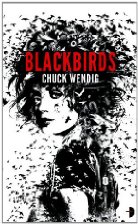 Summary:
Miriam Black is an early 20-something drifter with bleach blonde hair and a surprising ability to hold her own in a fight. She also knows when and precisely how you’re going to die. Only if you touch her skin-on-skin though. And it’s because of this skill that Miriam became a drifter. You try dealing with seeing that every time you touch someone. But when a kind trucker gives her a lift and in her vision of his death she hears him speak her name, her entire crazy life takes an even crazier turn.
Review:
This is one of those books that is very difficult to categorize. I want to call it urban fantasy, but it doesn’t have much supernatural about it, except for the ability to see deaths. The world isn’t swimming in vampires or werewolves of goblins. I also want to call it a thriller what with the whole try to stop the trucker from dying bit but it’s so much more than chills and whodunit (or in this case, who will do it). Its dark, gritty style reminds me of Palahniuk, so I suppose what might come the closest would be a Palahniuk-esque urban fantasy lite thriller. What I think sums it up best, though, is a quote from Miriam herself:
It starts with my mother….Boys get fucked up by their fathers, right? That’s why so many tales are really Daddy Issue stories at their core, because men run the world, and men get to tell their stories first. If women told most of the stories, though, then all the best stories would be about Mommy Problems. (location 1656)
So, yes, it is all of those things, but it’s also a Mommy Problems story, and that is just a really nice change of pace. Mommy Problems wrapped in violence and questioning of fate.
The tone of the entire book is spot on for the type of story it’s telling. Dark and raw with a definite dead-pan, tongue-in-cheek style sense of humor. For instance, each chapter has an actual title, and these give you a hint of what is to come within that chapter, yet you will still somehow manage to be surprised. The story is broken up by an interview with Miriam at some other point in time, and how this comes into play with the rest of the storyline is incredibly well-handled. It’s some of the best story structuring I’ve seen in a while, and it’s also a breath of fresh air.
Miriam is also delightful because she is unapologetically ribald and violent. This is so rare to find in heroines.
We’re not talking zombie sex; he didn’t come lurching out of the grave dirt to fill my living body with his undead baby batter. (location 2195)
As a female reader who loves this style, it was just delightful to read something featuring a character of this style who is also a woman. It’s hard to find them, and I like that Wendig went there.
While I enjoyed the plot structure, tone, and characters, the extreme focus on fate was a bit iffy to me. There were passages discussing fate that just fell flat for me. I’m also not sure of how I feel about the resolution. However, I’m also well aware that this is the beginning of a series, so perhaps it’s just that the overarching world rules are still a bit too unclear for me to really appreciate precisely what it is that Miriam is dealing with. This is definitely the first book in the series in that while some plot lines are resolved, the main one is not. If I’d had the second book to jump right into I would have. I certainly hope that the series ultimately addresses the fate question in a satisfactory way, but at this point it is still unclear if it will.
Overall, this is a dark, gritty tale that literally takes urban fantasy on a hitchhiking trip down the American highway. Readers who enjoy a ribald sense of humor and violence will quickly latch on to this new series. Particularly recommended to readers looking for strong, realistic female leads.
4 out of 5 stars
Source: Netgalley

Book Review: Roadside Picnic by Arkady and Boris Strugatsky
 Summary:
When the aliens landed, they ignored humanity. Stopping briefly on their way somewhere else. Leaving behind mysterious random detritus, much like the remains left behind a roadside picnic. Redrick happened to live in one of the towns visited, and as a result has become a stalker. He sneaks into the Zone to gather alien artifacts to sell on the black market. Soon his whole life–and those of everyone in the town–becomes dominated by the Zone.
Review:
When I saw that this was Russian scifi from the Soviet era, I knew that I needed to pick it up, if for no other reason than that I’d never seen any before. This new print has been returned to the authors’ original vision, with the heavy edits (really, censorship) removed. It also starts with an introduction by Ursula K. LeGuin. I want to highlight one thing she says about scifi that I think truly illuminates its power.
Soviet writers had been using science fiction for years to write with at least relative freedom from Party ideology about politics, society, and the future of mankind. (location 22)
Scifi provides an opportunity for writers and readers to remove the shackles of whatever society they are currently living in and imagine the other. I think that’s a very powerful tool, and I commend the Strugatsky brothers for utilizing it in such a way from behind the Iron Curtain. They had to fight for years to get some version of this book published, in spite of being well-known and respected authors. That is a commitment to their art that is truly admirable. Now, on to the review of the actual book.
The germ of the idea is truly brilliant and is immediately clear. This idea of an alien race stopping by for a picnic, essentially, and ignoring humanity like so many ants. It’s so different from the more egotistical interpretation of alien visitations that we usually see. The book was worth the read for that alone. The early scenes are vivid and clearly establish this post-visitation situation where the Zone the aliens landed in is uninhabitable, and the government and scientists are trying to study it while stalkers sneak in (at great risk to their lives) to extract artifacts for the black market. Similarly, the artifacts that the stalkers (and government) find and bring out of the Zone are wonderfully imagined. It is easy to see that the authors probably knew exactly what the aliens used the items for whereas the characters in the book are clueless. Trying to find any use they can for them.
The book though is truly about Redrick. It uses the scifi setting to explore this man who really just wants to escape the rat race and have a comfortable life with his family. He chooses to attempt to be his own boss by being a stalker in the Zone and is repeatedly thrown in prison for it. We never really see him as a whole man, since we only saw him after the Zone. It is as if the presence of the Zone gave him hope, and the repeated failures slowly rob him of his life energy.
My whole life I’ve been dragged by the nose, I kept bragging like an idiot that I do as I like, and you bastards would just nod, then you’d wink at each other and lead me by the nose, dragging me, hauling, me, through shit, through jails, through bars…Enough! (location 2295)
In spite of this excellent set-up and interesting character arc, the book didn’t fully satisfy me. I found Redrick difficult to sympathize with. He thinks he is a slave to the system, but really he is choosing to be a slave to money. He could have left the town and the Zone behind multiple times to go live a life with his family, but he doesn’t. I understand others might interpret his freedom of movement differently from me, but that is how I saw his situation. It seems most of his problems come from a love of not just money but a love of wealth. So although I periodically sympathized with what he was saying, I didn’t ultimately sympathize with him.
What I truly found disappointing though was the ending. Without giving too much away, suffice to say that while the rest of the book was realistic scifi, couched in darkness and despair, the ending was surprisingly positive in a deus ex machina manner. It felt like a real cop-out, particularly compared to the rest of the book. Whereas most everything else was innovative, this was generic, ho-hum, and disappointing. While I was still glad to have experienced Redrick’s world, the ending kept the book from truly grasping me or blowing my mind.
Overall, then, this book is an important piece of both Russian and scifi literature. It has enough uniqueness of setting to it to keep the well-versed reader of both genres interested but beware that the main character might not be entirely sympathetic, and the ending is a bit disappointing. Recommended to fans of Russian or scifi literature.
3.5 out of 5 stars
Source: Netgalley

Book Review: Deadly Row to Hoe by Cricket McRae (Series, #6)
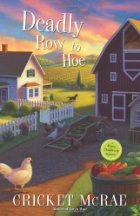 Summary:
Sophie Mae and her best friend decided to join a CSA (Community Supported Agriculture) as soon as the opportunity popped up in their small town. One day when they’re volunteering at the farm, a dead body is found in the compost heap. Sophie Mae is determined not to get involved this time, after all, she’s got enough on her plate with her soap making business and trying to make a baby with her husband, Detective Barr. But Barr’s boss asks her to help identify the body by talking to the folks in the community , and she just can’t say no.
Review:
Cozy mysteries consist of a mystery (that’s not too explicit or bloody) paired with an unlikely investigator, some sort of crafting, a good dose of humor, and a punny title. In other words, they were basically made for me. (Some even come with recipes!) So when this one popped up on NetGalley, I snatched it up, and I’m so glad I did! McRae successfully pulls together everything that makes a cozy great.
The plot is excellent. The murder mystery isn’t too gory, but is also realistic. The body is found in a compost heap, yes, but it’s just a dead body. There aren’t slashed off heads hanging out in tea kettles or something. Everyone is appropriately disturbed by the finding. There’s no ho-hum just another day element at play. Although I admit I had figured out whodunit before the end, the why and when were still a mystery. Plus I never felt that Sophie Mae was being stupid and just missing something. Why it was taking her a bit to see whodunit made total sense. I also really appreciate that GLBTQ people are included in the plot without a big deal being made out of it. They are just another character, which is just how I like my diversity in genre literature.
The characters are fairly three-dimensional for a cozy. Everyone had something I liked and didn’t like about their personality, even the heroine, which is key to characters seeming realistic. There were also a wide variety of people present from Sophie Mae’s best friend’s daughter to an elderly friend of the family. This range is something that is often missing in literature, and I liked seeing it here.
What I really come to cozies for, though, I admit, is the integration of crafting. In this case the theme is participating in a CSA, so parts of the book are devoted to how a CSA works from acquiring your weekly allotment to figuring out how to use it to cooking with it. I really appreciated the quips about having so much of a certain produce that they’re coming out your ears. I also really enjoyed the scenes that discussed taking real time out to cook dinner and what that feels like, such as talking about how garlic smells when you first throw it into a hot pan. I know not all readers enjoy this, but honestly that’s part of the point of a cozy. Taking the time to linger on crafts and talents that take time to cultivate but are well worth it, and McRae incorporated this element very smoothly into the book. I do wish some recipes or CSA tips had been included, but it’s possible I just didn’t see them since I had an advanced copy.
Overall this book has a dash of everything enjoyable about a cozy mystery. Recommended to cozy fans, particularly those in or considering a CSA.
4 out of 5 stars
Source: NetGalley

Previous Books in Series:
Lye in Wait
Heaven Preserve Us
Spin a Wicked Web
Something Borrowed, Something Bleu
Wined and Died


Book Review: Above Ground by A. M. Harte (Series, #1)
 Summary:
Lilith Grey has spent her entire life living below ground–among the lucky descendants of the humans who escaped there before catching the virus that turned the rest of humanity into monsters from fairy tales. But one day Lilith and her friend Emma get temporary vaccines and go above ground to a tourist theater to view these vampires and shapeshifters in person. When everything goes horribly wrong, Lilith finds herself whisked away from the carnage on the back of a werewolf. Can she ever get back below ground?
Review:
I was hesitant to accept a YA book for review, since the genre is not one I tend to enjoy. But I had previously read and thoroughly enjoyed a book by this indie author, so I decided to give it a go. Her other work, Hungry For You
The basic concept is intriguing. Many post-apocalyptic stories feature humans living in bomb shelters or other similar underground enclosures but not for the reasons put forth in this novel. This unique twist is what I’ve come to expect from Harte’s writing, and it definitely was the part of the story that kept me reading. Seeing how the mutated humans lived above ground versus how the non-mutated lived below ground was intriguing and interesting. I wish more time had been spent building this world and less on the emotions of the main character (not to mention her friend, Emma, and the werewolf, Silver). The scifi explanations for the fantastical creatures was also engaging, but again not enough time was spent on it. Similarly, while the typical werewolves and vampires exist among the infected above ground, there are also the more unique such as the ewtes who mutated to live in the water but can walk on the ground with water tanks. Actually, I could have easily spent an entire book among the ewtes. They were far more interesting than our stereotypical main character Lilith. The world and minor characters are what kept me reading….not the plot or main characters.
The initial plot set-up is painfully stereotypical. Clueless teenage girls wind up in danger. Two men save them. One is an angst-ridden werewolf. The other is a mysterious, handsome intelligent fella. The girls protest they can care for themselves but the reader can see they can’t really. The main teenage girl feels inexplicably pulled to the werewolf angst man. The werewolf angst man feels drawn to the teenage girl and angsts about it. And on we go. The last few pages of plot, thankfully, didn’t take the typical turn, but honestly the pay-off was incredibly minor compared to the rest of the stereotypical YA plot. Even just making it a teenage boy from below ground saved by a female werewolf would have been a change enough to make me more interested. I also was disappointed to see no depth or examination of the human condition here, which I saw in Harte’s previous work. I was excited to see what depth she could bring to YA but she didn’t even bring an empowered female main character to the genre. Quite disappointing.
Ignoring my own quips with the plot and main characters, the book simply does not read like a solid first entry in a series. It gives the reader mere tastes of what we want to know from a first book in a series, like who the DEI are and why everyone is afraid of them, while lingering on things like how the main character craves the werewolf. That is fine if it was a paranormal romance, but it feels more like it is meant to be a post-apocalyptic/dystopian style novel. A clearer world needs to be established and characters more fully fleshed-out if they are to hold up a whole series. There has to be a clear world and a three-dimensional main character set up before the danger if the reader is to feel any connection or caring at all. As it is, I mostly just wanted to wander off and follow the ewtes.
Overall, then, this is definitely a book for YA fans only. It’s the basic plot from YA with a twist set in a unique future world that was fun to visit. YA fans will have to try it out for themselves to determine how much they will enjoy that visit.
3 out of 5 stars
Source: Kindle copy received from author in exchange for my honest review

Giveaway! The author is running a giveaway along with her month long blog tour. Check out the rafflecopter for details!
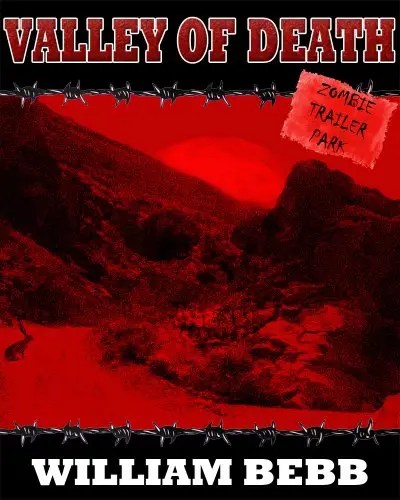
Book Review: Valley of Death, Zombie Trailer Park by William Bebb
Summary:
When Josey arrives a secluded trailer park near Albuquerque to empty their septic tank, it soon becomes apparent that not all is right in the park. In fact, most of the residents have turned to zombies. As Josey’s fight for survival goes on, we meet a quirky cast of survivors, bystanders, perpetrators–and zombies: illegal immigrants who call the valley home, their exploitative factory boss, a WWII veteran and grandpa, his young grandson, a paraplegic Vietnam Vet, a boa constrictor, bicycling missionaries, and many more. Will anyone survive the valley of death?
Review:
I have finally found the exception to my don’t-take-book-recommendations-from-other-people rule: my daddy. My dad texted me and told me he was reading a book about a zombie trailer park and asked if I’d like to borrow it when he was done. I couldn’t turn that down, so he sent his kindle loan to me as soon as he was finished reading it. I knew within the first few pages that my dad had picked a winner. That really shouldn’t surprise me, because, well, it’s my dad, and we’re very similar, but I had been burned a few times with book recommendations recently. Anyway. On to the review!
Bebb’s book is a fresh, engaging take on a zombie outbreak. The origin is a factory error, which is decidedly different from the more usual government experimentation or voodoo approach. It’s great commentary on the exploitative practices of factories, not to mention the exploitation of illegal immigrants, without ever being too heavy-handed or preachy. The zombies are a mix of the rage virus and traditional undead. Before dying they are inexplicably full of rage and will eat almost anything but also when they die they reanimate. It’s a cool mix, and I enjoyed it.
The cast of characters is incredibly imaginative, diverse, and even-handed. People are truly just people (or zombies) regardless of age, gender, or ethnicity. And, really, how many books can say they have a WWII vet, a sewer truck worker, a mechanically talented Latina, a wheelchair-bound obese meth chef, a loyal dog, bicycling missionaries, and a pot-growing paraplegic Vietnam Vet. I mean, really. And none of them are two-dimensional caricatures either. They are all well-rounded and presented with thought and humanity. I also never had that problem I sometimes have in books where you can’t tell the different characters apart. Everyone was entirely unique and easy to remember.
The plot is complex. I honestly did not know how it was going to end, and it maintains a fast pace throughout. I was never bored and was never entirely certain what was going to happen next. That’s coming from a big zombie fan, so I do think that’s saying something significant about the uniqueness of the engaging plot.
What really makes the book, though, is the sprinkling of humor throughout. This type of humor won’t match everyone, but it certainly works for me. I described it to my dad as “Patrick F. McManus with zombies,” but if you don’t get that reference, it’s hard to describe the humor. So, here are a couple of quotes from the book to demonstrate it.
Your average one armed pot growing hermit who just murdered two men might be thinking about a variety of things. (location 2592)
Crazy cop fuckers done bit off my titty! (location 5423)
That second one….oh man. I laugh every time I see it.
So with all this love, why not five stars? Well, much to Bebb’s chagrin, I’m sure, there aren’t enough commas. (His author’s intro states that previous reviews said there were too many and now people will probably think there are too few. Sorry to confirm that suspicion, Bebb!) Compound sentences tend to run on and on with no commas or semi-colons, which can be a bit frustrating to read. Also, the book isn’t quite properly formatted for the kindle. Its display varies from section to section. Similarly, while some sections are clearly divided by a dividing line (such as with tildes “~~~~”), others just have a big gap, which is not what one should use for ebooks. With the variety of ereaders, it’s important to use something besides space as a signal that the reader has entered a new section, since the space can display drastically differently on different readers. It’s best to use something like the tildes between sections. Using empty space is a holdover from print that doesn’t work. Bebb did use the tilde line in some sections, but not all, so there’s also a bit of a consistency problem.
Overall, though, the formatting and comma issues did not distract me from the wonderfully unique and humorous zombie trailer park story. I’m so glad my dad discovered this indie author and passed his work on to me, and I look forward to reading more of it in the future. Highly recommended to all zombie fans, provided you like the type of humor outlined above.
If you found this review helpful, please consider tipping me on ko-fi, checking out my digital items available in my ko-fi shop, buying one of my publications, or using one of my referral/coupon codes. Thank you for your support!
4 out of 5 stars
Length: 363 pages – average but on the longer side
Source: Borrowed
Buy It (Amazon. Not available on Bookshop.org.)
ETA: Had a delightful email convo with the author, and we determined that I read an older version of the book. The current one available should have mostly cleared up editing/layout concerns.
Book Review: Leaving Atlanta by Tayari Jones (Audiobook narrated by ensemble)
 Summary:
It’s 1979 in Atlanta, Georgia, and someone is kidnapping–and killing–black children. How this terror haunts one fifth-grade classroom is told through three different perspectives. Tasha, whose parents are “living apart” for a while. A painfully intelligent boy named Rodney who does not actually consider himself lucky to still have his father at home. And Octavia, better known as Sweet-Pea by her family and Watusi by her classmates. She’s the darkest-skinned child in the classroom, and is ridiculed by them all, but she has a spirit that outshines everyone.
Review:
The Atlanta child murders of 1979 to 1980 were a real thing that overshadowed the author’s own childhood. Jones clearly remembers what it was to be in fifth grade and relates those emotions with raw detail, but she also brings along an educated adult’s understanding of race and race relations in the American south. This all combines to create a powerful story that sweeps the reader away to another place and time while simultaneously leaving them with greater understanding.
The book is divided into three sections. Each child’s tale is told through a different narrative method. Tasha’s uses third person. Rodney’s second person, where the reader is told “you are” in an attempt to put the reader closer into Rodney’s shoes. Finally, Octavia’s is told in first person. Tasha’s story covers the first part of the school year, Rodney’s the second, and Octavia’s goes through January. It’s an interesting narrative choice that ultimately works. The reader sees three different reactions to the child murders and race relations at three different points in the crisis, in addition to the children’s observations of other people’s reactions. It provides a multi-layered perspective that clearly demonstrates the complexity of all points the story touches upon: crime, race relations, broken families, class issues, and even just the process of growing up.
I appreciate the narrative complexity that Jones chose, but I do feel the story told suffers a bit. I identified so much more strongly with Octavia than either of the other two children because her voice and personality were able to shine through so much more clearly. Of course, it’s possible that this is the whole point. In fact, it does feel a bit like the whole book is just building up to Octavia’s story. But although I had a similar level of attachment to Tasha, I simply didn’t feel that way for Rodney. Part of that could have been the narrator chosen for Rodney. His voice was rather flat and dull without the nuance of the other two narrators. But I don’t think that the second person narrative tense helped much. Thankfully, Rodney’s portion of the book was quick, and the other two sections more than made up for it.
Speaking of the other two narrators, I feel bad that I was unable to find any of the ensemble’s names. The women who narrated Tasha and Octavia did a phenomenal job. They captured both the age and the dialect of the children without once slipping into a tone that could be perceived of as false or mocking. They truly embodied the little girls, and I felt I got something extra from listening to the audiobook, which is precisely how it should feel. It’s unfortunate that the narrator for Rodney failed to do the same thing, providing a rather lackluster, mediocre performance.
The social justice commentary enmeshed in the book is brilliant. One cannot possibly read this book and not see how racism and entrenched classism negatively impacts children and families. Even at ten, these children get it that the media and police care less about them getting kidnapped that they would if they were white. Even at ten the children have already learned racism so well that they ostracize the darkest child in their class. (This book made me very interested in reading more about racism within the black community). Most powerful to me, though, particularly after reading the books in The Real Help Reading Project, is how subtly Jones demonstrates the difficult choices parents and other adults must make to provide what is best for their children and how that is exacerbated by inequality. I’d be more clear, but that would give away the ending of the book. Suffice to say it’s a powerful message presented in a subtle manner through a little girl with whom it is impossible not to establish a connection.
Overall this is an engaging, thought-provoking piece of historical fiction. It brings the reader directly into a classroom of fifth graders to see how not just a kidnapping and killing spree but also enmeshed racism and sexism impact the present and future of children. Recommended to fans of historical and literary fiction.
4 out of 5 stars
Source: Audible

Book Review: The Loving Dead by Amelia Beamer
 Summary:
When Kate saves her bellydancing instructor from a random assault in the parking lot then brings her home to a party at her house full of 20-somethings, she doesn’t expect much to come of it. But before she knows it, she finds herself inexplicably attracted to her…not to mention tying her up for some BDSM. That’s unexpected enough, but when Jamie and others turn pasty gray and start craving human flesh, Kate and her roommates find the world falling apart around them. Thanks to an STD-style zombie plague.
Review:
Zombie erotica is its own special kind of erotica, and this is not the first of its kind that I have read. Zombie erotica basically consists of….zombies and erotica. Also punny titles. The title is definitely the best part of this book. Everyone I said it to when they asked what I was reading totally cracked up. The basic concept is rather ordinary, and the execution, while it has a few laughs, is mostly ho-hum.
Making the zombie plague an STD is a logical leap. Many illnesses spread sexually, and often they spread before there are any visible symptoms. In fact it’s a great way to spread an illness because of the amount of *ahem* proximity between carrier and the previously healthy person combined with the fact that people almost always will be having sex. Toss in that the virus amps up attractiveness and/or promiscuity, and you’ve really got an epidemic. The problem, of course, is that at some point the carriers have to actually turn into zombies. Beamer handles this transition moderately well. It is eventually understood that the carriers are basically irresistible crack-cocaine to the nearby uninfected, so that even if they know this person is about to turn into a zombie, they will still hook up with them.
It’s unfortunate that such a creative zombie plague is wrapped in a mostly ho-hum storyline that only becomes interesting when it becomes borderline offensive. For the most part the story features two of the roommates in a household of 20-somethings approaching the zombie apocalypse getting separated early on, approaching the zombie apocalypse in their own way, then working to get reunited. Michael tries to pull the household together when Kate abandons ship pretending that nothing is happening to keep her “date” with an older man that is actually more of a sugar daddy appointment. Michael’s storyline is fairly straight-forward and believable, whereas Kate’s quickly goes off the rails. I also am not sure that I’m a fan of the whole writing her as a huge slut who winds up having to pay for her crimes whereas Michael is the golden guy thing. I don’t think Beamer intended it be read that way, but it certainly does not come across as sex positive.
The other part of the storyline that bothered me is that there is a rape. Now. I am not against rape as part of the plot in anything but erotica. It is a crime that happens and pretending like it doesn’t happen is bizarre. But rape in erotica is an entirely different ballgame. Erotica is all about turning on the reader, and I do not condone using a very real rape to turn a reader on. Clearly two consenting adults can agree to act out a scene of non-consent if they wish, but within the book, this is not a consenting scene of non-consent. There is no prior discussion, no safeword. The character is definitely raped. To me it is no different from tossing in a pedophilia scene. It is an awful, heinous crime, and it shouldn’t be running around turning people on. When a book’s entire point is to turn people on, it should definitely not be all up in my erotica.
All of that said, I must still admit that the book is well-written. It is engaging with a unique plot. I truly feel it is a book that each reader must decide upon for themselves, but I do hope that readers will come into it better informed than I was, knowing about the questionable sex positivity and the rape content.
2.5 out of 5 stars
Source: Amazon

Book Review: The Preying Mantis by Andreas Louw
 Summary:
FBI agent Betty Roy has been pursuing one serial killer for years. He murders one young female teacher who plays a musical instrument per season. Suddenly, though, he contacts Betty herself and starts ratcheting up the rate of the killings. He seems to have some sort of personal interest in her.
Review:
I picked this up during the Smashwords Summer/Winter sale for two reasons. The plot sounded intriguing, and honestly the cover amused me. What I found inside was a plot that was mostly strong (although it fell apart at the end) that was unfortunately supported by some truly bad writing.
Let’s start with the good. The plot is genuinely creepy. Although the Preying Mantis (as he calls himself) is fairly typical for a serial killer thriller, he’s got enough unique qualities that the reader is left intrigued and guessing. The murder scenes are brutal and frightening. I was engaged enough that I kept reading in spite of the bad writing quality, purely because I wanted to know what happened at the end.
Unfortunately, the plot at the end takes a bit of a nonsensical nose-dive. I have an incredibly difficult time believing that the FBI would let an agent recently removed from a serial killer case who they know is currently being pursued by him run off into the middle of the woods without backup. Or some sort of catch the criminal plan she is in on. Similarly, I have major issues believing this same FBI agent would be stupid enough to go to the woods at this point in time, let alone go there without her big guard dog that she instead leaves at a friend’s house. It’s a lot of characters acting stupid just to get them to where the author needs them to be. Thankfully, that only shows up at the end.
As for the writing itself, there are three separate issues at hand.
First up, we have an omniscient third person narrator telling a story that takes place almost entirely in New York City with American characters, and yet the narrator repeatedly speaks British English. This is bizarre, confusing, and jolts the reader out of the story. I actually had to check a couple of times and make sure the story was indeed happening in NYC. Here are a few examples:
She had met the old man before and knew his heart was a bit dodgy. (location 1095)
He thought it best not to point out at this stage that if he had been shagging Wells’ wife, he might not have been gay. (location 2306)
Betty came out of the shower, refreshed, and took out a pack of crisps and a soft drink. (location 3553)
In case it’s unclear, Americans don’t say dodgy, shagging, or crisps. We say sketchy, banging, and chips. I suppose it’s possible that Louw could want the narrator of this event taking place in America to be British, but if so, it should be for a reason. For instance, it would make sense if the story was being told by a British person researching the killer at a later date. That is not the case, though. As previously pointed out, this is an omniscient third person narrator telling a story set in America. They should speak American English. The British English also drifts into the American characters’ dialogue, but there are far larger problems with the dialogue, so I won’t bother citing those. Suffice to say though that if it’s a problem for the narrator to speak British English it’s an even larger one for the American characters to do so.
Speaking of dialogue (see what I did there), let’s get to that. The main problem with the dialogue is that it doesn’t sound realistic. At all. Also every single character sounds exactly the same. The Latino-American cop sounds exactly like the white American FBI Agent who sounds exactly like the serial killer who sounds exactly like the head of the FBI’s investigation. And none of them sound realistic. Rather than try to explain it, let me show you.
I shall go mad if I don’t have anything to do for the next two weeks. (location 310)
Would you like to order out? I am quite hungry and can do with some sustenance. (location 1213)
After about fifteen minutes he emerged form his office and said, “Let us go.” (location 2868)
How come you being here all by yourself in the middle of nowhere, dear? (location 3617)
The only way dialogue like this would work would be if, say, one character was OCD about never saying a contraction or had Asperger’s Syndrome or something. But none of the characters are like that and also they all speak exactly the same way. It’s a real problem for dialogue to sound so incredibly unrealistic. It drags the reader out of the story, plus it’s bad characterization. Each character should have an individual sound.
Finally, there are the general grammar/spelling issues. The most annoying being the author’s tendency to switch back and forth between present and past tense, frequently within the same sentence. For example:
She had been hunting him for the last two years and it reached the point where he has invaded every aspect of her life. (location 123)
Lemke had played this kind of game before and he is definitely not going to let someone like Newmark get under his skin. (location 669)
Shudders up and down my spine, y’all. And not the kind you’re supposed to get from reading about a serial killer.
Overall, the book has a relatively unique plot that is overshadowed by a first draft quality level of writing. I encourage Louw to get either a co-author or an editor for future endeavors, as well as a wider variety of beta readers. Sound editing and checks by beta readers could have cleared up many of these issues.
2 out of 5 stars
Source: Smashwords
 Support my work with a tip or browse my shop for curated book club guides, how to guides, cross-stitch patterns, and more!


This work by Amanda Nevius is licensed under a Creative Commons Attribution-Noncommercial-No Derivative Works 3.0 United States License.
 Opinions of a Wolf