
Archive
Book Review: Soul Surfer: A True Story of Faith, Family, and Fighting to Get Back on the Board by Bethany Hamilton

A powerful disability memoir about faith, resilience, and healing after a shark attack.
Summary:
They say Bethany Hamilton has saltwater in her veins. How else could one explain the passion that drives her to surf? How else could one explain that nothing—not even the loss of her arm—could come between her and the waves? That Halloween morning in Kauai, Hawaii, Bethany responded to the shark’s stealth attack with the calm of a girl with God on her side. Pushing pain and panic aside, she began to paddle with one arm, focusing on a single thought: “Get to the beach….” And when the first thing Bethany wanted to know after surgery was “When can I surf again?” it became clear that her spirit and determination were part of a greater story—a tale of courage and faith that this soft-spoken girl would come to share with the world.
Soul Surfer is a moving account of Bethany’s life as a young surfer, her recovery after the attack, the adjustments she’s made to her unique surfing style, her unprecedented bid for a top showing in the World Surfing Championships, and, most fundamentally, her belief in God. It is a story of girl power and spiritual grit that shows the body is no more essential to surfing—perhaps even less so—than the soul.
Review:
In many of the circles I’m in, “recovery” means recovery from addiction. But it can also mean recovery from trauma—and for many of us (studies suggest around 75%), those things are intertwined. That’s part of why memoirs about recovering from trauma resonate so deeply with me. I’m especially drawn to the ones that focus not on the traumatic event itself, but on the response to it—the healing, the resilience, the rebuilding. This is that kind of memoir.
I remember when the news broke in 2003: a teenage surfer in Hawaii had lost her arm to a shark attack. I was in high school myself, and even though I lived in Vermont (far from any waves), I immediately felt heartbroken for her, losing not just a limb, but the ability to pursue something she loved. Years later, when I learned Bethany was not only surfing again but competing professionally, I was stunned—and moved.
Bethany knows that readers will come to her story expecting to read about the shark attack, and she doesn’t shy away from it. But she also doesn’t sensationalize it. It’s described early in the book with striking clarity and calm. There’s no melodrama—just presence, perspective, and truth. It’s a credit to both her and her editorial team that this tone is preserved. Her calm focus in the water (“Get to the beach…”) is echoed in how she writes.
What carries Bethany through, more than anything, is her deep faith. She was a girl of faith before the attack, during recovery, and continues to lean on her faith throughout her life. Her story isn’t preachy, but it is grounded in that spiritual strength. Her family, too—supportive parents and brothers—play a major role, along with a strong friend group that surrounds her in the aftermath.
One of my favorite moments in the book is her description of working with a blind therapist during her recovery. That peer connection—being guided by someone who also lives with a disability—felt powerful and familiar. Coming from the world of recovery, I saw that moment as a type of peer support. Rather than being told how to heal by someone without shared experience, Bethany was supported by someone who understood. It’s a powerful reminder of why peer-based healing matters.
Bethany also takes care to honor Hawaiian culture. As a white surfer growing up in Hawaii, she shares what she’s learned about the Indigenous roots of surfing, respectfully credits Hawaiian words and traditions, and speaks with admiration about her Hawaiian coach. This kind of cultural awareness—especially in faith-based memoirs—is both rare and welcome.
Later in the memoir, she explores what it was like to become famous almost overnight. From media appearances to a Hollywood movie adaptation, Bethany shares the highs and lows with honesty—including awkward encounters with strangers and challenging public questions.
I listened to the audiobook, which includes a charming guitar riff at the end of each chapter—a small touch that added to the overall tone and kept me engaged.
Overall, this is an uplifting, engaging memoir of trauma, recovery, and spiritual grit. It doesn’t just tell the story of a shark attack. It tells how we can recover. If you’re interested in memoirs, faith-based stories of resilience, or narratives about disability and healing, this one’s worth the read.
If you found this review helpful, please consider tipping me on ko-fi, checking out my digital items in my ko-fi shop, buying one of my publications, using one of my referral or coupon codes, signing up for my free microfiction monthly newsletter, or tuning into my podcast. Thank you for your support!
4 out of 5 stars
Length: 222 pages – average but on the shorter side
Source: Library
Buy It (Amazon or Bookshop.org)
Book Review: The Serviceberry: Abundance and Reciprocity in the Natural World by Robin Wall Kimmerer
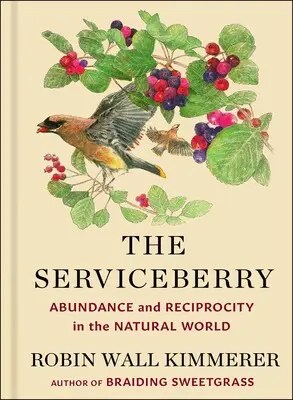
A Potawatomi author and botanist explores the concept of gift economies through the author’s reflections on nature, reciprocity, and the lessons of the serviceberry tree.
Summary:
As indigenous scientist and author of Braiding Sweetgrass Robin Wall Kimmerer harvests serviceberries alongside the birds, she considers the ethic of reciprocity that lies at the heart of the gift economy. How, she asks, can we learn from indigenous wisdom and the plant world to reimagine what we value most? Our economy is rooted in scarcity, competition, and the hoarding of resources, and we have surrendered our values to a system that actively harms what we love.
Meanwhile, the serviceberry’s relationship with the natural world is an embodiment of reciprocity, interconnectedness, and gratitude. The tree distributes its wealth—its abundance of sweet, juicy berries—to meet the needs of its natural community. And this distribution insures its own survival. As Kimmerer explains, “Serviceberries show us another model, one based upon reciprocity, where wealth comes from the quality of your relationships, not from the illusion of self-sufficiency.”
Review:
I was incredibly moved by Robin Wall Kimmerer’s Braiding Sweetgrass, which beautifully wove together the spiritual and the scientific. So, I was excited to dive into her new book, The Serviceberry, which blends natural biology with economics—yes, you read that right.
This short book is gorgeously illustrated by John Burgoyne with thematic line drawings that complement Kimmerer’s reflections. The story centers on her harvesting serviceberries, and this simple activity becomes the starting point for a profound exploration of economic systems.
I’ll admit, before reading this book, I didn’t know much about serviceberries, even though I spent my childhood picking wild berries. After reading Kimmerer’s description and researching more, I’m still not sure I’ve encountered them in the wild myself. I wonder if having a personal connection to the plant would have deepened my connection to the book, much like it did with many of the plants discussed in Braiding Sweetgrass.
The core of the book discusses gift economies—systems of mutual support that thrive on sharing abundance. Kimmerer writes:
Gift economies arise from an understanding of earthly abundance and the gratitude it generates. A perception of abundance, based on the notion that there is enough if we share it, underlies economies of mutual support. (page 75)
Kimmerer uses her own harvest of serviceberries as a metaphor: after gathering more than enough berries, she shares them with her neighbors, who might then return the generosity by baking a pie to share. She connects this to examples like Little Free Libraries and free stands giving away zucchini, offering a hopeful vision of a world where wealth is measured not by money, but by the relationships we build.
However, I struggled to fully embrace this vision. While I appreciate Kimmerer’s focus on the power of sharing, I was reading this book during a time of travel frustration—waiting overnight for a massively delayed airplane—and found myself questioning the likelihood of these ideas. The concept of abundance feels hard to grasp when faced with the reality of scarcity—especially when airlines don’t have enough seats for stranded travelers.
I also hear the idealistic rebuttal: in a gift economy, I wouldn’t need to travel far to see family because we’d all be close by, sharing our abundance. But my personal experience with things like Little Free Libraries, where people dump books in condition too bad for anyone to use, makes me question the idealism of this system. While Serviceberry presents a beautiful vision of generosity, it doesn’t address the real challenges of maintaining such systems at scale.
Despite this, I still value Kimmerer’s generosity in donating all her advance payments to support land protection, restoration, and justice. Her actions speak louder than words, and that’s something I deeply respect.
Overall, this is a quick read that challenges readers to think about economics, abundance, and reciprocity in new ways. While it didn’t convince me of the feasibility of the gift economy, it certainly provided food for thought. I recommend it to those who are interested in reimagining our current economic systems through a natural lens.
If you found this review helpful, please consider tipping me on ko-fi, checking out my digital items available in my ko-fi shop, buying one of my publications, using one of my referral/coupon codes, or signing up for my free microfiction monthly newsletter. Thank you for your support!
4 out of 5 stars
Length: 128 pages – novella/short nonfiction
Source: Library
Buy It (Amazon or Bookshop.org)
Book Review: Daniel Boone’s Own Story & The Adventures of Daniel Boone by Daniel Boone and Francis L. Hawks
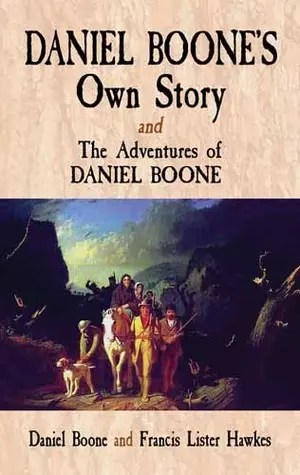
This book presents Daniel Boone’s summary of his adventures in the late 1700s and early 1800s plus a biography of his life first published in 1844.
Summary:
Daniel Boone blazed the Wilderness Road through the Cumberland Gap. Thousands followed, settling in Boonesborough, Kentucky, to form one of the first English-speaking communities west of the Appalachians. This two-part tale of the legendary frontiersman’s life begins with a brief profile by Boone himself, covering his exploits in the Kentucky wilderness from 1769 to 1784. The second part chronicles Boone’s life from cradle to grave, with exciting accounts of his capture and adoption by the Shawnee and his service as a militiaman during the Revolutionary War.
Review:
Growing up, I’d heard the legends of Daniel Boone and saw a few episodes of the (wildly historically inaccurate) tv show. I was raised with the mainstream US belief that westward expansion and colonization was great. It wasn’t until I was in college that I started to really learn about the true history of colonization. So I wasn’t too surprised when I read these period accounts to find that things were not the glowing hero account I’d heard. Not even when you take what happened at face value from the mouth of the man who lived it or from the biography that came shortly after his death.
Let’s start with what was true. Daniel Boone was, by all accounts, a talented hunter. He didn’t like to have many people around him, so he was constantly on the lookout for land that appeared to him to be empty (more on that later). He was taken captive by the Shawnee and adopted by them, living with them for two years before escaping. He was a critical tipping point person in the settlement (and stealing) of Kentucky by white Americans.
Here’s what stuck out to me when reading these accounts, though, with my twenty-first century eye. Daniel Boone and the other settlers considered Kentucky to be open space and fair game. However, even the early 1800s biographer pointed out that this land was being used as hunting grounds by multiple different Indigenous nations. So even folks of the time realized that the land was in use, just not in the same way as how white people would use it. When I dug into this more, though, I found this fascinating article about the idea of Kentucky being a “dark and bloody ground” aka land that was being fought over and contested by Indigenous nations with no one really living on it the way European settlers viewed living on land, as a myth propagated to be able to view the land as “free game” to then sell to settlers without even the pretense of a treaty with or purchasing from the Indigenous folks.
Reader should be aware that these period pieces use multiple slurs to refer to Indigenous peoples. Beyond the slurs, there’s this odd depiction of Indigenous peoples. On the one hand, they’re depicted as backwards and not very bright. But on the other hand they’re depicted as terrifying enemies difficult to overcome.
It’s interesting to me how both authors consistently view white folks as superior and more “civilized,” in spite of telling stories that make it look very much the contrary. For example, there’s a scene in which an Indigenous group of warriors takes a bunch of white women captive. They are in a boat and they line the women around the edges of the boat. The narrator says that they did such a thing to ensure safe passage for themselves, assuming the white men would never fire on the white women. But the white men do, and the narrator defends this, saying it’s better for the white women to be dead than to be held captive by the Indigenous people. This statement is extra confusing as we had just seen earlier in the book that Daniel Boone was taken captive and then adopted and treated as one of the tribe. Now, of course, not all captives were adopted. Some were murdered and, yes, some were tortured. (How captives were treated varied wildly.) But the point remains that the men fired on their own women and considered that to be a “civilized” act.
As it is women’s history month, I wanted to draw out some information on Daniel Boone’s wife, Rebecca. He brought her out to Kentucky, and on the trip there, one of their children is killed by Indigenous folks defending their land. (Because it WAS their land.) Then later her daughter is kidnapped. (Daniel retrieves her.) Ultimately, six of their ten children died early deaths, largely in the war between the Indigenous and the settlers. We also can’t forget when Daniel was captured and adopted. He was gone for so long that Rebecca gave up hope and went home to North Carolina, only to have Daniel show up, back from what she thought was the dead, and bring her back to the frontier. I can’t imagine living my life that way. I realize she had her own agency, and we must acknowledge the complicity of white women in the theft of the land. But I do wonder what it must have felt like to give birth to ten children, only to have six of them die in the bloody battle for land. Did she think it was worth it? What made her go back with Daniel when he showed up after being missing for two years? These are things we’ll never know because women’s stories simply were not recorded for us.
I would not call this a fun or easy read. It was an informative one. There’s a lot of value in reading firsthand accounts of history. Of course we’ll never get the whole truth from any one such account. But it is informative into how people in that time period thought and behaved. How they perceived it then and how we perceive it now.
Recommended to those with an interest in primary resources from the colonization of the US.
If you found this review helpful, please consider tipping me on ko-fi, checking out my digital items available in my ko-fi shop, buying one of my publications, using one of my referral/coupon codes, or signing up for my free microfiction monthly newsletter. Thank you for your support!
3 out of 5 stars
Length: 128 pages – short nonfiction
Source: Gift
Buy It (Amazon or Bookshop.org)
Book Review: The Queen of the Cicadas / La Reina de las Chicharras by V. Castro

Summary:
You’ve heard of Bloody Mary and Candyman but have you heard of La Reina de las Chicharras? The legacy says she’s a Mexican farmworker named Milagros who was brutally murdered in 1950s Texas then given new supernatural life by the Aztec goddess of death, Mictecacíhuatl. In 2018, Belinda Alvarez arrives in Texas for a friend’s wedding on the farm that inspired the legacy of La Reina de las Chicharras. But is it just a legacy or is it real?
Review:
I’m a woman of a certain age. I know that shit isn’t always right.
Chapter 9
This struck me as a Latinx, female-led version of Candyman, only, over time, La Reina de las Chicharras comes to protect the downtrodden who call her.
Milagros’s life story that leads to her becoming La Reina is told in parallel with Belinda’s discovering her story and coming into her own realizations about Mictecacíhuatl. I really resonated with the Milagros chapters but struggled to relate to Belinda. She needed more depth and roundness to seem as real as Milagros. Some additional chapter breaks could also help with the jumping perspectives. In general, though, the dual perspectives worked and the uniqueness of the storyline kept me quite engaged to find out what would happen.
In addition to the strong Latinx content, the Indigenous history of Mexico is present. Milagros’s relationship especially to the Indigenous people who were brutally colonized is drawn clearly. There is also relatively significant queer content here. Milagros is a woman who loves women. There are two important gay male characters, and Belinda exhibits fluid sexuality, although she never gives a label to this.
Two things in this book were at ethical odds with me. First, Belinda is written as a woman in addiction who then never overcomes it (or even tries to) in spite of her character arc seeming to indicate that she has been transformed in a positive way. I’m ok with a realistic depiction that not everyone finds recovery, but it bothered me that it comes across as a positive transformation when she remains in addiction. It’s relatively clear that this is a bit of a vengeance fantasy. I understand the importance and role of having a place for anger at injustice to go. But my own spiritual beliefs uphold forgiveness over vengeance, so my world view differs.
If you like urban legend style horror and want to see women in the lead, then you will likely enjoy this read. Those offended or disturbed by the idea of the universe holding multiple gods and religions simultaneously should likely look elsewhere.
4 out of 5 stars
Length: 224 pages – average but on the shorter side
Source: NetGalley
Buy It (Amazon or Bookshop.org)
If you found this review helpful, please consider tipping me on ko-fi, checking out my digital items available in my ko-fi shop, buying one of my publications, or using one of my referral/coupon codes. Thank you for your support!
Book Review: Sorrowland by Rivers Solomon

Summary:
Vern desperately flees the strict, religious, Black Power compound she was raised on while she is heavily pregnant with twins. Giving birth shortly thereafter and raising her babies in the woods, she finds herself transforming inexplicably. But what is she transforming into? Why? And can she protect her children from both the compound and the world?
Review:
Another Rivers Solomon book was my favorite read of last year (An Unkindness of Ghosts, review), so when I saw their new book come available on NetGalley – featuring a religious, Black Power compound – I requested it immediately and was thrilled to receive a copy. Like all of Rivers Solomon’s work this book is a gorgeous, intertwining mixture of compelling and challenging.
I was startled by the focus on pregnancy and mothering at the beginning of the book. It hadn’t been the focus of the other Rivers Solomon books I’ve read, and I must admit as a person who has never been pregnant or a mother myself, I always struggle a bit more to connect to these characters. And, indeed, by the end of the book it was not Vern as mother I connected to but rather Vern as a person caught in a complex web of the world as we know it with her ability to right wrongs and change the future limited. That twist in the gut of being caught inside of something much bigger than yourself, that I was able to relate to.
Who cared who knew if the knowing didn’t prevent future occurrences?
location 5089
The fantastical elements are immediately engaging – beautiful and grotesque. I don’t want to give anything away, but suffice to say her transformation took my breath away in a manner that reminded me of my feelings watching Season 1 of Hannibal. I mean that as a complement. It’s a fantasy that both feels like a fantasy and also real and leaves one wondering if Vern is right in the head or not? Can the world really work like this? What is happening to her?
The social commentary in this book is astute and apt without being preachy. Characters say what they say because their very lives have lived it – these are their experiences and real feelings. What may to some readers seem the most out there about the book can easily be traced to real occurrences in US history. It’s not far-fetched but one hopes its realness will reach more people because of how it is couched in fantasy.
There is rich queer content in this book, both in the sense of gender and in the sense of sexual relationships. There is two sex scenes, one of which I would consider explicit with people of multiple genders participating. However, contrary to how some booksellers are listing it, I absolutely would not call it “er*tica.” This is a serious fantasy book about issues of justice that just happens to have queer characters have sex “on screen” twice. Queer sex is not automatically “er*tica.”
With regards to other representation, there are many Black and two Indigenous (Lakota) people. Two characters have albinism, and this book eloquently depicts the visual impairments that come with that.
Overall, this book delivers what I have come to expect from a Rivers Solomon book – an engaging fantastical imagining with queer content and different abilities represented that draws attention to social issues. Readers who are able to keep an open mind to the book potentially not going the places they were anticipating or hoping for but who are willing to let the book lead where it may will enjoy this one.
4 out of 5 stars
Length: 368 pages – average but on the longer side
Source: NetGalley
Buy It (Amazon or Bookshop.org)

Book Review: Winter Counts by David Heska Wanbli Weiden

Summary:
Virgil Wounded Horse does his best to find his way making a life and a living on the Rosebud Indian Reservation (the Lakota people) in South Dakota – newly sober from alcohol, the legal guardian of his teenage nephew, and working as a hired vigilante. When heroin finds its way onto the reservation and directly impacts his nephew, he finds himself working to stop the threat of the cartels to his people alongside his ex-girlfriend.
Review:
This is simultaneously a wholesome and gritty thriller. Wholesome in that Virgil’s commitment to his sobriety, his family, and his people is full of honor and family values in the face of so many challenges. Gritty in that there are colorful depictions of violence as Virgil does his vigilante work and pursues the cartel. In a way it reminds me of Breaking Bad in the early seasons – someone doing something outside of the law for his family – only it’s outside of the law to stop the drugs, not to make them.
There was a lot I enjoyed here. The different setting and voice for this gritty mystery kept me engaged in a genre I’ve read a lot in. The mystery is solid. I had my suspicions but I didn’t have everything figured out before the end. So, yes, it’s not quite as simple as an outside cartel but it’s not a super obvious answer either. I also really like how the ex-girlfriend becomes such a key part of the story. Virgil listens to and respects her, even when he doesn’t immediately agree with her, which was so refreshing to read. I similarly like that we come into Virgil’s life after he’s already sober. This allows the book to explore him putting his life back together as a sober person and dealing with some really tough shit – demonstrating that things don’t get easy automatically just because you’re sober. I appreciated very much how thoughtfully the author shared his Lakota culture with the readers while simultaneously respecting what aspects of it need to stay private and sacred. As a person who has the Sioux Chef book, I appreciated so much the inclusion of Indigenous cuisine via an Indigenous chef and food truck coming to the reservation.
While I wouldn’t call the depictions and discussions of violence gratuitous as they are necessary to the plot, they are graphic. I thought it never went further than it needed to. However, it is important for potential readers to know they are there. There are discussions of off-scene cartel vengeance and rape of women and underaged girls. There are on-scene descriptions of fist-fights and gun fights.
Those who like grittier thrillers and either want a unique setting in the genre or want a mystery investigator who is sober will enjoy this read. I hope we’ll see more of Virgil in the future.
4 out of 5 stars
Length: 336 pages – average but on the longer side
Source: Library
Buy It (Amazon or Bookshop.org)
If you found this review helpful, please consider tipping me on ko-fi, checking out my digital items available in my ko-fi shop, buying one of my publications, or using one of my referral/coupon codes. Thank you for your support!
Book Review: Ceremony by Leslie Marmon Silko
Summary:
Tayo, an Indigenous Laguna man, returns from being a prisoner of war of the Japanese in WWII without his cousin. Cousin is the technically accurate word, but since Tayo grew up in his cousin’s household after his mother left him there brother felt more accurate. Tayo is half-white and has always felt estranged, but this feeling is only heightened after the war. He is suffering from shell-shock and feels emptiness in the alcohol and violence the other veterans take solace in. When his grandmother sets him up with a ceremony with a shaman with unusual ways, things start to change.
Review:
He wanted to walk until he recognized himself again.
61% location
After years of reading many books about alcoholism – both its ravages and quitting it – I’ve started having to actively seek out the stories that are a bit less well-known. Now, this book is well-known in Indigenous lit circles, but I’ve only rarely heard it mentioned in quit lit circles. I was immediately intrigued both due to its Indigenous perspective (this is own voices by an Indigenous female author) and due to its age (first published in 1986). Told non-linearly and without chapters, this book was a challenge to me, but by the end I was swept into its storytelling methods and unquestionably moved.
He was not crazy; he had never been crazy. He had only seen and heard the world as it always was: no boundaries, only transitions through all distances and time.
95% location
This book is so beautiful in ways that are difficult to describe. Its perspective on why things are broken and how one man can potentially be healed (and maybe all of us can be healed if we just listen) was so meaningful to me. I’m glad I stepped out of my comfort zone to read it.
We all have been waiting for help a long time. But it never has been easy. The people must do it. You must do it.
51% location
I really enjoyed how clear this book makes it that any care for addiction delivered needs to be culturally competent to truly serve the person who needs help. It also does not shy away from the very specific pain of being an Indigenous person in the US, and how addiction both seeks to quell that pain and rebel against the oppressive society.
It’s rare for me to re-read a book, but I anticipate this being a book I re-read over the course of time. I expect each reading will reveal new things. For those who already know they enjoy this type of storytelling, I encourage you to pick this up. Its perspective on WWII’s impact on Indigenous peoples and alcoholism is wonderful. For those who don’t usually read this type of story, I encourage you to try out something new. Make the decision to just embrace this way of telling a story and dive right into it. Especially if you usually read quit lit or post-WWII fiction.
4 out of 5 stars
Length: 270 pages – average but on the shorter side
Source: Library
Buy It (Amazon or Bookshop.org)
If you found this review helpful, please consider tipping me on ko-fi, checking out my digital items available in my ko-fi shop, buying one of my publications, or using one of my referral/coupon codes. Thank you for your support!
Book Review: An Indigenous People’s History of the United States by Roxanne Dunbar-Ortiz

Summary:
From the Revisioning History series, this explores United States history with a focus on the Indigenous peoples. History is explored in 11 short to medium length chapters in chronological order.
Review:
I majored in US History and took a full-length course on the Indigenous peoples of the US. I also previously was interested in the American Indian Movement of the 1970s, so read a few books about and by the people of that movement. I was kind of expecting, since this is a short book targeted to a mainstream audience, that I would not encounter too much that was new, but I was pleased to discover my expectations were incorrect.
This book was published in 2014 and thus took a more modern perspective than even my course late in the first decade of the 2000s took. It ensures a perspective not of we’re studying these ancient lost peoples but rather we’re studying the history of people who exist now in modern society and how genocide was enacted against them. The exploration of colonization and how it impacted Indigenous peoples is much more nuanced than the simple guns, germs, and steel history I’d studied in college. What I learned through this book is that colonization was strategic. It wasn’t just a happenstance of how germs worked out when the nations met and greater firepower. Of course, my coursework did acknowledge colonization, but not to the extent it was delineated in this book.
Through economic penetration of Indigenous societies, the European and Euro-American colonial powers created economic dependency and imbalance of trade, then incorporated the Indigenous nations into spheres of influence and controlled them indirectly or as protectorates, with indispensable use of Christian missionaries and alcohol….a colonizing regime institutionalizes violence.
4%-5%
To me an interesting aspect of this book was its discussion of Indigenous peoples and alcohol. Growing up, I definitely heard the myth that Indigenous peoples are more genetically prone to alcoholism. In recent years, I heard the theory that rates of addiction are higher in oppressed peoples, which makes sense as alcohol and other addictive substances can provide temporary relief from trauma. This book pushed my understanding two steps further. First, alcohol being used as an intentional weapon of colonization, calling it a “weapon of war” (21%), and noting that it wasn’t just introduced, it was also promoted (13%). This book also drew my attention to the idea that, for at least some Indigenous peoples, acting the part of the “drunk Indian” can be a form of protest. I read the article the author cites as the origin of this theory, and reading fiction work by Indigenous peoples seems to support this theory as well, for at least some instances. (See the book Ceremony, I’ll be reviewing it soon).
After covering the American Indian Movement, the book wraps up with a discussion of the expanding US imperialism and modern day colonization by historic colonizers (the US and the UK are specifically discussed). Through this, I learned of a potential connection between the Monroe Doctrine and overpowered policing forces. I also learned about the modern forced removal of the Chagossian people from Diego Garcia, an island in the Indian Ocean, which is now used by the US for a military based (rented from the UK). This is just one example of many given in the chapter, but it’s the one that stuck out the most to me, partially because I didn’t know the US even had a military base in the Indian Ocean but also because the book describes the forced removal including murdering every single pet dog on the island. While of course the forced removal alone is terrible there was just something about the added insult of murdering beloved pets that ground the whole event into my brain.
I have covered just a small snippet of what I learned in this book. It is well-written. The chapters are short to medium length and filled with information. There’s nothing extraneous here. It gets right to the point, which I appreciate. The chronological order is helpful as well for leaving the book and coming back to it as you have time. Highly recommended. I’ve already added several of the other books in this series to my wishlist.
4 out of 5 stars
Length: 218 pages – average but on the shorter side
Source: Amazon
Buy It (Amazon or Bookshop.org)
If you found this review helpful, please consider tipping me on ko-fi, checking out my digital items available in my ko-fi shop, buying one of my publications, or using one of my referral/coupon codes. Thank you for your support!
Book Review: Native: Identity, Belonging, and Rediscovering God by Kaitlin B. Curtice

Summary:
This is simultaneously a memoir about her faith journey and an opinion piece from her perspective as both a Christian and a member of the Potawatomi nation (a nation Indigenous to both the US and Canada). Kaitlin fearlessly grapples with the historical and current weaponization of Christianity, how she interprets Christianity in her own life, and how her Potawatomi knowing comes into her faith.
Review:
This book, to me, is first and foremost beautiful. I read it on my kindle fire just so I could enjoy its beauty in full-color and larger size than my paperwhite. There are five parts, and each part begins with an illustrated poem from Potawotami tradition that ties into the designated part.
A lot about this book is difficult to categorize, and that is part of its strength and beauty. It is partially a memoir, although not necessarily told in a linear fashion. In fact, it reminded me quite a bit of Braiding Sweetgrass (review). It is both about a topic the author has a lot of knowledge on (the experience of Christianity as an Indigenous person), but also is a memoir because her knowledge and herself cannot be separated as they inform each other.
Although I am not biracial myself, I imagine this book would be meaningful to readers who are. Kaitlin, while a full member of the Potawatomi nation, is half white and half Potawatomi. In addition to this, her parents split up when she was young, so she also experienced both living on the reservation and living off the reservation in a white town in a white church with folks essentially considering her to be white and ignoring her Potawatomi self. She discusses what it means to her to be able to pass for white and why she generally as an adult chooses not to. (She even flies with her tribal membership card, which while officially accepted, is usually not recognized by the first TSA agent she sees).
Her insights into how to improve what is broken or ostracizing in the church in the US were simultaneously interesting and challenging. I can imagine a reader very deeply enveloped in the church may feel challenged by her willingness to question what is often accepted as the word of God and also by her desire to draw in aspects of Potawatomi ways. Similarly, I can imagine a reader who has already cast aside the church might wonder why she bothers staying with something that may seem to them to be so obviously broken. This is the beauty of the book. Kaitlin refuses to do what might seem to either side to be the easiest and rather forges her own way, encouraging others to do the same.
The problem isn’t that we search for truth; the problem is that we become obsessed with our belief that we hold the truth, and we destroy entire cultures in the process.
52%
I know I am not the only person who has been wondering lately about other white women who support the patriarchy, and Kaitlin directly addresses this with her insight that comes from being a white passing Indigenous woman in white conservative spaces. I found what she had to say helped me both establish some understanding for something I previously could not understand at all and consider new ways to potentially reach these women.
Unless your lived experience is very similar to the author’s, I expect this will be a book that challenges you. It certainly challenged me. But to be challenged is to grow, and I thank the author for sharing her understanding of the world and her experiences. Being challenged helped me to grow in my understanding. Recommended for all but especially for those who are seeking a greater understanding of the church in the US.
4 out of 5 stars
Length: 208 pages – average but on the shorter side
Source: Purchased
Buy It (Amazon or Bookshop.org)
If you found this review helpful, please consider tipping me on ko-fi, checking out my digital items available in my ko-fi shop, buying one of my publications, or using one of my referral/coupon codes. Thank you for your support!
Book Review: Braiding Sweetgrass: Indigenous Wisdom, Scientific Knowledge, and the Teachings of Plants by Robin Wall Kimmerer
Summary:
Member of the Potawatomi Nation and botanist Robin Wall Kimmerer presents a series of essays on plants of North America, incorporating some memoirs from her life and her daughter’s recollections as well.
Review:
It’s difficult to describe how meaningful this book is. The description sounds so simple and yet, to me, it is a collection of scientific and Indigenous knowledge intertwined as near poetry. As an urban gardener who grew up rural among farms, I think of myself as plant knowledgeable, but I was humbled by this book. I also teach, and I found her ruminations on teaching and balancing teaching other people’s children versus your own to be beautifully honest. This book takes time to get through but because of the rich meaning in each essay. You find yourself wanting to savor it.
As a person who feels both spiritually and scientifically minded, this book spoke to me on a mind and soul level simultaneously in ways I cannot fully describe. I wish there was greater focus on teaching this way. I wish the two were not divorced from each other in our society. I think it would be healing to us all and to nature as well if they were not.
Allow me to try to pull out a few meaningful quotes to me by theme.
On morality, contentment, and consumerism:
Refusal to participate is a moral choice.
Transformation is not accomplished by tentative wading at the edge.
Balance is not a passive resting place.
In a consumer society, contentment is a radical proposition.
The consumption-driven mind-set masquerades as “quality of life” but eats us from within.
On teaching and being taught:
The professor made me doubt where I came from, what I knew, and claimed that his was the right way to think.
Teach any who will come.
I’d left my baby girls at home with their dad in order to introduce other people’s children to something they cared little about.
Facts about plants that fascinated me, include that a 3 sisters garden [growing corn, beans, and squash together the Indigenous way] yields more food than if you grew each alone, polycultures are less susceptible to pest outbreaks than monocultures, breathing in the smell of humus (the dirt, not the food) releases oxcytocin, and lichens are actually two beings together (a fungus and an alga). I also learned:
Sweetgrass thrives where it is used and disappears elsewhere.
Plantain is not indigenous but naturalized. It’s so prevalent and well-integrated that we think it’s native.
Estuaries can have the highest biodiversity and productivity of any method.
Forest ecologists estimate that the window of opportunity for cedars to get started occurs perhaps only twice a century.
I hope I have made you intrigued by this book. I loved it so much that I bought myself a copy after starting off with a digital library copy.
5 out of 5 stars
Length: 391 pages – average but on the longer side
Source: Purchased
Buy It (Amazon or Bookshop.org)
 Support my work with a tip or browse my shop for curated book club guides, how to guides, cross-stitch patterns, and more!


This work by Amanda Nevius is licensed under a Creative Commons Attribution-Noncommercial-No Derivative Works 3.0 United States License.
 Opinions of a Wolf