
Archive
Book Review: The Dead and the Gone by Susan Beth Pfeffer (Series, #2)
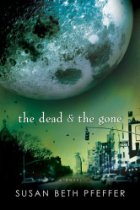 Summary:
Seventeen-year-old Alex Morales works hard with his eyes on a good college. He even works in a local pizza joint to pay for his own private Catholic school uniforms to help his Mami and Papi. Papi is in Puerto Rico for his mother’s funeral and Mami is working late when an asteroid strikes the moon and everything changes. New York City is struck by flooding and loss of infrastructure. Alex is left alone to care for his two younger sisters, Julie and Briana, and slowly he begins to think that maybe things will always be this bad. Maybe Mami and Papi will never come back, the moon will never look right again, and there will never be a world where he can go to college and not be left caring for his little sisters.
Review:
I inhaled the first book in this series, in spite of the scientific flaws (which I addressed in my review of the first book). Miranda’s journal ends so abruptly that I was eager to get to the next book right away. I was surprised, then, when the second book starts back before the moon is struck with an entirely different family in a different area of the country. This book shows Pfeffer’s abilities as a writer by showing the same apocalyptic event seen in the first book from the perspective of an entirely different family.
Miranda’s family is suburban-rural, agnostic/atheist humanist, blended (divorced parents with one remarried), and white. Alex’s family is urban (NYC), Latino, and devotedly Catholic. Both families are given room to have strengths and flaws, most of which have nothing to do with where they live, their ethnicities, or their religions (or lack of one). I honestly was startled to see Alex and his and his sisters’ strong faith treated with such respect in this book after Miranda’s lack of faith was treated with equal respect in the first. It’s easy, particularly in a book written as a journal, to mistake a character’s beliefs for an author’s, and Miranda, a teenage girl, has very strong beliefs. This book reminded me that those beliefs were just Miranda’s, just as Alex’s beliefs are just his, and it shows how well Pfeffer is able to write characters.
Some readers may find it odd and frustrating to go back in time to relive the apocalypse over again with different characters. I personally enjoyed it, because the world falling apart is one of the best parts of post-apocalyptic fiction for me. I also liked having the opportunity to see differences in how the apocalypse plays out based both on the location (suburban/rural versus urban) and the characters’ personalities and reactions. However, that said, I can see how this set-up of two vastly different sets of characters in books one and two could be off-putting to certain readers. Some religious readers may be turned off by the first book and Miranda’s staunch atheism. Those who read the first book and enjoy it for precisely that reason may similarly be turned off by the second book’s heavy Catholicism and faith. The diversity is a good thing but it also makes it hard to pinpoint an audience for the series. Those who are open to and accepting of other belief systems would ultimately be the best match but that’s a demographic that can sometimes be difficult to find or market to. However, if a reader is particularly looking for a diverse set of viewpoints of the apocalypse that is more than just characters’ appearances, this series will be a great match for them.
It should also be mentioned that this book is not a journal. It is told in third person, from Alex’s viewpoint, although the dates are still mentioned. It makes sense to do it this way, since Alex definitely does not come across as a character with the time or the inclination to keep a journal. It would have been interesting to view the apocalypse from the viewpoint of a boy who did keep a journal, however.
The plot makes sense and brings in enough danger without being overly ridiculous. It would have been nice to have maybe started the book just a bit earlier in the week to see more of Alex’s day-to-day life before the disaster. Instead, we learn about it through flashbacks, which makes it a bit harder to get to know him than it was to get to know Miranda.
Overall, this is a surprising and enjoyable second book in this post-apocalyptic series that lets readers relive the apocalypse from the first book over again with a different set of characters. This approach lends diversity to the series, as well as bringing in a greater variety of scenarios for those who enjoy the apocalypse process. Recommended to those looking for a diverse presentation of beliefs and how those impact how characters deal with an apocalypse.
If you found this review helpful, please consider tipping me on ko-fi, checking out my digital items available in my ko-fi shop, buying one of my publications, or using one of my referral/coupon codes. Thank you for your support!
4 out of 5 stars
Length: 341 pages – average but on the longer side
Source: Library

Previous Books in Series:
Life As We Knew It
Book Review: Life As We Knew It by Susan Beth Pfeffer (Series, #1) (Bottom of TBR Pile Challenge)
 Summary:
Miranda’s journal starts out like any other teenage girl’s diary. Worries about school, her after-curricular activities, and wondering how her family will work out with her dad having a brand-new baby with his new wife. But when a meteor strikes the moon things start to change. Slowly at first but with ever-increasing speed. Tsunamis wipe out the coasts. Volcanoes erupt. And soon Miranda finds herself, her mother, and her two brothers struggling to survive in a world that increasingly bares no resemblance to the one she once knew.
Review:
I’m a sucker for journal entry books, even though I know rationally that no diary ever has as much content and exposition as is contained in these fictional works. In addition to the journal format, I liked the premise for the dystopian world Miranda finds herself in. It’s very different from a lot of the other ones out there, since it’s 100% gradual natural disaster. This book lives up to the expectations set by its summary, offering a fun journal entry take on a natural disaster that turns into a dystopia.
Miranda, who lives in semi-suburban Pennsylvania, starts out the journal as a very average teenage girl, adapting to her parents’ divorce and father’s subsequent re-marriage, her older brother being away for his first year of college, and hoping to convince her mother to let her take up ice skating again. The book clearly yet subtly shows her development from this young, carefree teenager through angst and denial and selfishness in the face of the disaster to finally being a young woman willing to make sacrifices for her family. Miranda is written quite three-dimensionally. She neither handles the disaster perfectly nor acts too young for her age. While she sometimes is mature and sees the bigger picture at other times she simply wants her own room and doesn’t understand why she can’t have that. Pfeffer eloquently shows how the changes force Miranda to grow up quickly, and this is neither demonized nor elevated on a pedestal. Miranda’s character development is the best part of the book, whether the reader likes her the best at the beginning, middle or end, it’s still fascinating to read and watch.
Miranda also doesn’t have the perfect family or the perfect parents, which is nice to see a piece of young adult literature. Her parents try, but they make a lot of mistakes. Miranda’s mother becomes so pessimistic about everything that she starts to hone in on the idea of only one of them surviving, being therefore tougher on Miranda and her older brother than on the youngest one. Miranda’s father chooses to leave with his new wife to go find her parents, a decision that is perhaps understandable but still feels like total abandonment to Miranda. Since Miranda is the middle child, she also has a lot of conflict between being not the youngest and so sheltered from as much as possible and also not the oldest so not treated as a semi-equal by her mother like her oldest brother is. This imperfect family will be relatable to many readers.
Miranda’s mother is staunchly atheist/agnostic/humanist and liberal, and this seeps into Miranda’s journal. For those looking for a non-religious take on disaster to give to a non-religious reader or a religious reader looking for another perspective on how to handle disasters, this is a wonderful addition to the YA dystopian set. However, if a reader has the potential to be offended by a disaster without any reliance on god or liberal leanings spelled out in the text, they may want to look elsewhere.
I know much more about medical science than Earth science or astronomy, but I will say that when I was reading this book, the science of it seemed a bit ridiculous. An asteroid knocks the moon out of orbit (maybe) so the tides rise (that makes sense) and magma gets pulled out of the Earth causing volcanoes and volcanic ash leading to temperature drops Earth-wide (whaaaat). So I looked it up, and according to astronomers, an asteroid is too small to hit the moon out of orbit. If it was large enough to, it would destroy the moon in the process. Even if for some reason scientists were wrong and the moon could be knocked out of orbit, even in that scenario, the only thing that would happen would be the tides would be higher. (source 1, source 2) I know dystopian lit is entirely what if scenarios, but I do generally prefer them to be based a bit more strongly in science. I would recommend that reading this book thus be accompanied by some non-fiction reading on astronomy and volcanology. At the very least, it’s good to know that you can safely tell young readers that this most likely would not happen precisely this way, and this book is a great opening dialogue on disasters and disaster preparedness.
Overall, this is a fun take on the dystopian YA genre, featuring the journal of the protagonist and dystopia caused primarily by nature rather than humans. Potential readers should be aware that the science of this disaster is a bit shaky. The story featuring an agnostic humanist post-divorce family makes it a welcome diversifying addition to this area of YA lit.
If you found this review helpful, please consider tipping me on ko-fi, checking out my digital items available in my ko-fi shop, buying one of my publications, or using one of my referral/coupon codes. Thank you for your support!
4 out of 5 stars
Length: 337 pages – average but on the longer side
Source: PaperBackSwap
Book Review: The Underworld King by Ranjit More (Series, #1)
 Summary:
Drumila, four-armed king of the daityas, seeks to take them above ground to escape their enemy the naagas, giant flame-breathing serpents. Meanwhile, Krishna (the highest-ranking god) sends his daughter, Nandini, to Earth in human form to weaken Drumila and keep him from crossing the barrier from Earth into the higher plains. Unfortunately, Nandini ends up liking Drumila a bit more than they bargained for.
Review:
I was excited to have a fantasy based in a non-European mythology submitted to me, and wow is this different from the typical European-based fantasy. In a good way. This is a dense, different fantasy with a strong learning curve unless the reader is already very familiar with Hinduism.
The basic story reads just like mythology. This has pros and cons. On the plus side, it feels quite fantastical. On the minus side, some of the plot points can be cringe-worthy (such as an unwanted kiss that could have turned into a rape if the female character hadn’t suddenly 180ed from zero interest to desire) and the characters can be a bit two-dimensional. This will bother some readers, but those who enjoy mythology, in spite of its shortcomings, will appreciate this read. Personally, I generally prefer if authors update and modernize their mythological rewritings a bit more, but not all readers feel that way.
The author is well-aware that Hindu mythology won’t be familiar to many Western readers, so he offers an extensive footnotes that are well hyperlinked in the ebook that explain both definitions of words and various aspects of Hindu mythology. This means that the reader learns a lot but it does also slow down the reading of the book and breaks up the immersion in the world. The footnotes are a good idea but perhaps if some of the words and concepts were better incorporated and explained within the writing itself then there could be fewer footnotes that offered greater explanations of more value.
The ending is a bit abrupt. It’s clear this is intended to be the first book in a series, but an extremely abrupt ending like this one makes it difficult to feel like the reader got a full book out of the deal. It feels more like the pilot of a tv show than the first book in a series.
I would give this book a more full review, but it has been pulled from publication since the review copy was sent to me. I really wish when authors and/or publishers choose to do this that they would notify those of us with review copies. While I enjoyed the read enough to not regret reading it, it feels rather silly for me to bother reviewing a book no one else can get their hands on anymore.
Overall, this is a fantasy book set firmly in the tradition of Hindu mythology that will best appeal to readers who enjoy the traditional features of mythology and don’t mind an abrupt ending.
If you found this review helpful, please consider tipping me on ko-fi, checking out my digital items available in my ko-fi shop, buying one of my publications, or using one of my referral/coupon codes. Thank you for your support!
3 out of 5 stars
Length: 252 pages – average but on the shorter side
Source: Kindle copy from author in exchange for my honest review
Buy It Currently not available for purchase.
Book Review: The Kitchen Witch by Annette Blair (Series, #1)
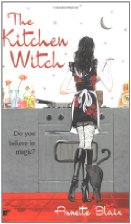 Summary:
Logan finds himself a single dad after his young son’s mother abandons him on his doorstep, so he moves back to his hometown of Salem, Massachusetts, looking to provide his young son with some stability. He has a bad rep from his teen years in Salem to get over, though, and he hopes his new job as a television producer at the local tv station will help. He wasn’t expecting his downstairs neighbor Melody Seabright, however.
Melody, who seems incapable of holding onto a job for any length of time, gets him to get her a meeting with the owner of the tv station and somehow convinces him to give her her own tv show, The Kitchen Witch. The only problem is she can’t cook, and whether or not she’s really a witch is up for debate.
Can Melody learn how to cook and hold onto the job? Or are both of their jobs now in jeopardy? And why does Logan keep thinking about such an unpredictable woman when he knows he needs to provide stability for his son?
Review:
I picked this up on a free book cart at a local library because the cover and title were cute, and I definitely am periodically in the mood for some lighthearted paranormal romance. I was a bit disappointed to find this isn’t really a paranormal romance, but I still enjoyed the contemporary tale it told, primarily due to its featuring a good-hearted single dad.
Logan is a contemporary romance character who will make many readers’ hearts beat a bit faster. He’s cute, young, has a high-powered job, lives in the quirky town of Salem and enjoys it, and is an awesome single dad to his young son. Having him be a bad boy who overcame it for his son is the perfect last touch for a contemporary romance. I can see many readers enjoying fantasizing about him.
Melody may be a bit more hit and miss with readers. The delightfully clumsy bit has been used a lot in romance recently and may feel a bit been there done that. Her apartment is divinely adorable, though, and she has some curves that are always looked upon as a good thing. Her difficult relationship with her own father adds some depth to the character, but some readers might have trouble sympathizing with a poor little rich girl, although I do think that Blair handled this particular aspect well.
Blair also writes children characters beautifully. The son sounds like a child, and yet still has the proper astuteness and vocabulary for his age. The only negative I can say about him is that I honestly already forgot his name. However, I enjoyed his presence every time he popped up into the story.
The plot is where things get a bit shaky. The book is definitely marketed as a paranormal romance, and there are hints at the beginning of the book that Melody might be a witch, but that never comes to fruition. The best I can tell is that she’s learned how to act and sound like a witch by virtue of living and working in Salem. There’s nothing wrong with this, but it was disappointing given that I thought I was getting a paranormal story. I also thought that if the book is going to have Logan suspicious Melody is a witch, at some point he should definitely find out once and for all whether she is one. I think perhaps the book was trying to say she’s just a regular girl with some knowledge of Wicca (which isn’t the same thing as being a paranormal romance witch, since Wicca is a religion and doesn’t actually involve paranormal romance style magic but it’s still a reveal I would have been happier with). However, that also is never firmly revealed. Just what type of witch, if any, Melody is is just a plot idea that is dropped and never fully dealt with, which is a bit frustrating.
A bigger plot issue to me though is that this book falls into the romance trope of everyone can see the couple should be together but the couple makes up fake obstacles to stand in their way and they just have to come to their senses and deal with their own stupidity to get over it. (I really wish there was a shorter way to describe that particular trope…..) It is just a trope that really bugs me. I don’t mind real obstacles in the way of a couple, but the couple just being idiotic and making up their own obstacles feels to me like the author stirring up fake drama to make the book longer. Also, I am 100% a-ok with a couple meeting, working out some realistic difficulties, and then being together. Things that are overly dramatic for the sake of drama just rub me the wrong way. Some readers may be ok with this trope, but for those who aren’t, be aware that this is where the plot eventually goes.
Having been to Salem multiple times, I can say that the author clearly did her research, as she depicts the culture and feel of Salem quite well. She also understands the layout of the town and even gives a realistic vague-ish location for Logan and Melody’s house. (In the few blocks nearish the House of the Seven Gables, in case you’re wondering).
The sex scenes were good, not ridiculous. They weren’t mind-blowingly hot, but they were fun to read and well-written.
Overall, this is a good contemporary romance featuring a lovable single dad love interest that is mismarketed as a paranormal romance. Those looking for paranormal romance should be aware that this fits in much better with the contemporary romance crowd. Additionally, those who are frustrated by couples keeping themselves apart for no reason should be aware that this is the romance trope found in this particular book. Recommended to those looking for a steamy contemporary read featuring a heartthrob single dad and a realistically quirky New England town.
If you found this review helpful, please consider tipping me on ko-fi, checking out my digital items available in my ko-fi shop, buying one of my publications, or using one of my referral/coupon codes. Thank you for your support!
3 out of 5 stars
Length: 320 pages – average but on the longer side
Source: Library free book cart

Reminder: I Will Be Accepting Review Requests November 1st through December 31st for Review in 2015
Just a quick reminder that Opinions of a Wolf will be OPEN to review requests November 1st through December 31st. All requests accepted will be reviewed during 2015 right here on this blog.
On November 1st a post will go live with full details on how exactly the review request process will work this year. There are two big changes for the review process this year.
- All requests will be submitted via a submission form. I will NOT be accepting requests via email or comments on the blog.
- I will only be accepting a maximum of 6 books for 2015.
I read and review review request books from indie authors only. Indie authors are defined (by me) as self-published or backed by a small, independent publishing house. These reviews are a two-pronged labor of love for me. First, as an indie author myself, I know many reviewers do not accept indie books. So I want to give you a place to send your books. Second, as a reader, I also want to do a service to the reading community by providing only 100% honest reviews of these books. If I say an indie book is good, they know they can trust it, since I’m not afraid of giving a negative review to an indie author. The value of your book being reviewed here is that everyone will know the review was honest from someone who reads a lot of indie work. Even a negative review proves that it’s not just your family and friends reviewing your work. Please remember that I am a real person trying to do a helpful thing for the community for free and engage with me from a place with that in mind.
I would also like to note that I strongly encourage women writers and GLBTQA writers to submit to me, particularly in genres that do not normally publish works by these authors. I was quite disappointed last year to get very few women or GLBTQA authors submitting. Please help me get the word out that I am actively seeking works by these authors.
You may see the full list of genres I am open to reviewing here. This list will also be on the submission form.
Remember: Don’t submit before November 1st and don’t submit in any way except using the submission form I will provide.
Good luck!
Book Review: Barely Breathing by Michael J. Kolinski
 Summary:
Jake Wood plans to visit his cousin, Jana, in Los Angeles. He hasn’t seen her in over 10 years, and he’s hoping the visit will help snap him out of the guilt he’s feeling after being the sole survivor of a workplace shooting. But when he arrives in LA, Jana fails to meet him or return his phone calls. He’s not worried at first, since he knows that she just got an exciting job working for the renowned scientific researcher Dr. Gregory Mirek. When he drops by Jana’s house and finds her best friend, Laurie, who hasn’t heard from her in days either, he starts suspecting she’s missing, and it might have something to do with Dr. Mirek.
Review:
I like a good mystery, and the description and cover of this book gave it a bit of a noir feel, so I was excited to see what twists on the noir mystery genre the book could bring. Unfortunately, a potentially interesting plot was held back by both some awkward writing and portions of the book that just left a bad taste in my mouth.
The plot is interesting and different enough from other mysteries to keep the reader engaged and intrigued. I personally have not seen a modern mystery revolving around a missing cousin, and I liked how different this felt. The inclusion of a mystery about Dr. Mirek and just what he’s researching into what happened to Jana, who is working for him, gave it another level of interesting information and twists that keeps the reader reading. On the other hand, the inclusion of Jake’s past trauma being the sole survivor of a work-place shooting felt tacked on and did not add much to the plot. If anything, at the beginning of the book, I was wondering if this book was the second in the series, since it felt like I was supposed to already know what had happened to Jake.
The writing really doesn’t support the plot very well, however. There is quite a bit of showing instead of telling as well as passages that just read awkwardly, instead of building the suspense they were supposed to. The quote below is an example of this.
After a long pause she said, “Yes, sacrifices,” in a faraway voice. At the time, I didn’t realize that she was referring to issues much more meaningful than gridlock. (loc 673)
There were also passages that just felt out of touch with modern life, particularly for the age of Jake, the main character, who sometimes reads like an old man. For instance, when Jana first doesn’t show up he googles her for the first time ever and looks at her Facebook page for the first time ever. There is no way cousins that got back in touch after a decade of low contact would wait that long to google each other or look at each other’s Facebook pages. Even people in this age-range who don’t use Facebook themselves will still google a new contact. Jake’s lack of technological and social media savvy just felt really wrong for his demographic.
As far as the characterizations of the main characters goes, Jake is moderately well-rounded but he also isn’t much of a noir hero. He’s clumsy, bad at appearing bad-ass, and hesitant, and yet simultaneously he’s good at fist-fighting (thanks to wrestling moves from high school), and he keeps being asked to be in porn by random people on the street (or if he is in porn). When his character isn’t thrust into noir-style encounters, it is well-rounded and interesting. When his character is, however, it feels awkward and unnatural. Laurie is relatively well-rounded and interesting, as is her boyfriend. We don’t see anybody else enough for them to be more than a passing two-dimensional character, and these are handled well.
The book does, however, put a bad taste into my mouth both in how it deals with fatness and how it deals with bisexuality. The book comes across as fatphobic. Any overweight character is also bad, and Jake judges them for being fat. I’m not saying an overweight person can’t be bad, but when every single overweight character is bad and the “good guy” main character judges them for it, it comes across as fatphobic.
Dr. Mirek is revealed to be bisexual, and the reveal is in the most insensitive way possible. Jake is pretending to be a journalist who had a tough interview with Dr. Mirek. He’s talking to an undergrad journalist student who previously interviewed Dr. Mirekto under the guise of getting more information on him from her than he could himself. She states that he was really creepy toward her in her interview and then reveals that she thinks he might be bisexual in a tone that implies that this is just as bad as creeping on her during her interview. To this Jake responds,
I don’t think my editor wants me writing that Dr. Mirek is a bi-sexual creep with a gambling problem. (loc 1594)
First, bisexual is spelled wrong, and it is never spelled correctly in the book. Second, this entire conversation implies that bisexuality is just as bad as being addicted to gambling or engaging in inappropriate come-ons. Just as with the fatphobia, there is nothing wrong with a bad guy character being bisexual, but equating his bisexuality with his badness, implying that it is part of what makes him bad, is a problem, and it is biphobic.
At the end of the book, it is revealed that Dr. Mirek had a relationship with Laurie’s boyfriend (implying the boyfriend is also bisexual, I might add), and that the boyfriend only participated in kidnapping Laurie and covering up the illegal animal experiments because of this relationship. The implication from the tone of the book is that getting into a same-sex relationship with Dr. Mirek is what brought the boyfriend down into crime. Even in the trial, the defense lawyer
conceded that Dr. Mirek and Danny Clarke had a consensual homosexual relationship. (loc 3694)
*end spoilers*
I would like to note that since this was a review copy submitted to me last November/December for review this year, I was extra offended at the biphobic content, as my review policies explicitly state that I do not wish to review anything with biphobic content. I am offended that an author who read my review policies well enough to submit properly and get accepted, who also knew one of his characters was bisexual, did not take a moment to check and see if this representation could possibly be biphobic. It is offensive to me as a person, and I feel that the author owes me an apology for putting me through reading something I very clearly stated I did not want to read. It is often impossible to know from a blurb if a book will be biphobic/homophobic/transphobic, and it is really up to the author to self-censor and not submit for review something like that to a reviewer who explicitly stated they do not wish to read that content. In all honesty, though, rather than an apology from the author, I would prefer he take some time to read up on bisexuality and biphobia to correct this biphobia in future writing.
Overall, the plot is interesting but the writing at the sentence level struggles. Additionally, the tone of the book is fatphobic and biphobic, which will both offend some readers and shows a lack of writing three-dimensional characters, since people are bad based on their bodies and sexualities and not their character. I recommend readers looking for a modern LA noir look elsewhere.
If you found this review helpful, please consider tipping me on ko-fi, checking out my digital items available in my ko-fi shop, buying one of my publications, or using one of my referral/coupon codes. Thank you for your support!
2 out of 5 stars
Length: 328 pages – average but on the longer side
Source: Kindle copy from author in exchange for my honest review

Counts For:

Book Review: Gone Girl by Gillian Flynn
 Summary:
On Nick and Amy Dunne’s fifth wedding anniversary, Nick comes home from working at the bar he co-owns with his sister to find his wife gone. The door is wide open, furniture is overturned, and the police say there is evidence that blood was cleaned up from the floor of the kitchen. Eyes slowly start to turn toward Nick as the cause of her disappearance, while Nick slowly starts to wonder just how well he really knows his wife.
Review:
I’d been wanting to read this since it first came out, but when the previews for the movie came out, I knew I also wanted to see the movie, and I just had to read the book first. Because one should always read the book first. A friend head me talking about it and offered to loan me her copy, and I flew through the book in just a couple of days. Even though I had guessed whodunit before I even started to read it, I was still swept up in a heart-racing read.
There have been many reviews of Gone Girl, so I am going to try to focus my review in on why I personally loved it, and also address a couple of the controversies about the book. Any spoilers will be marked and covered toward the end of the review. Please note that this review is entirely about the book and does not address the movie at all.
The tone of the book sucked me in from the beginning. How the book alternates between Nick’s current life and Amy’s diary of the early years of their relationship clearly showed that the relationship started out strong and fell apart, and I wanted to see how something so romantic could have gone so awry. Amy’s diary entries simultaneously sound feminine and realistic. She swears to the same extent that my friends and I do, and I loved seeing that in romantic, feminine diary entries. Nick’s portions, in contrast, perfectly demonstrated the measured response to a disappearance that could easily happen if a relationship was on the rocks a bit at the time. Nick’s reactions felt very realistic to me, and I appreciated it.
Even though I predicted the whodunit, I still found the end of the book to be thrilling, as exactly how it happened was not something I was able to predict.
If you don’t want any spoilers and just want to know why you should read the book, let me just say that anyone who has been in a long-term relationship will find the complex relationship between Nick and Amy frightening and chilling and will be left giving their partner side-eye periodically throughout the book. If you like the idea of a book that makes you freaked out at the thought of how truly awry a relationship can go, then you will enjoy this thriller.
On to the spoilers.
*spoilers*
This book has been accused of misogyny for three reasons. Nick’s internal dialogue, the character of Amy, and the fact that Amy falsely accuses an ex-boyfriend of rape. I did not find this book to be misogynistic at all, and I will now address each of these points.
Nick clearly struggles with how he relates to women due to the fact that his dad is a misogynistic bastard. It is realistic for a good person to struggle with bad internal dialogue due to hearing such dialogue from a parent. This is a very real thing that happens, and that people go to therapy for. The very fact that Nick fights against this internal dialogue shows that he knows that it’s wrong and is trying to win out over it. Just because one character has misogynistic internal dialogue does not make an entire book misogynistic nor does it make that character misogynistic. It just makes the book realistic. In fact, I find the fact that Nick ultimately defeats his internal misogynistic dialogue by realizing that it’s ok to hate women who are actually horrible but not all women to be really progressive. Some women are horrible people. Nick learns to turn his internal “women are bitches” dialogue into “Amy is a bitch,” and I think that’s awesome. Now, this point is related to the next point, the character of Amy.
There is at least one strain of feminism that thinks that it’s anti-woman to ever portray any women as bad or evil. There is also the strain of feminism that just says men and women are equal and should be treated equally. I am a member of the latter portion. It is equally harmful to never want to admit to women’s capability for evil as it is to say all women are bad or all women are childlike or etc… There are bad women in the world. There are evil women in the world. Women are not automatically nurturing, women are not automatically good at mothering, women are not automatically goddesses. Women are capable of the entire spectrum of evil to good, just like men are. It is unrealistic to act like women are incapable of evil, when we in fact are. This is why I find the portrayal of Amy as a narcissistic sociopath to be awesome. Because there are women just like her out there in the world. I was continually reminded of one I have known personally while I was reading the depiction of Amy. The patriarchy hurts men and women, and one way that it does so is with the assumption that women are incapable of evil. Nick and Amy’s other victims are unable to get people to believe them about Amy because Amy is able to externally project the virginal good girl image that the patriarchy expects of her. They don’t expect her to be evil. She appears to be a card-carrying, patriarchy-approved cool girl, therefore she is not evil and Nick and the others are delusional. It’s an eloquent depiction of how the patriarchy can hurt men, and I think that a lot of people are misinterpreting that a misogynistic slant.
Finally, the false rape accusation. Yes, it is extremely unlikely to happen. (An analysis in 2010 of 10 years of rape allegations found that 5.9% were able to proven to be false and 35.3% were proven to be true. The remaining 58.8% fell into a gray area of not being proven either way. Source) However, this means that false allegations of rape do indeed happen. 5.9% is not zero, and this isn’t even taking into account the gray cases that couldn’t be proven either way. Just because we have a problem with rape in this country and with rape culture does not mean that every accusation of rape is actually true. Just as not all men are rapists, not all women are truth-tellers. And let’s not forget that men can be raped, and women can be falsely accused of rape as well. Amy’s false rape accusation also fits well within her character development. As a teenager, she falsely accused a friend of stalking her. Then she accuses this man she dated in her 20s of raping her. Then she frames her husband for her murder. It’s a clear downward spiral, and the false rape accusation, complete with faking restraint marks on her arm, is a realistic warm-up to her insane attempt at framing her husband for her own murder. It fits within the character. It is not a malicious, useless, throwaway plot point. It fits who Amy is, and real life statistics support that it could indeed happen.
All of these aspects of Amy and Nick and Amy’s relationship are part of what made me love the book. I am tired in thrillers of so often seeing only men as the sociopathic evil. I have known women to be sociopaths in real life and in the news, and I like seeing that represented in a thriller. I also appreciate the fact that Nick is by no stretch of the imagination an innocent golden boy. He has some nasty internal thoughts, and he was cheating on Amy. And yet I was still able to feel sympathy for the cheating bastard because he gets so twisted up in Amy’s web. It takes some really talented writing to get me to sympathize with a cheater at all, so well done, Gillian Flynn.
Finally, some people really don’t like the end of the book. They wanted Amy to get caught or someone to die or something. I thought the ending of the book was the most chilling of all. Nick is unable to find out a way to escape Amy, so he rationalizes out their relationship to himself (she makes me try harder to be a better person or face her wrath), and ultimately chooses to stay in the incredibly abusive relationship for the sake of their child when he finds out she was pregnant. It is realistic that Nick is concerned that if he divorces her he won’t be able to prove anything, she may falsely accuse him of things, and he won’t end up able to see his child. This is something people on both ends of divorced worry about, and Nick has proof that Amy is unafraid to fake major crimes just to get even with him. It is so much more chilling to think of Nick being trapped in this toxic relationship, justifying it to himself along the way, in an attempt to protect their child. Bone. Chilling. Because it could, can, and does happen.
Overall, the book is an excellent depiction of how the patriarchy hurts men as well as women, depicts a chilling female sociopath, and manages to be thrilling even if you are able to predict the twist.
*end spoilers*
Recommended to thriller fans looking for something different but don’t be surprised if you end up giving your significant other funny looks or asking them reassurance seeking questions for a few days.
If you found this review helpful, please consider tipping me on ko-fi, checking out my digital items available in my ko-fi shop, buying one of my publications, or using one of my referral/coupon codes. Thank you for your support!
5 out of 5 stars
Length: 415 pages – average but on the longer side
Source: Borrowed

Counts For:
Book Review: From a Buick 8 by Stephen King (Bottom of TBR Pile Challenge)
 Summary:
When Pennsylvania state troopers are called in for an abandoned car, they expect it to be a simple report and transfer to impound. But instead they find a car that is slightly off. It looks like a Buick 8 but isn’t quite one. Plus its engine by all laws of mechanics should not work. The troopers agree to make the Buick their responsibility, putting it in a shed and keeping an eye on it. Because it’s not just a car. It might not be a car at all.
Review:
I was told before I read this by other Stephen King fans that it’s not one of King’s better books, but I would like to read everything he has written, so I picked it up anyway. This is a book that builds thrills slowly and gently to a conclusion that may not seem satisfying to many readers.
The biggest thing that I think took the thrills out of the book for me is that I am not a car person. When the narrator was describing the Buick 8, I had no idea any of it was off at all, so it didn’t give me the creeps. When they first describe the engine, for instance, I was surprised they were freaked out by it because it just seemed like a mysterious engine to me….like all engines. I definitely think there are more thrills to be found here if the reader is a car person. A car person will get caught up in what’s awry with the Buick, and see it as the mystery that the state troopers recognize it to be immediately.
What this book excels at is what King always excels at. The book establishes the place and feeling of rural Pennsylvania beautifully. The characters all speak in accurate and easily readable dialogue. There is a large assortment of characters, and they are easy to tell apart. The timeline of the book is carefully selected for just the right tempo for the book. These are all wonderful things that kept me reading and made me engaged with characters I might not normally identify with.
Some readers might find that the plot and thrills move too slowly for them. The Buick has issues gradually over time, and the conclusion they build to might not feel like a satisfying conclusion for all readers. Personally, I enjoy slower moving thrillers, so this worked for me, but it might not work for all. Similarly, I believe the ending will be more satisfying to those who have read the entire Dark Tower series than to those who have not. What is going on with the Buick is more understandable and a bigger deal if the reader is aware of all of the context provided by the Dark Tower.
Overall, if you are a car person who will appreciate a car that is slightly off and also enjoys slowly moving thrillers enhanced by a strong sense of place, this will be a great read for you. Similarly, those who have read the Dark Tower may be interested in this book due to some possible connections to that series. If neither of those descriptions fit you, you may want to pick up a different Stephen King book for your thrills. He certainly has plenty to choose from.
If you found this review helpful, please consider tipping me on ko-fi, checking out my digital items available in my ko-fi shop, buying one of my publications, or using one of my referral/coupon codes. Thank you for your support!
3 out of 5 stars
Length: 467 pages – chunkster
Source: Harvard Books

Counts For:
Book Review: Breed by Chase Novak (Series, #1) (Audiobook narrated by Peter Ganim)
 Summary:
When Leslie married Alex, she knew they both agreed on wanting children. What she didn’t realize, though, was how fiercely Alex, the last son in a long line of wealthy and powerful New Yorkers, would want only their own biological children. He’s willing to try anything to get them biological children, and she feels she can’t deny him one last-ditch effort with a doctor in Slovenia that a couple from their infertility support group swears worked for them. And the woman has the baby bump to prove it. So they fly off to Slovenia, and from the first instant in the doctor’s office, Leslie feels that something just isn’t right….
Review:
I’m a real sucker for evil pregnancy/children stories. Rosemary’s Baby

Essentially, the parents’ genetics were so messed up by the treatments performed by the doctor that they start turning into something different from human. Something a bit more animalistic. The children, of course, also have some of this animalistic genetics, but most of the differences don’t show up until puberty. This allows the children to be innocents for most of the book while their parents have gone off the rails from their very first treatment. My favorite part of this book is how it offers a smart critique of pushing our bodies to do something they don’t want to do. Where is that line? How far should we push things with science and at what point will using science make us something different from human? And is that something different going to necessarily be better? Leslie clearly feels that her children were ultimately worth everything she, her husband, and their bodies went through, but the book itself leaves the answer to that question up to the reader.
Beyond this concept, though, the actual execution of the characterizations and the plot get a bit messy. The writing can sometimes wander off onto tangents or become repetitive. Some aspects of the plot are explored too much whereas others are glossed over too quickly. The book starts out tightly written and fast-paced but toward the end of the book the plot gets disjointed and goes a bit off the rails. Part of the issue is a bit of a lack of continuity regarding just how messed up Leslie and Alex actually are by the treatments. Are they still at all human or are they completely untrustworthy? Is there any possibility of redemption for them? At first both seem equally far gone but then Leslie seems to pull back from the edge a bit, thanks to a MacGuffin. It’s hard to be frightened of the situation if the frightening aspect of the parents comes and goes at will.
Similarly, in spite of the book wanting us to root for Alice and Adam (the twins Leslie and Alex have), it’s hard to really feel for them when they come across as extraordinarily two-dimensional, particularly Alice. Children characters can be written in a well-rounded way, and when it’s well-done, it’s incredible. Here, though, Alice and Adam seem to mostly be fulfilling the role of children and not of fully fleshed characters.
Most of these issues are more prevalent in the second half of the book, so it’s no surprise the ending is a bit odd and feels like it leaves the reader hanging. I was surprised to find out there’s a sequel, as I thought this was a standalone book. On the one hand I’m glad there’s another one, because the story isn’t finished. On the other, I’m not a fan of such total cliffhanger endings.
Overall, the first half of the book offers up a thrilling and horrifying critique of just how far people should be willing to go to get pregnant. The second half, however, is not as tightly plotted and drops the well-rounded characterization found in the first half of the book. Recommended to pregnancy and/or genetic modification horror enthusiasts who may be interested in a different twist but won’t be disappointed by a cliffhanger ending.
If you found this review helpful, please consider tipping me on ko-fi, checking out my digital items available in my ko-fi shop, buying one of my publications, or using one of my referral/coupon codes. Thank you for your support!
3 out of 5 stars
Length: 310 pages – average but on the longer side
Source: Audible

Counts For:
Book Review: Beverly Hills Demon Slayer by Angie Fox (Series, #6)
 Summary:
Lizzie and Dimitri are back from their honeymoon and are all moved in to their new California oceanfront home. Lizzie is loving married life, even if she has to deal with keeping her talking dog Pirate’s pet dragon out of trouble. But one night someone dumps a purgatory creature on their beach, and their search for who did it and why leads Lizzie right back to two of her worst nemeses: a big bad demon and her birth father.
Review:
I was really excited to be able to get an advanced reading copy of this book, since I’ve been a fan of the series from book one. I also was happy to see that Fox wasn’t going to stop the series just because Lizzie got married. I think more urban fantasy needs to acknowledge that you don’t have to be single or have a dramatic love life in order to be bad-ass. This book demonstrates quite well that just because Lizzie got married doesn’t mean that the series will stagnate.
The book’s strength is its opening sequences demonstrating Lizzie’s married life, as well as the first time we see the biker witches’ new permanent digs. Both show that while everyone is still the characters we first met and fell for, they are also progressing and changing as their life situations change. The scenes of Lizzie and Dimitri’s new married life are a pleasure to read, seeing them settled into being a partnership and Pirate accepting of the fact that he is now banned from the bedroom. It’s also pretty hilarious to see them trying to hide the supernatural from their homeowner’s association. Similarly, the biker witches are still quirky and funny but now they have made a real home out of a motel, including a surprisingly beautiful magical courtyard out back. These are the characters we love in new situations, and it’s quite well done.
The plot is a bit meh this time around. We’ve seen this big bad demon multiple times before, as well as the problems with Lizzie’s birth family. It feels a bit like a recycled plot, in spite of some of the finer details being different. I think it’s high time Lizzie gets a new big bad to fight. Additionally, I think a lot of readers will have a problem with the direction the plot goes at the end of the book. Fox pulls up this thing that is earth-shattering to readers, and should be to the characters, but they kind of just brush it off and don’t really deal with the consequences. I’m hoping that they will in the next book, but even if they do, it’s still a rough plot for this book. It starts out ho-hum as something we’ve seen before then in the final third goes suddenly off the rails in a direction a lot of readers won’t like. Kind of a difficult plot to deal with when it’s wrapped in such cute characters, scenes, and overarching series developments.
*spoilers*
For those who’ve read it, I seriously question the plot having Lizzie kill Pirate with such vehemence when she’s possessed, only to have him brought right back to life. Now, don’t get me wrong, I appreciate the idea of having Lizzie possessed after all of her loved ones were possessed by the same demon in the prior book. That’s an interesting direction to go. But having Lizzie actually kill Pirate? Gut-wrenching to read. And then she faces no consequences because he is just brought back to life, and everyone instantly forgives her? It felt like Fox ripped my heart out for no reason, and then I didn’t forgive Lizzie as fast as her family and friends seemed to. It was a tough ending to the book.
*end spoilers*
The sex scenes are the perfect level of sexy and romantic. They feel just right for newlyweds but also don’t overwhelm the plot. One character from a prior book is explored more in-depth, and a new character is added. I wasn’t a fan of the latter, but I enjoyed the former.
Overall, this book handles its urban fantasy heroine’s new married life quite well, balancing the romance with the fighting, dangers, and sexiness readers expect. Some readers may be bothered by the fact that the plot starts out feeling like a do-over of previous plots, and some may be bothered by the ending of the book. However, fans of the series should definitely pick this one up to see where Lizzie and the gang are heading, and they will be left wanting to pick up the next one as quickly as possible.
If you found this review helpful, please consider tipping me on ko-fi, checking out my digital items available in my ko-fi shop, buying one of my publications, or using one of my referral/coupon codes. Thank you for your support!
4 out of 5 stars
Length: 308 pages – average but on the longer side
Source: Netgalley

Previous Books in Series:
The Accidental Demon Slayer, review
The Dangerous Book for Demon Slayers, review
A Tale of Two Demon Slayers, review
The Last of the Demon Slayers, review
My Big Fat Demon Slayer Wedding
Counts For:
 Support my work with a tip or browse my shop for curated book club guides, how to guides, cross-stitch patterns, and more!


This work by Amanda Nevius is licensed under a Creative Commons Attribution-Noncommercial-No Derivative Works 3.0 United States License.
 Opinions of a Wolf