
Archive
Series Review: The Hunger Games Trilogy by Suzanne Collins (spoiler warning)
Introduction:
Since I’m starting to finish up a bunch of series I’ve been reading for quite some time, I decided it’d be nice to reflect on the series as a whole after finishing. I tend to do this in my head anyway, and it’ll be nice to get it out in writing. Needless to say, there will be spoilers for every entry in the series. This is about analysis and reflection and conversation with others who have read the series. If you’re the type who likes spoilers before reading a series, you’re of course welcome as well.
 Summary:
The Hunger Games trilogy is a post-apocalyptic dystopia set in the small nation of Panem, which we assume is what is left of livable land in what used to be the USA. Panem is divided into 12 districts. It is a dictatorship that faced a rebellion previously by the 13th district. Every year each district, except the Capitol, must send one girl and one boy, chosen by lottery, to participate in the Hunger Games–a reality show in which they must fight to the death until only one survivor is left. Katniss lives in District 12 and volunteers to go in place of her younger sister, Prim. She forms an alliance with the boy from her district, Peeta. When they are left the only ones standing, they grab poisonous berries, planning to thwart the Capitol by leaving no survivors. They, of course, are stopped and are paraded around as engaged lovers for a year. The President is angry at them, but they believe themselves to be relatively safe from his wrath as national heroes. The next year, however, it is announced that this year’s Hunger Game will consist of the victors from the previous games. It is believed that this act of violence will help squash the rebellion that is brewing. Some of the victors plot with the rebels, however, and Katniss and some other victors escape with their aid and join in on the revolution, with Katniss the symbol of the rebellion.
Review:
I first stumbled upon this series last summer. I’m not sure how exactly, but given that I love dystopias, and it is one, it’s not too surprising. I loved that for once in YA lit there was a main female character who was interested in something besides the mysterious new boy at school or make-up. She is focused on survival and caring for her family. I also enjoyed how she is presented as powerful, strong, and deadly. It’s a nice change of pace from what generally is out there for teens to read. I thought the teens fighting to death as punishment concept was unique, and was ranting about it one day to someone else who said, “That sounds a lot like Battle Royale.” And that’s when my entire view of the series started to change.
I watched the Battle Royale movie, which is based on the manga series of the same name, and I was flabbergasted to discover the exact same basic concept of a corrupt government forcing teens to battle each other to the death once a year. There was less backstory on the characters, and Battle Royale has the teens actually behaving as sexual beings and is more violent, but the basic driving plot is the same. Battle Royale, the manga and the movie, was released in 2000. The first book of the Hunger Games was released in 2008. I immediately investigated to see if Collins admits an influence or even discusses a similarity between her trilogy and the Japanese series. She does not. She claims her influences were purely from watching reality tv and war coverage, as well as from Greek myths. She never discusses the similarity between her own books and Battle Royale. This is disrespectful at best. Most writers are influenced by other writers, and there’s nothing wrong with that as long as it is acknowledged. Yet Collins refuses to even acknowledge the similarities between her own books and Battle Royale. She doesn’t have to admit to swiping the idea and Americanizing it (although, I personally believe that is what happened). She doesn’t even have to say she was influenced by it (this is what I believe she should do). She should at least talk about how the two are similar and recommend the Battle Royale series to fans of her own series. It’s the only respectful thing to do. Now that that’s out of the way, let’s ignore for the moment the questionable origins of the story and focus on the content.
 Katniss spends the entire series struggling against forces that are bigger than herself. She sides with the rebels only to find herself questioning them as well, and in the end, she causes the death of both President Snow (inadvertently) and President Coin (directly by shooting her). Katniss claims she wants things to be different, yet all she sees is power hungry people all around her. She winds up doubting in humanity as a species, wondering at a species that repeatedly sacrifices its children for their own amusement and gain. I agree that humanity is pretty fucked, although for different reasons than Katniss’, so I enjoyed seeing this viewpoint in print. I was therefore a bit saddened to see in the epilogue that Katniss winds up settling down with Peeta and having babies in District 12 (and apparently doing nothing for the rest of her life?). This sounds to me like she didn’t know what to do with her depression or her accurate viewpoint of the world, so she just decided to hunker down and live it out as quietly as possible. You would think that someone who had seen what she had seen would find comfort and solace in working to improve things for others who suffer instead of living in luxury in the victor’s village. Of course, Collins doesn’t have to provide a positive ending, but the thing is, I believe that she thinks she did. Katniss goes through all of this and winds up with the “American Dream”–the white picket fence, husband, and babies. It feels like a serious cop-out to the critics of her much more realistic first two books to me.
I was similarly disappointed to see a love triangle introduced in the second book. Why must every YA author include a love triangle? What is up with that? I was enjoying Katniss falling for Peeta and realizing Gale might just be her childhood best friend/crush, but then she whips around changing her mind constantly between the two of them. Peeta and Katniss have the bond of the arena, an experience Gale cannot possibly share or understand. Katniss continually behaves in a disloyal manner to Peeta in a way that seriously makes me doubt the quality of her character. She acknowledges this in the third book when Peeta, upon returning from being tortured, tells her all the ways in which she has been cruel to him and to others, and they are true. Gale knows it too, as he tells Peeta in the third book that Katniss will choose whoever helps her survive better. In the end that’s pretty much what she does. Gale failed her by designing the bombs that killed her sister. Peeta is the only one who understands her pain, so Peeta is the one she “falls in love with,” yet everything about Katniss is so self-centered that I was left wondering why she should wind up with anybody at all. That said, I did enjoy that Katniss recognized that herself and Gale were too similar to be together. They both had too many violent tendencies to make a healthy couple, so she went with her opposite–the calm, peaceful Peeta. They balance each other, and that aspect of the romance made me smile.
Katniss’ original selfless love of her sister Prim gradually disappears over the course of the trilogy. When the bombers are coming to District 13, she forgets about her sister entirely, and it is Gale who ensures she gets to the lower levels safely. By the end of the series, Katniss has lost all the beauty of her personality found in the first book. She went from a selfless love to a self-centered, revenge-driven person who will sacrifice almost anyone in her quest to kill Snow. Even though she periodically has glimmers of recognition that everyone has been wronged by the Capitol, and indeed, some people more than herself. Finnick who was forced to give his body away to anyone he was told to in the Capitol. Johanna and Annie who were tortured. Peeta who was brainwashed. She has glimmers of sympathy, but overall she has essentially turned into an automaton, a Terminator, if you will. Yet Collins still writes her with a sympathetic tone. Why?
I have no issue with blood, violence, graphicness, or battle scenes used in the context of a story. That’s not what bothers me about the trajectory of the Hunger Games. What bothers me is that Katniss realizes the hopeless situation the human species is in, something I entirely agree with. She then proceeds to let it turn her into the worst humanity has to offer. She then realizes this and instead of working to change things, she just gives up. She gives up and bows her head and succumbs to a submissive life. The Katniss of the first book would do anything to defy the expectations and mores of society, but in the end, she sees that society has not really changed with the change of rule. Indeed, the most active thing she does is also one of the worst. She votes in favor of having another Hunger Game featuring the children of the Capitol. Maybe this is realistic and most people would either join the evil or give up, but I’d hoped for more in a series so beloved by so many teenage girls. Yes, the world sucks. Yes, it’s a constant struggle. Yes, it hurts and you may never succeed, but never stop trying. That was the message of the first two books, and yet it was entirely tromped on by the final entry in the series. Perhaps I shouldn’t be surprised by that, given the ethics of the author.
3.5 out of 5 stars
Source: library, borrowed, and Amazon
Buy It (Amazon or Bookshop.org)
Books in Series:
The Hunger Games, review
Catching Fire
Mockingjay, review
ETA Note: I wrote this post before the series was a hit or popular and long before a movie was on the horizon. Before most of America had read the books. I didn’t read them or write about them to get blog hits or because they are popular. I read them because they happened to be in my public library. I long ago stopped responding to comments on this post, because I don’t want to spend my time discussing a trilogy that I didn’t even like that much. Note that I made this decision long ago, as I haven’t responded to anything since May of 2011. When leaving a comment, please be sure to see my comment policy.
Book Review: Scott Pilgrim’s Finest Hour by Bryan Lee O’Malley (Graphic Novel) (Series, #6)
 Summary:
Ramona Flowers disappeared,and Scott Pilgrim has spent the last four months of his life wallowing in depression in an apartment his parents paid for playing videogames and avoiding fighting the last evil ex, Gideon. His friends have got on with their lives, and they finally get around to trying to get Scott to face up to his past. Will he fight Gideon? Will he have casual sex with any of his exes? Will Ramona show back up?
Review:
I loved this book so much. It’s one of those endings to a series that makes you like the previous entries in the series even more. I’m going to have a hard time writing this review without devolving into a bunch of random squeeing, so please bare with me.
O’Malley successfully ties up all the ends without being too cute. The answer to what the subspace is makes sense and fits in with the story well. It also doesn’t talk down to the reader’s intelligence at all. Similarly, why Scott likes Ramona so much gets answered. Them dating just makes a lot more sense after reading this book.
The action and the gaming and pop culture shout-outs that fans loved in the first five books are still present here. I’m particularly fond of O’Malley’s choice to use 8-bit type drawing to depict characters’ overly idealistic memories of past relationships. All of the other gaming references are still there as well, such as where characters get their weapons from.
O’Malley’s drawing has noticeably improved this time around. My main complaint in previous books of the female characters being hard to tell apart has been addressed. I had no issue telling them apart this time around. Plus, O’Malley still pays attention to background details that make it worth looking closely at the scenes, such as setting one scene in a bookstore that’s going out of business with signs that say “Please Help Oh God” in the background.
I know some people won’t like how little attention is paid to secondary characters in this volume. That didn’t bother me, because I was so caught up in Scott’s storyline, and it is called Scott Pilgrim after all. It’s not like the secondary characters aren’t there. It’s just that their personal storylines get tied up quickly. It didn’t bother me, but it might bother some.
The only thing that bothered me at all was that there is one section of the book where the pages go blank for a bit. I’ve always felt that’s a trite story-telling mechanism, and I don’t like the message it sends. However, I just flipped past them and continued on my way instead of taking the dramatic pause I assume we are supposed to take.
These are really minor flaws when it comes to a series like this. It could have easily fallen apart or failed to tie up the important questions in the end. Instead, O’Malley addresses what is a common issue for a lot of 20-somethings in a creative manner, fleshed out with gaming and pop culture references and humor that makes it entertaining while simultaneously being touching. I highly recommend the entire series to 20-something lovers of graphic novels or older graphic novel enthusiasts who can still relate to what it is to be in your 20s.
5 out of 5 stars
Source: Amazon

Previous Books in Series:
Volume 1: Scott Pilgrim’s Precious Little Life
Volume 2: Scott Pilgrim vs. the World
Volume 3: Scott Pilgrim and the Infinite Sadness
Volume 4: Scott Pilgrim Gets It Together
Volume 5: Scott Pilgrim vs. the Universe
Review of first 5 books
Book Review: Mostly Harmless by Douglas Adams (Series, #5)
 Summary:
Arthur Dent thought his zany days earth-less days were over. The whole Earth-being-blown-up was undone, and he found a woman to love. But when they’re traveling through the universe together, she suddenly disappears and Arthur finds himself in a parallel universe where the exact Earth he once knew doesn’t exist. Meanwhile, Ford Prefect pays a visit to the Guide offices and finds that something just isn’t quite right.
Review:
Thank goodness I didn’t let the flop of the fourth book So Long, and Thanks for All the Fish deter me from finishing the series. Adams returns to his strengths in this entry–outerspace adventures of Ford and Arthur, not to mention zany robots and odd cultures on other planets that manage to reflect the oddities of our own. Plus, the storyline actually moves the original plot of the Earth being destroyed by the Vogons forward.
Some of the jokes rank right up there with The Restaurant at the End of the Universe. One that sticks out in my mind is when Ford messes with a robot’s circuitry making it endlessly joyful. It was a delightful flipping of the endlessly miserable robot, Marvin, featured earlier in the series. It was quite enjoyable to see how hilarious both extremes are. Also of note is the village religious man on a planet Arthur winds up on, who is quite clearly making the village’s religion up as he goes along, and the villagers are semi-aware of this, but shrug and let him. That said, at least half of the jokes, while they tickled my funny-bone in a pleasant way, didn’t have me actually laughing like the first couple of books did. It was a pleasant read, but not uproariously funny.
Entire essays and theses could be written (and probably have been) on the themes in the Hitchhiker series. Excuse me. Trilogy. From belonging to homelessness to the purpose of life, Adams’ work has it all, which is what makes it good humor, actually. It’s humor pointing out the most basic questions of life in a setting that removes it from our own experiences enough to make us see it in a different light.
Some readers will probably be unhappy with the ending. I enjoyed it and saw the humor in it, in spite of it being rather dark. I know that Adams expressed some discontent with it and was in the middle of writing a sequel, The Salmon of Doubt, when he died, which has now been posthumously published, as well as a sixth entry written by Adams’ widow and Eoin Colfer. I don’t cotton to posthumously published works assembled by people who are not the author, nor continuations based on what people “think the author would have wanted.” For all we know, Adams could have changed his mind yet again. I prefer to view Mostly Harmless as the end of the series, as it was the last book truly finished by Adams.
Mostly Harmless is a wonderful closing chapter to the series that contains delightful meta jokes, as well as new territory, and neatly ties up the experiences of the characters. Fans of the series won’t be disappointed with this entry, which is a delightful jump up from the fourth book, but they may be left a bit sad to see the end.
4 out of 5 stars
Source: Raven Used Books
Previous Books in Series:
The Hitchhiker’s Guide to the Galaxy
The Restaurant at the End of the Universe
Life, the Universe, and Everything
So Long, and Thanks for All the Fish, review

Book Review: The Dangerous Book for Demon Slayers by Angie Fox (Series, #2)
 Summary:
It’s only been a couple weeks since Lizzie found out she’s a demon slayer, and she’s already been to hell and back–literally. You’d think she could get a vacation to Greece with her hunk of a griffin boyfriend, Dmitri, but her fairy godfather, Uncle Phil, has got himself tangled up with a succubus. Lizzie, accompanied by the geriatric biker gang, the Red Skulls, and Dmitri run off to Las Vegas to save him. They discover an unusual amount of demonic activity in Vegas, however, which points to a possible demon invasion from hell.
Review:
This was definitely a step up from the first book in the series. The action is tighter, characters more well-rounded, and the impetuses for decisions are more believable. The demon invasion winds up being a secondary plot point to Lizzie’s attempt to figure out what exactly the slayer truth “sacrifice yourself” means. I also enjoyed the fact that Fox gave the talking terrier, Pirate, more to do besides be excited when Lizzie shows up. The fact that she’s paying attention to animal characterization makes me happy.
One of my main complaints with the previous book was the romance story-line, in particular the sex scene, and I can’t say that that’s improved here. Although by the end of the book I found Lizzie’s affection for Dmitri believable, for most of the book I was baffled by it. He just doesn’t do it for me as a romantic hero, and I’m not sure exactly why. Similarly, the sex scenes were again cringe-inducing, not sexy. I mean, he rips her leather skirt up the middle, and she finds this endearing? The fact that the man seems to lack the knowledge that you can push a skirt up makes me seriously doubt his abilities in the sack. It’s odd, because Fox’s other scenes are generally well-done. The two sex scenes are so decidedly cringe-worthy that I sort of forgot this is supposed to be a paranormal romance. It read as a paranormal fiction featuring an odd choice for a boyfriend and thank goodness he’s not talked about too much.
In general though most of the book isn’t about Dmitri or his relationship with Lizzie. It’s about Lizzie’s experience figuring out what exactly it means to be a demon slayer. Thank goodness for that, because that combined with Lizzie’s crazy family and witty dog make for a good story. I recommend it to those with a taste for the paranormal and romance lovers who aren’t fans of sex scenes in romance to start with.
4 out of 5 stars
Source: PaperBackSwap
Previous Books in Series:
The Accidental Demon Slayer, review

Book Review: Scott Pilgrim By Bryan Lee O’Malley (Graphic Novel) (Series, #1-5)
 Summary:
Canadian Scott Pilgrim is 23 years old and has a case of what to do with myself quarter life crisis. He’s living in a studio apartment with Wallace (who is very gay), dating a 17 year old, and doesn’t have a job, but at least he’s got his band. Then he meets American Ramona Flowers and falls for her. Dating her comes with a catch, though. He’s got to defeat her 7 evil exes who really seem to enjoy jumping him when he least expects it.
Review:
Scott Pilgrim takes typical 20-something ennui and spices it up with a heavy dose of ninja fighting and videogame references, hitting its target audience dead-on. It’s the perfect mix of connection over real life issues and over generational references. It’s more than just a day in the life of Scott mixed with fighting evil exes, though. There’s a mystery to the whole situation. Why is Scott such a good fighter? Why does he fall so quickly for Ramona when nothing seems that special about her? What is up with Ramona anyway? It had me wishing that the sixth volume was out already so I could find out. (It comes out this summer).
The art is relatively average. Some of the characters and scenes are really well-drawn, but some of the minor characters blend together, particularly the women. I was left really confused about some of the women until later in the series where O’Malley put together a listing of all the characters. Even then, I thought they looked a bit too much alike. On the other hand, the art handles delicate scenes like sex and fighting really well, so it all balances out.
What really makes the series, though, is the creativity of the exes and the battles. They range from skateboarding to evil robots at concerts to races through value warehouse stores to (my absolute favorite) vegans with superpowers. Seriously, they have superpowers because they’re vegans. It’s the most awesome idea! Plus, there is a recipe for vegan shepherd’s pie given in the context of the story that I absolutely must try.
I definitely recommend this series to all 20-somethings, videogamers, and ninja-lovers. Plus, the movie version starring Michael Cera is coming out this summer, so you may as well whet your appetite for it by reading the books first.
4 out of 5 stars
Source: Borrowed
Books in Series:
Volume 1: Scott Pilgrim’s Precious Little Life
Volume 2: Scott Pilgrim vs. the World
Volume 3: Scott Pilgrim and the Infinite Sadness
Volume 4: Scott Pilgrim Gets It Together
Volume 5: Scott Pilgrim vs. the Universe
Volume 6: Scott Pilgrim’s Finest Hour (release date: July 20, 2010)

Book Review: So Long, and Thanks for All the Fish by Douglas Adams (Series, #4)
 Summary:
Although the planet Earth definitely blew up, Arthur Dent has found himself back on it again, and not in the prehistoric past like before. Everything seems about the same, except that the dolphins all have disappeared and apparently there was a mass hallucination of the planet blowing up caused by a CIA experiment. You’d think this would require all of Arthur’s attention, but instead he’s rather highly focused on a woman named Fenchurch who claims the Earth really did blow up and insists something has felt off ever since.
Review:
It’s no secret that one of my favorite comedic books is The Restaurant at the End of the Universe, the second book in this series. While I felt that the third book suffered a bit, it was still pretty damn funny in my opinion. I really wish I could say the same about this.
I still enjoy Adams’ writing style. It’s tongue in cheek, snarky, and self-referencing. It is a pure pleasure to read. This still holds true here, but the problem is that it’s just not laugh out loud funny. Oh, there are bemusing moments, but mostly it’s a case of jokes falling flat. I think the reason for this is that what makes the books funny is Arthur Dent–average British dude–stuck into the bizarre situations that are the rest of the universe with only the equally bizarre Ford Prefect as a true companion. Indeed, my favorite bit of this book is when Arthur and Ford are reunited. Without that Arthur stuck in outerspace element, you wind up with a rather run-of-the-mill, “huh, something odd is going on on planet Earth” book. It’s cute, but it’s not surprising, and the element of surprise is what makes the rest of the series so funny.
I also wasn’t fond of Adams’ obvious response to the fan question, “Does Arthur ever have sex?!” with the addition of the love interest, Fenchurch. He may think it is witty to reference this and answer it, but I was disappointed. I enjoyed wondering if poor Arthur spent 8 years devoid of sex. It added a certain element of mystery to him. This whole part felt kind of like a cop-out.
I don’t want to sound like I hated the book, because I didn’t. When compared to books not written by Adams, it actually holds up quite well. It’s enjoyable and has some unique scenes. It’s just, in comparison to the rest of the series, I was left a bit disappointed. I still plan on finishing reading the series, though.
3 out of 5 stars
Source: PaperBackSwap
Previous Books in Series:
The Hitchhiker’s Guide to the Galaxy
The Restaurant at the End of the Universe
Life, the Universe, and Everything

Book Review: Wolves of the Calla by Stephen King (Series, #5)
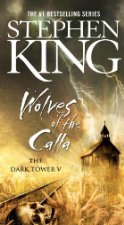 Summary:
The gunslinger’s katet have a lot more on their plate than just continuing along the path of the beam. Susannah is pregnant and has developed another personality, Mia, to deal with the pregnancy as it is most likely demonic. The Rose is in danger in then when of 1977 New York City. The man who owns the empty lot it grows in is under pressure from the mob to sell it to an unseen man. So the last thing the katet needs is to run into a town desperately in need of the help of gunslingers.
The Calla, a town made up of rice growers and ranchers who mostly give birth to twins, has been facing a plague once every generation. Creatures referred to as Wolves come and take one child out of every set of twins between the ages of about 4 and puberty. The child is later returned mentally retarded. Their local robot messenger, Andy, has warned them that the Wolves are coming in about a month, and their holy man believes gunslingers are on their way.
Unable to turn down their duty as gunslingers or give up on their quest for the Dark Tower, can the gunslingers pull it all off or is it just more than any katet, even one as strong as theirs, can handle?
Review:
Toward the beginning of the book, Roland says something like, “Being a gunslinger means weeks of planning, preparation, and hard work for 5 minutes of battle.” That’s really a good description of this book. It’s a lot of exposition, albeit very interesting exposition, followed by a rather anticlimactic battle that is really the exposition for the next leg of the katet’s journey. This could have gone really badly, but thankfully there’s a lot of information King needs to tell us, and most of it is interesting and relevant to the gunslingers’ world, so it works.
King is good at creating a culture. The Calla and its people possess a very distinctive speech pattern and colloquialisms that are simultaneously easy enough for the reader to learn and to follow. He hints that he just took the Maine accent and exaggerated it. Maybe that’s why a New England gal like myself found it so easy to follow. In any case, the town of twins, ranchers, and rice is rich with local legends, folklore, and traditions. It is enjoyable to read about, and the town also manages to provide information about the katet’s greater quest for the Dark Tower.
It is well-known that King’s Dark Tower series brings in elements and characters from his other works, as he sees all of his stories happening in the same world and being connected. To that end, the holy man of the Calla is the priest from Salem’s Lot, and a part of Wolves of the Calla is him relating his backstory to the katet. Something that irritated me about all of the tales told in the “Telling of Tales” section of Wolves of the Calla is that it would switch from the character speaking to an italicized third person narrative. I don’t know if all of the italicized portions were previously written for other books or if King felt that he needed to be an omnipotent narrator in order to properly tell everything that had happened, but I found it disjointing and jarring. It was only my unanswered questions about the Wolves and the Dark Tower that kept me reading through that section.
I enjoyed the growth in the relationship between Roland and Jake. Roland is gradually growing into a father figure/adviser, while Jake is gradually becoming a man and an equal with the other gunslingers. King handles this transition well, and it is believable. Meanwhile, Eddie and Susannah’s relationship doesn’t change per se, but Eddie does realize that he will always love Susannah more than she loves him. It is evident that both of them are uncomfortable with her multiple personalities. This is an issue that clearly has not yet been resolved.
I do have three gripes with King. The first is that he persists in calling Susannah’s multiple personalities schizophrenia, which is just wrong. Schizophrenics hear voices, at worst, they do not have multiple personalities. What Susannah has is Dissociative Identity Disorder, and it is just inexcusable that he would get this wrong.
Second, although previously in the series the reader isn’t allowed to know or see something Roland knows, the reader always gets to know what the other gunslingers know. Here, information is pointedly held back from the reader. I can only assume this was an attempt to maintain suspense about the Wolves, which I found to be a cop-out. Either come up with an idea creative enough that we’ll be surprised anyway or have the characters be surprised as well as us. Also, I already had the wolves figured out long before they are revealed anyway. The suspense came in wondering how the final battle would play out, not in wondering who the Wolves were.
Third, I don’t like the fact that Susannah’s main storyline is a pregnancy. I don’t like that one of her key roles so far as a gunslinger was to fuck the shit out of a demon so that Jake could be pulled through (The Wastelands). I also really don’t like that something as simple as her being pregnant causes her to abandon her husband and her katet in the form of another personality, Mia. It almost seems that King uses the multiple personalities just so that he can have a sweet woman around when he needs one but then can instantaneously turn her back into all of the negative images of women out there. I need to see where Susannah’s storyline winds up before I can offer a final analysis of the character and its implications, but at the moment, it reads as a very negative view of women.
The overarching storyline of the quest for the Dark Tower, however, is still going strong in this book. We learn a bunch of new, important information about the Tower, the beams, and the worlds, and new questions pop up. With each book it becomes more evident that saving the Tower is important to the well-being of all worlds. I am pleased to report that this was a marked improvement over the previous book, although not quite up to the intensity of The Waste Lands or pure readability of The Gunslinger. It still manages to suck you in and gets the story back on the path of the beam.
3 out of 5 stars
Source: Borrowed
Previous Books in Series:
The Gunslinger, review
The Drawing of the Three, review
The Waste Lands, review
Wizard and Glass, review

Book Review: All I Want For Christmas Is a Vampire By Kerrelyn Sparks (Series, #5)
 Summary:
Toni never meant to wind up working as a daytime security guard for vampires. She meant to be spending her December focusing on finishing up her masters degree so she and her best friend Sabrina would be one step closer to their dream of running a high-quality orphanage. But Sabrina was attacked and her claims that vampires orchestrated the attack has led to her uncle locking her up in a mental institution. Toni is determined to prove to Sabrina’s uncle that vampires are real, so she has gone undercover guarding the good vampires seeking some definitive way to prove their existence. Much as she wants to hate vampires, a certain Scottish highlander vamp named Ian has a way of making her feel very much alive.
Review:
Since I received this book as a present and there was no indication on the cover, I had no idea it’s the fifth book in the series until I was partway in and did a little bit of investigating. So, I haven’t read any of the other books in the series.
Of course, I don’t particularly think I would want to. The book starts out strongly. Toni is a character who it is easy to identify with. She’s a young adult with dreams and struggling with her self-esteem via a list of positive affirmations she says every morning. She is fiercely loyal and intelligent. Toni’s character does develop throughout the book, unfortunately not in a good way. Instead of realizing her own strength, she now has a whole new set of people–vampires and shape-shifters–to feel inferior to.
The vampire world that Sparks creates is simply not appealing. She sets up two groups of vampires–the good guys and the bad guys, or as the good vampires call them, the “Malcontents.” The Malcontents enjoy making others feel fear and pain and want to kill off all of the good vampires. The good vampires, no kidding, have their own priest and Mass. Yeah, you read that right, the vampires are Catholic. WTF?! That’s almost as bad as vampires that sparkle.
Additionally, the good vampires seem to have a thing for marrying mortals, and the leader of the good vampires has come up with a way to splice male vamps’ genetic material so that the mortal mother can give birth to a child who is half-vampire. Naturally these children have super-human abilities, such as levitating, but they also seem to be able to miraculously heal the sick. Reading these scenes gave me the same feeling as fingernails on chalkboard.
On the other hand, the romance portion of the plot is actually quite good. Toni’s and Ian’s witty banter reads realistically, and their sex scenes are fun.
If you’re just after the romance element and won’t mind the world Sparks has created, you’ll enjoy the book. All others should stick to Charlaine Harris and Nora Roberts.
2.5 out of 5 stars
Source: Gift from a friend
Previous Books in Series:
How to Marry a Millionaire Vampire
Vamps and the City
Be Still My Vampire Heart
The Undead Next Door

Book Review: All Together Dead by Charlaine Harris (Series, #7)
 Summary:
Against her fairy godmother’s better judgment, Sookie accompanies the Louisiana vampire contingency to Rhodes, Illinois for the vampire summit to work for the queen reading human minds at the various wheelings and dealings. She is excited that Quinn will be there as well, but a wrench is thrown in the works of their relationship when she is forced to exchange blood for a third time with Eric. To top it all off Sookie and fellow telepath Barry have the odd sensation that something isn’t quite right at the summit. It’s a lot for small-town girl Sookie to handle in one week in the north.
Review:
I want to say the action in this entry into Sookie’s adventures is excellent, but it isn’t quite there. The minor side-mysteries are quite good, but they are meant to distract from the main event, which frankly I had figured out way way way before Sookie. It was pratically hitting her in the face, and she didn’t get it. So the mystery leaves a little to be desired.
On the other hand, the plot point where Andre is trying to force Sookie to exchange blood with him, and Eric steps up to exchange blood with her instead is excellent. Quinn is unjustifiably angry, and Sookie discovers that trading blood three times is a magical number. She is more closely tied to Eric than she is comfortable with, and she is left incredibly confused about her feelings for him vs her feelings for Quinn. This is a love conflict that is bound to prove interesting because she has feelings for Eric but intellectually believes Quinn is a wiser choice. Now this is juicy romantic conflict!
Something that has been bugging me about the series that is featured epicenter of this book though is the whole idea of the vampires arranging their kingdoms based on the states. There’s the King of Tennessee and the Queen of Louisiana, and they even call each other simply by the state (as in, “Oh hi, Louisiana”). This makes zero sense. Why would the super-powerful and, for the majority of existence, hidden vampires arrange themselves based on arbitrary human dividing lines? Sure having multiple kingdoms in the US makes sense, but not arranged based on the human-created state lines. It doesn’t fit into the characterization of what a vampire is.
I think what really bothered me about this book though was that it made me dislike Sookie. I don’t like how she behaves, her superficial focus on clothing, or her prejudiced view of northerners. (Not a single northern woman she runs into does she view as anything other than a rude bitch). I don’t always need to like my main characters, but I think in a paranormal romance that’s problematic.
Overall, the action is excellent, even if some of the world-building doesn’t make sense and the characterization can be off-putting. I think this may be a set-up for a major, character-changing circumstance in Sookie’s life, which would make it more understandable. We’ll see if I’m right.
3 out of 5 stars
Source: Bought on Amazon

Previous Books in Series:
Dead Until Dark
Living Dead in Dallas
Club Dead
Dead To The World
Dead as a Doornail
Definitely Dead
Book Review: Definitely Dead By Charlaine Harris (Series #6)
 Summary:
Sookie needs to go to New Orleans for both personal and business reasons. Her cousin Hadley had been a vampire but died her second death leaving everything to Sookie, so she needs to go clean out her apartment. As far as business goes, the queen of Louisiana has also requested her presence to figure out if she will require Sookie’s services for the upcoming vampire summit. When Sookie finds out that Hadley was the queen’s lover, a connection between the two purposes for the visit shows up that may be more significant than she at first realizes.
Review:
I’m glad I learned on some blog (wish I could remember which one) that a short story comes between the previous book and this one in the series, otherwise I would have thought I missed a book or something. That annoying tendency to retell things that already happened? Actually awfully helpful here, since I haven’t read that short story. You don’t need to read the short story to enjoy this book, but I wish I had and advise you to as well. If you’re interested, some investigation reveals that short story is contained in the collection of Sookie short stories called A Touch of Dead.
Also thankfully, my prediction that Dead as a Doornail was a random clunker and not a death toll for the series was correct. Definitely Dead is a step back up in quality. The multiple storylines actuall do reveal to be related and not just random throwaways designed to throw you off the scent of the main mystery. We also get the addition of a new supe–part-demons–and some serious reveals. I mean makes you rethink how you look at the entire story reveals. To give you non-spoilery hints, you learn something about Bill and something about just why Sookie is so darn appealing to the supe guys. I personally love that sort of thing, and I’m hoping these two reveals will help the series continue to grow and expand.
On the minus side, I have to come right out and say it that I am not impressed with Quinn. I’m glad Sookie has become a bit more savvy about pursuing a long-term relationship, but with Quinn? Really? The man’s looks don’t match what has been established to be Sookie’s type at all–tall and lean–he is instead the muscle-bound guy. That suits some women, but it comes out of the blue that Sookie’s at all attracted to him. Also, what’s with the purple eyes? On what planet is it sexy for a man to have eyes not only an unnatural color, but an unnatural color that’s girly? I of course dislike him for nonsuperficial reasons too. He seems far too perfect. He says those puke-inducing gushy things to Sookie that, I’m sorry, perfectly nice men just don’t say in real life, and you know why they don’t say them? Because they sound corny and false and how the man treats you is far more important than what he says to you. There’s also the fact that he originally came on to her when there was a fight to the death going on in front of them, something I find indicative of just how sympathetic he really is to other people. Frankly, I just don’t find Quinn or Sookie’s interest in him believable. Something just rings false about the whole thing. It isn’t like her interactions with Eric, for example, that are full of witty banter and internal conflict about liking this person on both sides. Quinn and Sookie’s conversations literally make me want to puke at how disgustingly sweet and false they sound. Reading their conversations is like eating a twinkie. A deep-fried twinkie.
Thankfully, there isn’t much Quinn in this book, so it’s still an enjoyable read and a sign of better things to come in the series.
3 out of 5 stars
Source: Bought on Amazon

Previous Books in Series:
Dead Until Dark
Living Dead in Dallas
Club Dead
Dead To The World
Dead as a Doornail
 Support my work with a tip or browse my shop for curated book club guides, how to guides, cross-stitch patterns, and more!


This work by Amanda Nevius is licensed under a Creative Commons Attribution-Noncommercial-No Derivative Works 3.0 United States License.
 Opinions of a Wolf