
Archive
Book Review: I Don’t Want to Kill You by Dan Wells (Audiobook narrated by Kirby Heyborne) (Series, #3)
 Summary:
Teenaged John Cleaver had his sociopathy under control but when his town was plagued with two different demons, he had to let it loose a bit to fight them. He invited the demon Nobody to come face off with him, but he and those around him are left wondering if Nobody is real or if John’s sociopathy has just gone out of control. Meanwhile the teenage girls of the town are committing suicide left and right, and John can’t help but wonder why he’s ever tried to save anybody.
Review:
This is one of only a few YA series that I’ve enjoyed reading. The paranormal/youth aspect are almost like a Dexter lite, which is enjoyable. I must say, though, that I was disappointed by the ultimate ending to the series. However, since I write up series review posts every time I finish a series, I’ll leave my analysis of the series as a whole to that post, which will be coming up next. For right now, let’s look at the final book on its own merit.
The plot this time around was disappointingly full of obvious red herrings. I knew within the first chapter where Nobody was hiding, and it was kind of ridiculous that talented, intelligent John was missing it. Similarly, I found the serial killer who John identified as who he could end up being if he made the wrong choices to be a bit heavy-handed. John was already well aware of the risks of his sociopathy from the very first book. It felt a bit unnecessary to make this such a strong plot point. It came across as preachy, which is something that this series had avoided so far. Similarly, John goes to see a priest at one point in his investigations, and his conversations with him felt a bit too heavy-handed, almost like the (known religious) Wells was preaching at the readers through the priest. Authors are allowed their opinions and perspectives, but preachiness is never good writing. Perspective and opinion should be shown eloquently through the plot and characters.
Speaking of characterization, John was still strongly written, but his mother and sister were another story. They felt less like they were doing what was logical and more like they were doing what needed to be done to move the plot forward. On the other hand, I really enjoyed John’s new girlfriend. She was well-rounded and realistic. Plus she was fit while being curvy, which I think is a great thing to see in a book.
In spite of the slightly obvious plot, I still was engaged to get to the end. Even though I knew whether or not there was a demon and who the killer was, I still deeply wanted to see how John would handle it. The audiobook narrator, Kirby Heyborne, helped with this momentum. His narration was just the right amount of tension while still remaining in a teenager’s voice. Be warned, though, that there is some yelling in the book, so the volume does spike considerably at a few points in the narration. You may want to keep the volume a bit lower than usual to accommodate this.
Unfortunately, where the plot ultimately ended up was deeply disappointing to me. It was not at all a satisfying ending, and from a mental illness advocacy perspective, I actually found it distressing. Whereas John’s sociopathy previously was handled with a lot of scientific understanding, I found the ending of this book to be completely out of touch with real sociopathy. While it wasn’t offensive per se, it drastically oversimplifies sociopathy, both its treatment and its causes, which is just as bad as demonizing it. I will address this issue more fully in the series review, but suffice to say that I found the ending to this book’s individual mystery and the series as a whole to be disappointing, particularly given the potential of the book.
Overall, then, this is an average book that wraps up an above average series. If you are someone who is fine with stopping things partway through, I’d recommend just stopping with the previous book in the series, Mr. Monster. But if you are interested in the overall perspective, this book is still an engaging read that doesn’t drag. It just might disappoint you.
3.5 out of 5 stars
Source: Audible

Previous Books in Series
I Am Not A Serial Killer
Mr. Monster
Counts For:

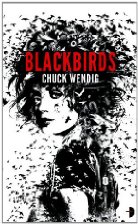
Book Review: Blackbirds by Chuck Wendig (Series, #1)
 Summary:
Miriam Black is an early 20-something drifter with bleach blonde hair and a surprising ability to hold her own in a fight. She also knows when and precisely how you’re going to die. Only if you touch her skin-on-skin though. And it’s because of this skill that Miriam became a drifter. You try dealing with seeing that every time you touch someone. But when a kind trucker gives her a lift and in her vision of his death she hears him speak her name, her entire crazy life takes an even crazier turn.
Review:
This is one of those books that is very difficult to categorize. I want to call it urban fantasy, but it doesn’t have much supernatural about it, except for the ability to see deaths. The world isn’t swimming in vampires or werewolves of goblins. I also want to call it a thriller what with the whole try to stop the trucker from dying bit but it’s so much more than chills and whodunit (or in this case, who will do it). Its dark, gritty style reminds me of Palahniuk, so I suppose what might come the closest would be a Palahniuk-esque urban fantasy lite thriller. What I think sums it up best, though, is a quote from Miriam herself:
It starts with my mother….Boys get fucked up by their fathers, right? That’s why so many tales are really Daddy Issue stories at their core, because men run the world, and men get to tell their stories first. If women told most of the stories, though, then all the best stories would be about Mommy Problems. (location 1656)
So, yes, it is all of those things, but it’s also a Mommy Problems story, and that is just a really nice change of pace. Mommy Problems wrapped in violence and questioning of fate.
The tone of the entire book is spot on for the type of story it’s telling. Dark and raw with a definite dead-pan, tongue-in-cheek style sense of humor. For instance, each chapter has an actual title, and these give you a hint of what is to come within that chapter, yet you will still somehow manage to be surprised. The story is broken up by an interview with Miriam at some other point in time, and how this comes into play with the rest of the storyline is incredibly well-handled. It’s some of the best story structuring I’ve seen in a while, and it’s also a breath of fresh air.
Miriam is also delightful because she is unapologetically ribald and violent. This is so rare to find in heroines.
We’re not talking zombie sex; he didn’t come lurching out of the grave dirt to fill my living body with his undead baby batter. (location 2195)
As a female reader who loves this style, it was just delightful to read something featuring a character of this style who is also a woman. It’s hard to find them, and I like that Wendig went there.
While I enjoyed the plot structure, tone, and characters, the extreme focus on fate was a bit iffy to me. There were passages discussing fate that just fell flat for me. I’m also not sure of how I feel about the resolution. However, I’m also well aware that this is the beginning of a series, so perhaps it’s just that the overarching world rules are still a bit too unclear for me to really appreciate precisely what it is that Miriam is dealing with. This is definitely the first book in the series in that while some plot lines are resolved, the main one is not. If I’d had the second book to jump right into I would have. I certainly hope that the series ultimately addresses the fate question in a satisfactory way, but at this point it is still unclear if it will.
Overall, this is a dark, gritty tale that literally takes urban fantasy on a hitchhiking trip down the American highway. Readers who enjoy a ribald sense of humor and violence will quickly latch on to this new series. Particularly recommended to readers looking for strong, realistic female leads.
4 out of 5 stars
Source: Netgalley

Book Review: The Preying Mantis by Andreas Louw
 Summary:
FBI agent Betty Roy has been pursuing one serial killer for years. He murders one young female teacher who plays a musical instrument per season. Suddenly, though, he contacts Betty herself and starts ratcheting up the rate of the killings. He seems to have some sort of personal interest in her.
Review:
I picked this up during the Smashwords Summer/Winter sale for two reasons. The plot sounded intriguing, and honestly the cover amused me. What I found inside was a plot that was mostly strong (although it fell apart at the end) that was unfortunately supported by some truly bad writing.
Let’s start with the good. The plot is genuinely creepy. Although the Preying Mantis (as he calls himself) is fairly typical for a serial killer thriller, he’s got enough unique qualities that the reader is left intrigued and guessing. The murder scenes are brutal and frightening. I was engaged enough that I kept reading in spite of the bad writing quality, purely because I wanted to know what happened at the end.
Unfortunately, the plot at the end takes a bit of a nonsensical nose-dive. I have an incredibly difficult time believing that the FBI would let an agent recently removed from a serial killer case who they know is currently being pursued by him run off into the middle of the woods without backup. Or some sort of catch the criminal plan she is in on. Similarly, I have major issues believing this same FBI agent would be stupid enough to go to the woods at this point in time, let alone go there without her big guard dog that she instead leaves at a friend’s house. It’s a lot of characters acting stupid just to get them to where the author needs them to be. Thankfully, that only shows up at the end.
As for the writing itself, there are three separate issues at hand.
First up, we have an omniscient third person narrator telling a story that takes place almost entirely in New York City with American characters, and yet the narrator repeatedly speaks British English. This is bizarre, confusing, and jolts the reader out of the story. I actually had to check a couple of times and make sure the story was indeed happening in NYC. Here are a few examples:
She had met the old man before and knew his heart was a bit dodgy. (location 1095)
He thought it best not to point out at this stage that if he had been shagging Wells’ wife, he might not have been gay. (location 2306)
Betty came out of the shower, refreshed, and took out a pack of crisps and a soft drink. (location 3553)
In case it’s unclear, Americans don’t say dodgy, shagging, or crisps. We say sketchy, banging, and chips. I suppose it’s possible that Louw could want the narrator of this event taking place in America to be British, but if so, it should be for a reason. For instance, it would make sense if the story was being told by a British person researching the killer at a later date. That is not the case, though. As previously pointed out, this is an omniscient third person narrator telling a story set in America. They should speak American English. The British English also drifts into the American characters’ dialogue, but there are far larger problems with the dialogue, so I won’t bother citing those. Suffice to say though that if it’s a problem for the narrator to speak British English it’s an even larger one for the American characters to do so.
Speaking of dialogue (see what I did there), let’s get to that. The main problem with the dialogue is that it doesn’t sound realistic. At all. Also every single character sounds exactly the same. The Latino-American cop sounds exactly like the white American FBI Agent who sounds exactly like the serial killer who sounds exactly like the head of the FBI’s investigation. And none of them sound realistic. Rather than try to explain it, let me show you.
I shall go mad if I don’t have anything to do for the next two weeks. (location 310)
Would you like to order out? I am quite hungry and can do with some sustenance. (location 1213)
After about fifteen minutes he emerged form his office and said, “Let us go.” (location 2868)
How come you being here all by yourself in the middle of nowhere, dear? (location 3617)
The only way dialogue like this would work would be if, say, one character was OCD about never saying a contraction or had Asperger’s Syndrome or something. But none of the characters are like that and also they all speak exactly the same way. It’s a real problem for dialogue to sound so incredibly unrealistic. It drags the reader out of the story, plus it’s bad characterization. Each character should have an individual sound.
Finally, there are the general grammar/spelling issues. The most annoying being the author’s tendency to switch back and forth between present and past tense, frequently within the same sentence. For example:
She had been hunting him for the last two years and it reached the point where he has invaded every aspect of her life. (location 123)
Lemke had played this kind of game before and he is definitely not going to let someone like Newmark get under his skin. (location 669)
Shudders up and down my spine, y’all. And not the kind you’re supposed to get from reading about a serial killer.
Overall, the book has a relatively unique plot that is overshadowed by a first draft quality level of writing. I encourage Louw to get either a co-author or an editor for future endeavors, as well as a wider variety of beta readers. Sound editing and checks by beta readers could have cleared up many of these issues.
2 out of 5 stars
Source: Smashwords
Book Review: The Book of Lost Fragrances by M. J. Rose (Series, #4)
 Summary:
Jac ran away from her family’s traditional perfumerie in Paris to pursue a career in mythology in her mother’s homeland of the USA. This move was spurred on by her mother’s suicide, and Jac’s own subsequent loss of touch with reality. Years of therapy later, all is well, but when Jac’s brother and current manager of the perfumerie goes missing, Jac must face up to her demons at home, as well as scenes in her own mind. Are they delusions or past life memories?
Review:
I requested this on NetGalley without realizing it was part of a series, but it is evident each entry in the series is about different people whose lives intertwine in a minor way. Thus, I was able to read this book without feeling that sense of disorientation that happens when you jump into the middle of a series. I’m glad too, because I found the story an intriguingly different plot-line for a thriller.
Essentially, there are some pottery pieces that Robbie discovers in his home that may or may not have once held a scent that allows whoever smells it to remember their past lives. A past life therapist wants these pottery pieces, Robbie wants to give them to the Dalia Lama, and the Chinese government wants to keep them out of the Dalai Lama’s hand in their on-going quest against Tibet. It’s a good big world plot, but the overall focus is mostly on Jac, which is how I tend to prefer thrillers. And Jac is a great character. She is strong, intelligent, a caring sister. She had a rough childhood, but still has her head on straight. Her struggle with whether or not she had past lives ends up not being as important as the reader might at first think, which I also appreciated. Jac’s character development is about accepting herself for who she is and not making selfish choices. It is not at all the romance I thought at first it was going to be, and that is a good thing.
Rose evokes the settings of Paris and NYC with equal aptitude. I must say I found myself craving an afternoon at the museum and some creperies when I was done with the book. The perfumerie business and house are equally beautiful and easy to picture, but also the tunnels underneath Paris are evoked well. Setting and characterization are strong points of Rose’s.
I did periodically feel the book moved too slow in the beginning. Also, I was disappointed that people who were evil now were evil in past lives and the good were always good. Similarly, only one person had a past life as a different gender. I get it that Rose’s point is that one needs to know one’s past lives in order to fix your mistakes that you make over and over, but I think it’s a bit short-sighted to think that if reincarnation did exist it would be that simplistic. Also, personally, I just don’t believe in soul mates, so having that as a strong theme in the book was rather eye-roll inducing.
Overall, this is a fun worldwide thriller with educated people at the center of it that includes thought-provoking themes like self-improvement and self-acceptance. Fans of the modern, globe-spanning thriller will enjoy it, as well as anyone who has a love of Paris.
4 out of 5 stars
Source: NetGalley

Previous Books In Series:
The Reincarnationist
The Memorist
The Hypnotist


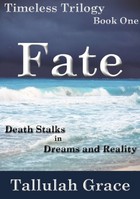
Book Review: Timeless Trilogy, Book One, Fate by Tallulah Grace (Series, #1)
 Summary:
Kris is a successful video editor in Charleston, South Carolina with two best friends she’s made her own family with. She has a beautiful beach house and a loving fluffy cat named Pegasus. She also just so happens to be precognitive. Her visions have never been about herself until she starts sensing that she is being watched, receiving late night phone calls, and finding flowers left at her house and on her car. Increasingly, she realizes she is in danger, and right then her old college flame moves in next door.
Review:
This is an interesting mix of suspense, romance, and paranormal that keeps the reader guessing and interested and shows promise in the writer.
Kris’s life prior to the stalking is relatable to the modern female reader. She has a core group of good friends, a pet she loves, a career that is solid but not yet stellar, and her dream home. All that she is missing is the man. The added touch of her visions gives her that extra something special, but her visions are not over the top. She can’t control when they come or what they’ll show her, so she treats them more as an odd talent. This keeps the heroine from being over-inflated, which is nice. The love interest, Nick, is cute without being a god and kind without being perfect. He’s a good guy with flaws, ie, the ideal love interest in a romance that we’ve, alas, been seeing less and less of lately.
The plot is this book’s strong point. It is scary and suspenseful, but still believable. No characters make obvious stupid mistakes that would make the reader scream at them, and let’s just say, Kris is no Buffy the Vampire Slayer, but she also isn’t a weak, quivering Disney princess. Kris is neither a super-hero nor incredibly weak, which is just the kind of heroine we need more of in literature.
All of that said, Grace shows promise as a writer, but she still needs to work on her craft. Her plot structure is excellent, but she frequently shows instead of tells. Similarly, she struggles a bit when first introducing a character, often falling back on the beginner writer’s method of explaining hair and eye color before anything else. Similarly, the book needs more editing for simple grammar, spelling, and typos. The book does not read like a strong author’s work, but it also is still enjoyable. I am left wanting to find out about the romances of Kris’s friends Cassie and Roni, but I am also hoping that the writing that goes along with creative plots improves in the next two books.
Overall, if you are a fan of suspenseful romance with a dash of the paranormal and don’t mind a bit of showing instead of telling, this book is a fun way to pass a few hours, particularly for the low cost of 99cents.
3 out of 5 stars
Source: Kindle copy from author in exchange for my honest review

Book Review: King of Paine by Larry Kahn
 Summary:
Frank Paine was a Hollywood A-list leading man until he let the woman he loved deal with a BDSM scandal in the news on her own, thereby destroying her career and saving his. The guilt got to him, so he ended up leaving Hollywood and joining the FBI in an effort to bring justice to the world. His first case in the Rainbow Squad, however, involves not child rape or molestation but adult, BDSM style rape-by-proxy, and his ex-girlfriend is a suspect. Meanwhile, a former Pulitzer Prize winning journalist who’s been drowning his sorrows in alcohol finds himself swept up into the life of Angela del Rio and and discovering rumors of a place called The River.
Review:
I’m of two minds about this book. I felt the need to find out what happened in the end, but I also didn’t enjoy the meat of the story very much. It’s kind of like when you find yourself watching a marathon of The Biggest Loser and wondering why, exactly, it matters to you who gets voted off when the show get so many nutrition and exercise facts wrong and why exactly are the competitors cut off from their family anyway? Actually, it’s exactly like that.
Kahn builds suspense well. He’s clearly paid attention to just how much and how often to ramp up the violence and intrigue to keep a reader reading. I also appreciated the two separate story-lines that then intertwined. Of course, the reader knows they’re going to intertwine, but how is not immediately obvious. That was a nice touch.
Kahn also moves smoothly between real life dialogue and the chats on an online BDSM website that are a key part of the investigation. It was definitely crucial to a modern story to include the internet, and he switches between real life and the internet quite well.
That said, other crucial parts of telling a story fell flat for me. Kahn does not write women well. On looking back, it is evident that women in his story are divided into the classic dichotomy of angel or whore. There is no real room for three-dimensional characterization, making mistakes, or understandable motivations. For instance, Paine’s ex goes from calling her brother to threaten to kill him to getting back together within a week. That’s, um, fast? Similarly, although Kahn slips back and forth easily between Paine’s and Roger’s perspective, he never shows any of the women’s perspectives, even though they are the ones being raped, beaten, tricked, used, and abused. I can understand using the perspective of an FBI agent, but why couldn’t the second perspective have been Angela instead of Roger? Or why couldn’t he have made the reporter a woman? Regardless, none of the women in the story were believable, real characters.
Similarly, I was ultimately disappointed with who the perpetrator of the crime ultimately is. Without spoiling it, suffice to say the choice is stereotypical, bordering on racist. It was a choice lacking in creativity or sensitivity.
Overall, although the suspense reeled me in, the content of the story left me with a sour taste in my mouth. I suppose if you want a junk food style suspense, or if the negatives I pointed out wouldn’t bother you, you may enjoy this book. Those looking for thought-provoking, realistic suspense should look elsewhere, however.
3 out of 5 stars
Source: Kindle copy from author in exchange for my honest review

Book Review: The Burning Sky by Joseph Robert Lewis (Series, #1)
 Summary:
In an alternate vision of history, the Ice Age has lingered in Europe, slowing down Europeans’ rate of civilization and allowing Ifrica (Africa) to take the lead. Add to this a disease in the New World that strikes down the invaders instead of vice versa, and suddenly global politics are entirely different. In this world, steam power has risen as the power of choice, and women are more likely to be the breadwinners. Taziri is an airship co-pilot whose airfield is attacked in an act of terrorism. She suddenly finds herself flying investigating marshals and a foreign doctor summoned by the queen herself all over the country. Soon the societal unrest allowing for a plot against the queen becomes abundantly clear.
Review:
Can I just say, finally someone wrote a steampunk book I actually like, and it’s a fellow indie kindle author to boot! All of the possibilities innate in steampunk that no other book I’ve read has taken advantage of are used to their fullest possibilities by Lewis.
I love that Lewis used uncontrollable environmental factors to change the political dynamics of the world. Anybody who has studied History for any length of time is aware how much of conquering and advancement is based on dumb luck. (The guns, germs, and steel theory). Lewis eloquently demonstrates how culture is created both by the people and their surroundings and opportunities. For instance, whereas in reality the Native Americans had to rely on dogs for assistance and transportation against invaders on horseback, Lewis has given the Incans giant cats and eagles that they tame to fight invaders. Similarly, in Europe the Europeans are constantly fighting a dangerous, cold environment and have dealt with this harsh landscape by becoming highly superstitious, religious people. This alternate setting allows for Lewis to play with questions of colonization, race, and technology versus tradition in thought-provoking ways.
Women are in positions of power in this world, but instead of making them either perfect or horrible as is often the short-coming of imagined matriarchies, there are good and bad women. Some of the women in power are brilliant and kind, while others are cruel. This is as it should be because women are people just like men. We’re not innately better or worse. Of course, I couldn’t help but enjoy a story where a soldier is mentioned then a character addresses her as ma’am, without anyone feeling the need to point out that this is a woman soldier. Her gender is just assumed. That was fun.
Although Taziri does seem to be the main focus of this book, the story is told by switching around among a few main characters who find themselves swept together in the finale for the ultimate battle to save or assassinate the queen. This strategy reminded me a bit of Michael Crichton’s Next where seemingly unrelated characters suddenly find how their destinies are all connected together. Lewis does a good job with this, although personally I found the beginning a bit slow-moving. It all comes together well in the end, though, with everything resulting in a surprising, yet logical, ending.
What kept me from completely loving the book is that I feel it needs to be slightly more tightly edited and paced. Some sections were longer than they needed to be, which I can certainly understand, because Lewis has made a fun world to play around in, but as a reader reading what amounts to a thriller, I wanted things to move faster.
That said, I thoroughly enjoyed exploring the steampunk world Lewis has created after a couple of years of loving the fashions and possibilities but finding no steampunk books I liked. If someone were to ask me where to start with steampunk, I would point them here since it demonstrates the possibilities for exploring race, colonization, and gender, showing that steampunk is more than just an extended Victorian era.
Overall this is a wonderful book, far better than the traditionally published steampunk I’ve read. I highly recommend it to fans of alternate history, political intrigue, and steampunk alike. Plus it’s only 99 cents on the kindle. You can’t beat prices like that.
4 out of 5 stars
Source: Won on LibraryThing from the author in exchange for my honest review

Book Review: Point by Thomas Blackthorne (series, #2)
 Summary:
Mysterious cutter circles are showing up in the Britain of the future. Thirteen teenagers gather in a circle, then slice the wrist of the person next to them all the way around the circle. The MI5 recruits a neuroscientist to help figure out the circles before they reach epidemic proportions. Meanwhile, her boyfriend, Josh Cumberland, finds himself sucked back into his old special forces unit when a civilian job reaches a mysterious end. Are the two events connected?
Review:
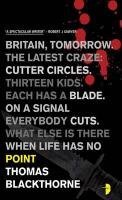
I received an ARC of this book through the Angry Robot Army, and I sort of wish I’d noticed it was the second in a series. I just dislike reading books out of order. Also, I think perhaps if I’d read the first book in the series, I wouldn’t have been so misled by the cover.
In case you can’t see the cover, it says, “Britain, tomorrow. The latest craze: cutter circles. Thirteen kids. Each has a blade. On a signal everybody cuts. What else is there when life has no point.” This makes it seem like this will be a book about depression and suicide in a post-apocalyptic world, right? In fact the people committing suicide have been brainwashed by music in an emotiphone to further a political power move. Which has…..nothing to do with real suicide or depression.
There’s nothing wrong with being a political intrigue book, but I am a bit disturbed at how Blackthorne utilizes psychology, psychiatry, and neuroscience in the book. He makes it look like in the future we’ll be able to just….program people out of it or to do whatever we want them to do. The brain is much more complex than that, and I just don’t like the message that such a plot device sends.
When looking at the book as the political espionage it actually is, as opposed to a book about mental illness in a dystopian world, it’s not a bad book. I have the feeling that those who enjoy political intrigue books will enjoy it. Josh is your typical wounded hero, and I did enjoy the scenes of him training. Blackthorne creatively incorporates reality tv into the plot-line that many readers will enjoy. The characters aren’t flat, but also aren’t particularly well-rounded. That’s ok, though, because the focus of the book is the action and political intrigue.
Overall, the book seems to be an average future political intrigue action flick…in written form. I recommend it to fans of that genre, but others will probably be bored.
3 out of 5 stars
Source: ARC from publisher

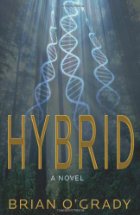
Book Review: Hybrid by Brian O’Grady
 Summary:
Amanda Flynn’s life changed forever when her Red Cross relief team was exposed to a deadly virus in the Honduras, leaving her the sole survivor. Seven years later, when she thinks most of the horror is over, the virus resurfaces in Colorado Springs, Colorado, and she finds herself forced to team up with various government officials, a priest, and a coroner, in a fight against a deadly terrorist plot.
Review:
I admit that I bought this book in a haze that I call “Kindle Sale Fever.” Periodically Amazon has sales of Kindle books where they suddenly cost 99 cents to $2.99, and I tend to impulse buy. Oops. (I mean, if you’d told 7 year old me such a thing would even be possible one day, I probably would have curled up and died in pure bliss). In any case, the Amazon blurb led me to think this was more in the transhumanist/zombie genre than evil terrorist plot thriller, which I tend to avoid. It’s nothing against the genre; I just don’t do politics in my happy fun reading time. So, this book was already facing a challenge to satisfy someone who doesn’t tend to like that kind of story.
At first, it definitely was working for me. The plot of Amanda Flynn mysteriously surviving the illness and escaping the CDC to avoid being treated like a guinea pig was engrossing for the sheer humanity of it. The initial break-out in Colorado Springs was also intriguing with the virus killing some people but healing others from serious illnesses like childhood leukemia. At a certain point though it started to feel like O’Grady was trying to do too much. The book was trying to straddle multiple genres and plot-lines that didn’t quite mesh. Among the things going on: new general trying to prove himself, survivors who turn psychic, Amanda dealing with her guilt, new African-American head detective dealing with being head detective in a largely white city, priest having crisis of faith, little girl miraculously healed of leukemia, coroner who might be a sociopath, definitely evil dude who hallucinates (or might not be hallucinating) some random Russian guy, head of the CDC trying to figure out the spy in his office, and Arab dude who may or may not be defecting from the terrorists to the Americans. See what I mean? This would be totally fine if they all somehow tied up in the end, but the main issue in the book of these survivors with psychic powers is just kind of dropped. We get far more information on the foiled terrorist plot than on the effects of the virus on the survivors, and that is by far the more interesting part of the story.
It’s also bothersome that the main character, Amanda Flynn, is the least well-rounded and likeable. The priest and the coroner are far more interesting and well-rounded, showing that O’Grady can write characters well, but Amanda simply rings false. Perhaps part of this is that we see the priest and the coroner before they become infected and are still entirely human. The story of Amanda and her survival in the Honduras is simply never fully told, and I think that would have helped a lot, even if addressed only in a flashback.
Overall, although the story itself is not for me, it does suffer from some characterization/plotting issues. Thus, I would recommend it to huge fans of terrorist thrillers, who would probably still enjoy it.
2.5 out of 5 stars
Source: Amazon

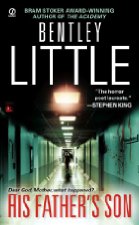
Book Review: His Father’s Son by Bentley Little
 Summary:
Steven’s life in California is so typical it borders on boring. He writes for AlumniMedia. He’s engaged to a librarian named Sherry. He goes out for happy hour every Friday night with his three buddies. Then one day his mother calls him and informs him his father tried to kill her. His father has had strokes and dementia, but in a moment of absolute clarity in the VA hospital, his father whispers to Steven, “I killed her.” Thus begins Steven’s tailspin into a world of darkness and ever-changing morality.
Review:
I believe this book succeeds in serving its purpose–it’s a page-turner with chills. If someone asked me for a simple thriller for the beach, I’d have no qualms handing this over. I cannot rid myself of the vibe though that the idea of this book could have led to a thriller of excellent quality instead of beach read quality, and that is a bit disappointing.
The set-up is excellent. Here we have an ordinary guy with some issues with his parents, but he still tries to live up to his family obligations. Then his father has an episode that makes mortality something Steve is no longer able to ignore. Steve then starts this quest that could easily be read as a metaphor for adults dealing with the increased fragility of their parents. However, about two-thirds of the way through, the plot takes an unexpected twist that then essentially nose-dives off a cliff into a scenario that is jarring and rather insulting to the reader. The book is not at all about what it at first appeared to be, and honestly, the original concept was much more intriguing than the final answer. The resolution is cliche, whereas the original set-up was not.
Other than the plot, Little sets scenes fairly well. It is easy to envision both the simpler scenes as well as the more complex scenes of violence. His writing style is not particularly memorable though. I didn’t once feel the need to write down a quote or dog-ear a page.
One of the more interesting elements of the book is that Steven is a writer, and his short stories pepper the book to give you an idea of his mental state at the time. I honestly enjoyed the short stories more than the actual book itself. I could easily see myself reading a collection of Little short stories in the future.
Overall, this is an enjoyable, if forgettable, thriller ideally suited to summer beach reading. I recommend it to fans of thrillers looking for an easy read.
3.5 out of 5 stars
Source: PaperBackSwap

 Support my work with a tip or browse my shop for curated book club guides, how to guides, cross-stitch patterns, and more!


This work by Amanda Nevius is licensed under a Creative Commons Attribution-Noncommercial-No Derivative Works 3.0 United States License.
 Opinions of a Wolf