
Archive
Friday Fun! (I’ve Been Really Busy So Let’s Talk About Fondue)
Hello my lovely readers! Like whoa, have I been busy this week! I actually finished reading The Meowmorphosis and have literally not had a spare moment to write up the review. My bad! It’ll be up next week. I’d tell you what I’ve been busy doing, but I can’t (well, except that part of it has been very long skype convos and sharing wine virtually with Amy).
So instead, let’s talk about how freaking excited I am for my friend Sara‘s birthday dinner tonight! She, bless her, wanted to get fondue. Fondue. Aka melted cheese and melted chocolate and dipping things and sharing your germs. If it is not abundantly clear why we’re friends, then I just don’t know what to say to you people anymore. This is pretty much what I have been thinking about off and on all day.
In other news, I haven’t quite finished the first book for The Real Help project but I am totally going to and get the post up tomorrow morning at some point. I might not be able to write it right when I get home tonight due to pure food coma.
Happy weekends!
Book Review: Point by Thomas Blackthorne (series, #2)
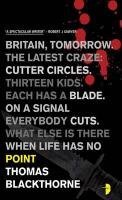 Summary:
Mysterious cutter circles are showing up in the Britain of the future. Thirteen teenagers gather in a circle, then slice the wrist of the person next to them all the way around the circle. The MI5 recruits a neuroscientist to help figure out the circles before they reach epidemic proportions. Meanwhile, her boyfriend, Josh Cumberland, finds himself sucked back into his old special forces unit when a civilian job reaches a mysterious end. Are the two events connected?
Review:
I received an ARC of this book through the Angry Robot Army, and I sort of wish I’d noticed it was the second in a series. I just dislike reading books out of order. Also, I think perhaps if I’d read the first book in the series, I wouldn’t have been so misled by the cover.
In case you can’t see the cover, it says, “Britain, tomorrow. The latest craze: cutter circles. Thirteen kids. Each has a blade. On a signal everybody cuts. What else is there when life has no point.” This makes it seem like this will be a book about depression and suicide in a post-apocalyptic world, right? In fact the people committing suicide have been brainwashed by music in an emotiphone to further a political power move. Which has…..nothing to do with real suicide or depression.
There’s nothing wrong with being a political intrigue book, but I am a bit disturbed at how Blackthorne utilizes psychology, psychiatry, and neuroscience in the book. He makes it look like in the future we’ll be able to just….program people out of it or to do whatever we want them to do. The brain is much more complex than that, and I just don’t like the message that such a plot device sends.
When looking at the book as the political espionage it actually is, as opposed to a book about mental illness in a dystopian world, it’s not a bad book. I have the feeling that those who enjoy political intrigue books will enjoy it. Josh is your typical wounded hero, and I did enjoy the scenes of him training. Blackthorne creatively incorporates reality tv into the plot-line that many readers will enjoy. The characters aren’t flat, but also aren’t particularly well-rounded. That’s ok, though, because the focus of the book is the action and political intrigue.
Overall, the book seems to be an average future political intrigue action flick…in written form. I recommend it to fans of that genre, but others will probably be bored.
3 out of 5 stars
Source: ARC from publisher

Reading Project: The Real Help–Helping Put “The Help” in Historical Context (Co-hosted With Amy of Amy Reads)
What’s a Reading Project?
I am really excited to be doing my first social justice themed reading project, which is different from a reading challenge. A reading challenge challenges you to broaden your reading horizons. A reading project takes a topic that matters to you (or that should matter to you) and creates a reading list about that topic by people who know to help you learn about it, as well as drive discussion on such an important topic. Now, allow me to explain the genesis of and reasons behind my first reading project.
What Led to the Project
I’ve grown to become good friends with Amy of Amy Reads over the past year, and when Kathryn Stockett’s The Help blew up in literary circles then became a movie, well, both of our ires got up. We discussed back and forth the issues via gchat, tumblr, and twitter, sending articles and mini-rants to each other and just generally being peeved that so much of the population got swept up into something so offensive to both black and white women in 2011 for goodness sake.
Let me explain to you in my own words my problem with The Help. Stockett is a white woman who grew up in the south with black maids. She claims that when her maid died she felt regret at never having gotten to know her as a real person, so she decided to write this fiction book about black maids in her home state in the 1960s. Right away, I was offended that her instinct was to write a fictional account instead of, oh I dunno, maybe making an effort to fight racism by befriending black people?
For those who don’t know, The Help is about a college educated white woman who comes home and interviews the black maids in her town and publishes their stories. I cannot really wrap my mind around the thought that Stockett thought of doing a project like this, but instead of being an editor of a collection of memoirs and real-life scenarios by black domestic workers she chose to fictionalize the whole process.
This leads me to one of my largest points. The Help is Stockett living in a fantasy land version of history. One of the first things you learn as a history major is to NOT romanticize the past. You have to get up close and personal with how ugly it truly was. Shows like Leave It To Beaver completely leave out real issues like racism, classism, sexism, etc… This is what Stockett is repeating. She regrets her relationship with her own black maid, so she writes a truly mary-sue style book wherein a college educated white woman gets to know the black female domestic workers and comes to their aid. This isn’t reality. This isn’t a harmless feel-good book/movie. It’s Stockett’s fantasy method of dealing with the racism she grew up with. Why not instead have written a book about a white woman who goes to college in the north and comes to regret the racism she was raised with? Who confronts the fact that she spent more time being cared for by a black woman than her own mother? That would have been real. That would have been something respectful to talk about. Instead, though, she chose to write a fantasy version of the 1960s American South where the racism really isn’t so bad and a white female activist isn’t put into any danger by her activism.
The whole thing is offensive. It’s offensive to black and white women. It’s offensive to black domestic workers of the past and present. It’s offensive to white women who faced real danger and estrangement from their families protesting racism. It’s offensive to the black people who stood up for themselves and fought racism without any white people coming along and telling them they should. And yet people are happily taking the blue pill and revising history.
Thankfully, not everyone is doing that. Slowly Amy and I started to see similar reactions to our own throughout the web. Here are just a few examples:
Indeed, with regard to the white children for whom they cared, black women often felt levels of “ambiguity and complexity” with which our “cowardly nation” is uncomfortable. Yes, my grandmother had a type of love for the children for whom she cared, but I knew it was not the same love she had for us. (Shakesville)
The Help is billed as inspirational, charming and heart warming. That’s true if your heart is warmed by narrow, condescending, mostly racist depictions of black people in 1960s Mississippi, overly sympathetic depictions of the white women who employed the help, the excessive, inaccurate use of dialect, and the glaring omissions with regards to the stirring Civil Rights Movement in which, as Martha Southgate points out, in Entertainment Weekly, “…white people were the help,” and where “the architects, visionaries, prime movers, and most of the on-the-ground laborers of the civil rights movement were African-American.” The Help, I have decided, is science fiction, creating an alternate universe to the one we live in. (Roxanne Gay)
And indeed, the stories of black domestic workers during the Civil Rights Movement are compelling narratives that deserve to be told. But by telling them through the lens of the benevolent white onlooker (Emma Stone’s “Skeeter” in The Help, who records the stories of the maids), it dilutes the message and impact. The black women who struggled during that time are strong enough to stand on their own. They don’t need an interpreter to serve as a buffer between them and the audience, to make their experiences more palatable for today’s viewers. (Kimberley Engonmwan)
It’s frustrating because in these narratives—written by privileged Whites—Black people are always passive. Things are done to them or for them, but they are never the agents of their own liberation. (And sorry, but no, telling the Nice White Lady about your shitty boss isn’t being an agent of your own liberation—not when Black women were actually organizing against Jim Crow, segregation, lynchings and violence, and the intimidation of Black voters.) (Feministe)
What really pushed it over the edge for me, though, and got me going from stewing to activisting (that is a word because I say so) was when someone tweeted a link to the American Black Women Historian’s response to The Help that is not only eloquently put, but also includes a suggested reading list at the end. The reading list got my wheels turning and next thing I knew I was emailing Amy to suggest we do something with that list.
What the Project Is
There are 10 books on the suggested reading list, 5 fiction and 5 nonfiction. For the next five months we will be hosting a project to read one fiction and one nonfiction book and discuss the content and issues raised. One blogger will host each book. For the first month, Amy will be hosting the nonfiction book, and I will be hosting the fiction book. Other bloggers with an interest in the project are welcome to host! Just email me and (opinionsofawolf [at] gmail [dot] com) and Amy (amy.mckie [at] gmail [dot] com) to let us know your interest and what book you might like to host the discussion for.
The fiction book will be discussed on the second Saturday of the month, and the nonfiction book will be discussed on the fourth Saturday of the month. The first Saturday of the month will wrap-up the previous month’s discussions and announce the next two books.
So next Saturday I will be discussing A Million Nightingales
On the 24th, Amy will be discussing Labor of Love, Labor of Sorrow: Black Women , Work, and the Family, from Slavery to the Present
We encourage you to join in with us on the project to stop letting people revise history. Get to know the facts behind the history of black domestic workers in the United States and read fictionalized accounts of the experiences written black writers, all recommended by educated historians.
Books of the Project
Fiction:
Like One of The Family: Conversations from a Domestic’s Life
The Book of Night Women
Blanche on the Lam
The Street
A Million Nightingales
Non-Fiction:
Out of the House of Bondage: The Transformation of the Plantation Household
To ‘Joy My Freedom: Southern Black Women’s Lives and Labors after the Civil War
Labor of Love, Labor of Sorrow: Black Women , Work, and the Family, from Slavery to the Present
Living In, Living Out: African American Domestics and the Great Migration
Coming of Age in Mississippi
Friday Fun! (Irene Update aka Help Out Vermont)
Hello my lovely readers! What a busy week it’s been. There’s just always something to do in Boston, and I love it. :-)
Hurricane Irene got downgraded to a tropical storm before hitting us. Boston didn’t fare too badly with mostly downed trees/branches/billboards, etc… The worst was loss of power for some. I was not one of them. As of this morning there were still people without power in Mass though.
However, I’m going to get serious for a moment and talk about my home state of Vermont. Vermont is a very wet state. It’s full of official wetlands and rivers, which means when a lot of rain hits, it doesn’t have anywhere to go. Vermont suffered horrible damages from Irene with entire villages cut off from assistance for days due to washed out roads. Vermont’s a rural state so farmers lost crops as well. Even worse, Vermont depends a lot on tourism and some of the historic covered bridges were washed away. Thankfully everyone in my family is fine, but I really feel for the Vermonters. Since I grew up there, I know that a lot of the people there are poor, working class folks who will really struggle to recover from such a travesty. If you have any spare change and have ever found my blog useful or amusing or a light in your day, I’d really appreciate it if you’d help with the relief efforts in my home state. Many options may be found here.
My week was busy full of friends and karaoke and gym and general other awesomeness. This weekend is a three day weekend, and I’m super excited! I’ll just be in town with my girls being generally epic.
Happy weekends!
Reading Challenge: R.eaders I.mbibing P.eril (RIP) VI
 Hello my lovely readers! You may remember that last year I participated in Carl of Stainless Steel Droppings’ RIP V. Well this year I’m participating in RIP VI! It consists of embracing the spirit of fall for the months of September and October by reading mystery/suspense/thriller/dark gothic/horror/supernatural from your tbr pile along with a group of fellow readers. It’s a great way to celebrate both fall and a love of those genres.
Last year I didn’t do too well with the challenge, largely due to personal circumstances beyond my control. This year I’m determined to finish Peril the First for which I’ll read four books that fit into any of the above-mentioned categories.
My potential reads that fit into the challenge (from bottom to top of tbr pile) are:
- Hunt Beyond the Frozen Fire by Gabriel Hunt
- The Lady in the Lake by Raymond Chandler
- Dark Harvest by Norman Partridge
- Horns by Joe Hill
- Deeper Than Dead by Tami Hoag
- The Mummy by Anne Rice
- Queen of the Damned by Anne Rice
- From a Buick 8 by Stephen King
- Symphony of Blood by Adam Pepper
Obviously I have plenty to pick from, so suggestions are welcome!
Book Review: The Last Werewolf by Glen Duncan
 Summary:
Jacob Marlowe finds out he’s the last werewolf living and has just been informed by the WOCOP that they plan to kill him during the next full moon. That’s just fine with him. He’s been living for almost 200 years and is just plain tired of it. So he plans to let the WOCOP’s tails follow him and just let the death happen. The fates don’t quite see it that way, though, and nothing quite goes according to Jake’s plans.
Review:
Think of this as what would have happened if Anne Rice chose to write about werewolves instead of vampires. The Last Werewolf reads very much like Interview with a Vampire only with the characteristics of werewolves instead of vampires of course. By this I mean that the sentences and story structure are incredibly literary while addressing the highly genre topic of werewolves.
Unlike vampires, werewolves must eat a human during each full moon or they become ill. Animals are no substitute. They cannot take a bite and leave the victim alive. No, they must completely ravish the victim. This is no weak True Blood style werepanther or werewolf that can simply shift at will and avoid killing people. Jake is affected by The Hunger and must eat and kill to stay alive. The rest of the month when he’s not in wolf form he has to come to terms with his actions. The crux and root of the dilemma at the heart of the story is this:
We’re the worst thing because for us the worst thing is the best thing. And it’s only the best thing for us if it’s the worst thing for someone else. (page 197)
It’s quite the moral conundrum and is addressed eloquently in the story.
There is also of course Jake’s suicidal mentality. He wants to die, but he doesn’t want to be the one to do it. He’s completely over life. Life is boring and pointless. There are absolutely some beautifully depressing passages about the emptiness of life that both perfectly depict depression and remind me a bit of the Romantic period of poetry. Think of Lord Byron. That type of thing. Beautifully suicidal. That may bother some readers. To me, it’s often a part of great literature. This overwhelming sadness and feelings of helplessness. They’re common human emotions and lend a great force to the narrative.
Now, I was sent this for review due to how much I enjoyed American Psycho in January, so I was expecting it to be graphically violent and sexual and have the two mixed-up. It is all of those things but–dare I say it–it wasn’t quite violent enough for me. I was expecting something shocking, due to the American Psycho connection, but I can see a lot of people reading this and not being put-off by the amount of violence. Compared to your average R rated action flick, it’s really not that bad. On the other hand, a lot of people are profoundly disturbed by the violence in American Psycho. There’s absolutely nothing wrong with the level of violence in this book, and I think Duncan was probably smart in that, since it will have a wider appeal. What can I say. I was looking forward to something incredibly gross and twisted and instead got a lot of beautiful prose with the occasional murder. It was a happy surprise, absolutely. I just want to make it abundantly clear to potential readers that if you can handle an R rated horror movie, you can definitely handle the violence in this book, so don’t be turned off!
So the prose is beautiful and the topics addressed and discussed are important or at least interesting, so why am I not raving? The ending left me disappointed. It felt rather cliche and expected, and I didn’t like what became the focus in the end. There are so many other ways the ending could have gone that would have been amazing and powerful, but instead I finished this book and basically said, “AGH not this shit again.” *mini-spoiler* It includes pregnancy and babies, and ya’ll know how I feel about that. *end mini-spoiler*
Overall this is a literary take on a genre theme. It is violent and sexual, but not disturbingly so. Recommended to fans of Anne Rice.
4 out of 5 stars
Source: ARC from the publisher in exchange for my honest review

Book Review: The Last of the Demon Slayers by Angie Fox (series, #4)
 Summary:
Lizzie is back from Greece with her hunky griffin boyfriend, Dimitri, and the geriatric witch biker gang (not to mention her talking dog Pirate and Pirate’s pet adolescent dragon Flappy) with plans to help the witches finally set up a real home at a New Jersey biker bar after years on the run. Of course nothing has ever gone according to Lizzie’s plans since the day she turned 30 and inherited her demon slayer powers. Naturally, her birth father shows up in a pillar of fire begging her to help free him from a bad situation with an even badder demon in California. Thus, Lizzie and the gang wind up following fairy trails across the country in an attempt to stop the demon, who just so happens to be out to kill demon slayers too.
Review:
Ah, this series. I have such a love/hate relationship with this series! That’s mainly because I love everyone except Lizzie and Dimitri. Why why is everyone else in this world so hilarious and relaxed, whereas Lizzie and Dimitri are basically THAT couple. You know THAT couple. They’re the ones who met each other during freshman orientation week and proceeded to have the perfect dream relationship throughout all four years of college and promptly moved in together and got engaged after. They’re the ones where the girl whines and bitches to you about some minor fight she had with her dude during your junior year when you’ve barely slept in three days and haven’t had a date in months. THAT COUPLE. It’s hard to root for that couple.
On the other hand, though, there’s everyone else. The geriatric biker witches are amazeballs. I would pay good money to have a bunch of older women like that in my life. They’re strong, empowered, and bound and determined to live their life to the fullest no matter what society says they should be doing. Interestingly, grandma gets a boyfriend this entry, and Lizzie is none too happy about it. Grandma tells her unequivocally that old people have sex. Yes! What? Lizzie is the only one who should be making everyone eye-roll with her sexy antics? I think not.
Then of course there’s Pirate and Flappy. Hilarious animal characters hit my heart *right here*. I would put up with almost anything just to see Pirate trying to train Flappy to sit. Seriously. Fox has a real talent for writing animal dialogue that is believable without being too sophisticated. It’s clear she has some critters in her life. For instance, Pirate runs up to Lizzie excited to see her yelling “Lizzie! Lizzie! Lizzie!” and then proceeds to beg for food. Typical doggy.
The plot definitely thickens in this entry. I’m not sure I’m totally happy with how it has. Essentially, it turns out there are actually more demon slayers, and as a Buffy fan, this just irritated me. I don’t like being told there’s only one only to have more show up. Either there are a lot of slayers or there aren’t. Plus, did we really have to make the new slayer so feminine? Lizzie is already a pretty extraordinarily feminine slayer. It’d be nice to have some variety. On the other hand, the rest of the plot of the supernatural world is interesting. There’s Lizzie’s father plus a visit to purgatory. I’m betting that the next entry will start to confront the presence of “good” supernatural creatures, since we’ve now visited hell and purgatory. If Dante taught me anything, it’s that that leaves only one place to go.
It’s interesting how I can’t stop reading this series even though I can’t seem to make up my mind how much I like it. I’ve rated entries everywhere from 3.5 to 5 stars. I think in general the experience of the hilarious side-kicks and minor characters off-sets the annoying main couple enough that I can kinda sorta mostly ignore them. There’s also always the hope that they’ll break up, which I root for in every book.
Overall, if you’ve stuck with the series this far, you’ll enjoy this entry. It takes the focus off the griffins and puts it back on Lizzie and her biological family. The ever-expanding cast of characters all fit together smoothly and hilariously.
3.5 out of 5 stars
Source: Amazon

Previous Books in Series:
The Accidental Demon Slayer, review
The Dangerous Book for Demon Slayers, review
A Tale of Two Demon Slayers, review
Book Review: The Prometheus Project: Captured by Douglas E. Richards (series, #2)
 Summary:
Brother/sister duo Ryan and Regan are back only this time they’re officially part of the team of scientists working in the top-secret alien city discovered deep underground in Pennsylvania. They rush off every day after school to work in the city of Prometheus. One weekend they convince their parents to let them sleep over in the city, only to wake up to discover all of the adults captured by a ruthless alien escaped convict whose mind control abilities mysteriously fail to work on the kids. It’s up to them to save not just the adults, but the earth itself from alien rule.
Review:
This follow-up to The Prometheus Project: Trapped (review) brings even more action and science than the first time around. It’s also a longer length that is more suitable for the older middle grade crowd.
Ryan and Regan’s relationship with each other has progressed from sibling tolerance to a level of respect for each other clearly due to working together in the city. It’s nice to see a healthy sibling relationship modeled in a middle grade book.
Again the plot fooled me with a twist ending I didn’t see coming, but that made perfect sense when it was revealed. This is the sort of thing I’d have loved as a middle grade reader. A mystery that manages to out-wit me without playing any tricks.
The villain is threatening without being too frightening. Although the kids’ parents are held captive, no undue violence is shown. Predominantly the scientists are held with plastic ties on their wrists and a simple verbal threat of “do this or else….” It seems an appropriate level of suspense for the age-range. The enemy is formidable, but it is possible to out-wit him.
Although the science, plot, and characters are strong, something just couldn’t let me jump from liking it a lot to loving it. Perhaps this is because I am out of the age-range intended, but it does seem to me as though sometimes the story expects a bit too little of the young reader enjoying it. I hope in future books that Richards challenges young readers a bit more with the writing in addition to the science.
Overall, this is another strong entry in this middle grade series. I firmly believe the series will keep young readers with an interest in scifi and secret government operations happily engaged while parents and guardians can have peace of mind about what they are reading.
4 out of 5 stars
Source: Won copy in exchange for my honest review from the author via LibraryThing
Previous Books in Series:
The Prometheus Project: Trapped, review
Buy It

Book Review: Lucky Stiff by Tonia Brown
 Summary:
Peter’s just a young 18 on his first spring break to New Orleans with his friends when he accidentally takes ecstasy instead of sleeping pills and dies. His friends, terrified, drag his corpse off to a local voodoo priestess who raises him with her special kind of magic–tantric magic. Somehow this method of raising Peter combined with the time of year makes Peter into a very special kind of zombie. One who can feed off of female orgasms instead of human flesh if he so chooses.
Review:
In case it’s not abundantly clear from the summary, this is an erotica novel. A zombie erotica novel. Frankly if you’re not grossed out by vampire undead sex, then this book shouldn’t bother you at all. It’s not like Peter decays (don’t worry, Brown takes care of that part logically). So it’s less sex with a decaying corpse and more sex with an undead dude.
Brown’s concept is hilarious and well-executed. Peter is a zombie with a permanent hard-on who can’t come but needs female orgasms to feed off of to keep him from going all cold-blooded killer. Um possibly the best female-friendly set-up for a paranormal erotica ever? Since he died a virgin, he starts off with the Madam learning how to pleasure a lady for five years, then he gets booted out to go find his own way and become a pick-up artist. He’s completely focused on and fascinated with the female orgasm. You might even call it a fetish. ;-)
It doesn’t matter if I can’t come as long as I can be a part of it when you do. (page 15)
On top of the fun and varied sex scenes though there’s lots of well-conceived plot. Peter has issues he has to deal with. He basically has to grow the fuck up enough to be able to handle a monogamous relationship and recognize real love for what it is. For instance, at first he thinks he’s in love with the Madam, but she tells him:
Sex is just sex. Sometimes it’s really good, true, but it’s nothing in da grand scheme a’ things. We may have fucked, but we never made love. (page 87)
In other words, he only thinks he loves her because he lost his virginity to her. He needs to go out and learn what real love is. That combined with navigating morality and your faith (he becomes a voodoo convert loyal to La Croix) are at the center of the plot.
Brown also drops in various witticisms that exhibit wisdom but are simultaneously hilariously dripping in paranormality:
The trick to being undead, much like being monogamous, is keeping everything fresh. (page 33)
Bits like that kept me laughing out loud whenever I wasn’t caught up in the erotica.
Alas, sometimes the dialogue is a bit stiff (haha, sorry, couldn’t resist). Ahem, in all seriousness, sometimes the dialogue felt a bit forced and unnatural. Similarly, I was bothered that, although Peter clearly is bisexual (he makes multiple comments about wanting to try things out with men in addition to women), for some reason male orgasms are too violent or pointed or whatever for him to be able to feed off of them. Um, I’m sorry, but this isn’t logical. At the very least it would make that if Peter gave head to a guy it would feed him, yes? It felt like Brown wanted to be edgy by making Peter almost bi, but refused to really go all the way. A great example of this is that Peter tries sex with a dude once, but only in the context of a threesome, and it’s the only sex scene not written as erotica. It’s simply briefly mentioned in past tense. I really wish Brown had gone all the way and made Peter bi. It’d be interesting to see that here. Alternatively, to just make Peter totally straight would’ve been fine too. This fine walking of the line rubs me the wrong way though.
Overall this is a fun erotica with a unique storyline that manages to make zombies sexy with a heavy dash of voodoo. I recommend it to those who love zombies and erotica fairly equally. I’m betting, knowing the people that I know, that this is not as small a portion of the population as some may think.
If you found this review helpful, please consider tipping me on ko-fi, checking out my digital items available in my ko-fi shop, buying one of my publications, or using one of my referral/coupon codes. Thank you for your support
4 out of 5 stars
Length: 248 pages – average but on the shorter side
Source: purchased
Buy It (Amazon. Not available on Bookshop.org.)
Book Review: The Egyptian by Layton Green (Series, #2)
 Summary:
Dominic Grey, previously a government worker and before that a champion jiu-jitsu fighter, is now working for Professor Viktor Radek on private detective cases frequently involving religious mysteries and the occult. His first case seems straight-forward enough–retrieve a vial stolen from a biomedical company in Egypt. But there’s more to this biomedical company than meets the eye, and Dominic soon finds himself racing around the globe from New Jersey to Bulgaria to Cairo in an attempt to unravel a mystery involving what just might be the elixir of life.
Review:
This follow-up to The Summoner (review) lives up to the excitement and global noir feel of the original without retracing the same steps. This holds promise for the series as a whole as one issue in writing serial detective novels is keeping everything fresh for the reader.
Green has either traveled the world extensively or done a ton of research, as his writing shows an intimate knowledge of the various areas of the world Dominic’s work takes him that is only evidenced by those who have been there. It is easy to tell when a writer intimately knows the setting they are speaking of, and this is clear in Green’s work. This lends an extra edge of excitement to the work.
Dominic’s character develops at a believable rate in this entry of the series. Who he is at the core is still the same, but his work and his encounters with a variety of people lead him to question himself, his life, and his intentions. I also appreciated that instead of pulling a 007 and moving on to the next woman without thinking much of his love interest from the first book, Nya, Dominic struggles with his emotions about the women he sleeps with. He is certainly no saint when it comes to the opposite sex, but the way he deals with women strikes a believable middle.
Unfortunately, Viktor does not feature as prominently this time around, and he also appears to be on a bit of a downward slope in his fondness for absinthe. I hope his character will be addressed more fully in the next entry in the series.
Two of the new characters added this time around are particularly enjoyable–Veronica (the love interest) and Jax (an international mercenary). I actually fell for Jax much harder than I’ve fallen for Dominic. He is from small town America with no ties to family, completely confident in the most rural corners of the world. He’s brassy, witty, and clearly has a bit of a good streak buried in him somewhere. I think both the ladies and the men reading the series will enjoy his presence, and I hope he’ll pop up in later entries (or even get his own spin-off series). Veronica is enjoyable for different reasons. She’s a career woman starting to question where her life is heading and falls for the guy she can’t have. It may seem cliche, but that sort of thing happens all the time in real life. She’s sympathetic without being pathetic. Also, personally, I found her a lot more enjoyable than Nya. She’s more assertive with Dominic; let’s just leave it at that. ;-)
The writing style itself still struggles in places on the sentence level. Sometimes Green tries too hard to sound philosophical, and it comes across as forced. Similarly, some paragraphs lean a bit too heavily on showing, not telling. The instances of this occurring are fewer than in the previous book, though, and it is obvious that Green is working hard on improving his craft. Personally, I did not find that these instances distracted me from the exciting plot at all.
Overall, The Egyptian is a fast-paced, unpredictable detective mystery, perfect for those looking for a light-weight, page-turner for their evenings or the beach.
4 out of 5 stars
Source: Free kindle copy from the author in exchange for review
Buy It
Note: The Egyptian and The Summoner are on sale for 99 cents for this release weekend only (August 27th and 28th)

Previous Books in Series:
The Summoner, review
 Support my work with a tip or browse my shop for curated book club guides, how to guides, cross-stitch patterns, and more!


This work by Amanda Nevius is licensed under a Creative Commons Attribution-Noncommercial-No Derivative Works 3.0 United States License.
 Opinions of a Wolf