
Archive
Book Review: Pixels of You by Ananth Hirsh, Yuko Ota, J.R. Doyle

Two interns, one human and one AI, dislike each other so naturally they’re forced to work together on a new project.
Summary:
In a near future, augmentation and AI changed everything and nothing. Indira is a human girl who has been cybernetically augmented after a tragic accident, and Fawn is one of the first human-presenting AI. They have the same internship at a gallery, but neither thinks much of the other’s photography. But after a huge public blowout, their mentor gives them an ultimatum. Work together on a project or leave her gallery forever. Grudgingly, the two begin to collaborate, and what comes out of it is astounding and revealing for both of them.
Review:
This forced proximity sapphic romance idea featuring a human and an AI is such a good one. The near-future world it is set in is fascinating. But both the relationship and the world weren’t explored enough for me.
AI in art is a really big issue right now. While it is also beginning to show up in written art, it has become a large issue much more quickly in graphic arts. So I was of course intrigued by a graphic novel exploring AI in a near future where a human artist is an intern side-by-side with an AI artist. But the book doesn’t really dig into the nitty gritty of whether what the AI produces can count as art or not. Even though the summary says that human-presenting AI like Fawn is new, no one seems particularly taken aback by Fawn. The most controversy she faces is other AI being jealous of her human-like skin. Given that Fawn is a photographer using solely her AI eye, there is a huge opportunity for exploration of what makes art, art. Yet this isn’t really explored at all. Similarly, Indira has a robotic eye to replace one she lost in an accident. It causes her chronic pain, but how having a robotic eye impacts her art as a photographer also isn’t really explored.
While I easily believed the forced proximity romance plot of Fawn and Indira if they were both human, I struggled to believe its rapidity given that Fawn is AI and Indira’s own background to her accident. (Which is a spoiler, but suffice to say one would imagine it would predispose her to negative feelings about AI.) I’m not saying these feelings couldn’t be overcome and the romance couldn’t happen, but it needed more time to develop. With regards to the spice of the romance, there’s some kissing and nothing more explicit than that.
The art in this graphic novel is beautiful. It has nice contrast that makes it easy to follow and suits the storyline.
Overall this is a pretty read and a fun world to visit, although it may leave you wishing for more.
If you found this review helpful, please consider tipping me on ko-fi, checking out my digital items available in my ko-fi shop, buying one of my publications, or using one of my referral/coupon codes. Thank you for your support!
3 out of 5 stars
Length: 172 pages – average but on the shorter side
Source: Library
Buy It (Amazon or Bookshop.org)
Book Review: The Saga of the Bloody Benders by Rick Geary

A true crime graphic novel telling of a family of serial killers in the 1870s.
Summary:
Out on a deserted stretch of Kansas road linking newly forming towns, a mysterious family stakes a claim and builds an inn for weary visitors. Soon, reports multiply of disappearances around that area. Generally, those who disappear have plenty of cash on them. A delicious tale of a gruesome family fronted by a beguiling lass who led their victims on…
Review:
I first heard about the Bloody Benders in an American Indians in Children’s Literature blog post about what Laura Ingalls Wilder left out of the Little House books. Essentially, Laura said she left out some aspects of her childhood because she didn’t think they belonged in a book written for children,…one of which is how Pa probably participated in mob justice against the Benders. American Indians in Children’s Literature does a great job breaking down how problematic it is that depicting white serial killers in her books wasn’t ok but depicting the horrifying treatment of Indigenous peoples was. In any case, I got curious about the Bloody Benders, and the internet said this was one of the better books written about the topic, so I picked it up from my public library.
The artwork is nice. I particularly enjoyed this depicted of the Bender family’s one-room grocery and inn to demonstrate how they pulled off the serial killings.
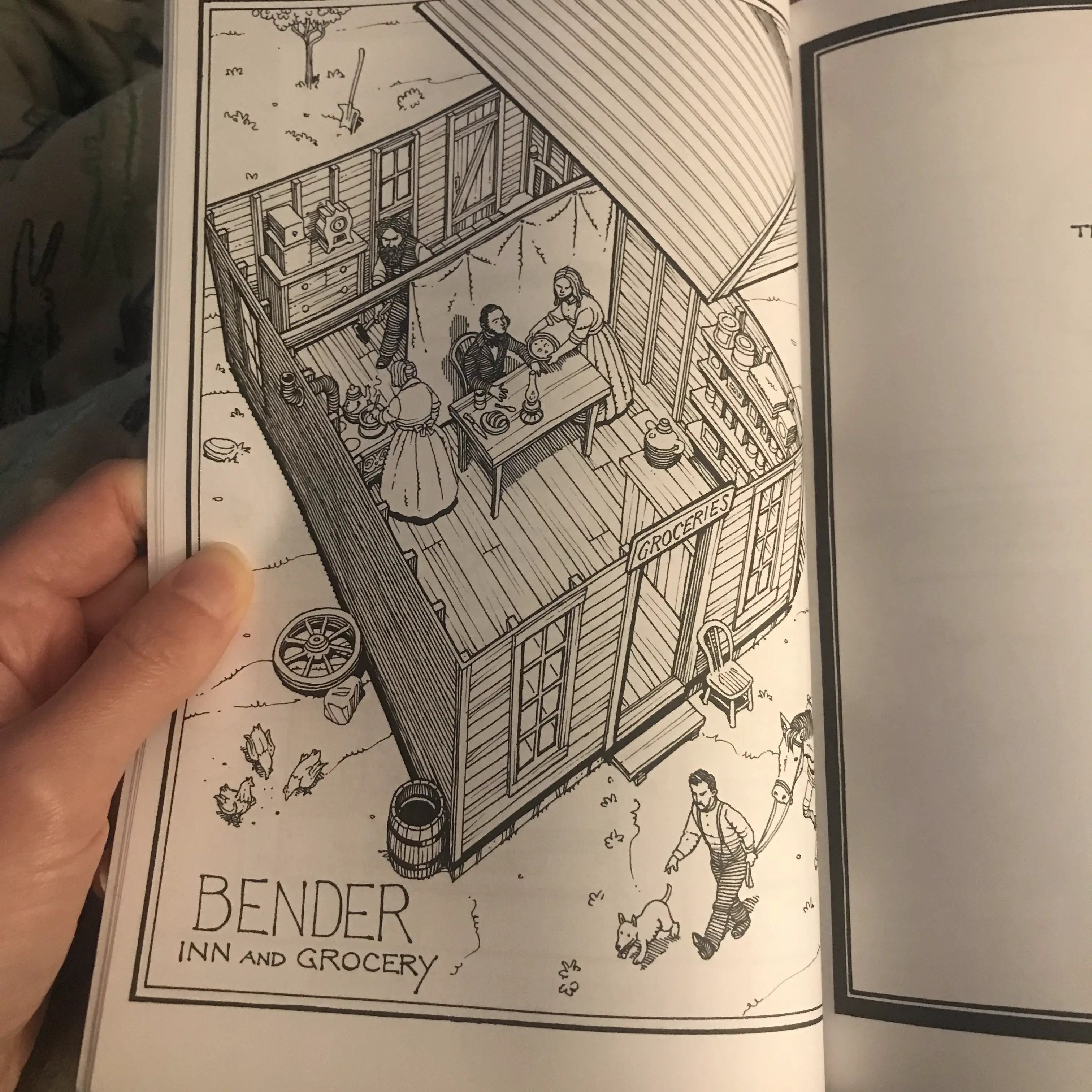
The content is factual and is careful to steer clear of using quotes in the panels when we don’t actually know what anyone said.
What made me dislike the book, though, was how it treated both Indigenous peoples and women. I understand that sometimes in historic nonfiction if a quote is being used or documents from the time period that it will use offensive language. However, this book used offensive language in parts that were narration written by the modern day author. It was published in 2007, and I truly feel someone on this book team should have been more thoughtful. A near-victim of the Benders was a Catholic missionary to the Osage people. Instead of saying it this way, though, the book says he, “dedicated his life to converting the savages.” This is the use of both a dehumanizing term and a glossing over of how missionary work was used as a weapon against Indigenous peoples in the Americas. This is a book about serial killers – I think whoever is reading it should be able to handle at least a footnote illuminating the complexities of this person’s missionary work.
With regards to the treatment of women, this is mostly in regards to how Kate Bender is discussed in the book. She is one of the four Bloody Benders, so I certainly don’t expect her to be discussed kindly, however while most of the book strives to stick closely to the truth as far as we know it, there is one part of the book that breaks down how folks determined the Benders pulled off their killings, based on the layout of the room, the trap door found, and reports of survivors. Most of this sticks to the facts, but then it gets to the part where Kate feeds the person sitting down at the guest table and says, “Does Kate also offer sexual favors as part of the package? No certain answer will ever be known.” What an unnecessarily and misogynistic supposition. Nothing that we know about Kate from survivors and those who knew her suggests she was promiscuous at all. In fact, earlier in the book it mentions she entertained suitors who ran errands for her but the suitors were never successful with her. Later when the book discusses possible endings for the various Benders that the rumor mills supposed, one proposed for Kate is as “a whore in Montana.” I trust that this was a true rumor, but it could have very easily said prostitute or sex worker.
True crime writing has the opportunity to analyze a crime and the society that surrounded it through a current lens. It can highlight both the good and the bad of that society and look at how this crime managed to occur, and, in the case of some crimes, go unstopped for so long. This book doesn’t do that, making it a beautifully illustrated reporting of what happened, lacking any analytical meat.
If you found this review helpful, please consider tipping me on ko-fi, checking out my digital items available in my ko-fi shop, buying one of my publications, or using one of my referral/coupon codes. Thank you for your support!
2 out of 5 stars
Length: 76 pages – short nonfiction
Source: Library
Buy It (Amazon or Bookshop.org)
Book Review: Long Story Short: 100 Classic Books in 3 Panels by Lisa Brown
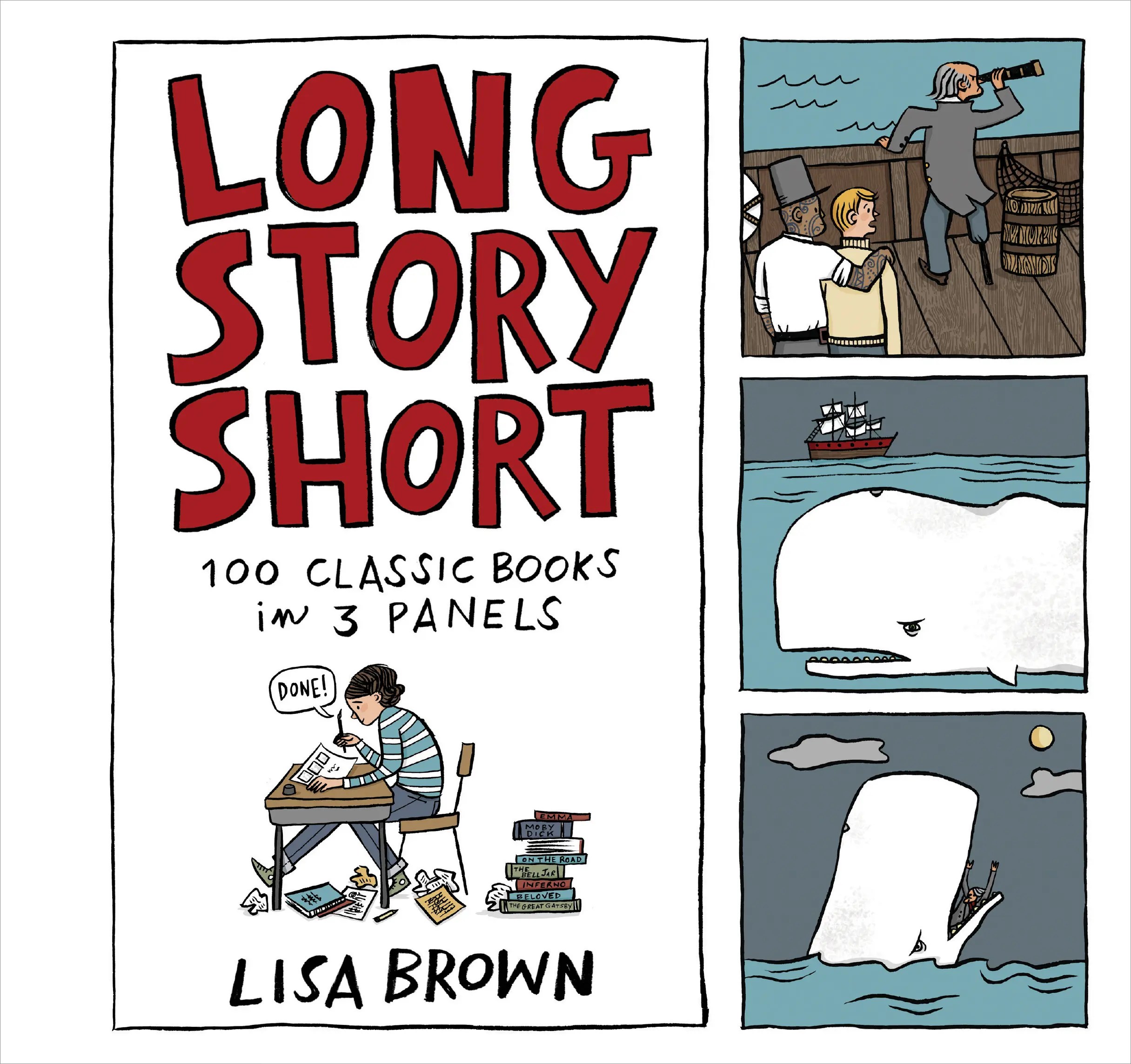
For English literature lovers who want to explain why they loved…or hated…a classic in one comic.
Summary:
100 pithy and skewering three-panel literary summaries, from curriculum classics like Don Quixote, Lord of the Flies, and Jane Eyre to modern favorites like Beloved, The Brief Wondrous Life of Oscar Wao, and Atonement, conveniently organized by subjects including “Love,” “Sex,” “Death,” and “Female Trouble.”
Review:
I became interested in this book because the amazing website American Indians in Children’s Literature described the comic about Little House on the Prairie but when I checked out the link I found the comic gone and a prompt about the book. In fairness, it had been more than 12 years since that article was published so I’m not too surprised Lisa Brown got a book deal in the meantime. It came in quite quickly for me from the library, and I read it in less than 30 minutes.
Rather than being organized by time period, the classics are organized by topic like “Love” and “Death.” This is also an inclusive definition of classics including ancient literature like Beowulf to modern pieces like The Fault in Our Stars. I like her illustration style. It’s colorful and engaging. You can see examples of actual panels from the book on her website. (It doesn’t include the Little House one but it does include one of my other favorites from the book – Edgar Allan Poe.)
You might think this is a way to Sparknotes your way through 100 books. This is not the case. The comics that were the funniest and most meaningful were the ones for books I had read. The ones for pieces I hadn’t fell kind of flat for me. This is actually sort of like a collection of inside jokes from one reader to another, and in order for the inside joke to make sense, you have to have read the book in question. That said, a couple of the comics for books I had read fell flat for me because I felt like they missed the point of the book. For example, I felt like the comic summary of Their Eyes Were Watching God was a very poor summary of an absolutely amazing book. So my experience of the comics was kind of all over the place.
Overall, this is an interesting collection of short comics drawn in an engaging manner. Recommended to big readers who want a couple of inside joke style chuckles. It could also make a good gift to a big reader you know.
If you found this review helpful, please consider tipping me on ko-fi, checking out my digital items available in my ko-fi shop, buying one of my publications, or using one of my referral/coupon codes. Thank you for your support!
3 out of 5 stars
Length: 80 pages – novella
Source: Library
Buy It (Amazon or Bookshop.org)
Book Review: Flung Out of Space: Inspired by the Indecent Adventures of Patricia Highsmith by Grace Ellis and Hannah Templer

Summary:
Flung Out of Space is both a love letter to the essential lesbian novel, The Price of Salt, and an examination of its notorious author, Patricia Highsmith. Veteran comics creators Grace Ellis and Hannah Templer have teamed up to tell this story through Highsmith’s eyes—reimagining the events that inspired her to write the story that would become a foundational piece of queer literature.
This is not just the story behind a classic queer book, but of a queer artist who was deeply flawed. It’s a comic about what it was like to write comics in the 1950s, but also about what it means to be a writer at any time in history, struggling to find your voice.
Author Grace Ellis contextualizes Patricia Highsmith as both an unintentional queer icon and a figure whose problematic views and noted anti-Semitism have cemented her controversial legacy. Highsmith’s life imitated her art with results as devastating as the plot twists that brought her fame and fortune.
Review:
I found this thanks to the Bitches on Comics podcast and was pleasantly surprised that my library had a copy. I have not myself yet read The Price of Salt. Although I have watched Strangers on a Train and loved it. I was shocked to discover the same author who wrote that classic piece of noir also wrote the first published lesbian book with a happy ending.
I love the content note at the beginning of this graphic novel. It’s too long to post here, but the authors eloquently describe the difficult task of loving literature written by a deeply flawed person. They also warn about what to expect in the book. Most of what they depict is Highsmith’s well-known anti-Semitism (using no slurs).
The art in this book is gorgeous. I especially love the pages where Highsmith is writing at her typewriter and scenes of what she’s writing are depicted around her. I love noir, and these images are just…well they’re so beautiful, I would frame them and hang them up in my home.
Something that was interesting to me was how Highsmith got her start writing in comics but loathed them and didn’t want her name put on them. I was tickled by the fact this handling of her life was itself a comic.
As a writer myself, I found the scenes about her struggles to get her first book deal (Strangers on a Train) quite relatable. Not surprising given that authors wrote this too.
Two things held this back from five stars for me. The first is a scene where a ring is thrown into a pond, and a duck is gazing at it. I was so distressed at the idea of the cute duck eating it, I couldn’t enjoy the scene. The second, and what others might find more important, was that, from what I’ve read since about Highsmith, she preferred the company of men but was only sexually attracted to women. In my reading of the comic, she seemed to loathe men and like the company of women. This is extra odd because she’s even been called a misogynist. Maybe the authors of this graphic novel have a different interpretation of her after reading all the primary sources. I’d have liked a note about that from them, if so.
Overall, this is a quick read with gorgeous art that eloquently explores a flawed human being who impacted both mainstream and queer 20th century literature.
If you found this review helpful, please consider tipping me on ko-fi, checking out my digital items available in my ko-fi shop, buying one of my publications, or using one of my referral/coupon codes. Thank you for your support!
4 out of 5 stars
Length: 208 pages – average but on the shorter side
Source: Library
Buy It (Amazon or Bookshop.org)
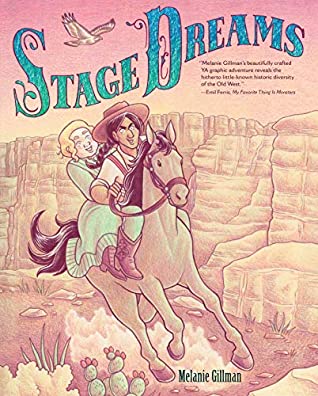
Book Review: Stage Dreams by Melanie Gillman
Summary:
In this rollicking queer western adventure, acclaimed cartoonist Melanie Gillman (Stonewall Award Honor Book As the Crow Flies) puts readers in the saddle alongside Flor and Grace, a Latina outlaw and a trans runaway, as they team up to thwart a Confederate plot in the New Mexico Territory. When Flor—also known as the notorious Ghost Hawk—robs the stagecoach that Grace has used to escape her Georgia home, the first thing on her mind is ransom. But when the two get to talking about Flor’s plan to crash a Confederate gala and steal some crucial documents, Grace convinces Flor to let her join the heist.
Review:
This is a graphic novel for readers who love Westerns but are tired of them erasing BIPOC and queer people. In this read you get all the fun of a Western but it’s peopled with both BIPOC and queer people.
The book starts with a stagecoach robbery by Flor (a Latina woman) and her pet hawk. She kidnaps a white damsel (Grace) who turns out to be a young trans woman on the run both to avoid her family’s wish for her to serve in the Confederate army and to seek out performing on the stage. Grace convinces Flor to let her help in a plot to spy on some Confederate documents.
Since this is a short book, there aren’t a ton of characters. It’s mostly the other folks on the stagecoach with Grace (all deliciously hateable), the tailor who helps them get ready for the Confederate gala, and the Confederate gala attendees. This doesn’t leave a ton of room for additional BIPOC in the story, but the tailor is Luis who is Black and completely supportive of Grace.
The book does an artful job of establishing that Grace is trans without ever using the word or deadnaming her. I had been concerned that Grace’s visible depiction might fall into the cringer category of visibly “man in a dress” like in the old movies when male characters dress as women to escape something. This absolutely does not happen with Grace. She simply looks like a larger woman. (Larger than Flor, close in size to the men in the stagecoach). There are also multiple times when the existence of other trans people are established. Luis says Grace isn’t the only larger woman he’s designed for. Flor discusses other women like Grace performing on stage out west.
I enjoyed Flor but wanted a little more backstory on her. What made her start robbing stagecoaches? How did she get the pet hawk? How does she know Luis? I get it she’s a more close-lipped character, but Luis could have dropped a few tidbits about the two of them, and I get the vibe from Grace that she might be the type to be able to lure information out of people with her charm.
The spying plot worked and fit into the small amount of space allotted. I liked that it gave Grace and Flor a reason to team up and showed them as active rather than passive. I did wish for a little more detail in these scenes, though. Specifically, when someone recognizes Grace, what is their relationship to her?
I love the art and thought it worked great for a Western story. Only when I looked it up later did I discover Gillman does everything by hand with colored pencils. Truly amazing and translated into a book that was beautiful to read.
Overall, this was a fun, beautifully drawn, sapphic read with a lot of diversity that establishes trans people as existing in history. It just left me wishing for more – more background and for Flor and Grace’s adventures to continue.
If you found this review helpful, please consider tipping me on ko-fi, checking out my digital items available in my ko-fi shop, buying one of my publications, or using one of my referral/coupon codes. Thank you for your support!
4 out of 5 stars
Length: 104 pages – novella
Source: Library
Buy It (Amazon or Bookshop.org)
Get the Reading Group / Book Club Discussion Guide
A beautifully graphic designed 2 page PDF that contains: 1 icebreaker, 9 discussion questions arranged from least to most challenging, 1 wrap-up question, and 3 read-a-like book suggestions
View a list of all my Discussion Guides.
Book Review: Cowboys and Aliens by Scott Mitchell Rosenberg (Graphic Novel)
 Summary:
In the American Wild West, invading aliens show up, intent to colonize the planet and enslave or destroy the humans. The warring white settlers and Native Americans must put aside their own battle for control of the land and defend it from offworlders.
Review:
This was given as a gift to me, because when the movie Cowboys and Aliens came out in 2011, I was super into the idea of two of my favorite things being combined–a western and scifi. A friend gifted this to me, and it languished on my TBR Pile for years. I finally picked it up, and while I enjoyed the read and the art, I did not enjoy it as much as the movie, finding it to be too heavy-handed and obvious in its message, as well as a bit too stereotypical in how it handled its Native American characters.
The art is bright and colorful with easy-to-follow panels. The book opens with a clearly laid out parallel between the colonizing alien species and the white settlers in America. It’s clever to make a group actively colonizing another group suddenly the victim of colonizers themselves. However, the direct juxtaposition jumping back and forth between the two visually is too heavy-handed. Readers know about colonization on our own planet. Just tell the story of the aliens and let us see the white settler characters slowly realize that they’re doing the same thing to others. Instead, the readers are shown several times both the parallels between the two and one of the white settlers suddenly dramatically realizing the similarities in the situations.
The Native American characters aren’t horribly handed, however they are treated a bit too much magically for my taste. Thankfully, how they help fight the aliens mostly comes from ingenuity, not magic.
Both of those things said, the aliens in the story are diverse and interestingly drawn. Seeing Native Americans and white settlers battle the aliens with a combination of their own gear and stolen alien items was really fun to read. Just not as much fun or as well-developed of a plot as it was in the movie.
Overall, this is a quick graphic novel that would be a fun read for either hardcore fans of the movie or those interested in the basic idea but who prefer graphic novels to movies.
If you found this review helpful, please consider tipping me on ko-fi, checking out my digital items available in my ko-fi shop, buying one of my publications, or using one of my referral/coupon codes. Thank you for your support!
3 out of 5 stars
Length: 112 pages – novella
Source: Gift

Counts For:
Bottom of TBR Pile Challenge
Book Review: Fables, Vol. 1: Legends in Exile by Bill Willingham et al. (Series, #1) (Graphic Novel)
 Summary:
All the characters from the fairy tales we know actually lived in that folklore world but were forced out into exile in modern-day New York thanks to an enemy known only as The Adversary. Snow White, right-hand to the ruler of Fabletown, seeks to keep everyone in line. But that gets more difficult when her own sister, Rose Red, is murdered. A reformed Big Bad Wolf, now their sheriff, promises to help her track down his killer.
Review:
Being a long-time fan of The 10th Kingdom, a story about the characters of folklore existing in a parallel universe to our own that some modern-day Americans accidentally visit, I was intrigued by this idea of a similar story in reverse. Instead of being engaging and a fun escape, though, my experience with it is best summed-up as meh. It’s a cool idea that is saddled to a ho-hum plot and flat characters, thereby rendering it a mediocre read.
The basic idea is some unseen Adversary has driven the fairy tale folk out of their land and into exile in our own. In our land, they’ve all agreed to give everyone a clean slate to start over. So far so good. From here though things go from interesting and semi-unique to basically a noir plot we’ve all read before wrapped up in 2-dimensional fairy tale characters. Big Bad Wolf is the hard-boiled detective. Snow White is his lady assistant. A noir version of a fairy tale could have been good, but instead the flattest elements of both genres are mashed together, rather than the best of each. What you end up with is a wolf without his fangs or a hard-boiled detective without his cigarettes and womanizing ways. The grit is just removed leaving an overly-sanitized world.
I do enjoy a mystery plot but I also expect them to keep me guessing. I knew the solution long before the end, and I’m guessing most other readers would too.
The art is mostly good, although the depiction of the talking pig gave me goosebumps in a bad way. He doesn’t really fit in to the feel of the rest of the art. However, the art is colorful and easy to follow, and made reading the story go quickly.
Overall, if a reader loves fairy tales and graphic novels and likes the idea of seeing fairy tale characters in modern-day New York, they will probably enjoy this book. Readers looking for an in-depth exploration of a fairy tale character or to see them more well-rounded in a non-fairy tale setting will be disappointed. Similarly, readers looking for a tough mystery to solve will want to look elsewhere.
If you found this review helpful, please consider tipping me on ko-fi, checking out my digital items available in my ko-fi shop, buying one of my publications, or using one of my referral/coupon codes. Thank you for your support!
3 out of 5 stars
Length: 128 pages – novella
Source: I remember I bought it at a comic book store, but I don’t remember which one.

Counts For:

Book Review: Captain America: Winter Soldier Ultimate Collection (Series, #1-9 and 11-14) (Graphic Novel)
 Summary:
Captain America has been increasingly violent and melancholy lately, and SHIELD is worried about him. When his arch-nemesis, the Red Skull, turns up as a corpse, things go from troubled to worse for Captain America. Ghosts of his past increasingly haunt him as the desire for the Cosmic Cube wreaks havoc once again.
Review:
I admit that I am new to the traditional comic book characters. I found my way into graphic novels via manga followed by more literary graphic novels followed by The Walking Dead, none of which are really comic book characters, per se. But I, just like most of the world, watched the new movies featuring Iron Man and Thor and loved them. So I decided to try to start reading the comic books, a daunting task for a newbie. I did my best to find a good introductory book, but I admit I probably should have actually watched Captain America before deciding to start with him.
Captain America is my least favorite of the Avengers. He, to me, is so incredibly lame. Whiny and lame. And traditional. I really should have started this comic book adventure with Iron Man.
Anyway, point being, take my review with the grain of salt that 1) I am new to traditional comic book characters 2) I don’t like Captain America.
The story itself is bright and action-packed. Once I understood who the Red Skull and Bucky were, I started to get the feel for the tension in the story. The pages are well-drawn and easy to follow with lots to suck the reader in. Fans of Captain America will probably appreciate the chance to get to know more of his backstory, particularly concerning Bucky, his side-kick, and what happened to him. The Cosmic Cube was amusing as ever to watch corrupt people, and I definitely was surprised by the plot twist at the end. In spite of my distaste for the character, I was a bit tempted to read more.
Overall, then, this is an action-packed entry in the Captain America canon that simultaneously provides character development and backstory. Recommended to fans of Captain America.
3 out of 5 stars
Source: Amazon

Book Review: The Walking Dead Volume 15 by Robert Kirkman (Series, #8) (Graphic Novel)
 Summary:
Everyone’s world was rocked when the zombies got through the community’s fence. Will they respond by banding together or falling apart?
Review:
Ok, before I review, the numberings need a bit of explanation. Comic books are issued very similarly to academic journals. So there are skinny issues that come out every few weeks (generally). A few of these bound together make a volume. A bunch of these bound together make a book (what we call in academia a “bound journal.”) I *was* reading the books of The Walking Dead but then I caught up to the author. I decided I didn’t want to buy issues, because they’re flimsy and you read through them very quickly, so I’m now reading the volumes. I hope that makes some semblance of sense. This will probably be the case throughout the rest of the series, because you have to wait a long time for the books, and I just am too impatient for that. My reviews will then be much shorter, because a book contains a few volumes, and I am now reviewing one volume at a time. Moving right along to the review!
This volume is basically cleaning up the mess from the action of the previous one and prepping for the action of the next one. Classic in-between chapter. What this volume really reminded me of is the infamous “Live together or die alone” speech by Jack in Lost. In fact, this volume sees Rick basically trying to turn into Jack and failing miserably. Long-time readers know I’ve never liked the guy, so personally I got a lot of schadenfreude out of seeing him be so pathetic in this volume.
That said, the survivors are definitely going for a new strategy, which will lend itself well to future fresh storylines, which any long-running series needs.
Fans of the sex will be quite happy with the developments in that area. Drama! Intrigue! Changes of partners!
Overall, it’s an enjoyable entry, if not mind-blowing, that perfectly sets things up for the next volume. Fans won’t be disappointed!
4 out of 5 stars
Source: Newbury Comics

Previous Books in Series:
The Walking Dead, Book One
The Walking Dead, Book Two
The Walking Dead, Book Three
The Walking Dead, Book Four
The Walking Dead, Book Five
The Walking Dead, Book Six
The Walking Dead, Book Seven
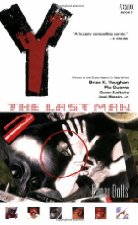
Book Review: Y: The Last Man: Paper Dolls by Brian K. Vaughan (Series, #7) (Graphic Novel)
 Summary:
Our trifecta of heroes have successfully crossed the Pacific Ocean and are now on the seacoast of Australia. Yorick naturally insists on looking for his long-lost girlfriend in the drug-infested city of Sydney. Meanwhile, Dr. Mann gets wooed by the one-eyed sailor rescued from the pirate ship in the previous book. We also learn more of Ampersand the monkey’s backstory.
Review:
It probably comes as no surprise that I am still loving this series, although I am super-grateful to have one containing so many issues to be holding up so well! Although I’m not a big fan of the Dr. Mann being duped story, the other two more than make up for it.
Seeing Sydney torn apart by heroin provides a different scenario in this post-apocalyptic world. We’ve seen the women fall to violence, over-monitoring, and chaos, but we haven’t seen the self-medication reaction yet. The scenes with the women on heroin are sad and poignant. The perfect backdrop to Yorick’s story.
Naturally as an animal lover and animal rights person I love Ampersand’s backstory. Originally abused and destined for a research lab, his shipping got mixed up and wound up with Yorick to be trained to be a helper animal instead. How this ties in with Dr. Mann is disturbing and the perfect set-up for the next issue. After seeing all he’s been through, I really hope they find Ampersand the next issue!
Overall, the art and story are consistently good and in spite of being the seventh in a long series the storyline has not gotten out of hand or become dull. This is an excellent entry that will leave fans craving more!
5 out of 5 stars
Source: Public Library

Previous Books in Series
Y: The Last Man: Unmanned
Y: The Last Man: Cycles
Y: The Last Man: One Small Step
Y: The Last Man: Safeword
Y: The Last Man: Ring of Truth
Y: The Last Man: Girl on Girl
 Support my work with a tip or browse my shop for curated book club guides, how to guides, cross-stitch patterns, and more!


This work by Amanda Nevius is licensed under a Creative Commons Attribution-Noncommercial-No Derivative Works 3.0 United States License.
 Opinions of a Wolf