
Archive
Book Review: A Bánh Mì for Two by Trinity Nguyen
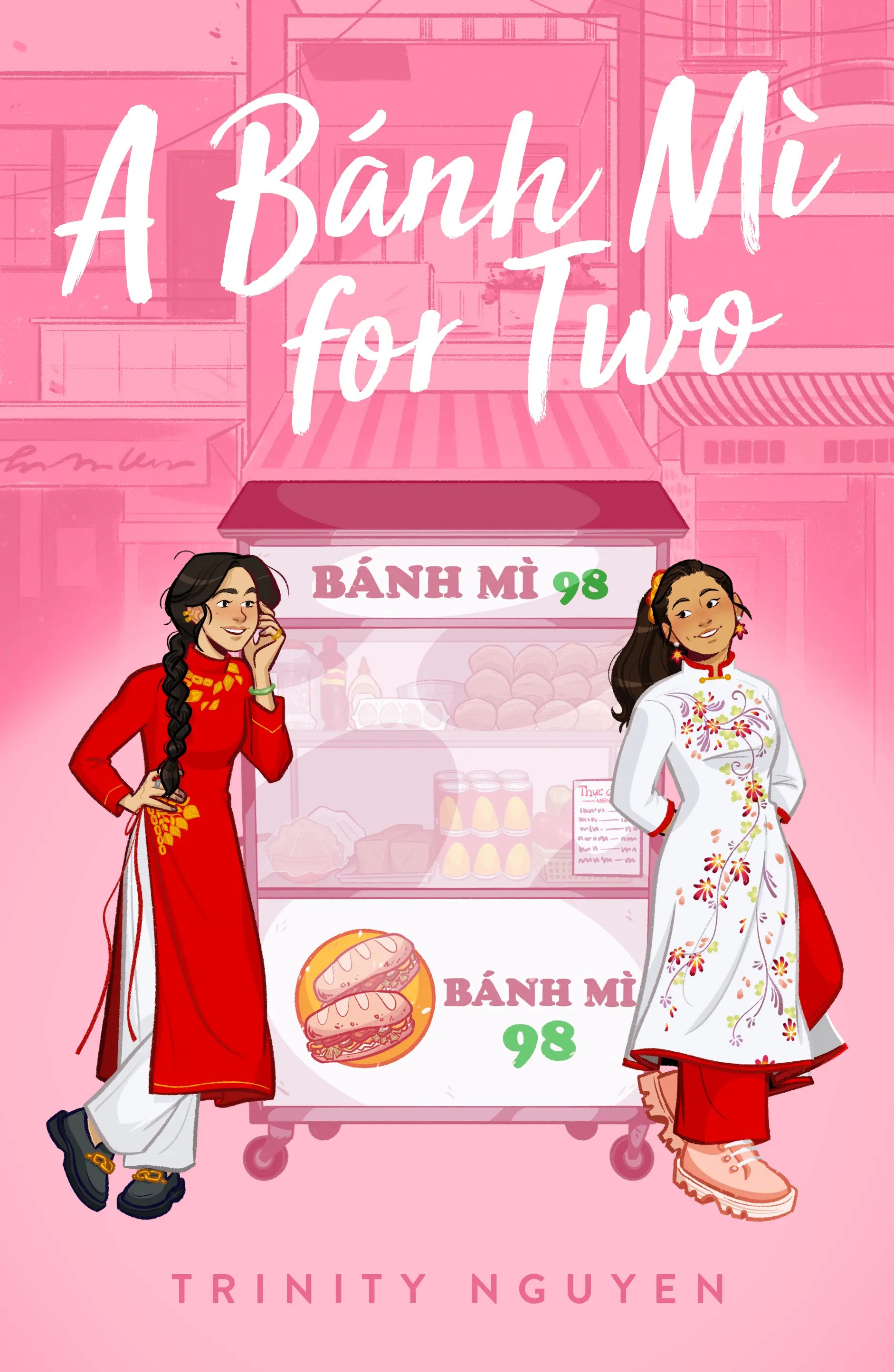
A sweet, closed-door sapphic romance set in Sài Gòn, where two foodie 18-year-olds fall for each other while uncovering family secrets and rekindling a love of food writing.
Summary:
In Sài Gòn, Lan is always trying to be the perfect daughter, dependable and willing to care for her widowed mother and their bánh mì stall. Her secret passion, however, is A Bánh Mì for Two, the food blog she started with her father but has stopped updating since his passing.
Meanwhile, Vietnamese American Vivi Huynh, has never been to Việt Nam. Her parents rarely talk about the homeland that clearly haunts them. So Vivi secretly goes to Vietnam for a study abroad program her freshman year of college. She’s determined to figure out why her parents left, and to try everything she’s seen on her favorite food blog, A Bánh Mì for Two.
When Vivi and Lan meet in Sài Gòn, they strike a deal. Lan will show Vivi around the city, helping her piece together her mother’s story through crumbling photographs and old memories. Vivi will help Lan start writing again so she can enter a food blogging contest. And slowly, as they explore the city and their pasts, Vivi and Lan fall in love.
Review:
I love a sweet, closed-door sapphic romance (see my review of Hani and Ishu’s Guide to Fake Dating), so when I heard about A Bánh Mì for Two, it was an easy add to my wishlist. The focus on food blogging and Vietnamese street food—both eating it and running a street food cart—was just the icing on the cake. This story strikes a delicate yet exquisite balance between lighthearted sweetness and the very real multigenerational trauma caused by the Vietnam War (referred to in Vietnam as The War Against the Americans to Save the Nation).
Told in alternating first-person perspectives between Lan and Vivi, the book avoids the common pitfall of muddled voices. While both characters are kind and thoughtful, they each have distinct ways of seeing the world, which keeps their narration clear and engaging. The romance is a sweet, slow burn, beginning with Vivi’s admiration of Lan’s food blog and blossoming into real-world chemistry after a chance encounter in Sài Gòn.
I especially appreciated the queer representation. There’s no on-page angst about being queer. Vivi does talk briefly with her friend Cindy (a Mexican American character) about how coming out can be complicated with conservative parents, but by the time the story begins, both girls’ families are accepting. It was also refreshing to see Vivi clearly identify as bisexual—representation that could’ve been easily overlooked since her only relationship in the book is with Lan. It’s affirming and intentional, which I loved.
The food descriptions are vivid but never overdone. They strike just the right balance between informing the reader (especially for dishes that might be unfamiliar) and keeping the flow natural. (I’ve eaten many a bánh mì in my life, and still found the food writing delightful!) I also really appreciated that this is a story about two 18-year-olds, and college isn’t presented as the only post–high school option. Lan’s mom encourages her to pursue school if she wants to, but also supports her jumping right into a career—a rare and welcome take in YA-adjacent fiction.
Vivi’s experience as a Vietnamese American studying abroad in Vietnam adds a beautiful emotional layer. She’s not a tourist—she’s searching for a kind of homecoming. She’s exploring why her mother kept so many details about Vietnam and their family a secret. This process is a powerful lens for the reader to learn about the war’s impact on Vietnamese families without the book ever feeling preachy. The historical context emerges naturally—through conversations, shared meals, and street encounters. It’s excellent writing.
The romantic progression between Lan and Vivi is tender and believable. One of my favorite parts was the motorbike rides around Sài Gòn—evocative, cinematic, and intimate. Even the third-act conflict felt justified. It wasn’t a contrived misunderstanding but a believable clash of cultural differences and personal pain. No one is villainized, and the resolution feels earned.
That said, a few elements pulled me out of the story. For example, Vivi’s study abroad program is mentioned as her reason for being in Vietnam, but we never actually see her attend class or study. This absence feels like a missed opportunity—readers might expect the study abroad setting to include some academic context. Similarly, while the book opens with several references to Vivi lying to her mom about her location—including photoshopping photos—the tension fades away later in the book. I found it a bit hard to believe that her mom wouldn’t catch on sooner.
The book is richly diverse, featuring Vietnamese and Vietnamese American characters, a Mexican American side character, and a sapphic romance at the center. Lan’s mother has a chronic illness, and her father passed away young from a stroke. The book also explores difficult family dynamics, grief, and healing across generations.
Overall, this is a fun, sweet sapphic romance featuring the beloved tropes of slow burn and study abroad, while offering thoughtful reflections on Vietnamese culture, family history, and the legacy of war. It’s beautifully steeped in food, healing, and love. Recommended for anyone looking for a sweet, queer romance with emotional depth, cross-cultural exploration, and heartwarming food moments.
If you found this review helpful, please consider tipping me on ko-fi, checking out my digital items in my ko-fi shop, buying one of my publications, using one of my referral or coupon codes, signing up for my free microfiction monthly newsletter, or tuning into my podcast. Thank you for your support!
4 out of 5 stars
Length: 224 pages – average but on the shorter side
Source: Library
Buy It (Amazon or Bookshop.org)
Book Review: Hani and Ishu’s Guide to Fake Dating by Adiba Jaigirdar

In this Bangladeshi-Irish YA romance, Hani needs to convince her two best friends that she’s really bisexual. She lies and tells them she’s dating academically focused and acerbic Ishu who agrees to fake date in exchange for help being elected Head Girl.
Summary:
Everyone likes Humaira “Hani” Khan—she’s easy going and one of the most popular girls at school. But when she comes out to her friends as bisexual, they invalidate her identity, saying she can’t be bi if she’s only dated guys. Panicked, Hani blurts out that she’s in a relationship…with a girl her friends absolutely hate—Ishita “Ishu” Dey. Ishu is the complete opposite of Hani. She’s an academic overachiever who hopes that becoming head girl will set her on the right track for college. But Ishita agrees to help Hani, if Hani will help her become more popular so that she stands a chance of being elected head girl.
Despite their mutually beneficial pact, they start developing real feelings for each other. But relationships are complicated, and some people will do anything to stop two Bengali girls from achieving happily ever after.
Review:
I have a soft spot for Irish literature, and when I heard about this book by a Bangladeshi-Irish queer Muslim author with a bisexual main character, it landed on my tbr list very quickly. This was a quick read with an easy to follow story and a sweet, very low spice romance.
I enjoyed Hani and Ishu each separately as character. They take turns narrating in the first person, and I never lost track of who was speaking. This book uses the grumpy/sweet trope quite well. Ishu is only grumpy because she’s focused and willing to speak her mind. Hani quickly sees through that. Hani and Ishu’s cultures are intertwined beautifully in the book. I like it when a book doesn’t feel the need to stop and explain cultural things to the reader. It’s on us to look it up if we want to, and that’s when I really learn things. (Like when Hani makes Ishu porota for breakfast. I looked that up right away. Yum!)
As a bisexual person, I appreciated how the story highlights the specific issues for Hani in coming out as bisexual. It’s clear that her friends would have fairly rapidly accepted her as a lesbian, but they view bisexual as being either confused or attention-seeking. They also don’t believe her because they’ve never seen her date a girl. This is a very realistic depiction of biphobia. Hani is quite confident about who she is and what labels she chooses. In contrast, Ishu is uninterested in labels, although she’s definitely attracted to Hani. It’s not clear if she’s only ever been interested in girls or more or if it’s just that Hani is the first person she’s ever been interested in. But that doesn’t matter to Ishu, and it doesn’t matter to Hani either.
When this book first came out, it was praised for depicting a queer Muslim character. (This article goes into depth about representation for South Asian queer women and interviews the author as well.) There is a perception that you cannot be both queer and Muslim. Both Muslims and non-Muslims hold this viewpoint. Yet people like Jaigirdar are both and depicting this in her books is important to Jaigirdar. Thus, we see Hani engaging with her faith. She goes to the Mosque. She reads the Quran. She eats halal. There is also a perception among many non-Muslims that if someone is serious about Islam and a woman then they will wear the hijab. But it is possible for someone to be devoutly engaging with her faith and also not wearing hijab. The author depicts this in Hani, as well as how she must struggle against the perception that she must not be a “serious” Muslim because she doesn’t wear hijab.
So this book covers a lot of seriously important representation well, and the romance is sweet and believable. What didn’t work for me was the secondary characters. Whereas Hani and Ishu felt well-rounded and interesting, everyone else felt flat and two-dimensional. There also were some kind of big issues that Hani and Ishu seemed to just gloss over. Now, they’re teenagers, so maybe that’s realistic. But Ishu having to hide the relationship from her parents long-term was concerning to me. Also, we never see the characters talk about being in an interfaith relationship. We do hear that Ishu appreciates Hani’s devotion to her faith as part of her. But Ishu is atheist, and we never really hear Hani’s thoughts on that.
Overall, this was a fun read with a lot of important representation. Recommended to readers who enjoy the fake dating and/or grumpy/sweet tropes.
If you found this review helpful, please consider tipping me on ko-fi, checking out my digital items available in my ko-fi shop, buying one of my publications, or using one of my referral/coupon codes. Thank you for your support!
3 out of 5 stars
Length: 352 pages – average but on the longer side
Source: Library
Buy It (Amazon or Bookshop.org)
Get the Reading Group / Book Club Discussion Guide
A beautifully graphic designed 2 page PDF that contains: 1 icebreaker, 9 discussion questions arranged from least to most challenging, 1 wrap-up question, and 3 read-a-like book suggestions
View a list of all my Discussion Guides.
Book Review: Reader, I Murdered Him by Betsy Cornwell
A YA romp told from the perspective of Mr. Rochester’s ward gives a new view of both Jane Eyre and London’s queer underground.

Summary:
Adéle grew up watching her mother dance in Le Moulin in Paris but soon found herself sent away to England with the man her mother said was her father. Mr. Rochester. Soon she meets her governess Jane Eyre and begins her own series of adventures.
Review:
If you have a love/hate relationship with Charlotte Bronte’s Jane Eyre, then this book is for you. If you love your YA with sapphic romance in period costumes, then get this book immediately.
The thing about Jane Eyre is…Mr. Rochester is terrible. Yet she’s still attracted to him. (This was beautifully summed up in the web comic Hark! A Vagrant). Shifting to Adéle’s perspective gives a whole new angle on just how deliciously insidious Mr. Rochester is. Adéle does not pull any punches when it comes to him. It’s downright cathartic for everyone who tears their hair out about Jane’s love for him.
There’s much more in this story than a shift of perspective on Jane Eyre though. Adéle is well-rounded, and we have entire chapters where Mr. Rochester and Jane aren’t mentioned at all or only in passing. My favorite part is when Adéle goes to a finishing school in London, because this is when the sapphic subtext becomes blatant. Adéle has the hots for more than one other teenage girl. (Both of whom are excellent choices, by the way). There’s cross-dressing! There’s scuttling around on the streets of London late at night in widow’s clothes! But also Adéle has feelings for Mr. Rochester’s nephew she’s been exchanging letters with since she first came to England. What to do. what to do. I loved seeing representation of a bisexual woman who leans more in a certain direction usually. I really like that even though she is capable of attraction to men that the sexist society fizzles it for her, making her a bisexual that leans toward women. What a fun twist on what we usually see in period pieces with fluid sexuality.
The book does start slow. The first chapter in Le Moulin was rough with overly flowery language and stirred up drama. But this drops out as Adéle ages and comes into her own. Perhaps some of this was meant to show how she is a little too idealistic in how she remembers her early years. I suspect the first chapter may have served better as flashbacks from her early time in England, rather than linear.
Please do take a moment to check out the content notes on StoryGraph. The ones listed as of the day I was writing this post are accurate.
Overall, this is a fun twist on Jane Eyre that gives agency to Mr. Rochester’s ward Adéle. Come for the twist, stay for the YA sapphic heart-throbbing.
If you found this review helpful, please consider tipping me on ko-fi, checking out my digital items available in my ko-fi shop, buying one of my publications, or using one of my referral/coupon codes. Thank you for your support!
4 out of 5 stars
Length: 288 pages – average but on the shorter side
Source: NetGalley
Buy It (Amazon or Bookshop.org)
Book Review: Stage Dreams by Melanie Gillman
Summary:
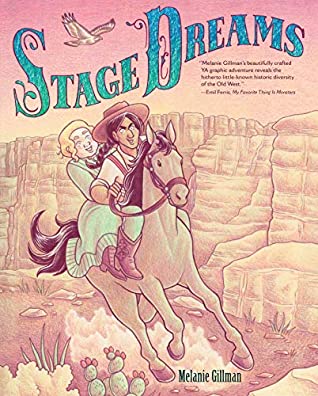
In this rollicking queer western adventure, acclaimed cartoonist Melanie Gillman (Stonewall Award Honor Book As the Crow Flies) puts readers in the saddle alongside Flor and Grace, a Latina outlaw and a trans runaway, as they team up to thwart a Confederate plot in the New Mexico Territory. When Flor—also known as the notorious Ghost Hawk—robs the stagecoach that Grace has used to escape her Georgia home, the first thing on her mind is ransom. But when the two get to talking about Flor’s plan to crash a Confederate gala and steal some crucial documents, Grace convinces Flor to let her join the heist.
Review:
This is a graphic novel for readers who love Westerns but are tired of them erasing BIPOC and queer people. In this read you get all the fun of a Western but it’s peopled with both BIPOC and queer people.
The book starts with a stagecoach robbery by Flor (a Latina woman) and her pet hawk. She kidnaps a white damsel (Grace) who turns out to be a young trans woman on the run both to avoid her family’s wish for her to serve in the Confederate army and to seek out performing on the stage. Grace convinces Flor to let her help in a plot to spy on some Confederate documents.
Since this is a short book, there aren’t a ton of characters. It’s mostly the other folks on the stagecoach with Grace (all deliciously hateable), the tailor who helps them get ready for the Confederate gala, and the Confederate gala attendees. This doesn’t leave a ton of room for additional BIPOC in the story, but the tailor is Luis who is Black and completely supportive of Grace.
The book does an artful job of establishing that Grace is trans without ever using the word or deadnaming her. I had been concerned that Grace’s visible depiction might fall into the cringer category of visibly “man in a dress” like in the old movies when male characters dress as women to escape something. This absolutely does not happen with Grace. She simply looks like a larger woman. (Larger than Flor, close in size to the men in the stagecoach). There are also multiple times when the existence of other trans people are established. Luis says Grace isn’t the only larger woman he’s designed for. Flor discusses other women like Grace performing on stage out west.
I enjoyed Flor but wanted a little more backstory on her. What made her start robbing stagecoaches? How did she get the pet hawk? How does she know Luis? I get it she’s a more close-lipped character, but Luis could have dropped a few tidbits about the two of them, and I get the vibe from Grace that she might be the type to be able to lure information out of people with her charm.
The spying plot worked and fit into the small amount of space allotted. I liked that it gave Grace and Flor a reason to team up and showed them as active rather than passive. I did wish for a little more detail in these scenes, though. Specifically, when someone recognizes Grace, what is their relationship to her?
I love the art and thought it worked great for a Western story. Only when I looked it up later did I discover Gillman does everything by hand with colored pencils. Truly amazing and translated into a book that was beautiful to read.
Overall, this was a fun, beautifully drawn, sapphic read with a lot of diversity that establishes trans people as existing in history. It just left me wishing for more – more background and for Flor and Grace’s adventures to continue.
If you found this review helpful, please consider tipping me on ko-fi, checking out my digital items available in my ko-fi shop, buying one of my publications, or using one of my referral/coupon codes. Thank you for your support!
4 out of 5 stars
Length: 104 pages – novella
Source: Library
Buy It (Amazon or Bookshop.org)
Get the Reading Group / Book Club Discussion Guide
A beautifully graphic designed 2 page PDF that contains: 1 icebreaker, 9 discussion questions arranged from least to most challenging, 1 wrap-up question, and 3 read-a-like book suggestions
View a list of all my Discussion Guides.
Book Review: Fiebre Tropical by Juliana Delgado Lopera
Summary:
Lit by the neon glow of Miami, this heady, Spanglish debut novel follows a Colombian teenager’s coming-of-age and coming out as she plunges headfirst into lust and evangelism.
Uprooted from Bogotá into an ant-infested Miami townhouse, fifteen-year-old Francisca is miserable in her strange new city. Her alienation grows when her mother is swept up in an Evangelical church, replete with abstinent salsa dancers and baptisms for the dead. But there, Francisca meets the magnetic Carmen: head of the youth group and the pastor’s daughter. As her mother’s mental health deteriorates, Francisca is saved and falls for Carmen, even as their relationship hurtles toward a shattering conclusion.
Review:
I’ve been learning Spanish off-and-of since I was nine or so, only getting more serious in the last few years. I thought this delightful mix of queerness, Miami, and being an evangelical teenager would be the perfect match for my first dive into a Spanglish book. It absolutely held my interest with its unique and engaging storyline.
I was raised varying flavors of Evangelical, so the thing that struck me immediately when reading this was how easy it was for me to decipher certain bits of Spanish just from what my own churches said. (Out of curiosity, I double-checked with a dictionary, and I was indeed correct). The depiction of Evangelicalism is just so spot on. The only thing that seemed odd to me was the idea of baptizing a dead baby – major plot point of the beginning of the book. I’ve literally never heard of this being done in any Evangelical church. But an aspect of being Evangelical (non-denominational) is each church interprets the Bible in their own way, so I gave this a pass as being a quirk of this particular church that seems to be largely made up of converts from Catholicism.
What was most engaging to me about the book was Francisca’s slow sexual awakening. How she’s not sure if what she’s feeling when alone with Carmen is Jesucristo or perhaps the Espíritu Santo or perhaps something else? This all leads up to a scene between Carmen and Francisca that I found absolutely simultaneously erotic and moving and yet they don’t actually do anything sexual. What this book does a great job depicting, actually, is how emotional and spiritual intimacy can hold so much more realness than sexual touching.
There are also two chapters in the book dedicated to Francisca’s mother’s teen years (Mami) and Francisca’s grandmother’s teen years (Tata). I found myself with much more empathy for Mami than Tata after reading these. But I also appreciated how they demonstrated the spiritual and relationship struggles across generations.
One thing that did turn me off from the characters was how the whole family seems to have a dislike for animals (as in living animals, not as in they don’t eat them). This just…confuses me. How can you dislike all animals? For Tata, the dislike extends beyond mere preference in a way I couldn’t forgive. With Francisca, I tried to brush her dislike of the local ducks off as general teenage grumpiness, especially at being uprooted from home in Bogotá, but after seeing how Tata was as a teenager, I suspect it just is the way the family is. I’m a big lover of animals, so that made it harder for me to relate to the characters.
Some reviews dislike the unanswered questions in the book – like why did the family have to leave Bogotá? I forgave this because it’s narrated by a teenager. When there’s upheaval in the family life of teens, many of them won’t go into great details about it. They’ll just be like – this is happening and it’s terrible. So I found that to be quite authentic to the teenaged narrator’s voice. Someone else pointed out that they never go to school in Miami. I would say…school is never discussed. But the more I think about it, the more this makes sense to me. The church is all-encompassing to Francisca. Of course it’s all she talks about to us. It’s all that matters. Nothing important happened at school. In contrast in Bogotá her entire life was school because school was also the church for her, as she attended Catholic school. It makes sense to me.
My experience of this book as a Spanish language learner was that it was just the right mix of things I understood, things I could guess from context, and things I had to look up (many of which turned out to be Colombian slang). I can’t guess what your experience would be if you are bilingual or routinely speak Spanglish yourself. I’d be interested to hear your experience if that describes you. Did you find the Spanglish authentic? If you don’t know any Spanish, I’d say that you can still get the jist of the story without looking up every single word, but you’ll miss some of Francisca’s sense of humor and personality. It might be worth looking up at least some of the longer sentences or repeated words (which are usually swear words) to get some context.
Overall, this is a unique read with a fun setting and a well-rounded main character. I didn’t always like her but I found myself rooting for her nonetheless, and I enjoyed practicing my Spanish along the way.
If you found this review helpful, please consider checking out my digital items available in my ko-fi shop, buying one of my publications, using one of my referral/coupon codes, or tipping me on ko-fi. Thank you for your support!
4 out of 5 stars
Length: 240 pages – average but on the shorter side
Source: library
Buy It (Amazon or Bookshop.org)
Book Review: Burn Down, Rise Up by Vincent Tirado

Summary:
For over a year, the Bronx has been plagued by sudden disappearances that no one can explain. Sixteen-year-old Raquel does her best to ignore it. After all, the police only look for the white kids. But when her crush Charlize’s cousin goes missing, Raquel starts to pay attention—especially when her own mom comes down with a mysterious illness that seems linked to the disappearances. Raquel and Charlize team up to investigate, but they soon discover that everything is tied to a viral worldwide game called the Echo Game. If you play it wrong, it can trap you in an echo – a parallel universe based on one of the worst times your particular region has seen.
Review:
I love a horror based around a bunch of people doing something that tempts the supernatural into coming to get them, and then being surprised when it does. (And when I say “love” I mean I will literally throw you out of my house if you say Candyman at a mirror twice). When I saw there was a sapphic version of this trope coming out, you bet I smashed the request button on NetGalley so hard.
The first hurdle any horror like this has to get over is giving us a horrifying scene right off-the-bat that’s scary even though we don’t really know what’s going on. This book does a great job at that. Charlize’s cousin, Cisco, has been missing. He comes back from being missing “wrong” and accidentally gives “something” that’s clearly supernatural to Raquel’s mom, who’s a nurse. This beautifully sets up both Charlize and Raquel to be heavily invested in what exactly is going on in their neighborhood. They used to be close friends but now they’ve drifted to acquaintances, and Raquel has the hots for Charlize. It’s just the right set-up.
The next hurdle the book has to get over is why are the Black kids sneaking out at night to play this viral game tempting the supernatural at 3am? The book takes this head-on with the characters acknowledging doing such a thing doesn’t go with their culture. Charlize and Raquel are motivated to save their family members, but what about Cisco? We learn he befriended a bunch of white theater kids who asked him to come along and do it as part of some theater kids bonding activity. I have to say, as a once upon a time theater kid myself, this sort of thing rang as very true.
So is the horror scary? Yes, largely because it’s starting to reach out into the Bronx even among those who aren’t playing the Echo Game. But I will say, I didn’t think it was terrifyingly scary. If this was a movie, I could sleep after it. Unlike The Ring, which made me terrified of being in the same room with my own television for two weeks. So I’d say it’s moderate on the scary scale. It’s definitely kind of gory, and the peril is real.
The relationships are interesting, realistic, and Raquel has just the right amount of them. She has her best friend, his brother, Charlize, Cisco, her father, and her mother. The fact that she was living with her mother and has to move in with her bachelor pad father while her mother is ill was one of my favorite parts of the book. Her dad clearly loves her and they were absolutely part of each other’s lives before, but there’s a difference between the dad who loyally pays child support who you see a few times a month and the dad you live with. I appreciated how that difference was drawn out, acknowledging the awkwardness without blaming either of them. I also liked how her dad both brought out the Latinx aspect of the story, as well as giving her a direct connection to when the Bronx burned in the 1970s. (This time period, of course, is when the echo draws from).
The Charlize/Raquel situation was cute. I liked how Raquel’s best friend, Aaron, also likes Charlize, and he just wants Raquel to be honest with him about liking her as well. I was a little bit confused about why Raquel has some internalized homophobia making it hard for her to accept that she likes Charlize. It was unclear to me if this was coming from her family (who seemed very accepting) or if it was just worrying how her peers would react or what exactly. I think a richer development of that would have helped make the scenes where Raquel works on accepting herself more powerful.
Overall, this is a fun take on the viral game tempting the supernatural trope. The setting of the Bronx and the main character’s Afro-Latinx culture are both well developed. It’s a medium scary read that will certainly appeal to YA readers.
If you found this review helpful, please consider tipping me on ko-fi, checking out my digital items available in my ko-fi shop, buying one of my publications, or using one of my referral/coupon codes. Thank you for your support!
4 out of 5 stars
Length: 352 pages – average but on the longer side
Source: NetGalley
Buy It (Amazon or Bookshop.org)
Get the Reading Group / Book Club Discussion Guide
A beautifully graphic designed 2 page PDF that contains: 1 icebreaker, 9 discussion questions arranged from least to most challenging, 1 wrap-up question, and 3 read-a-like book suggestions
View a list of all my Discussion Guides.
Book Review: Burn Baby Burn by Meg Medina

Summary:
Set in New York City during the tumultuous year of 1977, this focuses on Nora, a Cuban-American 17-year-old in her final months of high school and the summer immediately after. Son of Sam is terrorizing the city, shooting young people at what seems to be random, there’s a heat wave, and a black-out. Nora needs to figure out what she’s going to do with her life after high school, but her younger brother, Hector, is becoming more uncontrollable, and she needs to help her mother with the rent. All she wants to do is go to the disco with the cute guy from work, but is that even safe with Son of Sam around?
Review:
I really enjoyed this one. The setting was great – all the fun of the 1970s with none of the exploitation or sexual violence often seen in the movies and books that came out of that era. That is not to say that there is no violence (domestic violence, drug abuse, drug paraphernalia, arson, homes threatened by fires, brief and not very descriptive animal abuse) are all present. But still, compared to the movies from that time period, the violence is minimal.
I also enjoyed that, while the events of 1977 definitely are present, there is no unrealistic connections between the main character and them. You know how sometimes a main character in a historic piece is written in as having done something pivotal or having some connection to a historic person. None of that here.
While I appreciated the presence of Stiller (a Black woman progressive downstairs neighbor), I would have liked any indication of the queer culture that was present in NYC, especially with some particularly interesting moments also occurring in the 1970s (like the start of Gaysweek or the NY ruling on trans* rights). Given how many characters are heavily involved in the women’s movement, it seems like it would have been fairly simple to have a bit of crossover or touchstone between these.
Another thing that I think could have taken this book up a notch for those less familiar with disco would be a song suggestion for each chapter or a Spotify playlist to go along with it. Whenever music features heavily in a historic book, I think this is a good idea.
If you’re looking to dive into a quick-paced YA featuring disco and the reassurance that bananas years do pass, I recommend picking this one up.
4 out of 5 stars
Length: 310 pages – average but on the longer side
Source: Library
Buy It (Amazon or Bookshop.org)
If you found this review helpful, please consider tipping me on ko-fi, checking out my digital items available in my ko-fi shop, buying one of my publications, or using one of my referral/coupon codes. Thank you for your support!
Book Review: These Witches Don’t Burn by Isabel Sterling (Series, #1)

Summary:
Hannah loves her life in Salem, Massachusetts – working at the Fly By Night Cauldron store selling witchy items while secretly being the real deal herself – an Elemental witch. She’s about to enter her senior year of high school and things are a bit complicated of course – there’s her ex-girlfriend, Veronica, and fellow Elemental to deal with and the fact that her best friend is a Reg (non-witch) and can’t know. But when an end of year party ends with a blood ritual, Hannah becomes convinced there’s a dangerous Blood Witch in town, and she wants to find her before it’s too late. Plus there’s the cute ballerina, Morgan, she’s trying to date.
Review:
If you’re looking for queer representation in your YA fantasy, this book is here for you. Hannah is a lesbian, her coworker at the Cauldron is a gay trans man (in his first year of college), and Morgan is bisexual. The queer characters aren’t perfect, and they do gently educate each other with people apologizing to each other and strengthening friendships. I love how realistic that is. It’s not a fantasy land of everyone just perfectly knowing exactly what the right thing is to say, but it is a world of mutual respect and trying to be there for each other and correct mistakes. Speaking as a bisexual woman, I found the representation of Morgan accurate and kind, which is more than I can say about a lot of bisexual representation in literature.
The plot is less gentle and feel-good than you might expect. There is more violence and even death than I was expecting based on the plot summary and the fact that it’s the first book in a series. If you’re thinking about this one, know that you will be getting a mixture of feel-good and real danger. This is also definitely a book that’s setting up the next book in the series. I immediately put the next book on hold in the library, and kind of wished I’d done it sooner so I could have read them one right after the other.
While there are witches who are Black and People of Color in the book, they all seem to come from outside of Salem. While it is true that Salem is 70.8% white and non-Hispanic (Data USA), I think even if one was using the argument that Salem is very white in real life, the lack of People of Color inside of Salem in the book isn’t accurate. I also think, personally, that we have a responsibility in literature but especially in YA where we’re trying to help youth feel seen and heard, to depict all types of diversity, not just diversity of the queer spectrum.
If you or someone you’re giving book recommendations to is looking for a YA book rich in fantasy and queer characters, this may be the right read. I would recommend being prepared to have a conversation about why greater diversity matters and ensure the reader is ok with some violence (not just of the magic kind). I’d also be prepared to just pick up both books right away as this one really leads right to the next one.
4 out of 5 stars
Length: 336 pages – average but on the longer side
Source: Library
Buy It (Amazon or Bookshop.org)
If you found this review helpful, please consider tipping me on ko-fi, checking out my digital items available in my ko-fi shop, buying one of my publications, or using one of my referral/coupon codes. Thank you for your support!
Book Review: Grown by Tiffany D. Jackson
Summary:
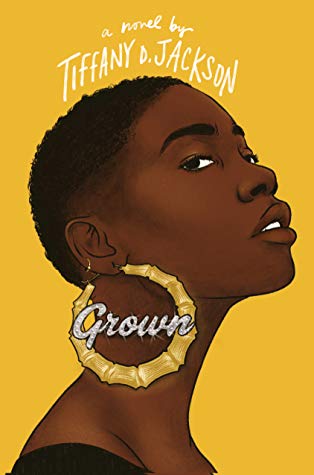
17-year-old Enchanted Jones has been making it work at her new highschool in the suburbs where she’s the only Black girl. She has a good reputation on the swim team, and she takes care of her little siblings after school while her mom and dad work to afford their kids’ private schooling and their new house. But what Enchanted really wants to do is sing – an idea her parents aren’t too fond of. When she goes to a reality tv show audition, she meets R&B singer Korey Fields. He takes a shine to her, but that might not be the good thing she thinks it is.
Review:
I read this book in less than 24 hours because I simply could not stop thinking about Enchanted and needed to find out what happened in her world. This book both manages to be about important issues but also doesn’t feel like it’s an “issues” book. It’s Enchanted’s story, and that happens to involve today’s issues because today’s issues are real.
This book is about a lot of things, but many of the things it’s about come right back around to how society treats Black girls. How we treat them like they are grown up, when they are still children. This book beautifully depicts how truly adolescent Enchanted is – something that many of our adolescents are not allowed to be but Black girls especially. Enchanted is interested in boys and has feelings about them but she also loves Disney movie night with her little siblings. She has big dreams of stardom but she also just misses seeing her grandmother and swimming with her in the ocean. She has typical adolescent breakthrough moments of realizing what you saw and thought was beautiful as a child might actually be something else. This book asks us to believe girls, but to believe Black girls especially, because so many others will just look at them and say “oh they knew what they were doing, they were grown.”
The book is also about how wealthy abusers groom girls and take advantage of their wealth and power to separate girls from their families. The abuse depicted in this book is realistic and depicts emotional, sexual, and physical abuse and could be a trigger, so please do note that. That said, the author depicts just enough abuse for us to know what’s going on, but it never feels gratuitous or unnecessary.
While this is YA, it has important content for adults too, especially if you regularly come into contact with adolescents. Highly recommended.
5 out of 5 stars
Length: 384 pages – average but on the longer side
Source: Library
Buy It (Amazon or Bookshop.org)
If you found this review helpful, please consider tipping me on ko-fi, checking out my digital items available in my ko-fi shop, buying one of my publications, or using one of my referral/coupon codes. Thank you for your support!
Book Review: Run by Kody Keplinger
 Summary:
Bo Dickinson is a girl with a wild reputation, a deadbeat dad, and a mama who’s not exactly sober most of the time. Everyone in town knows the Dickinsons are a bad lot, but Bo doesn’t care what anyone thinks.
Agnes Atwood has never gone on a date, never even stayed out past ten, and never broken any of her parents’ overbearing rules. Rules that are meant to protect their legally blind daughter—protect her from what, Agnes isn’t quite sure.
Despite everything, Bo and Agnes become best friends. And it’s the sort of friendship that runs truer and deeper than anything else.
So when Bo shows up in the middle of the night, with police sirens wailing in the distance, desperate to get out of town, Agnes doesn’t hesitate to take off with her. But running away and not getting caught will require stealing a car, tracking down Bo’s dad, staying ahead of the authorities, and—worst of all—confronting some ugly secrets.
Review:
This book would have wound up as a Disappointing Reads Haiku except that I actually didn’t have high expectations for it going in. The description didn’t appeal to me that much, and I had a feeling I might feel lukewarm about it. So why did I read it? I heard one of the two girls was bisexual, and hurting as I am for bisexual literature (it’s hard to find just from book descriptions), I’m willing to give most of it a shot if it sounds even moderately appealing. I do like stories of unlikely friendships and representation of less than ideal parenting situations (the realistic kind, not the fantasy kind of conveniently dead parents). I also liked the representation of not just bisexuality but also someone who is legally blind. I found the writing to be clunky, though, and the ultimate plotline to be a bit puzzling, rather than moving.
Agnes is written better than Bo. The depictions of her over-protective parents, what it is to be legally blind but not 100% blind, how others treat her, particularly in her church as an angel and not as a regular person, these were all great. The author is herself legally blind, and you can really tell. I’ve read many books about blind characters by people who were not themselves blind and the depiction was nowhere near as realistic as in this book. I think it speaks a lot to why own voices literature matters.
This realism doesn’t come through in Bo though. Bo reads like a two-dimensional caricature with the quick correction that oh hey I know I’ll make her bisexual but not a slut and that makes her seem sensitively written. Bo whose family is known in the small town as the trouble-makers, the no-goods. Bo with rumors spread about her and no-good drug-addict mom. Bo who, unlike Agnes, doesn’t speak mainstream English but mostly just in the sense that she says “ain’t” a lot. Bo who’s terrified of foster care so runs when her mom is arrested again. What bothers me the most about Bo (this may be a minor spoiler) is the book seems to think it gives her a happy ending. Like everything is ok now. But it’s clearly not. Speaking as a bisexual woman who had a less than ideal living situation in rural America in her teens, nothing about Bo strikes me as realistic. She reads as fake. She sounds fake. Some of her actions themselves are realistic but there’s no soul behind them. It might not have stuck out so badly if Agnes hadn’t been so well-written or perhaps if I wasn’t able to relate to well to who Bo was supposed to be.
One of the lines that I think demonstrates this problem that I couldn’t stop re-reading is below. It should have made me happy because Bo actually says the word “bisexual.” (Very rare in literature). But I was just irritated at how fake it all sounded.
“So … you’re all right with it, then? Me being … bisexual, I guess? I ain’t never used that word before, but … you’re all right with it?” (loc 2359)
It bothers me on two levels. First, rural people don’t just decorate their sentences with ain’t’s and double negatives. There’s more nuance to the accent than that and also Agnes and her average blue collar parents would have the same accent as Bo (they don’t). Second, I’ve never in my life heard a bisexual person speak about themselves this way, and I certainly never have. The number of times Bo asks Agnes if she’s “ok with it” (this is not the first time) is unrealistic. You know as soon as you come out if someone is “ok with it” or not and you deal and react to that. You don’t just keep wondering. You know. No amount of inexperience coming out would make you not know.
If Bo had been written as powerfully as Agnes, this would be a very different review, but since that’s not the case I have to say my dislike of the representation of Bo paired with my like of the representation of Agnes left this an average read for me, and it certainly won’t be a piece of bi literature I’ll go around recommending.
If you found this review helpful, please consider tipping me on ko-fi, checking out my digital items available in my ko-fi shop, buying one of my publications, or using one of my referral/coupon codes. Thank you for your support!
3 out of 5 stars
Length: 288 pages – average but on the shorter side
Source: Library
 Support my work with a tip or browse my shop for curated book club guides, how to guides, cross-stitch patterns, and more!


This work by Amanda Nevius is licensed under a Creative Commons Attribution-Noncommercial-No Derivative Works 3.0 United States License.
 Opinions of a Wolf